Showing posts with label 40s. Show all posts

Wednesday, October 15, 2025

31 Days of Halloween: Arsenic and Old Lace

1944, Frank Capra (It's a Wonderful Life) -- download

A movie about a pair of serial killers set during the Halloween season? What could be more 31 Days !!

This movie is a classic, both very much a product of its time but still stands the test of time. Dark Comedies have that enduring ability, but I guess a little slap stick doesn't hurt.

Renowned theatre critic Mortimer Brewster (Cary Grant, North by Northwest) wants to marry Elaine (Priscilla Lane, Four Daughters), but feels a need to hide it, for his reputation is built on hating marriage, romance and all the drivel. Meanwhile over in Brooklyn (the movie comes with a lot of derision for Brooklyn, something I would have to research) police officer Brophy is showing his beat to O'Hara who will take over from him, and this includes the old house belonging to the Brewster sisters, sweet old ladies that never turn a hungry soul away from their door. Mortimer and Elaine, her parents living next door to the Brewsters, and Mortimer wants to break the news to his aunts. We also meet Teddy, Mortimer's brother who thinks he's Teddy Roosevelt and whom the neighbours are constantly complaining about, but mainly his trumpeting in the middle of the night.

And then Mortimer finds a body in the window seat. You see, his sweet old aunts like to invite homeless men in, under the pretense of renting a room (the room is never rented) and kill them with wine laced with arsenic, strychnine and cyanide. They were inspired when their first potential renter died of a heart attack in front of them, and looked so peaceful afterwards. At first Mortimer believes Teddy must have done it, given his brother's state of mind, and begins to make plans to have Teddy committed to the Happy Dale Asylum. Then he learns it was his aunts, and begins cracking himself.

Screwball Comedy is the term. The situation just keeps on heaping more and more complications upon poor Mortimer. His black sheep other brother Jonathan returns, an escaped criminal with his own body count, seeking to hide out at his aunt's place, as well as hide his own body. His partner Dr. Einstein, an escaped murderer in his own right, will also finish the botched plastic surgery job he did on Jonathan, an operation that has left the man with a resemblance to Boris Karloff, in the movie Frankenstein to be precise -- this is an in-joke, as Boris Karloff played the character in the original Broadway production. Meanwhile Elaine just wants to head off to Niagara Falls, and they even have a cab waiting outside for them. 

The movie is hilarious. Its not really Halloween-ish, as the only connection is the commentary about it at the beginning. I am not sure of the state of decorating for Halloween in the 40s, but I would have liked to at least see some more trappings. Still, it checks the box.

Saturday, September 6, 2025

KWIF: The Thursday Murder Club (+2)

KWIF=Kent's Week in Film.


This Week:
The Thursday Murder Club (2025, d. Chris Columbus - netflix)
The Man Who Wasn't There (2001, d. Joel [and Ethan] Coen - dvd)
The Thin Man (1934, d. W.S. Van Dyke - dvd)

---

Adapted from the novel of the same name written by British media personality Richard Osman, The Thursday Murder Club is a star-studded story of sleuthing senior citizens.

All alliteration aside [ahh, apologies] the movie is set in England at Coopers Chase, a retirement community set on the grounds of a converted palatial estate. It's very, very bougie. There, new resident, Joyce (Celia Imrie), finds herself a new set of friends who run a club solving cold cases in the puzzle room on Thursdays.

The club is headed by Elizabeth (Dame Helen Mirren) who used to work for MI6, and also features psychiatrist Ibrahim (Sir Ben Kingsley), and ex-rights activist Ron (Pierce Brosnan), and each member has a particular set of skills to bring to the table the others do not. Joyce, as an ex-nurse, brings with her medical training and knowledge.

No sooner is Joyce revealing in her new friends and the latest cold case then rumblings of discord between the partners who own Coopers Chase start to spread. Ian Ventham (David Tennant) wants to raze the building (which surely has some have some historical protections, no?) and uproot the adjacent graveyard and develop the land. Tony Curran, Ventham's partner, opposes the project as he has a personal stake in keeping Coopers Chase as is. Soon Tony is dead and it's up to the Thursday Murder Club to figure it out, and, hopefully, at the same time, save their home.

Of course, there are real police on the case, DCI Hudson (Daniel Mays) is frequently irritated by the TMC's involvement in his investigation, but they have a plant, having seeded their young friend Donna (Naomi Ackie) as DCI Hudson's partner on the case. 

The film is generally pleasant, with a few amusing polite British chuckles along the way, but in spite of it star power (bright enough to give you a tan) it's about as sharp a mystery as you would find on the Hallmark Channel.  The material is so beneath the performers involved, that every time another recognizable face turned up, like Jonathan Pryce or Richard E Grant or Tom Ellis, I could only exclaim "HOW!?!" 

The sets, particularly the individual apartments, are beautiful, and the costuming is above average (the actors all, largely, look really good...Brosnan still so damn handsome), but it's so brightly lit and devoid of any real ambience that it looks more like a TV pilot than a feature film.

The music is by Thomas Newman, who can be capable of incredible scores, but here seems like he's on autopilot, not challenging himself in the slightest. At times the sounds would recall Finding Nemo, A Serious of Unfortunate Events or Harry Potter and the Sorcerer's Stone (also directed by Columbus), but mostly would just feel like the defacto plunking one hears in your average Hallmark holiday romance.

I've seen griping online of an American working on a British production bringing American sensibilities to it, which doesn't serve the story, setting or characters well. And, well, their not wrong. I think part of the Hallmarkiness of this outing is that Americans in trying to evoke "British" production style wind up being too earnest, cutesy and puerile. 

I was mildly entertained, but it's not good.

---

Ten weeks into rewatching the Coen Brothers' filmography and I'm still learning that I'll never be literate enough (in neither film nor books) to understand where the Coens are drawing all their inspirations from. A lifetime of obsessing over comic books, toys and indie music hasn't left a lot of time to gorge on classic cinema or read a lot of Greek epics or hardboiled detective fiction. So you'll forgive me for not being able to even hazard a guess as to what the Coens are riffing on with The Man Who Wasn't There beyond it's film noir stylings.

Filmed in gorgeous black and white contrast by Roger Deakins and set in post-war anywhere America 1949, The Man Who Wasn't There stars Billy Bob Thornton as Ed Crane, a meek-mannered barber. His wife Doris (Francis McDormand) is cheating on him with her boss, Big Dave (James Gandolfini), who she does bookkeeping for at the department store. Ed doesn't seem to mind so much. Doris keeps it pretty descreet.

But when Ed hears from a customer about the future of dry cleaning, and the customer (Jon Polito) needing an investor, Ed, who has kind of fallen into everything in life without really much effort, is ready to take a reach chance, be real proactive. So he blackmails Big Dave with an anonymous letter, threatening to tell his wife (the heiress to the department store business) of the affair, and he will lose everything.

Ed gets the money, but it didn't take much thinking for Big Dave to figure out who was behind it and in the midst of a kerfuffle, Ed kills Big Dave. Unfortunately Doris gets pinched for it. Ed then has to either sit with his guilt or try to exonerate Doris, and he's kind of hapless and ineffective at doing either.

Many a noir finds a hapless bystander getting involved in an intricate plot of murder and/or intrigue, while many other a noir finds a character charging recklessly forward driving the plot through their actions. Ed here is both the instigator and the bystander. In trying just once to do anything proactive in his life, he's set a whole chain of events in motion that he is incapable of stepping in front of to stop it. 

And so, as the story plays out, Ed's sad life just gets sadder. He finds a little joy in the piano playing of his lawyer's daughter (Scarlett Johannson) but once again his efforts to try something proactive backfire spectacularly. (I'll diffuse the tension right now, Ed has no sexual desire for teenage ScarJo, and in fact seems like an asexual character overall, not something much represented on screen and probably a might unintentional on the Coens part).

The Man Who Wasn't There is one of the Coens' longer films, brushing up near 2 hours, and in different lighting and pacing it would be another one of their screwball crime films. As it is, it winds up being one of their most visually striking movies (in a repertoire of visually striking movies), but also probably their most laconic by intention.  It's devotion to exploring a sensationalistic story but through a humdrum character means the film itself emits a bit of a humdrumminess, and yet, that's really its charm.  

I find its exploration of Ed, and his inability to escape his sub-mediocrity (both in life and self), fascinating. He's not a bad person at all, but he's also not a good person. He is the titular man who wasn't there. He floats through life, largely unnoticed, and it's not even that he has desire to be noticed, in fact he seems to prefer not having any attention put on him (like, look how uncomfortable he is with Big Dave trying to be friends with him). This is a film that's so deeply rooted to the ground, that it introduces flying saucer that seems to go to great pains to try to acquire Ed and whisk him away from his drab life into something more exciting, only to decide against it at the last minute a fly off.

The final 20 minutes really is when The Man Who Wasn't There comes to life, with the perfect sour ending that just revels in karma..For some it may be too late, but for me it's the meat of the film, where it goes from being a Coens also-ran to being an also-ran of-note.

---

As I just noted, I've not spent much time with "the classics" of cinema. My interests don't usually take me there too often. In my lifetime I doubt if I've ever seen 100 films from before 1950.  I also don't know that I'll rectify that any time soon. I find diving into old films akin to diving into foreign films...there's so much of it out there it's hard to know what is not just good, but worth the effort to sit through filming or scripting styles that may not resonate with me or retain my interest. There's only so much time in a day, in a life, that I can't wade through everything to find the gems.

I also realize that in my reluctance to wade through the unfamiliar that I'm liable to miss out on those gems, and it think my life would be much the poorer for never having gone slack-jawed over Myrna Loy as Nora in The Thin Man. Va-va-va-voom.

I had heard about the "Nick and Nora" series long ago, mostly legendary for it's rapid-fire repartee, but my interests never truly aligned. I underestimate old Hollywood productions, thinking that their entertainment factor is significantly reduced based on the naivete of the times in which they were produced. It's true that people were a lot simpler in the olden times, and my modern, refined, erudite, sophisticant palette is just so above it all. I can fall prey to snobbery at times, and think myself better than others, past or present. I'm not proud.

The Thin Man is based on the Dashiell Hammett novel of the same name. Hammett is cited as one of the godfathers of hardboiled detective fiction, but this "comedy of manners" was a real pivot for the writer (in what would ultimately be his last novel).  It's central plot revolves around a missing scientist whose secretary has been murdered, and sussing out whether the scientist was the kill or someone else, especially as additional deaths occur and the cast of suspects piles on.

But it's really not the murder mystery that is the draw here. That would be Nick (William Powell) and Nora (Myrna Loy). Nick is a renowned detective who has retired from the profession since marrying socialite Nora and taking up running her father's businesses. They enjoy drinking immeasurably and the fluidity of their alcohol consumption is only outpaced by their snappy banter. They always have the perfect retort for each other, and, well anyone else. They seem perpetually soused and are the liveliest, most high-functioning alcoholics in the world.

Despite his protestations that he's out of the business of sleuthing, Nora implores him to get involved in the case, because she's never seen him do his legendary work. How could any man resist anything Nora implores of him?

The Thin Man is the very definition of rollicking. The wit and charm assault is relentless, but never exhausting, though it can be hard to keep up with. I'm not sure if there's a modern comparison...it's not a comedy assault machine like, say, 30 Rock, it's much more dialogue-centric. I just can't think of any other film scripted with this density of dialogue so persistently.

The murder mystery is engaging enough, if only because of the characters involved. But there are a few little twists I didn't see coming. If I have any disappointments it's that Nora was sidelined when Nick finally capitulated to actually getting involved... the old chauvanistic (deemed chivalrous at the time) man's work, sparring Nora any unpleasantness. I think here naive exuberance would have made it even more fun and adventurous. Plus I just wanted more Nora.

There's five sequels to dive into, so along with more Coens, expect more Thin Man.

Saturday, February 20, 2021

10 for 10 (+1): lively and animated

 [10 for 10... that's 10 movies (or tv shows) which we give ourselves 10 minutes apiece to write about.  Part of our problem is we don't often have the spare hour or two to give to writing a big long review for every movie (or TV show) we watch.  How about a 10-minute non-review full of half-remembered scattershot thoughts? Surely that's doable? ]

In this edition: some all-ages fare, some of which has been sitting on my "to review" list for a looong time:

Happy Feet Two (DVD) - 2011, d. George Miller (Mad Max)
Pinocchio (D+) - 1940, d. various
Maleficent: Mistress of Evil (D+) - 2019, d. Joachim Rønning (Pirates of the Caribbean 5)
The Sleepover (netflix) - 2020, d. Trish Sie
Enola Holmes (netflix) - 2020, d. Harry Bradbeer (Fleabag, Killing Eve)
Bumblebee (netflix) - 2019, d. Travis Night (Kubo and the Two Strings)
Ponyo (Blu-ray) - 2008, d. Hayao Miyazaki
Mulan ('95) (D+)- 1998, d. Tony Bancroft, Barry Cook
Soul (D+) - 2020, d. Pete Docter, Kemp Powers
The Great Mouse Detective (D+) - 1986, Ron Clements, Burny Mattinson, David Michener, John Musker
Bonus: Batman vs. Teenage Mutant Ninja Turtles (on demand) - 2018,  d. Jake Castorena 

And...go:

---


Have I seen Happy Feet? I have no recollection of such events.  Happy Feet Two came into my life years ago as a gift to my daughter from a family member who sung its praises.  I love this family member, but I know their standards for movies is...well...not the same as my own. 

It was YEARS later when I learned that the Happy Feet series was directed by George Miller, creator and sole proprietor of the Mad Max series of films.  I mean, what?  But, then, you have to remember that Miller also directed Babe: Pig In The City, so the man is clearly a genius.  Happy Feet must be something special, right?

...Right?...

Honestly, it's fine.  It's fine to watch, it has some cuteness to it, there's a global warming message, a few little chuckles, a couple of neat, wholly out-of-place moments, even a couple of cool visual moments, but it's still a middle-of-the road children's movie.  
 
Where the best Pixar or Disney film kind of roots down inside you and makes a home, Happy Feet Two is a sorta pleasant mild breeze that feels kinda nice for a few seconds then goes away.  It's something you barely notice, and you're certainly not stopping for it and hoping for more.

Good for the young ones.  Fine to watch with them.  Maybe something that reveals some layers (though unlikely) on repeat viewings.  Robin Williams doing yet another suspect accent.  Sigh.

Moving on.

[8:47]
---


I don't have any great love for Pinocchio.  In general most of the classic Disney movies left no impression on me as a child.  I was a superhero kid and these quaint fables and morality plays didn't really have a place in my brainspace.

I'm certain I saw Pinocchio when I was a child, but it wasn't something I ever went back to, so watching as an adult I was surprised, both by how weird it was, and also by how bored I was of it.  It's a story that, even with maybe only seeing it once or twice as a child, I was still pretty familiar with, and yet, the things I didn't know seemed so freaking out-there.  I should have been impressed, but Pinocchio the character is such a shitty little wooden boy I was annoyed along with my boredom.
 
Pinocchio as a movie feels like it takes forever to get going, and when it does, it's baffling.  There's a whole pedophilia subtext of kidnapping children to take them to "Pleasure Island" that is just...no thanks.

I know a film from 1940 can't be blamed for the impact it's had on popular culture.  Not that the impact is a bad thing, but the overarching fable and the parts of the story that have permeated the culture are far more resonant outside the film than within.  The good things from Disney's Pinocchio has actually outgrown the film they came from.
 
[20:21]
 
---
 

Another Maleficent film. 
Ok.
The first one wasn't the best, but I like Jolie in the role and hoped that the second one, maybe, could do something a little better?  I honestly don't remember... 
 
(breaktime for a quick wikipedia refresh)
 
Oh, right.
 
This second entry in the evil-Disney-witch-prequel genre goes a lot bigger the second time around, with more political machinations as the parents of the prince to which Aurora (Elle Fanning) has fallen in love with are just bad people who want to start a war with the more magical realm on their doorstep.

It has not stuck with me, but I remember being more impressed with this second entry, particularly in how big it tried to get, and actually going full bore into war.
 
Just as I thought I might be tempted to watch this film again, I recalled the lingering  problem from the first film.  It looks ugly, the costuming and makeup the exception.  And this gaudy CGI aesthetic drags the whole franchise down.  It's maybe not as bad as the first one, but for the sheer scale, which must have made this an expensive enterprise, it still looks pretty bad.

[30:57]

---


Speaking of films I can't remember, The Sleepover is a hot bit of absolute nothingness.  What is this film, I asked myself, as I could not recall anything beyond the title.  Once I looked it up and saw that Joe Mangianello, Malin Akerman, and Ken Marino were the adults in show, I had the vaguest of recollections.  It's about a sleepover where the kids hosting the sleepover find out their mom is a superspy and has been kidnapped.  They mount a rescue mission, because of course they do.

Was this film any good? It can't have been too good or too bad, because I can't really remember it at all.  It's another of these Nickelodeon-styled middling kid fare.  Not unwatchable by kids or their parents, but also nothing that's really going to get people too excited.

I just asked my 11-year-old what she thought about it.  She thought it was a funny adventure movie that she watched a second time on a weekend group Netflix watch.  She has indicated it is something she would watch again.

I guess when you're 11 and have only watched a few dozen movies, mediocrity like this still stands out.

[38:39]

---


It should come as no surprise that the director of Enola Holmes had also directed Fleabag, as this film employs the talk-directly-to-the-camera asides that Phoebe Waller-Bridge's sensational comedy did.  Not that it's an exclusive thing, but to do it well requires good direction. 

The Letterboxd audience seemed mixed on this idea, that it's somehow the lesser for even deigning to employ such a trope, that it's been overplayed or that it cheapens Fleabag.  But I thought the picture employed it very well, and Millie Bobbie Brown is exceptionally good at the knowing glances or emphatic asides.  Brown is obviously the lead of the film, and it's really a breakout role for her.  Eleven on Stranger Things is kind of a thankless role, one that doesn't give her nearly as much to do, or showcase much depth or range.  Here, she gets to be intelligent, impetuous, clever, charming, feisty, fragile, focused and funny, and Brown excels at them all.  (When people pitch her as a young Princess Leia, it was in this film that I finally saw it.  And agree.  I don't want young Princess Leia adventures, but if they're going to do it, Brown is the right choice.)
 
I won't say she carries the film on her own, as there are so many great supporting players, from Henry Cavill as Sherlock Holmes, Helena Bonham Carter as their mother, and Fiona Shaw as the headmistress of a finishing school the abandoned Enola is forced to go to.
 
Cavill's Holmes stands out particularly because he breaks from the tradition of making him cold, cunning, calculated, and a little heartless.  Cavill brings warmth to the role (not to mention some serious handsomeness) and the elder-sibling/younger-sibling rapport between him and Brown catches on quick.
 
The main drag of the movie is it's primary mystery however, which deals with some weird political lordship at the turn-of-the-20th-century.  It's not that it's ill handled, but it's not the most gripping adventure.  The far more interesting facet of the movie is Enola coming to terms with her mother abandoning her, and the family that doesn't seem to want her.  But she's a determined and capable young woman, as the film proves, which makes her a pretty stellar role model to watch with young women of any age.
 
I liked this tremendously and hope there are more in the series promply in the works.

[56:38]
---


Oh, Transformers.  A property I've given more than a fair chance to, but just never caught on for me.  I spent some time with it in the 80's and it wasn't my thing.  I watched quite a bit of Beast Wars in the 90's, for reasons I still don't fully understand.  I actually liked the first Bay film, and gave up on the franchise after the second (I would watch the third in part years later).  The toys were never really my thing.

And then there's Bumblebee.  Why should this one be any different.  Why should I care about this one any more than anything that came before it.  Why should this Transformers entry/ quasi-prequel inspire anything other that an eyeroll?

Because it's pretty damn good, that's why.

It opens with a big sequence on the Transformers planet where there's some kind of conflict between the two factions of 'formers.  What makes someone an Autobot or Decepticon is not something explored in this or any of the other stories I have seen, it's just accepted that there's a good side and bad side.  Likewise, how do these robot-people come into existence?  That's just another conceit you have to give into with these things.  These stories do take time to explain why they transform into other things though, so there's that.  But anyway, this film opens with a big, expensive, and, most notably, CLEAN-looking sequence of Transformers in conflict on an alien terrain, and even though I don't have any nostalgia for the property, it's pretty damn awesome.

Then we get to Earth, which reminds me of so many of the sci-fi movies and TV shows I grew up with that promised big things only to put those big things on screen briefly and then trudge around mundane terrain of planet Earth. 

But this film is set in the 80's, which kind of puts it on-point when it follows this kind of storytelling trope.  Though I have no nostalgia for the property (I keep saying) this film is laden with nostagia for the 80's through and through, which makes it transformative in its own right.

It winds up being a-girl-and-her-robot tale, the kind we've seen a thousand times, (except it's usually a-boy-and-his-whatever) only this really understands all of the usual paces of such a story and it stays truthful, yet updates it to something that's still pleasing as a modern audience.  I love Iron Giant, and this is basically that, but live action, and with Transformers, and I kind of...maybe not love...but like it a damn lot.  And Hailee Steinfeld is great, just great.  She's proves herself capable of being a leading actor.

[1:10:41]

---


 I have been neglecting Studio Ghibli films for too long.  I seem to watch one or two and then none for years on end.  I keep meaning to just sit and binge them, but I just never get there.  Ponyo, though, is a good reminder of why I want to invest in the Ghibli films, more specifically the works of Miyazaki.  They're weird but they're great.

Here we have the story of a guy who lives undersea, who mated with some form of sea god, and has a school of fish children.  One of these little fishlings gets lost from his undersea cruiser (the design of which is just a beautifully clunky animated marvel) and gets trapped in a jar. She washes ashore where she's rescued by Sōsuke, a five year old who's having a hard time with his dad being away a lot.   

The most unreal friendship is forged between this girl-faced-fish and this playful boy, but in trying to keep Ponyo both secret and safe Sōsuke winds up in misadventure, including a pretty terrific looking tsunami.

It's a bizarre movie through and through, but it knows it and embraces it, finding emotional connections in many places along the way.  That's kind of Miyazaki's thing.

It's a pretty majestic movie and reminds me I need to get back on that Ghibli wagon.

[1:18:43]

---


Just like the 40's and 50's classics, I'm also not well versed in the 90's classics of Disney.  Look, I was a teenage boy when the Disney renaissance hit, and, well, let's just say none of these films were targeted at me.

I haven't had a tremendous desire to catch up on them either.  But I'm slowly picking them off when I have an inclination to.  Like, Tarzan was just a "lets see what Disney did with the property" whim a little while ago, and both Aladdin and Mulan were about seeing the "original" (Disney adaptation) before seeing the live action version.

I recall nominally liking Mulan but also being frustrated with it, in large part to how passive Mulan feels in the film.  At this stage, the film hasn't stuck much with me, save for a weird feeling of appropriation, that the wrong people were telling the story.  And that some actors, who were not Chinese, were voicing Chinese characters because Asian representation in 90's cinema was poor, and I'm sure casting were pretty narrow minded in their selections.

Eddie Murphy as Mushu the dragon wasn't nearly as annoying as I was anticipating, certainly much less a nuisance than he was as Donkey in Shreck, or other comic relief sidekicks (of the Robin Williams sort, see Happy Feet Two or Aladdin), but still, Eddie Murphy for a Chinese dragon named Mushu?

I still have yet to find that Disney renaissance movie that really resonates with me.

 [1:31:02]

---


I should probably write more about Soul ...and THINK more about Soul than I ultimately will in 10 minutes here.  But I really, really loved the film.

I acknowledge the criticisms of the movie (this New Yorker article lays them out pretty well), that we have a film that implies representing the Black experience, but upends it with a body switch comedy that undermines said experience.  And looking at the film through the lens of larger cultural representation in film, specifically family-centered animation, there's a shocking lack of Black voices and black stories available, and none certainly made on the scale of Soul.  In that regard, Soul is disappointing in its failure to go further, deeper, and more specific. You can almost feel the "correction" to make the film broader culturally, so that it was less specific to one type of culture.  It's an old mentality when it come to filmmaking, making a story for as broad an audience as possible, that the more specific you get, the more alienating it is.  I don't think that's correct thinking, but it's the way it's been for a long time.

Would Soul have been a much different film had it gone more culturally specific.  Or even something simpler like what if 23 was voiced by Lupita N'yongo instead?  The powers that be could have made these rather simple choices, and it is truly sad they didn't think to do so, and ostensibly they wouldn't have changed the film all that dramatically but the film could have meant much more with that kind of thought behind it.

Yet, that criticism fully understood, and even agreed with, I still loved Soul, the experience it takes us through, the before-life where souls aren't yet defined.  I love an imaginative reality, much like the one in Inside Out or even Monster's Inc. where it takes a non-coporeal concept and creates an imaginative society out of it.  There's also a philosophical component, about what makes us who we are, and what defines us as people.  What is it that we should carry with us to the afterlife?  It's ponderous without belaboring any specific point.

 The tonal score from Trent Reznor and Atticus Ross crossed with the jazzier score and music from Jon Baptiste is phenomenal. There's two realities in Soul both represented by difference in sound as well as visuals.  

I can watch Soul and see its flaws, but also appreciate its craft.  But I was experiencing the film in my own head as I watched it the first time, I'm curious with the viewpoint of others now resonating in my head if I approach it differently the second or third time around and if I'll like it as much?

[1:54:11]

---


Just before the Disney Renaissance there was The Great Mouse Detective, a quick and dirty Disney animated feature that kind of finds the middle ground between the golden age of Disney animation and the 90's era. 

The world of The Great Mouse Detective is one within a world, a sub-culture of mice and rats that live a very human-like existence, where they have all these things in miniature that are akin to our "normal-sized" reality, and then there's the maximized setting of our reality that are just gigantic objects to the rodents of the picture.

Visually, TGMD does not lack for cleverness, but the story is dull.  It's trying to play off of Sherlock Holmes (to be clear, there is a Sherlock Holmes in this reality, but "Basil of Baker Street" is his mouse analog, living in the trenches underneath Holmes' Baker Street residence) but it has no time for really crafting any sort of mystery, and the options for Basil to prove his intellect and keen sense of deduction are sorely limited.

Had this film played through an actual mystery, I think it would have resonated much more, but it's barely a morsel of a movie as is, certainly not a meal, and with no real meat nor potatoes to go along with it.

[2:01:44]

---

BONUS!


I've watched many, but not even close to all, of the direct-to-video DC animated features made in the past 15 years.  To be honest, the fact that they've almost exclusively been adaptations of comic book stories with only a few originals scattered in the midst has made them less interesting and less alluring to me.  I tend to only catch them by happenstance, usually on television or promoted on demand, and even then I feel a little reluctant to watch them, knowing that they're rarely satisfying.

The viewing of Batman vs Teenage Mutant Ninja Turtles was a little more calculated, in that I noticed it was airing on TV and I recorded it, hoping to watch it with my daughter knowing she was both a fan of the many different Batman cartoons and also a lapsed Ninja Turtle fan.

Alas, she seemed disinterested and so my eventual viewing of the recording was one where I was distracted playing a game on my phone through most of it.  What surprised me in taking it in this way was how much fun I had while barely viewing the animation at all.  Though based on a comic book that crossed the two properties over, the voice cast and the script bring it all to life pretty nicely.  

And then I cottoned onto late the fact that they were animating Batman in a classic Jim Aparo style and I started lamenting my distraction.  I was rapt through the last third of the picture as it, in a very gonzo nature, guided the Turtles through Batman's rogues gallery, suddenly mutated thanks to a modified mutagen.  There was some very sharply comedic moments in the picture, which is surprising as these DC Animated pictures are typically such staid fare.  There's a particularly great moment involving Poison Ivy that could have felt at home in the Harley Quinn series.

I caught only a glimpse of Batman fighting Shredder in the opening of the film, but the final fight was actually quite spectacularly orchestrated and executed.  It's not "big screen" animated quality, but for what it's trying to do, it's really nice looking.  It blends the animated worlds of Batman and Ninja Turtles exceptionally well without stepping on any of the animation that came before it, but also kind of giving a nod and a wink their way.

[2:13:28]

Tuesday, December 22, 2020

T&K's Xmas (2020) Advent Calendar: Day 22 - The Bishop's Wife

 1947, Henry Koster (Harvey) -- download

Obviously not a Hallmarkie, being that it is from the 40s, but its an Xmas movie on the Peanut Gallery's top Xmas movie list, so we went with it. I have seen it before, but generally don't recall the details, but that it is an odd sort of a movie which is setup as a romance between the handsome lead Cary Grant and Loretta Young, but the hitch is that Loretta, who plays Julia, is the Bishop's (David Niven) wife. And Cary is Dudley, an angel.

Dudley appears on the crowded, festive streets of a never really identified Big City. Everyone is staring in awe at the Xmas decorations in the store front windows, and for those who hadn't seen the movie before, the foreshadowing is right up front -- an angel in the window, just over Dudley's shoulder. Dudley bumps into people, assists on a few minor miracles and acts of kindness, before he comes across Julia staring pensively at a pretty hat. That starts things off, as he insinuates himself into the life of the very busy Bishop, a man who has no time for anyone let alone his wife, focused entirely on satisfying the church elders, so he can raise the moneys required to build a new cathedral. The elders are annoying him to no end. At the top of his Do Not Like list is Mrs Hamilton, the Wealthy Widow.

Dudley steps right in, basically courting Julia, but really just providing her some absolutely charming company while her husband is distracted. It doesn't have to be the 1940s to see how inappropriate this angel is acting around the man's wife, taking her out for lunch, ice skating and even having her daughter entertained, so he can spend more alone time with Julia. The Bishop definitely sees what is going on, and is Not Pleased. In fact, he is so displeased he wants to retract the prayer he made. But nope, you cannot get rid of Dudley that easily.

But don't fret, because despite being rather precocious, Dudley still has his heart in the right place. He knows what he is doing, and despite becoming a bit more fond of Julia than is appropriate in the angel work place, he does make it so everything works out in the end.

My favourite bit is his interaction with the local doddering professor, a family friend of the Bishop and his wife, but someone they have lost touch with. The man is likely an agnostic, but they don't hold that against him, but the heavenly charms Dudley uses on everyone doesn't work on him. That's alright as Dudley gifts him an Everfull Bottle (D&D minor magic item) that constantly refills with Sherry, and a wonderful story about an old coin the professor carries around with him.

This is a wonderfully charming little movie, a little peculiar in its manipulation of expectations, and while it is not overwhelmed with its own Xmas seasonal message, it does fit into the time well.

Tuesday, September 19, 2017

10 for 10: the "Old Things" edition

[10 for 10... that's 10 movies which we give ourselves 10 minutes apiece to write about.  Part of our problem is we don't often have the spare hour or two to give to writing a big long review for every movie or TV show we watch.  How about a 10-minute non-review full of half-remembered scattershot thoughts? Surely that's doable?   ]

This time on 10 for 10...it's old things...things from my childhood or older.

1. The Maltese Falcon (TCN) - 1941, d. John Huston
2. Spartacus (most of it, anyway...grr PVR/TCM) - 1960, d. Stanley Kubrik
3. Ladyhawke (Rip) - 1985, d. Richard Donner
4. Atlantis: The Lost Continent (TCM) - 1961, d. George Pal
5. House (TCM) - 1977, d. Nobuhiko Obayashi
6. Panic in Year Zero (TCM) - 1962, d. Ray Milland
7. The Ice Pirates (TCM) - 1984, d. Stewart Raffill
8. Grey Gardens (TCM) - 1976,  d. Albert Maysles, Ellen Hovde, David Maysles, Muffie Meyer
9. Romancing the Stone (netflix) - 1984, d. Robert Zemeckis
10. Breaking Away (netflix) - 1979, d. Peter Yates

...and go...

---
Sigh... I don't know how many times I've seen The Maltese Falcon, and yet I still don't really remember it.  It's a famous film, one of those revered pieces of cinema that people still bring up quite often, and yet, it never really sticks in my brain.  It wasn't even that long ago that I watched it.  A few months back maybe.  There's some noirish spy stuff going on, and Bogart in his quintessential PI role.  But what the hell.  Do I need to Wikipedia this for a refresher?  That's going to eat into my writing time...
...
...
Okay, back... yeah, Dashiell Hammett adapted, that great scene with Sydney Greenstreet and Peter Lorre...man, Lorre was just so great in everything, wasn't he.  Such a unique presence.  Man, still not remembering the particulars.

What may make The Maltese Falcon so great is it's forgettableness.  I remember being fully engrossed in the film while also not recalling a single thing about it even though I'd seen it a few times before.  So what could be better than a fully engrossing noir that is just as engaging the fourth time you watch it as the first, just as surprising?

Really, I'm just filling white space here.  I have nothing to say about this of value.  Moving on.

[7:46]

---

Oh, Spartacus.  Epic Spartacus.
You know, I bought a rather pricey Stanley Kubrick blu-ray collection a few years back (it was on a cheap one-day sale from Amazon) and it didn't include Spartacus.  Now of the films in that collection, I'd only seen maybe 2/3rds, so there's still some fresh watching (as well as some intense re-watching) to do, but the one film I wanted to see most of Kubrick's was Spartacus.  I wound up PVR-ing it off Turner Classic Movies, the channel that keeps on giving, and waited for the right time to set aside two and a half hours to watch it.

That Kubrick fellow sure knows how to make a film don't he?  There's such a masterful lens happening in every one of Kubrick's films, such precise shots, such immaculate execution.  Everything has its right place.  It's like staging action figures for a photo shoot, each detail pristine, only these action figures move, and emote like mad.

I didn't realize there was such depth to the Spartacus story, how tied to civil rights and religious persecution it was.  For some reason I was just thinking "gladiator epic", like Ben Hur or Gladiator, but no, it's just an epic in the truest sense, the kind of bloated 1960s film that requires patience, attention, and an intermission for sustenance and relieving one's self.  It's a long-ass film is what I mean.

It's at once engaging and tedious, really taking its time to sit in its scenery and establish its setting.  It draws an audience in, and is perfect for the theatres where people go to escape, and be held captive by an experience.  It's a shame then that its score is so damn overbearing.  It's amazing how a control-freak director like Kubrick could allow a soundtrack to so dominate the aural atmosphere.  It's a great, difficult film, but the score at times makes it unpleasant to watch.

My viewing of the film was cut short by a mis-classification of run-time by TCM, so the PVR cut it off after the 150 minute mark and there was still 1/2 hour to go.  Without a copy in my Kubrick set, I'll just have to wait until TCM runs it again to catch the finale.

[19:52]

---
This poster is somehow both iconic
and really, really awful


I have a distinct memory of going to a birthday party around age 8 or so and part of that party was sitting down and watching Ladyhawke.  I also distinctly remember getting very bored, very quickly and going into another room and playing with the birthday boy's G.I. Joe figures while they watched the movie.  Even at 8, I found fantasy direly boring.  I was a Star Wars and superheroes kid.

About two years ago the wife and I got talking about childhood movies and this came up as one that she'd like to see again.  Having had the aforementioned distinct memory, I thought maybe I would find a used DVD copy somewhere for 5 buck or less and we could watch it.  Well, dammit if Ladyhawke isn't one of the hardest-to-find movies on DVD...not just used, but new too.  So, long story short, we got a downloaded copy from a friend (see what happens when you don't make your catalog available Movie Studios?) and, well, thank god I didn't pay for this.

I'm not sure who thought this soundtrack was a good idea, but this sub-par Jethro Tull synth bullshit kills the film, to the point that I can't see it for what it is other than a janky fantasy movie with an atrociously unlistenable score (seriously, it's worse than Spartacus' times infinity.  Just listen to this and tell me you want to have anything to do with the movie that accompanies it...

[29:57]

---

Man, what to say about this pile of utter mediocrity.  Atlantis: The Lost Continent was made in the early '60's but has that 1950's flavour all over it.  It's old fashioned and goofy, with an utterly simplistic take on romance that is so persistently laughable.  These kinds of lower-tier genre movies from that era were all about funky sets, big ideas and special effects (no matter how bad).  Most wind up being just as bad as this one.

A fisherman finds a woman washed up on shore.  Turns out she's the princess of Atlantis.  The fisherman returns her home, only to be enslaved.  He then leads the slave rebellion.  Atlantis is destroyed, and he returns home with the princess.  I mean, stuff sort of happens in between but that's about the gist of it.  It's as uncomplicated as that.

 The film starts with a narration which establishes a grand scope for this film that it doesn't even try to live up to:
http://www.tcm.com/mediaroom/video/1279905/Atlantis-The-Lost-Continent-Movie-Clip-A-Series-Of-Mysteries.html
It's a series of mysteries about how disparate populations across the glob have such weird similarities, intoning that Atlantis is the missing link between these...and yet this concept is never approached again.  Oy.

The sets and minatures are the money shots for films such as these, but they're unimpressive. George Pal has a history as an effects wizard, but in the director's chair, this is a much lazier affair.

[39:38]
---

Oh my god, House.  What the hell do I say about House.

As unintelligible as movies get, House is.

It's effectively a live-action anime, but done with all the craft low-budget 1970's Japanese Cinema could provide.

Somehow House has taken on cult status.  I get most cult films, generally like most of them too, but sometimes they're just too outre for me.  Like this one.  After about 40 minutes I couldn't take it anymore and watched the rest of it in fast forward.  I mean yeah, it's bizarre AF, but it's also nonsensical AF.  I think if I watched Anime, like, at all, it might have been more entertaining as I think House is both an homage and a lampoon of the cliches of 70's Japanese cartoons.

So much soft-focus melodrama and flashbacks and melodramatic flashbacks, horror that's not really horrific so much as it's just weird and goofy (utterly laughable at times) with a soundtrack that is part Looney Toons, part novelty album.  The girls all have odd names (Gorgeous, Prof, Melody, Kung-Fu etc) but they don't seem like nicknames, such an anime trope.

There's nothing scary or horrifying about this movie, except the amount of time you'll lose watching it.  Good lord, man, why.  Why does this exist?  This is a film that is a test of patience (says the guy who could sit through 18 hours of Twin Peaks: The Return] and offers very little in reward.

[49:52]

---

Looking back over 50 years ago, we see what we see now, an obsession with the end of the world.  We've been fretting over the end times since the start of time.  Societies would panic that eclipses were the end of the world.  Religious leaders would predict doomsdays that would never happen.  The Rapture is a perennial favourite, hopefully keeping the flock loyal and in line.  In the 50's and 60's (and 70's and 80's...oh and 90's up through today) we're still pretty paranoid about the whole nuclear holocaust thing.

Panic in the Year Zero (which totally seems like something different if you write it as Picnic in the Year Zero as I keep doing for some reason) finds a family heading out of Los Angeles with a trailer in tow on vacation only to have some strange events occur around them.  Soon they catch wind of the fact that LA has been nuked, and the family desperately tries to find solace and sanctuary in the midst of the chaos.  They find themselves in desperate scenarios, doing things they can't believe they're doing (mostly it's just writer-director Ray Milland in the lead role doing these things, but compared to the young punks, he's still acting saintly.

As far as end-times movies go, this one is rather light on the grim realities of societal collapse, because it was the 1960's and the true horrors of human nature were best suggested then, not visually realized so literally on screen, like they are today for all the dum dums who wouldn't get it otherwise. Enough happens that it's like a lite version of, well, every one of these types of movies since, from Night of the Living Dead through to It Comes At Night.  Panic is actually quite watchable, if thin, and of course, too patly resolved as was expected at the time.

[59:58]

---

Woof.

There are some gems in 1980s sci-fi that never hit it big, but have their own distinct flavour and style that makes them more and more intriguing as they age.  Films like Lifeforce or 2010 or Dune are well-executed effects extravaganzas that have failings elsewhere but are still wonders to behold.  Ice Pirates so wanted to be that, but man, is it awful.

Water is scarce and tightly controlled so our heroes shanghai and rob transports, stealing their ice, when on one mission they manage to kidnap a princess.  From our first look of the utterly horrendous models of the poorly designed, poorly constructed, poorly shot spaceships to the hinky special effects, to the absolutely atrocious costume design, it's mere minutes before one realizes how stupendously crappy this movie in (let's not forget seeing an alien on the toilet...never forget).

The film tries for high-spirited pirate adventure attitude, but never commits fully to the premise.  All the actors are game in their roles. Bob Urich, Mary Crosby, Angelical Huston, Ron Perlman, and Michael Roberts all try to sell the hell out of this just atrocious, poorly visualized, shoddily constructed movie.  I have to give it to the film though that it does come up with a pretty spectacular (at least conceptually) final battle sequence where everyone's life accelerates at an astonishing rate (not just aging, but moving through moments in their life) as they fight for whatever it is they're fighting for.  It's a fun sequence, though still utterly campy and badly done.

There's a good movie here somewhere...concepts are sound, but man this is not the way to do it.  If there were a big budget modern remake, it's very possible a good space-comedy-pirate-adventure movie could come of it.

[1:11:23]
---

I've heard of this movie a number of times, quite often referenced in comedy as a "Grey Gardens" situation.  This is a documentary film about two relatives of Jackie Kennedy Onassis, a mother-daughter duo who Edie and Edith, who live together in utter squalor in an otherwise highbrow Long Island estate, dubbed Grey Gardens.

Modern television has covered troubled personalities like these ad nauseum. Turn on any episode of Hoarders, and you will see Edith Bouvier Beale.  Only Hoarders and its kin tend to exploit the lower class in their exposition of mental health disorders, while Grey Gardens is a look at the troubled upper class (not that Edie and Edith are upper class any longer).

It's a captivating film, piecing together the status of Edie and Edith's relationship. Who is dependent on whom?  At first it looks like Edie was dragged down into Edith's squalor, but it quickly comes around that that they're both enabling each other in their dire situation.  Edie is constantly talking about her former suitor, all the boys who asked her to marry them, all the men who her mother scared off.  Edie still has a sense of glamour about her, having been a part of the upper crust, but it's trashbag glamour now, as she tries to conceal all that she dislikes about herself, and deflects any of her known issues on her mother.

Edith, meanwhile, revels in the past, of her life as a singer, and is constantly singing in the 1920's-style warble that is like knives in the ears but was popular at the time. Edie often joins her, when she's not telling her to shut up.  They live in one room of the manor, cooking on a hot plate, eating out of cans.  Cats are everywhere, having the run of the house which is one sneeze away from being condemned.

As I said, fascinating.  But as much as this film could have been exploitative, one becomes very concerned about this duo, and Grey Gardens and the Edies history is extensively documented online.

[1:22:51]

---

Oh my god, I watched another Robert Zemeckis film.  I had sworn off of his movies after...what was it called?  What Lies Beneath perhaps?  I dunno.  There's not another director whose films grate on me so cloyingly and consistently.  I just can't with him, I just can't.

But then there's Back to the Future.  That's a (mostly) great trilogy.  It has its problems, and its Zemeckis-isms, but it's (mostly) great.  Same with Romancing The Stone.  It's such a Spielberg-lite film, and yet how can you not just get behind Kathleen Turner's romance novelist-turned-action hero Joan Wilder?  I mean she writes novels about women who long for a roguishly handsome, dashingly complex man-of-action to rescue them from their boredome (or whatever perilous situation she devises) but even after meeting Michael Douglas' Jack Coulton (fitting the rogue bill to a tee) as she tries to navigate the Columbian jungle in order to pay her kidnapped sister's ransom, she's the one who leads, fights, and figures out the solution to her problems.  Jack's more support than savior. 

It's unexpected, such women's liberation even from a film in the 1980's.  Today there's still a need for heroic female leads, but certainly far more movies with tough heroic women come out these days than ever before.  But its refreshing to look back and see from time to time a Ripley or Joan Wilder, a woman doing it for themself.

[1:31:41]

---

Man doing these 10 for 10 things are a slog.  I'm exhausted, and so unenthusiastic about Breaking Away, a perfectly decent and enjoyable coming-of-age film, that I kind of just want to leave it at that.

This is a film about a kid obsessed with Euorpean bicycle racing, and about his friends, and his family in the college town of Bloomington, Indiana.  It's a well-stocked cast, with young Dennis Quaid,  young Daniel Stern, young Jackie Earle Haley, and Paul Dooley as the dad, all working to deliver a very fine light drama about growing up in a town where the educated class and the working class are often in conflict.

There's not a tremendous amount of serious drama, and the comedy is sparse, but it all works together for a gentler teen movie than your Fast Times or Dazed and Confused or Superbad.  It's kind of a template for the John Hughes era of teenager movies in many ways, though less quotable for sure, but essential viewing for fans of this genre.  For a film from the late 70's though, it holds up tremendously well.  The themes of belonging and worrying about the future are kind of timeless.

The big bicycle race that the film leads up to is a hot mess, though, logically and practically.

[1:41:04]


Wednesday, April 27, 2016

3 (and a bit) Short Paragraphs: The Monuments Men

2014, George Clooney (Leatherheads) -- Netflix

A dilemma of being the guy who downloads movies (i.e. pirate) is that movies of mixed language are difficult to properly watch. Most movies with subtitles come all or nothing. Sure, there are fansubs, sites that build their own subtitles, but I have always found that connecting the right subtitle file with right copy of the movie to be arduous. They almost always have the timing off by a bit, if you even get one that is translated well. So, I wanted to properly rent this movie to see subtitles for only the non-English bits. Try and I might to rent the movie from one of the sources I have at my disposal, Sony and Microsoft, I could not. I could buy the file or the disk, but not rent the digital video. It's a shame when you want to consume something in a legal format, but they put walls up. I miss video stores.

And then it came to Netflix and I was left confused.

This is a WW2 movie, about a collection of old and 4F men with the sole purpose of identifying and saving priceless pieces of art and locations of great historical/architectural importance. As the war was winding down, the Germans were pulling back and taking with them as much of value as they could, often destroying it if they couldn't properly store it. Big pieces and architecture were blown up. Clooney gets the go ahead to build the taskforce, but support is at the minimum -- nobody really wants to help these guys save old paintings. But they persevere and succeed, all the way to Germany.

Confused? Well, of course English, German and French are spoken in the movie. But very little was subtitled in the movie. I have never understood the concept of only sub-titling key scenes. I get keeping the mystery to a plot, but if the language can be understood by someone isn't that already defeating the point of not subtitling it? Either way, I am not sure whether Netflix did a bad job of  subtitling or just followed Hollywood's only-key-scenes idea. So I could have probably lived with the subtitle files I thought were badly done.

That said, I like Clooney movies and I love the premise of the movie, but she fell kind of flat. You have an ensemble cast broken up and sent to key areas in Europe to accomplish key goals. But the tenuous threads connecting these characters is strained to a great degree turning the movie into a bunch of barely connected vignettes. And because of the need to give each of the recognizable faces (Clooney, Matt Damon, John Goodman, Bill Murray, etc.) enough screen time, they seemed to invent reasons for the characters to contribute. Again, strained. But I loved the performances and I like Clooney's likeable way of directing a movie. This one just needed some more polish.

Monday, February 2, 2015

Wintervision: New Mid-season TV

Galavant (Season 1) - Sundays @8 on ABC
Agent Carter (episodes 1-3) - Tusedays @9 onABC
Man Seeking Woman (episodes 1-3) - Wednesdays @10:30 on FXX
Schitt's Creek (episodes 1 & 3,4) - Tuesdays @9 on CBC
Young Drunk Punk (episode 1) - Wednesdays @8:30 on CityTV

---

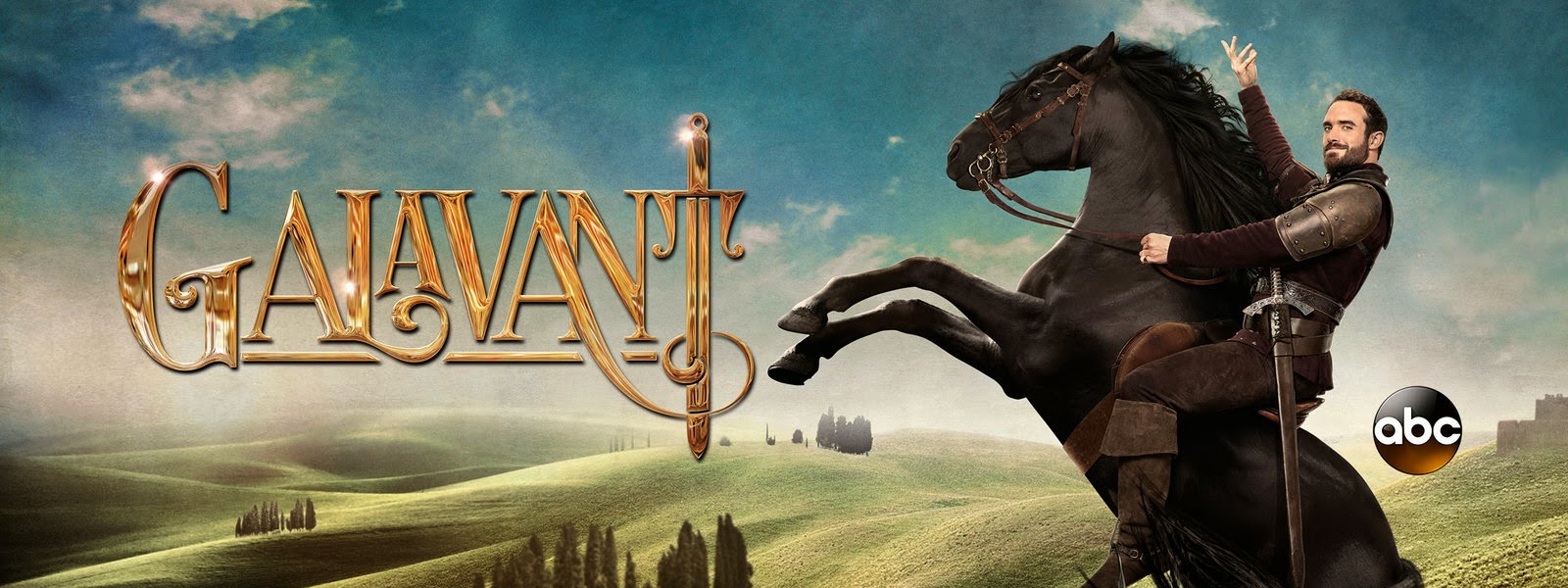
I hadn't heard anything in advance about Galavant, a 1/2 hour medieval musical comedy that ABC was seemingly trying to bury on Sunday nights in the January post-holiday haze.  I caught wind of it only the Friday before the first episode aired on some website or another noting that Weird Al, Ricky Gervais and Rutger Hauer were all set to guest star on a, well, "medieval musical comedy".  This was most assuredly going to be a train wreck.  I mean it's early evening network television, how could it not be?  Plus, ABC was apparently trying to get rid of it quickly, running two episodes a night for four weeks.  Burning it off quickly was certainly a sign of its quality, right?

I tuned in to Galavant at 11PM for the Pacific time zone airing, as my wife had already ventured off to bed and I was reluctant (and a little embarrassed) to watch the show in front of her.  It's a medieval musical comedy for the 8PM timeslot on ABC for Pete's sake.  So imagine my surprise when I found myself rolling on the floor with utter glee for the better part of an hour.  Galavant defied even my  slimmest expectations and for the following three weeks it became appointment television.  When co-star Timothy Omundson appeared on The Soup with Joel McHale between week one and two, he created a bit of an impression on my wife, and even she was on board with it.


The show ambitiously strives to be a little bit of everything, even when it conflicts with itself: it's raunchy and kid-friendly at the same time; it's a period piece, but not outside of making modern references; it's genre busting, yet also genre embracing;  it's a funny musical, but the music is incredibly well-crafted, not dispensable.  It's a rare show that achieves everything it sets out to do, without pandering.  It's a show that toys with metatext, the characters often aware that they're in a production, but it doesn't break the wall too often that it knocks it down altogether.  And the comedy doesn't solely extend from their self awareness.  Both the plot and the characters are exceptionally playful, growing in ways that convention dictates, and in ways that wink at the convention, and then also in ways that are just out of left field.  The fact is that it plays with three genres at once (being medieval fantasies, musicals, and comedies) and so it has three different ways to toy around and play with characters, story, and song without exhausting the possibilities.

It's the show's pilot that hooked me, before it even the first commercial break by breaking the knights-and-princesses story cliche.  In the opening moments we meet Omundson, playing the giddily dainty King Richard, who has stolen legendary knight Galavant's true love Marlena, forcing her to marry him.  Played by the handsome, toothy Joshua Sasse, Galavant is dashing and charming, even when he falls prey to goofiness.  Galavant bursts in on the wedding, keen to fight for his love, but Marlena (Mallory Jansen playing a comedic iteration of Cersei from Game of Thrones) finds the wealth and power offered by Richard trumps true love and voluntarily elects to continue the wedding.

From there the plot fast forwards a number of months and thickens even more, with genuine intrigue that's funny, but no less exciting.  Galavant is in a rut, heartbroken, out of shape, drunk and broke, when Princess Isabella (the pristine Karen David) asks for his help in rescuing her parents and taking back her kingdom from King Richard.  What he doesn't know is that Richard has sent her to fetch Galavant so that he may kill him, since he suspects Marlena's apathy towards him has something to do with her residual feelings for Galavant (turns out not so much, she just despises him).

With the first two episodes setting up the general thrust of the show, the middle four jockey between establishing the status quo at the castle (Richard's search for manliness with his loyal guard Gareth [a very game Vinnie Jones], Marlena's infidelity and lust for power, some asides with the chef and jester) and the road trip taken by Princess Izzie, Galavant, and his squire Sid (Luke Youngblood, pop pop!).  The final two episodes bring the whole cast together for some really rich shenanigans that jump all over the place, potentially taking a lot of the characters out of character, but making for absolutely delightful entertainment.  The penultimate episode features the show's most riotously funny musical number as Sasse and Omundson, who have spent the majority of the series apart, come together for a little ditty about regicide.

The songs (from omposer Alan Menken (The Little Mermaid, Aladdin, Beauty and the Beast) and lyricist Glenn Slater (Tangled)) of Galavant aren't particularly memorable, but they are exceptionally well executed, with the lyrics having to tow the line between genuine exposition and comedy, and faring quite well most of the time.  The best songs feature the characters singing sweetly about murder or death, or in the case of the romantic duets, mutual disgust leading to begrudging affection.  One of the smart moves the show makes with the songs is, unlike most musicals, these aren't big showy numbers.  Generally the songs remain contained to few people singing it, only occasionally breaking out into something bigger.  Beyond that, the songs act in the same way they normally do in musicals, as internal monologue, but what the show does is make them external, such that the other characters are kind of aware of what they are saying, though often not paying close attention.  It makes for a hearty giggle every time someone reacts to something in the song they're otherwise not supposed to hear.

I fell maddeningly in love with Galavant (the show, not the character).  It's truly an outstanding addition to the medieval fantasy comedy genre, that may even stack up to The Princess Bride in its ability to go for it (it will be interesting to note how well the show ages).  At eight episodes, it's really feature-film length but broken down episodically.  The cast is tremendous throughout, with Omundson the obvious breakout player, and will no doubt be seen cropping up more prominently between seasons.  The comedy doesn't aspire to be ground breaking, but entertaining, which it is, fully.  Where there's a handfull of "your mama" jokes and a play on Jon Hamm's name in the second episode that one could roll their eyes at, the show makes it clear that they know they're very silly and that it doesn't care.  It's game for anything.

Having bore witness to the majesty of Galavant, I have to wonder if the programming execs aren't actually subtly brilliant.  Burning through the show over four weeks with 1-hour blocks instead of eight 1/2 hour blocks perhaps serves the modern viewer a lot better, one more used to binge watching without waiting.  Given that Parks and Recreation is doing the same with its final season and that Agent Carter (which we'll get to in a moment) premiered with its first two episodes rather than just one, this may see a new trend on network TV.  In any case, ABC would do wise to know that too much of a good thing can spoil the soup, so the second season shouldn't go beyond 10 episodes.  Keeping the show at feature length will allow for quality songs, and tight storytelling that made the first season such a hit.  If they try to go full-season, it will burn itself out quickly.

---

With Agent Carter, I'm tempted to say "I love it" and just leave it at that.  But I can't.  I need to gush.

What a strange entity Agent Carter is.  Peggy Carter isn't exactly a prominent character in the Marvel Comics Universe, and I don't think there was any sort of fan clamor to see much more of Haley Atwell's character after the Captain America: The First Avenger film (as that film was more about getting people excited for Marvel's Avengers blockbuster).  But someone over at camp Marvel saw something special in Atwell and her performance as Peggy, commissioning her for a short film that was packaged as a special feature on the Iron Man 3 blu-ray.  After the short was well received, and the initial success of Agents of SHIELD, it was announced that Marvel was shopping around a Peggy Carter series.  The short helped sell people on the idea better, but even still it was met with some apathy.  Afterall, it's just Peggy Carter.  It's not Captain America, it's not any recognizable Marvel superhero, it's just Captain America's old-timey girlfriend.

It's that expectation that this series continually plays upon.  Peggy Carter, as a property and in the show, is completely underestimated by almost everyone around her.  The pilot episode goes to great lengths (and they are quite great) to show the audience, at the very least, what makes Peggy so special.  By mid-way through that first episode, I think everyone watching had bough in.  Agent Carter is amazing.

The crux of the show finds Peggy a low-level Agent at the SSR (Strategic Scientific Reserve), just one notch above receptionist essentially.  The SSR primary focus at the moment is finding Howard Stark, after it's discovered he had been manufacturing all kinds of dangerous weaponry and that somehow it's wound up in the hands of the enemy, a secret organization named Leviathan.  The SSR suspects that Stark sold the weapons, while Stark has secretly asked his old ally, Peggy, to help clear his name.  The conflict is obvious.  As Peggy gets deeper into understanding just Leviathan is, the more risk it poses not just to her physical well being, but to her status at the SSR and as an immigrant in America.

There's a lot of fuel for Agent Carter to mine:
First there's Peggy's past, having lost the man she loved (and not just any man, but Captain Frigging America) and her wounds still stinging.  She has a raw spot where Cap is concerned, and it's what allows Howard to manipulate her, while also keeping her from forging any bonds with anyone else.

Secondly, there's the time, set in the mid-1940s, post-war, women having had a taste of liberation during the war are being force back into the home as the men return to their jobs.  Women have proven themselves capable but are still deemed inferior.  The show manipulates this thread expertly, allowing Peggy to both stand in defiance of it, but also use it when its advantageous to her.  Her ability to stand up for herself, to handle herself in a fight, it shows her strength, but her manipulation of the institutionalized sexism and exploitation of people's misguided expectations shows her intelligence as much as her ability to piece together clues and perform fieldwork.  Atwell is an utter genius in this role.  She able to sell Peggy's toughness at every turn, but she's also equally capable of selling her intelligence.  Most times Atwell carries herself with such incredible confidence that its easy to believe she's the smartest person in the room (which she generally is).  At the same time, Peggy isn't flawless, and Atwell knows how to leave those chinks in her armor.  She's got her triggers that set her off or leave her blind, at the same time she's also not so smart as to be ahead of the story.  She's capable of failure and the stress of the work she does, the impact it has, breaks through emotionally from time to time.  How could anyone not be utterly infatuated with Atwell/Carter after watching this show?

Thirdly, the show exists in the Marvel Cinematic Universe (the "MCU") which allows it to connect with everything that has already gone on in both subtle and overt ways.  Naturally it's connected to the first Captain America movie, but it's also connected with the Iron Man series, since the world of Howard Stark (Tony's dad) plays prominently in the show.  It also pulls in elements from the comics that have yet to appear in the MCU, morphing them to the time period and giving them new life.  For the nerds in the crowd, it gives them the easter egg hunts they look for in genre adaptations, but it doesn't derail the show.  Unlike Agents of SHIELD this series manages to organically tie to the MCU and the source comics in a way that benefits the show, rather than being thrust upon it.

Not to harp upon Agents of SHIELD but where it faltered for so long was lack of purpose, lack of character clarity, lack of direction, and a general unease about its place in the world.  Agent Carter has none of that.  It knows where it fits, but it also doesn't seem to be as concerned (at least not yet) about fitting it.  From Peggy's first meeting with Howard in the pilot, it's absolutely clear what the show's mission statement is: find Howard's missing weapons, clear his name.  That it's also got a compressed season order -- only eight episodes -- means it's not farting around with side stories and tertiary character building.  It's story driven, almost cinematically, which most full-season shows can't sustain.  Likewise, it has an energy and confidence that Agents of SHIELD has strived for but never attained.  Weird that Agent Carter feels more like a Joss Whedon show (punchy dialogue, strong female protagonist) than the one he actually created.

I'm eager to see the series play out, but also just as keen to watch it again.  I'm an unabashed fan of The Flash and Arrow on the CW, and I even am modestly enjoying Agents of SHIELD, but those shows, despite my fandom, don't instill the craving to watch them over and over again.  Agent Carter I definitely want to go around again.  I hope that subsequent seasons run about the same episode order.  8 episodes allows for a much tighter series, and a much more enjoyable way to experience a different era of the Marvel CU.

---


Man Seeking Woman isn't the first comedy series about the dating life of the awkward adult male but ... wait, now that I think about it, perhaps it is.  Sure most comedies that feature single guys tend to have a heavy dating component with a revolving door of women, but those are mostly sitcoms where the situation is what the show is largely constructed around, not exploring dating and all the weird things (some) men go through emotionally and mentally throughout it.  Man Seeking Woman is a show that exclusively focuses on its lead character's dating life, much like any romantic comedy tends to do with its female protagonist.  The difference here is the show's heavy use of metaphor-as-reality to process the inner anxieties of the lead.  This may indeed be a dude's version of Sex and the City, The Mindy Project or The New Girl.

Jay Baruchel is perfectly cast as the average, somewhat awkward leading man.  I was surprised to learn that the role wasn't written with him in mind, for this is Baruchel's bread and butter (not that he can't play against type...see Goon for instance).  I was likewise fascinated to learn that this wasn't a product of the Apatow gang, instead coming from Saturday Night Live writer Simon Rich, based of his book of short stories, and produced by Lorne Michaels.  It's certainly a lot sharper and more daring than your typical SNL sketch (not that I don't have much affection for SNL).  But all that known, the show certainly makes more sense.  It does have the feel of a loosely sequential set of short stories or sketches.

The show's use of literal metaphors is what really makes it stand out.  The series picks ups as Josh, recently dumped by his fiancee, is picking up the last of his things.  He's an emotional wreck but putting on a brave face for his ex.  He steps out of her front door and it immediately starts to rain.  Pan wide and we see it's literally only raining on him.  Then a bird drops dead from the tree above, bouncing off him.  In the second vignette of the pilot, Josh is set up on a date with his sister, and she's a troll... literally a troll, but Josh, to his credit attempts to valiantly overlook this fact and engage with her, but he naturally finds it hard.  In the third act, Josh is invited to his ex's engagement party only to learn that her ex's new beau is Hitler... a 125-year-old, wheelchair bound Hitler (played under gobs of makeup by Bill Hader).  I genuinely love the way the show manifests emotional stress physically but doesn't just treat it as metaphor.  Gorbachenka the troll is aware she's a troll and has no apologies for it, and the patrons of the restaurant are well aware she's a troll and don't seem to care.  It seems to be only Josh's issue.  In synergy, the same applies to Hitler, where Josh is the only one outraged by his ex's new boyfriend (is it really because he's Hitler or just because he's dating his ex?).

The second episode uses this device expertly as Josh, wanting to text the girl he met on the train, freezes at the challenge.  His over-sexed best friend Mike (Eric Andre) keeps suggesting he send a dick pic, while his sister starts off strong but then likewise comes up clunky.  Smash cut to a war room where Josh takes in a series of suggestions from military advisers (fans of Battlestar Galactica will appreciate Michael Hogan's gruff one liners), the amount of time, angst and deliberation spent over what to say no doubt familiar to the average joe.  The episode ends after a miserably failed date with a montage of Josh's sad return home and shots of all the romantic things he did to set up, all underscored by sad 4-piece chamber music.  Josh steps into the kitchen where there's the 4-piece playing said underscore, and he tells them to pack up, that its not happening.  The exchange that follows is an utter delight.

The show delightfully toys with reality and surreality, presenting it all as real, but for the most part not unnatural.  In the third episode, Mike coaxes Josh into joining him on a club outing, but Josh knows all too well it's not his scene, so he finds distractions to prevent their outing.  "First, let just pound these beers real quick then we'll go, 5 minutes...", Josh says, and there's a goofy montage of them aggressively downing the beers to krunk music (and a barely audible aside noting "this is a terrible way to drink beer").  Then, stepping up to the club, Josh says, "We need to eat something, fuel for dancing and flirting...let's just pound some mexican food.  5 minutes?"  Cue montage in Josh's apartment with bags of groceries, a mexican cookbook, a mariachi band joining them, cooking up the burritos and serving an intricate meal.  Next in line at the club, Josh stalls once again: "Wait, let's just pound a 10,000 piece jigsaw puzzle first."  Cut to a montage of them finishing the puzzle in rapid order, mounting it, hanging it on the wall, taking a photo, adorning the cover of "Puzzle Aficionado" (it reads "Josh and Mike put it all together").  Finally entering the club, the last ones in, the bouncer lifts up the magazine in his hands, being the very same "Puzzle Aficionado" and exclaims "Oh shit, that was Mike and Josh!"  It comments on the excuses that guys put on to not get out and put themselves out there, and then delivers the comedy via an utterly absurd trio of montages that can't really be reality, but manages to present it as the reality of the show with a brilliantly unexpected tag.

One of the immediate draws of the show was that it was shot in Toronto... I always enjoy scoping out the backgrounds, seeing familiar locations repurposed... it's like a side game to the actual show.  It's not playing Toronto, because of course it's not, but it's also not playing really another setting either.  If anything it's an as yet unnamed fictional metropolis, which is perfect given the heavy fantasy-tinged elements of the show.

It's certainly an apt comedy for the FX stable fitting well as a sort of cross between Louis and Wilfred in a way.  It has a low-key, character-centric vibe to it that allows each vignette to move at its own pace.  It's not aiming for laugh-a-minute, and generally there's at least a kernel of truth behind every aspect of ridiculousness.  It's an immediate favourite.

---


Canadian television has a lot of great talent, but for the most part, that talent is wasted under low production values or scuttled off to America to actually do something worthwhile.  There's the odd breakthrough here or there, an SCTV or Kids In The Hall, a show that will be able to transcend its limitations through sheer inventiveness, but for the most part Canadian television strives to play broadly without any real panache and lacking a lot of interest as a result.  It's not just all about production values either, there's a general attitude to Canadian television, a slower pace, a decided lack of heightened reality that seem almost mandated to differentiate it from flashier materials south of the border.  We're all about moderation up here.

Schitt's Creek, in its most jaded summary, is a Canadian version of Arrested Development mashed with Green Acres, the premise of a rich family suddenly finding themselves on hard times and moving out to a rural community, in this case the aptly named "Schitt's Creek", a small town that Eugene Levy's patriarch had purchased as a joke a decade earlier for his son (played by Levy's actual son, Dan Levy).

When I first heard of the premise, this father-son cast, and it's groan inducing title, I wasn't very inclined to tune in.  The elder Levy has seemingly taken any job since American Pie, so he's not an outright indicator of quality, while the younger Levy was primarily a host on MTV Canada which isn't exactly a ringing endorsement for acting quality.  I had to wonder if the younger wasn't utilizing the cache of the elder in order to get himself a prominent role on TV.

Then I saw a few posters at bus stops around Toronto, and noticed a very persuasive additional cast member in Catherine O'Hara.  While Levy can't exactly be counted upon for starring in the best quality vehicles, O'Hara is nothing short of a comedy goddess and is always worth watching.  I was tentative still but I was definitely going to tune in.


The show is actually quite charming.  It's got the expected Canadian pacing but it's built more for an American cable-style audience (unfortunately it tries to pass itself off as set in America, though).  The addition of Chris Elliott to the cast as the town's mayor was a genuine surprise (most definitely a pleasant one as well).  The show wisely builds up its small town through its cast of supporting players, thus leaving the leads to their eccentricities (Eugene, surprisingly, the most straight-laced of the crew).  There are beats to this sort of comedy construct that seem almost unavoidable, such as the inevitable relationships formed between members of the upscale family and the rednecky townies, but it will be how the show handles its central characters in these beats that it can really differentiate itself.  So far it's not doing too badly.  The characters aren't horrendous people which is a good start, and the townies also aren't *that* rednecky.  I'm actually keen to watch this, so long as convention doesn't start to set in and O'Hara keeps doing what she does so well.

---

Young Drunk Punk is a Canadian show that makes no illusions about where it's set: Calgary, 1980.  Unlike the classic The Wonder Years, this show isn't trying for full-on earnestness.  It's a period sitcom, like That 70's Show (only more single camera, no studio audience, perhaps more akin to The Goldbergs...I dunno, I haven't seen it), taking advantage of the culture of its setting, juxtaposing, these kids deep into punk music and the aesthetic against the suburbs of Calgary and its cowboy hat-clad denizens.  

The show comes from Kids in the Hall alum Bruce McCulloch (who co-stars as the father of the main character) and it does feature a lot of his usual touchstones, although a bit more gentle.  Where his Kids in the Hall sketches that related to father-son dynamics were quite dark, here the father-son dynamic is a strained one where the two lack any real understanding of the other, it's not irreparably distant or in any way abusive.  Likewise McCulloch's sketches from his mid-20s relating to his youth featured a radical sense of anarchy and misdirected aggression, here, again, it's softer revolting, in part to make the characters not jerks and to make their antics more cartoonishly amusing.  This is not to say that the show is toothless, but rather that it's not trying to bite anything.  It's focused on being amusing, not making any grand statements or pushing comedic boundaries.  Of the Canadian sitcoms to crop up in recent years, this is the first one since Corner Gas that feels like it has any real legs.

The series opens at a fascinating point, with the lead, Ian (Tim Carlson), and his best friend Shinky (Atticus Mitchell) attending their high-school graduation, usurping the valedictorian speech for a dose of their style of anarchy (which comes mainly in the form of trying to expose their peers to greatness of punk music).  Where most coming-of-age comedies of this sort revolve around the awkwardness of high school for outsiders like Ian and Shinky, this show starts by showing they made it through, confident in who they are, but unsure of where to go from there.  In 1980, graduating high-school still primarily meant going out and getting a job, rather than considering college or university, and Ian's dad forces him out into the job market by decreeing he pay rent.  Ian's plans to go live with his sister are curtailed when she returns home after breaking up with her boyfriend (who Ian snidely nicknames "Cowboy", as he's nicknamed all her boyfriends).  The second episode finds Ian and Shinky doing pick-up manual labor, winding up working for Cowboy at a ridiculously hazardous job site full of desperate men.

The cast is quite great.  McCulloch as Lloyd is allowed to be both the authority and the oddball, playing into his strengths while also being very amusing.  Tracy Ryan as Helen, Ian's mom, is likewise given a choice role in being in charge, prim, but not your typical prude or humourless housewife (she works at Woolworths), and one has to wonder if she's oblivious or indifferent to what exactly it is her family is doing (so long as they're playing by her rules she seems okay).  It's too bad that Ian's sister, Belinda is yet another vapid, oversexed dumb bunny, but Allie MacDonald has nailed the role, and in Belinda's favour is that she's not yet a direct antagonist for Ian (they seem to have worked past that, although they're not in any way accepting of each other's lifestyle choices).  Of course it's Carlson and Mitchell as Ian and Shinky that the show hinges and both are thoroughly up to the task.  They live in the clothes like they were actually theirs and they are more than adept at delivering a well-timed one-liner as well as pulling out a physical performance.  The opening sequence of the second episode finds Ian taking punches outside a bar while Shinky watches and eggs him on (a familiar skit from Kids in the Hall) only for the reveal that they're trying out to be bouncers.  Carlson can take his lumps very well.

It's a genuinely entertaining show, upholding American-style production values and single-camera comedy pacing, but not losing any sense of Canadian-ness either.  I take some pleasure in recognizing that this would likely play just as well in the states as That 70's Show played in Canada.  It's quite accessible and fun.  I don't know if it sustains for four or more seasons how strong its legs will be, but I have no doubt that a solidly amusing first season is in store.