Showing posts with label knights. Show all posts

Tuesday, February 24, 2026

3 Short Paragraphs (Or Not): The King

2019, David Michôd (The Rover) -- Netflix

So, in 2013-ish Joel Edgerton and director Michôd collaborated on the screenplay for The Rover. At the same time they revealed they had worked also together on a script for an adaptation of Shakespeare's "King Henry" plays, often called the Henriad, which cover the reign of King Henry IV and the rise to power of his son, Henry the V. I fully admit I know very little of the plays, only knowing Branagh's 1989 film. I also know very little of the historical period. But it fascinates me that this movie displays as a historical drama, yet retains the fictional character of Falstaff, from the plays, as played by Edgerton himself.

Enough of the meta. This movie just looks & sounds goooood !! Its grim and gritty, yet so very fucking precise in its use of language (close, but not quite Shakespeare-ian) and imagery. And very oddly curtailed in its "historical" depiction. Usually these kinds of movies cover a long range of time keying on points from the history blogs, the sound bites of a figure of notoriety. This movie focuses on Hal's coming to power, and his famous battle with the French at Agincourt. That's it. It helps that its based on plays and not history.

So, Hal (Timothée Chalamet, Dune) is a bit of a layabout. He doesn't care for his father at all and spends his time in Eastcheap drinking and whoring with John Falstaff (Joel Edgerton, Train Dreams), an ex-soldier given to fat and hanging out with the wrong sort, leaning on his royal friend to get him out of tough situations. Meanwhile after fighting the Scots, King Henry's vassals are less than happy with his paranoid responses, one named Hotspur going so far as to insult the King to his face. That leads to the King (Ben Mendelsohn, Captain Marvel) naming them outlaw and sending his son to deal with the "rebellion", his younger son who he has now named as heir, because of Hal's rejection of everything.

Hal is actually incensed, knowing his little brother to be weak, ineffectual and desperate to please their father. He interrupts the grand battle between armies by challenging Hotspur to singular combat. The two fully armoured knights clash, grunting and striking each other in the mud until Hal comes out victorious, stealing glory from his brother. You get the feeling that despite Hal being a drunken fool, he knows how to fight and is keenly aware of his father's failings. Not long after, his brother still dies, trying to prove himself in Wales. And soon after that, King Henry IV dies in bed, covered in sores and regretting everything. Hal is forced to accept the crown.

Hal bears his crown with a heavy heart but a stubborn desire to Be Better. He doesn't want to be his father, a man continually at war with everyone, but also doesn't want to be seen as ineffectual. When, during his coronation, the French send him a single tennis ball, he doesn't react with violence to the insult, as all expected of him. But it becomes clear to us, the viewer, if not Hal himself, that there is a lot going on he was never aware of and there are constant outside factors influencing every aspect of his reign. This is probably when Hal could have used the friendship and guidance of Falstaff, but he leaves the man to his drink and his debts. Until he needs him.

It doesn't take a keen mind to see Hal is being manipulated, primarily by his lead advisor, Sir William Gascoigne (Sean Harris, Mission: Impossible - Fallout), a man always quick with loaded advice, and a very very affected way of standing, as if posing for the camera. It is William who unmasks an assassination attempt leading to the execution of two nobles, one who was Hal's friend in childhood. And it points all swords at France, a challenge not even peace-seeking Hal can ignore. 

Dude, you are being played.

Hal apologizes to Falstaff and brings the drunken knight along as a chief advisor, and they all set sail for France. They are armed with the attempts on Hal's life and some complicated, probably fabricated explanation as to how the King of France is not legally entitled to be king. But in front of the king is his foppish and arrogant son, The Dauphin (Robert Pattinson, The Batman), a cruel man who taunts Hal. They "easily" take the first castle but when they meet the Dauphin's army proper, he has The Higher Ground.

The Battle of Agincourt, the definite point in history. This is where Falstaff's brilliance comes into play. He is a man who suffers from his experiences in wars past, but wants what is best for his friend, and king. He also wants as little death as he can allow to happen, devising a plan where the lightly armoured English will feint an attack on the outnumbering, but heavily armoured French, allowing everyone to go down in the mud. It goes as planned, but at the cost of many English including John. Peace is drawn up and Hal is to marry the French princess (Lily-Rose Depp, Yoga Hosers) to seal it. He asks one thing of her -- always speak truth, because if there is one thing Hal needs it is an advisor who isn't entirely self-serving. 

The movie ends with Hal realizing how everything, the insults by the French and the entire war, was put into play by Gascoigne, to better the man's holdings. Hal dispatches the man in a less than dramatic fashion.

Again, I say the movie just looks good. There is budget and intent in the depictions. The lighting and colouring remains grim even in the lighter scenes, of which there are few. Given the movie is less a recollecting of historical facts, it is not surprising it is more a collection of artfully built vignettes.... much like a play generally is. Dialogue is at the forefront and it also is very precise, but not entirely period nor Shakespeare. If anything, it does feel a bit muted, with the tale of a heavy crown obvious, but not really impactful.

Saturday, February 17, 2024

KWIF: Past Lives (+2)

 KWIF=Kent's Week in Film

This week:
Past Lives (2023, d. Celine Song - AmazonPrime)
Nimona (2023, d. Troy Quane, Nick Bruno - Netflix)
Plus One (2019, d. Andrew Rhymer, Jeff Chan - Netflix) 

---

Between watching films like Anatomy of a Fall and Maestro, the new Mr. & Mrs. Smith series on AmazonPrime, and hearing the neighbours yelling at each other through the walls nearly every day, for, oh, the past four years, I feel like I've gotten more than my fill of intense, unhappy relationships.  It's bad for the mindset to have too much of that in one's life, even peripherally.

Celine Song's Past Lives is kind of a bittersweet tonic to such sequences of relationship animosity. It's an ode to individualism as well as to love. It's an incredibly mature, thoughtful look at relationships and shows people who are capable of self-awareness and managing their emotions.

Na Young and Hae Sung grew up together in Seoul. By the time they were twelve they were intensely competitive with one another in school, but also incredibly attached. Just as they're starting to explore feelings for each other, Na Young is ripped away as her family emigrates to Canada. No word of a lie, but their last moment with each other is one of the most beautifully composed visual metaphors in cinema, thanks to a perfectly scouted location.

Twelve years later, Na Young, now Nora (Greta Lee), is an aspiring playwright, while Hae Sung (Teo Yoo) has wrapped up mandatory military service and looks to the next phase of his life. But he's not forgotten a piece of his past, and he reaches out through a series of connections on Facebook to find Nora, who, curious herself, reaches out in return. Their connection is as immediate as if they had never left it, only the attraction is much more adult and the emotions much more understood. Alas, a half a world away, and half a day's difference makes a relationship hard to sustain... and what's more, Nora is finding it distracting from her goals, from what she wants to achieve. With no hope of Hae Sung coming to New York and no time for her to make a trip to Soeul, she presses "pause" on whatever is happening between them. And they both go about their lives.  

I think one of the more difficult things in film and television storytelling is making video calling interesting to watch, but Song here really gets so much out of how her actors behave towards the camera (and just off camera). There's so much to be said about what we see on the screen within a screen, but then there's what we see in the scene that the characters don't see of each other...physicality, gestures... and then there's the missed connections, which, somehow, are just heartbreaking.

Another 12 years pass. Nora is married to another writer,  Arthur (John Magaro), and they have, what I think can be said is a very practical partnership. When Hae Sung, recently reconnecting with Nora, comes to New York to visit, there is clearly a rekindling happening between them, a palpable attraction that hasn't gone away in the 24 years since they were last able to touch each other. What results is a Before Sunrise-esque level of engagement, talking candidly about what life has been like, and what life could have been like in different circumstances. Arthur is not ignorant of the connection they share, he's not oblivious to the cliches of storytelling where he's the odd-man-out, but at the same time, there's a reality that all three players are fully aware up. No one is upending their lives just for some idea of "love".

The way the characters engage with each other, with openness and honesty that is both given and received, is absolutely refreshing. There's no real drama in Past Lives, there's no romantic cliches of "true love conquers all", there's just a heavy concrete slab of reality at the foundation of this movie, and in Nora's character. She is a realist, and despite whatever emotions come with Hae Sung, she has so many more emotions tied elsewhere that would be uprooted to be with him.

Despite the almost wet blanket scenario and absence of high drama, it's a very romantic movie. It is a movie about love, and it's never a bad time to be in the presence of love.

But it's also a movie about what it means to feel complete, and love is only a piece of it. Why do people cheat on their partners or leave their family behind to run off with a new fling? It's often got nothing to do with the other person and everything to do with themselves...they're chasing external happiness. 

Hae Sung, for his part, can't let go of Nora because he's not found happiness with himself. He's still chasing a feeling he felt long ago in someone else, rather than trying to find that feeling inside.  

--This is the last film of the Best Picture Oscar Nominees that I had yet to see, and this is the first time in a long time, perhaps ever, I've seen all Nominees prior to the ceremony. Last week I ranked the nominees in my preferential order (not who I think will win, just my preference), and I think Past Lives would fall into that middle pack with The Holdovers, Oppenheimer, and American Fiction, where any of these four films could swap places in the 3-6 slot. But I still like Anatomy of a Fall and Poor Things well above them all.--

---

I like the idea of the Annupurna/Netflix feature Nimona, based on the graphic novel series by ND Stevenson, much more that I think I enjoyed Nimona.

The film starts with a bit of an overcomplicated history lesson voiceover describing how the mystical land and society was built around protecting itself from monster then jumps a thousand years in the future to find a techno-medi-evil terrain where a young street kid was taken in by the queen to be educated as part of the land's fabled knighthood, a position usually reserved for the elite families of the city. 

Ballister Boldheart is about to be knighted, bucking tradition, but during the ceremony he is framed for murdering the queen and goes on the run. He is found by Nimona, an energetic changeling who looks only for companionship from a fellow outcast. The pair have to battle both class structures and intolerance to uncover the truth of the Queen's death, as well as, perhaps, change some minds about changelings being the monsters this society has been so afraid of for generations.

Without really any fanfare, Nimona is a young adult fantasy-adventure that features queer characters as its leads.  Ballister was in a romantic relationship with Ambrosius Goldenloin, the champion knight, until Ambrosius cut his arm off when he thought Ballister murdered the Queen.  Nimona is trans-coded, and while the character is pronouned "she" throughout, Nimona kind of bucks the idea of even being gendered, or classified as any sort of form.  

I love that aspect of the film, that it so effortlessly includes these characters without ever awkwardly making a point about it, but at the same time, it's the entire subtext of the movie if you're looking for it. Unfortunately the setting of the film did absolutely nothing for me. The societal structure, the visual design, the meta-cross of fantasy and techno-future...I just didn't find it appealing. 

But the final act turned into a real emotional rollercoaster and really got me in the gut and got the tears flowing. The climax raises the stakes to a very surprising and intense level, and its resolution is a thing of absolute beauty.  I may not have been enthralled by the first two acts leading up to it, but it pays off really nicely. Riz Ahmed as Ballister and Chloe Grace Moretz both deliver really great voice performances as well. It's not a better film than Across the Spider-Verse in this year's Best Animate Picture Oscar race, not The Boy and the Heron, but it shouldn't be dismissed as so many Netflix originals often do.

Toasty's take...we agree.

---

After finishing the aforementioned Mr. & Mrs. Smith series starring Donald Glover and Maya Erskine, this indie romcom starring Erskin and The Boys Jack Quaid popped up prominently on Netflix. I had never heard of the movie, so, as I do, I promptly took a gander at Letterboxd to see how the cinemaphiles had rated it, and they liked it, singling out Erskine as the film's key draw.

I had seen Erskine around over the years, including the recent Obi-Wan Kenobi series, but she wasn't that prominently featured (I haven't yet watched her comedy series Pen15). So Mr. & Mrs. Smith is my first big exposure, and wow...what an impact.  I'll get to that review later this coming week.  But with the Letterboxd recommendation of more wonderful Erskine business, Plus One became a must-watch.

Erskine plays Alice, who gets into an arrangement with her buddy, Ben (Quaid) to be each other's dates to the many weddings each has to attend that summer.  They're just friends to start,  she even acts as his wingman for a time, and there's not an ounce of romantic chemistry between them at first, but the friend chemistry is wholly palpable. But you can't spend that amount of time with one another in fancy dress, loaded with alcohol, surrounding by sweeping sentiments of love, and not, perhaps, get swept up in it.

But how do they know it's real?  I came to the movie for Erskine, but Quaid is a very likeable presence and the ostensible lead of the film (it really does focus more on Ben's life and POV than Alice's). Where Alice has recently gone through a break-up at the start of the film, Ben seems kind of terminally alone. He's the last of his friends who is single by the time the summer wedding season gets into full swing, and when he looks at his twice-divorced father (Ed Begley Jr.) who just proposed to a woman half his age, Ben thinks he understands why.  So when he gets together with Alice, and, more surprisingly Alice is all-in on the relationship, it's Ben who starts to get shaken by what they have.

In a way, Plus One follows a pretty similar formula to beloved Kent household favourite Holidate,  so there was something comfortable about the structure, though the timeframe of the relationship is sort of compressed over a few summer months as opposed to a whole year. Still, changing venues, different people surrounding the characters, and the device of leading each wedding "chapter" off with the best man or bridesmaid speech (and highlighting all the different tropes of said speeches) was terrific. 

Erskine is the standout here. She's a bundle of aggressive energy, with a sincerity and vulnerability that temper the aggressiveness into charming. As she'd proven in Mr. & Mrs. Smith, she's a versatile and gifted actress, comedic or otherwise, and I expect we'll be seeing an increasing amount of her over the next couple of year. Quaid has more of his mom Meg Ryan's charm than his dad's sort of smarm, which makes him kind of perfect for a romcom lead. He's not the stereotype of the romcom lead, but he is a guy you definitely root for to get his shit together.  It's charming.

Thursday, December 5, 2019

T&K's Xmas Advent Calendar: Day 5

A Toast to Hallmarkent
The Knight Before Christmas (2019, Netflix)

The Story:
Sir Cole (Josh Whitehouse), a 14th-century Knight is out in the woods of Norwich for fun and games when he encounters an old crone (you ever heard of a young crone?).  He's trying to be galliant and bring the crone back to the castle and out of the cold, but she rewards him by spiriting him away to 2019 Ohio, on a quest for what he's always searched for (unsaid, it's true love).  But, she says, if he fails, he shall never become a true knight.

He lands in the middle of a Christmas fair, where, in full knight regalia, he's instantly a bit hit with the ladies.  Speaking of big hits, he's a little disoriented as it starts to snow heavily, he stumbles around and is accidentally run over by Brooke (Vanessa Hudgens), a school teacher.  The all to friendly cops arrive and, after checking him out, infer that he either has amnesia or is delusional.  Against all rational judgement and sense of personal safety, Brooke offers up her guest house to the guy who either has head trauma or is crazy.

Cole, has a shower and emerges in a towel. Brooke gets thirsty. (Beefcake and reaction to beefcake, this ain't your 48-year-old grandma's Hallmark movie...)  Cole learns the ways of Alexa (this Netflix movie is sponsored by Amazon?), binge watching junk reality TV, and does all those corny things displaced people from the past do in modern day.  Being completely out of one's element is funny, because they look stupid not knowing stuff they couldn't possibly know.  He starts teaching Brooke's niece how to sword fight, and Brooke's sister loses all sense of composure around him.  Brooke's neighbour, falling decidedly into the frienemy camp, comes over to eye up the thirst trap.  ("Toodle-pip" he says instead of goodbye).  Brooke starts to entertain the fact that Cole may be legitimately time displaced.

But just because Netflix's Hallmark movies are a little sexier doesn't mean they're also not wholesome. Brooke hosts a Christmas feast for the less fortunate and Cole is invited to help out. Shopping at a Walmart Cole samples their dinner rolls and comments on how highly processed food is crap.  Off to Cole showing Brook how to knead dough (because Cole, as a squire, worked in the kitchen, as squires do).  But sexy making bread time is interrupted when Brooke's niece goes missing in a blizzard. Sir Cole (seemingly impervious to the cold) comes to the rescue, because of his awesome knight tracking skills.  A kiss is interrupted by Brooke's brother in law.

Cole stops a pickpocket at the Christmas fair, and then gets basically offered a job on the force ('cause that's how that works)... if he can pass the psyche exam.  Still he seeks his quest (still doesn't know it's true love, the dummy) and thinks he shall never become a true knight.  On Christmas eve, they get dressed up for the dinner, they almost kiss, but are interrupted by a text.  The dinner goes smashing and Brooke and Cole kiss (with 20 minutes left to go) under mistletoe which triggers Cole's recall medallion and he returns home.  Brooke is heartbroken.  Cole returns home just in time to have a brief conversation with his brother and return back to Brooke for a grand Christmas reunion (and he brought his horse this time).  Love is magic you guys. And Christmas, it's magic too you guys.


The Draw:
I always dismissed Vanessa Hudgens.  I was certainly too old and not the target market for her teen High School Musical and Disney Channel stardom, and the years that followed it seemed like she was playing into that kid-star mold until Spring Breakers, which seemed almost a desperate ploy to break out of that mold (alongside a batch of kid-stars trying to break out of the mold). It seemed to work.  I didn't give Hudgens a chance until the charming if unfocussed Powerless in 2017.  She was the commanding lead of that show and had great straight-man comedic timing...plus that wonderful smile won me over.  Last year's The Princess Switch was Netflix's big coming out as a Hallmark Channel rival with these kind of movies, and it was, to be honest, better than almost all Hallmark Channel movies.  I was keen to learn that Hudgens is going to be the Candice Cameron-Bure of these for Netflix, and The Knight Before Christmas became top-of-the-heap holiday watching.

The Formulae:
Brooke's jaded about love presents itself early on when she coaches a pre-teen student who just faced a break-up to focus more on her goals and less about love.  This jaded attitude about love doesn't really present itself anywhere else though.  There are a lot of near-miss kisses.  Oh and a tree-buying sequence.  There's a Santa in the Christmas fair who may be the real Santa (not quite sure though...they play it coy.  Of course, having a magic crone AND Santa in the same film is a bit much).

A vague town event with a non-descript purpose.  The movie all leads to that thing, which isn't much of a thing, all told, except a setting to get the leads dressed up all nice and kiss. So it does its job and finds and draws out a few Christmas feels along the way.

Hallmark films aren't above a time travel story, so that's truly a formula, where the traveler has to choose between love and home...I assume (I haven't actually watched one).

They introduce a neighbour who could be a complication, but she never is.  These types of movies don't really care to much about interpersonal conflict or drama.

Oh yeah, and dead parents! 

Unformulae:
The usual Hallmark movie is usually female-centric, or from the women's focus, but this one seems almost balanced as being both Cole's story (finding his quest, learning to be a true knight), and Brooke's learning to overcome her jaded attitude towards love.

Bi-racial couples and multi-ethnicity casting abound like it ain't no thing (because it ain't). Hallmark Channel movies still haven't really joined the 90's yet in this regard, but Netflix is showing it's no biggie.

A kiss happens between the leads, and not at the very end of the movie.
Beefcake! BEEFCAKE! Shirtless dude scene, women with lust in their eyes.  There's never even the hint of sex in a normal Hallmark Channel movie, but over at Netflix, they know that modern ladies aren't so puritanical.

There's also a mid-credits scene setting up a sequel.  It looks like Sir Cole's brother, the just knighted Sir Geoffrey may be taking on a romance quest of his own next year... depending on how this one plays, I suppose.

True Calling?:
It's called The Knight Before Christmas and it's about a knight who shows up before Christmas.  Yep, that tracks.

The Rewind:
When the pickpocket is getting handcuffed. One cop (the great "hey that guy!" character actor Arnold Pinnock) who's got the kid's arm held behind his back lets go, the kids arms drop, and the actor playing the female cop is a beat or two behind the scene and steps in to take over.  The kid remembers he's supposed to be getting handcuffed and just puts his hands behind his back in anticipation of being cuffed.  At least the foreground conversation got captured perfectly...good enough!


The Regulars:
Hudgens is in her second go-around with the Netflix Hallmark-esque movies (let's call them "Nallmarxs") and yeah, she can keep coming back for these each year.  I'm in on that.  She's a charming romantic lead.

Though they don't really sell the medieval Norwich setting as honest 14th-century, Whitehouse does make for a dashing knight-esque figure, and he has all the chivalry and propriety one would expect from a fairy-tale knight.

Brooke's sister is played by Emmanuelle Chriqui, who could so easily lead one of these things.  Make it happen Netflix!


How does it Hallmark?
Honestly, it looks better than every Hallmark movie, and I like a lot of things about it that distinguish it from Hallmark.  It seems bigger budget and higher quality overall, even though it's really doing the same thing.  The thing about Hallmark movies is usually they're so bad or so formulaic they're entertaining.  You take most of the formulaicness or the badness out of it and you're just kind of a generic movie instead.  So, as much as I like VanHudg, I would probably prefer to do the Hallmark drinking game against an actual Hallmark movie than watch this.

How does it movie?
It really is more cinematic.  Netflix, not realizing that they can go super-cheap like Hallmark does is still using the cameras with the good lenses and putting some quality production values into their Christmas town and set-ups.  Their set and Christmas decorations don't look like they came from the dollar store.  But it's that very thing that's the problem.  Instead of feeling like a high-quality Hallmark, it feels instead like a not great big studio romcom.

I found the leads charming together but this didn't really work for me.  I know it's a "romantic fantasy" but I didn't buy that Sir Cole wouldn't have greater culture shock, nor that Brooke wouldn't be more wary of this guy.  And there's that whole ridiculously illogical sequence where Brooke gives this mentally unstable/possible guy from 650 years ago the keys to her car and lets him drive through town, which is careless, reckless, and absolutely dangerous.  Bad Brooke! Bad script! You both should know better.

Tuesday, July 7, 2015

Generic Fantasy: Seventh Son & Last Knights

2014, Sergey Bodruv (Mongol: The Rise of Genghis Khan) -- download
2015, Kazuaki Kiriya (Casshern) -- download

As the seventh son of a seventh son of a D&D player, it is my destiny to see all movies in the swords & ______ genres. Hell, in these days since Lord of the Rings has entered into cinematic pop culture, and generic fantasy emerging with a power of its own, I should expect to see more of calibre, right? Game of Thrones solidified that, right?

Sigh.

I am still rather surprised that the number of features green lit since the popularity of Lord of the Rings is actually quite minimal. Let's see, ignoring the teen magic ones (Potter and his ilk), we get the Clash of the Titans remakes, the quickly forgotten Conan reboot, the Narnia adaptations (and some other teen novel adaptations early on), and even more fairy tale adaptations, such as Snow White & the Huntsman. Not only minimal in number, but so low in quality for the most part.

Sigh.

And yet I pretty much see them all. Its required. I cannot forsake my destiny, can I ?

Seventh Son is an adaptation of the YA novels, the Wardstone Chronicles, or The Last Apprentice series. In this world, Spooks root out and slay the monsters that pester people. Gregory is the last Spook and seeks an apprentice to take his mantle and wield his magic arsenal. But a witch from Gregory's past breaks her chains to not only kill off Gregory's apprentice (Kit Harrington!) but to try and take over the world.

Jeff Bridges is playing Gregory in a brilliant / inane role that merges his previously played, tabacky chewing rural bumpkins, with weird moustaches and even weirder accents. Think Rooster Cogburn or Roy, the dead cowboy cop from R.I.P.D. To be quite honest, I rather enjoyed the character -- suited up in black stained cloak & hood, ever skilled and inestimably cynical. He is sort of a Witcher for teens.

Tom (Ben Barnes) is the new apprentice, after the witch (Julianne Moore) kills Kit.

Ugh, I want to say more about the plot, but really, its by the book, pun intended. Apprentice learns trade, distrusts master monster hunter, learns of his own inner destiny while learning to trust said master, finally going up against the Big Bad, and surpassing the master in skill. There is nothing wrong with doing a classic fantasy hero story but there needs to be something outstanding about the execution. The effects are only decent, the world building is next to nil and the supporting villain cast is kind of racist. White people save the world from exotic dark skinned villains from other parts of the world, yada yada; yawn. Yawn at the tired trope, not at the dislike of said trope.

There should be something here to latch onto, to enjoy. I enjoyed The Huntsman and the Clash movies so I should be able to find something here, right? Hrrm. Maybe I need another viewing. I need to see if I am less bored with the female supporting (i.e. love interest) now that I know its Alicia Vikander from Ex-Machina.

Meanwhile, the remake of the classic story previously covered in 47 Ronin, is Last Knights. Generic fantasy? Shouldn't it be considered a heroic Japanese story? Well, yes, if it was set in Japan like the other adaptation. But no, they chose to separate by being set in a unnamed generic fantasy world, replacing ronin samurai with lordless knights. You cannot blame them, as the timing was too close, but its rather ironic that the Japanese story was directed by a white man, and the white dominated cast story is directed by a Japanese man. Ironic but irrelevant, if you ask me.

There is a stylistic choice present in this movie that makes it rather attractive. The world building may be as lacking as the other movie, presenting just enough to know that this loyal order of knights (and their code of ethics) is in decline, in an Empire served more and more by corrupt politicians. Lord Bartok (Morgan Freeman) is a lord of this knightly order, rankled to have bow down to officials demanding bribes. Clive Owen is his raised-from-the-streets commander who suggests caution in this new world. The conversations between the two are long and wordy, just the way I like them, suggesting some thought to the script.

As expected, circumstances lead to Lord Bartok's death and disgrace in the eyes of the emperor. His fall means the fall of his entire family & followers, his castle burned to the ground and the dispersal of all his lands. Clive Owen's Raiden (no electrical powers) falls as his master does, returning to the drink and debauchery that Bartok raised him from. The rest of the followers (no need to stick to 47 here), as lordless knights, turn to other work and a plan to have vengeance for their master's death.

The execution of this story is rather masterful, as colorful and decorated as it should be. Settings are great, costuming is grand and sweeping but there was a disturbing sense of emotional detachment to it all. You just never had enough character to latch onto. The world building is great, although minimal (focused?), and it was great to get rid of the white washing of the characters. This is an empire that conquered all four corners of their world ages ago, melding becoming the norm, like in my own D&D games. But I wish some more attention had been paid to pacing and character, for I never felt entirely present with the lead characters.

Still, I enjoyed it. But not enough to add to The Shelf.

Monday, February 2, 2015

Wintervision: New Mid-season TV

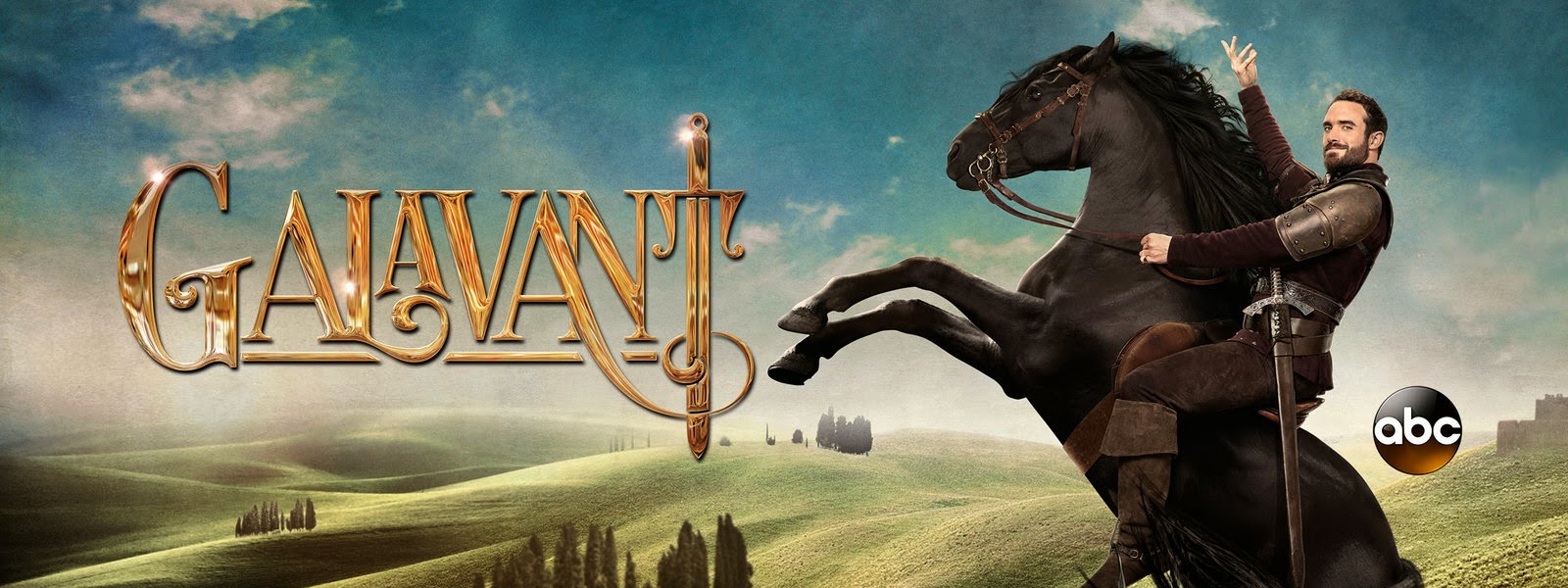
Galavant (Season 1) - Sundays @8 on ABC
Agent Carter (episodes 1-3) - Tusedays @9 onABC
Man Seeking Woman (episodes 1-3) - Wednesdays @10:30 on FXX
Schitt's Creek (episodes 1 & 3,4) - Tuesdays @9 on CBC
Young Drunk Punk (episode 1) - Wednesdays @8:30 on CityTV

---

I hadn't heard anything in advance about Galavant, a 1/2 hour medieval musical comedy that ABC was seemingly trying to bury on Sunday nights in the January post-holiday haze.  I caught wind of it only the Friday before the first episode aired on some website or another noting that Weird Al, Ricky Gervais and Rutger Hauer were all set to guest star on a, well, "medieval musical comedy".  This was most assuredly going to be a train wreck.  I mean it's early evening network television, how could it not be?  Plus, ABC was apparently trying to get rid of it quickly, running two episodes a night for four weeks.  Burning it off quickly was certainly a sign of its quality, right?

I tuned in to Galavant at 11PM for the Pacific time zone airing, as my wife had already ventured off to bed and I was reluctant (and a little embarrassed) to watch the show in front of her.  It's a medieval musical comedy for the 8PM timeslot on ABC for Pete's sake.  So imagine my surprise when I found myself rolling on the floor with utter glee for the better part of an hour.  Galavant defied even my  slimmest expectations and for the following three weeks it became appointment television.  When co-star Timothy Omundson appeared on The Soup with Joel McHale between week one and two, he created a bit of an impression on my wife, and even she was on board with it.


The show ambitiously strives to be a little bit of everything, even when it conflicts with itself: it's raunchy and kid-friendly at the same time; it's a period piece, but not outside of making modern references; it's genre busting, yet also genre embracing;  it's a funny musical, but the music is incredibly well-crafted, not dispensable.  It's a rare show that achieves everything it sets out to do, without pandering.  It's a show that toys with metatext, the characters often aware that they're in a production, but it doesn't break the wall too often that it knocks it down altogether.  And the comedy doesn't solely extend from their self awareness.  Both the plot and the characters are exceptionally playful, growing in ways that convention dictates, and in ways that wink at the convention, and then also in ways that are just out of left field.  The fact is that it plays with three genres at once (being medieval fantasies, musicals, and comedies) and so it has three different ways to toy around and play with characters, story, and song without exhausting the possibilities.

It's the show's pilot that hooked me, before it even the first commercial break by breaking the knights-and-princesses story cliche.  In the opening moments we meet Omundson, playing the giddily dainty King Richard, who has stolen legendary knight Galavant's true love Marlena, forcing her to marry him.  Played by the handsome, toothy Joshua Sasse, Galavant is dashing and charming, even when he falls prey to goofiness.  Galavant bursts in on the wedding, keen to fight for his love, but Marlena (Mallory Jansen playing a comedic iteration of Cersei from Game of Thrones) finds the wealth and power offered by Richard trumps true love and voluntarily elects to continue the wedding.

From there the plot fast forwards a number of months and thickens even more, with genuine intrigue that's funny, but no less exciting.  Galavant is in a rut, heartbroken, out of shape, drunk and broke, when Princess Isabella (the pristine Karen David) asks for his help in rescuing her parents and taking back her kingdom from King Richard.  What he doesn't know is that Richard has sent her to fetch Galavant so that he may kill him, since he suspects Marlena's apathy towards him has something to do with her residual feelings for Galavant (turns out not so much, she just despises him).

With the first two episodes setting up the general thrust of the show, the middle four jockey between establishing the status quo at the castle (Richard's search for manliness with his loyal guard Gareth [a very game Vinnie Jones], Marlena's infidelity and lust for power, some asides with the chef and jester) and the road trip taken by Princess Izzie, Galavant, and his squire Sid (Luke Youngblood, pop pop!).  The final two episodes bring the whole cast together for some really rich shenanigans that jump all over the place, potentially taking a lot of the characters out of character, but making for absolutely delightful entertainment.  The penultimate episode features the show's most riotously funny musical number as Sasse and Omundson, who have spent the majority of the series apart, come together for a little ditty about regicide.

The songs (from omposer Alan Menken (The Little Mermaid, Aladdin, Beauty and the Beast) and lyricist Glenn Slater (Tangled)) of Galavant aren't particularly memorable, but they are exceptionally well executed, with the lyrics having to tow the line between genuine exposition and comedy, and faring quite well most of the time.  The best songs feature the characters singing sweetly about murder or death, or in the case of the romantic duets, mutual disgust leading to begrudging affection.  One of the smart moves the show makes with the songs is, unlike most musicals, these aren't big showy numbers.  Generally the songs remain contained to few people singing it, only occasionally breaking out into something bigger.  Beyond that, the songs act in the same way they normally do in musicals, as internal monologue, but what the show does is make them external, such that the other characters are kind of aware of what they are saying, though often not paying close attention.  It makes for a hearty giggle every time someone reacts to something in the song they're otherwise not supposed to hear.

I fell maddeningly in love with Galavant (the show, not the character).  It's truly an outstanding addition to the medieval fantasy comedy genre, that may even stack up to The Princess Bride in its ability to go for it (it will be interesting to note how well the show ages).  At eight episodes, it's really feature-film length but broken down episodically.  The cast is tremendous throughout, with Omundson the obvious breakout player, and will no doubt be seen cropping up more prominently between seasons.  The comedy doesn't aspire to be ground breaking, but entertaining, which it is, fully.  Where there's a handfull of "your mama" jokes and a play on Jon Hamm's name in the second episode that one could roll their eyes at, the show makes it clear that they know they're very silly and that it doesn't care.  It's game for anything.

Having bore witness to the majesty of Galavant, I have to wonder if the programming execs aren't actually subtly brilliant.  Burning through the show over four weeks with 1-hour blocks instead of eight 1/2 hour blocks perhaps serves the modern viewer a lot better, one more used to binge watching without waiting.  Given that Parks and Recreation is doing the same with its final season and that Agent Carter (which we'll get to in a moment) premiered with its first two episodes rather than just one, this may see a new trend on network TV.  In any case, ABC would do wise to know that too much of a good thing can spoil the soup, so the second season shouldn't go beyond 10 episodes.  Keeping the show at feature length will allow for quality songs, and tight storytelling that made the first season such a hit.  If they try to go full-season, it will burn itself out quickly.

---

With Agent Carter, I'm tempted to say "I love it" and just leave it at that.  But I can't.  I need to gush.

What a strange entity Agent Carter is.  Peggy Carter isn't exactly a prominent character in the Marvel Comics Universe, and I don't think there was any sort of fan clamor to see much more of Haley Atwell's character after the Captain America: The First Avenger film (as that film was more about getting people excited for Marvel's Avengers blockbuster).  But someone over at camp Marvel saw something special in Atwell and her performance as Peggy, commissioning her for a short film that was packaged as a special feature on the Iron Man 3 blu-ray.  After the short was well received, and the initial success of Agents of SHIELD, it was announced that Marvel was shopping around a Peggy Carter series.  The short helped sell people on the idea better, but even still it was met with some apathy.  Afterall, it's just Peggy Carter.  It's not Captain America, it's not any recognizable Marvel superhero, it's just Captain America's old-timey girlfriend.

It's that expectation that this series continually plays upon.  Peggy Carter, as a property and in the show, is completely underestimated by almost everyone around her.  The pilot episode goes to great lengths (and they are quite great) to show the audience, at the very least, what makes Peggy so special.  By mid-way through that first episode, I think everyone watching had bough in.  Agent Carter is amazing.

The crux of the show finds Peggy a low-level Agent at the SSR (Strategic Scientific Reserve), just one notch above receptionist essentially.  The SSR primary focus at the moment is finding Howard Stark, after it's discovered he had been manufacturing all kinds of dangerous weaponry and that somehow it's wound up in the hands of the enemy, a secret organization named Leviathan.  The SSR suspects that Stark sold the weapons, while Stark has secretly asked his old ally, Peggy, to help clear his name.  The conflict is obvious.  As Peggy gets deeper into understanding just Leviathan is, the more risk it poses not just to her physical well being, but to her status at the SSR and as an immigrant in America.

There's a lot of fuel for Agent Carter to mine:
First there's Peggy's past, having lost the man she loved (and not just any man, but Captain Frigging America) and her wounds still stinging.  She has a raw spot where Cap is concerned, and it's what allows Howard to manipulate her, while also keeping her from forging any bonds with anyone else.

Secondly, there's the time, set in the mid-1940s, post-war, women having had a taste of liberation during the war are being force back into the home as the men return to their jobs.  Women have proven themselves capable but are still deemed inferior.  The show manipulates this thread expertly, allowing Peggy to both stand in defiance of it, but also use it when its advantageous to her.  Her ability to stand up for herself, to handle herself in a fight, it shows her strength, but her manipulation of the institutionalized sexism and exploitation of people's misguided expectations shows her intelligence as much as her ability to piece together clues and perform fieldwork.  Atwell is an utter genius in this role.  She able to sell Peggy's toughness at every turn, but she's also equally capable of selling her intelligence.  Most times Atwell carries herself with such incredible confidence that its easy to believe she's the smartest person in the room (which she generally is).  At the same time, Peggy isn't flawless, and Atwell knows how to leave those chinks in her armor.  She's got her triggers that set her off or leave her blind, at the same time she's also not so smart as to be ahead of the story.  She's capable of failure and the stress of the work she does, the impact it has, breaks through emotionally from time to time.  How could anyone not be utterly infatuated with Atwell/Carter after watching this show?

Thirdly, the show exists in the Marvel Cinematic Universe (the "MCU") which allows it to connect with everything that has already gone on in both subtle and overt ways.  Naturally it's connected to the first Captain America movie, but it's also connected with the Iron Man series, since the world of Howard Stark (Tony's dad) plays prominently in the show.  It also pulls in elements from the comics that have yet to appear in the MCU, morphing them to the time period and giving them new life.  For the nerds in the crowd, it gives them the easter egg hunts they look for in genre adaptations, but it doesn't derail the show.  Unlike Agents of SHIELD this series manages to organically tie to the MCU and the source comics in a way that benefits the show, rather than being thrust upon it.

Not to harp upon Agents of SHIELD but where it faltered for so long was lack of purpose, lack of character clarity, lack of direction, and a general unease about its place in the world.  Agent Carter has none of that.  It knows where it fits, but it also doesn't seem to be as concerned (at least not yet) about fitting it.  From Peggy's first meeting with Howard in the pilot, it's absolutely clear what the show's mission statement is: find Howard's missing weapons, clear his name.  That it's also got a compressed season order -- only eight episodes -- means it's not farting around with side stories and tertiary character building.  It's story driven, almost cinematically, which most full-season shows can't sustain.  Likewise, it has an energy and confidence that Agents of SHIELD has strived for but never attained.  Weird that Agent Carter feels more like a Joss Whedon show (punchy dialogue, strong female protagonist) than the one he actually created.

I'm eager to see the series play out, but also just as keen to watch it again.  I'm an unabashed fan of The Flash and Arrow on the CW, and I even am modestly enjoying Agents of SHIELD, but those shows, despite my fandom, don't instill the craving to watch them over and over again.  Agent Carter I definitely want to go around again.  I hope that subsequent seasons run about the same episode order.  8 episodes allows for a much tighter series, and a much more enjoyable way to experience a different era of the Marvel CU.

---


Man Seeking Woman isn't the first comedy series about the dating life of the awkward adult male but ... wait, now that I think about it, perhaps it is.  Sure most comedies that feature single guys tend to have a heavy dating component with a revolving door of women, but those are mostly sitcoms where the situation is what the show is largely constructed around, not exploring dating and all the weird things (some) men go through emotionally and mentally throughout it.  Man Seeking Woman is a show that exclusively focuses on its lead character's dating life, much like any romantic comedy tends to do with its female protagonist.  The difference here is the show's heavy use of metaphor-as-reality to process the inner anxieties of the lead.  This may indeed be a dude's version of Sex and the City, The Mindy Project or The New Girl.

Jay Baruchel is perfectly cast as the average, somewhat awkward leading man.  I was surprised to learn that the role wasn't written with him in mind, for this is Baruchel's bread and butter (not that he can't play against type...see Goon for instance).  I was likewise fascinated to learn that this wasn't a product of the Apatow gang, instead coming from Saturday Night Live writer Simon Rich, based of his book of short stories, and produced by Lorne Michaels.  It's certainly a lot sharper and more daring than your typical SNL sketch (not that I don't have much affection for SNL).  But all that known, the show certainly makes more sense.  It does have the feel of a loosely sequential set of short stories or sketches.

The show's use of literal metaphors is what really makes it stand out.  The series picks ups as Josh, recently dumped by his fiancee, is picking up the last of his things.  He's an emotional wreck but putting on a brave face for his ex.  He steps out of her front door and it immediately starts to rain.  Pan wide and we see it's literally only raining on him.  Then a bird drops dead from the tree above, bouncing off him.  In the second vignette of the pilot, Josh is set up on a date with his sister, and she's a troll... literally a troll, but Josh, to his credit attempts to valiantly overlook this fact and engage with her, but he naturally finds it hard.  In the third act, Josh is invited to his ex's engagement party only to learn that her ex's new beau is Hitler... a 125-year-old, wheelchair bound Hitler (played under gobs of makeup by Bill Hader).  I genuinely love the way the show manifests emotional stress physically but doesn't just treat it as metaphor.  Gorbachenka the troll is aware she's a troll and has no apologies for it, and the patrons of the restaurant are well aware she's a troll and don't seem to care.  It seems to be only Josh's issue.  In synergy, the same applies to Hitler, where Josh is the only one outraged by his ex's new boyfriend (is it really because he's Hitler or just because he's dating his ex?).

The second episode uses this device expertly as Josh, wanting to text the girl he met on the train, freezes at the challenge.  His over-sexed best friend Mike (Eric Andre) keeps suggesting he send a dick pic, while his sister starts off strong but then likewise comes up clunky.  Smash cut to a war room where Josh takes in a series of suggestions from military advisers (fans of Battlestar Galactica will appreciate Michael Hogan's gruff one liners), the amount of time, angst and deliberation spent over what to say no doubt familiar to the average joe.  The episode ends after a miserably failed date with a montage of Josh's sad return home and shots of all the romantic things he did to set up, all underscored by sad 4-piece chamber music.  Josh steps into the kitchen where there's the 4-piece playing said underscore, and he tells them to pack up, that its not happening.  The exchange that follows is an utter delight.

The show delightfully toys with reality and surreality, presenting it all as real, but for the most part not unnatural.  In the third episode, Mike coaxes Josh into joining him on a club outing, but Josh knows all too well it's not his scene, so he finds distractions to prevent their outing.  "First, let just pound these beers real quick then we'll go, 5 minutes...", Josh says, and there's a goofy montage of them aggressively downing the beers to krunk music (and a barely audible aside noting "this is a terrible way to drink beer").  Then, stepping up to the club, Josh says, "We need to eat something, fuel for dancing and flirting...let's just pound some mexican food.  5 minutes?"  Cue montage in Josh's apartment with bags of groceries, a mexican cookbook, a mariachi band joining them, cooking up the burritos and serving an intricate meal.  Next in line at the club, Josh stalls once again: "Wait, let's just pound a 10,000 piece jigsaw puzzle first."  Cut to a montage of them finishing the puzzle in rapid order, mounting it, hanging it on the wall, taking a photo, adorning the cover of "Puzzle Aficionado" (it reads "Josh and Mike put it all together").  Finally entering the club, the last ones in, the bouncer lifts up the magazine in his hands, being the very same "Puzzle Aficionado" and exclaims "Oh shit, that was Mike and Josh!"  It comments on the excuses that guys put on to not get out and put themselves out there, and then delivers the comedy via an utterly absurd trio of montages that can't really be reality, but manages to present it as the reality of the show with a brilliantly unexpected tag.

One of the immediate draws of the show was that it was shot in Toronto... I always enjoy scoping out the backgrounds, seeing familiar locations repurposed... it's like a side game to the actual show.  It's not playing Toronto, because of course it's not, but it's also not playing really another setting either.  If anything it's an as yet unnamed fictional metropolis, which is perfect given the heavy fantasy-tinged elements of the show.

It's certainly an apt comedy for the FX stable fitting well as a sort of cross between Louis and Wilfred in a way.  It has a low-key, character-centric vibe to it that allows each vignette to move at its own pace.  It's not aiming for laugh-a-minute, and generally there's at least a kernel of truth behind every aspect of ridiculousness.  It's an immediate favourite.

---


Canadian television has a lot of great talent, but for the most part, that talent is wasted under low production values or scuttled off to America to actually do something worthwhile.  There's the odd breakthrough here or there, an SCTV or Kids In The Hall, a show that will be able to transcend its limitations through sheer inventiveness, but for the most part Canadian television strives to play broadly without any real panache and lacking a lot of interest as a result.  It's not just all about production values either, there's a general attitude to Canadian television, a slower pace, a decided lack of heightened reality that seem almost mandated to differentiate it from flashier materials south of the border.  We're all about moderation up here.

Schitt's Creek, in its most jaded summary, is a Canadian version of Arrested Development mashed with Green Acres, the premise of a rich family suddenly finding themselves on hard times and moving out to a rural community, in this case the aptly named "Schitt's Creek", a small town that Eugene Levy's patriarch had purchased as a joke a decade earlier for his son (played by Levy's actual son, Dan Levy).

When I first heard of the premise, this father-son cast, and it's groan inducing title, I wasn't very inclined to tune in.  The elder Levy has seemingly taken any job since American Pie, so he's not an outright indicator of quality, while the younger Levy was primarily a host on MTV Canada which isn't exactly a ringing endorsement for acting quality.  I had to wonder if the younger wasn't utilizing the cache of the elder in order to get himself a prominent role on TV.

Then I saw a few posters at bus stops around Toronto, and noticed a very persuasive additional cast member in Catherine O'Hara.  While Levy can't exactly be counted upon for starring in the best quality vehicles, O'Hara is nothing short of a comedy goddess and is always worth watching.  I was tentative still but I was definitely going to tune in.


The show is actually quite charming.  It's got the expected Canadian pacing but it's built more for an American cable-style audience (unfortunately it tries to pass itself off as set in America, though).  The addition of Chris Elliott to the cast as the town's mayor was a genuine surprise (most definitely a pleasant one as well).  The show wisely builds up its small town through its cast of supporting players, thus leaving the leads to their eccentricities (Eugene, surprisingly, the most straight-laced of the crew).  There are beats to this sort of comedy construct that seem almost unavoidable, such as the inevitable relationships formed between members of the upscale family and the rednecky townies, but it will be how the show handles its central characters in these beats that it can really differentiate itself.  So far it's not doing too badly.  The characters aren't horrendous people which is a good start, and the townies also aren't *that* rednecky.  I'm actually keen to watch this, so long as convention doesn't start to set in and O'Hara keeps doing what she does so well.

---

Young Drunk Punk is a Canadian show that makes no illusions about where it's set: Calgary, 1980.  Unlike the classic The Wonder Years, this show isn't trying for full-on earnestness.  It's a period sitcom, like That 70's Show (only more single camera, no studio audience, perhaps more akin to The Goldbergs...I dunno, I haven't seen it), taking advantage of the culture of its setting, juxtaposing, these kids deep into punk music and the aesthetic against the suburbs of Calgary and its cowboy hat-clad denizens.  

The show comes from Kids in the Hall alum Bruce McCulloch (who co-stars as the father of the main character) and it does feature a lot of his usual touchstones, although a bit more gentle.  Where his Kids in the Hall sketches that related to father-son dynamics were quite dark, here the father-son dynamic is a strained one where the two lack any real understanding of the other, it's not irreparably distant or in any way abusive.  Likewise McCulloch's sketches from his mid-20s relating to his youth featured a radical sense of anarchy and misdirected aggression, here, again, it's softer revolting, in part to make the characters not jerks and to make their antics more cartoonishly amusing.  This is not to say that the show is toothless, but rather that it's not trying to bite anything.  It's focused on being amusing, not making any grand statements or pushing comedic boundaries.  Of the Canadian sitcoms to crop up in recent years, this is the first one since Corner Gas that feels like it has any real legs.

The series opens at a fascinating point, with the lead, Ian (Tim Carlson), and his best friend Shinky (Atticus Mitchell) attending their high-school graduation, usurping the valedictorian speech for a dose of their style of anarchy (which comes mainly in the form of trying to expose their peers to greatness of punk music).  Where most coming-of-age comedies of this sort revolve around the awkwardness of high school for outsiders like Ian and Shinky, this show starts by showing they made it through, confident in who they are, but unsure of where to go from there.  In 1980, graduating high-school still primarily meant going out and getting a job, rather than considering college or university, and Ian's dad forces him out into the job market by decreeing he pay rent.  Ian's plans to go live with his sister are curtailed when she returns home after breaking up with her boyfriend (who Ian snidely nicknames "Cowboy", as he's nicknamed all her boyfriends).  The second episode finds Ian and Shinky doing pick-up manual labor, winding up working for Cowboy at a ridiculously hazardous job site full of desperate men.

The cast is quite great.  McCulloch as Lloyd is allowed to be both the authority and the oddball, playing into his strengths while also being very amusing.  Tracy Ryan as Helen, Ian's mom, is likewise given a choice role in being in charge, prim, but not your typical prude or humourless housewife (she works at Woolworths), and one has to wonder if she's oblivious or indifferent to what exactly it is her family is doing (so long as they're playing by her rules she seems okay).  It's too bad that Ian's sister, Belinda is yet another vapid, oversexed dumb bunny, but Allie MacDonald has nailed the role, and in Belinda's favour is that she's not yet a direct antagonist for Ian (they seem to have worked past that, although they're not in any way accepting of each other's lifestyle choices).  Of course it's Carlson and Mitchell as Ian and Shinky that the show hinges and both are thoroughly up to the task.  They live in the clothes like they were actually theirs and they are more than adept at delivering a well-timed one-liner as well as pulling out a physical performance.  The opening sequence of the second episode finds Ian taking punches outside a bar while Shinky watches and eggs him on (a familiar skit from Kids in the Hall) only for the reveal that they're trying out to be bouncers.  Carlson can take his lumps very well.

It's a genuinely entertaining show, upholding American-style production values and single-camera comedy pacing, but not losing any sense of Canadian-ness either.  I take some pleasure in recognizing that this would likely play just as well in the states as That 70's Show played in Canada.  It's quite accessible and fun.  I don't know if it sustains for four or more seasons how strong its legs will be, but I have no doubt that a solidly amusing first season is in store.

Thursday, May 31, 2012

3 Short Paragraphs: Snow White & the Huntsman

2012, Rupert Sanders -- cinema

In the year of the faerie tale re-imagined including TV shows Once Upon a Time and Grimm and the other terrible Snow White movie, Mirror Mirror, but lacking any property made from the comic Fables, I was disappointed that nothing lent itself to the D&D player in me.  Until I saw the trailers for this movie.  Dual axe-wielding, leather armored Chris Hemsworth (who, in all honesty, will always be Kirk's day to me) cried out to be made into an NPC in my game.  Kristen Stewart was not whatsoever an image of Snow White to me, but in a re-imagining where she wields a sword and fights along side an army, I am cool with that.  And Charlize Theron as the Evil Queen.... be still my heart and command me, my Queen. Snicker.  And double yay when Kent gave me an early pass to see the movie!

So, basically what I got was exactly what I wanted -- a light fantasy fare, light on the faerie tale connection and strong on the  generic fantasy.  Queen Ravenna is a wandering beauty who bewitches Kings and steals their kingdoms and the life of the kingdom & its women. She is hundreds if not thousands of years old and sucks the life from maidens for her youth & beauty and magical power.  But when she takes Snow White's kingdom, she kind of takes a liking to young Snow and rather than killing her, locks her in a tower until her early 20s.  When Snow escapes and a prophecy proves to the Queen that the girl should have been dead long ago, she sends the drunken, mead-swilling Huntsman after the girl.  Prophecy becomes destiny and it is up to Snow White and the rebel heroes of the kingdom to defeat Ravenna and take back her father's throne.

This is brilliant generic fantasy, and by generic I mean that it is not all that tied to a specific world.  Faerie tales may be set on our earth and often in Germany or France, but this does not tie there at all. There are hints that more connection may have been dropped on the cutting room floor as there were a few disconcerting and completely unneeded references to Christianity in the movie.  The rest is dark fantasy with haunted forests, faerie glades and magnificent gothic castles !!  Kristen Stewart may not be the best Snow White in history (yes to pale skin but no red lips and limp, brown hair) but she does look rather fetching in armor wielding a sword.   And the 8 no 7 dwarves were brilliant grumpy ex-miners who had recognizable CGIed faces (think Captain America) and voices on real dwarf bodies.  This movie looked great, sounded great and I could watch Charlize have psychotic rages all day long.  Heh.

Sunday, July 31, 2011

3 Short Paragraphs: Black Death

2010, Christopher Smith (a british director of B horror movies you see sitting on the shelf) -- download

Yes, as a D&D player I tend to rent/download/go see most movies that have swords in them be they with sandals, sorcerers or crusaders. Those not made by the SyFy Channel tend to be a bit better and those of European creation creep even higher up. And you would think that adding Sean Bean to the mix would raise it even further? Nah, you just know he's going to die a horrible death.

This one is the dark ages and probably rode on the coat tails of Season of the Witch, hoping to cash in on DVD rentals the way all those similar plot, kind of similar named, straight to DVD movies do. So it's about men with swords who work for the Church and hunt down witch type folks who are accused of bringing the plague. This time our ensemble band of witch-hunters who travel with quite the impressive piece of witch torturing machinery, is heading out to find a village that is said to have avoided all plague. No disease. So it must be witch craft.

We find that the village, through a liberal dose of clean living, isolation and herbal medicines have managed to avoid catching or transmitting the disease. Oh, and they are also led by an evil witch. She's an evil witch that has the good intentions of the village in mind but she's evil none the less. Take my word for it, no misunderstood Wicca here. And she kills Sean Bean horribly.