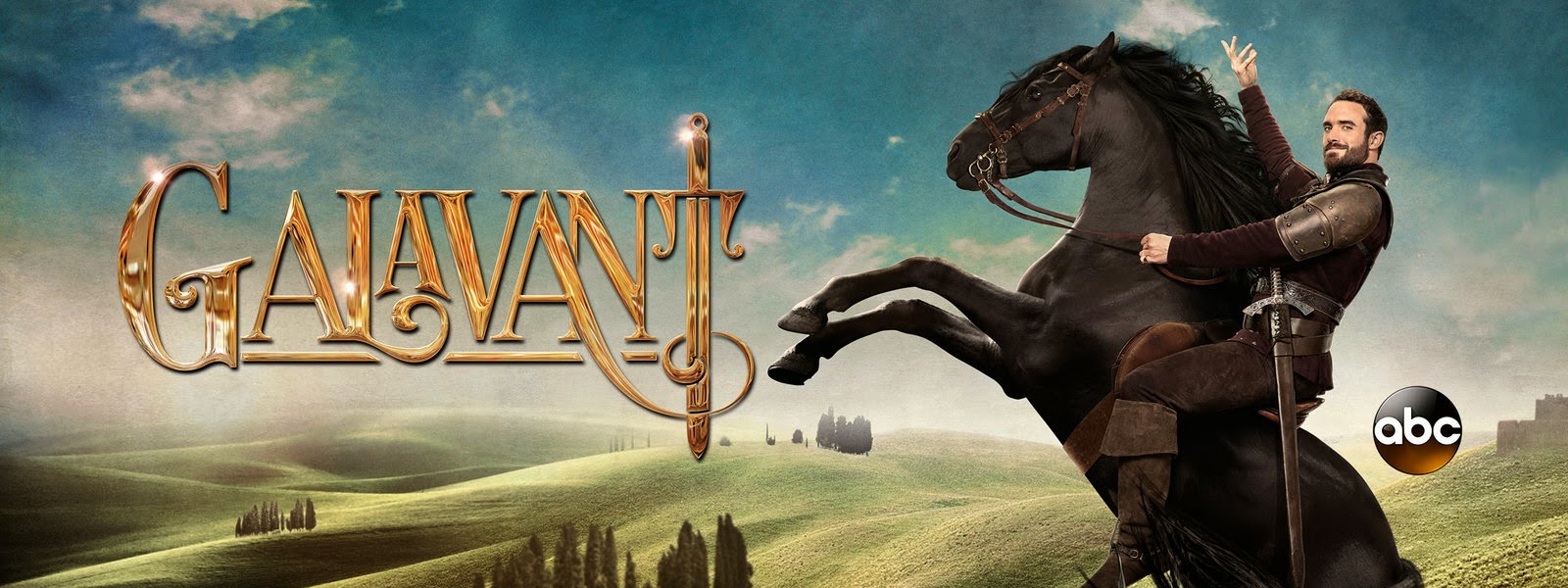
Galavant (Season 1) - Sundays @8 on
ABC
Agent Carter (episodes 1-3) - Tusedays @9 onABC
Man Seeking Woman (episodes 1-3) - Wednesdays @10:30 on
FXX
Schitt's Creek (episodes 1 & 3,4) - Tuesdays @9 on
CBC
Young Drunk Punk (episode 1) - Wednesdays @8:30 on
CityTV
---
I hadn't heard anything in advance about
Galavant, a 1/2 hour medieval musical comedy that ABC was seemingly trying to bury on Sunday nights in the January post-holiday haze. I caught wind of it only the Friday before the first episode aired on some website or another noting that
Weird Al,
Ricky Gervais and
Rutger Hauer were all set to guest star on a, well, "medieval musical comedy". This was most assuredly going to be a train wreck. I mean it's early evening network television, how could it not be? Plus, ABC was apparently trying to get rid of it quickly, running two episodes a night for four weeks. Burning it off quickly was certainly a sign of its quality, right?
I tuned in to
Galavant at 11PM for the Pacific time zone airing, as my wife had already ventured off to bed and I was reluctant (and a little embarrassed) to watch the show in front of her. It's a medieval musical comedy for the 8PM timeslot on ABC for Pete's sake. So imagine my surprise when I found myself rolling on the floor with utter glee for the better part of an hour.
Galavant defied even my slimmest expectations and for the following three weeks it became appointment television. When co-star
Timothy Omundson appeared on
The Soup with
Joel McHale between week one and two, he created a bit of an impression on my wife, and even she was on board with it.
The show ambitiously strives to be a little bit of everything, even when it conflicts with itself: it's raunchy and kid-friendly at the same time; it's a period piece, but not outside of making modern references; it's genre busting, yet also genre embracing; it's a funny musical, but the music is incredibly well-crafted, not dispensable. It's a rare show that achieves everything it sets out to do, without pandering. It's a show that toys with metatext, the characters often aware that they're in a production, but it doesn't break the wall too often that it knocks it down altogether. And the comedy doesn't solely extend from their self awareness. Both the plot and the characters are exceptionally playful, growing in ways that convention dictates, and in ways that wink at the convention, and then also in ways that are just out of left field. The fact is that it plays with three genres at once (being medieval fantasies, musicals, and comedies) and so it has three different ways to toy around and play with characters, story, and song without exhausting the possibilities.

It's the show's pilot that hooked me, before it even the first commercial break by breaking the knights-and-princesses story cliche. In the opening moments we meet Omundson, playing the giddily dainty King Richard, who has stolen legendary knight Galavant's true love Marlena, forcing her to marry him. Played by the handsome, toothy
Joshua Sasse, Galavant is dashing and charming, even when he falls prey to goofiness. Galavant bursts in on the wedding, keen to fight for his love, but Marlena (
Mallory Jansen playing a comedic iteration of Cersei from Game of Thrones) finds the wealth and power offered by Richard trumps true love and voluntarily elects to continue the wedding.
From there the plot fast forwards a number of months and thickens even more, with genuine intrigue that's funny, but no less exciting. Galavant is in a rut, heartbroken, out of shape, drunk and broke, when Princess Isabella (the pristine
Karen David) asks for his help in rescuing her parents and taking back her kingdom from King Richard. What he doesn't know is that Richard has sent her to fetch Galavant so that he may kill him, since he suspects Marlena's apathy towards him has something to do with her residual feelings for Galavant (turns out not so much, she just despises him).
With the first two episodes setting up the general thrust of the show, the middle four jockey between establishing the status quo at the castle (Richard's search for manliness with his loyal guard Gareth [a very game
Vinnie Jones], Marlena's infidelity and lust for power, some asides with the chef and jester) and the road trip taken by Princess Izzie, Galavant, and his squire Sid (
Luke Youngblood, pop pop!). The final two episodes bring the whole cast together for some really rich shenanigans that jump all over the place, potentially taking a lot of the characters out of character, but making for absolutely delightful entertainment. The penultimate episode features the show's most riotously funny musical number as Sasse and Omundson, who have spent the majority of the series apart, come together for a little ditty about regicide.
The songs (from omposer Alan Menken (The Little Mermaid, Aladdin, Beauty and the Beast) and lyricist Glenn Slater (Tangled)) of Galavant aren't particularly memorable, but they are exceptionally well executed, with the lyrics having to tow the line between genuine exposition and comedy, and faring quite well most of the time. The best songs feature the characters singing sweetly about murder or death, or in the case of the romantic duets, mutual disgust leading to begrudging affection. One of the smart moves the show makes with the songs is, unlike most musicals, these aren't big showy numbers. Generally the songs remain contained to few people singing it, only occasionally breaking out into something bigger. Beyond that, the songs act in the same way they normally do in musicals, as internal monologue, but what the show does is make them external, such that the other characters are kind of aware of what they are saying, though often not paying close attention. It makes for a hearty giggle every time someone reacts to something in the song they're otherwise not supposed to hear.
I fell maddeningly in love with
Galavant (the show, not the character). It's truly an outstanding addition to the medieval fantasy comedy genre, that may even stack up to The Princess Bride in its ability to go for it (it will be interesting to note how well the show ages). At eight episodes, it's really feature-film length but broken down episodically. The cast is tremendous throughout, with Omundson the obvious breakout player, and will no doubt be seen cropping up more prominently between seasons. The comedy doesn't aspire to be ground breaking, but entertaining, which it is, fully. Where there's a handfull of "your mama" jokes and a play on Jon Hamm's name in the second episode that one could roll their eyes at, the show makes it clear that they know they're very silly and that it doesn't care. It's game for anything.
Having bore witness to the majesty of
Galavant, I have to wonder if the programming execs aren't actually subtly brilliant. Burning through the show over four weeks with 1-hour blocks instead of eight 1/2 hour blocks perhaps serves the modern viewer a lot better, one more used to binge watching without waiting. Given that
Parks and Recreation is doing the same with its final season and that Agent Carter (which we'll get to in a moment) premiered with its first two episodes rather than just one, this may see a new trend on network TV. In any case, ABC would do wise to know that too much of a good thing can spoil the soup, so the second season shouldn't go beyond 10 episodes. Keeping the show at feature length will allow for quality songs, and tight storytelling that made the first season such a hit. If they try to go full-season, it will burn itself out quickly.
---
With
Agent Carter, I'm tempted to say "I love it" and just leave it at that. But I can't. I need to gush.
What a strange entity
Agent Carter is. Peggy Carter isn't exactly a prominent character in the Marvel Comics Universe, and I don't think there was any sort of fan clamor to see much more of Haley Atwell's character after the
Captain America: The First Avenger film (as that film was more about getting people excited for
Marvel's Avengers blockbuster). But someone over at camp Marvel saw something special in Atwell and her performance as Peggy, commissioning her for a short film that was packaged as a special feature on the
Iron Man 3 blu-ray. After the short was well received, and the initial success of
Agents of SHIELD, it was announced that Marvel was shopping around a Peggy Carter series. The short helped sell people on the idea better, but even still it was met with some apathy. Afterall, it's just Peggy Carter. It's not Captain America, it's not any recognizable Marvel superhero, it's just Captain America's old-timey girlfriend.
It's that expectation that this series continually plays upon. Peggy Carter, as a property and in the show, is completely underestimated by almost everyone around her. The pilot episode goes to great lengths (and they are quite great) to show the audience, at the very least, what makes Peggy so special. By mid-way through that first episode, I think everyone watching had bough in.
Agent Carter is amazing.
The crux of the show finds Peggy a low-level Agent at the SSR (Strategic Scientific Reserve), just one notch above receptionist essentially. The SSR primary focus at the moment is finding Howard Stark, after it's discovered he had been manufacturing all kinds of dangerous weaponry and that somehow it's wound up in the hands of the enemy, a secret organization named Leviathan. The SSR suspects that Stark sold the weapons, while Stark has secretly asked his old ally, Peggy, to help clear his name. The conflict is obvious. As Peggy gets deeper into understanding just Leviathan is, the more risk it poses not just to her physical well being, but to her status at the SSR and as an immigrant in America.
There's a lot of fuel for
Agent Carter to mine:
First there's Peggy's past, having lost the man she loved (and not just any man, but Captain Frigging America) and her wounds still stinging. She has a raw spot where Cap is concerned, and it's what allows Howard to manipulate her, while also keeping her from forging any bonds with anyone else.
Secondly, there's the time, set in the mid-1940s, post-war, women having had a taste of liberation during the war are being force back into the home as the men return to their jobs. Women have proven themselves capable but are still deemed inferior. The show manipulates this thread expertly, allowing Peggy to both stand in defiance of it, but also use it when its advantageous to her. Her ability to stand up for herself, to handle herself in a fight, it shows her strength, but her manipulation of the institutionalized sexism and exploitation of people's misguided expectations shows her intelligence as much as her ability to piece together clues and perform fieldwork. Atwell is an utter genius in this role. She able to sell Peggy's toughness at every turn, but she's also equally capable of selling her intelligence. Most times Atwell carries herself with such incredible confidence that its easy to believe she's the smartest person in the room (which she generally is). At the same time, Peggy isn't flawless, and Atwell knows how to leave those chinks in her armor. She's got her triggers that set her off or leave her blind, at the same time she's also not so smart as to be ahead of the story. She's capable of failure and the stress of the work she does, the impact it has, breaks through emotionally from time to time. How could anyone not be utterly infatuated with Atwell/Carter after watching this show?

Thirdly, the show exists in the Marvel Cinematic Universe (the "MCU") which allows it to connect with everything that has already gone on in both subtle and overt ways. Naturally it's connected to the first Captain America movie, but it's also connected with the Iron Man series, since the world of Howard Stark (Tony's dad) plays prominently in the show. It also pulls in elements from the comics that have yet to appear in the MCU, morphing them to the time period and giving them new life. For the nerds in the crowd, it gives them the easter egg hunts they look for in genre adaptations, but it doesn't derail the show. Unlike
Agents of SHIELD this series manages to organically tie to the MCU and the source comics in a way that benefits the show, rather than being thrust upon it.
Not to harp upon
Agents of SHIELD but where it faltered for so long was lack of purpose, lack of character clarity, lack of direction, and a general unease about its place in the world.
Agent Carter has none of that. It knows where it fits, but it also doesn't seem to be as concerned (at least not yet) about fitting it. From Peggy's first meeting with Howard in the pilot, it's absolutely clear what the show's mission statement is: find Howard's missing weapons, clear his name. That it's also got a compressed season order -- only eight episodes -- means it's not farting around with side stories and tertiary character building. It's story driven, almost cinematically, which most full-season shows can't sustain. Likewise, it has an energy and confidence that
Agents of SHIELD has strived for but never attained. Weird that
Agent Carter feels more like a Joss Whedon show (punchy dialogue, strong female protagonist) than the one he actually created.
I'm eager to see the series play out, but also just as keen to watch it again. I'm an unabashed fan of
The Flash and
Arrow on the CW, and I even am modestly enjoying
Agents of SHIELD, but those shows, despite my fandom, don't instill the craving to watch them over and over again.
Agent Carter I definitely want to go around again. I hope that subsequent seasons run about the same episode order. 8 episodes allows for a much tighter series, and a much more enjoyable way to experience a different era of the Marvel CU.
---
Man Seeking Woman isn't the first comedy series about the dating life of the awkward adult male but ... wait, now that I think about it, perhaps it is. Sure most comedies that feature single guys tend to have a heavy dating component with a revolving door of women, but those are mostly sitcoms where the situation is what the show is largely constructed around, not exploring dating and all the weird things (some) men go through emotionally and mentally throughout it.
Man Seeking Woman is a show that exclusively focuses on its lead character's dating life, much like any romantic comedy tends to do with its female protagonist. The difference here is the show's heavy use of metaphor-as-reality to process the inner anxieties of the lead. This may indeed be a dude's version of
Sex and the City, The Mindy Project or
The New Girl.
Jay Baruchel is perfectly cast as the average, somewhat awkward leading man. I was surprised to learn that the role wasn't written with him in mind, for this is Baruchel's bread and butter (not that he can't play against type...see
Goon for instance). I was likewise fascinated to learn that this wasn't a product of the Apatow gang, instead coming from Saturday Night Live writer
Simon Rich, based of his book of short stories, and produced by
Lorne Michaels. It's certainly a lot sharper and more daring than your typical SNL sketch (not that I don't have much affection for SNL). But all that known, the show certainly makes more sense. It does have the feel of a loosely sequential set of short stories or sketches.
The show's use of literal metaphors is what really makes it stand out. The series picks ups as Josh, recently dumped by his fiancee, is picking up the last of his things. He's an emotional wreck but putting on a brave face for his ex. He steps out of her front door and it immediately starts to rain. Pan wide and we see it's literally only raining on him. Then a bird drops dead from the tree above, bouncing off him. In the second vignette of the pilot, Josh is set up on a date with his sister, and she's a troll... literally a troll, but Josh, to his credit attempts to valiantly overlook this fact and engage with her, but he naturally finds it hard. In the third act, Josh is invited to his ex's engagement party only to learn that her ex's new beau is Hitler... a 125-year-old, wheelchair bound Hitler (played under gobs of makeup by Bill Hader). I genuinely love the way the show manifests emotional stress physically but doesn't just treat it as metaphor. Gorbachenka the troll is aware she's a troll and has no apologies for it, and the patrons of the restaurant are well aware she's a troll and don't seem to care. It seems to be only Josh's issue. In synergy, the same applies to Hitler, where Josh is the only one outraged by his ex's new boyfriend (is it really because he's Hitler or just because he's dating his ex?).
The second episode uses this device expertly as Josh, wanting to text the girl he met on the train, freezes at the challenge. His over-sexed best friend Mike (
Eric Andre) keeps suggesting he send a dick pic, while his sister starts off strong but then likewise comes up clunky. Smash cut to a war room where Josh takes in a series of suggestions from military advisers (fans of Battlestar Galactica will appreciate Michael Hogan's gruff one liners), the amount of time, angst and deliberation spent over what to say no doubt familiar to the average joe. The episode ends after a miserably failed date with a montage of Josh's sad return home and shots of all the romantic things he did to set up, all underscored by sad 4-piece chamber music. Josh steps into the kitchen where there's the 4-piece playing said underscore, and he tells them to pack up, that its not happening. The exchange that follows is an utter delight.

The show delightfully toys with reality and surreality, presenting it all as real, but for the most part not unnatural. In the third episode, Mike coaxes Josh into joining him on a club outing, but Josh knows all too well it's not his scene, so he finds distractions to prevent their outing. "First, let just pound these beers real quick then we'll go, 5 minutes...", Josh says, and there's a goofy montage of them aggressively downing the beers to krunk music (and a barely audible aside noting "this is a terrible way to drink beer"). Then, stepping up to the club, Josh says, "We need to eat something, fuel for dancing and flirting...let's just pound some mexican food. 5 minutes?" Cue montage in Josh's apartment with bags of groceries, a mexican cookbook, a mariachi band joining them, cooking up the burritos and serving an intricate meal. Next in line at the club, Josh stalls once again: "Wait, let's just pound a 10,000 piece jigsaw puzzle first." Cut to a montage of them finishing the puzzle in rapid order, mounting it, hanging it on the wall, taking a photo, adorning the cover of "Puzzle Aficionado" (it reads "Josh and Mike put it all together"). Finally entering the club, the last ones in, the bouncer lifts up the magazine in his hands, being the very same "Puzzle Aficionado" and exclaims "Oh shit, that was Mike and Josh!" It comments on the excuses that guys put on to not get out and put themselves out there, and then delivers the comedy via an utterly absurd trio of montages that can't really be reality, but manages to present it as the reality of the show with a brilliantly unexpected tag.
One of the immediate draws of the show was that it was shot in Toronto... I always enjoy scoping out the backgrounds, seeing familiar locations repurposed... it's like a side game to the actual show. It's not playing Toronto, because of course it's not, but it's also not playing really another setting either. If anything it's an as yet unnamed fictional metropolis, which is perfect given the heavy fantasy-tinged elements of the show.
It's certainly an apt comedy for the FX stable fitting well as a sort of cross between
Louis and
Wilfred in a way. It has a low-key, character-centric vibe to it that allows each vignette to move at its own pace. It's not aiming for laugh-a-minute, and generally there's at least a kernel of truth behind every aspect of ridiculousness. It's an immediate favourite.
---
Canadian television has a lot of great talent, but for the most part, that talent is wasted under low production values or scuttled off to America to actually do something worthwhile. There's the odd breakthrough here or there, an SCTV or Kids In The Hall, a show that will be able to transcend its limitations through sheer inventiveness, but for the most part Canadian television strives to play broadly without any real panache and lacking a lot of interest as a result. It's not just all about production values either, there's a general attitude to Canadian television, a slower pace, a decided lack of heightened reality that seem almost mandated to differentiate it from flashier materials south of the border. We're all about moderation up here.
Schitt's Creek, in its most jaded summary, is a Canadian version of
Arrested Development mashed with Green Acres, the premise of a rich family suddenly finding themselves on hard times and moving out to a rural community, in this case the aptly named "Schitt's Creek", a small town that
Eugene Levy's patriarch had purchased as a joke a decade earlier for his son (played by Levy's actual son,
Dan Levy).
When I first heard of the premise, this father-son cast, and it's groan inducing title, I wasn't very inclined to tune in. The elder Levy has seemingly taken any job since
American Pie, so he's not an outright indicator of quality, while the younger Levy was primarily a host on MTV Canada which isn't exactly a ringing endorsement for acting quality. I had to wonder if the younger wasn't utilizing the cache of the elder in order to get himself a prominent role on TV.
Then I saw a few posters at bus stops around Toronto, and noticed a very persuasive additional cast member in
Catherine O'Hara. While Levy can't exactly be counted upon for starring in the best quality vehicles, O'Hara is nothing short of a comedy goddess and is always worth watching. I was tentative still but I was definitely going to tune in.

The show is actually quite charming. It's got the expected Canadian pacing but it's built more for an American cable-style audience (unfortunately it tries to pass itself off as set in America, though). The addition of
Chris Elliott to the cast as the town's mayor was a genuine surprise (most definitely a pleasant one as well). The show wisely builds up its small town through its cast of supporting players, thus leaving the leads to their eccentricities (Eugene, surprisingly, the most straight-laced of the crew). There are beats to this sort of comedy construct that seem almost unavoidable, such as the inevitable relationships formed between members of the upscale family and the rednecky townies, but it will be how the show handles its central characters in these beats that it can really differentiate itself. So far it's not doing too badly. The characters aren't horrendous people which is a good start, and the townies also aren't *that* rednecky. I'm actually keen to watch this, so long as convention doesn't start to set in and O'Hara keeps doing what she does so well.
---
Young Drunk Punk is a Canadian show that makes no illusions about where it's set: Calgary, 1980. Unlike the classic
The Wonder Years, this show isn't trying for full-on earnestness. It's a period sitcom, like
That 70's Show (only more single camera, no studio audience, perhaps more akin to
The Goldbergs...I dunno, I haven't seen it), taking advantage of the culture of its setting, juxtaposing, these kids deep into punk music and the aesthetic against the suburbs of Calgary and its cowboy hat-clad denizens.
The show comes from Kids in the Hall alum
Bruce McCulloch (who co-stars as the father of the main character) and it does feature a lot of his usual touchstones, although a bit more gentle. Where his Kids in the Hall sketches that related to father-son dynamics were quite dark, here the father-son dynamic is a strained one where the two lack any real understanding of the other, it's not irreparably distant or in any way abusive. Likewise McCulloch's sketches from his mid-20s relating to his youth featured a radical sense of anarchy and misdirected aggression, here, again, it's softer revolting, in part to make the characters not jerks and to make their antics more cartoonishly amusing. This is not to say that the show is toothless, but rather that it's not trying to bite anything. It's focused on being amusing, not making any grand statements or pushing comedic boundaries. Of the Canadian sitcoms to crop up in recent years, this is the first one since
Corner Gas that feels like it has any real legs.
The series opens at a fascinating point, with the lead, Ian (
Tim Carlson), and his best friend Shinky (
Atticus Mitchell) attending their high-school graduation, usurping the valedictorian speech for a dose of their style of anarchy (which comes mainly in the form of trying to expose their peers to greatness of punk music). Where most coming-of-age comedies of this sort revolve around the awkwardness of high school for outsiders like Ian and Shinky, this show starts by showing they made it through, confident in who they are, but unsure of where to go from there. In 1980, graduating high-school still primarily meant going out and getting a job, rather than considering college or university, and Ian's dad forces him out into the job market by decreeing he pay rent. Ian's plans to go live with his sister are curtailed when she returns home after breaking up with her boyfriend (who Ian snidely nicknames "Cowboy", as he's nicknamed all her boyfriends). The second episode finds Ian and Shinky doing pick-up manual labor, winding up working for Cowboy at a ridiculously hazardous job site full of desperate men.
The cast is quite great. McCulloch as Lloyd is allowed to be both the authority and the oddball, playing into his strengths while also being very amusing.
Tracy Ryan as Helen, Ian's mom, is likewise given a choice role in being in charge, prim, but not your typical prude or humourless housewife (she works at Woolworths), and one has to wonder if she's oblivious or indifferent to what exactly it is her family is doing (so long as they're playing by her rules she seems okay). It's too bad that Ian's sister, Belinda is yet another vapid, oversexed dumb bunny, but
Allie MacDonald has nailed the role, and in Belinda's favour is that she's not yet a direct antagonist for Ian (they seem to have worked past that, although they're not in any way accepting of each other's lifestyle choices). Of course it's Carlson and Mitchell as Ian and Shinky that the show hinges and both are thoroughly up to the task. They live in the clothes like they were actually theirs and they are more than adept at delivering a well-timed one-liner as well as pulling out a physical performance. The opening sequence of the second episode finds Ian taking punches outside a bar while Shinky watches and eggs him on (a familiar skit from
Kids in the Hall) only for the reveal that they're trying out to be bouncers. Carlson can take his lumps very well.
It's a genuinely entertaining show, upholding American-style production values and single-camera comedy pacing, but not losing any sense of Canadian-ness either. I take some pleasure in recognizing that this would likely play just as well in the states as
That 70's Show played in Canada. It's quite accessible and fun. I don't know if it sustains for four or more seasons how strong its legs will be, but I have no doubt that a solidly amusing first season is in store.