Showing posts with label kidnapping. Show all posts

Thursday, August 8, 2024

Summer Chills: Abigail

2024, Matt Bettinelli-Olpin, Tyler Gillett (Ready or Not) -- download

We usually reserve horror-ish movies for the "31 Days of Halloween" but sometimes we are just in the mood for something Halloween-ish.

Two things. One, I am not all that bothered by spoilers any longer; after The Matrix was spoiled for me, I got over it. But Two, I really am annoyed by movies that set themselves up with a "you are not supposed to know _____" in the opening act, yet still base their entire marketing campaigns on telling your what _____ was. Like, are we still so stuck on particular formulas to screenplay writing that we have to write the "oooooo, you will never see this coming" but immediately toss it away as unnecessary? 

So, in case you are not me, and dislike being spoiled, skip reading the post now.

The little girl they kidnap is a vampire. I mean, its the fucking premise of the movie.

Again, that said, knowing didn't ruin anything to me, and waiting for the characters to get there was kind of fun. In fact, that they go quickly into the, "ok, so she's a fucking vampire, how do we deal with THAT?!?!?" is hilarious. That said, its not really a comedy, but a funny, action, horror-ish movie.

Six low-rent criminals follow the entourage of an obviously very rich little girl after her ballet practice,  back to her penthouse and kidnap her. They then drive her back to a mysterious mansion in the countryside. We have the thug Peter (Kevin Durand, Swamp Thing), the sleazebag wheelman Dean (Angus Cloud, Euphoria), punk hacker Sammy (Kathryn Newton, Freaky), sniper Rickles (William Catlett, Black Lightning), boss Frank (Dan Stevens, Legion) and all-around support Joey (Melissa Barrera, Scream). Yes, those are the names of the Rat Pack; low-rent criminals use aliases.

FYI the two names you don't recognize are Joey Bishop and Peter Lawford; if you knew who they were, your Rat Pack game is bigger than mine. Congrats.

Once inside the mansion they are instructed to bide their time while the fixer who arranged this job gets the ransom money. Joey, the pretty criminal, is tasked with being the only face the little girl, Abigail (Alisha Weir, Wicked Little Letters), will see and is meant to keep the girl calm & safe. In turn Abigail fucks with Joey, telling her father doesn't care about her, and apologizes as to what is going to come next. Frank is not thrilled about this ominous comment, and violently confronts Abigail, after which she reveals her father is the notorious crimelord Kristoff Lazaar. Apparently he is scary enough to make them all shit their pants.

Then sleazebag Dean gets his head ripped off, and they all assume it has to be the notorious enforcer who works for crimeboss Lazaar. Technically they are right. They confront Abigail only to find her mouth full of fangs. Also, they cannot get out of the house -- its all locked down.

The antics of survival are fun, amidst the chaos of dealing with a monster that looks like a 10 year old girl in a ballerina outfit. They believe they only have to survive until dawn, when the fixer will arrive with the ransom money. It takes them a long time to understand this was the plan all along -- there was no kidnapping plot -- they were kidnapped and are food and the basement pool full of decaying bodies says Abigail has been doing this a long long time.

It was a romp, which is pretty much what I said for the last movie we saw from the directors (Ready or Not), which was also a step outside the "31 Days of Halloween" tradition and was also a survival horror trapped inside a house. Weird parallels.

Wednesday, February 7, 2024

3 Short Paragraphs (Or Not): Gone Girl

2014, David Fincher (The Social Network) -- download

I think I remember now. Fincher films have structure, a clearly defined pace. Might have to watch a few more and expand on that. In this one, the structure is so clearly defined, and denoted by a subtitle -- "__ days gone". It helps us understand the compressed timeline of the movie as it progresses, and then stretches out. Its not something we notice in movies a lot, in that so much happens in such a short period of time.

Nick (Ben Affleck, Argo) and Amy Dunne (Rosamund Pike, Wrath of the Titans) are the perfect couple living in the midwest in a nice house in a nice town. The day begins with Nick visiting his twin sister (Mar)Go (Carrie Coons, The Leftovers) at the bar (The Bar) they own together. It may be Nick and Amy's 5th wedding anniversary but things seem off with Nick. He's drinking at 11am. He returns home to find his house in a disrupted state, furniture overturned, things broken, his wife nowhere to be found. He immediately involves the police.

As the search and the search drama goes on, we are interspliced with a story from the point of view of Amy, as she relates, via diary, how they met and eventually, how things started to go wrong. They were the perfect couple but only when in balance.

The beginning, where Nick is seen as the husband whose wife is missing and desperate to find her, where he is also the guy who smiles too much, who has every interaction dissected, who is the first suspect, who is a bit of an ass, who was cheating on Amy, is only the beginning of the story. Things shift, drastically. I hesitate to spoiler things but it has been almost a decade since the movie came out, so...

The next act of the movie is about Amy, who is not missing, who is not murdered, who has decided to punish Nick for no longer being the perfect husband. She will frame him for murder, a frame-job which she intricately builds over time, and then she will kill herself. But the "perfect" frame-job only works while she has money, and she is only a mastermind in her own mind, and once her plan comes undone, she adjusts, with homicidal intent. Fuck, she's psycho.

This was only a few years before Affleck was alleged to have had an affair with his nanny. But the movie might just be the template for Affleck being seen as the ultimate in entitled husband assholes. Sure, the movie might frame it so we think, "well, he's an asshole, but at least he's not a psycho," but it doesn't diminish the role he played in the events. Its complicated, as they say.

The structure of the story is fun, the way it plays with your sympathies. It makes you take sides, make conclusions but then smashes those conclusions on the floor. And the movie also frustrates you by just... ending. There is no conclusion, no resolution, just a situation where things end up. Amy is alive, she has what she wants, Nick is trapped but also chooses to be trapped. Fuck, she's psycho but then... what is he?

Kent's post. He thinks about it more than I do. But then again, he always does.

Sunday, February 28, 2021

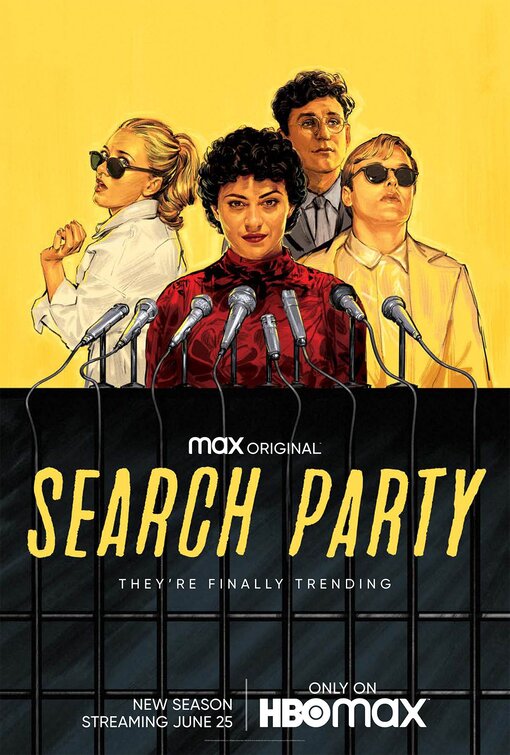
Search Party Seasons 1-4

 2016, 2018, 2020, 2021 - created by Sarah-Violet Bliss, Charles Rogers, Michael Showalter - HBO Max

There was a time in my online culture consumption that the AV Club was my go-to source for what was notable and worth my time.  By the time Search Party debuted it was in the AV Club's waning days.  Most of my favourite writers and critics had moved on and the site was starting to lose relevance.  Rather than being a daily visit, it went to sometimes, irregular visiting.  But the draw that kept me coming back was their episode-by-episode coverage of television shows.  They've been a very good resource (with a talented stable of writers, even with my favourites moving on) for unpacking what it is you just watched.

Search Party, in 2016 and 2018 was one of those notable shows that consistently was given high marks on a per episode basis and a was kind of buzzed about.  At the time though, Search Party was on TBS, a network that is not available from my cable provider (cable?).  It was pitched to me at the time as a mystery comedy and somewhere in my head I had conflated it to basically Scooby-doo or Encyclopedia Brown with inept, entitled millennials.  You know, something incredibly silly.  I wasn't actually reading the reviews because, I thought, if it's a mystery, I don't want any spoilers.  I knew that there were comedic people involved, like Arrested Development's Alia Shawcat, comedian John Early, and Wet Hot American Summer co-creator Michael Showalter was involved so it seemed worth noting for whenever it turned up in my country, whether on a Canadian channel or streaming service.

By 2019,  the AV Club was a ghost of its former self, and I rarely visited the site at all, except when something from their daily mail-out caught my attention.  They were less committed to covering television episode by episode and thus weren't very useful to me.  I didn't see what was going on with Search Party, or if the hype was there.  Every now and then I'd check my cable box (cable??) or streaming services to see if the show was available somewhere.  It just kind of sat in the back of my mind as one of those lost treasures waiting to be found, even though it seemed any hype had completely died on it.

About 2 weeks ago, my cable service (cable???) had a big highlighted tile promoting Search Party  on HBO.  A pang of excitement fluttered in my belly.  This was my "must watch next" show and I threw it on, not even warning my wife what it was we were about to start watching...because in reality, I had no idea what it was we were going to be watching.

I didn't know that there was a long 2 year hiatus between season 2 and 3, and that it had switched networks from TBS to HBO max, nor that the reason it was being promoted was that Season 4 had literally just been released.  A quick peek mid first season on the AV Club and it looked like they abandoned reviewing the show ep-by-ep early in Season 3 (the thing about the AV Club is their TV reviews only happen based on page hits, and just like TV shows, TV show reviews can get cancelled).  I was very confused about what was in store for me.

Minutes into the first episode, I realized I had no idea what was going on.  This for sure wasn't the goofy mystery comedy I had convinced myself it was.  Instead it was an uncomfortably dark comedy about aimless, self-involved millennials with a broodingly intense underbelly.   I wasn't necessarily enjoying it at first, but I was captivated and consuming it 4 or more episodes at a time.  


Season 1

Shawcat plays Dory Seif, a mid-20's NYU graduate lost in her life.  She's been dating Drew (John Reynolds) for a few years and they live together seemingly out of lack of desire to be elsewhere.  Drew is an incredible drip, a spineless dork who refuses to commit to a stance on anything and follows anyone's lead.  Dory kind of pushes him around because otherwise he wouldn't get anything done.  Dory works for Gail (Christine Taylor) a rich housewife, as her personal assistant, basically a paid friend to help her out with anything she needs.  It's a purposeless dead-end job that provides no fulfillment, and when she tries to find work elsewhere she is told pretty much flat out that she has no qualifications and is worthless. So when Dory finds a missing persons poster for Chantal Witherbottom (Clair McNulty), an acquaintance from college, she starts to fixate on the case.

Dory's fixation on Chantal quickly becomes all-consuming.  She starts to see clues, and becomes convinced she saw Chantal fleeing a Chinese restaurant. She pulls Drew and her other besties, Elliott (John Early) and Portia (Meredith Hagner), into her fixation.  They all have fleeting rememberances of Chantal but literally no connection to her.  As such they question why Dory is so committed to finding her.  Dory doesn't really have answers to that question, ever, except to say that Chantal seemed like a nice person, and that she wants to do something meaningful.  A reviewer (can't remember if it was the AV Club or not) noted that Dory and her friends' ability to pursue Chantal's case speaks to their entitlement, their ability to just go wherever, and say whatever - whether it's to infiltrate a Loving Hut-style cult operating out of a boutique arts and jewelry shop, or going to Chantal's family house for a hilariously inappropriate vigil - they have the luxury of doing so really without any questions or concerns.  

Each of Dory's cohorts has their own Millennial journey in Season 1.  Drew tries to find a spine while checking in on his downstairs neighbour, April (Phoebe Tyers), who may be in an abusive relationship.  April jumps down Drew's throat for even deigning to intervene, then later tries to repay him with agressive, angry innuendo and comeons. Elliott, is trying to launch a boutique bottled water project that promises to donate some portion of proceeds to getting water to children in Africa, except he builds the whole enterprise around his personality (a story about surviving cancer in high school primarily), only for it all to be based on a lie, exposed by Dory's journalist ex-boyfriend Julian (Brandon Michael Hall).  Despite being utterly ruined, Elliott boldly and proudly holds his head up high and lands a book deal to write about his boldly fake life.  Portia, meanwhile, is a professional actress, working on a police procedural where she's playing a young Latinx detective (Portia being an upperclass, blonde, very white woman),  only to be written out of the show because the show's lead is kind of jealous of her youth.

This leaves all three in prime position to follow Dory's lead in searching for Chantal.  To say that I'm skipping some nuances is an understatement, a lot happens in these 10 episodes, but it all culminates in a very intense and uncomfortable showdown in the season finale, and certainly doesn't play out as any of them had anticipated.  SPOILERS: it involves deceit, stalking, cheating, and murder.  Oh, and Canada.

But beyond the more sensational aspects of the show, it's really about looking at how disengaged millennials are, and how they've had to manufacture lives or truths for themselves.  Portia and Drew are both from upper class and seemingly have everything handed to them, but Drew is at once so overly concerned with consequences and yet completely dismissive of them when they arise, like he can just be a wounded, naive puppy and that makes everything ok.  Portia just thinks that because she is who she is that there shouldn't be any struggle, and so she refuses to struggle at all.  She just goes with whatever is happening, no fight really in her at all. Elliott basically has concocted his own reality where he gets to do what he wants, be who he wants, and disregard everyone around him except when it suits him.  His relationship with poor Marc (Jeffrey Self) is as toxic as anything, yet Marc can't help but embrace the abuse.  It's the kind of attention he wants and Drew is more than willing to give it to him. And Dory is just so lost, that she doesn't care about the impact her fixation is having on herself or the people around her, and she allows herself the option of getting lost in the narrative she's constructed, believing it to be the only truth despite what people around her tell her.  Her conviction only seems to suck them in.  It ultimately threatens to ruin them.

Season 2


Where season one was a darkly comedic mystery, even quasi-thriller at times, season two goes even darker, a bitingly bitter psychodrama that turns the whole show on its head.  

There's no escaping SPOILERS about where Search Party goes fromherein, so you've been warned.

At the end of Season 1, Dory was attacked and Drew clobbered Dory's attacker, killing him.  Elliott convinces them to dispose of the body rather than calling the cops and Portia refuses to be excluded, only to instantly regret getting involved.  Again, the show indites these millennials with their "good enough" attitude, thinking that they can somehow get away with this crime with the bare minimum of effort and a decided lack of tact or considerate thought.  But hey, they found Chantal and are hailed as heroes, despite building their whole heroic fable on a house of cards.

Julian, the guy who exposed Elliott last season, smells something off about this, and there's something rather potent about the hard working Black guy picking up on white people's bullshit that the show taps into.  Likewise, Detective Hartman, a Black female NY cop, is on the case of the missing dead guy, and it doesn't take long for her to recognize the perpetrators.  It's just proving it that eludes her.  Again, a hardworking Black person sees through the lies of the entitled, yet struggles to get out from under them, it's a potent metaphor.

But even with eluding direct capture through an ever expanding web of lies, all four of our protagonists are dealing with some intense post-traumatic stress.  Elliott starts developing physical symptoms including rashes and hair loss, and leans heavily on Marc, the poor sap, to hold him up.  Portia takes solace in her art, playing a Manson family murderer, and getting under the thrall of her director (Jay Duplass) in a very deliberate example of grooming.  Drew just wants to run away from his problems, a very Drew thing to do, which emboldens him set up a stack of domino lies to try and land a promotion that would take him to Asia.  And Dory, she tries to move on with her life, to confront her guilt, to hold the gang together, to keep the their secret buried under smoke and shadows.  And when she's threatened with exposure she goes even further.

Season two is so very, very dark, and intense, and uncomfortable.  The show never even tries to play on sympathies towards what Dory and friends have done.  If anything it wants you to understand what they're going through in their guilt but it also wants you to root for their inevitable capture, if only to alleviate the tension, which effectively builds and builds over the 10 episodes.  Dory, in particular, becomes challenging as our lead character to follow, as it's clear the walls are closing in on her to everyone except her.  It sets up the arc of the third season well.  It's gripping but heavy viewing and it weighed on my mind throughout the three or four days we were watching this season.  There's still some humour in it, and a few very big laughs along the way, but the darkness overwhelms the tone of the season.

Where the second season fails though, is in fulfilling its own promise of Julian and Detective Hartman.  Both are sent off in purposeful side stories that ultimately don't find their way back into the main thread.  Julian exposes Chantal's fake kidnapping in a very public article, but then is basically blacklisted for calling Chantal (who positioned herself as a victim of abuse) a liar.  Then he's sexually harassed by a woman running for senator who thinks that the boy who cried liar on a victim of abuse is ripe for the treatment.  The show makes it hard to figure out if this woman is trying to teach him a lesson, or if she is legitimately harassing him.  It's a thoughtful story but we've spent so little time with Julian as a POV character that it seems strangely pidgeon-holed at this stage of the series (and then only to not follow through much with Julian  Detective Harmon, meanwhile, is sent off on a wild goose chase with Dory's lies, and then falls into a situation much like Dory herself fell into.  It's meant to be ironic, and I think the show thinks it's clever (it is a little) but again, it fails the characters in favour of a punchline.  Detective Hartman is basically cast aside after this.

Season 3


Search Party
takes yet another pivot into full on farce in season 3.  It's an even wilder tonal shift than that between season 1 and 2.  Effectively Dory and Drew are arrested (Portia and Elliott manage to escape prosecution) and a very public trial happens.  Dory pivots even deeper into her darker self, convincing herself of her innocence and kind of reveling in the media attention.  Drew, on the other hand, is feeling at rock bottom with no where further to recede. 

Dory gets a pro-bono lawyer in the form of Cassidy Diamond (Shalita Grant) which is the result of Gail calling in a favour from a friend.  The only hitch is this is Cassidy's first ever trial.  Cassidy is the show's best-ever character, a modern take on Legally Blonde where everything about her screams "not a lawyer" and yet, she's completely awesome through and through.  This show needs to spin Cassidy off into her own show ASAP.  Grant is endlessly delightful in every scene.  Drew's dad, meanwhile, gets him a lawyer from a friend of a friend, who turns out to be Louis Anderson in prime form of a man well past his prime, and almost past caring about doing a good job.  In the courtroom, the trial is presided over by a judge who has a medical condition, and so he has to constantly be snacking.  The buffet of snacks on his bench grows and grows as the trial goes on.  

Prosecuting the trial is the feisty Polly Danziger (Michaela Watkins), who can't help but hate these millennial kids.  Her purpose of prosecuting Dory and Drew is just, but her attitude about it is all wrong.  She's placing the blame on a generation, and not the individuals, and so she's kind of the villain of the piece, even as Dory sinks deeper and deeper into unlikeable asshole territory.  The mugshot of Dory, decked out in her red and black patterned dress with her hair done up and a half smirk is kind of iconic, and Season 3 makes a case for putting Dory on the list of great villains like Hannibal or Freddy.  You WANT to see her punished.

Elliott, meanwhile, looks for a win and proposes to Marc with all the sincerity of a professional liar.  Marc doesn't care and their wedding promises to be epic.  It is, absolutely.  Portia meanwhile feels lost and finds Jesus, with all the conviction of Elliott and his marriage.  Chantal wants to have purpose and meaning and something to call her own and takes a paid interactive seminar for women in business, which seems like it takes off only to fail in spectacular Chantal fashion.  Julian gets confronted by the now-Senator who maybe harassed him, to no real satisfactory purpose.   These side stories feel like kind of meaningless asides compared to the big show trial that centerpieces the season.  While the season sor of collides at Elliott's wedding with the arrival of Dory's stalker, and then peaks again with the big trial finale, it ends with the friendships having ruptured and then reformed and ruptured again, like globules in a lava lamp.

The indictment of millennials persists in this season, and yet, like every season it also finds its sympathies for them.  The narrative here at times is Millennials are handed everything they could ever want, on a silver platter, and yet, what is given to them is never as good as it appears, and just as often as not sets them further back than ahead.  Just as the trial is a farcical indictment of a generation so too the show's critiques are held up as farce, as if acknowledging that what it has to say about them isn't necessarily the truth, just a grand exaggeration of the truth for comedic effect.

Season 4


Once more the show pivots.  Dory has been kidnapped, and nobody seems to notice.  We wanted to see Dory punished for two seasons now, and her kidnapper, Chip Wreck (Cole Escola) does quite a number on her.  He chains her up, shaves her head, forces her to renounce her friendships and claim him as her bestest friend ever.  He locks her up in a basement cell that is a plush recreation of her NY apartment.  It's like Saw if directed by Michel Gondry. 

Chip's confinement of Dory is part of his own priviledge... a rich, spoiled child with everything handed to him.  He's had an exceptional education but no need to apply it to anything.  He has exceptional talent (I mean his dolls are incredible and his plush recreations are absolutely amazing) but no need for his talent to be validated.  What he doesn't have is kinship, friends, and he's fixated on Dory being the one that actually understands him.  He feeds Dory only apples and chicken nuggets, he dehumanizes her while praising her, he's an even more disturbed version of Portia's grooming director from Season 2 and yet still less vile in some way.  Dory's attempts to escape are constantly thwarted, and her punishments severe, with Chip pulling out the final straw with some serious chemical brainwashing. 

The show is trying for us to find our sympathies for Dory again, and it's a credit to Shawcat's acting, some very brave moments of deep vulnerability that a completely broken Dory, after everything she's been through, finds her way back into our hearts.  She never wanted to be who she was, she never wanted the things that happened to her to happen, but at the same time, she refused to acknowledge her part in events for so long, she tried to bury it and pretend like there was a different truth to it all and it made her evil and villainous.  It's a warning, in some ways.  But finding truth in self, when we put on a deceptive face every day, is a real challenge.  When the world expects nothing out of Millennials and has for years only sought to judge them for how they don't stack up to previous generations, who are they?  What is their identity?

Drew has escaped to a fantasy land, which he thinks he finds joy in, but only finds minor solace in his escape.  Elliott is asked to sell out what remains of himself, and he does so gleefully, becoming a celebrity talking head on a right wing news channel, decrying his own gayness and pretty much anything he ever claimed to believe in.  Portia auditions to play herself in the docudrama on Dory's story, only to land the lead role.  But her perception of Dory and what the producer's perception of Dory is clash, and she just can't seem to get it.

Eventually the gang realize that Dory is missing, not just escaping them, but legitimately in trouble, and they can't convince anyone of the problem.  This second half of the season takes them on that inept Scooby-doo gang silliness that I originally thought the show would be.  Where the first half of the season is a Stephen King style thriller-drama, the second half of the season takes the shape of a full-blown comedy (with a little dramatic catharsis in the mix). There's a surprise guest star late in this season that just elevates the entire show into legendary status, and her performance is big, bold, cartoonishly delightful... and it brings to the show one of the top five most epic car chase sequences ever filmed (epic in its absurdity, truly).

Likewise, there's an episode that spotlights Chantal's journey following the events of Season 3 that shows that the show has completely mishandled its side stories in previous seasons.  Really stepping aside for a character for an entire episode, rather than trying to weave it throughout a season, is infinitely more satisfying and less frustrating.  It's less of a distraction and serves the character and the performer much better.  Plus Chantal, of all characters, is the most ridiculous figure, and continues to only get more and more ridiculous every time she's on screen.

The finale of season 4 provides a weird sense of closure to the series, but, along with the final moments of episode 9, episode 10 makes you question the reality of what you're seeing and have seen.  What is the truth for these characters.  If it were the series finale, it would be a rather fitting and beautiful sendoff to a very mixed and complicated series... but only a few weeks since its release, a season 5 has already been announced by HBO Max. The creators are teasing an actual finale, but stating "you never know".  How very Millennially non-committal of them.

Saturday, February 20, 2021

10 for 10 (+1): lively and animated

 [10 for 10... that's 10 movies (or tv shows) which we give ourselves 10 minutes apiece to write about.  Part of our problem is we don't often have the spare hour or two to give to writing a big long review for every movie (or TV show) we watch.  How about a 10-minute non-review full of half-remembered scattershot thoughts? Surely that's doable? ]

In this edition: some all-ages fare, some of which has been sitting on my "to review" list for a looong time:

Happy Feet Two (DVD) - 2011, d. George Miller (Mad Max)
Pinocchio (D+) - 1940, d. various
Maleficent: Mistress of Evil (D+) - 2019, d. Joachim Rønning (Pirates of the Caribbean 5)
The Sleepover (netflix) - 2020, d. Trish Sie
Enola Holmes (netflix) - 2020, d. Harry Bradbeer (Fleabag, Killing Eve)
Bumblebee (netflix) - 2019, d. Travis Night (Kubo and the Two Strings)
Ponyo (Blu-ray) - 2008, d. Hayao Miyazaki
Mulan ('95) (D+)- 1998, d. Tony Bancroft, Barry Cook
Soul (D+) - 2020, d. Pete Docter, Kemp Powers
The Great Mouse Detective (D+) - 1986, Ron Clements, Burny Mattinson, David Michener, John Musker
Bonus: Batman vs. Teenage Mutant Ninja Turtles (on demand) - 2018,  d. Jake Castorena 

And...go:

---


Have I seen Happy Feet? I have no recollection of such events.  Happy Feet Two came into my life years ago as a gift to my daughter from a family member who sung its praises.  I love this family member, but I know their standards for movies is...well...not the same as my own. 

It was YEARS later when I learned that the Happy Feet series was directed by George Miller, creator and sole proprietor of the Mad Max series of films.  I mean, what?  But, then, you have to remember that Miller also directed Babe: Pig In The City, so the man is clearly a genius.  Happy Feet must be something special, right?

...Right?...

Honestly, it's fine.  It's fine to watch, it has some cuteness to it, there's a global warming message, a few little chuckles, a couple of neat, wholly out-of-place moments, even a couple of cool visual moments, but it's still a middle-of-the road children's movie.  
 
Where the best Pixar or Disney film kind of roots down inside you and makes a home, Happy Feet Two is a sorta pleasant mild breeze that feels kinda nice for a few seconds then goes away.  It's something you barely notice, and you're certainly not stopping for it and hoping for more.

Good for the young ones.  Fine to watch with them.  Maybe something that reveals some layers (though unlikely) on repeat viewings.  Robin Williams doing yet another suspect accent.  Sigh.

Moving on.

[8:47]
---


I don't have any great love for Pinocchio.  In general most of the classic Disney movies left no impression on me as a child.  I was a superhero kid and these quaint fables and morality plays didn't really have a place in my brainspace.

I'm certain I saw Pinocchio when I was a child, but it wasn't something I ever went back to, so watching as an adult I was surprised, both by how weird it was, and also by how bored I was of it.  It's a story that, even with maybe only seeing it once or twice as a child, I was still pretty familiar with, and yet, the things I didn't know seemed so freaking out-there.  I should have been impressed, but Pinocchio the character is such a shitty little wooden boy I was annoyed along with my boredom.
 
Pinocchio as a movie feels like it takes forever to get going, and when it does, it's baffling.  There's a whole pedophilia subtext of kidnapping children to take them to "Pleasure Island" that is just...no thanks.

I know a film from 1940 can't be blamed for the impact it's had on popular culture.  Not that the impact is a bad thing, but the overarching fable and the parts of the story that have permeated the culture are far more resonant outside the film than within.  The good things from Disney's Pinocchio has actually outgrown the film they came from.
 
[20:21]
 
---
 

Another Maleficent film. 
Ok.
The first one wasn't the best, but I like Jolie in the role and hoped that the second one, maybe, could do something a little better?  I honestly don't remember... 
 
(breaktime for a quick wikipedia refresh)
 
Oh, right.
 
This second entry in the evil-Disney-witch-prequel genre goes a lot bigger the second time around, with more political machinations as the parents of the prince to which Aurora (Elle Fanning) has fallen in love with are just bad people who want to start a war with the more magical realm on their doorstep.

It has not stuck with me, but I remember being more impressed with this second entry, particularly in how big it tried to get, and actually going full bore into war.
 
Just as I thought I might be tempted to watch this film again, I recalled the lingering  problem from the first film.  It looks ugly, the costuming and makeup the exception.  And this gaudy CGI aesthetic drags the whole franchise down.  It's maybe not as bad as the first one, but for the sheer scale, which must have made this an expensive enterprise, it still looks pretty bad.

[30:57]

---


Speaking of films I can't remember, The Sleepover is a hot bit of absolute nothingness.  What is this film, I asked myself, as I could not recall anything beyond the title.  Once I looked it up and saw that Joe Mangianello, Malin Akerman, and Ken Marino were the adults in show, I had the vaguest of recollections.  It's about a sleepover where the kids hosting the sleepover find out their mom is a superspy and has been kidnapped.  They mount a rescue mission, because of course they do.

Was this film any good? It can't have been too good or too bad, because I can't really remember it at all.  It's another of these Nickelodeon-styled middling kid fare.  Not unwatchable by kids or their parents, but also nothing that's really going to get people too excited.

I just asked my 11-year-old what she thought about it.  She thought it was a funny adventure movie that she watched a second time on a weekend group Netflix watch.  She has indicated it is something she would watch again.

I guess when you're 11 and have only watched a few dozen movies, mediocrity like this still stands out.

[38:39]

---


It should come as no surprise that the director of Enola Holmes had also directed Fleabag, as this film employs the talk-directly-to-the-camera asides that Phoebe Waller-Bridge's sensational comedy did.  Not that it's an exclusive thing, but to do it well requires good direction. 

The Letterboxd audience seemed mixed on this idea, that it's somehow the lesser for even deigning to employ such a trope, that it's been overplayed or that it cheapens Fleabag.  But I thought the picture employed it very well, and Millie Bobbie Brown is exceptionally good at the knowing glances or emphatic asides.  Brown is obviously the lead of the film, and it's really a breakout role for her.  Eleven on Stranger Things is kind of a thankless role, one that doesn't give her nearly as much to do, or showcase much depth or range.  Here, she gets to be intelligent, impetuous, clever, charming, feisty, fragile, focused and funny, and Brown excels at them all.  (When people pitch her as a young Princess Leia, it was in this film that I finally saw it.  And agree.  I don't want young Princess Leia adventures, but if they're going to do it, Brown is the right choice.)
 
I won't say she carries the film on her own, as there are so many great supporting players, from Henry Cavill as Sherlock Holmes, Helena Bonham Carter as their mother, and Fiona Shaw as the headmistress of a finishing school the abandoned Enola is forced to go to.
 
Cavill's Holmes stands out particularly because he breaks from the tradition of making him cold, cunning, calculated, and a little heartless.  Cavill brings warmth to the role (not to mention some serious handsomeness) and the elder-sibling/younger-sibling rapport between him and Brown catches on quick.
 
The main drag of the movie is it's primary mystery however, which deals with some weird political lordship at the turn-of-the-20th-century.  It's not that it's ill handled, but it's not the most gripping adventure.  The far more interesting facet of the movie is Enola coming to terms with her mother abandoning her, and the family that doesn't seem to want her.  But she's a determined and capable young woman, as the film proves, which makes her a pretty stellar role model to watch with young women of any age.
 
I liked this tremendously and hope there are more in the series promply in the works.

[56:38]
---


Oh, Transformers.  A property I've given more than a fair chance to, but just never caught on for me.  I spent some time with it in the 80's and it wasn't my thing.  I watched quite a bit of Beast Wars in the 90's, for reasons I still don't fully understand.  I actually liked the first Bay film, and gave up on the franchise after the second (I would watch the third in part years later).  The toys were never really my thing.

And then there's Bumblebee.  Why should this one be any different.  Why should I care about this one any more than anything that came before it.  Why should this Transformers entry/ quasi-prequel inspire anything other that an eyeroll?

Because it's pretty damn good, that's why.

It opens with a big sequence on the Transformers planet where there's some kind of conflict between the two factions of 'formers.  What makes someone an Autobot or Decepticon is not something explored in this or any of the other stories I have seen, it's just accepted that there's a good side and bad side.  Likewise, how do these robot-people come into existence?  That's just another conceit you have to give into with these things.  These stories do take time to explain why they transform into other things though, so there's that.  But anyway, this film opens with a big, expensive, and, most notably, CLEAN-looking sequence of Transformers in conflict on an alien terrain, and even though I don't have any nostalgia for the property, it's pretty damn awesome.

Then we get to Earth, which reminds me of so many of the sci-fi movies and TV shows I grew up with that promised big things only to put those big things on screen briefly and then trudge around mundane terrain of planet Earth. 

But this film is set in the 80's, which kind of puts it on-point when it follows this kind of storytelling trope.  Though I have no nostalgia for the property (I keep saying) this film is laden with nostagia for the 80's through and through, which makes it transformative in its own right.

It winds up being a-girl-and-her-robot tale, the kind we've seen a thousand times, (except it's usually a-boy-and-his-whatever) only this really understands all of the usual paces of such a story and it stays truthful, yet updates it to something that's still pleasing as a modern audience.  I love Iron Giant, and this is basically that, but live action, and with Transformers, and I kind of...maybe not love...but like it a damn lot.  And Hailee Steinfeld is great, just great.  She's proves herself capable of being a leading actor.

[1:10:41]

---


 I have been neglecting Studio Ghibli films for too long.  I seem to watch one or two and then none for years on end.  I keep meaning to just sit and binge them, but I just never get there.  Ponyo, though, is a good reminder of why I want to invest in the Ghibli films, more specifically the works of Miyazaki.  They're weird but they're great.

Here we have the story of a guy who lives undersea, who mated with some form of sea god, and has a school of fish children.  One of these little fishlings gets lost from his undersea cruiser (the design of which is just a beautifully clunky animated marvel) and gets trapped in a jar. She washes ashore where she's rescued by Sōsuke, a five year old who's having a hard time with his dad being away a lot.   

The most unreal friendship is forged between this girl-faced-fish and this playful boy, but in trying to keep Ponyo both secret and safe Sōsuke winds up in misadventure, including a pretty terrific looking tsunami.

It's a bizarre movie through and through, but it knows it and embraces it, finding emotional connections in many places along the way.  That's kind of Miyazaki's thing.

It's a pretty majestic movie and reminds me I need to get back on that Ghibli wagon.

[1:18:43]

---


Just like the 40's and 50's classics, I'm also not well versed in the 90's classics of Disney.  Look, I was a teenage boy when the Disney renaissance hit, and, well, let's just say none of these films were targeted at me.

I haven't had a tremendous desire to catch up on them either.  But I'm slowly picking them off when I have an inclination to.  Like, Tarzan was just a "lets see what Disney did with the property" whim a little while ago, and both Aladdin and Mulan were about seeing the "original" (Disney adaptation) before seeing the live action version.

I recall nominally liking Mulan but also being frustrated with it, in large part to how passive Mulan feels in the film.  At this stage, the film hasn't stuck much with me, save for a weird feeling of appropriation, that the wrong people were telling the story.  And that some actors, who were not Chinese, were voicing Chinese characters because Asian representation in 90's cinema was poor, and I'm sure casting were pretty narrow minded in their selections.

Eddie Murphy as Mushu the dragon wasn't nearly as annoying as I was anticipating, certainly much less a nuisance than he was as Donkey in Shreck, or other comic relief sidekicks (of the Robin Williams sort, see Happy Feet Two or Aladdin), but still, Eddie Murphy for a Chinese dragon named Mushu?

I still have yet to find that Disney renaissance movie that really resonates with me.

 [1:31:02]

---


I should probably write more about Soul ...and THINK more about Soul than I ultimately will in 10 minutes here.  But I really, really loved the film.

I acknowledge the criticisms of the movie (this New Yorker article lays them out pretty well), that we have a film that implies representing the Black experience, but upends it with a body switch comedy that undermines said experience.  And looking at the film through the lens of larger cultural representation in film, specifically family-centered animation, there's a shocking lack of Black voices and black stories available, and none certainly made on the scale of Soul.  In that regard, Soul is disappointing in its failure to go further, deeper, and more specific. You can almost feel the "correction" to make the film broader culturally, so that it was less specific to one type of culture.  It's an old mentality when it come to filmmaking, making a story for as broad an audience as possible, that the more specific you get, the more alienating it is.  I don't think that's correct thinking, but it's the way it's been for a long time.

Would Soul have been a much different film had it gone more culturally specific.  Or even something simpler like what if 23 was voiced by Lupita N'yongo instead?  The powers that be could have made these rather simple choices, and it is truly sad they didn't think to do so, and ostensibly they wouldn't have changed the film all that dramatically but the film could have meant much more with that kind of thought behind it.

Yet, that criticism fully understood, and even agreed with, I still loved Soul, the experience it takes us through, the before-life where souls aren't yet defined.  I love an imaginative reality, much like the one in Inside Out or even Monster's Inc. where it takes a non-coporeal concept and creates an imaginative society out of it.  There's also a philosophical component, about what makes us who we are, and what defines us as people.  What is it that we should carry with us to the afterlife?  It's ponderous without belaboring any specific point.

 The tonal score from Trent Reznor and Atticus Ross crossed with the jazzier score and music from Jon Baptiste is phenomenal. There's two realities in Soul both represented by difference in sound as well as visuals.  

I can watch Soul and see its flaws, but also appreciate its craft.  But I was experiencing the film in my own head as I watched it the first time, I'm curious with the viewpoint of others now resonating in my head if I approach it differently the second or third time around and if I'll like it as much?

[1:54:11]

---


Just before the Disney Renaissance there was The Great Mouse Detective, a quick and dirty Disney animated feature that kind of finds the middle ground between the golden age of Disney animation and the 90's era. 

The world of The Great Mouse Detective is one within a world, a sub-culture of mice and rats that live a very human-like existence, where they have all these things in miniature that are akin to our "normal-sized" reality, and then there's the maximized setting of our reality that are just gigantic objects to the rodents of the picture.

Visually, TGMD does not lack for cleverness, but the story is dull.  It's trying to play off of Sherlock Holmes (to be clear, there is a Sherlock Holmes in this reality, but "Basil of Baker Street" is his mouse analog, living in the trenches underneath Holmes' Baker Street residence) but it has no time for really crafting any sort of mystery, and the options for Basil to prove his intellect and keen sense of deduction are sorely limited.

Had this film played through an actual mystery, I think it would have resonated much more, but it's barely a morsel of a movie as is, certainly not a meal, and with no real meat nor potatoes to go along with it.

[2:01:44]

---

BONUS!


I've watched many, but not even close to all, of the direct-to-video DC animated features made in the past 15 years.  To be honest, the fact that they've almost exclusively been adaptations of comic book stories with only a few originals scattered in the midst has made them less interesting and less alluring to me.  I tend to only catch them by happenstance, usually on television or promoted on demand, and even then I feel a little reluctant to watch them, knowing that they're rarely satisfying.

The viewing of Batman vs Teenage Mutant Ninja Turtles was a little more calculated, in that I noticed it was airing on TV and I recorded it, hoping to watch it with my daughter knowing she was both a fan of the many different Batman cartoons and also a lapsed Ninja Turtle fan.

Alas, she seemed disinterested and so my eventual viewing of the recording was one where I was distracted playing a game on my phone through most of it.  What surprised me in taking it in this way was how much fun I had while barely viewing the animation at all.  Though based on a comic book that crossed the two properties over, the voice cast and the script bring it all to life pretty nicely.  

And then I cottoned onto late the fact that they were animating Batman in a classic Jim Aparo style and I started lamenting my distraction.  I was rapt through the last third of the picture as it, in a very gonzo nature, guided the Turtles through Batman's rogues gallery, suddenly mutated thanks to a modified mutagen.  There was some very sharply comedic moments in the picture, which is surprising as these DC Animated pictures are typically such staid fare.  There's a particularly great moment involving Poison Ivy that could have felt at home in the Harley Quinn series.

I caught only a glimpse of Batman fighting Shredder in the opening of the film, but the final fight was actually quite spectacularly orchestrated and executed.  It's not "big screen" animated quality, but for what it's trying to do, it's really nice looking.  It blends the animated worlds of Batman and Ninja Turtles exceptionally well without stepping on any of the animation that came before it, but also kind of giving a nod and a wink their way.

[2:13:28]

Sunday, December 29, 2019

You Were Never Really Here

Twenty-for-Seven #9 (Day 4)
2017, d. Lynne Ramsay - AmazonPrime

I've been putting off watching this as I had heard this was difficult and ultraviolent.  I think my brain concocts far worse imagery with such a suggestion than with what actually appears on film.  But then I'm pretty desensitized to violence at this point.  You Were Never Really Here is quite violent to be sure, as our protagonist's preferred weapon is a ball peen hammer and his deep seeded rage.

Jaoquin Phoenix stars as Joe, who spends his time caring for his mother, contemplating suicide and finding missing children.  Though it's never explicitly stated it's inferred through background images that Joe has both history in the military and FBI, and that his mental health is likely what sidelined him.  Flashbacks reveal he was abused as a child by his father (who also used a ball peen hammer), and now he takes care of his elderly mother in the same home he grew up in.  He also clearly has a mission to save abused children, but through black market/under-the-table means, and uses this path to get out his anger.

The title is the only real reference to how Joe operates, despite the trail of destruction he leaves he seems to disappear from any real consequences, until his latest mission, rescuing a senator's aide's daughter from a child sex ring, which has connections much higher than anyone suspected.  The blowback on Joe and his very small circle of family and acquaintances, is brutal.

While film is crisp, brisk and action heavy (but in a very minimal way) it's also very subtle in its portrayal of Joe and Ramsay has a very deliberate hand in how and when she reveals information about him.  Are some acts that would appear suicidal just comforting to him?  It's hard to know what is what with Joe.

Phoenix is always an actor who invests in the roles he performs, and here he's living the part of a grizzled, traumatized veteran who knows his purpose but still has to fight himself to carry on.  It's wholly believable, and a little upsetting.  He seems relatively nice but you can tell there's something very dark living underneath.

Johnny Greenwood provides an ominous soundtrack to the picture which reinforces it's art-house action movie vibe, certainly elevating it as well.  After watching uber-stylized ultra-violence with two John Wick movies back-to-back, it's surprising to see something much simpler in composition be just as effective, if not even more impactful.

Tuesday, April 25, 2017

3+1 Short Paragraphs: Split

2016, M Night Shyamalan (Unbreakable) -- download

If you know me, you could understand why I did a little happy dance on the sofa at the end of this movie. I am so glad I wasn't spoiled, as it was not a traditional Shyamalan twist ending but a nice movie footnote. Not necessary, but nice. The (Shyamalan)man is doing his best to divulge himself of his one-note reputation for movies with surprise endings, after interest in the idea waned. His last two, including this one, are not about that, but I am glad he is not entirely dispensing with his style, which I completely love. We are still pretending that The Last Airbender didn't happen. And I always forget that After Earth was his. So, last four?

Also, this movie definitely had a look about it; I applaud him on using Michael Gioulakis, cinematographer for It Follows. For a movie that takes place mostly in a basement, it just looked good. It had a  wonderful use of the textures, and composition, and the set dressing was impeccable. I always say to film fan friends that I like the classic cinematic ways that Shyamalan choses to shoot a scene, something that harkens back to older days of massive screens where a shot filled every corner. There is one particular shot that brought a smile to my face, a simple one, just of panning from the psychiatrist's book filled room, back to her PC into which an email has just flowed.

Split is about a man with many personalities who kidnaps a trio of girls. He has a nefarious plan for them. Of course he does. In a completely compelling juggling of different roles, James McAvoy switches from one personality to the other as the girls do their best to escape from their captor. All the while one of the personalities is emailing their psychiatrist, needing to confess to the evil being committed and the agenda ahead of them. Patricia & Dennis, as a pair of colluding personalities, have a plan to draw out The Beast, a final personality, a final transformation of both mind and body. And that is what the movie is about, about whether perception is truly reality. If these two truly, utterly believe that their ritual (requiring the young ladies) can transform them into The Beast, then so it shall be.

There is also an underlying plot about victimhood, what makes a victim and what victims do for self-empowerment. One of the kidnapped, play by the again lovely Anna Taylor-Joy, does not join the others in their desires to violently react to their captor. She seems almost... passive. But in flashbacks and intelligent reactions, we see the two have a connection, a shared history of abuse that alters the power dynamic between the two. Its a wonderful little interplay that bookends the violence of the movie.

P.S. Look closely at the movie poster, if you want a hint as to what the footnote is at the end of the movie.

Friday, July 15, 2016

Tenuous Ties: 22 Jump Street / Hail Caesar!

Welcome to "Tenuous Ties", where we take two completely disparate movies, and write about them together because of some small thread connecting the two.  We're just trying to stay awake here.

22 Jump Street -- 2015, d. Phil Lord and Chris Miller -- TMN On Demand
Hail Caeser -- 2016, d. Joel and Ethan Coen -- VOD


21 Jump Street was a film that, on paper, shouldn't have worked.  Two somewhat marginalized actors, often dismissed as dumb or one note, starring in a comedy reboot of a (ridiculously silly, in hindsight) 1980's undercover cop drama set in high school?  It had "nice try" written all over it.

The curious thing is, though, it did work, thanks in large part to directors Phil Lord and Chris Miller.  The duo wasn't very widely known at the time, but they had a small and loyal cult following from their delightfully absurd, and endlessly quotable high school-set animated comedy about clones of famous world leaders (eg. Ghandi, JFK, Cleopatra) in their teenage years in the modern day.  Clone High was a perfect set-up for 21 Jump Street, since it spoofed a lot of the tropes of teen dramas (and over an all-too-short single season, many other television cliches as well).  Lord and Miller's stock-in-trade is playing off the humour of cliches, of the expected.  They expect an audience to be savvy enough to know where a typical plots twists or where the usual melodrama manifests, and then exploit that knowledge by either playing into the twist or melodrama to surreal levels, or by veering drastically away from it.

The posters for this movie are kind of
terrible though.  The fake posters for the
fake sequels are much better.
In 22 Jump Street they continue to do both those things, but here they also do a lot of metatextual references to sequels and sequel production, but keeping it in-scene or in story, sometimes confounding logic for the sake of the joke.  This gag is wound up to the nth degree during the end credits where the cast and crew present a few dozen possible sequels (with one of the better gags being the replacement of Jonah Hill with Seth Rogen due to contract disputes).

If the story of 21 Jump Street was about the nerd and the jock finding common ground and a dependency on one another as a team, the story of 22 Jump Street pushes that dependency into the analogy of uncomfortable clinging in an unhealthy romantic relationship. Channing Tatum's Jenko and Hill's Schmidt are put back in undercover in a college to uncover the source of a new and dangerous drug that led to a girl's death on campus.  Along the way, Jenko gets recruited by the football team, reverting back to his jock mentality, while a rejected Schmidt retreats into the school's art scene.  There's no "gay panic" here, as would've probably played out in a 1980's interpretation of this kind of story, but there's a fantastic therapy session (with John Hodgman as the therapist) which tackle's the troubled relationship spin head on.

22 Jump Street is a warped delight.  Everyone seems game, in roles large and small.  Some gags Tatum absolutely goes for.  I completely underrated him as an actor for years when he emerged as the hunky new romantic leading man, but in the past four or so years, he proved he has dramatic, comedic, action and romantic chops.  Hill likewise has shed his foul-mouthed, abrasive Cartman-in-real-life image after a strong series of dramatic performances, and so he can be a bit softer, more likeable in a comedic role without being caustic.

The two, in fact, are able to balance both the dramatic and the comedic well enough that the Coen Brothers (no slouches in meting out comedy and drama in equal measure themselves) tapped them for their latest farce, Hail Caesar!  Hill and Tatum are not brought in as a comedy duo, but as players in the Coen's usual sprawling ensemble.

Hail Caesar! follows Josh Brolin's Eddie Mannix, a studio "fixer" in the 1950's who keeps the stars in line.  His studio is undergoing their most expensive and expansive endeavour, a sprawling historical/religious epic, but its star, Baird Whitlock (George Clooney) has been kidnapped by Communists days before the film's conclusion.  Mannix must juggle this crisis with an unexpected pregnancy from Scarlett Johansson's Ethel Merman-esque synchronized swim-film star DeeAnna Moran, and a studio mandate to change the image of its crooning cowboy Hobie Doyle (Alden Ehrenreich) into an all-around leading man, much to the chagrin of the studio's main artiste director Laurence Laurentz (Ralph Feinnes).  Meanwhile, Mannix is entertaining an offer from Lockheed as an executive sales manager, but every incentive they offer seems less enticing.  He thrives under the pressure and believes in what he does.

The film sprawls around the studio, LA nightlife, film premiers and the oceanside home where the Communists are holding Baird.  There are many supporting players: the aforementioned Hill is featured as fall guy (the studio pays him to take the fall for a celebrity) as well as a certified accountant and all around professional; Tatum plays the studio's Fred Estaire-esque song and dance star (with a great cameo from Christopher Lambert as the director of his latest dancing sailor picture); Frances McDormand as the studio's tough-as-nails film editor; Tilda Swinton has dual roles as twin sisters writing gossip columns for competing papers; Dolph Lundgren as a Russian submarine captain; not to forget the gaggle of familiar faces as the group of communist screenwriters who've kidnapped Baird, and the counsel of religious elders the studio's called in to review the screenplay for their epic to ensure it's not going to offend anyone.

As much as the Coens may have had an actual story in mind for this, the real purpose seems to be giving the writer/directors the opportunity to shoot in earnest a synchronized swimming sequence, a singing cowboy by the moon, a song and dance number with sailors, and a huge 50's style epic that looks both fake and awe-inspiring equally all through the semi-ironic filter of looking at it all from the outside (the sequences are as real as anything from the era, but as viewers we're looking at them from Mannix's perspective, from "behind the scenes", which makes them humorously charming in their retro-ness, "oh the things that used to entertain us...").

There's a lot of star power here, but it's actually Ehrenreich that completely steals the picture.  He adopts the cocked smile and doe-eyed charm of Gene Autrey, with a thick southwestern twang that supposes naivety and dimness, but his simplistic speech betrays a rather smart and observant individual who basically saves the day for Mannix unexpectedly.  Given what's coming next, this is obviously his breakout role.  He manages that accent for both comedy, charm and sweetness, he sings, has a tough-yet-romantic charisma to appease the guys and the ladies (and vice versa), and even performs a number of stellar lassoing tricks that look effortless on his part.  It's is all part of an incredibly impressive, and noticeable performance.  After watching this movie, I honestly can see him as Han Solo.

And back to that tenuous tie (bet you thought it was Hill/Tatum, but no!), with Lord and Miller on board to direct the solo Han Solo Star Wars film and Ehrenreich in the title role (not to mention a script from Laurence Kasdan with some brush up from Lord and Miller) I've turned the corner from being completely against a solo Han Solo movie to being about 99% on board.  I'm always going to have some hesitation but I think they've absolutely cast the right actor and have found the exact right directors to make a funny, exciting, charming, romantic, swaggering, loveable nerf-herder of a movie.

And Ehrenreich has a distinctive mole under his lower lip, which, while not a scar on his chin, creates a defining characteristic that Han should have.  Just sayin', I think it works.