Showing posts with label nerd. Show all posts

Tuesday, December 12, 2023

T&K's XMas (2023) Advent Calendar: Day 12 - Round and Round

d. Stacey N. Harding 

T&K Go Loopty Loo - Hanukkah Edition - Oh, we love a time loop. It's clear that we're not the only one. Round and Round is, no word of a lie, the best Hallmarkie I've ever seen. It's also a pretty great time loop movie. It's evident that the writer of this holiday romcom (Tamar Laddy) knows time loops well, and isn't just trying to ape other time loop movies. The script actually brings something new to the genre, both in lore and self awareness.  There were some definite surprises, so if you're interested in watching this (and it's worth watching) spoilers below.


How did the Loop Begin?
Rachel is awoken with a phone call from Mom, having slept in with too much editing to do (a Hanukkah gift from her boss at the publishing house).  She's tasked with picking up the special sufganiyot (a jam filled donuts) from a specific bakery for her parents anniversary celebration on the 7th day of Hanukkah. Her dick professor boyfriend, Adam, calls with an "airport cold" and cancels on the meeting-the-family gathering. It's the last Hanukkah in her family home before her parents sell it which is stirring up emotions. 

It's disaster at the train station when a stranger bumps into her, and sufganiyot goes flying everywhere.  The dude is in too big a rush to do much other than apologize. He drops his ornate box which Rachel picks up.  At home, there's a light with a flicker that bugs Dad. Sister Soshana, wife Bex and nephew are there  and uncles and cousins (including the snobby and posh moved-to-Britain-four-years-ago one) and Gramma Rosie all arrive.  

Gramma Rosie wants to set Rachel up with Zach, an artist and art teacher, who drove her to the party, and he turns out to be the guy she ran into at the station. Rachel is not impressed.  She returns his fancy box, it turns out he's a big D&D nerd (it's got special D20s in it from his Zayda). Crappy BF Adam butt dials her. Gramma Rosie gifts Rachel a beautiful antique dreidel that's been in the family for generations.  

The cousins play competitive dreidel, but when Rachel spins her heirloom one, some magic starts to happen, but is interrupted when the curtains catch fire from faulty stringlights. The fire department comes, and once all is said and done, the damage isn't substantial but enough Rachel's parents have to postpone closing the house. But the party is over and everyone is off to bed.

Rachel wakes up the next morning to a phone call from her mom, telling her to pick up sufganyot for the party... let the loop begin.

It was the antique, family heirloom dreidel.

What was the main character's first reaction to the Loop?
Rachel at first thinks she just woke up from a dream and is having deja vu. When she gets to the bakery, she's chatted up by the same woman from the first day and asks if they've met before (she says "people sometimes mistake me for Barbara Streisand"). When she gets to the train station and runs into the busker playing the same song as the day before, she asks if he knows any other songs ("sorry, no requests") and then she's bumped into again by Adam (sufganiyot goes flying), and she knows what's up. She tells Shoshanna who writes it off, and then tries to prove her time looping to her sister-in-law Bex who makes a Nicholas Cage in Next reference (!), and then... Montage. (I thought about 3-6 time loops went by but it was just the better part of one day). Late in the day, Rachel assumes that because Zach is a nerd, that she can confide in him about the loop. She's right.

WHY did the main character get put into the Loop? Can someone else be brought into the Loop?
So, it turns out that the dreidel is not just a family heirloom, but also something every member of the family line (Gramma Rosie, her dad, even Soshana) gets a turn at going through a time loop.  But before she learns any of this (which is only once she's out of the loop), she tries to bring Soshana and Bex in but they're seemingly too pre-occupied, but Liam quickly gets it. He tries to put his number in Rachel's phone and says for her to call him if she loops again, but she points out the obvious that if the day resets so does her phone (but neglects to even try to remember his number).

The next loop, she's waiting for Zach at the train station, and, despite precautions, the sufganiyot still gets spilled, but Rachel has learned in the previous loop they key things to get Zach on board...and he's on board quickly.  On the way to picking up Gramma Rosie together, Rachel's filling in Zach on all the things she's tried to change but keep happening anyway (the donuts, the fire) and Zach tells her that "in those time-loop movies, the main character always has a big change to make in their lives"

How long is this time Loop? What resets it? Can you force the reset?
Rachel is in the loop from wake-up to bedtime.  They make it past midnight in one loop so it's definitely not a calendar day, but going to bed resets it.  I can only think that if this weren't constricted to the sub-90-minute Hallmark format that we would see a bit more of them pushing these limits.

How long does the main character stay in the Loop? Does it have any affect on them, their personality, their outlook?
This is concrete, it's 7 nights. It seems like it should be more, but I get the thematic significance of it being 7 nights, and it really makes it quite special, tying it all in with the festivities.
Over the 7 days Rachel gets more confident, more proactive, and ready to do more in her life. 

What about the other people in the Loop? Are they aware? Can they become aware?  Does anything happen if they become aware?
Each time Rachel approaches Zach in a loop, he becomes totally into trying to figure out why Rachel is in a time loop, digging through treasures of her past, coming across her manuscript, and taking her to a local comic book store to see if they can help.  The comic shop nerds don't seem to even bat an eye, they are in! Seth, the comic store manager, goes directly to the "time loop" section of the store and gives Rachel her "homework" (I'm not going to say it's the production so much as the actor really doesn't know how comic shops work when he's selecting his comics).  Rachel protests, but then she's reminded that in Groundhog Day Bill Murray spent potentially more than 12,000 days in the loop, they're going to have to get to work.  They brainstorm, and logic that maybe the antique dreidel was the "inciting incident".  So Rachel, Zach and Seth head back to Rachel's folks to retrieve the dreidel.  They spin it, but nothing immediately happens. She gets butt dialed by dick BF, Zach and Seth suss out what bar he's at.  Zach wonders if dealing with him is what ends the loop. So they go to the bar, Rachel confronts Adam, and alas, no change, except she winds up having a great time with Adam, and she really regrets that he won't remember her the next day.

It's the seventh loop when Rachel's her most proactive and meets Zach at his home first thing in the morning, and it becomes the most difficult loop for him to accept her... the charming, natural rhythm they have had for the past six days seems more difficult, and things seem...different...

What does the main character think about the other people in the Loop? Are they real? Do they matter?
In the fifth loop at the comic store, Rachel, Zach, Seth and the other guy discern that time loop characters are "stuck" somehow, and they begin probing Rachel's life.  It's time for her to return to her young adult fantasy manuscript, and they are just the squad to help her refine it.  It starts her on a new path, but as much as they're helping her, and Rachel uses the time to learn more about the people around her, and maybe even help others make new connections. 

In the sixth loop, the nerds suspect that maybe it's getting the donuts to the party that will end the loop, so they put all efforts into getting those donuts to their destination. At the bakery, Rachel gets her usual call from dick boyfriend and decisively dumps him. Zach finds out that Mildred, the nosy lady in line at the bakery, is all alone on Hanukkah and coaxes Rachel into inviting her to the party. Turns out she's one of Gramma Rosie's old friends. On the way Zach and Rachel kiss.  She's really into him and he clearly gets that she knows him, and he likes it.  He's a positive, optimistic guy, so he's going with it.  But... the Hallmark complication.

Most memorable event in a Loop? Most surprising event during a Loop?
Adam has turned up at the party! (WHAT!?!) The dick boyfriend is now the dick ex-boyfriend who refuses to be the dumpee. I totally didn't see that coming...even though that's the total Hallmark formula, for the dick boyfriend who never has time for his girlfriend to show up in the third act.... but in a time loop it's so effing clever for it to be the anomaly.  Just a stunner.

This makes things ugly and awkward, but it's still a lovely gathering and family celebration and no fire! Gramma Rosie acknowledges that, yeah, she knows something is up with the dreidel but refuses to really say anything more. Gramma Rosie is kinda hilarious. Rachel spins the antique dreidel, magic happens, and she wins everything... except Zach leaves, feeling really down about this girl he's only known for half a day but clearly connected with.

The next morning Rachel wakes up...in her parent's house. She freaks out, so excited for the day to be moving on. Her dad comes in and spills the beans that he too had a time loop to win her mother's heart, and so did Soshana in finding true love with Bex. It's a freaking family tradition! I love it.

But even more, the reunion of Rachel and Zach is straightforward and charming, but even better when Rachel figures out that the special box Zach's been using to protect his dice given to him by his grandfather is the perfect home for the dreidel, and the combination allows Zach to get the memories of the past 7 days back. I love this suddenly very magical reality that exists, and I want to know and explore more!

How does this stack up in the subgenre?
It's a love letter to time loop movies. It namechecks Palm Springs, Edge of Tomorrow, Groundhog Day, even the Paper Girls comic. It really, really understands and likes time loops and timey-wimey things. On top of more nerdiness than ALL the Hallmarks in history combined, there's also a couple needledrops (I Melt Wtih You by Modern English most prominently).  It's not an epic production, it uses the time loop as the perfect vehicle for a holiday movie and a rom com. 

 Clearly Tamar Laddy is a fan of time loops, and understands the tropes very well. She's also clearly well versed on nerd culture (you don't just drop a Next reference), so what could have been very Big Bang Theory (remedial nerd) is sort of like Nerdity 102 (it's not super duper advanced, because she knows she's still playing in Hallmark territory, but she could go hardcore if she wanted to). She also wrote Crashing Through The Snow, one of my favourite Hallmarkies, she does romantic comedy very very well.  I think her scripts are so savvy in playing with subgenres that she could be writing feature films, but maybe she just enjoys playing in the Hallmark realm. Whatever her motivation, I'm a fan.

To be blunt, this was awesome. I enjoyed it immensely. It's probably the best movie Hallmark has ever made, or, if not, the best I've ever watched. The cast is not the usual stable of Hallmark actors. Rachel is played by improv comedian and actress Vic Michaelis. She's super charming, nails the comedy, aces connecting with her costars, and is cute as hell. I know Bryan Greenberg from later seasons of The Mindy Project (which he was on for the time loop episode as well, and he played a nerd there too). Dad is played by Rick Hoffman, who is a total "hey, that guy!" character actor who is best known for being on Suits). Paula Shaw plays Gramma Rosie, and she's been in so many Hallmarkies, but she's never stood out so wonderfully. I kept seeing Carrie Fisher or Debbie Reynolds in her performance. She save some extra special energy for this one.

I seriously, seriously loved this. This is, easily, my favourite Hallmarkie of all time. It's also the best holiday time loop I've seen so far. Yes. Just yes!

Saturday, February 6, 2021

10 for 10: too busy to review

[10 for 10... that's 10 movies (or tv shows) which we give ourselves 10 minutes apiece to write about.  Part of our problem is we don't often have the spare hour or two to give to writing a big long review for every movie (or TV show) we watch.  How about a 10-minute non-review full of half-remembered scattershot thoughts? Surely that's doable? ]

In this edition, some things I actually watched fairly recently but don't have a whole lot to say about:
Widows - 2018, d. Steve McQueen - netflix
Hustlers - 2019, d. Lorene Scafaria - amazonprime
Sicario - 2013, d. Denis Villeneuve - netflix
The Most Dangerous Game - 1932, d. Ernest B. Schoedsack, Irving Pichel - amazonprime
The Bee Gees: How Do You Mend A Broken Heart - 2020, d. Frank Marshall - hbomax
The Christmas Chronicles: Part Two - 2020, d. Chris Columbus - netflix
Juliet, Naked - 2019, d. Jesse Peretz  - netflix
Hotel Artemis - 2018, d. Drew Pierce - netflix
The To Do List - 201, d. Maggie Carey - netflix
Flight - 2012, d. Robert Zemeckis - netflix

....allons-y....

---


 My intention was to do a big one-two punch of Widows + Hustlers, the former a movie I was very keen to see when it was originally released but never got out to see, the latter I was only mildly interested as a result of good buzz.  After watching them, and enjoying them both, I just couldn't connect the threads, other than being mildly crime related and being two films with a largely female ensemble cast.

Widows I wanted to love, based on its cast.  Viola Davis, Michelle Rodriguez, and Elizabeth Debicki each heavyweight performers in their own right in my mind, and always make what their in better for their presence.  Yet, something about this film just didn't connect.  It's not a mess, it's not poorly told, directed, or shot, it just doesn't accelerate.  Is it as simple as the film brings Carrie Coon into the picture, another heavyweight who makes anything she's in better, and legitimately wastes her?  No, it's not, but it's kind of endemic of the film that seems to not know what to do with what it has.

I think this is the first Steve McQueen film I've seen, and he's a director with a solid reputation preceding him, but I'm not very impressed.  Davis is obviously the lead of the picture and she commands the screen but her character is left in sort of a confused limbo for much of the film as she tries to wrangle the other widows of her husband's gang into performing their last job.  She doesn't have a lot of options left to her, having become accustomed to a certain lifestyle.  Debicki has the biggest journey in the film, taking her character from abused spouse to sex worker to empowered force of nature and she walks away with the picture in the process.  Rodriguez plays demure, very against type for her, and it's rare to see such a softer side of her.  She's been playing tough girl since her debut.

I think this would have worked better as a pulpier, flashier movie, rather than attempting gritty realism which I hear is what McQueen favors.  The whole side angle of Colin Ferrell and Brian Tyree Henry's political aspirations gives a particular insight into tainted Chicago politics, but it's largely out of step with the rest of the film.  I just think it should have been more exciting, rather than striving for thought provoking...which it is, but only just.

[14:17]

---


Hustlers
though was more surprising than I expected.  It's a sort of friendship love story, about a woman with no options left it seems but to turn to stripping, and the star performer who takes her under her wing.  Constance Wu (Crazy Rich Asians) is the former, with Jennifer Lopez as the latter.  When Wu joins up at a high-end strip club in the late 2000's she feels like an outsider and doesn't know how to work the business.  Lopez is introduced via a pole dance sequence which somehow is shot avoiding the gross salaciousness of a strip club, and instead seems to admire and be in awe of her physical prowess.  Every time men in the audience creep into frame, to lob money at the dancer, it threatens to bring the performance down, but Lopez, in character, seems to be in a zone of her own.  It's something I think that takes a female director to pull off and it's what Scafaria brings, is such warmth, love and respect for these women and what they do.  There's no real judgement here.  It's a celebration of them. The backroom sequences early on, which bring together sort of a clan of women, including popular performers of the day Lizzo and Cardi B, are just so alive, and it's a pointed contrast to the future jump later on when the back room is populated by foreigners, possibly illegal immigrant, indentured sex workers (just watched season 2 of The Wire before watching this so it was prominent in my mind this possibility)

As Wu's character takes off under Lopez's guidance the two become fast friends and intimately connected.  They start a side hustle of getting their patrons, rich wall street assholes, too drunk and overcharge their credit cards.  Getting rich and moving up in the world.  But then the financial crisis of 2009 hits and the well dries up so their gamble turns more aggressive and serious, which winds up catching the attention of the police and a sting operation takes it down.

Based on a true story, but obviously loosely adapted, it's a powerful statement about the nature of wealth, and how it's obtained, as well as the different class and gender economies in the world.  It pokes around a lot of themes but doesn't extrapolate tremedously upon any of them.  It's a pretty good story though, and I think it hits in a more thought-provoking manner than Widows and is more fun too.  Lopez is great and talks of her being robbed for at the very least an Oscar nomination were bang on.

[30:54 - already 10 minutes behind]

---


Sicario
is one of those movies I had heard about when it came out, that it had one of the most intense sequences put to film, and that it had more than a few surprises under its belt.  I knew it was a movie about the cross border drug trade, but not much else... like, I didn't know until this past year that it was a Denis Villeneuve  film, nor that it had Roger Deakins as its cinematographer.  Those are two very key pieces of info that should have placed this much higher on my to-watch list years ago.

It's a film that had a modest amount of hype.  Not too overblown, but enough that kept the title resonant 6 years later, and obviously spawning a sequel that maybe didn't hit the same level of accolades but seemed to manage fine.  It was a film whose hype was modest enough that it could have easily lived up to it.  And yet, I felt kind of empty after watching it.  Like I wasn't quite sure what I should feel about it.

It's the story about a task force that doesn't so much as operate in the grey area as it operates rather illegally, dismantling drug cartels, but also working its own angle to keep supplies running -- the idea being that the drugs are going to flow anyway, might as well make it flow in the most efficient way with the least disruptive impact on society.  Emily blunt plays a New Mexico area FBI agent who gets recruited into this special task force (one blessed from on high), and she's never quite certain the role she's playing or why she's actually there...until she finally discovers what that is, and it's not good.

This is a hard film.  I mean it's really watchable and yes, there are some pretty intense moments, but it's a raw nerve, exposing the darker reality of our world in dramatically entertaining fashion, but no less makes for uncomfortable viewing.  The film's "good guys" aren't really that good, and the work they're doing makes sense, but it's without any ideals or scruples.  It's not even gray area, they're in the black, and the only thing that makes them the "good guys" and not the bad guys is that they're not really in it for the money.

I didn't feel the itch to watch the sequel after watching this and I'm not sure if I will.  


I probably will.  Although it won't have the Deakins-isms I so tremendously enjoyed in this.

[42:47]

---


Another plan foiled from lack of time was the idea of doing a week long series of "to hunt man" reviews, spurred on by watching The Hunt .  The first film I watched after The Hunt I decided should be The Most Dangerous Game, the original hunting-man-as-sport movie (based on the original hunting-man-as-sport novel [novella?]).  

Well, you can't really even call The Most Dangerous Game a movie.  At about 62 minutes, I've seen TV episodes longer.  It falls in that weird runtime blank space where it's not a short film, but it's also not a feature.

What it most assuredly is is a truly goofy movie. 

A famed big game hunter is aboard a ship that crashes when the signal light that's supposed to guide them ashore is deliberately misplaced.  The lone survivor, he finds his way to a manor house where he's greeted by a cartoonish Cossack with extremely broad makeup and hair applied, like he's in a Universal monster movie.  A most ridiculously accented, highly theatrical Russian Count strolls down the stairs and introduces himself as well as his guests, a drunkard and a dame.  The drunkard is played by Robert Armstrong beautifully.  He's not at all "natural" drunk like in the recently reviewed Another Round but he doesn't quite play it like a cartoonish drunk either.  It's so far beyond that, that I could only applaud and be amazed by the choices he made.  Fay Wray (of King Kong fame) plays the drunkard's sister, and obviously the defacto love interest for our new hero (who, as a big game hunter, is, in modern eyes, a despicable piece of shit).  She tries to warn the new blood of the Count's intentions, but the Count makes them known on his own.  You see, the Count sees in him a kindred spirit, a man who understands the hunt, the thrill, but how the edge wears off after time, and you need a more dangerous game, one who can fight back with the same level of calculation... it's time to hunt man... are you with me, co-hunters, or against me , and be hunted.

Well, obviously it's no fun if they just hunt down people together so they square off in a tepid tete-a-tete that takes them through the jungles of the King Kong set.  Literally.  If you're at all familiar with King Kong you're going to recognize much of the terrain they traverse in this film's short run time.

Oh, this is a stupid, stupid story, and yet, it's kind of delightful to watch... like when the Count sics his dogs on the hunter and it's so very clear that the dogs are just playing and the man is holding treats for them to jump up on him.  And Fay Wray does what she's famous for doing, which is screaming, all the bloody time.  It's pretty grating, in a dumb fun way, both her screaming and the movie.

[58:25]

---


How Do You Mend A Broken Heart
is the subtitle of this HBO biopic of the Bee Gees, a sibling-led group whose legacy I don't think I've ever given too much consideration to.  The subtitle, one of the Bee Gees more popular songs, seems to indicate a sort of thesis for the film, but it's one that never comes to fruition.  Barry Gibb is the sole survivor of the trio, Robin and Maurice having passed away a few years apart in the past decade.  You would think this would be Barry, pontificating on what the loss of his brothers means as he reflects upon their 50 years in music, but no.  It's mostly a manufactured, talking heads retrospective that rapidly accelerates through their 60's and 70's discographies with a bit of dabbling in the 80's and beyond.  Because they were so prolific, having written thousands of songs, with dozens of hits (both to their name as a group and as songwriters for theirs), there's really no justice served here to any of it.  

If you don't know anything about the Bee Gees, and really I didn't, it does serve as a really good primer to their career, with a modest amount of insight into the influence they wielded, and the emotional highs and lows they experienced.  It attempts to get to the heart of the group, but it always seems a bit cold and distant whenever they try.  There's a lot more drama that could have been teased out, but with 50 years to cover there was no time.  It's like "hey we had drug habits...and then we didn't" and "we were married, and then divorced, and married again" with no real emotional connection to these events in their lives.  

A lot of the talking heads comes from interviews with the brothers from older interviews, and it keeps them at a distance, knowing that they've already passed and yet the film is trying to recontextualize their insight into this new narrative.  

My biggest takeaway was that I the Bee Gees had a very long career, but in that very long carreer, they produced only a small window of music (at pique disco) that I actually liked.  I kind of wish they just set the whole doc in that era and dove deeper into the making of their biggest hits.

[1:09:44]

---


The first Christmas Chronicles movie debuted on netflix during our "dark year" here at T&KSD.  I know I watched the film, as I distinctly recall viewing it my phone during a stupidly long bus ride across town as we tried to deal with my daughter's lice problem at a professional facility.  You don't really forget something like that.  The film was quite fun, with a sort of Adventures In Babysitting (but with christmas and fantasy) kind of vibe, but far from perfect.  Kurt Russell definitely sold the damn thing with his gusto.  I was hoping for something bigger, more adventurous, and actually more action heavy...I wanted Russell to be "action Santa".  

So with the promise of a sequel, I was hoping that the 80's influence would spin it into something more James Cameron-y (as much as I dislike how the man directs, I like his idea of sequels going bigger)...alas Part Two is too much of a sequel, bringing back the character Kate from the first film, now an awkward pre-teen, and her new, soon-to-be stepbrother with her. 

By tying the film so closely to the first it does lend it a sense of connection that I think worked in favor of the overall film, but also set it on a path that I didn't personally want to see it go on.  It gets very magic-centric, which isn't ostensibly a bad thing, but director Chris Columbus brings to it everything you would expect him to, given his track record.  It's a family movie, and it's okay, but it doesn't stand out or apart in any way beyond Kurt (and the stunt casting of Goldie Hawn as Mrs. Clause...but it's not stunt casting if she's great in the role, right?).  I hope they keep making these so that maybe they'll eventually get a really good one.  Kurt and Goldie are awesome, and their wardrobes as Mr and Mrs C are my favourite Santas ever, so I can't not want more, even if what we've gotten so far has been mediocre at best.

[1:21:43]

---


I was a big fan of Nick Hornby in my late teens/early 20s.  High Fidelity was my obvious gateway.  Being a music fan, but moreover just an obsessive nerd, I felt seen and understood by his novel, and the film made from it.  Fever Pitch was deep in the weeds about very specific British football obsession, and yet I could relate to that too, and About A Boy perfectly encapsulated white male ennui which I've been know to indulge in.  I followed Hornby on his subsequent two (maybe three?) but they stopped speaking to me.  He was eminently readable, he's got a very fluid style, but I didn't connect with what he was saying anymore.  It's like what he wanted to explore wasn't personal, so much as intellectual to him, and that created distance.

I didn't really want to see movies based on his books, I felt I had moved past him, his work, and derivatives thereof.  But, with Juliet, Naked, I mean...Chris O'Dowd.  I love Chris O'Dowd.  His Isrish accent and way of elocuting is one of the most soothing and enjoyable things on Earth.  Even though this film seemed to come and go without any fanfare at all, I was excited when it popped up on nextflix and it jumped to the top of my list. I just had to convice my wife that the O'Dowd factor would overrule her dislike of Ethan Hawke. (She left the film early, not because it wasn't interesting she said, but she had a book she was more into reading)

Well, damn if this wasn't just a complete joy for me to watch, and if it's true at all to the book, it returns Hornby back to the type of personal, nerdy storytelling I originally liked about him.  In this case O'Dowd plays a man obsessed with a musician of nominal cultural impact, played by Hawke.  Along with a few hundred others online, O'Dowd is constantly deep in the weeds, talking bootleg concerts and the intricacies of songs with strangers for hours. Rose Byrne plays his long suffering girlfriend, whom he constantly tries to engage in his passion, and over the years his distraction has turned her off of him completely. 

But in the mail comes a cd with raw studio recordings of his "perfect album", Juliet.  Byrne discovers it and listens and is, frankly, non-plussed.  She inadvertently strikes up an email friendship with Hawke, and then suddenly we're introduced to Hawke's character and his life today.  He's now a loving and devoted father to a 10-year-old son, but there's other kids, from one night stands in the reaches that he's not connected with, including a young woman who is visiting him for the first time.  

Oh boy, I could talk at length about this film.  It stuck with me, and the beats are perfect.  There's not really heightened drama, it's too aware of itself to do that.  The characters are in a place where they want to have something real and nice, and with that in mind, they just try for nice, even though it might not always work out.  This isn't riveting cinema, but it's subtle, pleasant, and seems made for me.

I'll watch it again. And maybe read the book, get back on that Hornby train.

[1:38:56]

---

I should be done...

---


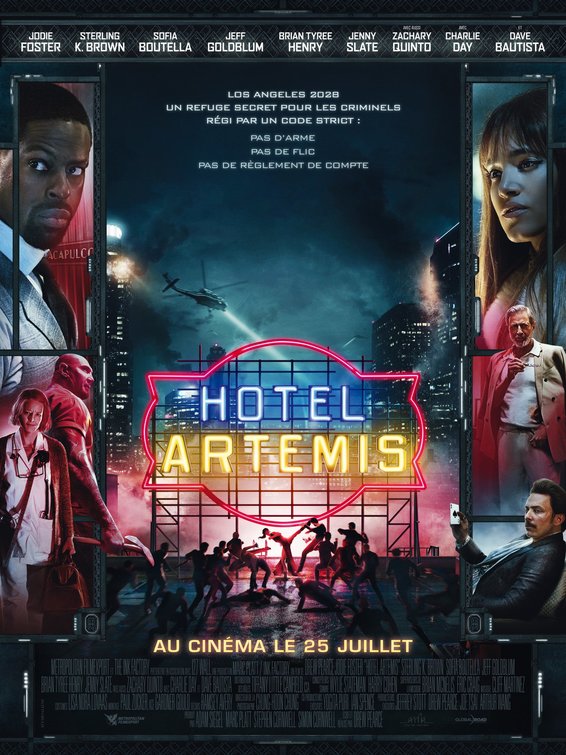
I don't know how Hotel Artemis came and went from theatres without making a single blip on my radar.  When it popped up on nextfilx, I had to search the inner reaches of my brain long and hard to figure out if I'd ever heard of this film before.  I mean, the cast is outstanding, with Jodie Foster, Sterling K Brown, Brian Tyree Henry, Jeff Goldblum, Dave Bautista, Jenny Slate, Charlie Day, Zachary Quinto, and Sophia Boutella.  I mean, that's a cast of characters you want to see no matter what the setting.

In this case it's a near-future dystopia where water supplies are managed by corporations and they're starving (dehydrating) out the citizens of LA, as they protest these entities which now can decide who lives or dies by who has water.  But this is literally just background.  In the fore is the titular hotel, where bank robbers Brown and Henry wind up when Henry gets himself shot up.  The Hotel is acually a hospital, with four beds, that services the criminal, the rich, and the criminally rich.  It has a definitive rules of operation/code of conduct, that the nurse (Foster) holds as gospel.  But with the events going on outside, her faith in those rules is doubly called into question, first when the Hotel's patron needs to check in (with no beds available) and the second when an childhood acquaintance of Foster's son (Slate) winds up on her doorstep severely injured.

It's a film that works only because it believes in its internal consistency and the world in which it operates.  The style is shadows and neon, such that it feels like it's an outside part of the John Wick universe... and even though it never directly connects to Wick, it at the very least owes it a debt of gratitude as inspiration.

It's fun, engaging, and full of neat, clunky, near-future tech that's equally possible and improbable.  I see Toasty is sitting on a review of this.  Can't wait for his thoughts.  I bet we agree.

[1:50:36]

---


Is The To Do List an earnest homage to horny teen movies of the 80's and 90's or is it a satire of them? 

I mean, why can't it be both?

I think it would have made for, well, maybe not a better movie, but maybe a more impactful movie had it picked a lane. It's spends more time in the homage lane than the satire but this could have been Wet Hot American Summer level great had they flipped it into satire, especially with this cast.  I mean, the bulk of this cast playing teenagers is in their late 20's or even early 30's, so they don't look the part.  Why not play into that?

The crux of the film, though, is that it's a female-led, sex-positive, "horny teen" comedy so if it spent too much time satirizing the genre, then maybe that point of giving a teen woman's POV sex comedy wouldn't come across as hard. 

I liked the resolution of the film, which has nothing to do about landing one guy or another but rather reinforcing the point of one freely and openly exploring one's sexuality without guilt or shame. I can't help but think that making it set in the early 90's just makes the whole endeavour seem strange though (mercifully the 90's jokes aren't so dominant or overpowering).  It's really just....why? There's nothing about this story that really needed the setting to be the '90's.

I enjoyed it, but I didn't love it.  It should have been far funnier than it was, but not for lack of trying.

[1:56:34]

---


Oh, Robert Zemeckis.  Why, why do I even bother?

Because they were covering it on the Blank Check podcast and I thought, surely with Denzel, it can't be *that* bad right (for the record, the Blankies weren't really panning this film, they were actually fairly positive about it all things considered).  I basically watched the film on 1.5 speed, and was intercutting watching the film with listening to the podcast, so I may have tainted my viewing experience a little... but being semi distracted is pretty much the only way to watch a Zemeckis film that's not BTTF or WFRR?

Denzel drops his usual rocksolid, watchable performance, (although I have to compare his drunken acting against both Another Round and The Most Danger Game and Denzel's drunken acting doesn't feel real or natural like Another Round, but it's not funny like TMDG, nor) but this is the typical manipulative and laborious tripe from Zemeckis which reminds me why I stopped watching his movies. I laughed, inappropriately, often.

The idea of a very flawed man doing something incredibly heroic is compelling but the story doesn't negotiate it in a satisfactory manner. If anything it's played too subtly and via relationships that don't really seem to matter to the character or the viewer.

Like so many Zemeckis films it tries so hard to play for realism but then has moments (or sometimes just production decisions) so broad or ridiculous that it's like the director is self-satirizing his own story.  It's not good.  The Blankies pointed out the frequent on-the-nose musical cues and yeah, I just had to roll my eyes.  Feelin' Alright, indeed.

And even without looking it up, I just know that rolling a commercial passenger plane is just impossible.

[2:00:54]


Saturday, July 22, 2017

10 for 10: the "stuff I watched last year" Edition

[10 for 10... that's 10 movies which we give ourselves 10 minutes apiece to write about.  Part of our problem is we don't often have the spare hour or two to give to writing a big long review for every movie or TV show we watch.  How about a 10-minute non-review full of half-remembered scattershot thoughts? Surely that's doable?   ]

In this edition:
1. The Martian (TMN on demand) - 2015, d. Ridley Scott
2. Hunt for the Wilderpeople (in theatre) - 2016, d. Taika Waititi
3. Midnight Special (VOD) - 2016, d. Jeff Nichols
4. The Big Short (Netflix) - 2015, d. Adam McKay
5. Sleeping With Other People (Netflix) - 2015, d. Leslye Headland
6. Admission (Shomi) - 2013, d . Paul Weitz
7. Elstree 1976 (Netflix) -2015, d. Jon Spira
8. Mascots (Netflix) - 2016, d, Christopher Guest
9. 10 Cloverfield Lane (Netflix) - 2016, d. Dan Trachtenburg
10. ARQ (Netflix) - 2016, d. Tony Elliott

aaaand...go

---


The Martian should have been something I saw in theatres, but it wasn't a big tentpole sci-fi, superhero or fantasy movie, and Ridley Scott isn't one of our "always see" directors.  Also, I've realized Matt Damon just isn't a draw for me.  I like him just fine, but he's never going to sell me on a movie on his own.  Sooo, it kind of languished, not for anything other than lack of time or access.  When we got the movie package last year for Game of Thrones, well, The Martian was there waiting.  And hey, it was good.  Entertaining, full of "Fuck Yeah, Science" moments (what was it?  "I'll science the shit out of this"? Eh, I don't recall).  It was a nice story of survival, but it was trying for a lighter, feel good tone, and a such there wasn't a terrible amount of drama.  I mean, we're not talking Castaway isolation (in terms of not having any other cast to cut away to), but for height of the stakes for ol' Matt Damon, there wasn't a lot of tension.  I think it may be a plausibility thing, the fact that we haven't actually landed anyone on Mars yet.  Sure, there's the potential, but we're just not at reality yet.  I liked it but it hasn't stuck with me.  And I couldn't help but think of this as related character to Matt Damon's role in Interstellar, and there's a lack of consistency between the two characters (both stranded on planets) that just bugged me.

(David has a great write-up from long ago...and also mentions the Interstellar thing)
[8:58]

---

The Hunt For The Wilderpeople  is now on Netflix, and it probably deserves a rewatch.  Any of Taika Waititi's directorial efforts do, in fact.  His first effort, Eagle vs Shark, was very much the Napoleon Dynamite of the New Zealand set, while the mocumentary What We Do In The Shadows has become an evergreen favourite because of its genre trappings.  Hunt For The Wilderpeople has a title that insinuates genre trappings, but is actually an exceptionally enjoyable, warm and funny (with a sombre undercurrent ) comedy about a young orphan boy, Ricky (Julian Dennison), in New Zealand who has behavioural problems, but is taken in by the sweetest, kindest-hearted woman anyway.  Her husband, a staunch, crotchety Hec (Sam Neill), doesn't really want much to do with the kid, and keeps to himself most of the time.  But the new surrogate mother figure suddenly passes away and Hec finds himself in a position he never wanted to be in, a mentor and father figure, and it a role he resoundingly rejects.  Faced with returning to state custody, realizing he's had his last chance at finding a home,  Ricky runs away.  Hec knows where he's going, and reluctantly sets out to bring him back.  In the trip on return, the two, as expected, bond, but in ways unexpected.  It's themes are well trod, but it's the way in which the story is told, Waititi's wry yet uproarious humour, and a very deliberate pacing and film style which make this one worth not just watching, but treasuring.  Waititi's next venture is Thor: Ragnarok for Marvel, which should be amazing.

[19:28]

---

I just wrote about Stranger Things, FINALLY,  and how spectacular it was, in large part due to its  1980's sensibilities.  Not just homage, or attempting retro trappings, but achieving a genuine sense of the era, a sense of belonging, of being of the '80's.  Jeff Nichols' Midnight Special strives for much of the same, and achieves to a certain extent.  There's the definite sensibilities of 80's genre dramas like John Carpenter's Starman or Spielberg's E.T., the type of movie that doesn't want to wow with special effects or any genre trappings, really, outside of one small conceit.  Here, it's a young boy who has a supernatural ability, an inner light that can manifest itself in both helpful and destructive ways.  The boy's father (Michael Shannon) has to extricate him from a cult-like religion and the pursuing governmental forces, both of whom have ill designs for the boy.  The chase is a fraught one, and seeing the lingering impact of the religious teachings on both the father and son is much of the meat of the story.  It's a sombre road movie, with Shannon's expert brooding carrying the bulk of the film on his shoulders.  I'm still not certain the retro 80's aesthetic (despite being modern day) helps the story much.  It's a pastiche for sure but using it would imply that it was more exciting or fun.  It has a pretty distinct ending, one which a viewer could go either way on (it could be too much, or make the viewer wish there were more of it).  It's a sad film, overall, but worth the journey.

(David watched it too and remembered far more details than I did)
[30:31]

---
I like the composition of the arrows but
there's just too much white space here.
I think the fact that the top and bottom
arrows are longer than the left and right
arrows is also part of the problem


The 2008/2009 housing crisis was a real shit show, and it had been brewing for years, due to a lack of regulatory oversight or industry foresight.  It was also the product of immense greed, the brainchild of the richest of assholes trying to get more money for the rest of the richest of assholes.  The fact of the matter is, the stock market is lost on the layperson for the most part, which allows the people that work in the industry, and the government agencies that oversee it, to do whatever the fuck they want to manipulate it to keep the money flowing in from ignorant investors and circulating among themselves.  The Big Short is a big-name cast movie (Christian Bale, Ryan Gosling, Steve Carrell, among many many others) that dives into what actually happened, and expresses it in a way that may still be a little too inside baseball for some, but with enough entertainment value that you'll get the gist if not the specifics.  Frequent Will Ferrell collaborator Adam McKay does an impressive job with this dense and dry topic, presenting it in such a way that you get angry but are still engaged with the story and the characters.  At the time, it was a fairly important movie, but important movies usually only get seen by people who already know the topic.  I don't think the Big Short reached enough of the laypeople audience to really measure an impact. People just knew they got screwed, and for a lot of them it was such a sore subject they just didn't want to know how.  They would rather be distracted.

[39:13]

---
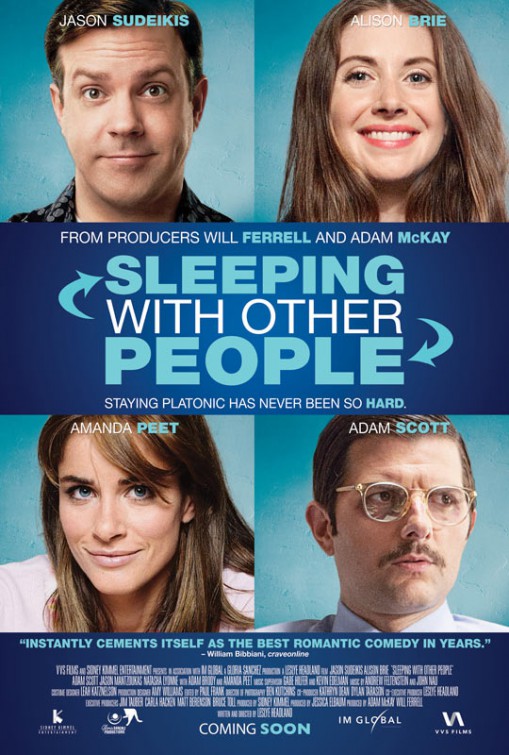
Man, it is really hard to sell a comedy, even
a romcom with a poster.


The main flaw with Sleeping With Other People is the inference that ex-SNL star Jason Sudekis and then-Community/Mad Men star Alison Brie were the same age, the story involving the fact that they first hooked up in college.  There's a very noticeable 7-year-gap between the two of them.  Sudekis has looked to be pushing 40 for over a decade while Brie was playing a teenager when Community started.  Even with a real-world 7-year-gap, it's still hard to reconcile how they could have met in college.  The movie pays it no mind, and carries on, and delivers an enjoyable, yet unassuming, and ultimately unmemorable romantic comedy.  But I just couldn't get past it.

The comedy is light, though the cast is talented, including Amanda Peet, Adam Scott in full dickbag mode, Jason Mantzoukas playing against type as a nice guy best friend, sharing a delightful relationship with Andrea Savage.  It's a solid watch but no real standout comedy bits, and neither the characters nor plot will stick with you.

[47:14]

---
Like, I mean, really hard to sell comedy
with a poster.

Another romantic comedy, Admission, is equally as unmemorable.  Paul Rudd and Tina Fey are a great comedic pairing, both immensely likeable alone and together, but something about this film just doesn't click.  The conceit of the film is a light expose of the rather political and jaded admissions process for elite universities.  Not only do they rigorously screen their applicants but they also scout for applicants, looking for the best and brightest, which may seem noble, except when you understand that it's all done for the prestige, to maintain the reputation, to keep the elite status, all of which keeps alumni and donor money coming in, as well as allowing the school to charge more for tuition.  Fey plays the head of admissions at one such prestigious school, but when an applicant coming from a troubled alternative school run by Paul Rudd shakes up her worldview, (plus a romantic connection with Rudd) will her staunch adherence to customs and rules override her conscience as it always has.  You know it won't.  Rudd's far too charming, and his whip-smart kid who takes such a shining to Fey couldn't help but sway her.  It's a sweet film, and the usual charismatic schtick from Rudd goes a long, long way in watchability, but it's so by the number that it's almost painful.  You've seen this type of story a dozen times, if not dozens upon dozens of times.  Depending on your preference for romcom, it may be comfortably familiar, or it may be monotonous.  If you're not into romcom, take a hard pass, this isn't the place to start.

[57:01]

---

I probably shouldn't have even bothered watching Elstree 1976, a documentary featuring a few of the peripheral faces (or masked faces) from the original Star Wars series.  I'm not sure that the film does much in the way of enhancing the Star Wars experience, beyond going into the minutiae of how the film's success has affected a handful of the lesser-known performers.  The journey it takes is from the modest, British backgrounds of the actors, and onto the stage of Elstree studios.  Their seemingly well-honed stories at this point tell of their feelings about the film before they knew what it would become, which honestly could be just as much fabrication for "good" storytelling as actual recollection.  The Star Wars nerd in me was hoping for some unseen goodies, some trinkets of Star Wars that only the people on the inside would have had, some insight into things that could have been but weren't...but this isn't the doc for that.  It's not even really a "making of" which the title would almost imply, but rather the journey of the people involved.  There's a large portion of the film spent on fandom, how these performers capitalized upon it, and the politics of being a convention attraction.  It gets rather petty, and silly, and would make a pretty funny series, actually (note to self... how do I watch Con Man: The Series).  The people all seem nice, but this doc is inessential at best for all but the diest of die hard Star Wars nerds.

[1:07:38]

---

Speaking of conventions, Mascots takes us into a behind the scenes look at the people who participate in an international mascot competition.  [Okay, yeah, a competition is not a convention.  It was a shitty transition and I'm sorry.]  This mocumentary comes to us from Christopher Guest, because it obviously comes from Christopher Guest.  In fact it too obviously comes from Christopher Guest.  In fact it's almost a knock-off, for so middling are the results that there's not much about this film that doesn't immediately make the viewer wish they were watching Best in Show instead.  It's loosely the same story/plot, only with a somewhat different cast of absurd characters.  Really, had all of guests movies just been that same variation of formula, this would just be another in a tired line at this point, instead it's a disappointment that Guest would return to the same well.  What Best in Show had going for it was the plausibility.  There may be mascot competitions out there, but where best in show was sending up the people an personalities behind an analog Westminster Dog Show, a fairly well known event facilitated in Madison Square Garden in New York, Mascots isn't replicating anything familiar to the audience.  As such the competition that is being put on feels absurd and unbelievable.  Maybe I will see a mascot competition someday and marvel at how absurd and unbelievable it really is, and maybe I'll cut Mascots a little slack for it, but until then it just feels overboard, too broad.  It really wouldn't matter if the film were funny, and it is in fits and starts, but it just never clicks.  It feels rushed, the characters don't feel as fleshed out, and it's hard to care too much or invest in any particular person's chance at winning.  I would have preferred a mockumentary about furries to this, to be honest, but that seems to ribald for Guest these days.

[1:18:17]

---
erm, spoiler alert?

I have to wonder why the tenuous "Cloverfield" connection.  Overtly I realize that "Cloverfield" is now a brand for the studio, and one that's making them some nice coin, but in-world, in-story there is literally no crossover, so why?  I would actually like a for-real sequel to Cloverfield, one which does not use hand-held camcorders and so much nauseating shakey-cam to see the monsters mash NYC, but that's not this film.

No, 10 Cloverfield Lane is instead a smart, taut thriller that has you guessing through to the third act.  The fantastic Mary Elizabeth Winstead is Michelle, run off the road and awakens to some serious injuries inside a bunker.  Her captor is an equally fantastic John Goodman as Howard, who claims to have rescued her. Something bad has happened outside and they can.not.go.out.there. lest the bad things come find them. There's a third party in the bunker, the defiant Emmett (John Gallagher Jr.), who confirms Howard's story, to a point.  Howard is gracious to his "guests" so long as they obey the rules.  The bunker is homey with a 1970's vibe, and everyone gets along, until they don't.  Howard is explosive when he feels challenged, or violated, and Goodman as ever uses his stature and presence to scary effect.  Invariably all is not as it seems, or is it?  The question of Howard's honesty ebbs and flows, and even Emmett is a constant unknown.  Are they good men?  What's really going on?  Things erupt in the third act and where the film could have gotten really mean and not provided answers it instead opts for a big budget Twilight Zone-reveal that is equally out of place yet thrilling pay-off (but still no connection to Cloverfield).  This one's rock solid.

(Here's David's take)
[1:30:35]

---
He really doesn't wear the gas mask that much
in the film to frame the poster around it

I could have made 10 Cloverfield Lane #10, but I chose not to, just to drive some people mad.  If you're driven mad by the fact that 10 Cloverfield Lane is not #10 for no real reason, then mission accomplished.

Arq is a fine little time travel thriller, which has the feeling of a small-scale Edge of Tomorrow [aka Live.Die.Repeat] or an English Time Crimes, or a bigger budget, more mainstream Primer or a non romcom Groundhog's Day.  In other words, it's in good company, carving out its own place in the living-things-over-again market.  As with some of those other films there's no real scientific rationality to why someone is living their life over and over again, but the fun is not in the reality of the situation, but the rules that the plot establishes.  If there's an apparent defined set of rules to how the time reset works, then it's all good, the audience can invest.  I love these stories, as they explore one event from a whole bunch of alternate possibilities.  It's tremendous fun, but Arq actually builds a story, a purpose to it, and even, in the background, a whole other world (which we don't ever really see or interact with).  It's quite great though, real pulp sci-fi with a winning couple of leads in Rachel Taylor and Robbie Amell. It teases bigger things I certainly would like to see and know more about and explore, but it's plenty satisfying on its own.

(read David's take)
[1:42:06]

-FIN-

Tuesday, July 14, 2015

I Saw This!! Anxiety (or, I haven't written a review here since April, so here's 8)

I Saw This (double exclamation point) is our all-too regular feature wherein Graig or David attempt to write about a bunch of movies they watched some time ago and meant to write about but just never got around to doing so. Now they they have to strain to say anything meaningful lest they just not say anything at all. And they can't do that, can they?

Okay, time to get back up on this horse.

Noah - 2014, d. Darren Aronofsky -- netflix
Dogtooth ("Kynodontas")- 2009, d. Yorgos Lanthimos --netflix
Zero Dark Thirty - 2012, d. Katheryn Bigelow -- netflix
Nebraska - 2013, d. Alexander Payne -- netflix
John Wick - 2014, d. Chad Stahelski, David Leitch -- blu-ray
Harmontown - 2014, d. Neil Berkeley -- netflix
Blue Ruin - 2013, d. Jeremy Saulnier -- netflix
The Scribbler - 2014, d. John Suits -- netflix

---

When I was becoming a burgeoning cinephile in the mid-to-late 1990s, taking note of writers, directors, actors and actresses, composers and other names on the production roster that were making the movies that I both liked and connected with (sometimes deeply, sometimes superficially), Darren Aronofsky was high on my list of directors to follow, a singularly intriguing creative person worth being devoted to.  What struck me most about Aronofsky wasn't anything he did on screen, but what he did off-screen, which was bridge the worlds of comics and cinema.  With comics obviously being a very integral part of my life, releasing a movie with a comic book tie-in (not just a licensed prequel, sequel or adaptation) was a sure-fire way of getting my attention.  Aronofsky did this with his very first feature, Pi, and I was hooked.  The one-shot comic (published by Dark Horse if I recall correctly) and the feature were both black and white art-house endeavours, cerebral and somewhat impenetrable, but fascinating and puzzling in equal, mostly good measure.

His follow-up was Requiem For A Dream (2000), one of the most profoundly disturbing and intense films I've ever seen.  It's a brilliant piece of cinema, joining the likes of Clockwork Orange and Dancer In The Dark as astounding cinema that can only be watched once.

Aronofsky went back to comics again with The Fountain (2006), his third and highly troubled feature, creating an accompanying graphic novel (with artist Kent Williams) that expands upon the three timelines presented in that film.  I owned the graphic novel for years before read it, as I wouldn't read it until I ha watched the film.  I wound up owning the film on dvd for some time before I actually watched it and subsequently read the graphic novel.  While I appreciated the entire endeavour, it left me somewhat cold.  Despite this, I would follow Aronofsky to The Wrestler (2008) and Black Swan (2010) in the theatres, finding both to be great movies on their own, but again not resonating with me.  I was disappointed when he dropped out of The Wolverine, as I thought he would make a great comic book movie, particularly a great, brooding and dark Wolverine story, and even more disappointed to find out his biggest budget movie would be a biblical adaptation.  How boring.

Yet, Aronofsky's next feature, Noah, would find once more be accompanied by a graphic novel (actually an adaptation of the screenplay by Nico Henrichon) fleshing out his tale at something less directly religious and more disaster/spectacle/epic.  Even still, I waffled with seeing this production, my interest level never reaching past mild.  The graphic novel would be a pricey purchase and the film's subject matter far from enticing, so getting the full experience (as I only assume it was intended) was somewhat off-putting.

It was only its arrival on Netflix that I finally conceded in watching the film, and I found it a curious product.  I'm still not entirely sure I understand why it exists.  It's almost as if it was made in an exercise to see whether the Bible could be mined for blockbuster motion pictures.  The focus seems to be more spectacle than anything resembling religious parity.  This isn't the "true" story of Noah being told, and, not being a religious student of any sort, I'm not even sure what the biblical message of Noah is supposed to intone, but I would be surprised if the biblical moral was at all in Aronofsky's mind when putting together this production.

It is indeed epic, a sweeping tale of birthright and revenge, of fathers and sons, of obedience, love and betrayal, the temptations of evil, righteousness and the gray area between selfishness and selflessness.  Noah is a man convinced in his mission, unwavering in his belief that God has told him what needs to be done, and the climax of the film deals with exactly how unwavering will he be.  Can he perform an unspeakable evil as part of God's will?

Noah is a flawed beast, an awkward behemoth that's both awe-inspiring and teetering on the fringes of being comically laughable.  The key cast of Russel Crowe, Jennifer Connelly, Ray Winstone, Emma Watson, Logan Lerman, and Douglas Booth are extremely serious minded about the events they're participating in (Winstone may be a bit more on the scenery chewing side, though), probably its saving grace from being B-movie camp.  Anthony Hopkins as Methuselah provides the film's brief moments of comic relief...or marginal levity as it were. 

It's still hard to believe this film got made.  It's not unwatchable but it's also not outright entertaining.  It has moments of action and some visual sense of wonder but the characters never settle in as believable people, nor do they reach the height of mystical figures.  They persist as figures in a tale, servicing a specific story with no will the change the outcome of the tale.  The emotion that should be wraught throughout never materializes under the weight of the expectations of the story at-hand.  That tsunami set to encompass the world sort of nullifies almost any other drama the film attempts to build.


As noted in David's take[link], there's a sense that this was supposed to be even more wondrous and metaphysical than it actually was (which perhaps that graphic novel I've yet to read bears out?), and I think the tale could have used a bit more of an alien setting to explore its characters and story, distancing itself from any form of Earth-based history (real or Biblical or allegorical)

---


I had come across (the just defunct) The Dissolve's best films of the decate [so far] list [link] and became somewhat intrigued with seeing all of these movies.  Melancholia, which I reviewed back in April [link], was actually the last of a small streak of these that I watched, but Dogtooth was the first.

The idea behind this Greek film is fascinating, the story of three siblings who are the subjects of lifelong social experimentation by their parent.  They've effectively been held hostage in their family home and yard, unable to view the outside world at all, except through the limited exposure to outsiders brought into the home by their father.  They are taught the wrong words to represent objects, they are told that the land outside of the fence is toxic, and that a sibiling (that likely never existed) escaped and is trapped out there in the land just beyond the fence.  They are kept placated, if not happy, by an endless stream of lies, some elaborate others simple.  Now in their late teens and early twenties, they're starting to become restless and curious, though the outisde world is still a monster.  The main lie, from which the title draws its name, is that they will only be allowed outside the compound once they lose a dogtooth (the parents more than aware that those permanent teeth aren't going anywhere on their own).

The film plays out with deliberate, observational pacing.  It's not interested in celebrating or reveling in the lies the parents are telling the children, nor is it condeming them.  There's a passivity to the camera -- it's of the handheld, mobile, sort, a seeming adherence to the old Dogme '95 aesthetic -- a watchful eye peering in unobtrusively on events with no judgement borne out for what it sees.  In every right these kids parents are monsters (even before dad's heinous act with a VCR) but they're portrayed just as carefully as the kids are.

In my anticipation for watching this film, knowing only the rough plot and a few details, I was expecting something more exploitive, a bit more kitschy or on display for laughs.  I was anticipating looking in with fascination and delight, I wasn't expecting the engrossing curiousity, disgust and intensity with which I watched.  Something like the kids being told that flying planes overhead are actually just toys (and once they've passed out of eyesight they can be found in the grass as mother has thrown a toy in the grass to be found) could be riotously amusing as, say, a Will Ferrell film, but here it's bizarre but certainly not played for laughs.  Likewise, their listening to Sinatra's "Fly Me To The Moon" in English, being willfully mistranslated to Greek by their parents could be comical but sits just as it is...something that happens in this household.  The film ceases to continue so much as it ends.  There's easily more story to be told here, as the criminality of the parents actions, or the psychological implications of what's been done to them are left unexplored.  A second feature following at least one of the kid's journey into the real world is filled with tremendous possibility (just imagine their reaction to a real plane).

---


Zero Dark Thirty was an Oscar winner for the 2012 cinematic year, and a resoundingly successful follow-up for its director Katheryn Bigelow after winning best director for the Hurt Locker.  It's at this point the infamous story of the intelligence tracking and death of Osama Bin Laden, and while many who have seen it focus on the gripping third act's focus on SEAL Team 6 as they invade the compound they suspect is housing Bin Laden, they tend to gloss over the rather fiercly feminist aspect of the film.  The progressively feminist story is purly by its true story nature, not so much by design, as Jessica Chastain's Maya, a recent graduate and recruit into the CIA, is thrust head-first into the war on terror and takes the lead on finding Bin Laden.

All manner of obstacles are in Maya's way, political and organizational are the tip of the iceberg.  Facing down illegal torture methods, possible threats to her life, systemic sexism, and her own novice background are all trial by fire for her.  These things harden her as they threaten to break her, but her resolve is strong, and her persistence, as well as her intelligence and dedication, is enviable.

As a "based on a true story" film, Zero Dark Thirty is a masterpiece.  It's equal parts military and political thriller, as well as personal drama and, in its own way, revenge fantasy.  It juggles many levels of beurocracy, international travel, intrigue, and more with a fluidity that finds no diversion it takes out of place. The story is propelled forward with increasing momentum, the audience already knows where its going but is never made to feel like it's just biding its time before getting there.  Though no doubt there are embellishment, unlike, say, Argo which took extreme (and obvious) liberties with its source material in the name of manufactured drama, Zero Dark Thirty rarely, if ever, steps on its own toes or hits its audience over the head with false notes.

The shame here is Bigelow has crafted an immensely entertaining and successful feature, award-winning and important, delivering the story of Bin Laden's death in just over a year after it happened allowing for some sense of public closure, and yet she did not become a highly sought after, in-demand director.  Bigelow's execution here is deft, navigating multiple genres and wonderful character and world building with defiant ease.  It's a film on the same scale as a Bond or Bourne movie which would make her a natural target for taking on a blockbuster franchise and yet we never hear her name in the rumour mills for the next big feature.  Is it institutionalized sexism of Hollywood studios, or is it that Bigelow is just not interesed in those kinds of films (Point Break, Strage Days and K-19 tell me otherwise).

---

Was Nebraska also on that aforementioned list of best 50 films of the decade so far?  Even if it wasn't, it'd been a film sitting on my "to watch" list for a long time.  I loved the pacing and light humour of Alexander Payne's The Decendents and I had heard great things about Bruce Dern, Will Forte and June Squibb's (award nominated) performances in the film, but seeing as there wasn't a single sci-fi, action, fantasy, or metatextual "gotcha" to the movie, it just took a long time (languishing in my Netflix queue for months on end) for me to get to it.

It's a simple story filled with complex emotions.  Dern is a cantankerous senior citizen who's going senile while also restless as his freedoms are stripped from him.  He's never had a good relationship with his sons (Forte and Bob Oedenkirk), and he and his wife (Squibb) can barely stand one another's company.  When a Publisher's Clearinghouse-esque letter arrives telling him that he "may have already won", he's convinced he needs to make the trip to their home office in Nebraska to claim the prize.  Everyone around him tells him it's just junk mail, but he's dedidcated to the trip.  Eventually Forte concedes to driving him, giving the two men their first ever real moment of togetherness.

It's a road trip movie and a family movie, as they stop and visit elements of Dern's past along the way.  His home town revels in his story of sudden fortune and the extended family gather for an impromptu reunion that goes about as well as any assembly of family goes.  It's frequently chuckle-funny, occasionally awkward and sad, but always rewarding.  There's a depth and truth to the story at play, particularly to the emotions, with Dern being a man who has never cared for showing his, and Forte coming to understand not just who his father was before, but who he is now, and that like most parents, despite the difficulties they have, he has done as best as he knows how.

Forte delivers a perception-shattering performance.  The weirdo/goofball/creepy characters he's played in previous films and in Saturday Night Live sketches fade away almost immediately as Forte's eyes show a knowingness, a maturity and wearyness that he's never earnestly expressed before.  Dern's Oscar winning performance is almost the easier job, being gruff, stoic, and occasionally completely unsure of his surroundings, but he delivers a character that never wavers in identity and provides the framework for everything else in the film to react to.  Squbb, meanwhile, is the overt comic releif, the Oliver Hardy to Dern's Stan Laurel.  She's mouthy, aggressive and uncensored (she even shocked me a couple of times), the perfect counterpoint to Dern's weary silence.  She didn't win the best supporting actress Oscar, but it was a likewise worthy performance.

---

We're not Keanu fan's over at the Kent household.  While I have a greater threshold for Keanu than the missus does, it's not really much of a qualification...it's like saying I can take  cleaning the litter box more better than she can... which is a bad example because she definitely cleans up the cat crap more than I do... but I digress.  Point being, Keanu is not a great actor, in fact he's pretty terrible.  Consistently so.  Limited facial expression, even more limited vocal intonation, the most animated Keanu ever got was in the Bill & Ted movies and the last of those was over 25 years ago.  The perfect role for Mr. Reeves would be Pinocchio because he's a little wooden boy...except that Pinocchio would demand he turn into something resembling human.  Maybe if Pinocchio turned into a T-1000 at the end of that story instead.  Scratch that, just make him a Terminator and be done with it because that's spot on the type of range he displays.

Woah.

Anyway, John Wick.  John Wick showed up in last October in theatres with little hype or enthusiasm (because Keanu's last bunch of pictures were all major duds...to be clear, no, not a remake of Gerald McCraney's Major Dad) but became a rare honest-to-goodness blockbuster success through word-of-mouth.   One friend of ours love the movie so much he saw it multiple times in theatres and continually sang its praises (and waited with baited breath for its Blu-Ray release).  That David even spoke effusively aboutit [link] resonated and, with these collective signs  I began to actually want to see the film.

Woah.

The wife was still far from enthused... she gets that way about things with too much hype and/or starring Keanu.  The aforementioned friend (shout out to Troy-who-doesn't-read-this-blog!) got his copy of the film on Blu-Ray, watched it a couple times over and lent it to us for a viewing.  It was a unique experience.  The wife, naturally, wasn't looking forward to it and chose to distract herself from her lack of enjoyment by live-Facebooking her reaction to the film.  I chose to turn out the lights and have a spiked refreshment at hand. 

At first we gently mocked the movie -- a few "Fuck you, Theon!" comments  (something me and the wife shouting regularly at co-star Alfie Allen's Game of Thrones character) and mimicry of Keanu's stilted acting tossed about for good measure -- but then Allen's character, the entitled son of a Russian mobster, goes and kills John Wick's puppy (after he was denied the acquisition of Wick's sweet ride), and things get goofy/serious.  The puppy was a present form Wick's recently deceased wife, so that he wouldn't be alone, and the ex-mob hitman sees only red, and we're thrust, along with John, back into the world he had hoped to leave behind.

It's this world, it's neutral ground hotels, it's secret society gold coins, and it's weird codes of honour, that make the movie.  Keanu is a vehicle for delivering both this world's nuances and it's brutal yet beautifully orchestrated violence, and the film's directors Chad Stahelski and David Leitch and writer Derek Kolstad seemed to understand the exact type of character Keanu should play, and the limits of what he can play.  This was obviously tailor made for him.  He can't quite handle the sombre hurt of the recently widowered nor can he take on the deep emotion of having a piece of his wife restored with the puppy to any great shakes.  But when he's asked to be a cold, calculating orchestrator of violence, which is 90% of Keanu's role here, he nails it straight on.

The film is beautifully stylized, the fluorescent greens and blues saturate the parts of the screen that aren't bathed in shadows.  It's Michael Mann by way of modern graphic novels.  The action is top notch... it's not "another level" like the big budgets of the latest Fast and Furious or Mission Impossible or James Bond feature, but it's full of John Woo-esque gunplay and throw-down, drag-out fights are close to par with the greatest fight porn of the modern day,  The Raid 2 [link].  My favourite of the battles found John Wick taking on Adrianne Palicki's Ms. Perkins, an assassin more ruthless than Wick... but I enjoyed even more Lance Reddick's reaction to her breaking of the hotel rules.

John Wick was exactly what it should've been, only better.  It's a B-movie ratched up to A-level status thanks to savvy filmmaking and tremendous world building.  I even caught the wife, on more than one occassion, watching the movie intently, forgetting about the Facebook updating for a spell.  Though still hard pressed to admit that a Keanu movie actually entertained her, I'm fairly certain there was a begrudging amount of respect there for the end product, and that's about as big a praise for this film as anything. 

Woah.


---

Harmontown is a documentary about the creator of the beloved cult TV show Community creator Dan Harmon, and the months following his firing from the show as producer and showrunner after its third season.  Harmon had, before his firing, started a live show/podcast that was part comedy show, part confessional, where he would ruminate with his co-host Jeff Davis about his life, his failures and successes, his frustrations, and anything else he wanted to get off his chest, most of which probably better suited for the therapist's couch than a public forum.

After his firing, at his lowest point, he thrust more energy into his podcast, and he started sensing a bit of a groundswell. Not so much a movement, but a cult of personality forming around him.  Taking a risk, he decided to take the show on the road and let a documentary crew follow him.

It's a film about Harmon, primarily, about who he is as a person, and that person is admittedly very, very difficult.  The film highlights the Harmontown podcast and the people who gravitate towards it, embracing honesty and pain and the communal catharsis it provide, but it's all centered around Harmon and his often self-desctructive tendencies.  The people along for the ride are his girlfriend, Erin McGathy, Davis, and the show's resident Dungeons and Dragons gamesmaster Spencer Crittenden, and each has naturally a different relationship with Harmon.  McGathy bears the biggest brunt of Harmon's self-destructiveness which often manifests as lashing out, while Davis more deals with pushing the show forward.  Spencer meanwhile sits quietly, uncomfortably on the outside of it, and observes.

It's with Spencer's story that Harmontown as a documentary justifies its existence as more than a piece of self-glorification/implosion.  Spencer is the fan's way into Harmontown, as he was a man on the outside who innocuously offered to run a D&D campaign and suddenly found himself a man on the inside.  Spencer is a stereotypical outcast nerd, the kind with a quiet, gruff exterior, a shell hardened by traumatic childhood ostracisation, a person who finds comfort in the world of fantasy and its nuances.  But through his role on Harmontown's podcast he's given the opportunity to have a voice in the world he never though he'd have, to be heard and seen and validated.  As he's on tour he has people, not unlike himself, awkwardly approaching him with admiration and adulation, genuine affection for who he is and what he contributes, and the film captures intimately what that discovery is like for him.  Where Harmon, a bit of a self-aggrandizer, is only marginally surprised by his supportive fanbase (there's an expectation of some level of worship going on, like how a televangelist preacher takes the worship of God as his own), Spencer is genuinely shocked.  Though in their own ways both men are grateful.  It's obvious though that Harmon needs the outpouring of support and affection, almost like a drug, for Spencer it's almost an affirmation that his place in the world is okay.

This is a film that's meant for the fans and the outlier fans, all the avid Community watchers and AV Club message boarders, the people who know what a showrunner is.  It's not that it can't appeal to a broader audience, but without having the shorthand of understanding Harmon from his work (and for sure Community is a devastatingly hilarious and often genious personal endeavour with each character a manifestation of his personality) the uninitiated viewer may just wonder "what's the big deal about this guy?"  That difficult personality Harmon displays can rub even the most ardent fan the wrong way at times.

---


Of all the films in this I Saw This!! column, Blue Ruin is the one I enjoyed the most, and yet, it's the one I'm having the hardest time recalling.  I have specific images in mind, a general impression of what the movie is, but a lot of the details are fuzzy.  Perhaps as I write about it, it will come flooding back.  Spoilers will follow.

The film is a low budget revenge thriller (partiall funded via Kickstarter, no less), that's less exactly a thriller, and certainly not your typical revenge story either.  Dwight (Macon Blair) is a drifter living out of a bullet-hole-riddled, tarp-covered car.  He scrounges and survives, but hasn't given up completely on civility, reading novels by flashlight at night.  The police stop by, obviously familiar with Dwight's story, and inform him that the man who killed his parents is being released from jail.  Very quickly Dwight sets up his plot to take his revenge, connecting the battery back to the engine and returning back home, a place it's apparent he hasn't been in a long time.

Where most revenge fantasies find their lead characters frighteningly proficient at stalking and murder, Dwight's plans fumble and falter from moment one.  Clean shaven, wearing stolen oversized business casual clothes, Dwight looks like a soft man, timid, bleary eyed, pudgy, completely unassuming.  He's not cut out for this sort of business, particularly when his target's family begins to hunt him down, and yet, he has no choice.  This is his drive, his mission.  His sister should be the one to talk sense in him, in any other film she would be admonishing him for what he's doing, angry abut how it impacts her life, and yet she's cautiously supportive.

I hesitate to call Blue Ruin a dark comedy, because it's a dead serious movie, and yet it's spin on the revenge tale is so fresh and about face that it's impossible not to laugh unconsciously in reaction to Dwight's failures and botched successes.  Dwight a fascinating character, burdoned by what he does and what he wants to do, but it's the only thing he has left in life to care about.  His time as a vagrant leaves him awkward in conversation, reserved... he keeps to himself, he doesn't make eye contact.  He seems to want nothing more than to slink back into that life of desperate solitude but he has his mission which he has to see through to the end.

Director Jeremy Saulnier tells his film in an extremely straightforward manner, and yet it's exactly the right touch.  There's no distraction, no flashy angles, unusual cuts, or any of the vast variety of tricks indie directors for so long following the Tarantino boom have used to try and distinguish themselves.  Saulnier instead relies upon holding shots, minimal cutting and letting scenes and actors breathe.  It's not as much about mounting tension, but about establishing the natural settings and normalicy that otherwise exists in this unconventional scenario.

Yeah, I'm remembering it well now, but it's certainly worth another watch.

---

And finally for today (in actuality, I've been writing this column over a 5-day period), there's The Scribbler.  I first heard about this film via Bleeding Cool (a comic-book and nerd cinema-related website I write for) as they reported a graphic novel being released for the picture.  A couple days after this report I noticed that the film was on Netflix, so I figured why not give it a watch.  If it’s bad, I can turn it off.

It’s not a bad film, per se, but it’s far from great. It has the same sensibilities of The Crow, a highly stylized, dark and gritty quasi-supernatural/quasi-superhero-esque production, replete with whatever janky emo-style music is fueling the goth teenagers as they brood introspectively in their bedrooms.  Set in a facility that’s home to residents undergoing psychological rehabilitation (long and short term residents), it’s definitely not a Cuckoo’s Nest full-blown lock-down/caged-in situation but more of a half-way home.  But it’s dank.  Extremely so.  Remember that toilet stall Ewen MacGregor dove into to retrieve his suppository in Trainspotting?  Imagine that stall as an entire building.  Yeah, it’s gross.  The city this building resides in seems to be shrouded in perpetual night, or at least whenever it is day it’s like the sun nervously shines as the darkness threatens it’s habitual take over.  Also, rain and lightning seem almost a constant, for mood you see, except when it’s more convenient not to be raining.

Our protagonist, Suki (played by Katie Cassidy) is a young woman with multiple personality disorder who comes to the building recovering from her latest suicide attempt.  There she rekindles a friendship with Hogan (Garrett Dellahunt), a gearhead who pretends to be insane in order to live in the building on the cheap, sex up its desperate/vulnerable women, and liberate their drugs for his own profit.  She also befriends Cleo (Gina Gershon) a long-term resident, who shows her the ropes, including avoiding the stairs where a crazy naked girl likes to push people down them.

The film is so aggressively in your face about how edgy it’s trying to be.  It uses all the cinematic tricks of psychological thrillers and body horror films (oh, those shadows and neons), only never to any great terrifying or suspenseful effect, it’s strictly an aesthetic choice, like it wants to be a horror movie but the story doesn’t facilitate it. The sex scene between Suki and Hogan is kind of disgusting rather than titillating because of how it was shot, edited and soundtracked.  It’s like the film wants you to be repulsed by it because of the style choices it makes, but it’s only a slightly left-of-standard superhero origin story.  It realistically wants you to root for the title character as she comes to understand who she is and how her multiple personalities help her fulfill her true potential but it’s story is at cross purposes with its tone.

The acting in the film is quite good.  I liked everyone’s performances in it (including Michelle Trachtenberg as Suki’s nemesis, Michael Imperioli as her skeevy psychologist, and Eliza Dushku as the detective investigating the deaths in the building), they truly seem invested in their roles, so it’s unfortunate that the director’s vision (which seemed to be “let’s make a Cronenbergian superhero story but with a Zack Snyder pastiche”) clashed with everything else going on.  Honestly, I probably would have liked this in 1993, when comic-to-screen movies were rare, and rarely good, but we’ve moved well past that in the 20 years since. 


---
Man, this took a long time and over 5000 words.  If I were concerned with page hits and visitors and any sort of monetary-earning angle to this site, I would’ve pushed each review out one-a-day. But even though they have no real connection to one another, beyond the fact that I’ve procrastinated in writing about them, they still feel like part of a whole and belong together in one fell swoop.  I’m rather impressed at my ability to recall how I felt about a film despite not entirely recalling the film (though as I write the specifics of the film tend to re-emerge).  I’m working from the top of the “to review” list with this one, but I may start at the bottom and work up from hereon out, get to the fresher stuff first instead of taking forever and having current releases wind up in yet another I Saw This!!