Showing posts with label prison. Show all posts

Sunday, November 27, 2022

KWIF: The Bad Batch (+3)

Kent's Week In Film #2
The Bad Batch - 2016, d. Ana Lily Amirpour - Netflix
Alice, Sweet Alice - 1976, d. Alfred Sole - Xumo
Red Sonja - 1985, d. Richard Fleischer - DVD
The 39 Steps - 1939, d. Alfred Hitchcock - SilverScreenClassics


After watching Ana Lily Amirpour's A Girl Walks Home Alone At Night I was intrigued by her bold, confident style, and her deep and very broad genre interests, only to find that she was also the creator of The Bad Batch, a film I'd been very intrigued by back when it came out in 2016, but never got around to watching.  I don't think I ever knew the premise, just the strong imagery of desert scenes, a one-armed woman, and a pair of yellow cutoffs with a smiley face on the ass.  I thought it was a post-apocalyptic scenario, but it's even more genrefied than that.

The unwanted of American society, the troublemakers, the mentally disturbed, the illegal, the criminal are scuttled into a no man's  land outside the Texas border, a desolate space with no laws and nobody watching.  Anything goes.  We follow Arlen (Suki Waterhouse), an uneducated southern twentysomething, as she's tattooed and entered swiftly into the gates.  She sets off with virtually nothing and is quickly found by the bodybuilding cannibals, aka the Bridge People.  They take her arm and her leg, but after a time she manages an escape, to be accepted into Comfort, a civilization within the outcasts, where there's commerce, housing, comfort and calm, and a border to protect them. But all of this is thanks to The Dream (Keanu Reeves), who has managed to find luxury amidst the shit, in part thanks to his aptitude for making drugs, giving back to the people, and generally running a cult.  He clearly has a pipeline into the outside world.

Jason Momoa is MiamiMan, one of the beefy cannibals who finds a stoned Arlen in the desert while looking for his missing kid, and knowing she might be in Comfort, charges Arlen with the task of helping recover her.  There are sparks...very confusing sparks. 

The film ambles, often quietly (there's not a lot of dialogue for the first half of the movie) allowing the viewer to take stock of the environment of this very open prison, to get a sense of the people within it, and not everyone is what they seem.  The curious choice Amirpour makes is we never really get to know Arlen  We don't know what she did, we don't truly know what kind of person she is.  Ultimately she's a survivor, and so is MiamiMan, which may explain the connection.

It's an unconventional film with an unconventional narrative, a real sense that anything could happen.  In other hands it may have accelerated into something action-oriented, or even more horrific.  The opening moments of the film are filled with utter dread, but when the worst basically happens to Arlen in the first five minutes, there's not really anywhere else to go, terror wise.  It probably could have used a little more action, or horror, or something just to elevate its blood pressure.

At one point, the film starts positioning itself as a revenge thriller, and then completely abandons it.  Amirpour is savvy in knowing the cinematic language and using it against the audience.  Sure, it subverts expectations but it needed to deliver then in other ways.  In the end it's a curious outlier of a film, not really fitting into any specific genre, but weaving through many, yet never fully embracing them.  It's also a surprisingly star-addled affair, thought you might never know it.  Outside of Momoa, there's an unrecognizable Jim Carrey, an unmistakable Keanu nailing a no-pressure performance, and Giovanni Ribisi as a mentally trouble townsman, plus Diego Luna almost completely obscured as a DJ.

Amirpour knows her lenses, and while her song selection isn't as tight as A Girl Walks Home... she still adeptly uses those needledrops throughout, but the film struggles to find its narrative function.  I love world building, and it's clear Amirpour does as well, but it also needs to be populated with interesting characters (which she has) and a story to drive it.  The ending of The Bad Batch is virtually the same as that of A Girl Walks Home..., just the angle of approach to getting there is different.

---


A recommendation from the Quentin Tarantino/Roger Avery "Video Archives" podcast as part of their look at "American Giallo". Once you get past the awkward timing of nearly every scene in Alice, Sweet Alice, (aka Communion) there's a rather gripping murder-mystery/suspense thriller.  It starts with a child's murder for which another child is blamed.  Kind of daring. I knew going in that Alice wasn't the murderer, but I think if you went in cold, it would only be the first act, at most, where you would suspect Alice of the crime. There wasn't a long-term plan here to deceive the audience. 

The actual murderer is revealed at the end of the second act, which then spends time with them, givings us some insight into who and why they are. It's a little disjointed from act to act, as the focus shifts from one character to the next, and sadly Alice is pretty much gone from the film's second half, yet somehow it all hangs together quite well. 

There are some surprising attacks and murders, and that great, soupy, bright red 70's blood is put to great effect. This revolves a lot around church, and I don't quite grok the message, but it's obviously not one that thinks highly of Catholicism.  

---


Red Sonja
. The money is up there on screen, all 17 million dollars of it. The sets and costumes are quite amazing. It's just too bad the direction is so uninspired and the script is as tired as the most generic of Italian-shot sword-and-sandals fare from 20 years earlier, and far less charming. Even the master, Ennio Morricone, seems to be sleepwalking through his score 

What is most surprising his how poorly acted it is. When Ernie Reyes Jr's hammy hyperactive obligatory 80's kid sidekick is the best you got going for you... hooboy. Besides Reyes, only Nielsen really seems to be giving it a real go, it's just she's not a good actress. She can sell the sword fights better than anyone in the movie, and she looks convincingly intimidating 50% of the time, but it's not nearly enough to really sell this character, nor the romance with Arnold (was that Arnold's first ever kissing scene at the end? Hallmark movies are more convincing). And that wig? Moof.

The film tries to be a semi lighthearted adventure, as was the style at the time, but it needed more seriousness, a bit of grit. This needed to be a hard R, with more blood and violence, you know barbarian shit. Nix the kid prince and his not-quite comic relief babysitter, and toughen Sonja up some more... we should never see her smile.  And Arnold... just make him Conan...who are we trying to fool here? 

---


What Hitchcock does in The 39 Steps that I absolutely love is he keeps the actors busy, there's movement in every scene.  When there's exposition to get out, the players have other things they need to be doing at the same time, be it making a meal or trying to file off a handcuff or check out the scene outside the window.  It's a small thing, but it makes a huge, huge difference in how a scene plays from just static two heads talking.  What is being spoken at times can be life or death, but the world does not stop for it.  Every scene in the movie is immersive in this way.

Often in the action around the main characters is where Hitch's sense of humour comes out, such as the train sequence where our Canadian hero Richard Hannay (Robert Donat), on the run from the law after being accused of murder, is sharing a booth with two women's undergarments salesmen.  Hannay's anxiety about being found out is just bristling with tension, but it's completely undercut by the men's prime focus, discussions of their trade interspersed with their utter disinterest in the murder they just read in the newspaper.

Hitch perfected the mistaken-identity layman-on-the-run with North by Northwest but The 39 Steps is a pretty damn good prototype.  It's rare for a film from 1939 to have surprises (because if they're any good at all, the good stuff tends to get cribbed and rehashed over time) and yet the story here doesn't follow the traditional layman-on-the-run set up so there are a lot of unexpected deviations, as if Hitch is tired of the genre tropes before they've even really been established yet.  There are a couple of moments bordering on deus ex machina, allowing Hannay an easier escape than likely, but they're not egregious enough to bring down the film's enjoyment.  


Saturday, November 26, 2022

Star Wars: Andor Season1

2022, Disney+ - 12 episodes
created by Tony Gilroy


Back in 2016 when Rogue One hit the theatres, I was in the pocket for Gareth Edwards.  I had quite enjoyed Monsters and I thought his Godzilla was pretty great. The rumours that swirled around the trouble behind the scenes of Rogue One I thought, certainly, were in spite of his efforts, and that the film that resulted was still largely his film.  But the rumour was that Tony Gilroy, screenwriter of the Bourne Series and writer/director of Michael Clayton, had extensively rewritten and reshot the film, and that it was largely a success because of his efforts.  I thought Gilroy an imposter.  I had heard he wasn't a Star Wars fan, that this was just a dispassionate work-for-hire gig for him, and so there's no way this guy, with no great love for the property, could have contributed anything great, right? 

Feed me all your crow, I'm ready to eat it.

Gilroy has masterminded not just an amazing Star Wars show, but a mature drama that's a perfect entry for the new golden age of television. It's a sweeping ensemble drama that could very well be an Earth-based political thriller but with half the intensity and likely a fraction of the viewership.  There's something very potent about using something like the Star Wars universe as a platform to tell a story about fascism, tyranny, oppression, complacency, subversion, resistance, and rebellion, and the impact such dramatic systems have on so many different types of people affected by them.

Cassian Andor (Diego Luna) is our titular character, and the de-facto lead, but there are so many other characters who have their own journeys that never directly engage with him.  Cassian, searching for his long lost sister, runs afoul of local law enforcement.  Their harassment leads to the accidental death of one officer, and then the outright murder of the other.  The death of these officers is the first domino in a chain reaction that splits off into muliple factions that spiral and climb and zigzag in such surprising directions all while examining the reality of what the Star Wars galaxy was like just as the Empire was at it's height, 5 years before A New Hope came along.

Cassisan's friend Bix (Adria Arjona) has been a fence for his stolen Imperial goods for years.  He's caught the attention of Luthen (Stellan Skarsgard), who is sort of the secret puppeteer of the rebellion behind closed doors.  Not yet a definite collective force against the Emprie, but rather a series of independent operators, Luthen is maybe the only one who knows who all these players are.  He wants Cassian as a new recruit, but Cass is too jaded, and a little to self-reflexive, so instead he's hired as part of a crew for a job, which is to steal a regional cachet of credits from the Empire.  

While Cassian meets his new crew, all as wary of him as he is of them, and they sort of put each other through their paces in preparing for the job, things back home are getting worse.  An attempt to capture Cassian by the regional security force went horribly awry. Syril Karn (Kyle Soller), the morally righteous deputy inspector who led the assault, finds himself severly tested when he loses everything as the Empire takes over and the entire security force is shut down.  Syril goes back to living with his mother (Kathryn Hunter) who approaches Syril with sugar in one hand and lye in the other.  Their scenes together, perhaps the most gloriously pedestrian ever in a Star Wars production, are also some of the series best.  It just goes to show that, for all the high drama of family dynamics of the Skywalker Saga, there are just normal parent/adult child relationships in this universe, full of backhanded compliments, bitter truths, and sarcasm.  Plus in these scenes with Syril and his mom, we get to see just every day mundanity in Star Wars...what people eat, how they act when they're just getting on with life, making do in this shitty galaxy.

Syril's debacle on Ferrix yields one small nugget, a stolen piece of technology which catches the attention of the Imperial Security Bureau, the special investigative service of the Empire that sniff out the problems big and small for the Empire, and crush them... a galactic KGB if you will.  One agent, Dedra Meero (Denise Gough) has to navigate fierce competition within the bureau, as well as some intense bureaucratic protocols that make it really hard to do her job, but she's piecing together that maybe a lot of the small acts of sedition against the Empire on different planets across the galaxy are perhaps not unrelated, and that the thief Cassian Andor may be the key to unravelling it all.

On the other side, senator Mon Mothma (a returning Genevieve O'Reilly), an opulent, erudite crusader for the well being of not just her constituents, but all of the galaxy, is more than aware that the senate is just a farce, with many of her colleagues utter toadies of the Emperor's and whatever resistance she puts on in Senate chambers is merely a show that is being allowed to happen, so that it can't be said the other side is not represented.  She, however, is back-channel funding resistance fighting through Lucien, but is finding moving her money around much more difficult with further Imperial lockdown as a result of the heist upon the Imperial reservoir Cassian was involved in.

The heist at the mid-point of the series, is an intense climax to a slow-burn lead-in.  From Cassian's perspective, it did not go well, but he got out alive.  From Lucien's perspective, it was a success whether or not it succeeded.  Just the mere attempt would result in a over-reactive response, which Lucien knows will further tamp down on individual rights and freedoms and shake people out of their complacency about the Empire and the evil its spilling across the galaxy.  If Lucien wants to build a serious rebellion, he's going to need people who are motivated to fight, bodies to throw at the front lines and smarter bodies to do the dirty work that needs doing in the background.

Star Wars, for years, had been so black-and-white, good guys versus bad guys.  The prequels introduced the ideas of a political reality that lead to this structure, a political nature where one man saw a broken system and was conniving enough to exploits the cracks to ultimate power.  Slowly over time, things change, the grip tightens and control becomes ultimate. But those structures are not simple ones, it's not just the oppressed and the oppressors, rulers and resisters... there's whole systems of middlepersons who grease the wheels and keep the machines of rule and rebellion going.  Nothing happens without money, without conviction, without belief in their causes.

There's no doubt that the Empire is full of work-a-day people just doing jobs, fearing for their life if they don't perform up to snuff.  But there are also believers, those that think that no matter how the work is done and costs that result, it's justified, a cause of galactic peace and order worth every sacrifice, including one's own conscience.  And we see the same in the mirror of the rebellion, of men and women who know that the only avenue to defeating the enemy and liberating the people from their tyranny is by relieving themselves of their conscience in order to meet them on their own playing field.

Gilroy understands the human side of this star war and he drills right down into it.  He wants us not to focus on the biggest picture, but the mosaic that makes up the bigger picture.  There's only so many small stories he can tell in the time he's given, but his ancillary characters all seem to have an inner life in a way that so many peripheral characters in Obi-Wan Kenobi or Book of Boba Fett did not.  Those other Disney+ series struggled with their storytelling, which felt like stretching a film over multipe hours and episodes to no superior effect, and no additional rewards in their telling.  Like Oshea Jackson Jr. turned up in many scenes in Obi-Wan but there was no character there, no sense that he exists outside of those moments that need him to exist.  Here, every character feels a part of something, living a life outside of the story or stories that intersect or impede upon what they were doing.

The sprawling nature of the show comes at an expense, and that's a dramatic lack of elaborate aliens.  There's not the usual diaspora of life in this Star Wars entry as we're used to, and there's multiple ways to think about that.  It's an opulent, expensive show...it looks fantastic and can not have been cheap to construct all those sets, all those wardrobes , and all those extras (the Volume, the 360 degree digital screen environment built for The Mandalorian, which seemed to confine Obi-Wan extensively and much of Boba Fett, seems absent here, and if it is used, is not at all obvious), so the concession was likely a drastic reduction in the number of creatures and special effects needed.  There are a few of each, but sparing.  At the same time, this is a very human tale, and a lack of aliens really roots it in that humanity.  Sometimes in-story there is a logical reason for it to be all humans (prisoners separate by their homeland, for instance, to reduce conflict and communication problems) as well as the never-spoken-but-we-all-know-it fact that the Empire, space Nazis that they are, believe a human race the superior race and have no problem with genocide.  If anything, the lack of aliens raises awareness of the lack of aliens..it's noticeable, and should be noted.

I cannot gush enough about this series.  Each episode left me wanting more, and eagerly anticipating the following Wednesday when more would come.  I would sit watching with a big, dumb smile on my face, reveling in the little details but also the joy of having a really adult Star Wars show that has something to say about these human, political and economic structures that confine us.  There's a definite rise in fascistic mentality in the world in recent years, a lot of fear displaced into reactionary conservative politics, handing power over to people incapable of utilizing if for the betterment of anyone but themselves.  For all the efforts of The Force Awakens, that type of simplistic revisionism that descends into and action and spectacle heavy production doesn't inspire one to think too much about the structures that lead to tyranny and complacency about tyranny.  Here, it's front and center, in every moment...the parallels to real life can be drawn at almost any moment.  Hopefully it's inspiring, but at the very least it's thoroughly compelling.

A second/final season is in pre-production and can't come fast enough.  This may not be STAR WARS of the flash-bang space-wizard laser-sword variety, but it definitely has its place.  The hope is that this is just the first of stories like this, not the only.  More than any other Star Wars, it's the riskiest endeavour, its most challenging to the status quo of what we Star Wars fans know and will accept, and I will happily take more.

Saturday, September 10, 2022

Double Dose: The Chrises Go Netflix


(Double Dose is two films from the same director, writer or star...or genre or theme...pretty simple.  Today:
 Chrises Evans and Hemsworth do Netflix [the lesser Chrises, Pine and Pratt are Amazon bound])

Spiderhead - 2022, d. Joseph Kosinski - Netflix
The Gray Man - 2022, d. Anthony and Joe Russo - Netflix

Director Joseph Kosinski made a big, bold splash for me with Tron: Legacy, a film that's far, far from flawless, but I have enjoyed a half dozen times over and will probably enjoy it at least as many times more.  It's a sumptuous visual feast, absolutely striking, with one of the best soundtracks of all time.  Kosinski followed it up in 2013 with the Tom Cruise-starring sci-fi vehicle Oblivion, another visually striking movie that I quite liked (but have yet to rewatch).  And since then...nothing.  This incredibly impressive visual stylist just sort of disappeared under a pile of films that just didn't get off the ground.

This year (thanks to a multi-year delay on one) we're treated to two new films from Kosinski.  The first, the mega-blockbuster of the year, Top Gun: Maverick, which would have secured Kosinski blank check status had he not also come out with Spiderhead mere weeks after.

I didn't really care for Maverick, but that film wasn't really Kosinski's vision...when you're working on a Tom Cruise vehicle, Cruise is in control.  I liked a little better Spiderhead, which finds Chris Hemsworth starring in his second Netflix movie, with Miles Teller giving Hemsworth a beef-show rivalry after getting shockingly jacked for his Maverick co-starring role.   The plot has Hemsworth, Steve, a tech billionaire, operating a legal, remote prison, where the prisoners are treated and fed very well but are subjects in a test of chemical control.  With a surgically installed unit in their spine, their handlers put the inmates in controlled room experiments, sometimes paired up, sometimes solo, where they mess with their emotions.

There's a level of amusement and (sometimes great) discomfort (and sometimes great discomfort at being amused), as we watch the subjects get pushed into traumatic depression, or heightened into states of orgasmic amour with an person they're otherwise not attracted to.  It seems to be that much of this is not necessarily science, but voyeurism and power tripping on Steve's part.  But the deeper we get into the film, the more we learn Steve has his own bag of secrets, some fascinating vulnerabilities (I wish the film had explored more) and also strange delusions as to what his place in this prison is.  Steve takes a real liking, and feels a strong sense of kinship with Teller's Jeff, who he starts trusting more and more, though never truly letting go of the warden/prisoner control.   It's a fun role for Hemsworth who gets to be charming, gregarious, but also menacing and sinister, and flip through those regularly.

The sets are right in my wheelhouse, a lot of concrete and wood panelling that feels retro-futuristic, very 70's but also beyond, and Kosinski really leans into all the angles this architecture presents.  Still a good visual stylist, the film looks good, but it feels a very contained movie.  

There's something a little obvious about the story, most of its rhythms feel completely expected.  There's not really any true surprises.  As much as I found both things to be intrigued with and generally enjoy, the final act, literally and figuratively, doesn't stick the landing and ultimately sinks the film for me. I was expecting it to end with something more in the dystopian chaos range of a j.g. ballard (see High Rise) -- the film operates mostly in that sphere for the first two acts (albeit a bit neutered with it's yacht rock soundtrack) -- the last 15 minutes or so don't adequately escalate in a way that makes sense for the conceit. It should have been an orgy of chaotic drug freakouts in that prison, and gotten very wild, but it doesn't really at all.  It feels safe when it shouldn't be at all.  It's downtempo finale honestly feels like a side effect of COVID-era filmmaking, keeping people apart and things small.


The Gray Man
 is the opposite of small.  The most expensive film Netflix has produced yet, the streamer I think felt that somehow the Russo's success with billions-earnings of Avengers: Infinity War and Avengers:Endgame was a full credit to them, and not a confluence of dozens upon dozens of things going just right.  Yes, they can take some of the credit, but at best their take of the success of their MCU entries is 49%...not even a controlling share.

AppleTV+ found out with the critically maligned Cherry (with Tom Holland) that maybe the Russos need a producer behind them that knows exactly what they want to keep them on track.  I imagine The Gray Man was already deep in production by the time Cherry was released, and by then the genie ..err.. money couldn't be put back in the bottle.

Based off the bestselling novel of the same name (film studios love to tout "based off the bestselling novel" but at this stage a bestseller can be, like, 20,000 copies, a mere fraction of a fraction of Netflix's massive (though declining) global audience, so it means nothing) The Grey Man reteams the Russos with their MCU screenwriting collaborators Stephen McFeeley and Christopher Marcus, and former Captain America Chris Evans, so one would thing bringing that whole gang together for a globetrotting spy vs. spy action movie would been nothing but gold.

Gold sure isn't Gray. BAM! ZING! Got'em! (Ahem.)

The film puts Ryan Gosling in the role of an CIA operative who is the best at what he does.  He's a troubled man, whose proclivities for violence were put to "good use".  But when he discovers that his latest mission was a job meant to cover up his handler's misdeeds, he is cut loose by the agency and goes on the run.  The agency knows he's basically their best guy, so they send the only one they're sure can get him, a free-market mercenary maniac played by Evans, with a funny lil mustache.

The two chase each other across Europe, with Evans pulling zero punches in leveling buildings and destroying all manner of vehicles and possibly causing dozens of collateral damage deaths in the process, and Gosling spending little effort to stop the destruction. (The amount of people in this movie who have no problem with all the destruction and unseen death as a result but then get all upset to learn that Evans has kidnapped a preteen girl who Gosling is like the godfather of, well, then for some reason that just too far for them...it's absurd logic.  All that collateral damage, again, unseen, likely killed a half dozen girls).

The movie's cast is stacked.  Ana de Armis being a colleague of Gosling's who winds up helping him despite her reservations (despite the massive budget, de Armis doesn't get an action scene remotely as good as her role in No Time To Die).  Rege-Jean Page seems kind of wasted as the desk-bound CIA bad guy, and Jessica Henwick is definitely wasted as his lackey.  Billy Bob Thornton is Gosling's mentor, and is fine, while Alfre Woodard gets an all too brief cameo that seems over almost as soon as it starts.

There's a pretty huge action scene on a streetcar in Vienna, which is the only sequence in the film that implies how expensive the film was, and also the only one that really sticks out to my memory of the entire production.  The rest of the film sees a lot of action for action sake that hasn't stuck in my brain. 

Taking away the 200 million dollar price tag, and it's a slightly above average action film that feels kind of like an old school 80's superstar actioneer, the kind of perfectly fine movie you would find Schwartzenegger or Stallone in back in the day. But you slap that price tag on it and it needs to deliver a LOT more than it does.  It doesn't live up to the expectations of a film costing that much, and it's hard not to think about, or have it influence one's opinions on the movie.  I think had this been theatrically released first, and bombed with critics (and probably the mass audience) it would have found a second life in streaming as a "hey, that's not that bad" reclaimed sleeper hit.

I would watch another in this series (as it totally leaves it hanging) should it ever materialize, but reign the budget in folks.  

Thursday, December 26, 2019

High Life

Twenty-for-Seven: #2 (day 1)

2018, d. Claire Denis - AmazonPrime

The film opens on Monte (Robert Pattinson) making repairs on the exterior of a spacecraft while he talks with the baby inside, contained in a makeshift pen, with monitors displaying a variety of old earth programming.  They are alone, but we don't know why.  As the first act progresses, we get flashes of, presumably, Monte's youth on Earth...walking in the woods, a dog, a friend, the friend standing over the dog's body in a stream, the friend dead herself.  The flashes are so brief as to tease a puzzle. Two concurrent puzzles. 

We catch Monte's life and routine on the space ship, caring for an infant, working through his own depression, inputting reports into an automated system every 24 hours to sustain the life support systems. and disposing of bodies out of the air vent (but with delicate care).

Act two jumps back in time, revealing that this started out as ship full of convicts, sent out into deep space in an experiment to reach a black hole and "capture its rotation" (a "class 1 suicide ride" they describe it as).  The group of prisoners includes a doctor obsessed with reproduction, and is performing insemination experiments on the prisoners, but the radiation is killing the babies.  The crew is an uneasy mix, and a lot of weird shit happens on this ship, leading to murders and suicides.

The third act moves forward about 15 years in the future, to find Monte and his daughter Willow working the rounds on the ship.  They have been long out of communication from earth and isolated with only each other's company.  They encounter another experimental transport, only to discover things went even more wrong there, before reaching the black hole and venturing into it together.

High Life is a fascinating and meditative science fiction tale.  I'm not certain the moral or message after this initial viewing.  I had assumed initially it was an exploration of depression, but the second act toils so much in the dire circumstances of the crew, reveling in its ugly primalness and desperation, that it seems the point.  The third act finds its own level of solace, comfort and resignation, rather than the earlier depression and despair.  It leaves an impression regardless.

There's a retro cheapness to the production, giving it a 70's aesthetic with some more modern touches, and yet there's almost too many modern touches that will, in the future, date this film as part of its time.  It all seems intentional, as if Denis was looking at 70's sci-fi films and wanting to replicate their outdated timelessness.  The cheapness, perhaps of the set or ship (the ship exterior looks like a wood-paneled cargo container, strangely boxy) or costume design is masqued by effective direction and editing, the performances and mood leading the film.

This fits in the Silent Running/Solaris mold of pensive spacefaring that we don't get enough of, or at least rarely do modern versions of this type of story manage to do it so effectively. 

Thursday, August 15, 2019

Saturday Sci-Fi Spectacular, vol 1

War for the Planet of the Apes
Upgrade
High-Rise
Alien:Covenant
------------------------------------

It's a rare occasion when I get an evening to myself, nevermind a full day, where I can just linger and do nothing.  A few Saturdays back I wound up in that very scenario, with the kids off visiting with grandparents, the wife out RPGing for the night... all I really had to do was walk the dogs and feed myself, which left me with many hours to fill in very much the way I would have filled a sleepy Saturday some 25 years ago: movie marathon.

But what to watch?  My ability to watch movies became very limited once children came along, not to mention competing forces of epic television, streaming services and a new revolution in comedy via podcast and standup.  What to watch?  Do I spend precious minutes that turn into dozens of minutes scrolling through feeds, or thinking about my sizeable, if aged, DVD/Blu-ray collection?  What to watch?  And how to program this mini home festival so that it feels like a cohesive whole?  I've missed so many films over the years that I still want to watch, but so many competing for attention I'm always at a loss on where to start.  What to watch?

I settled on watching science fiction movies from the past few years that I've been meaning to get to.  In a couple instances, they were the latest chapters in series that I've enjoyed or was invested in.  In another case it was picking back up a movie I started watching but didn't finish.  Just narrowing down to a genre and also a time frame made it so, so easy to just dive in and start watching.  I knew where I wanted to start, and where I wanted to end, which made the middle relatively self evident.

---

War for the Planet of the Apes (2017 - d. Matt Reeves - netflix) was the easiest choice.  I love the Planet of the Apes franchise.  The original pentalogy is always watchable and fascinating (save the last one, Battle for the Planet of the Apes which may well be worse than the Tim Burton/Mark Whalberg misfire), and this modern series reinvented the story brilliantly, from the traumatic animal abuse in Rise of the Planet of the Apes to the emotionally affecting Shakespearean drama Dawn of the Planet of the Apes, these are legitimately great films.  The fact that I didn't see War for the Planet of the Apes in the theatre and basically let it dangle on the vine for years after it's post-theatre release speaks ill of my devotion to the series, but I do love it.

This third installment opens with literal war.  A waning humanity desperately clawing at relevance by murdering apes with their guns, but apes are smart, and tactical and have the advantage of the war being on their turf, in the forest.  But Cesar (the brilliant Andy Serkis) sees the writing on the wall. The more desperate the humans become, the more dangerous, so their home is only protected, only safe for so long.  It's time to leave.  As the community of apes prepares to leave for new land, a strike force infiltrates the ape's forest home at night, in the process killing Cesar's mate and first born son.

The anger and rage towards humanity that Koba felt - and Cesar fought against - in the last installment starts to boil inside him.  He abandons his tribe for revenge, but without his leadership they are taken captive.  Cesar was blinded by his own grief and fury, and his society pays the price.

There's actually very little direct war, in War for the Planet of the Apes, as it's mainly a prison camp/prison break style movie with a lot of dramatic motivation.  Cesar and The Colonel (Woody Harrelson) are the main focus of the film, with Cesar desperate to get his society away from human influence, while the Colonel fights the inevitible (the plague that made apes smart across the globe are making humans mute and depreciating their intelligence) thinking that eradicating the apes will stop anything.  At the same time, he's preparing for war, not just with the apes, but an opposing human faction.

Certainly the messiest of this latest Planet of the Apes series, it's still a very engaging, gripping, entertaining 2 hours and 20 minutes of drama and adventure.  It's a literal technological marvel how seamless the CGI apes fit within their surroundings, how natural they feel to the environment.  You're not seeing a performer or special effects, it feels like you're watching actual apes who are amazing performers.  How can you not just adore Bad Ape (a bald chimpanzee played by Steve Zahn) or Maurice the wise orangutan (played by Karin Konoval)?  I want to hug them so badly.

If anything didn't work in the film, it was the tail end of the climax.  Without spoiling anything, it sets up a new threat for the apes, then immediately dispenses with it.  It's a very strange moment that is meant to be ironic, but not the comedic kind of irony that it pretty much is.

Based on where War for... ends, I don't know where the franchise goes from here.  This truly feels like closure.  Whether it attempts to reinvent the original (which was tried with the Tim Burton venture...a financial success but not a creative one) or if it has a new path it could forge in a futuristic ape society that would in any way appeal to a human audience, I don't know.  This trilogy was full of surprises and deeply resonant characters that show exactly the right way to reboot an older property for modern times... by telling a good story not rehashing an old one.

(I can't believe how terrible most of the posters were for this movie)
---

My second movie for the evening was Upgrade, the 2018 action-thriller from Australian director Liegh Whannell.  I had heard about this movie via The Weekly Planet podcast shortly before it came out.  The hosts of The Weekly Planet were both rather taken with the style of the film, and how technically accomplished it was for its very small budget.

The story is set in a sort of 5-mintues-into-the-future type scenario, in a world where the technology we're just on the cusp of standardizing has become standard.  Fully integrated home systems with voice activation and AI response cues and self-driving cars are a the forefront in this film.  Our lead character, Grey (Logan Marshall-Green) is a luddite in this integrated world.  He likes to be disconnected and repairs vintage muscle cars for a living.  He's wary of technology, but not outright disdainful.

While he and his wife are traveling in her automated car, the vehicle goes haywire, taking the wrong course and putting them into the dangerous surroundings of the city.  There they are accosted by three men who execute them, or so it appears.  Grey survives and battles with full body paralysis, grief and depression... until one of his muscle car clients, a wealthy technology magnate, offers him an experimental trial implant that would cure his paralysis.

When Grey accepts he's surprised at how quickly he's able to move, but even more surprised to find an artificial intelligence speaking directly into his head.  The AI wants to aid him in his quest for justice/revenge and when Grey's physical limitations are met, the AI takes over.

The film's sensibilities are very 1980s without seeming dated (it may be a little cliche, but it's definitely playing into those cliches).  Whannell approaches the storytelling and design in a way that wouldn't be out of place in a vehicle starring Arnold Schwarzenegger, Sylvester Stallone, or Kurt Russell in their prime.  If anything it does a better job at modernizing the Robocop story than the 2014 version does.  At the same time, there's a synergy with Alex Garland's Ex Machina, where this feels like the action-oriented younger brother, a little less mature, a little less heady but similarly stylized.  Or maybe it's a next-generation tale in the world of Person of Interest.

Where this film feels innovative though is in the fight sequences.  Whannell and team have crafted a stunning new method for capturing dynamic and kinetic fights.  Whenever the AI takes over Grey's body the camera starts tracking Marshall-Green's movements precisely.  Every twist, tilt or punch has a corresponding camera move that just cranks us the momentum of these well orchestrated sequences.  It's rather ingenious.

I have to say I loved this movie.  It's an instant classic of action and sci-fi in my book.  I can't believe Toast hasn't written about it yet (though I'd be dismayed if he hasn't actually seen it).
---

I was super keen to see High-Rise in 2015 as I had just become acquainted with director Ben Wheatley's Kill List and was intrigued by his style and sensibilities.  The poster and the trailer for High-Rise seemed downright Cronenbergian in their tone and aesthetic (I'm most definitely thinking of Shivers as a big inspiration here) and I was in for it.  I intentionally kept myself in the dark about what it was really about, the few glimpses I caught was all I needed to see.

In my head I was also thinking this was some sort of Demon Seed situation, where the technology in a high rise tower goes haywire and starts manipulating its residents.  But it turns out, there's not a damn bit of science in this fiction, unless you consider architecture science.  Though, the tone here is once more 5-minutes-into-the-future, but it's five minutes into the future of 1975

Based off the book by J.G. Ballard (who wrote Crash, which Cronenberg adapted), the titular high-rise of the film is part of an experimental neighbourhood, the first finger in a hand formation.  The concept is of a microcosm of society with different classes of people living on different levels in the building.  Though work happens in town, not in the building, almost everyone's leisure time is spent in the cinder and concrete monstrosity they call home.  They all seem to be very enamored with it at first, but the class structures start to poke through and eventually decay any and all goodwill between men.

The first act introduces this place and a cross-section of the people in it, the second half chronicles the slow degradation of the relationships between them, and the third act is all madness and rioting and orgies abandoning all sense of self.  In the collapse of civilized society, everyone kind of winds up the same.  The inference is that perhaps the complex's designer, as played by Jeremy Irons, did use some forms of satanic symbolism in the overall design, and the concept of a hand reaching up from beneath the earth to pull everyone down.


It really does owe a lot to Shivers, but the same allegory of societal structures is at play here as the most-definitely-sci-fi film Snowpiercer but the two stories do play out quite differently.  Our focal character here is not underclass struggling for justice and truth like Chris Evans in Snowpiercer but rather a middle class/straddling upper class Tom Hiddleston, someone who from the middle can see the struggles on both sides, and doesn't know where he belongs (he doesn't really belong at the bottom nor the top).  It's an interesting film, to a point, but it doesn't really hold together fully as a narrative, and the characters exist to represent their class rather than have any real individualism or personality.  In the end I struggled to maintain interest, as the last act of debauchery is tedious and loses the plot, if there ever really was one.

(unlike War for the Planet of the Apes, the High-Rise posters are pretty great)
---

And finally, the last film for the evening, because I wanted it dark, was the latest in Ridley Scott's exploration of the Alien franchise.  2017's  Alien: Covenant is a serves as prequel to his 1979 classic as well as sequel to his much-maligned-but-loved-by-me 2012 outing Prometheus [link to my take...Toast's take on Prometheus is here, we disagree!]


I know that Prometheus as the sum of its parts isn't a great movie, but there are so many of those parts that I just love that I can watch it over and over again without any voice nagging in the back of my head about the quality or plot holes or absurdity.  I just enjoy it.

The critical response to Covenant was even worse than Prometheus but I thought that maybe Scott was on the same track, that he was going to still be operating at a level of insane and awesome individual bits that don't coalesce as a whole.  But even the scant few Prometheus defenders I knew didn't have much good to say about Covenant, which wasn't a good sign.  As such I skipped it in theatre, and then avoided it on VOD, and even still kept passing it by on the streaming services.


I did still hold out hope that everyone was wrong, that I would find a movie in here that I could appreciate, like Prometheus.  But no.  This is trash.  It's a garbage film full of dumb characters doing dumb things, getting in stupid situations that make no sense, and having dumb conversations about which dumb thing they're going to do next.  It's awful. It's a Z-grade horror film with an A-grade budget that wants to provide world building and an origin story but in a most shoehorned fashion.

The opening scene takes us back to David's creation (David from Prometheus as played by Michael Fassbender), his education and his evolution. He's the malevolent force of the picture full of other malevolent forcest.  Following the end of Prometheus David has returned to the Engineers home in their own ship carrying a payload of bioengineered weapons which he's set loose and eradicated their society.  But David has left a homing beacon running, which brings a new crew of colonizers to this planet teeming with bad shit.  There are so many malevolent forces!  Too many.  Way too many.  It's stupid how many malevolent forces there are.  No human should be able to survive a minute on this hellscape planet David has created and yet we keep following the cast around as if there's some hope that any of this will turn out well.

This film is tragically unentertaining.  The characters, with the exception of David and Walter, are boring and thin.  David and Walter, however, are both artificial intelligences that are explored, but not explored very well.  The film should fully revolve around these two characters, but it gets distracted too often with its human cast (and killing them off) to the detriment of really getting into any sort of commentary about the nature of AI (as unnatural as it is).  There is some thinking about the nature of creation and evolution but even that seems rudimentary and not well crafted.

This is science fiction, but the science part of it feels left on the floor and repeatedly stepped on like a doormat.  I hated this movie.  What a waste of time and money (and I'm not even talking about my time or my money).

(Toast's take on Covenant is here, we disagree, in that I hated it so much more than he did)

Thursday, January 31, 2019

3 Short Paragraphs: Papillon

2017, Michael Noer (Northwest) -- download

I was a big fan of the original in my youth, the movie with Steve McQueen and Dustin Hoffman. Both movies are semi-biographical, about a Frenchman framed for a murder in the 30s and sent to French Guyana to serve out a life sentence. Neither McQueen nor Charlie Hunnam are really believable as the bold, determined, charismatic Frenchman but their charm carries it off.

I remember the earlier version as more an adventure movie, where a man is pitted against the system and the environment, surviving against all odds. Like most 70s adventure movies, they are never remembered as contiguous stories but as key events. The new one likes to focus on Hunnam's innate animal-ism, likening him to a caged tiger who will escape, it being a matter of time, not circumstances. The events happen, as he mixes it up with friend and co-conspirator Degas (Rami Malek), but nothing really stands out, not even the locale.

If you are going to recreate a critically acclaimed, if no widely remembered, older movie then you need to do something that raises its spirit above the original. But in the end, this movie is so uninspired,  that even the vague emotional connection I have with the original is more tangible than this one. All that I can remember is that Malek and Hunnam were really, really good but... what did they do again? Survive, make escape attempts, survive, fail, finally succeed.

Saturday, July 22, 2017

10 for 10: the "stuff I watched last year" Edition

[10 for 10... that's 10 movies which we give ourselves 10 minutes apiece to write about.  Part of our problem is we don't often have the spare hour or two to give to writing a big long review for every movie or TV show we watch.  How about a 10-minute non-review full of half-remembered scattershot thoughts? Surely that's doable?   ]

In this edition:
1. The Martian (TMN on demand) - 2015, d. Ridley Scott
2. Hunt for the Wilderpeople (in theatre) - 2016, d. Taika Waititi
3. Midnight Special (VOD) - 2016, d. Jeff Nichols
4. The Big Short (Netflix) - 2015, d. Adam McKay
5. Sleeping With Other People (Netflix) - 2015, d. Leslye Headland
6. Admission (Shomi) - 2013, d . Paul Weitz
7. Elstree 1976 (Netflix) -2015, d. Jon Spira
8. Mascots (Netflix) - 2016, d, Christopher Guest
9. 10 Cloverfield Lane (Netflix) - 2016, d. Dan Trachtenburg
10. ARQ (Netflix) - 2016, d. Tony Elliott

aaaand...go

---


The Martian should have been something I saw in theatres, but it wasn't a big tentpole sci-fi, superhero or fantasy movie, and Ridley Scott isn't one of our "always see" directors.  Also, I've realized Matt Damon just isn't a draw for me.  I like him just fine, but he's never going to sell me on a movie on his own.  Sooo, it kind of languished, not for anything other than lack of time or access.  When we got the movie package last year for Game of Thrones, well, The Martian was there waiting.  And hey, it was good.  Entertaining, full of "Fuck Yeah, Science" moments (what was it?  "I'll science the shit out of this"? Eh, I don't recall).  It was a nice story of survival, but it was trying for a lighter, feel good tone, and a such there wasn't a terrible amount of drama.  I mean, we're not talking Castaway isolation (in terms of not having any other cast to cut away to), but for height of the stakes for ol' Matt Damon, there wasn't a lot of tension.  I think it may be a plausibility thing, the fact that we haven't actually landed anyone on Mars yet.  Sure, there's the potential, but we're just not at reality yet.  I liked it but it hasn't stuck with me.  And I couldn't help but think of this as related character to Matt Damon's role in Interstellar, and there's a lack of consistency between the two characters (both stranded on planets) that just bugged me.

(David has a great write-up from long ago...and also mentions the Interstellar thing)
[8:58]

---

The Hunt For The Wilderpeople  is now on Netflix, and it probably deserves a rewatch.  Any of Taika Waititi's directorial efforts do, in fact.  His first effort, Eagle vs Shark, was very much the Napoleon Dynamite of the New Zealand set, while the mocumentary What We Do In The Shadows has become an evergreen favourite because of its genre trappings.  Hunt For The Wilderpeople has a title that insinuates genre trappings, but is actually an exceptionally enjoyable, warm and funny (with a sombre undercurrent ) comedy about a young orphan boy, Ricky (Julian Dennison), in New Zealand who has behavioural problems, but is taken in by the sweetest, kindest-hearted woman anyway.  Her husband, a staunch, crotchety Hec (Sam Neill), doesn't really want much to do with the kid, and keeps to himself most of the time.  But the new surrogate mother figure suddenly passes away and Hec finds himself in a position he never wanted to be in, a mentor and father figure, and it a role he resoundingly rejects.  Faced with returning to state custody, realizing he's had his last chance at finding a home,  Ricky runs away.  Hec knows where he's going, and reluctantly sets out to bring him back.  In the trip on return, the two, as expected, bond, but in ways unexpected.  It's themes are well trod, but it's the way in which the story is told, Waititi's wry yet uproarious humour, and a very deliberate pacing and film style which make this one worth not just watching, but treasuring.  Waititi's next venture is Thor: Ragnarok for Marvel, which should be amazing.

[19:28]

---

I just wrote about Stranger Things, FINALLY,  and how spectacular it was, in large part due to its  1980's sensibilities.  Not just homage, or attempting retro trappings, but achieving a genuine sense of the era, a sense of belonging, of being of the '80's.  Jeff Nichols' Midnight Special strives for much of the same, and achieves to a certain extent.  There's the definite sensibilities of 80's genre dramas like John Carpenter's Starman or Spielberg's E.T., the type of movie that doesn't want to wow with special effects or any genre trappings, really, outside of one small conceit.  Here, it's a young boy who has a supernatural ability, an inner light that can manifest itself in both helpful and destructive ways.  The boy's father (Michael Shannon) has to extricate him from a cult-like religion and the pursuing governmental forces, both of whom have ill designs for the boy.  The chase is a fraught one, and seeing the lingering impact of the religious teachings on both the father and son is much of the meat of the story.  It's a sombre road movie, with Shannon's expert brooding carrying the bulk of the film on his shoulders.  I'm still not certain the retro 80's aesthetic (despite being modern day) helps the story much.  It's a pastiche for sure but using it would imply that it was more exciting or fun.  It has a pretty distinct ending, one which a viewer could go either way on (it could be too much, or make the viewer wish there were more of it).  It's a sad film, overall, but worth the journey.

(David watched it too and remembered far more details than I did)
[30:31]

---
I like the composition of the arrows but
there's just too much white space here.
I think the fact that the top and bottom
arrows are longer than the left and right
arrows is also part of the problem


The 2008/2009 housing crisis was a real shit show, and it had been brewing for years, due to a lack of regulatory oversight or industry foresight.  It was also the product of immense greed, the brainchild of the richest of assholes trying to get more money for the rest of the richest of assholes.  The fact of the matter is, the stock market is lost on the layperson for the most part, which allows the people that work in the industry, and the government agencies that oversee it, to do whatever the fuck they want to manipulate it to keep the money flowing in from ignorant investors and circulating among themselves.  The Big Short is a big-name cast movie (Christian Bale, Ryan Gosling, Steve Carrell, among many many others) that dives into what actually happened, and expresses it in a way that may still be a little too inside baseball for some, but with enough entertainment value that you'll get the gist if not the specifics.  Frequent Will Ferrell collaborator Adam McKay does an impressive job with this dense and dry topic, presenting it in such a way that you get angry but are still engaged with the story and the characters.  At the time, it was a fairly important movie, but important movies usually only get seen by people who already know the topic.  I don't think the Big Short reached enough of the laypeople audience to really measure an impact. People just knew they got screwed, and for a lot of them it was such a sore subject they just didn't want to know how.  They would rather be distracted.

[39:13]

---
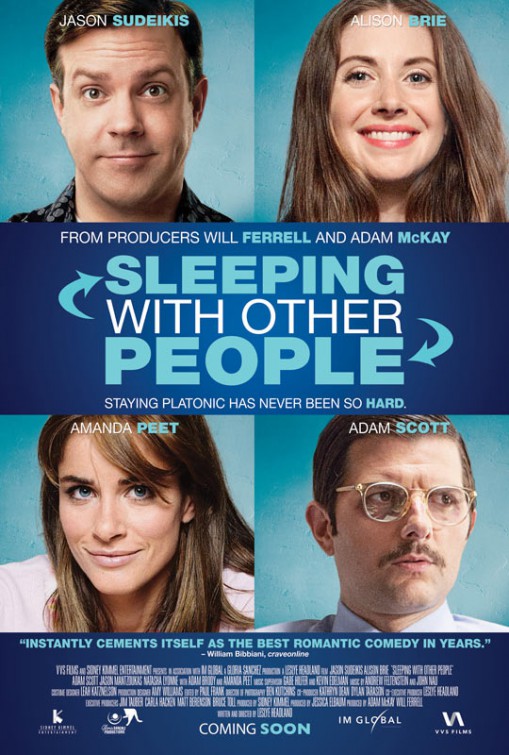
Man, it is really hard to sell a comedy, even
a romcom with a poster.


The main flaw with Sleeping With Other People is the inference that ex-SNL star Jason Sudekis and then-Community/Mad Men star Alison Brie were the same age, the story involving the fact that they first hooked up in college.  There's a very noticeable 7-year-gap between the two of them.  Sudekis has looked to be pushing 40 for over a decade while Brie was playing a teenager when Community started.  Even with a real-world 7-year-gap, it's still hard to reconcile how they could have met in college.  The movie pays it no mind, and carries on, and delivers an enjoyable, yet unassuming, and ultimately unmemorable romantic comedy.  But I just couldn't get past it.

The comedy is light, though the cast is talented, including Amanda Peet, Adam Scott in full dickbag mode, Jason Mantzoukas playing against type as a nice guy best friend, sharing a delightful relationship with Andrea Savage.  It's a solid watch but no real standout comedy bits, and neither the characters nor plot will stick with you.

[47:14]

---
Like, I mean, really hard to sell comedy
with a poster.

Another romantic comedy, Admission, is equally as unmemorable.  Paul Rudd and Tina Fey are a great comedic pairing, both immensely likeable alone and together, but something about this film just doesn't click.  The conceit of the film is a light expose of the rather political and jaded admissions process for elite universities.  Not only do they rigorously screen their applicants but they also scout for applicants, looking for the best and brightest, which may seem noble, except when you understand that it's all done for the prestige, to maintain the reputation, to keep the elite status, all of which keeps alumni and donor money coming in, as well as allowing the school to charge more for tuition.  Fey plays the head of admissions at one such prestigious school, but when an applicant coming from a troubled alternative school run by Paul Rudd shakes up her worldview, (plus a romantic connection with Rudd) will her staunch adherence to customs and rules override her conscience as it always has.  You know it won't.  Rudd's far too charming, and his whip-smart kid who takes such a shining to Fey couldn't help but sway her.  It's a sweet film, and the usual charismatic schtick from Rudd goes a long, long way in watchability, but it's so by the number that it's almost painful.  You've seen this type of story a dozen times, if not dozens upon dozens of times.  Depending on your preference for romcom, it may be comfortably familiar, or it may be monotonous.  If you're not into romcom, take a hard pass, this isn't the place to start.

[57:01]

---

I probably shouldn't have even bothered watching Elstree 1976, a documentary featuring a few of the peripheral faces (or masked faces) from the original Star Wars series.  I'm not sure that the film does much in the way of enhancing the Star Wars experience, beyond going into the minutiae of how the film's success has affected a handful of the lesser-known performers.  The journey it takes is from the modest, British backgrounds of the actors, and onto the stage of Elstree studios.  Their seemingly well-honed stories at this point tell of their feelings about the film before they knew what it would become, which honestly could be just as much fabrication for "good" storytelling as actual recollection.  The Star Wars nerd in me was hoping for some unseen goodies, some trinkets of Star Wars that only the people on the inside would have had, some insight into things that could have been but weren't...but this isn't the doc for that.  It's not even really a "making of" which the title would almost imply, but rather the journey of the people involved.  There's a large portion of the film spent on fandom, how these performers capitalized upon it, and the politics of being a convention attraction.  It gets rather petty, and silly, and would make a pretty funny series, actually (note to self... how do I watch Con Man: The Series).  The people all seem nice, but this doc is inessential at best for all but the diest of die hard Star Wars nerds.

[1:07:38]

---

Speaking of conventions, Mascots takes us into a behind the scenes look at the people who participate in an international mascot competition.  [Okay, yeah, a competition is not a convention.  It was a shitty transition and I'm sorry.]  This mocumentary comes to us from Christopher Guest, because it obviously comes from Christopher Guest.  In fact it too obviously comes from Christopher Guest.  In fact it's almost a knock-off, for so middling are the results that there's not much about this film that doesn't immediately make the viewer wish they were watching Best in Show instead.  It's loosely the same story/plot, only with a somewhat different cast of absurd characters.  Really, had all of guests movies just been that same variation of formula, this would just be another in a tired line at this point, instead it's a disappointment that Guest would return to the same well.  What Best in Show had going for it was the plausibility.  There may be mascot competitions out there, but where best in show was sending up the people an personalities behind an analog Westminster Dog Show, a fairly well known event facilitated in Madison Square Garden in New York, Mascots isn't replicating anything familiar to the audience.  As such the competition that is being put on feels absurd and unbelievable.  Maybe I will see a mascot competition someday and marvel at how absurd and unbelievable it really is, and maybe I'll cut Mascots a little slack for it, but until then it just feels overboard, too broad.  It really wouldn't matter if the film were funny, and it is in fits and starts, but it just never clicks.  It feels rushed, the characters don't feel as fleshed out, and it's hard to care too much or invest in any particular person's chance at winning.  I would have preferred a mockumentary about furries to this, to be honest, but that seems to ribald for Guest these days.

[1:18:17]

---
erm, spoiler alert?

I have to wonder why the tenuous "Cloverfield" connection.  Overtly I realize that "Cloverfield" is now a brand for the studio, and one that's making them some nice coin, but in-world, in-story there is literally no crossover, so why?  I would actually like a for-real sequel to Cloverfield, one which does not use hand-held camcorders and so much nauseating shakey-cam to see the monsters mash NYC, but that's not this film.

No, 10 Cloverfield Lane is instead a smart, taut thriller that has you guessing through to the third act.  The fantastic Mary Elizabeth Winstead is Michelle, run off the road and awakens to some serious injuries inside a bunker.  Her captor is an equally fantastic John Goodman as Howard, who claims to have rescued her. Something bad has happened outside and they can.not.go.out.there. lest the bad things come find them. There's a third party in the bunker, the defiant Emmett (John Gallagher Jr.), who confirms Howard's story, to a point.  Howard is gracious to his "guests" so long as they obey the rules.  The bunker is homey with a 1970's vibe, and everyone gets along, until they don't.  Howard is explosive when he feels challenged, or violated, and Goodman as ever uses his stature and presence to scary effect.  Invariably all is not as it seems, or is it?  The question of Howard's honesty ebbs and flows, and even Emmett is a constant unknown.  Are they good men?  What's really going on?  Things erupt in the third act and where the film could have gotten really mean and not provided answers it instead opts for a big budget Twilight Zone-reveal that is equally out of place yet thrilling pay-off (but still no connection to Cloverfield).  This one's rock solid.

(Here's David's take)
[1:30:35]

---
He really doesn't wear the gas mask that much
in the film to frame the poster around it

I could have made 10 Cloverfield Lane #10, but I chose not to, just to drive some people mad.  If you're driven mad by the fact that 10 Cloverfield Lane is not #10 for no real reason, then mission accomplished.

Arq is a fine little time travel thriller, which has the feeling of a small-scale Edge of Tomorrow [aka Live.Die.Repeat] or an English Time Crimes, or a bigger budget, more mainstream Primer or a non romcom Groundhog's Day.  In other words, it's in good company, carving out its own place in the living-things-over-again market.  As with some of those other films there's no real scientific rationality to why someone is living their life over and over again, but the fun is not in the reality of the situation, but the rules that the plot establishes.  If there's an apparent defined set of rules to how the time reset works, then it's all good, the audience can invest.  I love these stories, as they explore one event from a whole bunch of alternate possibilities.  It's tremendous fun, but Arq actually builds a story, a purpose to it, and even, in the background, a whole other world (which we don't ever really see or interact with).  It's quite great though, real pulp sci-fi with a winning couple of leads in Rachel Taylor and Robbie Amell. It teases bigger things I certainly would like to see and know more about and explore, but it's plenty satisfying on its own.

(read David's take)
[1:42:06]

-FIN-

Saturday, October 25, 2014

3+1 Short Paragraphs: Un Prophete

2009, Jacques Audiard -- Netflix

I cannot remember why, but this movie has been on the edge of my radar for quite some time. I vaguely recall a positive review by Roger Ebert. Also on the periphery of my mind is a scene of a man looking out a small window, perched high in the room considering his confinement and the world beyond.

Un Prophète is a French prison drama, about a young Arab boy (his racial origins & France's racial tensions play a part in the movie) sent to prison, straight from streets that have not treated him well. His face is stitched up, his arms and back are criss-crossed with scars and his clothes are only worth being tossed in a bin. We never really know what crime he committed or what happened to him before, because it doesn't matter. This prison is where Malik El Djebena becomes someone.

Malik goes into the prison young and afraid. He is not like the stereotypical strutting street thug ready to prove himself a criminal to his peers. He is merely there because life has led him there. And when the local prison Don, a Corsican named Luciani, coerces him into murdering another prisoner, Malik is torn and forever changed. He becomes the errand boy, the guy who makes the instant coffees, the guy who delivers messages, all for the Corsican criminals who run the prison with the obvious and unchallenged help of the prison officials themselves. And with this exposure, Malik doesn't leave the prison young, or afraid.

What was fascinating about how all of this was played out was that we are never really sure if Malik is meant for this life. He is not a bad man, but nor is he a man to stand up against evil. There is some commentary about how prison makes criminals of its residents, but this movie is more about Malik finding a place, a family and a direction for himself. The prophetic allusions are  somewhat unbalanced, as he has the only meaningful conversations of the movie with absent characters, who might represent his own more intelligent personality emerging. It is never clear and really, it does not play a big part. That he leaves the prison, leader not follower, ascribes some mystical overtones to what led him there, but really, the movie is more a personal evolution not a grand one.

Wednesday, July 23, 2014

3-1 Short Paragraphs: Escape Plan

2013, Mikael Håfström (The Rite) -- download

OK, I am going to stop posting about movies that I don't even have the attention span to stay in the room while watching, nor keep awake. I was doing dishes, wandering about. And I think I nodded off sometime just before the climax of the movie but I admit, that has been a problem of late, even if I am enjoying the movie. I have become my dad, sans armchair. But he was doing that at 7pm and I am doing it at 10pm.

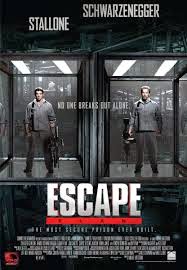
Arnie and Sylvester join together for a movie about professionally breaking out of prisons. Stallone is supposed to be the book writing expert, but really, I cannot take him seriously as he tries to sound educated while talking with a mouth full of marbles and hitting on his assistant. He gets stuck in a (do you really care about spoilers on this one!?!?) floating prison with Arnie, who actually comes off as rather intelligent, in comparison. Meanwhile, The Man in the Suit (Jim Caviezel) is a sadistic "warden" trying to foil their escape plan. There are expected plot twists, unrealistic escapes and lots of punching, shooting, unfortunate mook deaths (I felt kind of sorry for some of these guys, probably having taken the only security job they could find) and yawns.  And they escape.

Sunday, April 6, 2014

Muppets Most Wanted

2014, d. James Bobin -- in theatre

I'm an unabashed Muppets fan.  They trigger something very deep within me such that not only do I excuse the hacky jokes, the overt sentimentality and the evermore dated nature of their very being, but I embrace it all.  That being said, I understand full well how, in our lifelike computer generated entertainment culture, the Muppets seem remarkably limited on-screen, low-tech (no tech, actually) and that their appeal outside of wonton nostalgia is a challenge for the kids who didn't grow up with Kermit and the gang on their TVs or their dinner wear or their lunchbox.

The first movie traded in on the idea of this fading nostalgia exceptionally well, and by confronting it so fully, it's afforded the Muppets (as a commodity) some renewed relevance, allowing it to move past the mustiness and shake off the cobwebs.  In the wake of the Jason Segel/Nicholas Stoller/James Bobin "relaunch" the Muppets unfortunately didn't trade in on the film's success as much as they should have.  A one hour special during the Montreal Just For Laughs comedy festival, a wickedly confusing Lady Gaga/Muppets holiday special on Netflix, and the odd appearance on late night television and awards shows.  Strangely the viral videos that had launched the Muppets into renewed relevance in the first place started to slow in the film's wake.  It's almost as if the focus was all put towards doing a sequel.

Muppets Most Wanted picks up literally at the end of the previous Muppets feature with body doubles standing in for Segel and Amy Adams shot from behind.  Embracing their ability to pierce the fourth wall without utterly destroying it, they address that the previous film had wrapped, all the "adoring fans" seen in The Muppets closing number were all extras, and their triumphant return the previous film postulated wasn't their reality.  They then notice that one camera is still trained on them, which means that they must be doing a sequel.  Cue the film's first musical number "We're Doing A Sequel".

The Muppets exist in a strange reality. Though they never break the illusion that they're puppets, or acknowledge their operators, beyond that everything else is fair game.  The "story" of the Muppets is a non-linear and equally nonsensical one, which sees them performing as characters in films like Muppet Treasure Island or A Muppet Christmas Carol, and equally performing as themselves in The Muppets Take Manhattan or Muppets From Space, but this isn't their reality either.  They acknowledge at least half a dozen times that the preceding film was indeed a film, and not their actual reality, but at the same time they carry forth that same reality into Most Wanted of the struggling group of weirdos and anthropomorphic animals performing for a society that once-but-no-longer cares for them.

This leads them under the sway of Ricky Gervais' Dominic Badguy who promises them a successful European tour, offering much and undermining Kermit at every turn.  Dominic is partners with the world's most dangerous frog, Constantine, a thief who just escaped from a Russian gulag and who happens to look  just like Kermit, but with a mole on his face.  The scheming duo manage to replace Constantine for Kermit, who gets escorted off to the Russian gulag under the watchful eye of Tina Fey's doting warden, Nadia.  Then, while on tour, Constantine and Dominic (whose criminal nom-de-plum is The Lemur) use the cover of the Muppet Show to bust into museums and vaults neighbouring the theatres they perform in.  This brings together FBI agent Sam the Eagle and Interpol Agent Jean Pierre Napoleon (Ty Burrell in a fantastic Clouseau-inspired performance) in an awkward partnership to follow their trail, the only real hurdle to solving the crime being Napoleon's excessively liberal European work schedule.

The comic conceit of the film, that this thick- and unruly-accented frog could believably replace Kermit is probably it's most delightful aspect, is a great use of the classic absurdity of mistaken identity.  Yet the script twists it wildly with the cast of the Gulag (including, prominently, Ray Liotta, Jemaine Clement and Danny Trejo) recognizing rather quickly that Kermit is not Constantine.  Meanwhile, with promises of creative freedom and sellout shows (and giving them all what they want), the Muppets buy into Constantine-as-Kermit.

Constantine is the film's biggest treasure.  Despite my affection for the previous Muppets feature, I found its new character, Walter, a bit dull, so it pleases me that this film's new Muppet is so delightful.  Constantine's butchering of the English language, his terrible Kermit impersonation (which he believes is spot on), his elaborate but passionless wooing of Piggy, and his overbearing relationship with his Number 2 are ceaselessly entertaining.  Thanks to the work of Matt Vogel, Constantine may look exactly like Kermit (with a mole) but his physicality is altogether different and it really builds a new character beyond just the voice.

Flight of the Conchord's Bret McKenzie deservedly won an Oscar for one of his original songs from the previous film ("Man or Muppet").  My daughter has played the soundtrack endlessly in the intervening years and (beyond the unfortunate placement of Starship's "We Built This City (on Rock and Roll)") it's a great soundtrack with fabulous original and Muppet-ized songs.  The new soundtrack tops it.  McKenzie's 6 new songs are each infectious gems, better in context, but great on their own.  They genre hop from ragtime to doo wop to soul culminating in the over-the-top ballad "Something So Right" featuring Celine Dion.  The songs manage to hit the irreverent humour the Conchords are known for but also carry the story of Muppets Most Wanted forward and even tossing some emotion and character development in there.  They are a feat and should likely net McKenzie another Oscar.

I should note that my four year old reacted rather negatively to the film.  There was a lot of crying and a general anxiousness as she watched the movie.  It was largely a result of Constantine, she said, and I think more than the performance of the character it was the effectively intense score from Christophe Beck (another little girl in front of us was also notably frightened by the film), leading to two restless nights.  So this one, strangely, may not be for all young viewers.