Showing posts with label corruption. Show all posts

Saturday, July 26, 2025

3 Short Paragraphs (Or Not): Havoc

2025, Gareth Evans (The Raid: Redemption) -- Netflix

I am doing something I don't consider very often, if ever -- started the stub post before I am even half way through the movie. I barely ever watch movies straight through these days, but this one jumped out at me almost immediately that screamed, "Do some research, find out why you are seeing what you are seeing on the screen." So, I paused and here I am.

Literally from the get go, which starts the movie with a chase scene -- cops after a semi-truck driven by thieves in LED masks, you can see that .... well, none of it is real. There are little to no practical effects  happening here, almost the entirety of the scene is CGI & greenscreen and, well this is why I had to go and Google it, maybe some AI. From the chase scene we go to the dirty, grimy unnamed American city which is so CGI enhanced I could easily think I was watching a movie set in the same Batman world of Penguin. It was all very very surreal to look at. And yet, somehow alluring and... successful?

I could not shake the feeling I was playing a computer game.

Later; having watched what remained. Said research told me this was an Evans movie, but that became apparent soon after I passed the above preamble.

And for maybe for that reason, it really appealed to me?

At its core, this is a Gareth Evans movie, i.e. an Asian ultra-violent action movie. How exactly does a label stick to a guy after such a short career? He so very much veered away with The Apostle which traded in his Indonesian martial arts and gunplay for ... his own roots? It was a familiar UK rural horror mystery. Evans is Welsh. This movie returns to his earlier successes but given I didn't know that going in (it was a Tom Hardy violent cop movie on Netflix; perfect for my current mindset), I was kind of surprised once it became apparent.

OK. Walker (Tom Hardy, Taboo) is a corrupt cop in a nameless American city that mashes up Chicago, NYC and Gotham, but a man with some regrets. The opening violent CGI rendered chase scene ends at a Triad club where a couple of the heist kids are paying off some debt to a gangster named Tsui, when a trio of hockey-masked gunmen come in and shoot up the place. When Walker shows up, rookie "not-partner" Ellie (Jesse Mei Li, Shadow and Bone) in tow, it becomes apparent the kids were not the shooters, like all the cops on scene want to assume, but escaped after being caught in the wrong place at the wrong time. Also, one of the kids is Charlie (Justin Cornwell, Bel-Air), the son on a wealthy & powerful, but corrupt, city official (Forest Whitaker, Andor) whom Walker is also under the thumb of. This is all well trod dirty cop movie territory.

At this point, the Peanut Gallery, wandered in during one of my sessions, and asked, "Is that supposed to be snow? It looks more like ash...." Yes, the CGI continues throughout the movie making the Xmas setting look more post-apocalyptic when the AI prompt was likely "make the snow look dirty".

The above establishing act is followed by two acts where Walker learns what is going on, and tries to get the kids to safety while being chased by the Triad who assumes the kids killed Tsui. There are a lot of Triad members -- like an endless stream of video game spawned NPCs. The three hockey-masked gunmen (including Timothy Olyphant The Mandalorian), who turn out to be Walker's fellow corrupt cops, have not taken well to his emerging regrets about being dirty, and also want the kids dead, as witnesses / survivors. Everything is tied together, to Walker, to each other, to the corruption at the heart of the movie.

The second act takes place in a club, their John Wick moment, but replacing the precise gunplay of that movie with frenetic blade & gun & kicks. This fight scene is crunchy. Part of me chuckled as I was reminded of the Burly Brawl, doors constantly opening, spilling forth even more Triad gang members, giving us a triangle of violence. With some sacrifices, Walker and the kids escape.

The convoluted, not very clearly mapped plot ends up leading everyone to Walker's hideout, a shack of oddly connected, barely standing rooms that struck me more as the setting for a gun-toting escape room than a movie set. Again, NPCs galore, all shooting and stabbing and kicking each other, ending in a reveal of who-killed-who-why. Its all rather ridiculous, with the fake blood spraying in gouts worthy of a slasher movie, and a pretty-much-everyone-dies moment but that's what we wanted here, right?

Critics seem to hesitantly love the movie, maybe because Evans so unabashedly loves the genre he choses to embrace. The mashup of Asian action "kung fu friday" cinema with dirty cop & neo-noir setting work well for the film minded, but the audience.... not so much. I can see why. On its dirty-snow surface, its almost a farce. But I enjoyed myself.

Thursday, November 28, 2024

3 Short Paragraphs (Or Not): Rebel Ridge

2024, Jeremy Saulnier (Green Room) -- Netflix

It would be an interesting study (to only you) to look back on all my posts where I ponder the type of movies I watch -- the guilty pleasures, the ones I feel I Should Watch, the ones I basically hate watch (shit I know will be shit and yet, there I go), the really good stuff that I never get around to watching (Parasite I [still don't] see you) and the transitions from a That Guy who started a blog stating he "was into movies and had something to say" to whatever This Guy is. And more likely, of late, the movies that will just sit square in the middle... genres I like but I don't expect much more than a familiar tune from, big old "meh" movies.

I am not sure where this movie lies. It is very very much the typical Straight To kind of movie with few Named Faces and a director with only one lauded title that I am aware of -- the absolutely emotionally chilling Green Room. But, almost immediately, I saw this was rather a passion project, crafted with such care as to not only present the formula as expected, but also fly in the face of it all.

The formula? First Blood -- a discharged military man is abused by local authorities and fights back. The difference? He doesn't kill a single fucking person. I was about half-way through the movie when I realized this was how it was going to play.

I also have to admit, I was somewhat triggered by the premise as it started -- another movie about black men in America at the mercy of an authority that sees them as fodder. It was just after Nov 6 that I started watching this movie, and while its not just black America that will be abused by the coming regime, its not going to get any better. Its that I tire of seeing it, but it makes me despondent, especially after the movie lays it out so well that the abuse heaped upon him is entirely legal. But after turning it off for a bit, I returned.

Terry Richmond (Aaron Pierre, Old), Marine vet, rides his bike into a small town in Louisiana when the cops literally knock him from his bike. He had his headphones in and didn't notice them tailing him. In his backpack is $36k in cash, which he is going to use to bail out his cousin and buy a truck to start a business. His cousin was caught on a misdemeanour but is in real danger, in prison, because he was a witness to a greater crime. The cops take the money on suspicion of... whatever. When Terry talks to a court clerk about the matter, she tells him quite frankly it would be over a year before he could legally get the money back, if he even could.

Rather than taking it lying down, he goes to the police station to report the money as stolen. Not sure why but for the fact he is a man used to standing up for himself. That leads him to confront police chief Sandy Burnne (Don Johnson, Doctor Odyssey), which is ... not a good move. Despite the police chief appearing to act reasonable, and even telling Terry he will give him back the $10k to bail out his cousin, on Monday morning they transfer his cousin early. Terry's cousin is killed in holding.

I won't go through every plot detail but following the formula, the movie has the Bad Guys push Terry too far and he has to "take the law into his own hands". But he does so... without lethal force. Terry was not the cliche skilled killer who came back from overseas with a chip on his shoulder. In fact, he was never deployed. He was a close quarters combat expert who was seen more valuable on American soil training other soldiers. The corrupt police have a conspiracy in play manipulating the system so as to hide any transgressions they may perform, as they were already under the state's eye after getting caught in such behaviour years ago -- the movie assumes they have always been abusing suspects, and continue to do so. They now do everything in their ability to keep the police force running "legally" by hiding their own crimes in technicalities, no matter who it hurts.

The movie is thoughtful, in that it thinks on each situation it is dealing with and replaces spectacle with measure response. Terry doesn't come in guns blazing shooting every cop he sees until he has his revenge. He actually takes their "deal", which is disheartening in its own right, until they violate it by hurting the clerk who helped him. When he does fight back, it is just to guilt/force one of the force into helping him turn over evidence on all the dealings. Of course, it is a thriller and not a crime procedural or law potboiler, so there have to be stand-offs and action filled scenes. But they all have reasons for being instead of just blowing shit up for the sake of fireballs.

It was a surprisingly solid movie, definitely still in my genre-filler category, but thankfully, a bit risen above the usual fare.

Wednesday, January 4, 2023

Fernando Di Leo's The Milieu Trilogy

Caliber 9 ("Milano Calibro 9" - 1972)
The Italian Connection ("La Mala Ordina" - 1972)
The Boss ("Il Boss" - 1972)
directed by Fernando Di Leo - The Criterion Channel

I hadn't even heard of these films before, so what exactly prompted me to spend five-and-a-half hours watching 70's Italian exploitation cinema? Well, I do love an exercise in cinema, and with the trio of films being added this January to the Criterion Channel as part of their ensemble of Di Leo's "Italian Crime Thrillers", being dubbed a trilogy, and, well, being cited as by Tarantino as influential to his career... yeah, I took the bait.  

At this point I need to realize that pretty much every movie that Tarantino ever saw was influential to his career, and that no single film or filmmaker is going to reveal any specific insight into what makes him the filmmaker he is.  It's the sum total of everything he consumed that does that, and the more time I spend with Tarantino's film criticism, from his new book Cinema Speculation as well as his podcast "Video Archives" (with Roger Avery), the more I see that he's just got a unique brain with a memory for film (shots, music, performances, lines, trivia, history etc) unlike almost anyone else on the planet.  He's just a hardcore nerd about these things, and his ability to dissect cinema into its subcomponents and tease out what may make a film unique from almost anything else of its ilk is a talent that may be uniquely his own.

And so watching these three films of Fernando Di Leo, I can absolutely see Tarantino totally digging these crime thrillers with an appreciation of the various performers, the director, the composers, knowledge of Italian cinema, and knowledge of Italy of the 70's (at least through the lens of cinema).  If I had all that stashed in my brain I might appreciate these films more than I do.  But honestly, coming out of a near 6-hour marathon, I felt like I could have put my cinematic viewing somewhere else, somewhere perhaps more rewarding (like the trio of Fritz Lang films added to Criterion Channel, or tackling some of the more intriguing films from various top ten of '22 lists).


But, some might say, every film viewed is a learning experience.  Of the "Milieu Trilogy", the first, Calibre 9, was the most interesting, and, at least to my eye, the most visually accomplished.  An intriguing, surprisingly, and unfortunately relevant subplot has a police chief and his new associate arguing over what manner of crime they should be focusing on. The chief is stuck in his old mindset of reactionary policing, busting up gangs and tamping down on the civic unrest (student protesters, reactionaries - of what, I'm not sure) whereas his new transfer wants to address the crimes of the rich, the withdrawal of wealth out of the country, and the abuses perpetrated on the working class.  It sounds like a very modern arguement.

There's equally an interesting conversation on the criminals' side where an old mafia don laments that there is no mafia anymore, just gangs fighting one another, stealing from each other, lacking the honor and respect of the old ways. There is an argument in Di Leo's third film, The Boss, made by a different police chief to his superintendent that at least the mafia used to maintain a sense of order, a sense of keeping everything in its place. These gangs, the protesters, all of it is just chaos.

Unfortunately, in Caliber 9, of these two topics of conversation, only the latter is actually of relevance to the story as it plays out.  It's really a tale of criminals and their distrust of one another, the lack of loyalty and honour that was supposedly found in the mafia is gone.  Here, $300,000 US of the Americano's money goes missing in an elaborate exchange. Most of the middlemen have been interrogated or killed but one is released from from prison 3 years later, and immediately the Americano's thugs are up his ass even though he professes no knowledge or involvement the theft. What follows is a spinning yarn of cops, thieves, mobsters, gangster and all the conniving and fighting that goes on amongst them all.

Gastone Moschin is a compellingly stoic lead, with a very Statham-esque aesthetic.  One wonders how a mug like that can pull the devotion of a beauty like Barbara Bouchet but that's all part of it.  There are a lot of great cinematic moments, some really neat scenes in Caliber 9, but the perhaps necessary dubbing of the entire film, some frequently poor lighting, an occasionally tonally out-of-step score, plus a few really hammy actors kind of bring an otherwise engrossing film down a peg or two.


The second film of the triology, The Italian Connection, largely dispenses with the social commentary.  Here, a pair of American hitmen are assigned to take out a pimp in Milan to send a message to the local mob. The local mob leader also send their men after the pimp. The pimp is completely in the dark as to why he's being hunted so, but he quickly learns nowhere is safe, no one can be trusted, and his only defense is to go on the offensive.

Without the social commentary of Caliber 9, this entry in the trilogy feels like a huge step down from what came before.  There are more internationally recognized actors (including Henry Silva, Woody Strode, Adolfo Celi, and Luciana Paluzzi, the latter two both prominently from Thunderball) so it does feel like the talent pool has gone up, and Mario Adorf is a lot less hammy promoted to lead here (he was as a secondary villain in Caliber 9).  But it's all a bit of a mess (so much of the Italian dubbing is clearly over English dialogue, there's a really muddled focus for the first hour, a lot of leering and gratuitous nudity, plus some really crummy dialogue), especially for an action-oriented thriller. The characters don't really pop like they probably should (Silva and Strode were apparently the inspiration for the hitmen of Pulp Fiction but beyond being a 70's black-and-white odd couple, I don't see it), and the fighting looks quite silly most of the time. There is a good, propulsive chase sequence to close out the second act, which comes close to redeeming the film (if Adorf were Jackie Chan, it'd be a completely different story, as appealing a performer as Adorf is in a Bruce Campbell kinda way, he's not much of an action star).  A great jazz funk score from Armando Trovajoli though, is the best part of the film (both Caliber 9 and The Boss are scored by Luis Bacalov, who pulls elements from the former back into the latter, and the score works much better with The Boss, where it's also a highlight)


The third act of this trilogy, The Boss, seems thinly drawn when in its wake has come so many epic tales of mobsters, gangsters and the mafioso. The intention of the film is clearly to show the breakdown in the organization of crime in Italy at the time, as well as to heavily implicate government, police and institutional corruption in the current state of the country.  Like Caliber 9, we spend many asides with the police, who are just as ineffective here as the were in the first part of the trilogy.  Hamstrung by corruption both within their forces and the systems of government above them, they hope that the criminals effectively "take care" of each other, doing what they cannot.  In this film, for sure, it's all out war between different mobs, fuelled by Henry Silva's enforcer's over-the-top actions in taking out one branch of the local mob.  This leads to a revenge kidnapping, and then a lot of tit-for-tat, before Silva, as our main character, decides to just liberate himself from all of it.

An undercurrent in all three of these films is the student protests, and I don't know enough about Italy circa the early 1970's to know what the students were protesting.  In The Italian Connection, there's talk of Maoism and a very confusing statement about "Where will we put 600 million Chinese people when they come?"  Are the protestors anti-communism or supporting communism?  Whatever it is, the message is clearly of its time and place, and whatever influence it has on the story seems trapped there.

All three of the films, but The Boss especially have a particularly difficult time with women. Mainly leered at as sex objects, they're also slapped around, beaten and killed off quite callously.  In The Italian Connection, Paluzzi plays guide to the hitmen, capably navigating the streets and the people, only to be dragged to a meetup by the hitmen to draw fire.  Also in the Italian Connection are a lot of sex workers who seem to garner no respect (though I think we're to think that Adorf's pimp treats them respectably...for a pimp, making him sort of a good guy, at least comparatively).  In The Boss, pretty much the only female character is the mobster's daughter Rina (Antonia Santilli) who gets kidnapped, but turns out to be a "drug addict nympho" who doesn't seem to mind at all sleeping with any of her captors, and seems to not be fussed being slapped around alot.  She also spends most of the film in some form of undress. The misogyny is always the worst part of exploitation films, but films in recent years have trained me to wait for the turn in these characters, something to draw them out of the exploitation, and very much it's waiting here for something that never comes.

While perhaps not a complete waste of time, but it also wasn't that rewarding watching these.  Caliber 9 is the most interesting and has the most to say, while there are action films far better than The Italian Connection and mob war movies far better constructed than The Boss to partake in.  

Tuesday, April 21, 2020

3 Short Paragraphs: 21 Bridges

2019, Brian Kirk (lots of TV including Game of Thrones) -- download

The only thing I really knew Chadwick (why not just Chad?) Boseman from before the Marvel movies was Gods of Egypt, so yes, entirely forgettable. But since then, well... there is nothing else; he is just T'Challa and I have trouble seeing him as anything else. Especially when he speaks out loud. Not that I expect an African accent to come out of his mouth, but to hear him speak American just sounds... off. That said, he's doing his best to build a career in spite of Marvel, with a smattering of crime movies since he first appeared in Civil War; 21 Bridges is the latest.

The character is set in stone as the son of a murdered cop who grows up to be the detective with the reputation for not just pulling his sidearm, but putting the bad guys down. He believes in justice, he believes in just retribution. They play this like it will be a key point to the story, but its just a plot device for him to be used. When eight policemen are gunned down during what appears to be a botched robbery of a drug dealer, he is called in because every cop in NYC wants these criminals dead, and who better to do it. He is the blunt weapon for their blue rage.  That is, until he notices something was off about this whole deal and he needs the gunmen alive in order to unravel the mystery.

This movie is crafted in the shadow of cop movies of old, back in the time when the NYC was infamous for its corruption and dirty cops. Its not a spoiler, as the idea is pretty much written in neon from the beginning. But that's not the point, as it is about determining what the conspiracy was as opposed to foiling it. Boseman, like Taylor Kitsch and JK Simmons, get interesting characters to play, but not much use is made of them.  We get hints of where a much more interesting movie could have gone, such as making the criminals somewhat sympathetic, or the actual title of the movie, where Bosemen gets brief permission to close all access and egree points to Manhattan. But then they just rush to the conclusion of a Straight To crime flick.

Saturday, July 22, 2017

10 for 10: the "stuff I watched last year" Edition

[10 for 10... that's 10 movies which we give ourselves 10 minutes apiece to write about.  Part of our problem is we don't often have the spare hour or two to give to writing a big long review for every movie or TV show we watch.  How about a 10-minute non-review full of half-remembered scattershot thoughts? Surely that's doable?   ]

In this edition:
1. The Martian (TMN on demand) - 2015, d. Ridley Scott
2. Hunt for the Wilderpeople (in theatre) - 2016, d. Taika Waititi
3. Midnight Special (VOD) - 2016, d. Jeff Nichols
4. The Big Short (Netflix) - 2015, d. Adam McKay
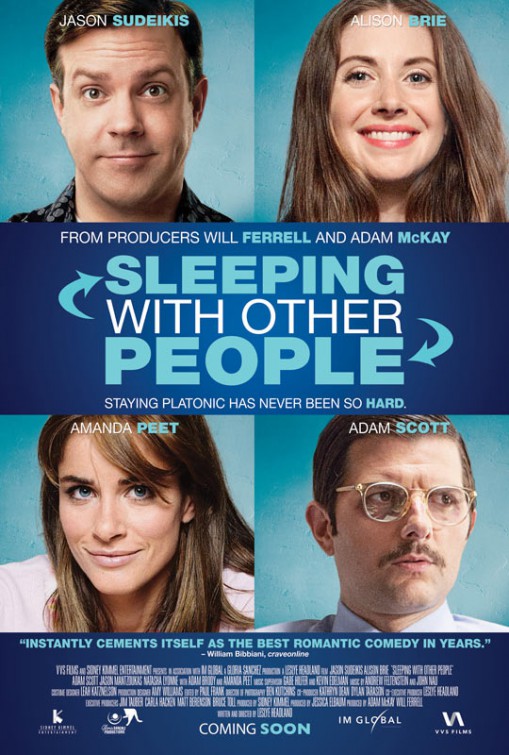
5. Sleeping With Other People (Netflix) - 2015, d. Leslye Headland
6. Admission (Shomi) - 2013, d . Paul Weitz
7. Elstree 1976 (Netflix) -2015, d. Jon Spira
8. Mascots (Netflix) - 2016, d, Christopher Guest
9. 10 Cloverfield Lane (Netflix) - 2016, d. Dan Trachtenburg
10. ARQ (Netflix) - 2016, d. Tony Elliott

aaaand...go

---


The Martian should have been something I saw in theatres, but it wasn't a big tentpole sci-fi, superhero or fantasy movie, and Ridley Scott isn't one of our "always see" directors.  Also, I've realized Matt Damon just isn't a draw for me.  I like him just fine, but he's never going to sell me on a movie on his own.  Sooo, it kind of languished, not for anything other than lack of time or access.  When we got the movie package last year for Game of Thrones, well, The Martian was there waiting.  And hey, it was good.  Entertaining, full of "Fuck Yeah, Science" moments (what was it?  "I'll science the shit out of this"? Eh, I don't recall).  It was a nice story of survival, but it was trying for a lighter, feel good tone, and a such there wasn't a terrible amount of drama.  I mean, we're not talking Castaway isolation (in terms of not having any other cast to cut away to), but for height of the stakes for ol' Matt Damon, there wasn't a lot of tension.  I think it may be a plausibility thing, the fact that we haven't actually landed anyone on Mars yet.  Sure, there's the potential, but we're just not at reality yet.  I liked it but it hasn't stuck with me.  And I couldn't help but think of this as related character to Matt Damon's role in Interstellar, and there's a lack of consistency between the two characters (both stranded on planets) that just bugged me.

(David has a great write-up from long ago...and also mentions the Interstellar thing)
[8:58]

---

The Hunt For The Wilderpeople  is now on Netflix, and it probably deserves a rewatch.  Any of Taika Waititi's directorial efforts do, in fact.  His first effort, Eagle vs Shark, was very much the Napoleon Dynamite of the New Zealand set, while the mocumentary What We Do In The Shadows has become an evergreen favourite because of its genre trappings.  Hunt For The Wilderpeople has a title that insinuates genre trappings, but is actually an exceptionally enjoyable, warm and funny (with a sombre undercurrent ) comedy about a young orphan boy, Ricky (Julian Dennison), in New Zealand who has behavioural problems, but is taken in by the sweetest, kindest-hearted woman anyway.  Her husband, a staunch, crotchety Hec (Sam Neill), doesn't really want much to do with the kid, and keeps to himself most of the time.  But the new surrogate mother figure suddenly passes away and Hec finds himself in a position he never wanted to be in, a mentor and father figure, and it a role he resoundingly rejects.  Faced with returning to state custody, realizing he's had his last chance at finding a home,  Ricky runs away.  Hec knows where he's going, and reluctantly sets out to bring him back.  In the trip on return, the two, as expected, bond, but in ways unexpected.  It's themes are well trod, but it's the way in which the story is told, Waititi's wry yet uproarious humour, and a very deliberate pacing and film style which make this one worth not just watching, but treasuring.  Waititi's next venture is Thor: Ragnarok for Marvel, which should be amazing.

[19:28]

---

I just wrote about Stranger Things, FINALLY,  and how spectacular it was, in large part due to its  1980's sensibilities.  Not just homage, or attempting retro trappings, but achieving a genuine sense of the era, a sense of belonging, of being of the '80's.  Jeff Nichols' Midnight Special strives for much of the same, and achieves to a certain extent.  There's the definite sensibilities of 80's genre dramas like John Carpenter's Starman or Spielberg's E.T., the type of movie that doesn't want to wow with special effects or any genre trappings, really, outside of one small conceit.  Here, it's a young boy who has a supernatural ability, an inner light that can manifest itself in both helpful and destructive ways.  The boy's father (Michael Shannon) has to extricate him from a cult-like religion and the pursuing governmental forces, both of whom have ill designs for the boy.  The chase is a fraught one, and seeing the lingering impact of the religious teachings on both the father and son is much of the meat of the story.  It's a sombre road movie, with Shannon's expert brooding carrying the bulk of the film on his shoulders.  I'm still not certain the retro 80's aesthetic (despite being modern day) helps the story much.  It's a pastiche for sure but using it would imply that it was more exciting or fun.  It has a pretty distinct ending, one which a viewer could go either way on (it could be too much, or make the viewer wish there were more of it).  It's a sad film, overall, but worth the journey.

(David watched it too and remembered far more details than I did)
[30:31]

---
I like the composition of the arrows but
there's just too much white space here.
I think the fact that the top and bottom
arrows are longer than the left and right
arrows is also part of the problem


The 2008/2009 housing crisis was a real shit show, and it had been brewing for years, due to a lack of regulatory oversight or industry foresight.  It was also the product of immense greed, the brainchild of the richest of assholes trying to get more money for the rest of the richest of assholes.  The fact of the matter is, the stock market is lost on the layperson for the most part, which allows the people that work in the industry, and the government agencies that oversee it, to do whatever the fuck they want to manipulate it to keep the money flowing in from ignorant investors and circulating among themselves.  The Big Short is a big-name cast movie (Christian Bale, Ryan Gosling, Steve Carrell, among many many others) that dives into what actually happened, and expresses it in a way that may still be a little too inside baseball for some, but with enough entertainment value that you'll get the gist if not the specifics.  Frequent Will Ferrell collaborator Adam McKay does an impressive job with this dense and dry topic, presenting it in such a way that you get angry but are still engaged with the story and the characters.  At the time, it was a fairly important movie, but important movies usually only get seen by people who already know the topic.  I don't think the Big Short reached enough of the laypeople audience to really measure an impact. People just knew they got screwed, and for a lot of them it was such a sore subject they just didn't want to know how.  They would rather be distracted.

[39:13]

---
Man, it is really hard to sell a comedy, even
a romcom with a poster.


The main flaw with Sleeping With Other People is the inference that ex-SNL star Jason Sudekis and then-Community/Mad Men star Alison Brie were the same age, the story involving the fact that they first hooked up in college.  There's a very noticeable 7-year-gap between the two of them.  Sudekis has looked to be pushing 40 for over a decade while Brie was playing a teenager when Community started.  Even with a real-world 7-year-gap, it's still hard to reconcile how they could have met in college.  The movie pays it no mind, and carries on, and delivers an enjoyable, yet unassuming, and ultimately unmemorable romantic comedy.  But I just couldn't get past it.

The comedy is light, though the cast is talented, including Amanda Peet, Adam Scott in full dickbag mode, Jason Mantzoukas playing against type as a nice guy best friend, sharing a delightful relationship with Andrea Savage.  It's a solid watch but no real standout comedy bits, and neither the characters nor plot will stick with you.

[47:14]

---
Like, I mean, really hard to sell comedy
with a poster.

Another romantic comedy, Admission, is equally as unmemorable.  Paul Rudd and Tina Fey are a great comedic pairing, both immensely likeable alone and together, but something about this film just doesn't click.  The conceit of the film is a light expose of the rather political and jaded admissions process for elite universities.  Not only do they rigorously screen their applicants but they also scout for applicants, looking for the best and brightest, which may seem noble, except when you understand that it's all done for the prestige, to maintain the reputation, to keep the elite status, all of which keeps alumni and donor money coming in, as well as allowing the school to charge more for tuition.  Fey plays the head of admissions at one such prestigious school, but when an applicant coming from a troubled alternative school run by Paul Rudd shakes up her worldview, (plus a romantic connection with Rudd) will her staunch adherence to customs and rules override her conscience as it always has.  You know it won't.  Rudd's far too charming, and his whip-smart kid who takes such a shining to Fey couldn't help but sway her.  It's a sweet film, and the usual charismatic schtick from Rudd goes a long, long way in watchability, but it's so by the number that it's almost painful.  You've seen this type of story a dozen times, if not dozens upon dozens of times.  Depending on your preference for romcom, it may be comfortably familiar, or it may be monotonous.  If you're not into romcom, take a hard pass, this isn't the place to start.

[57:01]

---

I probably shouldn't have even bothered watching Elstree 1976, a documentary featuring a few of the peripheral faces (or masked faces) from the original Star Wars series.  I'm not sure that the film does much in the way of enhancing the Star Wars experience, beyond going into the minutiae of how the film's success has affected a handful of the lesser-known performers.  The journey it takes is from the modest, British backgrounds of the actors, and onto the stage of Elstree studios.  Their seemingly well-honed stories at this point tell of their feelings about the film before they knew what it would become, which honestly could be just as much fabrication for "good" storytelling as actual recollection.  The Star Wars nerd in me was hoping for some unseen goodies, some trinkets of Star Wars that only the people on the inside would have had, some insight into things that could have been but weren't...but this isn't the doc for that.  It's not even really a "making of" which the title would almost imply, but rather the journey of the people involved.  There's a large portion of the film spent on fandom, how these performers capitalized upon it, and the politics of being a convention attraction.  It gets rather petty, and silly, and would make a pretty funny series, actually (note to self... how do I watch Con Man: The Series).  The people all seem nice, but this doc is inessential at best for all but the diest of die hard Star Wars nerds.

[1:07:38]

---

Speaking of conventions, Mascots takes us into a behind the scenes look at the people who participate in an international mascot competition.  [Okay, yeah, a competition is not a convention.  It was a shitty transition and I'm sorry.]  This mocumentary comes to us from Christopher Guest, because it obviously comes from Christopher Guest.  In fact it too obviously comes from Christopher Guest.  In fact it's almost a knock-off, for so middling are the results that there's not much about this film that doesn't immediately make the viewer wish they were watching Best in Show instead.  It's loosely the same story/plot, only with a somewhat different cast of absurd characters.  Really, had all of guests movies just been that same variation of formula, this would just be another in a tired line at this point, instead it's a disappointment that Guest would return to the same well.  What Best in Show had going for it was the plausibility.  There may be mascot competitions out there, but where best in show was sending up the people an personalities behind an analog Westminster Dog Show, a fairly well known event facilitated in Madison Square Garden in New York, Mascots isn't replicating anything familiar to the audience.  As such the competition that is being put on feels absurd and unbelievable.  Maybe I will see a mascot competition someday and marvel at how absurd and unbelievable it really is, and maybe I'll cut Mascots a little slack for it, but until then it just feels overboard, too broad.  It really wouldn't matter if the film were funny, and it is in fits and starts, but it just never clicks.  It feels rushed, the characters don't feel as fleshed out, and it's hard to care too much or invest in any particular person's chance at winning.  I would have preferred a mockumentary about furries to this, to be honest, but that seems to ribald for Guest these days.

[1:18:17]

---
erm, spoiler alert?

I have to wonder why the tenuous "Cloverfield" connection.  Overtly I realize that "Cloverfield" is now a brand for the studio, and one that's making them some nice coin, but in-world, in-story there is literally no crossover, so why?  I would actually like a for-real sequel to Cloverfield, one which does not use hand-held camcorders and so much nauseating shakey-cam to see the monsters mash NYC, but that's not this film.

No, 10 Cloverfield Lane is instead a smart, taut thriller that has you guessing through to the third act.  The fantastic Mary Elizabeth Winstead is Michelle, run off the road and awakens to some serious injuries inside a bunker.  Her captor is an equally fantastic John Goodman as Howard, who claims to have rescued her. Something bad has happened outside and they can.not.go.out.there. lest the bad things come find them. There's a third party in the bunker, the defiant Emmett (John Gallagher Jr.), who confirms Howard's story, to a point.  Howard is gracious to his "guests" so long as they obey the rules.  The bunker is homey with a 1970's vibe, and everyone gets along, until they don't.  Howard is explosive when he feels challenged, or violated, and Goodman as ever uses his stature and presence to scary effect.  Invariably all is not as it seems, or is it?  The question of Howard's honesty ebbs and flows, and even Emmett is a constant unknown.  Are they good men?  What's really going on?  Things erupt in the third act and where the film could have gotten really mean and not provided answers it instead opts for a big budget Twilight Zone-reveal that is equally out of place yet thrilling pay-off (but still no connection to Cloverfield).  This one's rock solid.

(Here's David's take)
[1:30:35]

---
He really doesn't wear the gas mask that much
in the film to frame the poster around it

I could have made 10 Cloverfield Lane #10, but I chose not to, just to drive some people mad.  If you're driven mad by the fact that 10 Cloverfield Lane is not #10 for no real reason, then mission accomplished.

Arq is a fine little time travel thriller, which has the feeling of a small-scale Edge of Tomorrow [aka Live.Die.Repeat] or an English Time Crimes, or a bigger budget, more mainstream Primer or a non romcom Groundhog's Day.  In other words, it's in good company, carving out its own place in the living-things-over-again market.  As with some of those other films there's no real scientific rationality to why someone is living their life over and over again, but the fun is not in the reality of the situation, but the rules that the plot establishes.  If there's an apparent defined set of rules to how the time reset works, then it's all good, the audience can invest.  I love these stories, as they explore one event from a whole bunch of alternate possibilities.  It's tremendous fun, but Arq actually builds a story, a purpose to it, and even, in the background, a whole other world (which we don't ever really see or interact with).  It's quite great though, real pulp sci-fi with a winning couple of leads in Rachel Taylor and Robbie Amell. It teases bigger things I certainly would like to see and know more about and explore, but it's plenty satisfying on its own.

(read David's take)
[1:42:06]

-FIN-

Sunday, October 16, 2016

31 Days of Halloween 2016: The Hallow

2015, Corin Hardy -- download

As a D&D player, sometimes you see a monster in a movie and ponder, "That thing is a pretty low level, why so dangerous?"  OK, maybe just me. But seriously, any Fighter worth their level could have taken out the Ghoulies or even zombies. But if average people in movies are zero-level, then maybe you can accept them being torn to bits by 1/4 CR monsters. Now turn the tables, and take a rather innocuous monster from a D&D game, say evil Fey, and toss them against a government official and his wife. Instant horror movie.

OK, maybe not that silly.

But The Hallow (not the Hollow) is basically that, as creatures that would go well into any D&D game become the monsters in our world. Adam is the conservationist hired by the Irish government to identify regions of the ancient Irish forests that will be opened up for logging. I guess they imagine a conservationist will control it well enough, so it doesn't end up looking like British Columbia. But the locals don't buy it, and one even gets rather violent over it. But his concern is not exactly with the forest, but with what lives in the forest.

Adam find the horror staple -- black goo -- but with some quick study finds it to be a fungus with qualities like the cordyceps fungus, i.e. it takes over what it infests. And he finds signs of it in his house. Things between him and the violent local escalate, but Adam doesn't guess that the people messing with him and his wife are not quite human. And then they escalate their attacks, assaulting him in his car and his house, stabbing him in the eye in the process, a thin needle grown from that black fungus. It is very clear they are being attacked by something not human. Adam is infected and the creepy little Fey monsters (or are they just people & animals converted by the fungus?) steal his child. It takes him too long to remember that cold iron can help defend against the nasty things.

I loved the connections to old faeries tales and Irish dark mythology. The forests once covered Ireland until we burned and cut them down. The Fey were driven deeper and deeper into the wood. We essentially burned out the fungus. But why do they need a human child? What driving biological force needs a small human? Myth and biology blur in the terror and Adam is just in desperate need to protect his family before he turns.

Saturday, January 2, 2016

I Saw This!! What I Have Been Watching (Pt. 1)

Its been a while since I did a TV "What I Am Watching" and many things have faded into the "I Saw This!!" category. So, combined.

Limitless is based on the Bradley Cooper movie, and surprisingly is not a TV remake, but a continuation of the story. Eddie Mora has become Senator Edward Mora and the super brain drug NZT is still out there, but now in the hands of the FBI. Slacker wannabe rockstar kid Brian Finch becomes the new This Is Your Brain On Drugs guy when he gets mixed up in a murder plot involving an old friend who has hit it rich -- with the help of NZT. We think they might be resurrecting the conspiracy from the movie, but no, just a conspiracy of the week which Brian helps solve.

Brian is helped by Mora, who wants him to be his eyes on the FBI. Mora has figured out how to stabilize NZT and has the FBI believing Finch is naturally immune to the nasty side effects -- unlike every other FBI agent who used it, he has not yet died horribly. Mora manipulates him, via henchmen and only a few guest appearances, and Brian has to learn how to juggle the intricacies of the web he is in.

This show actually is incredibly light hearted considering the ramifications. Brian is a manchild and it shows. His knowledge is limited, but he realizes quickly that he can absorb new knowledge pretty quickly. He also quickly realizes his limitations as knowledge-of doesn't always lead to skill-in. FBI partner Jennifer Carpenter (somehow being actually skinnier than she was in Dexter) keeps him in check and shows him what hard earned experienced can do.

Brian is also realizing there is a bit of the Jekyll-Hyde going on, as Brian on NZT can be a bit of a dick. He only sees the connections and has to concentrate to see the people involved. Brian having come down is more empathetic, more likeable and not so overly concerned with how smart he is. With Great Power....

The show isn't deep but is a lot of fun. Stylistic choices as well as some Community style theme episodes (he does a gimmick around play-doh maquettes; and he does a Ferris Bueller episode) keep it light and moving on. And of course, there has to be some deeper conspiracies going on, around Carpenter's dad and the leader of the FBI team and what's up with Mora, etc. Very few shows get by these days without us wondering how many skins the onion has.

Speaking of the good doctor, we just binge-watched the first series of British TV's Jekyll & Hyde. Set in the 30s, with Dr. Jekyll's grandson coming into his inherited traits, it's more of a monster of the week and a whole monsters vs humanity tale than anything. It's amazing how genre TV has become more the norm these days -- my 14 year old self would be in heaven considering how much we have to absorb.

Robert Jekyll has been raised in Ceylon by an adoptive family, a good British boy being raised by a nice Indian (Tamil?) family. He is prone to outbursts but his father keeps him in check with small white pills. But sometimes, such as when lifting a lorry off a young girl, even the pills cannot keep the Hyde in check. Robert is summoned to England to deal with his father's estate and because the pull of his history is too much. But really, he is just being manipulated into joining a great conspiracy between the evil monsters of the Tenebrae and the agents of the British government's monster intelligence agency run by chief asshole Richard E Grant.

It's a fun romp of a show full of monsters and double dealing and mythology. Poor Jekyll gets dragged along by his heart while Hyde (they really only play it like Clark vs Supes, a bit of a hair change and brighter smile) gets all the super strength fun. The CGI is great and the set designs are spectacular; I was particularly fond of the period Batman-ish superhero character called Spring Hell Jack, who was supposed to be Jack Burton's grandson. Also, the centaurish man headed doggy "harbinger" is just creepy as fuck.

Like most British genre series, the arching plot is loose and seems to change as each episode progresses. But still, loved it. Ended with one hell of a cliff hanger, so there better be a Series 2.

Still in the British period genre realm was The Frankenstein Chronicles starring Sean Bean. Set in a world where Mary Shelley exists and the novel is out there, it focuses on the investigation of fledgling police inspector John Marlott, and by fledgling, I mean the police force is fledgling. Marlott is a seasoned member of the river patrol and is hired by a Lord to investigate the appearance of a sewn together young girl on the river flats, i.e. she is a Frankenstein monster patchwork person. Lord Harvey suspects someone is trying to discredit the Surgeons who are about to pass a law allowing them to take any unclaimed body for their cadaver needs. The religious folk oppose it as the surgeons are seen as doing unholy things to bodies in the name of medical science. But better than buying them from grave robbers who can never assure condition.

It's a fascinating story about a point in history where things are emerging: medicine, law enforcement, the rights of the poor, etc. Marlott is just an ex-soldier (the same regiment as Sharpe, as an amusing side note), man of the streets dealing with his own demons. Bean is incredible, playing Marlott as skilled yet dragged along by what is happening, having to navigate the morays of upper crust society. All good mystery stories seem to need to drag someone along. Most of the series has you wondering whether there is any genre element to it at all, or is it just a mystery about murders and conspiracies between the elite of England the beset upon poor.

But rest assured, there is some proper Frankenstein in the story leaving us with a final episode just BEGGING for a new series.


Sunday, August 31, 2014

3 Short Paragraphs: Oculus

2013, Mike Flanagan (Absentia) -- download

It kind of bugs me that, now, when they do flashbacks to 11 years ago, it is not the distant past but soon after I arrived in Toronto. So, pretty recent to me. Still the current phase of my life. But in the movies, it all looks pretty ancient. Yes, old. Ugh. Clothes dated, styles dated and they appear to be living in houses and driving cars from when they were just invented.  Was 2003 really all that different from now? I agree that 1974 was probably very different looking than 1984. But has all that much changed since 2000, beyond technology? Is not noticing a sign you are getting *sigh* old?

Oculus takes place now and 11 years ago, Now with siblings Kaylie (Karen Gillan) and Tim reconnecting when he is released from an asylum. He was there since Then. And Then is the two as kids, with their mom (Katee Sackoff) and dad (Rory Cochrane).  The Now kids need to destroy a mirror that killed their parents and ruined their lives. The Then kids experience the purchase of the mirror and how things go really really wrong. We get both views through a decent merging of realities, memories blending and bumping into now. That is the mirror, with its nasty way of making you not quite experience what really is going on, until you die or kill or both.

There is a typical trope here, with the Artifact of Doom haunting the family, making dad all obsessed and abusive while mom becomes obsessed in her own housewifey way. The kids are pretty much left alone by the mirror and/or the haunting ghost image that occasionally appears from it. So, dad kills mom, Tim kills dad, Tim gets locked away, both grow up. Kaylie spends the decade planning how to destroy the mirror, and record all the details for people to see, so she is not seen as plain crazy like her brother. The trouble is that her plan is so convoluted, she doesn't see when the mirror begins to fuck with her, making her think she is doing things against it, when really they are doing things against themselves. Its rather inventive but I was disappointed that Kaylie never got the idea the mirror could derail her plan so badly, that she never even considered that it already was. So, the moral is that you never try to inventively kill an Artifact of Doom --- you work with a bunch of people to blow the fuck up, from afar, out the range of Evil.

Friday, August 22, 2014

Catching Up: Netflix TV Show Roundup

Tron: Uprising - season 1
Doctor Who - The Tennent years (seasons 2 - 4)
Luther - seasons 1 - 3
Red Riding Trilogy: 1974, 1980 & 1983
Star Wars The Clone Wars - season 1
Happy Endings - seasons 1 & 2

-

The "Catching Up" prefix on this site is reserved for those times where David or myself wind up so deep into our viewing lists but so far behind on our reviewing that we just have clear the docket.  Chances are most of these items we watched months (perhaps over a year, even) and now we're in the position of struggling to recall just what exactly we thought of the movie and/or show.  Presented in order of viewing.

---


I love Tron.  Tron is great.  It's not for everyone, but I get mesmerised every time I watch it.  I shared it with my stepson a few years back, around when he was 8.  He didn't get it.  I can't say I got it at that age (which was the age I was when it came out) but I was still dazzled.  The effects aren't quite as impressive as CGI today, but at the same time, it's a film that was created using a tremendously unique and labor intensive process that was never replicated, so it dazzles on its own merits.  Tron: Legacy wasn't the film the old fuddy-duddy Tron fans wanted, but I have a hard time figuring out exactly what they wanted or hoped for.  I for one, was equally dazzled by the deep, deep blacks and vibrant neons.  The liquid-like digital world of Legacy was beautifully realized and if the story and/or characters fell flat the visual marvel held it aloft, like the globe on mighty Atlas' back.

Tron: Uprising was Disney XD's first original program (I think), a bold effort at extending it's cinematic properties for teen-aged boys into an appealing television format.  Unfortunately, it failed miserably, which probably isn't surprising, given that the general consensus on Legacy, even from Tron fans, was that it disappointed or sucked outright.  Uprising acts as a prequel to Legacy, which ultimately extends a story the masses didn't care about in the least.  If it hadn't have been deep into production by the time Legacy hit/bombed, it likely would have been pulled altogether.

Within the world of Tron, the digital civilization inside the nebulous computer dimension, computers have developed beyond their programming into a form of sentience, while a new species of self-aware, self-generating programming have begun to rise.  The totalitarian force in place, led by Flynn's doppleganger, Clu, are trying to keep these programs from further growing, both as viable programs and in numbers, and is oppressing all of this digital society in order to do so.

Uprising largely is enjoyable across its 19-episode run, with a talented regular voice cast in Elija Wood, Mandy Moore, Emmanuele Chriqui, Lance Henricksen, Bruce Boxleitner, Tricia Helfer, Paul Reubens, Reginal VelJohnson and Nate Coddry, and some good short players, like Paul Sheer, Lance Reddick, Aaron Paul, John Glover, Donald Faison, and David Arquette among others.  The animation is jarringly unique, and at first a little unpalatable, but as you immerse yourself in its world, it's quite mesmerising.  There's an unreal texture to it all, like watching through a filter, but the surreality of it inevitably works.   Disappointingly the show's creators were rather toothless in story writing, and there are no real analogies to digital culture represented, it's more a singular take on how its young characters navigate their world of oppression and learn to reject the status quo.  The story is largely that of Tron training Beck into a guerilla resistance fighter, but the main problem is the story constantly keeps hitting the notes of Beck's rejection of Tron's teaching, and the two break up and get together again practically every other episode.  It's frustrating the lack of progression the show makes, even more so when you realize at episode 19 that that is it.  It should have progressed much further in the story (and had they known it was a finite series I'm certain a better story would have been told).  It's strongest points are the character connections to one another, as well as some pretty enjoyable action sequences every episode, while the weakest are its repetitve elements.  It is rather forgettable, but I'm tempted to dip into it again just for its dose of visual pop.

===

Entering Doctor Who is at once daunting and utterly easy.  On the one hand there's 50 years of history to the character, hundreds of adventures, over a dozen different doctors, and a relatively dense mythology.  On the other hand, most of the adventures are stand-alone or requiring only a base amount of back-story (usually delivered within the adventure) and one only need enter with a healthy suspension of disbelief and a tolerance to BBC's modest effects budget to have a good time.  I watched some Doctor Who repeats on TV Ontario (our provincial version of PBS) as a pre-teen, mostly Tom Baker and Peter Davidson, but in a slapdash fashion so that I rarely saw every part of a story arc.  I was perpetually lost, but still made the effort.

I watched the Fox/BBC TV movie/pilot co-production back in the late 90's with a group of Whovians but still felt like an outsider, and when the Doctor made his triumphant return in the form of Christopher Eccleston, I actually invested myself in the whole season (airing on CBC made it readily accessible).  But I lost track of the Doctor immediately after the Christmas special, when David Tennant made his debut and I didn't return until the hype machine of his departure hit.  I watched the three specials that ended his run (feeling lost once again) and climbed back on board the Tardis with Matt Smith (at least for a year or so).  In other words, I skipped the Tennant years almost in their entirety.  Eccleston brought me back in and I wound up loving Smith's Doctor rather quickly so I didn't feel much a need to backtrack... particularly with the switch of showrunners between the 10th and 11th Doctors.

But with Matt Smith's announced departure last year, and the grand "Day of the Doctor" celebrations, I felt that I should give the Tennant years a chance.  He's considered the people's Doctor, universally loved, even if he wasn't everyone's favourite.  I went into the Tennant years with a sour attitude and an almost determined focus not to like him, but I did.  I liked him quite a bit.  Rose Tyler, though, I don't care much for.  Same with Rickey (though Mickey is okay).  Rose's mom was fun though, but I didn't like the concept that Rose wasn't just the Doctor's companion but the love of his life (at least the love of that life).  Donna was quite a surprise as a companion, someone ill-equipped for interplanetary travel and diplomacy, but with a grander purpose in the scheme of things.  Martha got majorly screwed over by the Doctor in the wake of it all, but becomes one fierce character.

While I still prefer Smith's Doctor most, the Tennant years are far more consistent creatively.  Some of finest episodes in Doctor Who's entirety happen during Tennant's run, with "Blink" being incredible mini-movie that just so happens to feature the Doctor. Any episode that features former companion Sarah Jane Smith (and K-9) are amazing (I love how happy Tennant gets when he's with her, and the moments Sarah Jane shares with other companions) and the Face of Boe has a thoroughly satisfying arc through this run.  Tennant deals well with the anxiousness he feels towards his evil alternate, the Master, and being the last two time lords alive, Tennant's Doctor is desperate for brotherhood, while the Master only seeks his demise.  Perhaps, my favourite Doctor Who episode that explores the character's mythos is "The Next Doctor", in which a seemingly moribund Tennant meets an amnesiac calling himself The Doctor (played brilliantly by David Morrissey) in the late 1800s (he's a nifty, lo-fi analog, complete with his own companion, a "sonic" screwdriver which is just a screwdriver, and a TARDIS which is a hot air balloon) and wonders if he's looking at his own future self.  By the end of the journey, Tennant earns his finest moment, at the brink of regeneration, with tears of equal joy and sorrow, uttering "I don't want to go".  Matt Smith's long face, pronounced jawline, and pronounced pep are all shocking in the transition, but Tennant's vibrant smile coming out of Eccleston's grim visage was an equally bracing adjustment.  It just goes with the territory.
---
---
---

Luther was a show David told me to watch years ago, but there's no shortage of shows on my "to watch" backlog.  It took its time.  Three seasons combining for a total of 14 episodes, it wasn't intensive watching but it is, at times, and intense watch.

Detective Chief Inspector (DCI) John Luther of the Serious Crimes Unit is not a straight shooter.  He's got his own sense of morals and a penchant for bending the law.  He's not a corrupt cop, per se, but he's not a by-the-book one either, and it's this behavior that's always in danger of catching up to him.  John thinks he can bend the law to catch his perp, serial killers or perpetrators of major violent crimes, but as clever as he is, he's never thinking far enough ahead.

The first episode finds him investigating the murder of two rural Londoners, piecing all the clues together, and finding Alice Morgan guilty, but with only the barest of tangible evidence to back it all up.  Alice is a full bore sociopathic genius, and she winds up taking a shining to Luther as their cat and mouse game winds up in a draw.  She becomes equal parts guardian angel and devil in disguise for Luther, an ally and nemesis in the same package.  Their relationship is awkward and difficult, but matures and solidifies with every episode.  I disapprove of their relationship wholeheartedly which I think is what makes it so fun.  The first season is disheartening, the randomness and severity of the violence overwhelming, and the second season ratchets it up to an even higher degree, with two 2-episode arcs and a Luther embattled from all sides.

John is never for shortage of enemies, and allies are rarely good for John (or John isn't good for them) and there's a sense that John is constantly working at a deficit, but that's what makes it so compelling to watch.  Idris Elba plays Luther as cocky and cunning, tough and intimidating, but sometimes just not very smart, nor always a master tactician when working against his enemies.  Elba adopts a strut for Luthor that just seethes confidence, a man with no problem in the world, but his terminally pained face reveals otherwise. The formula of the show is pretty great, finding Luther and company always at a reaction point to whatever violence is being perpetrated that week.  As the audience we're always privy to what is happening but it takes a while, and some investigation (and occasional seedy dealing), for the police to catch up.  But once the perpetrator becomes known, the speed with which they are caught  definitely accelerates, it feels far more natural than the show's American cousins.

Luthor lives and breathes the London air.  You often hear about New York being a character rather than a setting, London is very much this in this show.  It's beautiful and menacing, forgiving and merciless, refined and run down, it promises everything and threatens to swallow them all whole.  It's definitely a UK show in flavour, but the byproduct of intensive irradiation of American police procedurals.  I love that the bad guys have guns and other weapons, but London police still do not carry firearms.  It makes for some heady confrontation and arrest sequences.  Worth re-watching, and begging for the promised film.  A prequel novel is also available.

===
===

The Red Riding Trilogy is comprised of three movies that in a way stand on their own but together form a whole, centred around a series of kidnappings, murders and police corruption in Yorkshire county in England.  The events of the series. while fiction, occur simultaneously with the real events of the Yorkshire Ripper (also referenced in the show), and the story pulls inspiration from notable events and figures of the times in construction of its story, lending it an eerie realism amid some of the more dramatically embellished parts of its story.

Based of the novels comprising the Red Riding Quartet by David Peace, the Trilogy starts with 1974, another little girl is kidnapped and the community is in an uproar.  Andrew Garfield stars as a up-and-coming reporter sent in to investigate.  As he digs deeper, he begins to see ties to past child kidnappings, and, face-to-fist, learns of the area's police corruption.  The more he digs, the more dangerous things become, as the local unscrupulous land developer seems to be connected to it all.  This first film is dreadfully intense, overwhelmingly so, and is produced very much in the style of 70's small-town cult/conspiracy films like The Wicker Man, complete with the total bummer of an ending.   It's incredibly well-made, the best looking of the trilogy, with director Julian Jarrold providing a very grimy, grey tone overall to the region, with spatters of vibrant colours or light poking through all the gloom and grey.  He also heavily uses darkness and shadows to great effect, and shooting on 16mm film only helped to sell the 70's aesthetic.

1980 picks up with the events of the first film a fading memory, focusing less on continuing the investigation started by Andrew Garfield's reporter, and instead looking back on the Yorkshire Ripper investigation when it appears he's struck again.  A London Assistant Chief Constible (Paddy Considine) is charged with forming a task force stationed in the region.  He had been there before, investigating events depicted in the previous film, an investigation he had to leave after his wife had a miscarriage.  So amid his delving into old Ripper case files, he can't help but dredge up his past investigation, learning that there may be a connection.  He's all too aware of the corruption among the region's police force, but underestimates just how far they will go to cover their tracks.  There's a sense of optimism to 1980 that 1974 didn't have, I think mostly because Considine's character is senior in the police hierarchy that he should be more effective at cutting through a lot of the corruption or working around it.  But the fact is he gets just as mired in it as Garfield's reporter character, inescapably so.  The use of peripheral and connective characters here is brilliant.  It is a disconnected story in procedural sense, of what is being investigated, but it starts to build the series' Yorkshire landscap in ways that don't just repeat what happened before.  If there's any let down in the plot, it's that Considine's character, set up to be "squeaky clean", has a vulnerable point in the form of an affair with a coworker which gives the forces of corruption leverage on him.  It's an unnecessary element, a little too cliche, and I think had he been utterly squeaky clean the oppressiveness of the corruption around him would feel even greater.


The Trilogy comes to a close with 1983, told from the perspective of David Morrissey's character, a Detective Inspector with a small part in 1974, and was part of the task force in 1980.  What makes this unique is he's a fully entrenched part of the corruption, but when children once again start to go missing his conscience starts to weigh down on him.  His investigation into the disappearances mirrors that of Mark Addy's schlubby solicitor, who reluctantly starts investigating after a casual meeting with a neighbour from his childhood home yields some curious coincidences to another case file of his.  Addy's father was a West Yorkshire policeman, and he'd long heard the rumours of his father's own corruption.  Just like Morrissey's DI, his conscience won't let him drop the case.  This third film switches between these two characters, with interludes featuring BJ, a male prostitute seen briefly in the shadows of the previous two movies offering insight into the darkest regions of Yorkshire.  This film deals head on with the child kidnappings, which sort of got scuttled to the side in the first film, and having little exposure within the second film.  Child abuse and its impact lead to the somewhat cathartic resolution of the Trilogy, but there's still no real happy ending.  The police corruption is never fully dismantled on screen (though you can see from the pieces placed how it might all crumble), which is dissatisfying and leads me to believe that there's still perhaps another film or trilogy waiting in the wings (or perhaps it's just the truth that the power corrupts, and that it's impossible to fully weed out).

Overall, the Red Riding Trilogy is fascinating, if somewhat dark and disheartening viewing.  I have to wonder if the creators of the recent HBO show True Detective were inspired by this, as there are a lot of similarities (though I would indeed say that I though Red Riding Trilogy was better, if only by a slight margin).  The performances are all quite amazing (particularly Garfield and Morrissey), and the weave of the overall Trilogy is something to take in, certainly unlike any other crime drama that I've seen.  I liked it even though it bummed me the fuck out.

---
---
---
---
---

Like many a fan of old, I too became quite disillusioned with Star Wars as a property.  Where once I was a purchaser of every new toy on the shelf, of every comic book, novel, magazine, soundtrack, and fast-food tie-in knick-knack,  it wasn't that the Prequel Trilogy failed to live up to expectations (which they did) that killed it for me, but the overwhelming glut of peripheral material the meant being a Star Wars fan should an all encompassing experience.  I soured on Star Wars in the build up to Episode II, and suffered through the remaining two movies (though, I did feel that Episode III somewhat redeemed the endeavour, but I'm not getting into that now) still desperately wanting to be a fan.

The brightest spot in Star Wars during the first decade of this millennium was the Cartoon Network Clone Wars shorts from Samurai Jack creator Genndy Tartakovsky.  They featured all of Tartakovsky's great Samurai Jack-isms, and were excellent bite-sized nuggets of mood and action.  Basically it was the best parts of the Prequels without all that poorly-acted  melodrama, dry political manoeuvring, and silly Jar-Jar/C-3PO kid-bait.  I loved it.  So it was disappointing to me to see them trot out a new Clone Wars movie in the theatres as prelude to a new TV series that was a) digitally animated in a chunky, unappealing style, b) not directed or involving Tartakovsky in any way, and c) featured a new, young, brash (and, at least from previews, highly annoying) protege for Anakin in the form of Ahsoka.Tano.  Basically I thought they were even further gearing Star Wars towards a children's audience.

This is me eating crow.  Over the past few years, I have caught a random episode or five of The Clone Wars and found them to be not only tolerable but mildly enjoyable and surprisingly not patronizing.  I wasn't ready to give in to regular viewings though.  It was actually upon the recommendation of a coworker (a non-Star Wars nerd) that I decided to give it at shot, and what's more, make it family viewing with my 12- and 5-year-old.

I recall the reviews of the pilot/movie were underwhelming, and it's true, Ahsoka is crammed into being part of series and kind of grates from the get go (the sheer fact is she's Anakin's padawan and it's not even brought up in Episode III that he had one).  The plot of the film is thin, with the young Jedi's on a mission to rescue Jabba the Hutt's kidnapped son, but it features some absolutely cracking action sequences, including a wall climbing fire fight that's as stunning as anything seen in the live action films.  That sequence alone was enough for me to buy into the rest of the series.

The first season of The Clone Wars gets off to a slow start, in that there's plenty of action throughout each of the early episodes, but they feel like one-offs, and there's no cohesive glue.  Midway through the season the show starts exploring multi-part episodes, and gains more confidence in developing the characters beyond what we know of them from the Lucas films.  Ahsoka comes into her own as a realized character, Anakin is portrayed as conflicted in a much less ham-fisted way than the Prequels, and the first season gives many of the background Jedi and other characters more prominent roles.  The show even develops unique identities for the clone troopers like Rex and Cody, giving them each distinguishing colour markers on their uniforms.  As the first season goes on, it becomes less reliant on connecting itself to the original trilogy, and less concerned with bridging the gap between Episodes II and III, instead feeling more at ease to weave its own story, and make the characters and their relationships work (the Anakin/Padme thing still doesn't quite have much chemistry to it, so it largely avoids their dynamic in the first season.  Were I to bet at a secret affair without foreknowledge, it would've been Anakin and Ahsoka for sure).

There are some great episodes in the first season, all in the back half (like the episode where Rex and Cody root out the traitor in their midst, or the Ryloth Trilogy which tells a large story through three compartmentalized episodes), and by the end it's found its groove.  The Clone Wars fans out there have long said it's worth investing in, even for the lapsed and jaded Star Wars fan, and I'm inclined to agree.  The Prequels didn't destroy Star Wars, not irreparably anyway.  The concepts in Episodes I through III are all quite sound (as this io9 editorial observes), but Lucas' execution of the central story, Anakin's journey, is where it failed and fell apart through bad acting, poor direction, and unfortunate choices made.  Clone Wars the cartoon isn't focussed solely on Anakin, it's telling the story of the Clone Wars in which he is a character, and by making him a part of the ensemble, rather than building the whole series around him, it serves the franchise well, and actually gives the appropriate sense of scope to the fabled battles mentioned in the original films.

===
===
===

For a few years I was an avid daily reader of the Onion AV Club website, which was easily the best online source for cinematic and television criticism and pop-culture commentary.  It's still a pretty good site with great writers, but ever since the entire movie staff got poached by Pitchfork to form The Dissolve, it just hasn't been the same essential go-to source.  I'm more of a casual observer these days than a devotee.  That said, their television writing staff is tops online, if only because their opinions conform so often with my own it's kind of scary.  I barely have any quibbles with what they say (certain episodes of Community Season 5 notwithstanding).

For any reader of the site, you know AV Club champions certain shows, many of which align with my own viewing interests.  But one show they were constantly trumpeting, and then actively bemoaning the loss of, was Happy Endings.  Despite my trust in them as writers, I for some reason had an absolute mental block when it came to that show... I just couldn't see past it being a latter-day Friends knock-off and wouldn't give it's cast of attractive 20-somethings any leniency, despite having a mild crush on Casey Wilson from her short stint on SNL and enjoying Adam Pally's "Bro" appearances on the Comedy Bang Bang podcast.  I just had this stick in my craw about Elisha Cuthbert and another Wayans kid for some reason which I can't even justify now.

Suffice it to say, like the Clone Wars above, I was wrong.  Even more wrong I would say than I was about the Clone Wars, I would say.  Happy Endings comes out the gate strong (it's pilot is directed by producers Joe and Anthony Russo, who also did Community's pilot and paintball episodes went on to much acclaim with Captain America: The Winter Soldier, if you didn't know).  Live every network comedy, it's formed around the premise that Dave (Zachary Knighton) is left at the altar by Alex (Cuthbert) and resolving that the group of friends won't be damaged by it.  By episode 2, the gang is hanging out together with only a slight amount of tension residing between Dave and Alex (but this is because the more awkward moments are in episodes buried in the middle of the season as they were weaker and thus aired out of order as networks are wont to do... I wonder if they're in order on the DVD releases?).

The Dave-and-Alex thing crops up frequently through the first two seasons, not so much a "will-they-or-won't-they" but rather a "should-they?".  But even when those moments do come up it's never the center of an episode.  The episodes are almost always formed around things that have minor to no real consequences for the characters, which makes for a rather light and fun atmosphere to visit within.  I respect a show that actively diffuses any potential awkward situation and refuses to play the awkward-as-comedy game (though I certainly appreciate that kind of humour as well).  A favourite early episode deals with the artist illegally living in the crawlspace above Dave and Max's apartment (it's just a shame he wasn't a re-ocurring character) and a season 2 episodepresents one of the absolute best Halloween costume-as-comedy gags ever which interferes with both Max and Penny's abilities to pick up at a party (I won't spoil it because it's hilarious).

What works best for Happy Endings is how well-realized its characters are, and how well defined they are almost from start.  Alex owns her own store and is always up for a challenge, but she's also a variation on the dumb blonde.  She's not full-stop Phoebe airhead dumb or "white out on the computer monitor" stupid, just often slow to catch on or oblivious to deeper meanings and contexts. Unlike all the other actors, it takes a while for Cuthbert to ease into what her role is exactly.  Eliza Coupe plays Jane, Alex's sister, and she's my favourite character on the series.  Jane is a focussed, anal-retentive taskmaster, and is successful because of it.  But she's also got a party-girl history and a mean competitive streak, all of which the other characters toy with constantly.  Jane is married to Damon Wayans Jr.'s Brad, and their dynamic is incredible.  They have a playfulness that rings true to real couples, and they continually manage to avoid the stereotype of married couples whose spouse constantly irritates them. These two love each other and love everything about each other, especially the quirks that tend to annoy everyone else (it makes sense why they're married), and their sex-in-public troubles are a great running gag.  Brad is a goof, but with utter confidence in his goofing around.  He's not easily embarassed because he has utter belief in how cool he is, without being a dink about it.  Brad also has a tendency to drop his pants (sometimes in order to entice Jane, but just as often for fun or comfort).  Brad being black and in a mixed race couple comes up perhaps more than it would normally in real life, but the little struggles that Brad has with race are the only flaws in his armor.  Brad is best friends with Max (Pally), a gay man the show is determined to bust every gay stereotype with.  If the show falters at all early on it's with the constant repetition that Max is gay, but eventually they just settle into him being a gay character.  Max is a loafer, has no job (he eventually starts a limo company with an old '80's limo he buys), eats insane amounts of food, and is generally quite juvenile (he's generally the instigator for the really off-beat and goofy things that happen in the show).  The short romances they give Max all generally are pretty great, and speak to the character as a person seeking love and not hammering home gay cliches.  Penny (Wilson) is Max's BFF. They dated in high school.  Penny is a successful career woman, but terminally single because she constantly tries to change herself for her boyfriends.  Though the show never gets too deep into the characters' psyches, Penny is unhappy with herself so she compensates with a desperate need for attention.

The relationships these characters share with each other, and how they develop further throughout the series are all great, and it's a thoroughly good time.  It never gets to heavy even when it starts to focus in on the real problems these characters face.  There's always an aside or quip to undercut the drama.  That's kind of what you want out of a comedy show, quite frankly.  The first few episodes of the second season seem to hold back on the goofier elements of the characters and their collective quirkiness, as if they were trying to reshape the show for a new audience.  But by the Hallowe'en episode it returns fully to form and launches into great stories like Penny's jealousy when Max's other ex-girlfriend visits, Penny's efforts to change a guy instead of herself, everyone preparing for Brad and Jane's "Spring Smackdown", or Dave and Max dealing with the bully at the gay gym.

It's not a perfect comedy, and not as clever or outre as some, but the characters are great, it's warm, welcoming, and non-threatening.  I understand why its loss was so bemoaned.  It had life. But there's still season 3 for me to watch, so I'm not ready to bemoan it yet.