Showing posts with label New Zealand. Show all posts

Tuesday, June 18, 2024

KWIF: TÁR (+5)

KWIF is Kent's Week in Film where each week Kent has a spotlight movie in which he writes a longer, thinkier piece about, and then whatever else he watched that week, he attempts a quick wee summary of his thoughts.

This Week:
TÁR (2022, d. Todd Field - Crave)
Love Lies Bleeding (2024, d. Rose Glass - rental)
The Mechanic (1972, d. John Boorman - AmazonPrime)
The Breaker Upperers (2018, d. Jackie van Beek and Madeline Sami -  Netflix)
Jim Henson: Idea Man (2024, d. Ron Howard - Disney+)
Cyborg (1989, d. Albert Pyun - DVD)

---

A few years back, while shooting Nightmare Alley, Cate Blanchett was renting a house in close proximity to my neighborhood. It meant that at any time I might be out walking the dog, and *BAM* I just run into Cate Blanchett. It sent cold shivers up my spine and riddled me with discomfiting anxiety. I just know I would get mush-mouthed, say something really dumb, and then have my knees buckle underneath me as I lay on the ground in a pool of my own drool while my dog would probably just lay down in proximity to me as she would think "this is what we're doing now." And then for weeks, or months, or the rest of my life I would have a surge of red-faced embarrassment and cold panic sweats every time I thought about it, which would be all. the. time.

Toasty's usually the one to talk about his anxieties in a review, and then have an inner monologue in italicized font, but yeah, there's a reason we're friends, as our stupid brains act so similarly stupid.

We shouldn't idolize people, full stop, but when we're in awe of someone for their talent, their looks, and/or their charisma, it's hard not to let a little worship slip into one's thought process. So that anxiety that I was feeling, that fear of embarrassing myself in front of Cate Blanchett, I thought came from a place of great admiration. It's true, I admire her very much. But I actually went down the list of Cate Blanchett films I had seen and, somehow, that list almost all leaned into the nerdier spectrum of her output (Lord of the Rings, Indiana Jones, Hannah, Life Aquatic, Benjamin Button).

So, if I was that worked up about running into the woman, what was it I greatly admired her for? I mean, I think of her entire resume like, Thor:Ragnarok probably ranks as more of a lark for her than one of her proudest moments, right? I tried to think of a movie that she starred in that I saw just for her, and I could not think of one. Almost every film I had seen her in was a byproduct of her being in a property or working with a director I already liked. No Elizabeth, no Carol, no Veronica Guerin, no Blue Jasmine....

...well, okay, no Blue Jasmine makes sense.

But right now, I'm perusing Blanchett's filmography and it's startling how few films Blanchett has been the legit star of. She's an immaculate supporting player or co-lead, elevating everything she is in and rarely getting the glory for it. Given her undeniable talent, it's legitimately ridiculous how few films she's been the only face on the poster.

When Tár came out it was an absolute critical darling, and seemed to be all over the podcasts I was listening to, praising Blanchett for her best work yet in a career of little but great work. Lydia Tár even became a regular punchline (not the but of the joke but the a referential joke for those in the know, as if Tár were a real public figure). I don't know why I didn't see Tár in theatres, if only to be part of the conversation, but once the sensation of Tár passed, it fell down my "to watch list".

Ok Kent, enough setup. You want to see more Cate Blanchett movies, so you watched a Cate Blanchett movie. Now tell us about the movie.

Like this post, Tár has a very long, ponderous, pretentious even opening act, about 40 minutes or so of this 158 minute film. In fact, it virtually opens with its closing credits in the tiniest font that almost seems a lampoon of the "you should have seen this blockbuster in theatres" regret.  Yes, for those first 40 minutes, we get a lot of talk about classical music orchestration and conducting, first as an magazine interview in front of a live audience, and then as Tár guest lectures at some university or conservatory.  

If it sounds off-putting, I won't say that it isn't, but it's also not as repulsive as it might sound. In a strange way, it's all done very inside baseball, so as a viewer, if you're not in the know (like me) you're on the outside looking in and striving to pick up as much meaning out of it as you can. All this pretentious patter and audience serves a purpose. Lydia is a horribly pretentious person, and is so goddamn full of herself and her status that she obsessively sanitizes herself after interacting with anyone outside her sphere, as if they're a taint and make her unclean.

The gist of Tár is somewhat of a me too story, a reckoning for the "elite" that think themselves untouchable and unimpeachable just because they have a certain status in one sphere of society, and think they don't have to contend with nay sayers or anyone who doesn't give a shit about their vocation.

Lydia has been stringing her assistant along for years (are they/were they involved?) with promises of advancement. Typical grooming shit. Lydia has another former "protege" that not only has she cut loose but actively has kept her from getting any work in the field. She circles, like a hawk, fresh meat in her orchestra, even while her longtime partner watches. Lydia is smart enough, loquacious enough, erudite enough that she can reduce almost any counter-argument to "fuck you you bitch", a retort she smugly acknowledges as defeat. She's a predator, and Blanchett is utterly compelling, and at times freaking scary without ever raising her voice or making a threatening motion.  Blanchett plays Tár's as impervious to reality until she can no longer ignore it. Her Tár navigates an existence that she has crafted around herself to protect her, she's manufactured an identity that doesn't feel anything but self-satisfaction. But it is an identity that is definitely guarding something, and Blanchett straddles the line about whether that guard is holding something in or keeping something out. 

Writer-director Field approaches his subject with the same fascination as a nature documentary. We're watching the alpha groomer in her natural habitat of environments that look the other way as they stand to benefit from her brilliance. Maybe certain audience members were utterly bemused by the opening acts of Lydia's pretentious ponderings on conducting and composition (it's deep in the weeds nerdy shit for classical nerds, so I shouldn't denigrate it, given how deep in the weeds I get on my own nerd shit) but what is hidden in those conversations is that Lydia, as much of a predator as she is, is also a victim of the patriarchy.

Lydia dismisses conversations around "female conductors" citing plenty of others (which I think runs like 5 or 6 and I wouldn't be surprised to find was a fairly exhaustive list of the most prominent names) and meritocracy. Lydia dismisses a student's objections to caring about the compositions of long-dead, straight, white, problematic men, the artist can affect how one responds to the art after all, but she excuses away any legitimate criticisms, and decimates the poor student that his "woke" attitude will limit him in his aspirations (as if there's no place for conscience in art... but Lydia mistakes the capitalistic structures she benefits from for artistic ones).

The clearest example of Tár's unconscious embrace of the patriarchy is how she models herself on her mentors, and her idols. Throuhgout the movie, when Lydia needs to have a promotional photo or album cover done, she goes to great lengths to recreate the wardrobe and poses of male conductors. 

I won't lie, Tár is a long, and frequently uncomfortable movie. She is not an anti-hero, she is the villain of the piece, and it's a slow burn in revealing it all, until it finally explodes. But Field isn't satisfied for Tár's chickens to come home to roost, he also needs to show what happens when the mighty fall. Blanchett's performance of a humbled Lydia, her roots showing, and what extremes she has to go to in order to get even a tiny fraction of the glory and self-satisfaction she once took for granted...well, the ironing is delicious.

I don't have a place to talk about the truly bizarre closing credits music - yes, even though the credits run in the initial minutes of the film, there are still closing credits for the cast.  After an entire film devoted to classical and neo-classical music, the end credits have a heavy techno thump which made me think we were watching Letterkenny credits or something.

---

The trailer for Love Lies Bleeding promised 80's tinged, neon-drenched, lesbian bodybuilders doing a murder or two with quasi-revenge thriller vibes. Um, yep it delivers on all fronts.

The plot finds Jackie (Katy O'Brien, The Mandalorian), a down-but-not-out female bodybuilder hitchhiking her way from Oklahoma to get to Vegas for a competition. She immediately gets entangled with the family of gym manager Lou (Kristen Stewart, Panic Room), first with Lou's slimy, abusive brother-in-law JJ (Dave Franco, The Afterparty Season 1) who gets her a job at the gun range Lou's estranged dad, Lou Sr. (Ed Harris) owns and also runs his illicit gun-smuggling operation out of... and then Jackie falls into a torrid romantic entanglement with Lou herself. 

When JJ beats Lou's sister half to death, Lou is so enraged she's ready to kill JJ but Lou Sr. talks her down. Jackie, having been fed a steady diet of steroids by Lou in prep for the Vegas competition, experiences serious roid rage and takes matters into her own hands. Things only get more complicated from there.

The film never questions whether JJ, a supreme piece of shit, was worthy of his fate, but whether there's justification in the increasingly extreme acts required to cover it up. This is, in its end, a love story, a very dark, albeit exciting, one about two women with pasts they can't seem to face on their own, but could perhaps together if they can only learn to trust what they're feeling.

Love Lies Bleeding is a very bold, stylized dramatic crime thriller that is inspired by the films of the era it's replicating, but with a vastly different vantage point than we'd see in such films from that time. It takes a very specific, bold visual swing in the climax of the film which very much fit the vibe, but may challenge many. For me it was actually the coda that followed the bold swing which felt unnecessary, except to say that the path these two women are on is probably only going to get darker.

---

After watching Hit Man the week prior, I had hitmen on the brain, and, well, this cult-classic of the subgenre on my list. The Mechanic stars Charles Bronson at the height of his powers as a contract killer mainly doing work for an international criminal syndicate. 

The opening sequence of The Mechanic runs a wordless 15 minutes in length as it takes us through Arthur Bishop's (Bronson) meticulous process for killing his target. It's both puzzling and riveting filmmaking that ends with a spectacular bang.  It is also, without a doubt, the inspiration for the opening sequence of David Fincher's The Killer.  Both are equally excellent in their own respective way.

From there Arthur meets up with what appears to be his girlfriend but turns out to be a sex worker he sees, and role plays with on an irregular basis. Everything with Arthur is transaction. He's approached by a member of the syndicate, "Big Harry", who seems to be at odds with the rest of the organization. Harry would like Arthur's help in smoothing things over, unaware that Arthur has been given his contract.

After Harry is terminated, Arthur has an exchange with Harry's son, Steve (Jan Michael Vincent, Airwolf) who seems to have an interest and aptitude for Arthur's profession, so he take him on as a protege.  In an early outing Steve loses the advantage on a target, leading to Arthur giving chase on dirt bikes through the hills and back yards of elite L.A.  This was later taken by Bill Hader as inspiration for a similar L.A.-based dirt bike sequence in Barry Season 3. Again, both are equally great in their own way.

There's an inevitability to The Mechanic that mutes the journey somewhat. I've seen enough of this sort of thing to know where it's going. It could be the first, but it won't be the last. The film is also diminished by its lack of characterization for Arthur. It gives him the stoic rebel treatment, a man of skill but also luxury, and a man alone. Bronson was never really known as an emotive actor so there's no emotional component to his playing the role. Was taking Steve on a product of guilt or loneliness? I'm not even sure Brosnan knows, and he certainly ain't telling.

One other detraction, there's use of post-Woodstock hippie lingo that not only feels high camp but at this stage is somewhat indecipherable. I really didn't like it, and it kept coming up...even from Bronson!  Even still, just to see the origins of the subgenre made it very worthwhile.

---

We originally watched The Breaker Upperers shortly after its debut on Netflix in 2018 (the dark year). It was recommended by some website or reviewer I followed and we were very entertained. I wrote a brief summary of my feelings on Letterboxd (as was the style at the time):

New Zealand comedy gets me. Love it. I also love a best friend romcom (you know, where it's about the deep rooted platonic love of best friends... we used to call these bromances or chick flicks but they've transcended those problematic classifications into an integral part of the romcom genre). This one is going to get played again and again. It's self aware, it's woke and it's frigging hilarious. It may not be the tightest of executions story-wise but it's never not fun.

Ugh, I hate that I used the word "woke" now. As usual, the man-baby clowns on the internet (and off) ruin everything, including words.

When we first watched it, we only knew a face or two in the production, probably from Taika Waititi's films. Jemaine Clement puts in a cameo, but otherwise it was just enjoying the delightful pairing of Jackie van Beek and Madeline Sami as best friends who met after fighting over the same guy and 15 years later live together and run a proxy break-up service.

After years of performing the service, the cracks both in the viability of the service and in the friendship start to show. Jen (van Beek) just turned 40, is still single by choice but is having a bit of a crisis. Mel (Sami), meanwhile, is all about avoidance and what feels good now, and what feels good is pursuing the hot (and so dumb...and sooo young) rugby player (played by James Rolleston, the now grown up Boy of Waititi's Boy) who's come into their office to enlist their services in breaking up with his hard-as-nails girlfriend.

But one case, in which they pose as cops to tell a fragile woman about the death of her boyfriend (who really just skipped town) starts to break the friendship bond, as Mel wants to, well, basically provide an aftercare/friendship service and Jen basically wants nothing to do with other people and their emotions at all.  The divide eventually explodes and then its up to Jen to realize her mistakes and profess her undying platonic love for her best friend.

Since the film came out, I've seen a bit more New Zealand-base programming, like Wellington Paranormal and Taskmaster New Zealand, and Sami has become a much-liked performer of ours from Season 1 of TMNZ, Our Flag Means Death and Deadloch, so I thought it worth a revisit.  It remains very fun, and that kiwi vibe is just such a thick and delightful flavour, but on this go around, I found myself wishing for a little more of the conceit, of watching the shenanigans of the business play out, but it's obviously a film more interested in exploring the relationship dynamics, and I'm guessing better for it skewing that way.  With our uptick in Kiwi media exposure there was a lot more familiarity with the performers this time around, which, given how much I enjoyed it the first time around, you don't really need at all.

---

I hate writing reviews about documentaries, primarily because I don't watch enough of them to be able to discern good documentary filmmaking from bad. I mean, I've seen great documentary films, and I recognize them as such, but then there's this whole mushy middle ground of biographical documentaries that takes about two hours to cover someone's life and career. Depending on the person, compressing their life into that amount of time just isn't going to do it justice, and if it does do it justice, are they really that interesting a person?

Ron Howard's ode to Jim Henson for Disney is just one of many Henson documentaries that has been made in the past 30 years since the legendary muppeteer and filmmaker passed away.  It's a documentary that involves his children and his Muppet family in the talking heads portions that kind of sticks to a consistent narrative while avoiding almost any drama at all.

What is absolutely clear is Henson was a man driven by creative impulses and a desire to fulfill those impulses, and puppeteering wasn't his original passion, but it just became the vehicle through which he could step up through the world of media and entertainment. He started his career with his girlfriend-then-wife Cheryl, and they started a business together. But once Cheryl started pumping out babies, Henson kind of left her to it, and proceeded forward on a career without her.  

The film very subtly implies that Henson was somewhat of an absentee father and husband, driven by his creativity, but it never dwells on the fact even though it seems to keep coming up without really directly being addressed. That all his children seemed to enter the entertainment field in some respect speaks to their desires to be closer to their father. There is a telling moment where Brian Henson, a bit of a gearhead and electronics whiz, starts working with his father on advanced animatronics, and he says working and playing with Jim as opposed to his father was a completely different experience.

Henson's early career pre-Sesame Street could support a two hour documentary of its own. I managed to catch part of Street Gang: How We Got To Sesame Street documentary a few weeks back and for the 20-25 minutes Idea Man covers that subject, one should really just take a complete 2-hour detour into Street Gang instead. Likewise, the origins and operations and ending (and attempted revivals) of The Muppet Show are pretty glossed over and need more detail.  There's probably a full documentary worth of story behind The Dark Crystal and there's at least a YouTube video essay worth discussing Henson's sale of his business to Disney, plus I would maybe like to see the event that was Henson's funeral in full... in other words, there's so much more to this story.

While yeah, there were the requisite greatest hits moments of Henson's work in the Muppets and Sesame Street that pulls out the feels, and Idea Man does give a good overview of what Henson accomplished in his life and a sense of what was left unfulfilled for him. For as successful as he was, Henson was not a mainstream guy. He was a weirdo, and it was almost a fluke that he managed to turn that weirdo energy into something the public responded to at large, but it was clear from his non-Muppets output that his hippie-jazz sensibilities were a niche product.

---

For the longest of times, Jean-Claude Van Damme's second starring feature, Cyborg, was a joke. That tacky-looking videocassette cover seemed to be everywhere, but word of mouth was that it wasn't even a so-bad-it's-good type of movie. When JCVD hit it big in 1990 with the one-two punch (err...roundhouse kick?) of Lionheart and Kickboxer -- which, alongside Bloodsport, might well just be the same movie -- he solidified his on-screen persona, as well as the type of movie he would star in. A low-budget, no-plot, post-apocalyptic wasteland action movie from the dying days of Canon films, at the time seemed like the kind of thing an up-and-coming actor does just to have a gig, and once they get big, are embarrassed by.

But as direly cheap as Albert Pyun's cobbled-together Cyborg is, JCVD actually comes out pretty clean from the affair, and might I actually say, it's a pretty good physical performance. It's not great acting -- nobody's ever asked him for that anyway -- but the man takes his lumps in the picture and it's wonderful to see him "fight wounded". In the 80's and 90's seemed to be stages to an action star's career where they start out as human beings and then wind up as superheroes. The earlier stages, where they are vulnerable, capable of being injured and they carry those wounds with them, oh, those are far more interesting. There's a sequence in this movie where JCVD's character gets to face the wasteland warlord who murdered his surrogate family, but he's already beaten off a half dozen other guys, been on the run for hours, and is just done. He tries his roundhouse kicks which have no power and are just shrugged off by his massive opponent. He's beaten down once more and awakens literally crucified on an inland derelict ship's mast. It's surprising.

Look, don't get me wrong, Cyborg is a bad movie. It's been said that it was cobbled together at the last minute from the remnants of Canon film's cancelled Masters of the Universe sequel and a cancelled Spider-Man film, both of which Pyun was to direct, and it's been said Pyun wrote the script over a weekend to preserve the budget (I didn't fact check that). While I don't see anything recognizably He-Man or Spider-Man about this, I can totally believe the script was tossed off over a weekend. There's not much here.  It's basically Escape from New York meets The Road Warrior, but without really developing a personality for the lead protagonist (named...Gibson Rickenbacker? Seriously? I don't think that was ever said in the film) and with a director whose shooting style can be described as "good enough, moving on".

As abysmal as the first act of this film is (Gibson is paired up with no less than three women in the first 10 minutes of the film, one of them in flashback) the second act is a bit of a corker. What starts off as a heroic journey where Gibson and his female sidekick pursue the big bad wasteland gang rescue a cyborg they've taken hostage...the tables are turned, as the cyborg has Stockholm syndrome and Gibson and friend become the pursued. In a way, Pyun managed to fall into an accidental subversion of the genre that still plays pretty fresh.

The final act seems... far fetched, the timeline of events don't make a lot of sense, and Gibson should still be half dead, not mounting another very physical assault, but the rain-soaked atmosphere (there are some very wet sets on this movie) provides a definite mood for the climactic showdown. 

Canon Films as a label has developed a cult fandom over the past dozen years or so, and so has the late Pyun, whose repertoire I've been poking at (eg. Nemesis, Dollman) and left underwhelmed . I'm not really a connoisseur of trash cinema, but I do so delight when trash accidentally crosses over into something, if not good, then unexpectedly interesting.

Wednesday, April 19, 2023

KWIF: Bullet Train (+6)

Kent's Week in Film is this: each week (or so) I have a spotlight movie which I write a longer, thinkier piece about, and then whatever else I watched that week I do a quick little summary of my thoughts... just to speed things along. I usually write this on a Sunday.  Today is Wednesday. This entry covers the past two and a half weeks minus some rewatches.

Bullet Train (2022, d. David Leitch - AmazonPrime)
The Visitor (1979, d. Giulio Paradisi - tubi)
Galaxy of Terror (1980, d. Bruce D. Clark - tubi)
Two Little Boys (aka Deano and Nige's Best Last Day Ever) (2012, d. Robert Sarkies - tubi)
Hercules (1983, d. Luigi Cozzi - tubi)
The Dungeonmaster (1984, d. [x6] - tubi)
The Young Master (1980, d. Jackie Chan - Crave) 

---


Sitting pretty evenly between the stylish cool of John Wick (and his world largely populated by assassins) and the overwhelmingly frenetic comedic tone of Deadpool 2 (both in which director Leitch had a hand), Bullet Train is both highly entertaining and allcaps A LOT.

A necessary bio-break meant pausing the movie, and with half the players seemingly dead or out of the picture, I thought "surely we're about to hit the endgame". But the time elapsed showing on screen read 1 hour 10 minutes with another 50+ left to go. That seemed like too much movie. And it was!

Though I was never bored in this latter half of the film, it did lose a lot of its mojo when the boss level shows up, mainly because, at this point, it started to incorrectly think we cared about the larger story it'd been attempting to weave. The problem is Brad Pitt's Ladybug is our central POV character and he's utterly circumstantial to the whole affair of this underlying story, so while the film is trying to invest us in its story from an insider's perspective, we're actually tracking it as an outsider. And given Ladybug's sort of laissez-faire attitude, the film shouldn't care as much about the story as it does. I certainly didn't.

The film does a better job at getting us to care about many of its characters, largely a lot of ruthless killers (Ladybug being the "no guns", trying-to-find-zen exception). Lemon and Tangerine are "The Twins", played by Brian Tyree Henry and Aaron Taylor-Johnson. Henry and Taylor-Johnson are both immensely charismatic in this, which sort of neuters their intimidation factor. They're supposed to be a couple of psychos, the dialogue keeps reminding us of this, but the performances and characterization don't really show it.


As said, a very entertaining movie, but also one that constantly thinks were too dumb to keep up with it (given the shape of the world, there may be a point there). It's continually doing visual cutaways or brief flashbacks to moments or objects or people from earlier in the film, because it thinks we've forgotten or aren't paying attention? It also takes a lot of side trips into the various characters histories, but in a very inconsistent manner (some players get extensive history sequences, others don't get any). This imbalance would be more bothersome if the film had any room to breathe, but it's pretty go-go-go from the get go.

There is a lot to drive an astute film goer nuts within Bullet Train, and I can see how the vast amount of real-world improbabilities and impossibilities, on top of the overbearing cinematic devices used in telling its story would be frustrating, annoying or maddening, if you let it be. There's a better, cleaner film within what's presented, sure, but that's not really what its striving for. Taking it just as surface level entertainment, it delivers pretty highly.

[Toasty's take (we agree)]

---


Something I enjoy doing all too much is browsing the ghastly Fox-owned streaming service Tubi. It is absolutely overloaded with content with zero discretion as to quality or subject matter. It is currently the best source for 70's/80's also-ran/B-grade genre schlock, the kind that used to lure you in at the video store with a lurid tape-box/sleeve cover image (often a painting of some kind) that falsely presented intoned a film with scale and quality far beyond its means. 

The Visitor jumped out at me primarily because of cast: a young, already leathery-looking Lance Henriksen, Glenn Ford, John Huston, Shelley Winters....  Names like these in schlock is never a demarcation of quality, but it is a lure, as was its description that promised demonitc, telepathic children and an "intergalactic tug-of-war". My mind, as it so often did with the text on the back of the VHS box (paired with the front-of-box painting), reeled with with potential.

The film opens with that potential revealing itself via a stark, desert-like wasteland with an ever-so-alien sky, shot with all manner of low-budge effects tricks. It's very striking. An impressive soundtrack of tones and whistles and scratching strings accompanies a sudden snowfall as a haggard, cloaked old man faces off against an unknown cloaked silhouette.  It's 4 minutes of ominous, menacing, wordless visuals which falls apart the moment a talking head starts to try and fill in the eye-roling mythos for this tale, as a christ-like figure explains its good-vs-evil concept to a group of bald, white robed children in an indoor arboretum.  The film crashes and burns the moment the overwhelmingly 70's funk horns start blaring as we're transitioned to a 5 minute sequence of a basketball game (culminating in a ball exploding, no questions asked) during which any sense of the fantasy of what came before is completely lost.

The film doesn't know what direction its going it, its not at all confident in its plot. I heard tell (via a later listening to the Video Archives podcast) that this was originally scripted as a proposed sequel to a sort of demon-seed pregnancy movie then re-formed into a sci-fi horror.  The kind of confused conception is evident, and the storytelling never settles into its more fantastical plot.  It could have been the original The Orphan had it not reached too high.  It's too boring to be bonkers, ironic viewing, and it's too bonkers to even approach being good. 

BUT IS IT HORROR?
It's more genre thriller or suspense than horror, at least it's trying to be.

---


Galaxy of Terror
, from Roger Corman's New World Pictures, does a good job at feeling like a film ahead of its time, and by that I mean you could easily mistake it for a cheesy rip-off of sci-fi horror films from 1987 as opposed to 1980.  What works in the film's favour is its incredible set designs, it's moderately competent special effects, and some costuming that isn't outright embarrassing.  The acting is fine but the script is garbage nonsense that doesn't matter.  It's almost like it was written to employ sets, creatures, models and costumes that Corman already had sitting around, and less like they were constructed solely for the purpose of this picture.  I'm sure it's a mix of the two.

A rag-tag team on a rescue mission arrive on a strange planet and encounter the same dangers the prior crew clearly died from.  It's a film built entirely around set-pieces, gross-out gags and tentacle rape.  Sid Haig, Robert Englund, Erin Moran, Ray Walston and others sleepwalk through the meaningless dialogue and tolerate the humiliating horror gags they're forced to suffer through to collect their paycheck.

It's said that James Cameron was working effects on this, when he requested to do second unit filming of the sets to give them more coverage, which got him noticed for his first directorial gig, Piranha 2.  The trivia on this film is kind of more interesting than the film itself.

BUT IS IT HORROR?
sure, barely. It's surely horrible.

---


So many of the Kiwi comedy films I've seen seem to center around naive simpletons or awkward oddballs (or both), and I've generally been quite receptive to that sort of thing. There's a subtle, sly tone and balance these films have to sustain, seeing the humour in the oddities of the characters, but also retaining some sense of empathy and affection for them. We want them to succeed, or at least find some growth in their journey (although it seems a particular NZ trait for these characters to kind of learn nothing or refuse to change). 

Two Little Boys (or it's original name, Nige and Deano's Best Last Day Ever) centers its story around two nitwits who are trying to cover up the accidental killing of a Norwegian backpacker in the opening moments of the film, which makes it particularly tough to invest in these characters. I don't know that we want them to get away with it, or if we're even supposed to (Nige's guilt being what it is).

Nige and Deano are estranged best friends reunited by the accident, but very quickly the toxic nature of their relationship returns, and it's clear why Nige wanted to end the friendship in the first place. 

So, if the film doesn't really want us to want the boys to get away with manslaughter, and if it doesn't want us to hope for reconciliation than what outcome exactly are we supposed to want here?

It's not a poorly done movie. There's some interesting editing choices, some fine needledrops, and even some fun vfx and camera trickery. McKenzie, Blake and Pohatu are all really quite good, inhabiting their roles well, making me quickly forget their more prominent personas in Flight of the Conchords, Lego Masters and Wellington Paranormal where I know them each well, but it's just fundamentally flawed story with a thoroughly unsatisfying conclusion (and an even more unsatisfying coda).

---


I've watched a couple of Hercules movies in the past year, and they are, when in the hands of Italian filmmakers, passable escapist entertainment.  This one, though, is a spectacularly ill-conceived peplum that tries to smush together all of Hercules' 12 labors into one 90 minute story in an awkward mish-mash of fantasy, sci-fi and mythology that dares to rip-off Superman, Star Wars and Clash of the Titans at once but with a quarter of their budget.

The effects are pretty daring but done on a frugal budget, so they can be either read as really charming or really bad (or perhaps both?).  The costuming, though, is superb, and super sexy.  This is the best Hercules look, methinks, and the ladies are totally va-va-voom without being lurid about it. I was surprised to find the lip sync was totally on point, like, amazingly so. There are also some fairly amazing sets, which the Italians have been great at for some time, but there's also some that really feel the budget limitations.

This was under the Canon film group logo, so there's a sense that this was trying to capitalize upon the success of Masters of the Universe, by mixing sci-fi with fantasy and superheroes, but they would have to take another crack at it a few years later.

So, that final sequence...Hercules is warned that if he removes the sword from the stone, it will result in the awakening of the pheonix.  He needs the sword to fight the big bad guys, and so he does unsheath it.  The phoenix is awakened and the whole bloody island begins to collapse, killing thousands in the process? This is the big heroic ending??

---


The Dungeonmaster
 basically auto-played on Tubi after Hercules. I didn't select it, and I didn't intend to watch it. It opens with a sequence that plays out like an 80's glam metal music video, of a toe-headed man in glasses following in slow motion a woman in a flowing red dress through some weird local architecture that could is weird enough to be vaguely construed as "fantastical" without any set redressing.  She strips, lays on a bed, and beacons him near, only for demonic creatures to break through the wall and capture her, leaving the man, confused. Title sequence and credits. Man wakes up from dream.  The film starts with a cold open. It's rather inane.

We later see the "real life" scenario of this couple, their existence. He's a too-handsome nerd who has made a primitive 80's computer AI assistant that makes his aerobic instructor girlfriend jealous because of how much time he spends with it. Then they seem to get sucked into another dimension, she's chained up, he's in a weird costume, and a tall, deep-voiced, sallow-looking figure tells him they're going to play a game. 

What follows is a series of vignettes, each from a different director, each in a different genre, including a Mad Max-style chase and fighting a Harryhousen-esque stop-motion animate statue. None of it is particularly well-executed, and our "hero" is armed with his AI in a wrist gauntlet that serves as a total deus ex machina in every scenario.

It is supremely goofy 80's genre trash, and yet it's not unwatchable, thanks mostly to a charming Jeffrey Byron. Like most anthologies, it's not very unified, nor is this all that satisfying in whole or in part. But it also doesn't take itself too seriously, which doesn't exactly save it, but does help elevate it somewhat above some of the other more unwatchable low-low-budg fantasy trash of the era.

---


I'm not as well versed in Jackie Chan's filmography as I would like to be.  Having recently watched the Police Story trilogy (I know there are more than three, but I've only seen the first three at this point), I have to say I much prefer the fight-coordination-focused Jackie Chan pictures to the stunt-set-piece-focused Jackie Chan. I mean, yes the stunts are cool but...are they maybe only cool because of the end-credits revelations showing the behind-the-scenes attempts?  As opposed to films like Drunken Master or, here, Young Master, where the film is instead built with a simple story meant to weave through a series of fighting set pieces that showcase the performers' physical prowess, Chan's inventiveness, and humour? It's not like the Police Story films take themselves overly-serious, but they're not really comedies, and the fights definitely take second fiddle to the stunts in those films.

I like Chan's sensibilities, and the sheer cleverness and comedic timing that is built into the very balletic martial arts fights needs not just the movement skills, but comedic acting chops as well to sell it all.  In Young Master, Chan and his various scene partners can run up to 10 minutes through a mesmerizing coordinated routine that is as much dance and pantomime as it is kung-fu. It is ridiculously entertaining, and not a single fight seems redundant or repetitive, somehow Chan and crew constantly keep it fresh.  The opening Dragon dance sequence is a stunner, the coordination difficulty level cranked up to 10, as two two-man teams must react to each other team, themselves within the team, and their surroundings, as they traverse the edges of water barrels and climbing to a 10-foot-high narrow platform.  It's at once joyous and intense. 

Chan's direction with Young Master is so much clearer than his Police Story 1 & 2 work, likely because they are somewhat more involved in their shooting (being shot on city streets and active locations).  He knows exactly what needs to be focused on in any given sequence, and even at this early stage in his career, seems to have a crew of people he trusts to carry out the plan, and follow the action.  Again, I don't have a deep knowledge of his repertoire, but this is a completely clean, crisp effort that doesn't attempt anything flashy behind the camera because it has absolutely no need to. The performances are all the flash needed.  An absolute gem of a movie, that I watched twice in the same week.

Friday, October 29, 2021

10 for 10: Something Something TV Something Something

  [10 for 10... that's 10 movies  TV shows which we give ourselves 10(ish) minutes a piece to write about.  Part of our problem is we don't often have the spare hour or two to give to writing a big long review for every movie  TV show we watch.  How about a 10-minute non-review full of half-remembered scattershot thoughts? Surely that's doable?]

In this edition:

  1. Never Have I Ever s2 - netflix
  2. The Bad Batch s1 - D+
  3. MODOK s1 - D+
  4. Black Monday S3 - Showtime/Crave
  5. Clickbait - netflix
  6. Brooklyn Nine-Nine S8 - NBC
  7. Locke & Key S2 - netflix
  8. Wellington  Paranormal S1 - 3 - crave
  9. Lego Masters Season 1&2 - fox/ctv scifi
  10. Doom Patrol S3 - space

GO!

---

 Oh boy do I ever love Never Have I Ever.  It hits all the teen rom com sweet spots for me and teen rom coms are kind of my least favourite of the rom com genre (because teens are kind of awful). 

I indeed loved season 1, so much so that I happily did a binge re-watch of it just as season 2 was hitting Netflix, after which I was SO excited for season 2...which I was already SO excited for.

The problem now is, I'm writing about it and I can't remember much of what happened...oh, except Devi tried to date both Paxton and Ben at the same time, which wound up in her losing both of them rather quickly, returning Ben to nemesis status. Then her mom starts thinking about moving them to India to be closer to family, and also Devi having a crisis of identity when the new cool girl in school, Aneesa, is also Indian like her but kind of better in every way (or so she thinks).  She accidentally starts a nasty rumour about her which she has to atone for.  It all leads to Devi being forced to reconcile her behavior towards Paxton, Ben, her mom and all her friends, as well as finally addressing the trauma of losing her father last year. (Mississauga native Maitreyi Ramakrishnan is a powerhouse this season as Devi).

Meanwhile Nalini (Devi's mom) discovers that maybe India isn't going to be the supportive return home she's looking for.  So back in LA, she starts getting closer to a super-handsome competitive dermatologist (played by Common) much to Devi's disgust.

Devi's BFF Fabiola starts dating, but hides that she's queer from her mom.  Devi's cousin Kamala, now in a seemingly happy relationship with the man her family arranged to marry, starts having issues at work and he seems less than supportive (traditional roles get examined, and feminism within tradition prodded).  Paxton gets a spotlight episode (with Gigi Hadad doing the narration), and Ben and Aneesa start dating, which sets off alarms in Devi's head?

It's all complex drama, and watching Devi handle these twists poorly over and over, yet still learning from them is both frustrating and rewarding.  She's a fascinating central character, but a complicated one for sure (which is what makes for interesting, entertaining television).  John McEnroe providing her inner monologue is still the most entertaining thing, and he's such a bang-on suitable choice because of his own hot-headed temperment, and his asides into his own personal tennis accomplishments - sometimes related, sometimes not - is just good comedy.

I love this show.  Repeat viewings needed. More episodes needed.  I kind of want to go rewatch it all right now.

[16:14]

---

Time was I could spend hours upon hours thinking and writing and talking about Star Wars, any Star Wars.  I have thoughts and feelings about all of it, and a lot invested into that crazy universe.  But, I don't have a lot to say about Star Wars: The Bad Batch.  I don't have complex feelings.  I like it.  It entertains me.  But it doesn't rock the boat, and maybe that makes it just a little... bland.

Picking up from the recent Disney+ release of The Clone Wars Season 7, The Bad Batch follows a quintet of, let's say, aberrant clone troopers at the dawn of the Galactic Empire.  The clones are Hunter (an expert tracker with a strange face tattoo), Tech (he's got super smarts and is good with gadgets), Wrecker (who is big, abnormally strong, and kind of dim), Crosshair (a sniper with a chip on his shoulder), and Echo (a "regular" clone who was experimented upon and decided to join with the Bad Batch).  

In the pilot, the Batch meet their sister, Omega, who was not rapidly aged as they were so is still a pre-teen girl.  Together they escape the dismantling of the cloning facility by the Empire, as well as manage to avoid the effects of Order 66.  Except that Crosshair swears loyalty to the Empire, and becomes their number one enemy/pursuer.  They take on mercenary work-for-hire roles, including rescuing a rancor and facing down bounty hunters (Cad Bane returns).

There's a lot of emphasis on found family, and they meet new friends along the way (Rhea Perlman plays their handler, and she's great).  The show operates within the era of the building of the Empire, so it's intriguing to see that in its nascent form, an element I wish they would hit even harder.

I was iffy about Omega at first (as I always am when Star Wars introduces a youthful character) but she fast becomes utterly endearing and is never grating (the New Zealand accent is one of my favourite things).  This show is almost entirely devoid of The Force which makes it stick out from most other Star Wars.  

I like what happens in this show, but I'm not as enamored with it as I was with Rebels.  It's very much a continuation of Clone Wars, if only more focussed.  The animation picks up much of the Clone Wars aesthetic with a bit of a paintbrush feel.  It often looks outstanding, there's some great set and environment designs.

[30:44]

---

The animated series MODOK is, of course, an anomaly in the current Marvel catalog.  Since Disney+ launched, basically all Marvel programming has fallen under Marvel studios careful watch.  All other programs that were running had stopped and any in-flight productions were cancelled (RIP New Warriors...they robbed me of a live action Squirrel Girl).  

MODOK (as well as a handful of other projects, including the upcoming Hit Monkey) were announced around the same time as all these other things were winding down, and the new slate of Marvel programming at Disney+ was ramping up.  These shows would not be Disney+ shows, but airing on rival streaming service Hulu (in the US at least), and all would be adult animation.  It was a weird decision, but not an unwelcome one.

Behind MODOK is comedian(/actor/writer) and nerd extraordinaire Patton Oswalt along with Jordan Blum and produced with Stoopid Buddy Stoodios who also make the long-running animated action figure sketch comedy Robot Chicken.  The series uses the stop-motion puppets that Soopid Buddy has perfected, and employs a lot of the physical comedy language that series has used for over a decade and a half.

The story of MODOK, the "Mental Organism Designed Only for Killing", is surprisingly a dual family/workplace comedy.  It follows MODOK as the leader of AIM (Advanced Idea Mechanics) where he has no shortage of rivals looking to usurp him, and no shortage of minions who he feels are completely undermining him.  At home, his marriage is falling apart, and his children have no respect for him.

What could have been a bog standard animated show, which resets its norm after each episode is instead an ongoing character study of this very, very unusual man, as his life crumbles before him and he needs to build it back up.  He gets his greatest enemy in himself (thanks to some wonky time travel) and manages to team up with his former greatest enemy, Iron Man (Jon Hamm).  He also has a rivalry with Hollywood superstar superhero Wonder Man (Nathan Fillion) who starts dating MODOK's wife.

It's a funny show, featuring occasionally extreme puppet violence that somehow is surprisingly endearing in painting a portrait of a sad-sack killing machine, but it's one for the nerds...like me.

[42:39]

---

I just recently wrote about Black Monday Season 2, which was a wild, sometimes very bloody mess of a run set in the fast-times world of a Wall Street stock brokerage firm in 1990 (and rapidly expanding outside of that).  Season 3 we watched hot on the heels of Season 2, and it presented a story of even greater scope and ambition, with more extremes, that managed to somehow still feel overly contained.

Dawn (Regina Hall) is fresh out of jail.  Mo (Don Cheadle) is running his own record label now, and ready to settle down with Dawn.  But the nature of their relationship makes progressing it a very painful experience and Mo winds up engaged to one of his new musical prodigies instead.

Blair (Andrew Rannells) meanwhile, is now a politician (sacrificing all dignity and integrity posing as a Republican gay) but gets shot at a rally. Following the attempt on his life is more attempts on his life as well as a few more successful attempts on the lives of others in the orbit of the "Jammer Group".  Oh, yes, there's a serial killer on the loose.

So the gang, having all fractured by late in the season (as they do every year) must come together and devise an absurd plot to out the killer.

Stepping away from the Wall Street satire, Black Monday does lose a sense of purpose, but it doubles down on its characters and the arcs in presents them.  Thinning out the peripheral cast by killing them off just further emphasizes the show's commitment to this likeable if nothing-but-flawed group of not-friends.

I like Black Monday a lot.  I want to love it but it's characters maybe a little too cruel, and too lacking in self awareness, and the outlook a little too bleak to be something I want to celebrate and view over and over.  That said, it is pretty damn outlandish, and there's not a lot of that type of comedy going around (at least in live action).

[56:58]

---

Clickbait  was HUGE for Netflix a few months back, one of those limited series that people binged in one or two sittings, just pulled through its tawdry story, and ironically a viral sensation.

But it's also one of those shows that's all empty calories, a tasty meal you don't even remember having a couple days later.

So what the hell is Clickbait?

Ah, right.  This guy (Adrien Grenier - Entourage) is kidnapped, and his kidnappers put him up on a video on a youtube analog, with him holding signs saying "I hurt women" and that at 5,000,000 views, he dies.

His family, and the police and others start digging into his past, into his web history, into his accounts that start to reveal a history of joining dating sites and carrying on relationships with women who are not his wife.  There's also insinuation that may something inappropriate happened between him and one of the college-age volleyball players whom he is a sports massage therapist for.

This is a critique on the nature for people to pile-on to a situation with only the thinnest of information, to form judgements without facts, and to treat clickbait headlines as "all the information I need to make a decision".  It's actually pretty sharp in that regards, though the series needs to work some serious gymnastics to get to the ultimate reveal and then pile on some stakes that, seriously, just don't feel right, or earned.

That said, it is a compelling view, one that deliberately pulls you through it. Each episode shifts point-of-view to a different character, hitting harder that idea that even with multiple perspectives you may still not be getting the whole truth, the whole story.  There is a savvy statement underneath this pulpy, trashy show.

It's not a must watch, but it certainly fits the bill if you want something propulsive and bingeable...it's the TV equivalent of a bag of potato chips.

[1:06:24]

---

I can't believe that Brooklyn Nine-Nine has run for 8 years, and that it's over.  I still remember putting it down as a show to watch in a Fall TV Preview back in 2013.  Looking at the other shows that I listed along with it, only a few lasted more than a season or two, and none of them lasted as long as B99...and none of them I really enjoyed except B99.

About 2 or 3 years ago, I let my daughter start watching it, and she immediately became obsessed with it.  She's watched every episode at least three or four times over, some of her favourite episodes I'm sure she's seen dozens of times.  It was really hard for her to let go of the show.  She put off watching the final 2-part episode, until I convinced her of its greatness and sat down and watched it with her.  There were tears.  Michael Shur has given us three of the greatest series enders with B99, Parks and Recreation, and The Good Place.  He's figured out how to close out a long running/beloved show with satisfaction and sentimentality, without being treacly.  He knows how to deliver series enders that feel important, grander than just another episode, yet still fit as part of the whole.  

Here he does that with one of the show's famous "heist" episodes (where the key players of the department participate in a friendly competition that means more to all of them than it logically should).  I might even say that it's perhaps the best of the heist episodes, and they're all highlights of the show.

Even before the two-part finale, the show had a lot to deal with coming back: Black Lives Matter, defund the police, COVID-19... they all are brought into the series opener, and then put down a thread underneath the show that is not just story beats, but actual resonance with the characters.  The stress of BLM and systemic racism in police structures took a toll on Holt and broke up his marriage to Kevin (poor Cheddar lives in two homes now).  Of course Jake makes it his mission to reconcile them but it's not as simple or easy as he thinks.  Rosa quits the police force and becomes an advocate for marginalized individuals who experience police harassment.  They face off against a police officers union representative (John C. McGinley in a most disgustingly earnest repeat role), which hits its climax when Jake makes a wrongful arrest, and has to decide whether he wants to fight via the union or accept a semi-just punishment... does he take advantage of a broken system or set an example no one will notice or follow?

B99 still stayed funny and absurd in spite of the weight of the changing world on its back, and not a lot of sitcoms have ever managed serious issues without sacrificing the comedy for the "very special episode".  I'll miss you B99, it was a good run, but it was your time to go.

[1:23:12]

---


I wrote my history with the comics of Locke and Key in my season 1 10-for-10 write up, my general sentiment being that the show did some things the comic did well and did its own things well but had a general problem with tone.  Was I excited for season 2 of Locke and Key? Not so much, and the first episode was a big soggy noodle of an episode that threatened to stop me watching altogether.

Season 2 returns with an all-teen-drama all-the-time episode that just drove me bonkers.  I turned to my wife and said "I'm here for the magic keys and demon fightings, not teen drama".  The show used the first episode as a cleanser as well as a refresher for the second season, a way to establish that Tyler's girlfriend Jackie is aging out of her understanding of magic, that Kinsey is still painfully unaware that Gabe is Dodge (and some other love triangle crap), that Bodie is lonely, that Uncle Dunc is having trouble adjusting to life in Keyhouse, that Nina, having put her alcoholism into remission, needs something else in her life, and that Gabe is escalating his plans... he wants to make his own key.

These threads then play out over the subsequent 9 episodes, and there's a lot of fun magic key action.  What's frustrating is the sheer ineptitude of the Locke family to use the keys effectively.  I mean, it's believable enough that these kids aren't warriors, they're not really experienced in fighting demons or crafting elaborate plans, but geez.  They're the new "Keepers of the Keys" and they manage to lose SO MANY of them to demons who can't forcefully take the keys from them.

The actor playing Gabe/Dodge, Griffin Gluck, I've liked in other projects, and last season he was fine as Gabe (before we knew he was also Dodge), but here when he has to go into menacing he only sometimes pulls it off.  He looks like a young Joseph Gordon Levitt, and there's not a lot of sinister happening in that face.  That all said, you really do just want to give him a smack all.the.time.

There's some absolutely great moments of intensity this season, some real pulse pounding sequences of the Lockes putting themselves into jeopardy, not because they're being stupid, but because they're being daring.  There's also some good creepiness here, but the show's production design doesn't really lean into it.  It was part of the complaint about season 1, that horror should be a definite element of the show and it's by and large side stepped.

The first episode not-withstanding, as well as a late in season 2 flashback episode that really doesn't tell us anything we don't already know, this was really quite fun.  Not perfect, but fun.  It deviates wildly from the comics while still utilizing much of what the comics established, so it's not feeling like a retread. I've come out feeling more positive about season 2 than I did season 1.

[1:38:12]

---

It's always hard to write about comedy in a way that actually sells the comedy and does it justice.  I have in the past described whole scenes or tried to detail jokes which I know don't really serve the actual comedy well.  Comedy is not meant to be explained.  Explaining why something's funny only dulls the potency.  

So, that said, for the three seasons, 18 episodes (so far), of Wellington Paranormal, I'm just going to hit upon some touch points that will either give you the reader an "I'm in" or "Pass" result.

Wellington Paranormal was created by Flight of the Conchords' Jemaine Clement and super-director Taika Waititi.  Clement acts as showrunner, I believe, and has a more active hand in the series, while Waititi is just an executive producer.  It is actually an offshoot of What We Do In The Shadows, the 2015 movie (which itself spun off into the ongoing FX series of the same name).

Wellington Paranormal is set in Wellington, New Zealand and follows O'Leary and Minogue, two police officers who have been tasked by Maaka, their Sergeant, to head the "Paranormal Crimes" division.

Wellington isn't a super metropolis so the type of crime that Minogue and O'Leary are used to facing is mostly domestic disturbances, street crime, break-ins that sort of thing.  They have a very particular demeanor when handling people they encounter in these situations (it's asking a lot of rhetorical questions) and they approach the paranormal with the same casualness, until situations escalate and Minogue typically freaks out.

The same conceit of What We Do In The Shadows is employed here, which is that the officers are being followed by a documentary crew.  Toasty mentioned in a recent review how he prefers found footage to this documentary style, but for comedy (not necessarily horror) it works well enough (see also The Office, Parks and Recreation, Modern Family etc).  The thing that Wellington Paranormal does with its documentary footage that is unique, however, is it acknowledges that documentary footage is/has been captured (in one episode in season two and another in season three, the cops reference the fact that they've seen the documentary What We Do In The Shadows, which I love).

I found the series to be hilarious from the get go, right in my wheelhouse humour-wise.  I giggle incessantly during the show.  The storytelling and the types of paranormal encounters they experience get ever more creative as the series progresses, to the point that season three has many of the series highs (though I did like the pod people of season 1 and the follow-up episode even more...there's actually some continuity).

The show is goofy, silly comedy, relying a lot upon the officious mannerisms of O'Leary and the denseness of Minogue, but it also is very often exceptionally clever with its use of paranormal activity and later episodes toy with horror convention much more than the earlier ones do.

This will go on the "rewatch often" pile.  I think it's funnier than What We Do In The Shadows.

[ok, one joke... one of my favourite lines in the show.  Sergeant Maaka asking his assembly of officers if anyone has seen his missing box of jam donuts his grandma made. "My name was clearly written on the side of the box! 'Maaka' written in marker."  The New Zealand accent truly is one of my favourite things.]

[1:53:57]

---


 I'm long past my point of enthusiasm or interest in "reality TV".  There are some people who subsist almost solely on them for their entertainment diet, and I pity them. In recent years the only "reality TV" I have watched/binged is Nailed It, a baking show where the contestants are knowingly set up to fail in trying to bake elaborate cakes and things beyond their capacity, yet try their best anyway (in a time too short to *actually* accomplish it) with hilarious results.  But I'm not here to talk about Nailed It.

Lego Masters I started PVRing for my stepson, who is a Lego buff and seemingly more so as he ages.  I thought the show would be something he would really be keen on, programming directed directly at him.

Alas, he mostly plays video games, and occasionally watches murder procedurals.

I just put an episode on while killing time, just to see, and while all the usual manipulative bullshit editing of reality TV is still there (just show me the people building!) by the half hour mark of this hour long show the projects are built and the judging commences.

And wow, what some of these people build is outstanding, and like any specialty form of art, whether it's cakes or blown glass or metal forging or home renovating, you have to have at least a passing interest to really care, but it's probably possible for anyone to appreciate the skill and craft put into these Lego diaramas or constructs.

Lego Masters is a rare show where it's relatively clear who are the strong and who are the weak each episode.  There's no upset-for-sake-of-drama, and the contestants are all very, very supportive of one another.  The challenges they face are frequently very challenging and even though they may sometimes cater to a strong skill of one designer or another, it doesn't guarantee anything.

Some of the challenges, my favourites actually, involve stress testing the designs, whether holding up in strong winds, or to a shaking foundation, or to weight put atop them.  It's impressive what those little plastic bricks can do.

We watched about half of season two before catching a marathon of Season 1 (only catching the latter half of Season 1) and then finishing season two.  They're immensely interesting to watch, to see what they're asked to do and to see what each team comes up with.  Will Arnett hosts and is amiable enough to not be annoying, and smart enough to know when his dumb jokes are dumb, and play into them.

I kind of got hooked.

[2:06:06]

---

Doom Patrol, season 3 baby!  It's still airing as I write this, but I'm just so enthused that I have to say that the best special effect on the show is Brendan Frasier's swearing.  

As the series progresses, the showrunners seem to be on a mission to have the most swears per minute of any form of entertainment ever (they've got to have beaten Deadwood by this point).  Frasier is the king of swearing in the show (and now in real life), but he's obviously been training the rest of the cast because all of them have gotten very, very good at hitting those swears for maximum comedic punctuation.

But Frasier's voice coming out of Robotman/Cliff Steele is just one of the absolute best things on Earth.  The way Cliff swears makes me laugh every.time.  It's like when a child swears not knowing that what they're saying is inappropriate...that's how Cliff swears.  And he does it so, so much, and with such gusto. [Edit.  Just watched episode 8, and there is, what may be, the best scene on TV this year, with Robotman (the guy in the suit) meeting a physical subconscious entity of Cliff Steele (actual Fraser) and the "What.the.fuuuck?" exchange is fucking goddamn deliriously fucking glorious.]

This season has been an interesting affair, with a lot of plot lines that don't seem to really go anywhere and a main plot line that has unseen purpose.  The arrival of Michelle Gomez to the cast has been a fucking delight.  She's just an absolutely compelling presence with the driest of dry British humour.

The show has sent Rita, in search of purpose, time traveling.  It's sent Larry off into space and back again with a little lump inside him.  It's solidified Cliff's reunion with his daughter and welcomed in a grandson he loves to bits, but also given him something more serious to avoid (or deal with irrationally).  As for Jane, she's trying to liberate her host, Kay, to help her be well and take control, but the other personalities are ready to go to war in a fight for self-preservation. Cyborg struggles with his identity, and identifying the trauma of what his father has done to him.  Oh, and Chief's dead, and the Sisterhood of Dada are brought in as their main ...not antagonists, but, rather...thing... for this season (with the Brotherhood of Evil, led by a petty, petty Brain [he's a brain in a big, immobile, metal skull] and Monseur Mallah [a French-speaking gorilla wearing a beret] rearing their heads).  

[Edit: episode 8, even ignoring the great Robotman/Cliff "what the fuck?"-off, is maybe the best episode of the series yet as each character has to face off with their subconscious self, and it gets, real, real deep.  It's a potent, but still very very wild episode].

Doom Patrol is not a superhero show.  It's a comic book show, yes, and it features people with super powers, yes, but they're quick to point out they're not superheroes.  Early in the season one of them points out that they won't bother to intervene in something bad happening because they seem to just make things worse whenever they do... so they're just going to sit it out and veg, loaf, whatever.

It's a bizarre entity but always unexpected, and even if a particular plot doesn't resonate, man all that swearing will elicit more than a few hearty chuckles.

[2:18:29] (only 60 minutes over..sigh)

---FIN---

Thursday, March 4, 2021

10 for 10: Lockdown entertainment

[10 for 10... that's 10 movies which we give ourselves 10 minutes apiece to write about. Part of our problem is we don't often have the spare hour or two to give to writing a big long review for every movie  we watch. How about a 10-minute non-review full of half-remembered scattershot thoughts? Surely that's doable? ]

In this edition: things I watched relatively recently for a change.

The Aerial [La Antena] - 2007, d. Esteban Sapir (AmazonPrime)
Midnight Sky - 2020, d. George Clooney (Netflix)
Let Them All Talk - 2020, d. Steven Soderbergh (HBOmax)
Locked Down - 2020, d. Doug Liman (HBOmax)    
I'm Your Woman - 2020, d. Julia Hart (Amazon Prime) 
To All The Boys: Always and Forever - 2021, d. Michael Fimognari (netflix) 
Boy - 2010, d. Taika Waititi (tubi)
Underwater - 2020, d. William Eubank (Crave) 
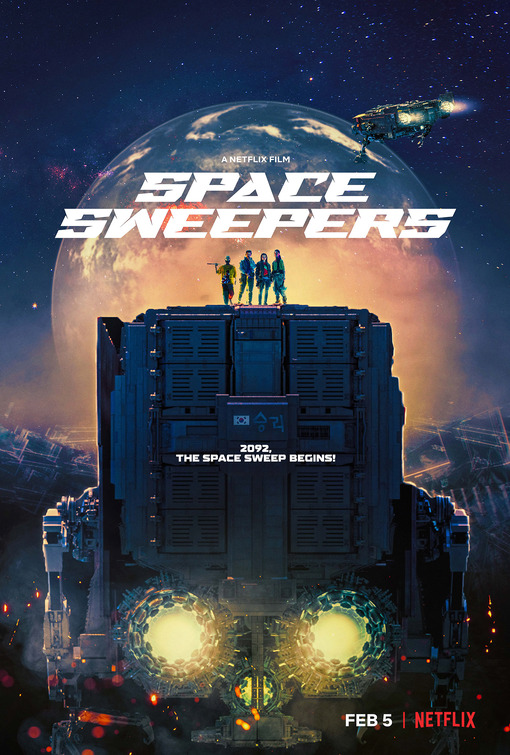
Space Sweepers [Seungriho] - 2021, d. Sung-hee Jo (netflix) 
Sound of My Voice - 2011, d. Zal Batmanglij (Disney+/Star)
Hell or High Water - 2016, d. David Mackenzie (Netflix)

aye-yup...

---


In my news feed there's this one website that keeps cropping up that says something like "You MUST watch this sci-fi film before it leaves Netflix" or "The best unknown sci-fi film on Amazon" and the like.  Real attention-grabbing, urgent sounding clickbait that drives me mental and is everything that's wrong with the internet.  And yet, that's how I found this film.

La Antena is an Argentinian film that attempts (and succeeds) at replicating the sci-fi films of the silent movie era.  It's certainly a pastiche, a tribute and homage to the imaginative works of the 1910s and '20's from directors like Fritz Lang and Georges Méliès,  It captures that rough-hewn graininess, and replicates in-camera effects as well as crafts elaborate sets, and cakes on make-up on its performers crafting a severe surrealism.

The story is about a manufacturer that has taken over the city by being the only provider of food.  The city has somehow lost its voice, and so there's magic over the airwaves with music and the sole singer who can still make noise.   An electronics repairman gets embroiled in a conspiracy involving a mysterious child and an even more nefarious plot.

It's definitely a unique and bizarre picture, but it's certainly intriguing and very watchable.  Just like vintage B&W science fiction, there's a sense of awe in the technical accomplishments, which may seem rudimentary by modern standards, but still hold tremendous wonder.   

[10:34]

---


I mostly agree with the Toasty-post on The Midnight Sky.  It's not a great movie.  It's not even a good movie.  It's got a budget and ideas, but it's really two movies in one and there's a serious disconnect between them until late in the third act...and certainly way too late really for the meaning to come into play.

There's a catastrophic something happening in the world and the Arctic space observatory is abandoned except for Clooney, who is dying anyway so he wants to spend it doing what he loved.  As we see through flashback throughout the film, he perhaps loved it too much, staring into the sky and missing what Earth had to offer him.  Maybe it would be a more potent metaphor if it managed to relate it back to us watching too much TV.  Alas, COVID/pandemic/lockdown/nothing else to do. But there's not really any intended metaphor here.  There's a manufactured adventure about having to tell a long-distance space research vessel not to return home, and a left-behind little girl that Clooney has to look after.  There's not really enough meat here for a whole feature, but a somewhat charming little adventure does take place... somewhat charming...

But we intercut with Clooney and the kid with that space research vessel which winds up feeling like pretty much every other mission-in-space-where-things-go-wrong movie ever.  There have been SO MANY of these that they start to blur together and it gets very hard to make the adventure unique.  I never thought I'd be so bored of space adventures but at this point when you've seen one, you really have seen most of them.

Despite having Felicity Jones, David Oyewolo, Kyle Chandler, Demián Bichir, and the standout Tiffany Boone on board, it's still just your business-as-usual space adventure.  It looks good... the effects work is very well done, but it's not very interesting, as its own part or as a whole.  Something about Clooney's direction and the editing fails to excite.

There is a third act twist, and here's where Toasty and I differ... I thought it worked.  Not tremendously well, but I think it suddenly put the whole film into a different perspective that made things somewhat more worthwhile.  It doesn't save the movie entirely, but it lessens its tepidness.

[23:35]

---


Meryl Streep, Candice Bergen and Dianne Wiest are estranged college friends, reunited by an all-expenses paid journey on the Queen Mary 2 cruise liner that takes them from New York to London.  Streep is a Pulitzer Prize winning author who is having difficulty with her latest manuscript.  Bergen is still upset with her for basically using her life story for Streep's most famous work decades ago.  Wiest is the woman in the middle, just trying to enjoy herself.

The opening scenes of the film are difficult to swallow as Streep's author is exceptionally pretentious and entitled.  There's a detachment from reality that it seems like her new editor (Gemma Chan) is more than willing to feed into by kowtowing to every demand, including the cruise and the arrangements for her old friends to join her.  

Once we get on the ship, however, the film becomes a crackling light drama, full of subtle humour and a little interpersonal intrigue.  What is the deal with their friendships?  Why do they keep bailing on each other?  Who is the man Streep is seen with repeatedly on the ship? What's up with the mystery author they keep running into? 

Her nephew (Lucas Hedges) is Streep's personal aide and their dynamic is loving but at times severely businesslike. He's asked to basically spy on Streep by Chan who has clandestinely joined the cruise which puts him in an awkward spot.  But clearly there's something going on between them, isn't there?

I've never been a fan of cruises, but the opulent "not-a-cruise" Queen Mary 2 is a fantastic contained setting for a film (for many films).  Soderbergh, having retired and returned, is really in full blown quick-and-cheap filmmaking mode, but somehow his quick-and-cheap style works so very well at capturing the intimacy and emotion, and he manages to work with the ambient lighting tremendously well.  I wonder if this was another of his films-shot-on-an-iPhone (like High Flying Bird).   

This is truly a wonderful little movie, that feels so much bigger than it is.  It not only sucks you in but gives you a true sense of who these people are, what they've experienced in their lives, and what makes them who they are in these later years of their lives.

[40:39]

---

[already wrote about it...moops]

[45:12]

---


Rachel Brosnahan (The Marvelous Mrs. Maisel) is a completely unknown entity to me.  I've never seen anything she's been in before this film, but she holds the screen quite well.  Even still I have to say the star of this film is the 70's aesthetic, which is dynamite in its recreation.  Hart and her cinematographer Bryce Fortner are just in love with the style, design and feel of the 70's.  The filters they apply to the film give it a very era-specific vibe, accentuating the earth tones and buzzy yellows of fluorescent bulbs.  

I may have confused this film with the similarly titled and highly praised Promising Young Woman, but I was drawn in, mostly by the film's aesthetic.  Brosnahan plays Jean, the wife of a guy who makes a living in non-specific crime.  When he betrays his boss, a man shows up at Jean's house and advises her to take her baby and run.

She's protected by Cal (Arinzé Kene) for reasons that don't become clear until the third act, but he comes and goes as he has his own unseen life to attend to.  The film effectively puts us in Jean's desperate plight, one which she's not sure how to escape.  It shows her full of fear, as well as finding her own strength in light of what she's going through.

However, the film fails Cal and his wife Teri (Marsha Stephanie Blake) by teasing out their history, their life, their story, and only in the context of how it relates back to Jean's tale.  Both Cal and Teri are very intriguing and both Kene and Blake are very alluring on-screen presences.  I would have really loved to have seen how the events of this film played out on their end as well, from their point of view.  It would have made for a much richer, and even more engrossing experience.  

[1:00:04]

---

The Netflix stable of teenage romance movies (they're not really funny so I can't call them rom coms) are really not targeted towards me as an audience, yet, I can't help but find them very, very enjoyable.  There's a whole slew of films on the streaming service that have looked to the best of the past, and brought that style of teenage drama and romance to the modern day.  I don't know that the To All The Boys series is the best of them, but they're pretty wonderful.

Having churned out three of these in less than four years, it's creates a tightly serialized narrative of the relationship Lara Jean (Lana Condor) and Peter (Noah Centineo) have together.  The first film brought them together, the second film challenged them with another possible love interest, and the third brings in the biggest threat to a relationship...growing up and moving away.  

I absolutely love that the romantic triangle is not with another man, but with Lara Jean falling in love with New York and wanting to go to school there.  High school romance is fraught with hormones and misunderstood emotions, and this film series kind of ignores the impetuousness of youth.  Instead it arms its leads with an emotional intelligence that hopefully the (most likely) young women watching this take note of.  The way Peter and Lara Jean react to honesty, and relate honestly is such a rarity in film and TV culture.  The idea that one has to react badly to something that is positive to someone else is thrown to the wayside.  Being supportive of someone you love, even if it means hurting yourself, is such a rewarding thing to see on screen.

This third entry brings the series home (and away).  It really ties a nice bow on the whole story, and yet, I still want more.  I want to see what the college years bring Lara Jean and Peter and how their relationship is tested by their long distant relationship. 

I like the globe trotting nature of this film (it's only three settings but it's so much bigger than most teen romances) as it jumps from Korea, to California to New York and back again.  It's a very full, fun, and rewarding film, that's totally not meant for me.  But I like it all the same.

[1:10:49]

---


There was a recent Toasty-post about Taika Waititi's second feature, Boy, and once again we agree.  

I really like Waititi's sensibilities, his sense of comedic timing and storytelling.  He's a fascinating director with maybe not the strongest visual acumen but his sense of empathy through the camera lens is second to none.  

His films don't always share a consistent tone, but there's a trilogy of sorts to be found with Eagle vs. Shark, Boy, and Hunt for the Wilderpeople.  They're kind of the "Rural New Zealand" collection in Waititi's overall repertoire.  

This rural setting isn't a point of fascination to him, so much as familiarity.  He sees a weirdness there that he can exploit for humour, but also a commonality that can transcend borders.  There's very human stories to be told in any rural setting.

Here the title character is named "Boy", and he is still very much a boy living with his grandmother and siblings in an impoverished situation.  There's not much wealth in his community at all and yet there's still a sense of social standing and he seems to be towards the bottom of the rung.  Perhaps it's because his father is in prison...  or was in prison.

Before Boy's father turns up, he's been lionized by Boy into some mythic figure.  But when he does show up (played by Waititi) disrupting the usual flow of life, it turns out he's still very much a boy himself.  He's playing at being a gang leader, he tells tall stories that Boy believes only because he wants his father to be much better than he is.  Waititi's characterization is one of zero self awareness, and 100% posturing with absolutely nothing to back it up.  His whole purpose for returning is not to see his children and become a responsible father, but to find the stolen money he buried...in a field...somewhere.  

It's a film is somewhat about how daydreaming of a bigger life when in an isolated, poor situation is one of necessity, but also if you can't escape the daydream and face reality there's nothing but problems ahead.  It's also about taking responsibility, which Boy eventually does and his father cannot. 

It's really, really charming, as is to be expected of a Waititi prodution.

[1:24:18]

---


 Toasty-post on Underwater we kind of disagree (but I also agree with what he says...so)

The film opens with a long tracking shot following a tube down to a building at the floor of the Marianas Trench. Immediately it seems like such a bad idea to have a structure down there because the pressure has got to be immense. One flaw and the whole thing would implode. Roughly four minutes later, the film confirms that very thought, and the small band of survivors must escape the wreckage, only to find horrid creatures are hunting them.  It's two very extreme dangers making for a rather brisk and satisfying escape thriller. It has a ticking clock element which means it never has time to stop and navel gaze (though you can navel gaze at KStew's navel if you wish, it's out there).  

It's a film thin on character building, somewhat disinterested in world building (like... was the organization behind this, or at least certain people within it, *trying* to release an elder god?), as if the bigger picture was intended then cut out.  Even still, few films proceed at such a breakneck pace as this, and for that I respect it.

The final act reveals the threat they were facing all along and it's hilariously awesome. It was spoiled for me and it really was the only reason I wanted to watch the film. It was an even more delightful payoff than I had hoped. It's not the most original or deep (no pun intended) movie, but it's pretty damn fun. Which reminds me, what did the fish say when it kept hitting the brick wall?

[1:33:26]

---


The trailer for Space Sweepers presented this Korean sci-fi as something absolutely bonkers.  I couldn't really make sense of what the actual plot was about, but the setting was a ruined Earth, a society in space, and the blue collar workers who scavenge space debris for cash.  Plus there's a robot.

The actual film, to my surprise and disappointment, far more conventional.  

Yes, there's a ruined Earth which is becoming more impoverished, more destitute, more desperate as time goes on.  There's the space sweepers who clean up debris in orbit of Earth for cash that barely covers their operating costs.  There's an Elysium-style orbital society where only the elite get to inhabit and there's a nefarious corporation behind it that is terraforming Mars as a permanent home for said people.  And then there's a missing little girl that all of society is on high alert for as they're told she's a rebel bomb.  Turns out she's the key to everything, Fifth Element-style.

This film cribs from so many other films and sci-fi stories, I lost track of them all.  It's a vibrant and well animated adventure put it falls prey to tired cliches and overused tropes.  But even with its lack of freshness there's still much to enjoy.

I found the international sensibilities of the film surprising, and I like how they incorporated multiple cultures into the film, speaking in their native tongue, explaining that everyone has ear pieces that automatically translate, so everyone understands each other.  Richard Armitage is the main bad guy and he's in gritted teeth mode, not so much chewing scenery as refusing to.  You can basically see him cashing his check.  The main cast is much more invested, however, including the snarky robot who is saving their cash to get synthetic skin and appear as human.  I like that robot.

There's a few action set pieces that are decent but not exceptional, spare the opening action set-piece which is headache inducing and nonsensical.  Yes the ships are doing things at a very high speed but the ability to process the action and orient where it's taking place is far too brain-breaking to be enjoyable.

The plot is, as you may expect, about saving the girl, but there's also a good thread about one of our leads who lost his little girl in an accident and so he is both distant towards this new girl, but also hypersensitive about her.

Altogether, a very watchable if overly typical sci-fi picture.

[1:46:52]

---

the poster teaches you
(part of) the secret cult
handshake, one of the more
ridiculous aspects of the film


I watched the first episode of The OA years ago and never went back to the rest of the series despite my intrigue.  I found some of it very captivating but much of it also very frustrating, and that frustration seemed to be centered around actor/writer/co-creator Brit Marling.  I've seen Marling in a few other things and she's a difficult presence.  She always seems kind of aloof and disconnected.  With only a few exceptions almost all of her performances have been in films she's had a strong hand in creating.

Sound of My Voice is one I hadn't heard of, and predates The OA by around 6 years, and yet it seems like it's the template for which The OA was built upon.  Marling plays the leader of a cult, and she tells her followers she's from the future...like 2050 or thereabouts.  Why she's leading this cult, what she's preparing them for, what she's alerting them to or warning them about, her actual purpose for having a cult is completely unknown, and it's a very bad choice for this movie to leave so much on the table as it's a sorely unsatisfying watch.

The film centers around a documentary filmmaker who had experience with cults at a young age and his privileged but troubled girlfriend.  They're attempting to infiltrate and expose the cult, but the question of the film is constantly "are they getting sucked in"?  At the beginning of the second act we are introduced to a mystery woman who later turns out to be a government agent, looking for Marling's character.   The film ends with a double reveal about who Marling's character is, basically obfuscating our belief in what we've seen.  It's a pseudo-Shyamalan-esque "twist" that only frustrates in leaving everything intriguing entirely unexplored.  It's effectively 2/3 of a film.  Where is the third act?

It kind of makes me want to return to the OA.  Even though Marling's character in the OA is bringing a much different message there's enough connecting threads to what I saw that I suspect it might cover similar ground, yet provide actual answers.

[2:00:56]

---

[the substitute]


All the thrills of an intricate heist movie with all the bitter melancholy of our depressing reality. The slow, agonizing death of rural culture, and the animosity it breeds towards modern society at large is laid bare. Where there used to be a wistfulness for days-gone-by, there are now only generations who have known only the poverty of small town life.

Hell or High Water film is about scrabbling, tooth and nail, to capitalize on whatever opportunity presents itself, to claw one's way out of that poverty and secure a future for their family.

The only outright "bad guy" in this film is the banking system that preys upon the people of small towns, more than aware there's no hope for debt repayment and in the end it's these institutions that wind up inheriting what should be family land (or moreover belonging to the ancestral tribes that live there before the Europeans settled it). 

But there are still bad guys. Chris Pine is robbing banks, and though he wishes no actual violence on anyone, where guns are involved, there will be violence. Where his brother, lifetime criminal Ben Foster, is involved, there will be violence. Foster is a bad guy. But even as a bad guy, he still defies the usual "crazy brother/partner" cliche...he's not educated, or thoughtful, but he does have some charm and intuitiveness.

Jeff Bridges is a Texas Ranger, nearing retirement and the way he behaves towards his partner (Gil Birmingham), half Native American, half-Mexican, is pretty deplorable. Despite having legit affection for his partner, he has zero sensitivity and thinks employing every stereotype or slur on record in his "playful banter" is somehow acceptable. Birmingham seems to just be counting down the days until the old coot is gone. Yet Bridges has a preternatural sense of human behavior and is zeroed in on what the brothers are doing. He's a great Ranger, just not a great person.

The film lives in Texas culture, with no direct judgements made. It's a slyer indictment through subtle comments and actions. It seems like every other person is strapped with a weapon and just too eager to use it. Every one of them wants to play cowboy, not out of any sense of civic duty, but more for the thrill and self-satisfaction. So not only does robbing a bank pose the risk of getting caught but alsonhaving to face off against dozens of armchair Dirty Harrys. God bless Texas?

It's a sharp, taut and complex film, fully in control of its characters and narrative.

---fin---