Showing posts with label underwater. Show all posts

Friday, June 6, 2025

3 Short Paragraphs (Or Not): Flow

2024, Gints Zilbalodis (Away) -- download

Kent flowed.

OK, its about time I wrote about something that was not only in my bin for a while, one of the Should Be Watching, but also because it was entirely worth waiting for. This was not only everything everyone said it was (Best Animated Feature) but it was beautiful to watch, beautiful to listen to, and one long Cat Video. Also, its PoAp.

Some planet after some event. Maybe its Earth maybe its a Ghibli world, but that doesn't matter. We have a world without humans but the remnants of humanity, the refuse left to grow over, leaving lots of room, and peace for the surviving animals. A little black cat (OK, the director says it was "dark gray" but I am partial to black cats, so he was black for me), for one, who lives in a house once owned by an artist, where he sleeps on a made bed that is only easily reached by the lithe little jumps a cat can reach. That is, until the waters come.

The movie begins with a tense encounter between the cat and a pack of dogs, not a feral looking scary bunch, but a pack of once-pets, but still cat/dog, so conflict. Until they are all swept away by a flash flood. The cat does find refuge, briefly, back at his home, the lovely artist's shack surrounded by cat sculptures, but the waters continue to rise quickly until the cat finds himself perched high upon a stone cat. When that  too is under water, he is picked up by a capybara in a sail boat. 

Yup. Too cute.

Thus begins a "road trip" movie, a journey towards... well, we never really know what, but in a world overwhelmed by water, I imagine they were looking for dry land, and a time when the waters aren't rising.

There are no humans in this movie, so there is no dialogue as these are not "cartoon animals", but there is no lack of communication, albeit fantastical in nature. The cat is constantly mewing and meowing, in the manner we are accustomed to, which is in turn for our benefit, as cats sans humans don't often make those noises. But the other animals he encounters interact with him in very definable manners. The capybara is helpful and looking for companionship. The secretarybird that joins them is domineering, stoic and their navigator... he seems to know where he is going. The meercat lemur is frenetic, a covetous collector of human things. And the golden retriever is a typical big, goofy pal who didn't share in his pack's desire to chase a cat in terror. They are all gathered together on the boat on their way... somewhere.

This movie is just so beautiful to look at. Obviously inspired by the films of Miyazaki, everything is bright and beautiful and mystical. Their journey is punctuated by the constant slow rise of the waters, now deep enough that whale-creatures join them on their journey, at least one finding itself bonding with the cat. This is not our Earth and in the distance, just over the horizon, the massive monoliths that the secretarybird guides them to are ominous, magical.

They say the journey is more important than the destination, and in the end this applies to the movie succinctly. They do reach the monoliths, there is a beautiful, mysterious interaction but then the waters recede, disappearing, pulling back, as if  they were not even there. Where does the water go? Why is the land not saturated and destroyed after being underwater for so long? What about the whales? What's next for our cat and his friends? No answers but your own headcanon. And it doesn't matter, doesn't diminish from an absolutely lovely movie.

Also, I would love to see some lemurs wearing pots as hats.

Saturday, November 19, 2022

KWIF: Black Panther: Wakanda Forever (+2)

 I'm trying something new.  It's been exceptionally difficult to keep up on everything there is to keep up on, both as a consumer and as someone who likes to prattle on about the things he consumes.  So the plan is this: Kent's Week in Film -- each week I have a spotlight movie which I write a longer thought piece about, and then whatever else I watched that week, I do a quick little summary of my thoughts. I'm still working out the whole formulae, so it might evolve from here, but let's just get started...

KENT'S WEEK IN FILM #1
Black Panther: Wakanda Forever
(2022) d. Ryan Coogler - in cinemarrr
See How The Run (2022) d. Tom George - Disney+
Don't Worry Darling (2022) d. Olivia Wilde - Crave 


Burdened with the achingly unfortunate passing of its franchise lead and the cultural landmark status of its predecessor, Black Panther:Wakanda Forever had much to overcome to be a worthy successor... hmm... overcome may be too strong a word... "work through"... it had much to work through to be a worthy successor. Much like Shuri had to work through her past and reconcile with her legacy in order to rise as the new Black Panther (Not a spoiler, basically revealed in the trailer)

The problem, however, is that Shuri (Letitia Wright) isn't our focal character. The film feels lost without Chadwick Boseman's T'Challa to centre it, and it is looking for a leader everywhere (just like Wakanda)...in Ramonda (an outstanding Angela Bassett), M'Baku (never enough Winston Duke), Okoye (Danai Gurira should have her own franchise), as well as Shuri. At the same time it also has to take the pains of the further world building of Wakanda, and adding more fruit to the MCU pie, by introducing another young hero in Riri Williams (super charming Dominique Thorne), a whole rival (undersea) nation, plus its leader (one of Marvel's oldest characters) Namor (an exceeds expectations Tenoch Huerta). It also needs to pick up the threads of the prior film where Wankanda stopped hiding from the world, and the global earth shake that caused, and the knickers that it twisted all up as a result.

The film, to be honest, has too much to handle adeptly in its 2.5hour+ runtine. Some aspects work very well... Namor and his people aren't overly simplified villains to crush and swat away, and Riri Williams is actually integral to the plot and built out as a character rather than the living Maguffin America Chavez was in the Doctor Strange sequel. But, as a result of these boons, Wakanda suffers from erratic pacing and story beats. I think this would have been better served as a 6-to-8 hour mini series where the intrigue of global politics, the internal strife of faith in leadership, and the emotion component of grieving and loss could breathe more.


To be clear, there's not much in the way of bad scenes here -- Coogler himself is quite the deft craftsman, and surrounded with creatives who make it all look so good -- mostly its sequences are challenged by the amount of time they can spend, and the timing of the edits that hamper their success. The opening funeral montage, for example, is beautiful and sad (that is until the cgi spaceships show up) but it also feels rushed. 

I also can't help but feel the film needed to place Shuri even more as it central figure, but it was afraid to. I bet somewhere, deep in the process, it went from "let's keep the new Black Panther a mystery" to "let's be pretty obvious it has to be Shuri". For well over half the movie I did think we were supposed to wonder who would be the new Panther, since Shuri doesn't really feel like she's being set up for this until very late in the film. Almost too late. To the point of deus ex machina...it needs her to be Black Panther, but has she truly earned it based on her journey here? She's never seemed like much of a fighter, so it seems a stretch, even with a fancy suit and super powers, to put her up against a 400-year-old superstrong flying mutant warrior from the sea. Hell, I though Okoye was the right candidate until they gave her a different (but comics accurate) suit. At the same time, Shuri and Namor, were always on the cusp of something flirtatious but it never quite gets there. This really needed an infusion of sexiness (but then captor-captive relationships are probably not a good idea, so nevermind).

And then there's Everett Ross, yep the token colonizer is back. He has a small bit of purpose here, better employed than he was in the first, to be sure, but again, not and explicitly necessary ingredient in this particular pie. At least it acknowledges that a CIA agent having debts or allegiances to a foreign land (despite being the "good guy" thing to do) makes him a very bad, very compromised CIA agent.


With Boseman gone, Wakanda Forever becomes exceptionally female-centric, with the majority of the cast being women. There's a thread of "powerful black male erasure" in not recasting T'Challa, but it's a damned if you do/damned if you don't scenario.  I lean more on the side of don't than do, so this feels like the right play, but it's certainly not the only play that could have been made .  

The female-centricness is not something trumpeted or even really pointed out. At the same time, it also feels a like it's lacking in a strong female POV, which is maybe why a lot of the film feels like its housekeeping rather than really advancing these characters in a meaningful and empowered way (of course the women of Wakanda have never felt disempowered in any sense).

This may grow on me in a second viewing (as the original did), as I think there's a lot of thought put into it all, and I truly hope there's a Lord of the Rings-style extended cut for home viewing that lets this all breathe more (so many people complaining it's too long, I think it's not long enough).

---

From everything I had heard about See How They Run, I thought I would be so in the pocket for this type of lighthearted and pithy murder mystery romp, but I never felt fully invested. Rockwell is great at doing quirk that's more than quirk, and Ronan is just marvellous with full Irish lilt employed, but I'm undecided on whether it was too cheeky or not cheeky enough.

Maybe the conceit of a murder mystery happening on the set of The Mousetrap (1000 performances in, but still very early in it's seemingly endless London theatre run), complete with some actual real-life players (Richard Attenborough, Agatha Christie) was a bit too specific, and perhaps an analogue version (Toast of London's dusty old "The Moose Trap" mayhaps) might have suited the film better.

---

Ignoring the media circus surrounding Don't Worry Darling and just watching the film I found myself a bit frustrated with it at first (too many needledrops...the assault of 50's bebop is overwhelming at times), and then surprisingly engaged by it. I had the film's conceit spoiled for me long before watching it, yet still I had much in the way of surprises throughout.  The main criticism of the film is that its conceit doesn't hang together.  There are logic gaps that leave too many questions on the table and suggest there was a possible late-stage rewrite. It does indeed have a "twist" but it's not a "twist ending", as it's pretty fully revealed with a little under half an hour left to play.  

The film starts to show its discordance with its 1950's perfection aesthetic in small bits to start, but ever increasing in nature as it progresses.  Some of these do come with a cool sense of foreboding, while others feel a little too heavy handed.  Florence Pugh and Harry Styles make for a very sexy couple in the onset, and it's a great looking film in general.  Olivia Wilde really shows off what she's capable of here, everything from sex scenes to action sequences, paranoid intrigue to esoteric moments.  If the story isn't sealed tight, it's not as much Wilde's fault, I think, so much as Wilde brings so much to it that it makes these logic gaps less immediate.  I can't strongly recommend it, but at the same time, I wouldn't warn anyone away from it either.  

(Small Spoiler)
My one observation, about halfway through, was that the overwhelming tones of Men's Right Activism, particularly in the media broadcasts, made me think this was some COBRA-like techno-militia bent on world dominance (eg. Springfield from the G.I. Joe cartoon).  You take COBRA out of the cold war and put it into recent years and it's totally an organization started by the MRA set.

Thursday, October 13, 2022

Horror, Not Horror: the trash bin

"Horror, Not Horror" movies are those that toe the line of being horror movies but don't quite comfortably fit the mold.  I'm not a big horror fan (Toast is the horror buff here), but I do quite like these line-skirting type movies, as we'll see. 

In the past few months I've been wading more and more into the underexplored depths of genre cinema.  Some of this has been on my own, at random, and some of it's been prompted by the films discussed by Quentin Tarantino and Roger Avery on the very fun Video Archives podcast (noted by an asterisk below).  These are, to a one, not good films, but the hope is always that, for as maybe limited in budget, or as tossed off as they may have been, they still have something going for them. Oh, but surprise, one of these is a prestige picture that was nominated for Oscars!

---


Hercules Conquers Atlantis
(1961) dir. Vittorio Cottafavi - Tubi
(AKA Hercules and the Captive Women)
What is it? One of the many, many iterations of Hercules in the "sword'n'sandals" genre of action/adventure movies, largely made in Italy throughout the 1950's through 1980's.  In this one Hercules, played by the handsome and beefy Reg Park, is ostensibly kidnapped by his friend and taken on an adventure where he discovers Atlantis, but the place is a nefarious one, and only the might of Hercules can stop their evil plot (whatever it was).
Why watch? I had, on a whim, picked up a copy of the Mario Bava directed "sequel" film to this, Hercules in the Haunted World, so I thought I should just give this one a shot first.
The good? Bava served as a director of photography so there are some pretty nice shots in this.  Reg Park, former Mr. Universe, is really nice to look at.  Bava does this tilt-down/pan-up shot in the cave which is really sweet, and there's a high-up crane shot of.  The shot of Hercules bounding through a courtyard of dead bodies is kinda nuts as is the reveal of the Atlantian elite guard which is a little provovative.  It's impressive seeing Hercules driving a chariot of 10 horses, if only there were a Hercules movie that could sustain that sort of scale.  Hercules being a petty dick was pretty fun, as were all Reg Park's muscles.  Fay Spain's eyes are the best special effect in the movie.
The bad? The audio - dubbing, sound effects, music - is pretty awful most of the time, and seemingly mixed all at the same volume. The action sequences are incredibly clumsy. The story is flimsy nonsense with little internal consistency. The wardrobe and sets waver between spectacular and silly. The envisioning of both ancient Greece and Atlantis is pretty uninspired. The cinematography wavers between impressive and pedestrian.
The trash? Reg Park does this one-armed swimming technique which just blows my mind thinking about it.
Is it horror? No, but there's definitely some little twinges of horror that the film never thinks to exploit.

---

Hercules in the Haunted World
(1961) dir. Mario Bava - BluRay
What is it? Reg Park's second - and final - foray as the demigod hero.  But this one's directed by Mario Bava, and Christopher Lee co-stars.  Maintaining no continuity from the prior film (in which Hercules had a wife and son), here he must go on a quest to retrieve a specific stone in order to cure the madness of his lover.  The stone's destination? Hell!
Why watch?  Bava, of course.
The good? This is a visual feast of nonsense.  I watched it twice.  Bava's innovative craftsmanship and colour sense is so damn impressive.  The visual effects, in many instances, seem so surreal, as if they shouldn't exist.  The big finale features the raising of the dead which is a sequence that would have for sure scared the crap out of me as a kid (but is both fun and silly as an adult watching on a hi definition TV)
The bad? The story is utterly nonsensical.  The Kino blu-ray features an audio commentary from a Bava scholar who identifies that there was obviously a completely different shooting script at one time and that few pains were taken to marry the original story with what they wound up with.
The trash? Very little trash in this one.  It's a really stunning watch.  I guess, the biggest trash is that they dubbed over Christopher Lee's performance. Blasphemy!
Is it horror? No, but it does swerve that way for the climax for a bit, providing a sense of Bava's chops in the genre.

---

*Demonoid: Messenger of Death
(1981) dir. Alfredo Zacarias - Tubi
What is it? A Mexican (but English) horror film about a demonic hand which possesses people to kill. Samantha Eggar stars as the wife of the mining honcho who releases the hand.  It seems to be fixated on trying to get her specifically as it goes from possessing person to person and murdering along the way.
Why watch?  It was a Tarantino/Avery recommendation.
The good? Honestly, it has a pretty solid sense of its own history and the evil forces at play.  It does better than many horror films in that aspect. The acting is surprisingly decent for such a off the beaten path production.
The bad? But make no mistake, this is some cheesy-crust crazy-bread stuff.  The special effects are that special blend of late-70's/early-80's waxy gore with stark red corn syrup blood. I have to wonder if the makers of this took any of it seriously or if they knew it would eventually be considered campy fun.
The trash? They really liked to work their gross visual effects, and we've come so far in making that shit so gross that it's really quaint what they used to be able to get away with.  Oh and gratuitous nudity tied to violence in the first five minutes (seen in one of the trailers even)
Is it horror? Yeah. It's that special type of 80's low-budg horror.

---

*Blind Rage
(1976) dir. Efren C Pinon - YouTube
What is it? The war in Viet Nam has decimated the markets in the Asian Pacific, so the world bank (I guess?) has decided to invest 15 million dollars into the region, to be held at a bank in Manila before dispersing. A man on the inside is recruited by a Black L.A. mobster to pull off a heist of said 15mil, but he's going to do it with ... 5 blind guys!  Because who would ever suspect blind guys of robbing a bank. 
Why watch? Another Tarantino/Avery recommendation.
The good? Umm, this movie real bad, but so bad that I enjoy telling people about how bad it is. It ends with a cameo by Fred Williamson in a bright blue butterfly collared deep-V-neck jumpsuit chomping on a cigar, looking great and being a total badass.  And the line: "It's all going down right now at the International House of Pancakes".  
The bad? There's no protagonist to this film.  There's nobody we follow all throughout the movie.  Is there anyone to really care about if they succeed or fail? No, there is not.  
The trash? This movie is part Blaxploitation, part kung-fu, and part crime thriller, none of which is done particularly well.  Is "Blindsploitation" a genre?
Is it horror? No, nor is it trying to be, though people do be getting shot, tho.  And the script is a nightmare, lol.
---


*Welcome to Blood City (1977) dir. Peter Sasdy - YouTube
What is it? A group of strangers find themselves in the desert with no memory of who they are, and a note each found on their person telling them that they were a killer.  Kier Dullea (2001: A Space Odyssey) doesn't believe a thing.  They're escorted to Blood City by the sheriff (Jack Palance) who doesn't really want to tell them much about how the town operates, but it's basically a place where anything goes, including slavery and murder.  In fact, the more you murder, the greater your status.  But who are the people in a control booth watching all this, and why? 
Why watch? Though Avery and Tarantino didn't necessarily love this, they were generally intrigued by the premise, and cited it as one of the Westworld knock-offs of the era, which intrigued me.
The good? The premise was really, really intriguing.  A group of people with a secret past, possibly filled with murder, but without their memories, are they still the same murderers?  Just one of many questions the film poses, but never answers.  It's rather rife with ideas that don't get explored well enough, and has a mysterious backdrop that gets slowly revealed in a pleasant way (possibly cribbed by Cabin in the Woods) but ultimately doesn't pay off.  And hey, more Samantha Eggar
The bad? The film is either shot terribly, with the active actor partially or fully out of frame most of the time, or else its transfer to video/digital went horribly wrong.  It's actually pretty funny how awful it looks.
The trash? The one female "murderer" is the helpless object of affection and treated like a non-entity by everyone (content warning: off screen rape).
Is it horror? No, but it's certainly playing with dystopian themes which can be scary to some.
---


*The Keep
(1983) dir. Michael Mann - Criterion
What is it? The infamous/forgotten Michael Mann disaster that finds Nazi soldiers in 1941 taking over an old Romanian Citadel only to unleash a terrible, murderous being from its cage.  The being uses Jewish scholar Ian McKellen to try and get set free upon the Earth, by tempting him with revenge upon all Nazis.  Scott Glenn plays an otherworldly savior type who's arrived on earth to stop it, but not before sexing up Alberta Watson, McKellen's daughter. 
Why watch? I caught this film years and years ago on a late night TV airing, and have long been wanting to revisit it.  It's a moody piece with haunting Tangerine Dream synths, that probably was even moodier in Mann's lost original 210minute cut.  This 98 minute hack job by the studios leaves the film feeling disjointed and frequently confusing.
The good?  I love all the strange lighting, the sets, the evil creature, Mann's style is all over this, even in it's chopped up form.
The bad? I have to think that a 210minute version of this would be better as a cohesive story, but still potentially direly boring.  But then again, there are some intriguing character reveals and dynamics that I think may have played out so much better in a longer form.
The trash? Scott Glenn meets Alberta Watson for less then a minute before they start boning.  Does he have Starfox's powers?
Is it horror? I think it's trying to be.  
---


Leviathan 
(1989) dir. George P. Cosmatos - AmazonPrime
What is it? The other, lower-budget undersea movie of 1989 (next to the Abyss), it's basically Alien (with a dash of Carpenter's The Thing) in a sealab.  Starring Robocop, a Ghostbuster, Flash's girlfriend, and Evil-Lyn, so it's 80's to the core.
Why watch? It's been on my "to watch" list since I first spied its tape cover at a video store.  It always looked like something that would be in my wheelhouse.
The good? There's some really great sets and some nice underwater sequences.  It does manage to build a decent amount of attention, but...
The bad? ...you can basically watch as the film's budget starts shrinking the longer it goes on. They try to edit around the budget limitations, but they become painfully obvious.  The budget limitations can't capitalize upon the film's buildup and it's a real wet fart of an ending.
The trash?  The creature, and not in an "oh, it's so gross" kind of way but more in a "really? That's what you're going with?" kind of way.  It's a pretty corny looking beast, and the film does an incredibly poor job with devising any sort of mythology or backstory behind it.  It's basically a perfunctory creature with little to no intrigue behind it.  It's a terrible let down to an otherwise acceptably entertaining picture.
Is it horror? It probably was at some point during production.

---

Nightmare Alley
(2020) dir. Guillermo del Toro - Crave
What is it? The saga of down-on-his-luck crumbum Bradley Cooper who winds up helping out at 1920's-era carnival/freakshow, learning the tricks of the trade.  He effectively steals one man's mentallist act then starts performing for New York High society, pushing the boundaries of good taste and kayfabe.  Psychologist Cate Blanchette starts working with him, if only to ultimately use him for her own purposes, then destroy him for fun.
Why watch? Generally intrigued by del Toro's films, and I share his fascination with carnivals of old.  Oh yeah, and Sid worked on it!
The good? It looks great.  It's a phenomenal looking film in every aspect.  The attention to detail in every scene -- the sets, lighting, costuming, makeup, props - all just eye catching and really attractive.  I also liked how it exposed the sham of mentallists (if only it had more fun with it)
The bad? The film is tedious. It's a long 150 minutes of watching a not great person do not great things. You never really connect with Bradley Cooper, nor with any of his relationships. There's nothing there. You know he's bad news from the beginning, and that sense of distrust never abates. It makes it very, very hard to invest in him. Were he, maybe, more charming, or perhaps if we had some insight into what his goals were, what he's actually working towards, or, mayhaps if he were even a semblance of a good person we could follow him, hoping for his success even as he makes the wrong choices and finds himself unable to stop from going deeper into the darkness. But we know he's shit from the beginning, Del Toro wants us to know that being easy on the eyes will get him far, but for this story, it's not enough. We're rooting for him to fail (and hoping, at least, that he doesn't take others undeservedly down with him)..
The trash?  The last 30 minutes finally pick up the pace but they're kind of the worst moments of the film. Just waiting for Cooper to get his comeuppance, little of which is satisfying, moreover, it all seemed kinda overblown and carny...I mean corny.
Is it horror? Meh, its toes creep over the edge of the deck, but it never really tests the waters, nevermind jumps right in.

Thursday, December 2, 2021

4 on the Floor: the lives aquatic

Playing With Sharks: The Valerie Taylor Story - 2021, d. Sally Aitken - Disney+
Dave Not Coming Back - 2020, d. Jonah Malak - AmazonPrime
Becoming Cousteau - 2021, d. Liz Garbus - Disney+
The Life Aquatic with Steve Zissou - 2004, d. Wes Anderson - Disney+ 

I wish I had discovered a passion for oceanography when I was younger, but, as a middle class white kid with really no hardships, I settled quite easily into a life of leisure and culture and, let's face it, laziness.  Why learn, why adventure, why explore when others can do it for you and you can just sit back and consume it.  It's a fairly sad self-realization, and as I sit in my mid-forties I do feel only the smallest twinge of regret for a life unlived.  That said, I kind of live for the culture I experience, that's really my comfort zone and what both fuels and satisfies me, so I don't really regret years of watching film and television, reading comics and listening to music and podcasts, and writing about a lot of it.

Anyway, sitting down with a trio of documentaries recently, and a re-watch of Wes Anderson's Life Aquatic... I found myself transfixed, as I always do whenever I watch any ocean or sea-faring documentary.  In Becoming Cousteau -- which is a brisk but thorough traversing through the life of the most famous French ocean explorer (filmmaker/conservationist etc) Jacques Cousteau -- we learn about how the Captain found his love for the sea, and basically gave up so much else in his dedication to it.  He married Simone Melchior at 27, but it didn't seem for love.  Simone wanted to be on the sea, and she was willing to marry this "ugly" man (he had just had jaundice when she met him, she clarifies) and bear him two sons if she could just live on the boat.  It was her strongest, and, at least from the limited perspective of a documentary about her husband, only desire.  As much as Jacques loved being on his ship, the Calypso, it seemed that Simone loved it more.  Even faced with terminal illness, she still forged ahead with another voyage so strong was her desire to be at sea.  


I did not have that drive, I think, for anything. Jacques and Simone sacrificed their land lives for their adventures, as did the crew of the Calypso.  Everyone worked for free, all resources went into the boat and their exploration equipment.  It was noted that it seemed in each of them a desire to escape from land and just be surrounded by the unknown.  In the process of escaping and exploring, as young men in the 40's and 50's, they ignorantly just did stupid guy shit, like harassing whales and tortoises, blowing up coral reefs to count the fish, and slaughtering sharks preying upon a young whale.  As resources ran dry, they accepted help from big oil in the early 50's and started exploring the depths of the seas for oil on their behalf, directly responsible for Abu Dhabi's oil boom.  Less than a decade later Cousteau and crew became increasingly aware of the detrimental effects the industrialised world was having on our water systems.  A hard pivot into protectionism and conservation was his dedicated atonement for the rest of his life.

It's kind of the same pattern we see in Australian diver Valerie Taylor.  She started her diving career as a shark hunter, participating in spearfishing tournaments in the late 50's and early 60's.  Being a woman was obviously outside the norm for the sport and the documented footage of the time is eyerolling in its ogling gaze.  Valerie met her husband, Ron Taylor, in the sport, and together they they studied sharks, their behaviour and started making films.  Like Cousteau's Palm d'Or-winning film The Silent World  in 1953, the Taylors had a hit film in 1971 with Blue Water, White Death.  Of course, the Taylor's success could likely be directly linked to the global exposure Cousteau's adventure films and television series.  But they caught the attention of young Steven Spielberg who enlisted their help in bringing Peter Benchley's Jaws novel to life (the Taylors were largely responsible for directing all second unit shark footage).  The unfortunate side effect of Jaws' massive success, which the Taylors were partly responsible, was a dramatic increase in fear of the creatures.  The uneducated fear of sharks was something that the Taylors would strive to combat for the rest of their lives (Rod would pass away in 2012, but Valerie continues to run awareness campaigns globally), again an atonement for their earlier ignorance.  


In the grammatically frustrating Dave Not Coming Back there is also an atonement of sorts.  The whole purpose of the documentary is to basically find something to take away from Australian cave diver Dave Shaw's death during an attempted body recovery in the Boesmangat cave located in North Cape, South Africa.  In 2004, Shaw and cave diving partner, Don Shirley (no, not the Green Book one) were exploring the Boesmangat when they discovered the body of a young diver who disappeared there a decade earlier.  With the support of that young man's family, they mounted a recovery mission, which, given the severe depth of the cave (280 meters), would be extremely dangerous and time consuming.  Diving down 280 meters would take less than 20 minutes, resurfacing, however could take upwards of 20 hours.  People with replacement air tanks would have to be stationed at key stages to support the slow ascent.  All of this carefulness, all of the patience required, all of the preparation...it's definitely not something that appeals to me recreationally, but it's fascinating to watch and learn.

The documentary sets up the body recovery with the intricate detail of a heist.  There is a definite sense that they should not be doing this, but Dave most of all is determined.  The dangers are very up front and Dave explicitly states that if he doesn't make his first resurfacing mark on time that no one should come after him, nor wait for him.  The timing was precise and better to lose one life in this adventure than two.  As the title intones, things do not go well for Dave, and Don makes a spur of the moment decision to go after Dave which results in disaster.  The film's third act pivots from the "heist" to an intense rescue mission as the remaining crew have to do everything in their arsenal of skills and resources to get a suffering-from-the-bends Don to the surface before he dies but without further aggrivating his decompression sickness.  It's truly a nail biter.

In Becoming Cousteau, we are told of Jacques and partner Ã‰mile Gagnan developing the Aqua-Lung for deeper sea diving.  Its a breakthrough for underwater exploration, but a breakthrough that comes at a cost.  Having just watched Dave Not Coming Back prior to Becoming Cousteau one of the questions I was left with was how did we discover decompression sickness, and how did we learn how to moderate it? The Cousteau doc, in detailing the explorer's participation in evolving the Aqua-Lung also shows the horrifying side effects of not understanding what the effects of depths do on the human body, as one of Cousteau's colleagues dies during a prototype test.  Later on we find Cousteau's crew involved in deep-sea habitat tests, with two subjects living inside a submerged canister for a week, with no true ill effects but also noting a different mental space.

If there's a drawback to Becoming Cousteau it's that it has to move so quickly through everything the man has done.  There's no time for depth (not a pun), as there's just so much to cover (it even skips past the fact that Cousteau was in part responsible for the French Navy joining the Allies, and that his estranged brother (who they don't even talk about) was a Nazi collaborator and setenced to death in 1946 (though this was commuted and he was eventually released from prison).  But the thing is Cousteau was a filmmaker (he notes he would loathe to be called a documentarian, but that's truly what he was), having a camera with him most of his life and filming constantly.  He developed his own case for filming underwater and some of the pre-WWII footage included in this film, is stunningly unreal in black-and-white.  It's not something we're used to seeing.  The sheer volume of footage this documentary jumps through is boggling, but it's also kind of frenetic as a result.  It doesn't slow down much to breathe in any of what it shows.  That said there's hundreds of hours of Cousteau documentaries to partake in (I don't know if they can be enjoyed, per se, given the earlier ignorance and frat-boy brutishness of the filmmakers, and then the man's increasingly grim outlook on the moribund state of the world.)


Filming underwater was also a passion of Valerie Taylor, and it's a huge part of the draw of her film as well.  It's obviously narrowed into specifically a look at sharks, but they are endlessly fascinating creatures, intimidating with a grotesque beauty.  The behind-the-scenes footage of Jaws should be enough to draw in any cinephile, but there is definitely rewards beyond that.  If my excitement for Taylor's seems lacking in comparison, it's only because I watched it some time ago, as opposed to having seen Dave Not Coming Back and Becoming Cousteau in the past few days.

The underwater footage of Dave Not Coming Back is haunting and gorgeous.  There is archival footage from previous dives as well as recreation footage.  The film, mid-way through, makes it explicitly clear that Don Shirley is leading the re-creation filming efforts (showing some of the initial rehearsals), and the results are, as noted, breathtaking -- in some cases literally.  I found myself at times, during the re-creation action, holding my breath.  Don describing the effects of decompression sickness (the bends) coming on, I could sympathize, if only a little, having been experiencing bouts of severe vertigo in the past two months.  Beyond both the archive and re-creation footage there are some absolutely gorgeous vistas of North Cape and the ostensible hellmouth that is Boesmangat, an open wound in the surface of the otherwise flat desert.  It's ironic that, as the film intones, filming underwater was part of what lead to Dave's death.  Wearing a helmet with an encased camera led to an unfortunate tragedy of errors.  

All three of these documentaries are absolutely worthy watching, though Dave Not Coming Home being both the most intimate, beautiful and upsetting of the three, but also somehow the most rewarding.  The Talor documentary is cautiously uplifting, while the Cousteau documentary is a whirlwind that has many joys and just as many bummers.  


Now, The Life Aquatic with Steve Zissou doesn't have the same real-world, tangible attraction to the beauty, mystery, and danger of the natural world as these documentaries do.  If anything Life Aquatic lives in sort of the recesses of the juvenile mind of someone who absorbed the worlds of Valerie Taylor and Jacques Cousteau as a child, and is spitting that representation back out on the screen in intricate detail.

Zissou is clearly modeled after Cousteau, to the point that much of the appeal of Becoming Cousteau was in discovering just how much of the man's life Anderson and Noah Baumbach adopted for their script.  It's not direct lifting, but the parallels are easy enough to find, and one could see from Cousteau's personality, his ambitions and regrets, how Zissou was born as a fictional character, and how his world was built around him.

What I love about Life Acquatic is the exact opposite of what I love about the Cousteau doc, I love its artificiality.  I adore the cross-sectioned boat that we clearly see is a stage setting but when Anderson pans in to follow a character as they manoeuvre through its confines, it's such a tangible world we escape into.  The wardrobe, the facial hair, the physiques, the adventures are all a part of the ordeal, and it's all grounded by amazing performances from Bill Murray, Owen Wilson, Kate Blanchett, Willem Dafoe, Angelica Houston and all the supporting character actors doing fine, fine work.  All of the underwater sequences are highly artistic and creative stop motion, which only deepens the film's artificiality.  It's a bold choice but it fits with this kind of glorified, adventurous, otherworldly, superheroic perspective that a child might have had watching Cousteau's adventures (and Cousteau demanded his film be called Adventures, not documentaries).

The music of Becoming Cousteau really sticks out, and I think it's because it feels in tune with Mark Mothersbough's score for Life Aquatic. There's catchy early digital tones in both and I have to wonder which is the chicken and which is the egg.

I had, as a child, a few Fisher Price Adventure Toys.  As I get older, and deeper into my childhood nostalgia, I continue to forget about just how great these toys were.  Whenever I watch The Life Aquatic with Steve Zissou, I wish for a whole series of Zissou branded adventure toys.  Kind of like how The Mandalorian feels like Jon Favreau playing with his Star Wars action figures and vehicles, LIfe Aquaticfeels like Anderson playing with his Fisher Price Adventure heroes.

And now we see why I didn't ever get into diving into the ocean.  Everything with me comes back to sitting idly and playing with toys.

Thursday, March 4, 2021

10 for 10: Lockdown entertainment

[10 for 10... that's 10 movies which we give ourselves 10 minutes apiece to write about. Part of our problem is we don't often have the spare hour or two to give to writing a big long review for every movie  we watch. How about a 10-minute non-review full of half-remembered scattershot thoughts? Surely that's doable? ]

In this edition: things I watched relatively recently for a change.

The Aerial [La Antena] - 2007, d. Esteban Sapir (AmazonPrime)
Midnight Sky - 2020, d. George Clooney (Netflix)
Let Them All Talk - 2020, d. Steven Soderbergh (HBOmax)
Locked Down - 2020, d. Doug Liman (HBOmax)    
I'm Your Woman - 2020, d. Julia Hart (Amazon Prime) 
To All The Boys: Always and Forever - 2021, d. Michael Fimognari (netflix) 
Boy - 2010, d. Taika Waititi (tubi)
Underwater - 2020, d. William Eubank (Crave) 
Space Sweepers [Seungriho] - 2021, d. Sung-hee Jo (netflix) 
Sound of My Voice - 2011, d. Zal Batmanglij (Disney+/Star)
Hell or High Water - 2016, d. David Mackenzie (Netflix)

aye-yup...

---


In my news feed there's this one website that keeps cropping up that says something like "You MUST watch this sci-fi film before it leaves Netflix" or "The best unknown sci-fi film on Amazon" and the like.  Real attention-grabbing, urgent sounding clickbait that drives me mental and is everything that's wrong with the internet.  And yet, that's how I found this film.

La Antena is an Argentinian film that attempts (and succeeds) at replicating the sci-fi films of the silent movie era.  It's certainly a pastiche, a tribute and homage to the imaginative works of the 1910s and '20's from directors like Fritz Lang and Georges Méliès,  It captures that rough-hewn graininess, and replicates in-camera effects as well as crafts elaborate sets, and cakes on make-up on its performers crafting a severe surrealism.

The story is about a manufacturer that has taken over the city by being the only provider of food.  The city has somehow lost its voice, and so there's magic over the airwaves with music and the sole singer who can still make noise.   An electronics repairman gets embroiled in a conspiracy involving a mysterious child and an even more nefarious plot.

It's definitely a unique and bizarre picture, but it's certainly intriguing and very watchable.  Just like vintage B&W science fiction, there's a sense of awe in the technical accomplishments, which may seem rudimentary by modern standards, but still hold tremendous wonder.   

[10:34]

---


I mostly agree with the Toasty-post on The Midnight Sky.  It's not a great movie.  It's not even a good movie.  It's got a budget and ideas, but it's really two movies in one and there's a serious disconnect between them until late in the third act...and certainly way too late really for the meaning to come into play.

There's a catastrophic something happening in the world and the Arctic space observatory is abandoned except for Clooney, who is dying anyway so he wants to spend it doing what he loved.  As we see through flashback throughout the film, he perhaps loved it too much, staring into the sky and missing what Earth had to offer him.  Maybe it would be a more potent metaphor if it managed to relate it back to us watching too much TV.  Alas, COVID/pandemic/lockdown/nothing else to do. But there's not really any intended metaphor here.  There's a manufactured adventure about having to tell a long-distance space research vessel not to return home, and a left-behind little girl that Clooney has to look after.  There's not really enough meat here for a whole feature, but a somewhat charming little adventure does take place... somewhat charming...

But we intercut with Clooney and the kid with that space research vessel which winds up feeling like pretty much every other mission-in-space-where-things-go-wrong movie ever.  There have been SO MANY of these that they start to blur together and it gets very hard to make the adventure unique.  I never thought I'd be so bored of space adventures but at this point when you've seen one, you really have seen most of them.

Despite having Felicity Jones, David Oyewolo, Kyle Chandler, Demián Bichir, and the standout Tiffany Boone on board, it's still just your business-as-usual space adventure.  It looks good... the effects work is very well done, but it's not very interesting, as its own part or as a whole.  Something about Clooney's direction and the editing fails to excite.

There is a third act twist, and here's where Toasty and I differ... I thought it worked.  Not tremendously well, but I think it suddenly put the whole film into a different perspective that made things somewhat more worthwhile.  It doesn't save the movie entirely, but it lessens its tepidness.

[23:35]

---


Meryl Streep, Candice Bergen and Dianne Wiest are estranged college friends, reunited by an all-expenses paid journey on the Queen Mary 2 cruise liner that takes them from New York to London.  Streep is a Pulitzer Prize winning author who is having difficulty with her latest manuscript.  Bergen is still upset with her for basically using her life story for Streep's most famous work decades ago.  Wiest is the woman in the middle, just trying to enjoy herself.

The opening scenes of the film are difficult to swallow as Streep's author is exceptionally pretentious and entitled.  There's a detachment from reality that it seems like her new editor (Gemma Chan) is more than willing to feed into by kowtowing to every demand, including the cruise and the arrangements for her old friends to join her.  

Once we get on the ship, however, the film becomes a crackling light drama, full of subtle humour and a little interpersonal intrigue.  What is the deal with their friendships?  Why do they keep bailing on each other?  Who is the man Streep is seen with repeatedly on the ship? What's up with the mystery author they keep running into? 

Her nephew (Lucas Hedges) is Streep's personal aide and their dynamic is loving but at times severely businesslike. He's asked to basically spy on Streep by Chan who has clandestinely joined the cruise which puts him in an awkward spot.  But clearly there's something going on between them, isn't there?

I've never been a fan of cruises, but the opulent "not-a-cruise" Queen Mary 2 is a fantastic contained setting for a film (for many films).  Soderbergh, having retired and returned, is really in full blown quick-and-cheap filmmaking mode, but somehow his quick-and-cheap style works so very well at capturing the intimacy and emotion, and he manages to work with the ambient lighting tremendously well.  I wonder if this was another of his films-shot-on-an-iPhone (like High Flying Bird).   

This is truly a wonderful little movie, that feels so much bigger than it is.  It not only sucks you in but gives you a true sense of who these people are, what they've experienced in their lives, and what makes them who they are in these later years of their lives.

[40:39]

---

[already wrote about it...moops]

[45:12]

---


Rachel Brosnahan (The Marvelous Mrs. Maisel) is a completely unknown entity to me.  I've never seen anything she's been in before this film, but she holds the screen quite well.  Even still I have to say the star of this film is the 70's aesthetic, which is dynamite in its recreation.  Hart and her cinematographer Bryce Fortner are just in love with the style, design and feel of the 70's.  The filters they apply to the film give it a very era-specific vibe, accentuating the earth tones and buzzy yellows of fluorescent bulbs.  

I may have confused this film with the similarly titled and highly praised Promising Young Woman, but I was drawn in, mostly by the film's aesthetic.  Brosnahan plays Jean, the wife of a guy who makes a living in non-specific crime.  When he betrays his boss, a man shows up at Jean's house and advises her to take her baby and run.

She's protected by Cal (Arinzé Kene) for reasons that don't become clear until the third act, but he comes and goes as he has his own unseen life to attend to.  The film effectively puts us in Jean's desperate plight, one which she's not sure how to escape.  It shows her full of fear, as well as finding her own strength in light of what she's going through.

However, the film fails Cal and his wife Teri (Marsha Stephanie Blake) by teasing out their history, their life, their story, and only in the context of how it relates back to Jean's tale.  Both Cal and Teri are very intriguing and both Kene and Blake are very alluring on-screen presences.  I would have really loved to have seen how the events of this film played out on their end as well, from their point of view.  It would have made for a much richer, and even more engrossing experience.  

[1:00:04]

---

The Netflix stable of teenage romance movies (they're not really funny so I can't call them rom coms) are really not targeted towards me as an audience, yet, I can't help but find them very, very enjoyable.  There's a whole slew of films on the streaming service that have looked to the best of the past, and brought that style of teenage drama and romance to the modern day.  I don't know that the To All The Boys series is the best of them, but they're pretty wonderful.

Having churned out three of these in less than four years, it's creates a tightly serialized narrative of the relationship Lara Jean (Lana Condor) and Peter (Noah Centineo) have together.  The first film brought them together, the second film challenged them with another possible love interest, and the third brings in the biggest threat to a relationship...growing up and moving away.  

I absolutely love that the romantic triangle is not with another man, but with Lara Jean falling in love with New York and wanting to go to school there.  High school romance is fraught with hormones and misunderstood emotions, and this film series kind of ignores the impetuousness of youth.  Instead it arms its leads with an emotional intelligence that hopefully the (most likely) young women watching this take note of.  The way Peter and Lara Jean react to honesty, and relate honestly is such a rarity in film and TV culture.  The idea that one has to react badly to something that is positive to someone else is thrown to the wayside.  Being supportive of someone you love, even if it means hurting yourself, is such a rewarding thing to see on screen.

This third entry brings the series home (and away).  It really ties a nice bow on the whole story, and yet, I still want more.  I want to see what the college years bring Lara Jean and Peter and how their relationship is tested by their long distant relationship. 

I like the globe trotting nature of this film (it's only three settings but it's so much bigger than most teen romances) as it jumps from Korea, to California to New York and back again.  It's a very full, fun, and rewarding film, that's totally not meant for me.  But I like it all the same.

[1:10:49]

---


There was a recent Toasty-post about Taika Waititi's second feature, Boy, and once again we agree.  

I really like Waititi's sensibilities, his sense of comedic timing and storytelling.  He's a fascinating director with maybe not the strongest visual acumen but his sense of empathy through the camera lens is second to none.  

His films don't always share a consistent tone, but there's a trilogy of sorts to be found with Eagle vs. Shark, Boy, and Hunt for the Wilderpeople.  They're kind of the "Rural New Zealand" collection in Waititi's overall repertoire.  

This rural setting isn't a point of fascination to him, so much as familiarity.  He sees a weirdness there that he can exploit for humour, but also a commonality that can transcend borders.  There's very human stories to be told in any rural setting.

Here the title character is named "Boy", and he is still very much a boy living with his grandmother and siblings in an impoverished situation.  There's not much wealth in his community at all and yet there's still a sense of social standing and he seems to be towards the bottom of the rung.  Perhaps it's because his father is in prison...  or was in prison.

Before Boy's father turns up, he's been lionized by Boy into some mythic figure.  But when he does show up (played by Waititi) disrupting the usual flow of life, it turns out he's still very much a boy himself.  He's playing at being a gang leader, he tells tall stories that Boy believes only because he wants his father to be much better than he is.  Waititi's characterization is one of zero self awareness, and 100% posturing with absolutely nothing to back it up.  His whole purpose for returning is not to see his children and become a responsible father, but to find the stolen money he buried...in a field...somewhere.  

It's a film is somewhat about how daydreaming of a bigger life when in an isolated, poor situation is one of necessity, but also if you can't escape the daydream and face reality there's nothing but problems ahead.  It's also about taking responsibility, which Boy eventually does and his father cannot. 

It's really, really charming, as is to be expected of a Waititi prodution.

[1:24:18]

---


 Toasty-post on Underwater we kind of disagree (but I also agree with what he says...so)

The film opens with a long tracking shot following a tube down to a building at the floor of the Marianas Trench. Immediately it seems like such a bad idea to have a structure down there because the pressure has got to be immense. One flaw and the whole thing would implode. Roughly four minutes later, the film confirms that very thought, and the small band of survivors must escape the wreckage, only to find horrid creatures are hunting them.  It's two very extreme dangers making for a rather brisk and satisfying escape thriller. It has a ticking clock element which means it never has time to stop and navel gaze (though you can navel gaze at KStew's navel if you wish, it's out there).  

It's a film thin on character building, somewhat disinterested in world building (like... was the organization behind this, or at least certain people within it, *trying* to release an elder god?), as if the bigger picture was intended then cut out.  Even still, few films proceed at such a breakneck pace as this, and for that I respect it.

The final act reveals the threat they were facing all along and it's hilariously awesome. It was spoiled for me and it really was the only reason I wanted to watch the film. It was an even more delightful payoff than I had hoped. It's not the most original or deep (no pun intended) movie, but it's pretty damn fun. Which reminds me, what did the fish say when it kept hitting the brick wall?

[1:33:26]

---


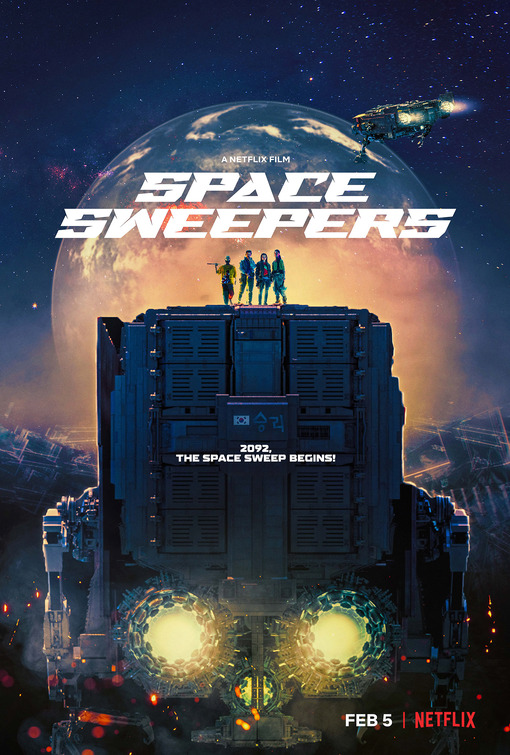
The trailer for Space Sweepers presented this Korean sci-fi as something absolutely bonkers.  I couldn't really make sense of what the actual plot was about, but the setting was a ruined Earth, a society in space, and the blue collar workers who scavenge space debris for cash.  Plus there's a robot.

The actual film, to my surprise and disappointment, far more conventional.  

Yes, there's a ruined Earth which is becoming more impoverished, more destitute, more desperate as time goes on.  There's the space sweepers who clean up debris in orbit of Earth for cash that barely covers their operating costs.  There's an Elysium-style orbital society where only the elite get to inhabit and there's a nefarious corporation behind it that is terraforming Mars as a permanent home for said people.  And then there's a missing little girl that all of society is on high alert for as they're told she's a rebel bomb.  Turns out she's the key to everything, Fifth Element-style.

This film cribs from so many other films and sci-fi stories, I lost track of them all.  It's a vibrant and well animated adventure put it falls prey to tired cliches and overused tropes.  But even with its lack of freshness there's still much to enjoy.

I found the international sensibilities of the film surprising, and I like how they incorporated multiple cultures into the film, speaking in their native tongue, explaining that everyone has ear pieces that automatically translate, so everyone understands each other.  Richard Armitage is the main bad guy and he's in gritted teeth mode, not so much chewing scenery as refusing to.  You can basically see him cashing his check.  The main cast is much more invested, however, including the snarky robot who is saving their cash to get synthetic skin and appear as human.  I like that robot.

There's a few action set pieces that are decent but not exceptional, spare the opening action set-piece which is headache inducing and nonsensical.  Yes the ships are doing things at a very high speed but the ability to process the action and orient where it's taking place is far too brain-breaking to be enjoyable.

The plot is, as you may expect, about saving the girl, but there's also a good thread about one of our leads who lost his little girl in an accident and so he is both distant towards this new girl, but also hypersensitive about her.

Altogether, a very watchable if overly typical sci-fi picture.

[1:46:52]

---

the poster teaches you
(part of) the secret cult
handshake, one of the more
ridiculous aspects of the film


I watched the first episode of The OA years ago and never went back to the rest of the series despite my intrigue.  I found some of it very captivating but much of it also very frustrating, and that frustration seemed to be centered around actor/writer/co-creator Brit Marling.  I've seen Marling in a few other things and she's a difficult presence.  She always seems kind of aloof and disconnected.  With only a few exceptions almost all of her performances have been in films she's had a strong hand in creating.

Sound of My Voice is one I hadn't heard of, and predates The OA by around 6 years, and yet it seems like it's the template for which The OA was built upon.  Marling plays the leader of a cult, and she tells her followers she's from the future...like 2050 or thereabouts.  Why she's leading this cult, what she's preparing them for, what she's alerting them to or warning them about, her actual purpose for having a cult is completely unknown, and it's a very bad choice for this movie to leave so much on the table as it's a sorely unsatisfying watch.

The film centers around a documentary filmmaker who had experience with cults at a young age and his privileged but troubled girlfriend.  They're attempting to infiltrate and expose the cult, but the question of the film is constantly "are they getting sucked in"?  At the beginning of the second act we are introduced to a mystery woman who later turns out to be a government agent, looking for Marling's character.   The film ends with a double reveal about who Marling's character is, basically obfuscating our belief in what we've seen.  It's a pseudo-Shyamalan-esque "twist" that only frustrates in leaving everything intriguing entirely unexplored.  It's effectively 2/3 of a film.  Where is the third act?

It kind of makes me want to return to the OA.  Even though Marling's character in the OA is bringing a much different message there's enough connecting threads to what I saw that I suspect it might cover similar ground, yet provide actual answers.

[2:00:56]

---

[the substitute]


All the thrills of an intricate heist movie with all the bitter melancholy of our depressing reality. The slow, agonizing death of rural culture, and the animosity it breeds towards modern society at large is laid bare. Where there used to be a wistfulness for days-gone-by, there are now only generations who have known only the poverty of small town life.

Hell or High Water film is about scrabbling, tooth and nail, to capitalize on whatever opportunity presents itself, to claw one's way out of that poverty and secure a future for their family.

The only outright "bad guy" in this film is the banking system that preys upon the people of small towns, more than aware there's no hope for debt repayment and in the end it's these institutions that wind up inheriting what should be family land (or moreover belonging to the ancestral tribes that live there before the Europeans settled it). 

But there are still bad guys. Chris Pine is robbing banks, and though he wishes no actual violence on anyone, where guns are involved, there will be violence. Where his brother, lifetime criminal Ben Foster, is involved, there will be violence. Foster is a bad guy. But even as a bad guy, he still defies the usual "crazy brother/partner" cliche...he's not educated, or thoughtful, but he does have some charm and intuitiveness.

Jeff Bridges is a Texas Ranger, nearing retirement and the way he behaves towards his partner (Gil Birmingham), half Native American, half-Mexican, is pretty deplorable. Despite having legit affection for his partner, he has zero sensitivity and thinks employing every stereotype or slur on record in his "playful banter" is somehow acceptable. Birmingham seems to just be counting down the days until the old coot is gone. Yet Bridges has a preternatural sense of human behavior and is zeroed in on what the brothers are doing. He's a great Ranger, just not a great person.

The film lives in Texas culture, with no direct judgements made. It's a slyer indictment through subtle comments and actions. It seems like every other person is strapped with a weapon and just too eager to use it. Every one of them wants to play cowboy, not out of any sense of civic duty, but more for the thrill and self-satisfaction. So not only does robbing a bank pose the risk of getting caught but alsonhaving to face off against dozens of armchair Dirty Harrys. God bless Texas?

It's a sharp, taut and complex film, fully in control of its characters and narrative.

---fin---

Wednesday, January 23, 2019

Aquaman

2018, James Wan - in theatre

Yes, the orange tunic does make an appearance.
 Simply stated, Aquaman is an absolute mess, but an entertaining one.

James Wan didn't seem to know what kind of film he wanted to make this, so he just tried to make this all of them. Action, adventure, superhero, drama, comedy, science fiction, fantasy, romance, giant monster, horror... at some point he steers through all of them with absolute conviction, if little coherence. Part Indiana Jones, part Star Wars, part Excalibur and beyond, it's genre whiplash even if the glib and balls-to-the-wall tone sort of persist throughout. There's an energy to it all, and a conviction from the people involved, that make the sum of its parts equal "good enough".

Yes, it really did seem like Willem Dafoe gave
a crap.
Aquaman was always going to be a hard sell. He persisted as a running joke in fandom for decades, even if comic book and cartoon creators took him seriously. Zach Snyder(/Joss Whedon) introducing him as a surfer-dude/he-bro in the messy-in-all-the-wrong-ways Justice League and this movie has to recover from that. The narrative thrust asks us to believe that Jason Momoa's Arthur is worthy of being king, but beyond the story telling us its his destiny, it's a role that doesn't quite fit. Taking down his war-mongering half brother Orm (Patrick Wilson) seems certainly the job he's equipped for, but despite being a complete dick, he's a far sight more kingly than Aquaman. The film wants to send Arthur on a quest of discovery, finding a fabled trident that will prove to the seven underwater kingdoms that he is the true ruler, but it gets distracted too much by action and romance and origin stories to build up Aquaman as a leader.


Yes, that is Nicole Kidman looking amazing
as a fish lady and kicking ass while doing it
It is rare, though, to feel a director's enthusiasm so prevalently when watching a movie. There's a decided amount of care, thought and detail put into the each sequence, if only forgetting to see how it fits as part of the whole. The costume, character and set designs are all quite outstanding, the undersea effects fared far better than the trailers suggested (and certainly better than what Justice League gave us), and there are more than a few moments of real awe and stunning beauty.

The score from Rupert Gregson-Williams is as all over the map as the film itself, and in more assured hands could have aided the tonal consistency of the film rather than accentuating its incongruities. The composer uses a lot of 80's synth sounds throughout juxtaposing against traditional orchestral (and some of that guitar riffing which the DC cinematic universe is strangely keen on) and it winds up invokinga heavier sci-fi feel than the script really demanded. The consistency of the film would have been helped by a more assured hand. That said, it is these synth elements that stand out and are the most appealing aspects of the score, they're just incongruous to the overall narrative design.
Yes, Dolph Lundgren is riding an armored
sea horse.  This movie really is bonkers.

The supporting cast is quite stellar and surprisingly committed to this utterly bizarre production (riding giant seahorses or sharks and a lot of floating about or fighting with giant crab-men), with Wilson, Willem Dafoe, Dolph Lundgren and Nicole Kidman delivering earnest and likeable performances. Their acting chops give the film a needed gravity that Momoa and Amber Heard just aren't quite capable of. The two leads seem to be starring in a goofier B-movie to the rest of the cast's A-list blockbuster. It's unfortunate, since both are quite likeable, but at times it seems painfully obvious that they are thinking about acting and not so in the moment.

Aquaman isn't a good movie, but it's not a bad one either, it sort of transcends these labels through sheer enthusiasm. It's a really weird, massive experiment with a playfulness that had me smiling broadly more often than not. I did notice a walkout at the end of the first act, which I totally get. This isn't going to appeal to a lot of people, but if you're in for seeing stuff you've never seen before on screen, this definitely has that.
Yes, they actually did Black Manta comics-
accurate.  Amazeballs.