2014, David S Goyer, NBC -- download
Cheat !!
Yeah mutherfucking cheat. Not really horror, but definitely something seated in the horror genre world.
...
Wait, I never reviewed Constantine during its original run? WTF, dude! I was one of the few people who liked the Keanu Reeves movie, and definitely liked the NBC TV show run, while also being somewhat disappointed they dismissed the lead actress after the first ep. Anywayz, Kent covered it way back then and I guess I will now.
Ed Note: I didn't actually re-watch the entire series again; it sputtered out as much as the whole month did. P.S. Who is Ed anyway?
Anywayz, I needed something in the genre wheelhouse but a little less heavy. Again, fucking again, work weighed its ugly chains across me, and I was emotionally spent before I could finish the season of actual good movies. One thing about watching, every night, movies that are based around increasing your stress reactors, is that if you stress reactors are already in overtime, it begins to get to you. Thus, I needed something lighter, something that just made me smile. And, as we had caught a few of the Arrow-verse episodes with Johnny Boy, I reminded me how much I liked Matt Ryan in the role.
The series is meant to be John Constantine, seasoned practitioner of the dark arts, transplanted from the UK to the US, escaping all the bad deeds he committed across the pond. He is trying to avoid getting mixed up in things that make him a buck, but is drawn back into an epic situation by a snobby angel who basically blackmails John into helping him. Something big is coming and only John can help. Its always that.
Despite the epic setup, which stumbles because they didn't keep the main actor/character from the pilot, the show quickly drops into a Supernatural Encounter of the Week show. Which was entirely fine by me. It was John Constantine Light, with the utter ridiculous aspect of having him not smoke (smoking on TV is bad) but constantly fidgeting with his lighter. But it was also John Constantine Light, in that nothing really horrific happens. But Matt Ryan's smarmy charm more than makes up for all of that. And his supporting cast is solid. And the stories are fun, occasionally reminding us of characters from the comic, as all good adaptations should.
Where the show ultimately failed is because it wanted to embrace its source material but keep it PG rating. DC Legends of Tomorrow did it better, because they basically transplanted the newly envisioned comic book John, where he is much more integrated into the superhero side of DC, and added him into their mix of magic related stories. Its not close to source material, but the characters and stories were fun and better told.
John Constantine would benefit more as a byproduct of Deadpool's fame -- R Rated. Really scare us, really shock us, cloud us in nicotine smoke and embrace his bi-sexuality, or at the very least, sexuality.
Tuesday, October 16, 2018
Monday, October 15, 2018
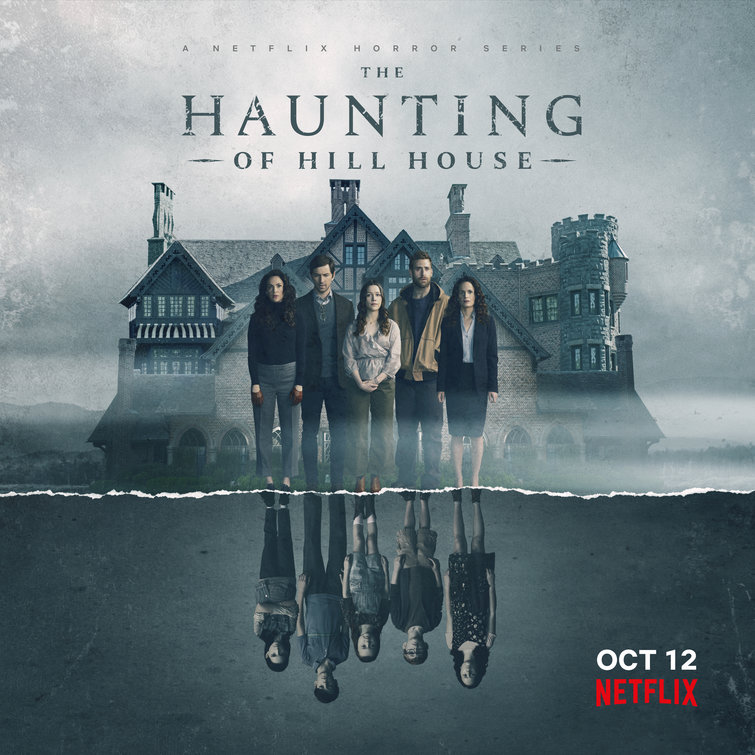
31 Days of Halloween 2018: The Haunting of Hill House (the rest)
2018, Mike Flanagan (Absentia) -- Netflix
I make no qualms about my love of Mike Flanagan's work and my inability to articulate exactly why. I covered that confusion in the last post about this series, something that I absolutely, unabashedly and loudly loved. It was both what I expected from him (depth & expansion on horror tropes) and so much MUCH more.
The first episode ended with a revelation and a jump scare. From there it gathered the family to deal with Nell's death, their own estrangements and the looming terror of that house they fled so long ago. And then it ends on a surprising, incredibly touching tragic note.
I was floored.
Despite this series being one of those that tried to be memetically popular (telling us that people would be too scared to watch the next episode...) I never actually got wrapped up in the jump scares and the ghostly nightmare. What I tethered to was the damaged family and how despite their trauma, and their desperate attempts to avoid admitting what had happened to them, they were still so very strongly tied to each other. Love is hate, and hate is love.
The Man on the Bicycle stares at the screen-memory-hologram. It won't matter how much he pedals right now, as this image is fading. There are some bright colours, some scents emerging from the screen, but the rest is foggy and dissipating. With a sigh, he pedals a bit faster to allow him to watch what he can, while he can.
With the initial scare out of the way, Flanagan can ease us into the stories of the Crains. We start with Shirley, tense and strict, who runs a funeral house with her hesitant husband. Of course, Nell's funeral is held there. Flashbacks provide us more background, to the kids and to the house itself. Theo is emotionally distant, living in Shirley's shed/guest house and hiding intimacy behind a pair of gloves. Luke, well poor lost Luke is an addict. And nobody likes to talk about dear old Dad, except with the greatest of venom.
The show spends a lot of time filling in the blanks, but hesitates in telling us exactly why the family had to run away from the house but refuses to tell us what happened and why mom never came with them. But it left them all severely damaged. And now, in the current day, it seems that with the death of Nell, the house wants them to come back. And that is where the real terror comes from -- the impending doom.
There were a couple of stand out episodes, the primary being the "all one take" episode. Of course, its not entirely a single take, but the continuity of the story telling, as the family gathers at the funeral home, is utterly stunning. The increase of emotional tension, the furtherance of the Crains being actually, truly haunted (by ghosts and by tragedy) all lends itself to a perfect episode. The frosting on this cake is how Flanagan takes the familiarity of a "one take" episode and, when it dives into the flashbacks in the house, uses its motif to accurately represent the geometry bending attributes of the haunted house itself.
Another was the introduction of how exactly the house traumatized small, meek Luke. In an episode that contrasts adult Luke trying to get sobre, we get younger Luke haunted by one of the scariest ghosts in the whole series! Sure, we are in an age of tall, thin, slender men but Luke is so tiny and that fucking thing is so tall ! Does he even need to float inches above the ground? Of course, the ghosts of the Hill House are its victims, so the real man who died is not as nearly scary as the image seared into Luke's young mind, one that obviously alters him forever.
The Bicycle squeaks to a slow pace, needing oil but only finding the blood and sweat running down the Man's legs. He looks over his shoulder. The door is there, the one his bicycle extends from. Beyond is supposed to be the haven he will get when he finally gets to stop pedaling, but right now, all he sees is the silhouette in the doorway, a tall, slender man, and The Man begins pedaling ever more frantically. Not that he can get away... ever.
In the end, I found myself rather impressed by the show. But not by the scares, but by the emotions it left in me. It doesn't take much for me to get in touch with sadness, and maybe that is why I can so easily connect to Flanagan's work. Maybe he knows sadness and let's me touch someone else's for a brief time, so I can let go my own. We are all haunted by something, I guess.
Sunday, October 14, 2018
31 Days of Halloween 2018: Apostle
2018, Gareth Evans (The Raid) -- Netflix
Full disclosure. After a discombobulation of That Month and complete abandoning of the blog (not hiatus; i just ran away) I am going to try and find my way again by finishing off these posts. And then we will see where I go from there.
Remember, I am not one of the novitiates of Evans' greatness that is The Raid. It was a fine movie, but didn't draw out any great praise from me. Solid it was, as was this, but that is about it. But I am a great fan of post-Downton Dan Stevens, and it was October, so here we were.
This movie is a period piece where a drug addict goes to an island controlled by a cult in order to free his beloved sister, the only person who cares for him. Michael Sheen leads this religious group, which we find out pretty quickly, are a bunch of thugs escaping prosecution, and surviving by seeking hostage payments from the parents of illustrious members. But there is something else going on, something about who the cult worships alongside their pseudo-Christianity god.
I kept on seeing hints of the movie I wanted to see here. It looked great, as the cult had been active long enough to have a town filled with a good number of familiar supporting British cast. And the whole dichotomy of Old Testament Religion meets Elder Gods was curious and grand. Tension is high, with Stevens doing his best bent-out-of-shape addict who may get caught by the islanders at any moment. And once we head into the explanations, it becomes visually stunning but full of "huh? what is that about?" moments.
This reveals why I may not really like this guy as a director. He gives me wonderful pieces, that if you see them as clips, or as right now, as snippets of memory, they seem quite wonderful on their own. But as a whole, as a contiguous entity, they don't pull together. His fight scenes in The Raid looked incredible, but after a while became rote. The monster at the core of the island is spectacular in its depiction, but is not fully thought through and not fulfilling by the time the credits roll.
Saturday, October 13, 2018
31 Days of Halloween 2018: The Haunting of Hill House S1E1
2018, Mike Flanagan (Occulus) -- Netflix
If you are going to write reviews (?!?!) about things you should never admit you might not be the best at articulating why you like something, or do not like, for that matter. As I have mentioned before, in one of my never-ending inward looking paragraphs as to why I do this thing, I mentioned that I find it hard to consider these posts are reviews and just more as blog posts. That excuse allows me to ramble on about nothing in particular and be forgiven. You forgive me, right?
Also, I never claimed to be good at this, but I continue to do it as much or more for me, than for you Random Anonymous Reader. Reader? OK, fine just me. And occasionally Kent.
So, I like Mike Flanagan. We have enjoyed almost all of his movies. But when I think about why I like what he does, nothing concrete comes to mind. I like the way he builds characters -- in that it reminds me to lofi Stephen King from the 70s & 80s when his books were as much, or more, about characters than they were about the scary situations they were in. And yet, in paradox, I cannot say that his characters stand out. He does not intend them to be flamboyant or have characteristics beyond their role in the movie, as King did, and thus they don't exactly stay in the memory. But I do remember that as he establishes them, I am attentive and interested. Which is more than most horror movies ever accomplish with backstory.
The Haunting of Hill House is a horror staple. There was the novella from 1959 and the two movie adaptations, one faithful one not so much. Flanagan does not attempt to be faithful to the exact plot (people investigating a so-called haunted house) but re-works the story and characters in two time periods: a family being haunted by the house, and the family's return due to tragic circumstances, many years later. He takes the names and makes the family his own.
The Crain family, with dad Hugh (Henry Thomas / Timothy Hutton) have moved into infamous Hill House. He and his wife are house flippers, renovating difficult spaces and re-selling them. His wife Liv (Carla Gugino) has the architectural eye and Hugh manages the reconstruction with a convincing, "I can fix it..." The five kids tag along. But, as expected, Hugh cannot fix what is wrong with this house.
At first things are fun, as the house is massive with all kinds of rooms and stuff for the kids to explore. But then we jump to That Last Night, where Hugh is waking his kids and demanding son Steven get them to the car, now !! We get a car full of kids screaming, "Where's mom?!?!?" but we get no answer as he speeds away.
Flip to the future. Steven is a writer, who made a hit off a novel about That Night. Shirley runs a funeral home, Luke is an addict, Theodora wears elbow length gloves and picks up strangers in bars (always short hand for trauma on TV), Dad is estranged. What about Mom? Nell ? Steven returns home after a long day, home to an apartment, not his wife's house, and finds Nell there, quiet and in the corner. And then dad calls, "I am at the house, Nell is here, she is dead." Jump scare.
Flanagan does a wonderful job establishing something horrible has happened in their past, and it left an imprint. And it was centred around mom. Immediately the house is a villain, which is obviously from the gothic depiction and details. Immediately we see the events have imprinted themselves on the family forever. The tension builds, and the jump scare is almost a release. I knew I was in for a good ride.
Friday, October 12, 2018
31 Days of Halloween 2018: Malevolent
2018, Olaf de Fleur Johannesson (The Higher Force) -- Netflix
Debunking the ghost hunter. Suffering retribution on the fake ghost hunter. Acknowledging that which the fake ghost hunter seeks out may turn out to be very very real. Its common enough to almost be a trope, so if you are going to explore it again, be sure to do something very well or at least originally. Alas, again with the just OK. If not for a very focused and intense portrayal by Florence Pugh, I don't think this movie would have even crept into that range.
Angela (Pugh) and Jackson (Ben Lloyd-Hughes) are Americans in Scotland making a rough living pretending to be ghost hunters, hinged around Angela's sensitivity to the dead. Jackson owes money to his drug dealers and Angela is having one too many actually spooky encounter (accompanied by nose bleeds) that she wants to quit the scam. But she gives into her brother for one last gig -- the foster house haunted by murdered children, children killed by the son of the owner Mrs Green. She can still hear their screams and wants the spirits acknowledged and driven away.
This movie is not the house nor creepy Mrs Green nor even the dead little girls walking the unused corridors. This movie should have been all Angela and since the jump scares and dead girls are already fading from my memory, I wish it had been even more about her. We got hints of backstory, drops of a strength behind her quiet demeanour. But that is all pushed aside so we can add to her trauma.
Also, why was this movie set in the 80s? And why were they Americans? There seemed to be plot choices that were made, but then never followed through on.
Debunking the ghost hunter. Suffering retribution on the fake ghost hunter. Acknowledging that which the fake ghost hunter seeks out may turn out to be very very real. Its common enough to almost be a trope, so if you are going to explore it again, be sure to do something very well or at least originally. Alas, again with the just OK. If not for a very focused and intense portrayal by Florence Pugh, I don't think this movie would have even crept into that range.
This movie is not the house nor creepy Mrs Green nor even the dead little girls walking the unused corridors. This movie should have been all Angela and since the jump scares and dead girls are already fading from my memory, I wish it had been even more about her. We got hints of backstory, drops of a strength behind her quiet demeanour. But that is all pushed aside so we can add to her trauma.
Also, why was this movie set in the 80s? And why were they Americans? There seemed to be plot choices that were made, but then never followed through on.
Thursday, October 11, 2018
31 Days of Halloween 2018: Resolution
2012, Justin Benson, Aaron Moorhead (The Endless) -- download
NOTE: You should watch this movie before you watch the previous (my previous viewing, not the chronological previous) one. Why? Because the second movie references the first (this movie). Is it important? Turns out, no. Both can be enjoyed independently.
OK, so these guys are going on my list of favourite directors based on our earlier viewing of Spring and my immense enjoyment of these two. They are using the immediate tropes of horror & tension, but attaching the story to a very out-there scifi aspect. In The Endless they had expanded on the world they laid the groundwork for, in this movie.
At its heart, this is a buddy movie. Mike has tracked his highschool friend Chris to a remote cabin in the woods. Chris is an unrepentant junkie, and he did not send the video that inspired Mike to come save his friend. Nonetheless, Mike will do his best.
What begins is more an exploration of a setting, than a traditional plot. Something is going on in these hills. Whatever it is, the local hippy cult is involved. So are the local drug dealers that also went to high school with Mike and Chris. The local tribal police own the building that Chris is squatting in, or so they say. And the scientist in the crappy trailer. And the lost dog. They are all being tossed together to make an interesting story that Chris and Mike are getting mixed up in. Whenever Mike seems ready to complete Chris's rehab, or give up and move on, more mysterious and compelling clues show up. Something or someone wants these guys to stick around.
The horror elements are intense. They may be slow burning, but they burn steadily. Something is going on, something definitely Not of this World. The manipulations go from subtle to shocking, but what really drew me in was that they hinted at a bigger thing going on. Old Ones? Alien intervention? Powerful magics? We never get an explanation... Even when the movie comes to a conclusion, both for the pair of guys and for us the viewers, we get little in the way of explanation, but another question that keeps us (and them) around.
I am now hoping for a trilogy.
Wednesday, October 10, 2018
31 Days of Halloween 2018: The Endless
2017, Justin Benson, Aaron Moorhead (Spring) -- Netflix
Gawddamn it, Steve said watch Resolution first !! So, if you are reading this, do that.
Finally; fucking finally. A great movie !!
We loved Spring so I so glad we like their follow-up. And again, they go with a twisting of expectations while along along the trails of movies familiar to the genre in which it is based.
Aaron and Justin are brothers, brothers who escaped/left a cult many years ago. Aaron, the older, controls his brother and their shitty lives. Justin resents the control, and the fact he never really wanted to leave the cult. Justin convinces Aaron to return to the mountain in the desert one last time, so he can get closure, so he can see through the eyes of an adult that these people were who his brother defined them as, and not the happy place of good memories he recalls.
And yup, its cult-y. Happy people acting weird, spouting off metaphor filled dialogue about trust and perseverance. And tons of ambiguity. Almost immediately Aaron starts catching weird things that are beyond just weird hippy beer making cultists (they can't be all bad, if they make craft beer) -- such as the tall narrow piles of... clay? They look like geological formations but are too narrow and delicate to survive. And there are some classic bumps in the night, until he bumps into the angry guy whose body also is hanged in the shed.
The movie twists and turns and runs down the path from creepy, horror into nervous science fiction. Something is going on in those woods and all Aaron wants to do is find his brother and convince him to leave with him. Meanwhile the hippies are waiting for something, something to do with three full moons and ascension but more likely related to the otherworldly It they keep on talking about.
Much of this season has been about decent attempts but failed execution or flat climax. Pyewacket just plodded along until it reached the expected fiery end, but without much heat. The Lodgers ended with nary a ripple in the mood & tone. Mandy just ended, everyone but Red. But this movie ends with satisfaction and enough openness that I can fill in what I want.
Tuesday, October 9, 2018
31 Days of Halloween 2018: Jug Face
2013, Chad Crawford Kinkle (pretty much just this) -- download
OK, WTF. A movie starts out with a hillbilly brother fucking his sister, the main character, and we are supposed to find these characters sympathetic? Yeah, whatever out of the ordinary vibe (hillbilly occult) they were going for was lost on me almost immediately.
The movie begins with an opening segment, cryptic drawings of a child depicting a backwoods family who sacrifice the local preacher to a pit full of blood. There are hints at demons or spirits implying some sort of pact. We then fall into the story, a potter possessed by something, probably The Pit, making these disturbing moonshine jugs with people's faces. Ada (above sister) finds the newly made jug with her face on it, and hides it. What does that bode? Nuttin' good.
This family / these families have lived in these woods forever -- dirty, poverty stricken and adhering to strange rituals. Ada is to be "joined" with the neighbour's ugly son but only if she is "pure", i.e. virginal. We know she isn't as was just fucking her brother, and she has to hide it or her dad will whup her. And then she finds out she is pregnant.
So, to hide her incestual promiscuity and pregnancy, she begins a conspiracy involving the potter -- a half-baked young man who obviously dotes on her, and her dottering grandfather. Oh, and the rather lucid, talkative spirit who follows her grampa around. But The Pit won't have any of that and eats one of her neighbours. Her Pa knows that this shouldn't happen and that they have upset The Pit -- so a sacrifice has to happen. The jug face was supposed to depict who would need to be sacrificed, and since the potter Dawai doesn't remember who he fired, he makes another one and just blames it on Ada's beau to be. The Pit gets its sacrifice.
It doesn't work.
Again, we are supposed to sympathize with Ada? Not only is she fucking her brother but she just got the neighbour kid killed AND Dawai the potter is being blamed. And since she pissed off The Pit, she also got her neighbour killed. And it just continues !! More blame, more death and more hungry Pit until finally the truth comes out. But w.... t.... f..... no climax, no resolution, just an ending to this current drama and the movie.
You see, you can do a peek into a seedy and despicable slice of life. But either they have to be particularly shocking or spectacularly well depicted. This was neither. Its a not a badly done movie, as the acting is decent, but nothing compelling or interesting happens in the least. And yes, I just couldn't get past the main character fucking her brother !!
Monday, October 8, 2018
31 Days of Halloween 2018: Unfriended
2014, Levan Gabriadze (Lucky Trouble) -- download
Well, that was clever.
Am I wrong, but shouldn't every horror movie about friends who did something wrong (i.e. I Know What You Did Last Summer) have one nice girl/guy survivor? Or are we, in this age of the social media based judge & jury state, everyone is guilty and worthy of punishment? I suppose that since this entire movie is around social media based interaction, its appropriate?
You saw that episode of Modern Family where the mom tries to track down the daughter, and we see it all through the "eyes" of her macbook screen? This movie is like that, all in the evening social "gathering" of a group of of highschoolers on iChat. Is that what Apple calls its PC based video chatting? Or is Facetime transparent in this post-iPhone movie? I can't keep up with what you kids do.
OK, that is out -- Old Man View. Sure, the movie is clever but do kids actually just hang out in video chat? Sure, its 2014 but weren't phones the focal point back then? Sure, there are the technical challenges of presenting an entire movie through a phone screen, but do kids actually ever just hang out in front of their laptop screens? Cybering (what is the current 2018 term for cyber-sex?) I can believe but general social chatting? Well, whatever the reality of the situation, that is where the kids are when a mysterious third party shows up, one they cannot kick from the chat, one that slowly unravels their lives.
This group was at the centre of a social media lynching that posted a video of a un/popular girl who crapped her pants at a party. In response, the girl shot herself. Now, a year later, it appears she is back and (the real horror here) hacking their social media accounts. Over the course of the movie, the ghost in the machine reveals details of how each participated in the cyber-bullying of the girl, from posting videos to leading "kill yourself" tirades in anonymous comments to just generally messing with her. But not just that, as the spirit reveals that each and every one of them is just a soulless bully even against each other. And to backup the bullying, the spirit has the ability to force them to commit suicide in gruesome manners.
Its all rather well done, quick and frenetic, jumping from app to Facebook to personal chat. There was a bit of stick handling done, as the conversation of the others seems to quiet down (i.e. they don't do anything) while we focus on conversation private to two, but beyond that, it all was displayed really well. It still amused me that a ghost, revenge spirit or whatever became tech savvy enough to play with software, removing buttons and hacking accounts. The afterlife has some good malware.
In the end, there is no Final Girl. All the kids are horrible, to each other and to others. All the kids deserve to die. Deserve to die? Ghost girl is obviously as bad as they were, if that's where her revenge takes her.
Labels:
31 Days,
computers,
download,
Halloween,
high school,
horror,
social,
technology
Sunday, October 7, 2018
31 Days of Halloween 2018: The Lodgers
2017, Brian O'Malley (Let Us Prey) -- Netflix
At what point in recent pop culture did we decide that decrepit, old but still lived in manor houses of the UK were ripe to be haunted? I am assuming, that as the regency era came to a close and fewer of those old moneyed families had the coin to keep the estates in a state of full repair, they became more attuned to the "haunted house" vibe of America's Victorian mansions? Creaking, cracked, moldering and falling down. But something in only more recent memory has had more of them attract spirits and other creatures of the night.
The Lodgers takes us to early 20th century Ireland and the house of the twins Rachel and Edward. Their house shares a state akin to Crimson Peak, with no servants and no funds to keep it repaired. Barely enough to feed the young adults.
Unlike most of these movies, we wade into the sinister quite immediately as Rachel, who has fallen asleep while reading, has to rush home before the last bell of midnight. As she reaches her bedroom door, we see the trapdoor at the base of the staircase bubble up with fetid water. Something wants out of ... the basement ? The next morning the twins sing the nursery rhyme that defines their lives:
This is a lovely looking, artful movie. Rachel is fey and sultry and her brother is just... pale & creepy. There is an unsettling connection between the two the belies the tie to the watery creatures beneath the house. Rachel wants to run away from it and is helped by a local boy, recently returned from war with his own bonds. But can she escape with no cost? No, no she cannot.
I just wish the sodden weight of the end of the movie had felt heavier. There is no great reveal, not that there needs to be, but we never really felt the menace of these other worldly creatures. What was the pact? What would happen if they just left? There had to be more danger than just death? Alas, we get nothing.
At what point in recent pop culture did we decide that decrepit, old but still lived in manor houses of the UK were ripe to be haunted? I am assuming, that as the regency era came to a close and fewer of those old moneyed families had the coin to keep the estates in a state of full repair, they became more attuned to the "haunted house" vibe of America's Victorian mansions? Creaking, cracked, moldering and falling down. But something in only more recent memory has had more of them attract spirits and other creatures of the night.
The Lodgers takes us to early 20th century Ireland and the house of the twins Rachel and Edward. Their house shares a state akin to Crimson Peak, with no servants and no funds to keep it repaired. Barely enough to feed the young adults.
Unlike most of these movies, we wade into the sinister quite immediately as Rachel, who has fallen asleep while reading, has to rush home before the last bell of midnight. As she reaches her bedroom door, we see the trapdoor at the base of the staircase bubble up with fetid water. Something wants out of ... the basement ? The next morning the twins sing the nursery rhyme that defines their lives:
"Girl child, boy child, listen well. Be in bed by midnight's bell. Never let a stranger through your door. Never leave each other all alone. Good sister, good brother be, follow well these cautions three. Long as your blood be ours alone, we'll see you ever from below."Rachel is of an age, past puberty but isolated by her obsessive brother and the supernatural circumstances. The funds are finally running far too low for them to ignore, and Rachel tries to scheme her escape. Her brother won't have any of it, as he knows the true danger. He saw what 'the lodgers' in the water did to their parents. He is afraid of what will happen should they break the pact.
This is a lovely looking, artful movie. Rachel is fey and sultry and her brother is just... pale & creepy. There is an unsettling connection between the two the belies the tie to the watery creatures beneath the house. Rachel wants to run away from it and is helped by a local boy, recently returned from war with his own bonds. But can she escape with no cost? No, no she cannot.
I just wish the sodden weight of the end of the movie had felt heavier. There is no great reveal, not that there needs to be, but we never really felt the menace of these other worldly creatures. What was the pact? What would happen if they just left? There had to be more danger than just death? Alas, we get nothing.
Saturday, October 6, 2018
31 Days of Halloween 2018: Pyewacket
2017, Adam MacDonald (mainly a TV actor) -- download
I have a feeling that this year is going to be mostly just-OK movies, a few Stinkers but even fewer Good. Every year we do it -- we see the best of the year's horror offering before the month even starts. Its inevitable, as Good Movies need to be watched no matter what genre they are. And these days, Good Movie translates as something easily digested and in my wheelhouse. I just don't have the mental energy for properly Good Movies, i.e. dramas and impactful stuff.
But no, that doesn't mean we have already seen Anabelle -- I doubt that sequel will be in our lists for years to come, maybe just as some completist drive. But A Quiet Place was already seen and... was there anything else really critically acclaimed this year? Hmmmm...
Anywayz, this was OK, on the edge of Good.
Leah and her mom are dealing with the death of father & husband. Leah's your typical metal highschooler, dressed in black and a bit too interested in books on the occult. Mom hates it, Leah's friends and the bottle of wine a night is not helping her coping skills nor her relationship with her daughter. Her last resort is to sell the house full of memories and movie Leah to the wooded countryside just out of town. Leah can still attend school but it involves long drives back and forth. Leah's not happy but really is just your typical pouty, combative teen.
If the movie did anything REALLY well it was portraying this relationship. They don't really get along but they definitely don't hate each other. Until things come to a head one night and mom screams some really hateful things, that she instantly regrets. But too late, Leah has run off into the woods with her book of spells and conjuring items. Yep, she casts a spell to summon a real demon to kill her mom. You can almost hear her mind ticking, as she doesn't quite believe what she is doing but it works as an outlet for the anger boiling up from inside. And a real demon won't appear, anyway, right?
Her mom recovers and is desperate to make it up to Leah. It doesn't help that Leah cut herself to cement the ritual and, well, mom sees that as Leah hurting herself in response. They try to repair the relationship, but then things start going bump in the night. Pyewacket the demon (not Kim Novak's cat) has come and he has come for Leah's mom.
The paranoia, the desperation, the anguish at what she has done -- this is well portrayed. Too bad the inevitable ending was not so telegraphed. While Marmy and I are quite adept at predicting how typical plotlines go, we like it when we are surprised, even a little. But demon summoning always has a cost, and they are predictable little buggers. I was hoping for at least something to raise this movie out of the depths of mundanity, just a little bit more on top of the solid performances.
Friday, October 5, 2018
31 Days of Halloween 2018: Cold Skin
2017, Xavier Gens (The Divide) -- download
We first met Xavier Gens in the inaugural year of this horror movie binge-ing, where I also began my foray into "is it horror, or is it not?" I decided then, that The Divide was not. I remember liking that movie more than I wrote, but that is probably more due to the viewing which was Toronto After Dark and involved the cast and director. But my thoughts of it being focused mainly around "does the viewer and the participants get to share in the fear?". If not, then no.
This time we get a period movie on a small, frozen island near Antarctica with Cthulhu-ian overtones. Sounds like the perfect storm (pun intended) for me. Monsters, miserable setting and isolation -- all horror aspects in my book. And yet, it didn't work. Not as horror, not as adventure. Not as a fishy love story?
A pair of desperate men are assigned to a weather station and a lighthouse. They have to fend off hordes of merfolk each night, while also dealing with the isolation and diminishing resources. I liked the setup. David Oakes is the new arrival, taking the place of the previous weather man who ... disappeared. Ray Stevenson is Gruner, the madman in the lighthouse. Almost immediately they are at odds with each other which is not helped when the island reveals its true nature; Gruner and the new man (only called Friend) are attacked by seemingly endless hordes of Cthulhu-style Deep Ones, mermen with a definite homicidal desire. And not just that, but Gruner has taken captive a very obviously female one, whom he rescued as a child and has raised as his slave, pet and ... (ick)... lover.
Yes, Grunerfucks rapes his fishy slavegirl. Despite a few rather feeble attempts, this movie is no The Shape of Water. There is no beauty to the connections, just a general ickyness. The domination of Gruner over the morality of Friend is considered acceptable because of the setting, both in year and in isolation. But at least it allows that situation to evolve.
Eventually the two men are in a place where the true horror can be revealed. They are stuck with each other, with dwindling supplies and the hordes never lessen, no matter how many they kill. If only the movie had dwelled entirely on this aspect instead of veering into the moral morasses both men have created for themselves. This just wasn't the movie to explore that. Once that becomes the focus, then we are no longer rooting for the men, but for the mermen. And when things end, you are not really sure how you got there but that he had to write "Fin" at some point. Pun intended.
We first met Xavier Gens in the inaugural year of this horror movie binge-ing, where I also began my foray into "is it horror, or is it not?" I decided then, that The Divide was not. I remember liking that movie more than I wrote, but that is probably more due to the viewing which was Toronto After Dark and involved the cast and director. But my thoughts of it being focused mainly around "does the viewer and the participants get to share in the fear?". If not, then no.
This time we get a period movie on a small, frozen island near Antarctica with Cthulhu-ian overtones. Sounds like the perfect storm (pun intended) for me. Monsters, miserable setting and isolation -- all horror aspects in my book. And yet, it didn't work. Not as horror, not as adventure. Not as a fishy love story?
A pair of desperate men are assigned to a weather station and a lighthouse. They have to fend off hordes of merfolk each night, while also dealing with the isolation and diminishing resources. I liked the setup. David Oakes is the new arrival, taking the place of the previous weather man who ... disappeared. Ray Stevenson is Gruner, the madman in the lighthouse. Almost immediately they are at odds with each other which is not helped when the island reveals its true nature; Gruner and the new man (only called Friend) are attacked by seemingly endless hordes of Cthulhu-style Deep Ones, mermen with a definite homicidal desire. And not just that, but Gruner has taken captive a very obviously female one, whom he rescued as a child and has raised as his slave, pet and ... (ick)... lover.
Yes, Gruner
Eventually the two men are in a place where the true horror can be revealed. They are stuck with each other, with dwindling supplies and the hordes never lessen, no matter how many they kill. If only the movie had dwelled entirely on this aspect instead of veering into the moral morasses both men have created for themselves. This just wasn't the movie to explore that. Once that becomes the focus, then we are no longer rooting for the men, but for the mermen. And when things end, you are not really sure how you got there but that he had to write "Fin" at some point. Pun intended.
Thursday, October 4, 2018
31 Days of Halloween 2018: Mandy
2018, Panos Cosmatos (Beyond the Black Rainbow) -- download
Wow, just wow. Yes, the director precedes himself with quite the reputation, but wow, this movie.
Don't take me the wrong way, I am not wow-ing out of being impressed, but more by "wow, what an experience". This movie was incredible to watch, but I am not quite sure that made it good.
As I said, Cosmatos is already known for his previous movie (Beyond the Black Rainbow), some calling it comparable to Lynch and Cronenburg, or others less forgiving and saying it "has a doomy, dreamy, druggy, draggy feel that's impressively sustained - until it becomes oppressive, then pointless, then laughable." I haven't seen it, but if Mandy did anything, it makes me want to even more.
At its core, Mandy's story is a pretty straight forward revenge flick. Its 1983, Red (Nic Cage) and Mandy (Andrea Riseborough) live together in the woods. By day Nic is a lumberjack and Mandy works a convenience store. By night they make love in the woods, fish on the lake and frolic in the green. Mandy wears metal shirts, has a strange scar and reads 70s fantasy novels as if deep philosophy. And then the hippie cult shows up.
Jeremiah, the cult leader, wants Mandy for himself and summons four ATV riding demons to capture the couple. Yup, ATVs and motorcycles. Things don't go as the cultist planned and Mandy scoffs at his overtures. She is rewarded with death by fire, while Red watches on, bound in wire, but is left alive. That was a mistake.
This movie is all colour and sound, seen through the lense of mind altering substances. And rage. Red's vision is well ... red, of fury and blood. At one point he forges (literally) a massive battle axe straight from the covers of heavy metal albums and D&D games. Or vans. You could see this entire movie through the lense of an 80s metal head D&D player, kind of like Joe Manganiello's new business venture Death Saves. As long as said D&D player is deeply steeped in LSD.
I was rather disappointed that the demon bikers turned out to be basic LSD addicts, instead of true demons, but they were portrayed in a manner that out did Hellraiser or Silent Hill in horrific natures. Too bad, this is as far as the real horror of the movie went. The rest just degrades into bland death scenes, finally petering out with the (inevitable) craven death of Jeremiah.
I am still challenged about whether the trippy imagery and sound barrage actually contributes to the movie, or just pulls you from the centre of revenge. I think if Cosmatos had delved more deeply into the anguish and fury of Red, as he did when Red self-medicates with vodka. That imagery of Nic Cage dialed to 11 was what I wanted more of, and less of the animated Riseborough scenes. But, still... quite the experience.
Wednesday, October 3, 2018
31 Days of Halloween 2018: House on Willow Street
2016, Alastair Orr (Indigenous) -- download
Yeah, well that sucked.
South African indie director Orr, with a few horror movies under his belt, comes at us with one he described (in an interview) as being out of the ordinary, not exactly was you expect. I suppose he was trying to be creative in his story choices but just came off with a bunch of WTFs.
We start with Hazel, waking up up in a shredded shirt and a back covered in burn scars. Enter tragic backstory which doesn't matter all that much. She is the leader of a snatch crew, criminals who scope out and kidnap rich kids, ransoming them back to their wealthy parents. At first I thought they might be hired by her parents, to get her back from an Evil Cult. But no, they are just a bunch of thugs seeking to make money.
The first hiccup in the plot was that they spent 6 weeks prepping the job but never seemed to catch on that something hinky was up. The prep is supposed to imply watching schedules, noting patterns and setting up a base of operations. Other than the installation of some camera equipment in an abandoned warehouse, they didn't seem to have prepped at all, because were they very surprised about what actually happened during those six weeks.
The actual kidnapping is pretty easy, grabbing the girl from her bedroom in a rather creepy old house. There are also some triggers for us to catch on to something occult going on. With the girl back at the warehouse, we see she is not quite right. And thus begins a pretty ho hum Evil Spirit story.
Ho hum would have been fine, but the movie just goes all over the place, from bad to worse. There is a segment in the middle, the part of many films where we get a dramatic view from a camcorder. If the rest of the movie was low key indie, this segment was downright amateurish, almost film school / YouTube level of acting and plot. This shows us how Rich Girl became Possessed Girl, all during those six weeks that our crew was supposed to be paying attention.
From Evil Spirit in an Evil House we are exposed to some sort of Old One style demon from whom the Vatican protects us via a magic book supposedly written by God himself. If you are going to have a talisman that protects our world, locking it away in the Vatican seems foolish. The house (on Willow Street, but seriously, who cares what street it is on) is supposed to be as far away from the book's location as possible, which gives the demon some leeway. Someone writing the movie should have Googled antipodal locations. Unless Willow Street is off the coast of New Zealand, it ain't that far away. Also, the Vatican KNOWS this location, so how about just purchasing the land and establishing a watch base?
Ignoring that, the demon needs to attain four souls to become all powerful. So then, why has that been so hard? If its been hanging around that point on the planet since the beginning of human kind, why does it keep messing up? In fact, what is supposed to be the classic list of Evil Things That Have Happened (in the house) over history just sounds like a list of all the times the demon has failed. With no one's intervention required. Even this time, when he converts two of the snatch crew into creaking, cracking hentai-tongued Possessed, he cannot do much more than some low key TK. So much for All Powerful.
The thing chases down Hazel, the last of the crew, to make her the fourth. But she gets helped by an eye-rolling twist. But by the time we got to the twist, I was so bored and annoyed, I didn't really care. And neither should you. Decent poster though...
Tuesday, October 2, 2018
31 Days of Halloween 2018: The Night Eats the World
2018, Dominique Rocher (debut) -- download
So, first thing, when I saw Marmy had grabbed this one, I was rather confused. I remembered the blogposts and it had been clearly a French movie set in Paris. But her copy was obviously English and obviously not dubbed. Turns out it was filmed twice; once in French and again in English. I kind of love that, as it opens up the audiences but also retains itself as a movie by its director. The crime series Hinterland did something similar filming the show three ways: in Welsh, in English, in the more likely mix of the two.
Anywayz, onward...
When is a zombie movie not a horror movie? Well, sometimes when they are comedies but more often than not, they are always horror. This one? The debate will rage, but I saw this as a cerebral survival movie. Many reviewers saw this as interminably boring but I was rapt with attention.
But I may be biased.
For years, I have had recurring dreams and I have crafted story snippets and flash fiction set around the Last Man on Earth. Zombie fiction lends itself so well to this idea, but in general, creators don't use it. Almost all zombie apocalypse movies are group events, so they can pick off the survivors one by one, or at the very least make the Walking Dead commentary about how mankind is the real monster. My focus is on the Lone Survivor and how they deal with their solitude as well as the dangers. So, I absolutely love how this story aligned with my thoughts...
Sam goes to a party to argue with his ex, and to retrieve his box of cassettes. The party is annoying and he feels alone and isolated. An elbow to the face and a few drinks sends him to a room with peace & quiet, where he falls asleep. When he awakes the place is in shambles, the walls painted in the blood of conflict but the entire apartment eerily empty. It doesn't take him long to realize the zombie apocalypse has happened and he is trapped inside building by himself. The rest of the party goers have been killed. He is alone. And from the utter silence outside, all of Paris has been affected.
And thus begins a zombie movie that jumps directly into my headspace. Its not concerned with conversations on the existential dread and anguish and fear. Sam is focused on survival, but since he is alone, he never verbalizes what he is going through in those initial days and weeks. Immediately, he gathers food and protection and ... stuff. But as time and the alone-ness of it all settles in, we see how he is affected in his actions, not always his words.
I also was rather taken with some of the tropes they overturned. For example, if you peek into a place where the dead might be wandering. Are you going to creep around quietly hoping to surprise the quiet dead? Or will you do as me and Sam would do, banging & yelling to attract any monsters that might be around the corner. So with precision and only a few missteps, Sam is able to secure the apartment building for himself.
Yes, I said 'quiet dead' which makes so much more sense than the moaning masses. If they are dead, their lungs don't work and they don't need to breathe. Autonomic vs somatic. So, why do so many zombies cry and groan and crackle? Rocher's zombies bang and claw and snap, but they never make a single wheezy noise. Creepy !!
The movie has little action, and focuses around Sam as he hides and survives and slowly uses up all his resources and sanity. The middle act covers the methods Sam survives, through paint ball guns and gathering water on the roof and keeping himself occupied with percussion experiments (tunage!) and whatever he had on those cassettes he came to collect at the beginning of the movie. But eventually his isolation begins to take a toll on him. Enter Sarah.
I won't go any further, for the sake of spoilers, but an event changes the direction of Sam's living arrangement. He will have to move from being the safe alone guy, to being the On The Move guy. From survival to road story and hopefully we will get that movie.
Monday, October 1, 2018
31 Days of Halloween 2018: Hereditary
Starting in 2011 we (Marmy and I, as Kent is not that much of a horror fan) enjoyed celebrating the Halloween season (as soon as the candies hit the stores) by watching too many horror / Halloween related movies, most of them bad. 2012 had a few flicks but not the full month. Un/Re-employment kill 2013. Apathy killed 2014. But we returned in 2015 with a full run. 2016 had a good start, but stalled in the last few days, likely due to work life. 2017 almost started with a fizzle, but then I remembered, "It's October 1st !" But it fizzled out on my birthday with the last few episodes of Stranger Things S2. This year, after I fizzled out the "break the hiatus" for this site, I actually found myself excited to do at least THIS month.
And so we begin.
2018, Ari Aster (feature debut) -- download
So, what do you like in your horror movies? I know I have asked this question many times on many different posts, but the fact we start this loose tradition again, makes me wonder what will succeed (with us) and what will fail? Jump scares? Haunting music? Creepy background stuff? Body horror? Blood & gore? Suspense thicker than congealed blood? There are so many elements that make up a good movie, but it takes a delicate balance to make a great horror movie.
Hereditary does that.
Toni Collette and Gabriel Byrne are married with children (note: he is 17 years older than her, which is gratingly obvious). Toni's mother has recently passed and there is an odd, palpable apathy to her death and the family's reaction. History; bad history. Toni is an artist, in miniature (yes! love, LOVE the works represented in this movie!!) who begins working out her issues with her mom, issues that (after a brief stint at a grief session) revealed to be completely and truly understood, through small dioramas of the most unsettling nature. They have a rather lovely house. Houses with dark pasts are almost always so lovely.
Meanwhile her daughter, played wonderfully creepily by Milly Shapiro (it cannot be overlooked that part of Milly's off-putting nature is heightened by her cleidocranial dysplasia features; but they must have been enhanced by makeup, because she really isn't all that creepy in real life) is not helping our sense of displeasure at this family. Was gramma a witch or just insane? Did her daughter carry it on, or her grandaughter? Or both? Both women send chills down our spines. Toni does disturbing dioramas of her dead mother and Milly cuts the heads off dead birds.
The movie takes this unsettled space, a family plagued by mental illness and possibly worse, and just keeps on ratcheting it up. And up and up and up. With tone and colour and sound (oh, that background deep tone that runs through the tensest scenes....) we are left entirely anxious. Even if this movie had never tried to introduce any supernatural elements, it would have left me squirming in my seat over how entirely on edge this family was.
I really don't want to spoil a major plot element that splits the movie in two; I am still rather surprised I was not aware of it. But it turns the movie on end, as well as sending it down the inevitable path we should expect, as the family just completely falls apart in response. Let us say, the movie is relentless in doing harm to this family. Gabriel Byrne, who begins as a charming (if cardboard) nice guy, slowly unravels. The son, well the son who was a little bent before, is broken entirely, and nobody seems to be helping him. Mom is not very motherly.
If anything, by the time this rollercoaster has run its course, we have been served most of the above ingredients of a horror movie. Most are successful, some are less so. As Marmy said, it may have explained too much, but I did love how it decided to take on a rather 70s ghosts & witches pallour, rather than leaving us in the usual ambiguity. I really enjoyed it, but I can see how it could take away for some people.
Saturday, August 18, 2018
3 Short Paragraphs: Game Night
2018, John Francis Daley, Jonathan Goldstein (Vacation) -- download
Yes, I generally reserve this tag for the movies I have no feelings for, one way or the other. Why did I watch it? Mainly because of the involvement of John Francis Daley, who most know primarily as a guy on Freaks and Geeks but I know as one of the nice guys they killed on Bones. And because I generally like everything Jason Bateman has been doing since his reemergence. Well, except for Arrested Development which is just not something I can get in on.
So, a group of friends have a regular game night, something the three couples have been doing for years. You would think, in this age of table top gaming (go Google Wil Wheaton's TableTop) where board gaming cafes and YouTube review shows give you a fuck load more than Charades and Scrabble, which is where this movie goes. But the real intent was that Max's (Bateman) brother gets them mixed up in a murder mystery live action game, that turns out to be far too real. The board games were just a gimmick to get the plot going.
The fishes out of water second and third acts are fun if pretty run of the mill, especially once they begin to believe the crimes being committed are real, and Max's brother is really, truly in trouble. The hyper competitive couples are both endearing and cringe worthy, as is typical of Hollywood light comedy capers these days. I just wish it had been actually more about gaming culture, and no I don't mean LARPing or having the group be actual D&D players. Though, that would have probably been a far more interesting movie if you had the plot around a group that had started playing D&D when they were kids and the campaign was still going on. Especially since a major plot element focused on an uber uncomfortable neighbour who was excluded from the group. Alas, people would rather see Charades than seeing 40 year-olds killing Mind Flayers.
Thursday, May 17, 2018
Anon
2018, Andrew Niccol (Gattaca, In Time) -- Netflix
Niccol's last foray into futuristic social commentary, In Time, was marred by a dominance of pretty people and a lack of focus on the world's futuristic elements. But in his latest, a comment on the lack of privacy in the digital world, you cannot escape the futuristic. It's everywhere -- in much the way we think our own world is, dominated by social media and digital systems stealing away our privacy, Anon's world is saturated by sub-cutaneous information overload. In our real world, despite the hype, it's still pretty easy to disconnect from personal data stealing online culture -- just don't contribute and you won't be out there. But imagine a world where its in your head from birth, where the government can see through your eyes, record all that information and access it at any time --- there is literally no privacy.
Clive Owen is Sal, a cop who investigates serious crimes. His job's rather easy, he can just review the criminal activities through the perp's own eyes (and recent past) to glean all the details he wants. It doesn't stop people from trying; it's just easy to solve. Sal is kind of bored, when a mystery comes along. Someone is murdering those who recently had their illicit behaviours removed from the record.
Of course you subvert can the system. Sleep with a hooker and don't want your wife to find out? Hire a hacker to remove the event from your own record (and the copy with the govt), from the hooker's record, from every record of everyone involved. Fill in the time with the memory version of a looping vid (or static print out placed in front of a security cam) and all the details are gone. A hacker is hacking the hacks and killing to remove all evidence.
Sal's a good cop and quickly puts together some details, generates a sting op to find this skilled hacker, and it all goes wrong, because they always do. Amanda Seyfried returns (in a Niccol movie) as the hacker in question, a young women entirely removed from the system and offering the same to others. But why is she killing her clients? That is the question.
This is brutalism meets film noir meets techo overlay. The entire concrete world (shot in Toronto and NYC) is overlayed, an augmented reality, with advertising and information. As we generally see through a cop's eyes, I am not sure everyone has the access Sal does, but he gets EVERYTHING. He knows the details of everyone and everything he sees, with text and video for everything in his field of view. Its a fascinating world, where he can wave things off but never really does, where everyone has the look of a person distracted by their phone, in the extreme --- eyes always lost in a distance look at something not really there.
You know my love for interfaces, and while much of this is too simplified (think flying boxes as representations of all data) it is well populated, focusing on the utter glut of available info. And these smoking, grim talking people, so devoid of emotional inflection walking around a stone city a little too clean, a little too tidy. It made me think the view may be cleaned up, editing out refuse and clutter. The world is as you want, or need, to see it.
The commentary is that even when we have all the private info available, crime won't just go away. Sure, it will be easy to solve said crimes, but people are people. Its supposed to be chilling that the government will have access to everything about us, but that's not really perceived here almost as if Niccol's is OK with this world. Just stay away from illicit behaviour and you can have your life to yourself. I think if they had shown a bit more of how the information can be abused, we could have bought into the scary aspects of this world.
Sunday, April 29, 2018
3+1 Short Paragraphs: Ready Player One
2018, Steven Spielberg (Jurassic Park, AI) -- cinema
I didn't know this book was so divisive until they announced Spielberg was adapting. Suddenly, a book that I saw as a fun and inventive romp focused on an obsession with 80s pop culture, primarily geek culture became the source of derision and controversy. Sure it's empty, sure its pandering and maybe the characters are not exactly paragons of virtue, but when are they? Anywayz, I am the exact demographic for this kind of story, as I grew up in the 80s and geek culture was my culture. And that also makes me the demographic for the movie, and also, who better to do it than an icon of that era himself -- Spielberg!
Wade Watts is growing up in The Stacks, the 2040s American version of tower blocks made up from mobile homes stacked on top of each other in precarious frames. This is pure dystopia, where people survive a horrible world set against them and escape into an ultimate VR experience called The Oasis. In case you are wondering how poor people can access a wonder of technology, remember even homeless people have smart phones today. The founder of The Oasis has died, and he has left behind the ultimate game -- a hunt for an in-game Easter Egg where the finder gets control of his company. Of course, an Evil Corporation (IOI) wants that control so they can make even more money off it, and they are not afraid to hurt Wade and his friends as they hunt for the egg.
Despite The Oasis being created by a man who was obsessed only with his own childhood, Spielberg's is littered with other references to geek culture reaching out past the 80s. Identifying those references in the book was the fun part, and catching all the (expanded) references in the movie is again the fun bit. And that's all there is here -- a fun adventure romp for those who like geek infused adventure. And there is nothing wrong with that. You cannot make me feel bad about that.
If I was disappointed in anything about the movie, it was that it dispensed with the D&D heavy elements from the novel to add in more straightly familiar video game and movie references. The Tomb of Horrors is replaced by a racing game, War Games by an impressive recreation of The Shining and the rest all leading to an old Atari game at the centre of a FPS battle world. But again, I remind I am the demographic, so I loved it even with the straight forward plot and execution.
And yes, I saw the sticker on the back of Aech's postal truck.
Labels:
action,
adaptation,
book-to-movie,
cgi,
cinema,
future,
geek,
sf
Saturday, April 21, 2018
Breaking Hiatus: The Commuter
2018, Jaume Collet-Serra (Run All Night) -- download
The other day, I was thinking I want to get back into writing about movies; again not explicitly reviewing movies, but returning to whatever I was doing here. Then, the other morning, Jason K blogged about blogging and THAT was what I wanted to return to. But no, I cannot resurrect thisboyistoast.nu again, as I already did (as a photoblog) and it is already on hiatus itself. BUT, I can return to blogging about movies, as I watch them, with no requirement of format or length or requirement.
That should make it easier, right? So says my lazy lizard brain.
The Commuter is the latest Liam Neeson movie from French director Jaume Collet-Serra. Without trying to, I have seen all of his movies, so I guess that puts him in my wheelhouse. My favourites were The Shallows and Run All Night. But including this new one, his three Neeson movies are of a certain style, where a man is forced by plot circumstances to become involved in something more violent than he ever intended.
This movie begins with a commentary on aging, particularly the aging action star, that cannot be anything but intentional. Michael MacCauley 62, laid off from his insurance job after 10 faithful years. That means he started that job at 52, and hoped to ride it out till retirement. He had his kids in his mid 40s, and chose a life commuting to and from the suburbs over whatever he was doing before. In a great opening sequence, we are given a collage of what makes the title of the movie, his commute to NYC and back each day on a crowded train where he is one of the regulars.
On the day he is laid off, he has had a few beers with an old friend, and we find out MacCauley is an ex-cop. He is returning to his home, where he will have to tell his wife (and their college age kids) that life is about to collapse. But he is approached by a lovely young woman (Vera Farmiga) with an offer. Use his cop skills to find someone on the train who doesn't belong, tag them, and make $100k.
Of course, its never that simple. Things escalate towards a conspiracy of murder and corruption and a desire to kill the person he is supposed to tag. But he is a man of principle and does his best to derail their plan. Despite the danger to himself and his family, he has to do what is right.
Its fun to watch Neeson in the gray years of his life play the leading action hero, but not in the cocky, shout into the future way that someone like Bruce Willis or Sylvester Stallone does. Liam bears his age well, but it shows on him. The visceral fight scenes have him pummeled and bounced about in a dance of violence, where it is not his strength that wins, but wisdom (skill learned through time) and willpower winning out. While the movie does do a bit of spiraling out into ridiculous (big action needs big sequences), I cannot help but like the movie.
The finale shows an interest in making this movie into a series. Not Taken style where he repeats the same plot over and over, but one where an aged cop foils the plots of the bad guys. I doubt it will go that way, but its fun to think of such while Liam is around to foster it.
Wednesday, February 28, 2018
Black Panther
(some minor spoilers below, but if you haven't seen it, what are you waiting for)
2018, d. Ryan Coogler
Black Panther, simply put, is exciting, important, and so long overdue.
It's not just that it's a blockbuster film that features mostly an all-black cast, but it's also a film written by black writers, and directed by a black director. It presents a perspective not normally seen in films of this scale. It's easy for entitled straight white males with a twitter account, blog, youtube channel, or Fox News talk show to undervalue that when, for one's entire life, almost all creative narratives has catered to one's sensibilities (whether conscious or unconscious). But anyone with a shred of empathy can understand why this means so much, since it's not playing to the common big blockbuster straight white male sensibilities. This is a Marvel movie, part of the Marvel Cinematic Universe. This is a studio that has grossed literally billions upon billions of dollars from its films. This is the big time. People of all different skin tones and backgrounds, languages and cultures, are going to see this movie just because it is a Marvel movie. That type of exposure could have led to more of the same Marvel-style filmmaking, but Marvel wisely tapped writer/director Ryan Coogler and co-writer Joe Robert Cole to craft a movie that just couldn't be told in the usual mold. They tell an accessible superhero fantasy tale, but it's one that's loaded it with characters and perspectives that will be many people's first experience with seeing things in such a way, or exposed to the viewpoints it presents. To be honest, it shouldn't be a film that means so much just to black people, but to people everywhere.
The film opens with a narration and the images formed by CGI sand relating the history of the fictional African nation of Wakanda, how a meteorite fell from the sky bringing with it vibranium, a rare and precious metal found exclusively within Wakanda's borders. Over time, the people of Wakanda learned to harness the many unique properties of vibranium, creating a highly technological, futuristic society, one they hid from the world under the guise of a poor farming country keeping the world at an arm's length away in order to protect their utopia, and to vibranium out of the hands of colonials who would most certainly abuse it's properties for militaristic-- rather than beneficial-- purposes.
T'Challa (Chadwick Boseman) returns home for the first time immediately following the events of Captain America: Civil War where his father was killed. Now crowned the new King, he faces the challenges of other tribes and the pleas of his former lover, Nakia (Lupita Nyong'o) , to change their secretive ways, to join the world at large and use their intelligence and technology and attempt to make a difference for people who are suffering. But T'Challa's biggest challenge comes in the form of Erik Killmonger (Michael B. Jordan), a lost relative with a grudge against the royal family, and against the nation of people who turned a blind eye to all the suffering people in the world who look like them. Erik wants to take the crown by force, and change the world with force.
These are the major threads of the film. How does one help the world? Is it through dominance with technological and military might, or sharing knowledge and science, and compassion? Some of the more narrow-minded people who have commented on the film called either take in the film "anti-white", but again they're viewing from their own perspective of privilege and entitlement, and how this challenges it. This is really a statement about "anti-oppression". That it so happens that the oppressive systems in real life are largely favourable to white men is an extrapolation of that commentary, and the fact is, in the reality of Black Panther, the Wakandans have the capability to usurp that, and no doubt with some ease. But T'Challa's standpoint is that defeating oppression with oppression gets humanity no further. The hope, I think of the film, is to provide inspiration that through intelligence and technology as well as embracing culture and heritage, that a difference can be made, albeit unfortunately not as radically as having vibranium in your pocket.
There's a sequence in the 2017 film The Lost City Of Z (review coming...eventually) where the British explorer Percy Fawcett tries to explain to the Royal Geographical Society that he found evidence of a lost culture in South America, advanced pottery and statues. Now this being set in early 1900's Britain, this crowd of old, rich, white men laughed and mocked Fawcett for the very suggestion that native cultures anywhere were capable of advanced thought. Britain at the time was at their tail end of colonialism and still had to justify their missions of "bringing civility" to "primative" people... racing and fighting other European nations like France, Portugal and Spain along the way. The perception of other races and peoples as being both intelligent and cultured was counter to the colonial's narrative and threatened the moral validity of their rather heinous actions.
This type of narrow thinking is still way too prevalent today, which is why the Afrofuturism represented in Black Panther is so important, because it challenges the idea of white supremacy on film on such a grand scale for, really, the first time. Until now, the visual challenge to the idea of white supremacy in cinema, particularly with regards to Africans or African Americans, has been in small physical victories, or moral victories, or with the assist of white savior archetypes. But to see an entire African nation -- one that dons clothing, jewelry, make up and/or face paint that is inspired by actual African cultures -- be the most advanced civilization on the planet, producing technology that is so far advanced from Tony Stark's Iron Man and rivals that of the "gods" of Asgard.... that is absolutely groundbreaking, absolutely important.
Of course, I'm talking a lot around the film, not so much about the film. That's because the cultural impact and significance (especially since Black Panther has become so successful -- already in the top 30 all-time Domestic Box-office and climbing) is undeniable. But, you know, none of the cultural aspects of Black Panther would really matter if it weren't a film actually worth watching. The reality is it's a damn entertaining, thoroughly engrossing movie.
The opening narrative sequence is pure homage to Disney (corporate owners of Marvel Studios), and subsequent scenes in the first act have a similar feel, like the fly-over introduction to Wakanda (it's framed like any number of Disney or Pixar fantasies which swoop through unfamiliar terrain providing some of the texture and culture of this new world that is so eye popping you want to stop and explore a while before you continue on with the film) and the triumphant, colourful, musical ceremony of T'Challa's crowning. The outright blend of both advanced technology and African-inspired traditions are enticingly full of wide-eyed discoveries and vibrant imagination.
The second act begins with T'Challa heading out to South Korea with Nakia and his head of security, Okoye (Danai Gurira) in search of Ulysses Klaue, a nefarious mercenary who is the only person to successfully steal Vibranium out of Wakanda (as seen in Avengers: Age of Ultron). He is Public Enemy #1 in Wakanda, and they want him back, dead or alive. The sequence is no doubt inspired by the Bond films (Skyfall in particular) but substitutes the superhero for the superspy once the action kicks in. Shuri (Letitia Wright), T'Challa little sister, acts as Quartermaster, ergo, the Q to Black Panther's Bond. The capture goes awry (thanks in no small part to Killmonger) an T'Challa returns home to more problems than when he had left.
The third act shifts its core focus to Killmonger, enlisting support from the Wakandans in the most devious and ruthless of ways, challenging for the throne, all while using the techniques he learned from US special forces training in usurping and destabilizing countries to his full advantage. How will T'Challa overcome when his very foundation is shaken with Killmonger's truths?
In a few short weeks, Jordan's Killmonger has already become a legendary villain in cinematic history. He rivals Heath Ledger's Joker for sheer command of the screen, but exceeds thanks to Coogler's immaculate unveiling of Killmonger's history, tragedies, and motivations. In a film absolutely loaded with fantastic characters, the tragic Killmonger stands a head taller, and I don't know if it's one thing... you can point to the writing, the performance, the directing, editing, or score, but it's probably the masterful combination of them all. The film's called Black Panther but Jordan as Killmonger is the headliner. He is a character you want to love and embrace, but he's so ruthless and at times heartless in how driven he is, he pushes you away. It's glorious, an epic performance.
Wright plays Shuri as the most brilliant ray of light in an already vibrant movie. Wright's broad smile and beaming personality are so damn endearing, you can't help but love her, and melt into a little puddle every time she's on screen. She's effectively conveys being the smartest person in a country that consists almost solely of smart people, not through any sort of affectation or overly technological jargon, but through confidence and glibness. The sharpness of her wit is the greatest sign of her intelligence, especially since she's still so young.
Okoye is perhaps the most striking figure on screen. The costume design alone, the vibrant red, ornate armor of the Dora Milaje, is extremely attractive, coupled with the shaved or close cropped hair, jewelry and weaponry creates a look that is ferociously tough, yet decidedly feminine. Gurira handles the action sequences tremendously well, an intimidating presence. Her character, as the royal guard, is steadfast in her honor and duty. She serves not a person, but the crown and her country. Personal opinion has no place in her role. It makes relationships tough. At times I found Gurira struggled with the Wakandan accent, some line readings falling flat, but even the occasional awkward line delivery can't bring down how imposing her presence is on screen.
Enough heaps of adoration cannot be given to how utterly, dementedly delightful Andy Serkis as Klaue is. If there's a concept of a mustache-twirling super-villain in the modern age, Serkis has mastered it. Filled with utter childish glee at whatever it is he's doing, Klaue seems to be a man of no fear, endless invention, and a real love of 90's dance music. Usually Serkis' performance is buried behind a CGI character, but here he gets to show that it's not animators that turn in those brilliant roles like Gollum or Cesar (in the Planet of the Apes films), it's all in his face and tone and voice, just with fake images skinned over him. This is the only film I can think of that manages not one but two great on-screen villains.
One great character I haven't brought up yet (in a film quite loaded with great characters) is M'Baku as played by Winston Duke. M'Baku is perhaps the best discovery of the film. While the character in the comics at times is...problematic at best, racist at worst...here he's given a real personality, some real motivation, and a couple of the best scenes in the picture. If he's a villain, ally or neutral figure, we can't be totally sure... he's a wild card. In any regard he's a massive, imposing, and dangerous figure...and yet Coogler and Cole's script manages to find humanity and purpose in what could have been a very one-note side character.
I haven't even talked about Angela Bassett, Forest Whitaker, or Daniel Kaluuya who all have solid roles in this deep, deep film. That's because this film is so damn packed it'd take me hours to write about them all (and it's already taken me hours to write this far). Hell, I haven't even talked about Chadwick Boseman who's in total "Batman" mode here...really being the foundation upon which the rest of Wakanda is built. Boseman's T'Challa was a standout in Civil War but here, like Michael Keaton in Batman or Batman Returns, he's required to do what's needed of him so that the rest of the cast can shine. I don't think I can ever get tired of the soothing tone of his manufactured accent, he imbues it with such sophistication and authority, but a softness and comfort. He obviously mastered the dialect, and all other players in Wakanda are trying to catch up. Nobody's accent quite measures up... maybe Winston Duke's.
It should also be noted that Martin Freeman is in the film, returning as Everett Ross from Civil War, but only because he is very pointedly in the "token white guy" role, the usual role the "token black guy" would be in were the scenarios reversed. He gets stuff to do, he has a little bit of a purpose in the story, but overall he's there to satisfy the "token white guy" role, which seems to be an absolutely purposeful -- and fantastic -- meta commentary within the film.
As wonderful as Black Panther is, there are some nit-picks. If there's a flaw here, it's in the over-reliance on CGI in a couple of major action sequences. The Korean car chase, has some great moments, but a lot of it is bespoke. Likewise, the big final battle has a couple of inventive elements, but most of is somewhat underwhelming in its choreography and animation. I struggle to think of many big land battles that have turned out very impressive since CGI took over. These types of scenes seem too generic for Black Panther. It's a special film, and it deserves better constructed action sequences. What's more, I would have much preferred spending more time with the characters than on these sequences. The one-on-one battles for the crown are spectacular, with Coogler having cut his teeth ably on mano-y-mano fighting with Creed, they feel personal and dangerous in a way that the in-costume Black Panther sequences do not.
But beyond that, there are so many layers to this onion, so many great performances, and so much to take in. It's a bold and different movie for Marvel, the next step in the line they've started with James Gunn at the helm of Guardians of the Galaxy followed by Taika Waititi on Thor Ragnarok, which is trusting the creative talent to make this kind of picture their way.
Playing to the "middle class" white male basically drove North American cinema for so long, but it should be apparent from the undeniable success of both Wonder Woman and Black Panther (and even the Fast and Furious movies) that there's an audience need and desire to satisfy beyond that narrow studio impulse, and also money to be made from it. It's going to take the voices of the women, people of colour, and LGBTQ creators, speaking from their own perspectives, presented on the biggest platforms, to show everyone new ways of viewing the world, ones that are no less enticing and magical. And by seeing and accepting the world from different viewpoints we can empathize, understand, unify and grow, making for a better world.
2018, d. Ryan Coogler
Black Panther, simply put, is exciting, important, and so long overdue.
It's not just that it's a blockbuster film that features mostly an all-black cast, but it's also a film written by black writers, and directed by a black director. It presents a perspective not normally seen in films of this scale. It's easy for entitled straight white males with a twitter account, blog, youtube channel, or Fox News talk show to undervalue that when, for one's entire life, almost all creative narratives has catered to one's sensibilities (whether conscious or unconscious). But anyone with a shred of empathy can understand why this means so much, since it's not playing to the common big blockbuster straight white male sensibilities. This is a Marvel movie, part of the Marvel Cinematic Universe. This is a studio that has grossed literally billions upon billions of dollars from its films. This is the big time. People of all different skin tones and backgrounds, languages and cultures, are going to see this movie just because it is a Marvel movie. That type of exposure could have led to more of the same Marvel-style filmmaking, but Marvel wisely tapped writer/director Ryan Coogler and co-writer Joe Robert Cole to craft a movie that just couldn't be told in the usual mold. They tell an accessible superhero fantasy tale, but it's one that's loaded it with characters and perspectives that will be many people's first experience with seeing things in such a way, or exposed to the viewpoints it presents. To be honest, it shouldn't be a film that means so much just to black people, but to people everywhere.
The film opens with a narration and the images formed by CGI sand relating the history of the fictional African nation of Wakanda, how a meteorite fell from the sky bringing with it vibranium, a rare and precious metal found exclusively within Wakanda's borders. Over time, the people of Wakanda learned to harness the many unique properties of vibranium, creating a highly technological, futuristic society, one they hid from the world under the guise of a poor farming country keeping the world at an arm's length away in order to protect their utopia, and to vibranium out of the hands of colonials who would most certainly abuse it's properties for militaristic-- rather than beneficial-- purposes.
T'Challa (Chadwick Boseman) returns home for the first time immediately following the events of Captain America: Civil War where his father was killed. Now crowned the new King, he faces the challenges of other tribes and the pleas of his former lover, Nakia (Lupita Nyong'o) , to change their secretive ways, to join the world at large and use their intelligence and technology and attempt to make a difference for people who are suffering. But T'Challa's biggest challenge comes in the form of Erik Killmonger (Michael B. Jordan), a lost relative with a grudge against the royal family, and against the nation of people who turned a blind eye to all the suffering people in the world who look like them. Erik wants to take the crown by force, and change the world with force.
These are the major threads of the film. How does one help the world? Is it through dominance with technological and military might, or sharing knowledge and science, and compassion? Some of the more narrow-minded people who have commented on the film called either take in the film "anti-white", but again they're viewing from their own perspective of privilege and entitlement, and how this challenges it. This is really a statement about "anti-oppression". That it so happens that the oppressive systems in real life are largely favourable to white men is an extrapolation of that commentary, and the fact is, in the reality of Black Panther, the Wakandans have the capability to usurp that, and no doubt with some ease. But T'Challa's standpoint is that defeating oppression with oppression gets humanity no further. The hope, I think of the film, is to provide inspiration that through intelligence and technology as well as embracing culture and heritage, that a difference can be made, albeit unfortunately not as radically as having vibranium in your pocket.
There's a sequence in the 2017 film The Lost City Of Z (review coming...eventually) where the British explorer Percy Fawcett tries to explain to the Royal Geographical Society that he found evidence of a lost culture in South America, advanced pottery and statues. Now this being set in early 1900's Britain, this crowd of old, rich, white men laughed and mocked Fawcett for the very suggestion that native cultures anywhere were capable of advanced thought. Britain at the time was at their tail end of colonialism and still had to justify their missions of "bringing civility" to "primative" people... racing and fighting other European nations like France, Portugal and Spain along the way. The perception of other races and peoples as being both intelligent and cultured was counter to the colonial's narrative and threatened the moral validity of their rather heinous actions.
This type of narrow thinking is still way too prevalent today, which is why the Afrofuturism represented in Black Panther is so important, because it challenges the idea of white supremacy on film on such a grand scale for, really, the first time. Until now, the visual challenge to the idea of white supremacy in cinema, particularly with regards to Africans or African Americans, has been in small physical victories, or moral victories, or with the assist of white savior archetypes. But to see an entire African nation -- one that dons clothing, jewelry, make up and/or face paint that is inspired by actual African cultures -- be the most advanced civilization on the planet, producing technology that is so far advanced from Tony Stark's Iron Man and rivals that of the "gods" of Asgard.... that is absolutely groundbreaking, absolutely important.
Of course, I'm talking a lot around the film, not so much about the film. That's because the cultural impact and significance (especially since Black Panther has become so successful -- already in the top 30 all-time Domestic Box-office and climbing) is undeniable. But, you know, none of the cultural aspects of Black Panther would really matter if it weren't a film actually worth watching. The reality is it's a damn entertaining, thoroughly engrossing movie.The opening narrative sequence is pure homage to Disney (corporate owners of Marvel Studios), and subsequent scenes in the first act have a similar feel, like the fly-over introduction to Wakanda (it's framed like any number of Disney or Pixar fantasies which swoop through unfamiliar terrain providing some of the texture and culture of this new world that is so eye popping you want to stop and explore a while before you continue on with the film) and the triumphant, colourful, musical ceremony of T'Challa's crowning. The outright blend of both advanced technology and African-inspired traditions are enticingly full of wide-eyed discoveries and vibrant imagination.
The second act begins with T'Challa heading out to South Korea with Nakia and his head of security, Okoye (Danai Gurira) in search of Ulysses Klaue, a nefarious mercenary who is the only person to successfully steal Vibranium out of Wakanda (as seen in Avengers: Age of Ultron). He is Public Enemy #1 in Wakanda, and they want him back, dead or alive. The sequence is no doubt inspired by the Bond films (Skyfall in particular) but substitutes the superhero for the superspy once the action kicks in. Shuri (Letitia Wright), T'Challa little sister, acts as Quartermaster, ergo, the Q to Black Panther's Bond. The capture goes awry (thanks in no small part to Killmonger) an T'Challa returns home to more problems than when he had left.
The third act shifts its core focus to Killmonger, enlisting support from the Wakandans in the most devious and ruthless of ways, challenging for the throne, all while using the techniques he learned from US special forces training in usurping and destabilizing countries to his full advantage. How will T'Challa overcome when his very foundation is shaken with Killmonger's truths?
In a few short weeks, Jordan's Killmonger has already become a legendary villain in cinematic history. He rivals Heath Ledger's Joker for sheer command of the screen, but exceeds thanks to Coogler's immaculate unveiling of Killmonger's history, tragedies, and motivations. In a film absolutely loaded with fantastic characters, the tragic Killmonger stands a head taller, and I don't know if it's one thing... you can point to the writing, the performance, the directing, editing, or score, but it's probably the masterful combination of them all. The film's called Black Panther but Jordan as Killmonger is the headliner. He is a character you want to love and embrace, but he's so ruthless and at times heartless in how driven he is, he pushes you away. It's glorious, an epic performance.
Wright plays Shuri as the most brilliant ray of light in an already vibrant movie. Wright's broad smile and beaming personality are so damn endearing, you can't help but love her, and melt into a little puddle every time she's on screen. She's effectively conveys being the smartest person in a country that consists almost solely of smart people, not through any sort of affectation or overly technological jargon, but through confidence and glibness. The sharpness of her wit is the greatest sign of her intelligence, especially since she's still so young.
Okoye is perhaps the most striking figure on screen. The costume design alone, the vibrant red, ornate armor of the Dora Milaje, is extremely attractive, coupled with the shaved or close cropped hair, jewelry and weaponry creates a look that is ferociously tough, yet decidedly feminine. Gurira handles the action sequences tremendously well, an intimidating presence. Her character, as the royal guard, is steadfast in her honor and duty. She serves not a person, but the crown and her country. Personal opinion has no place in her role. It makes relationships tough. At times I found Gurira struggled with the Wakandan accent, some line readings falling flat, but even the occasional awkward line delivery can't bring down how imposing her presence is on screen.
Enough heaps of adoration cannot be given to how utterly, dementedly delightful Andy Serkis as Klaue is. If there's a concept of a mustache-twirling super-villain in the modern age, Serkis has mastered it. Filled with utter childish glee at whatever it is he's doing, Klaue seems to be a man of no fear, endless invention, and a real love of 90's dance music. Usually Serkis' performance is buried behind a CGI character, but here he gets to show that it's not animators that turn in those brilliant roles like Gollum or Cesar (in the Planet of the Apes films), it's all in his face and tone and voice, just with fake images skinned over him. This is the only film I can think of that manages not one but two great on-screen villains.
One great character I haven't brought up yet (in a film quite loaded with great characters) is M'Baku as played by Winston Duke. M'Baku is perhaps the best discovery of the film. While the character in the comics at times is...problematic at best, racist at worst...here he's given a real personality, some real motivation, and a couple of the best scenes in the picture. If he's a villain, ally or neutral figure, we can't be totally sure... he's a wild card. In any regard he's a massive, imposing, and dangerous figure...and yet Coogler and Cole's script manages to find humanity and purpose in what could have been a very one-note side character.
I haven't even talked about Angela Bassett, Forest Whitaker, or Daniel Kaluuya who all have solid roles in this deep, deep film. That's because this film is so damn packed it'd take me hours to write about them all (and it's already taken me hours to write this far). Hell, I haven't even talked about Chadwick Boseman who's in total "Batman" mode here...really being the foundation upon which the rest of Wakanda is built. Boseman's T'Challa was a standout in Civil War but here, like Michael Keaton in Batman or Batman Returns, he's required to do what's needed of him so that the rest of the cast can shine. I don't think I can ever get tired of the soothing tone of his manufactured accent, he imbues it with such sophistication and authority, but a softness and comfort. He obviously mastered the dialect, and all other players in Wakanda are trying to catch up. Nobody's accent quite measures up... maybe Winston Duke's.
It should also be noted that Martin Freeman is in the film, returning as Everett Ross from Civil War, but only because he is very pointedly in the "token white guy" role, the usual role the "token black guy" would be in were the scenarios reversed. He gets stuff to do, he has a little bit of a purpose in the story, but overall he's there to satisfy the "token white guy" role, which seems to be an absolutely purposeful -- and fantastic -- meta commentary within the film.As wonderful as Black Panther is, there are some nit-picks. If there's a flaw here, it's in the over-reliance on CGI in a couple of major action sequences. The Korean car chase, has some great moments, but a lot of it is bespoke. Likewise, the big final battle has a couple of inventive elements, but most of is somewhat underwhelming in its choreography and animation. I struggle to think of many big land battles that have turned out very impressive since CGI took over. These types of scenes seem too generic for Black Panther. It's a special film, and it deserves better constructed action sequences. What's more, I would have much preferred spending more time with the characters than on these sequences. The one-on-one battles for the crown are spectacular, with Coogler having cut his teeth ably on mano-y-mano fighting with Creed, they feel personal and dangerous in a way that the in-costume Black Panther sequences do not.
But beyond that, there are so many layers to this onion, so many great performances, and so much to take in. It's a bold and different movie for Marvel, the next step in the line they've started with James Gunn at the helm of Guardians of the Galaxy followed by Taika Waititi on Thor Ragnarok, which is trusting the creative talent to make this kind of picture their way.
Playing to the "middle class" white male basically drove North American cinema for so long, but it should be apparent from the undeniable success of both Wonder Woman and Black Panther (and even the Fast and Furious movies) that there's an audience need and desire to satisfy beyond that narrow studio impulse, and also money to be made from it. It's going to take the voices of the women, people of colour, and LGBTQ creators, speaking from their own perspectives, presented on the biggest platforms, to show everyone new ways of viewing the world, ones that are no less enticing and magical. And by seeing and accepting the world from different viewpoints we can empathize, understand, unify and grow, making for a better world.
Subscribe to:
Posts (Atom)