Showing posts with label man-child. Show all posts

Tuesday, July 9, 2024

3 Short Paragraphs (Or Not): Slumberland

2022, Francis Lawrence (I Am Legend) -- Netflix

I watched this as comparison to IF, both movies about a child dealing with make-believe that has become a very real part of their life. Both are about a child dealing with the loss, or potential loss, of a parent and seeking to escape it. Both have oversized man-childs stepping in as companions for the child as they enter and explore a world of magical wonderment. Where IF felt like a vehicle for Ryan Reynolds to play with some family friendly magic, primarily for his audience, this actually feels like a kids movie made for kids, but not childish in the least.

Nemo (Marlow Barkley, Spirited) lives a fairy tale life in a lighthouse with her Dad (Kyle Chandler, Godzilla vs Kong) the lighthouse keeper. She is home schooled by day, read stories and taught to dream the best dreams by night. Then reality hits and her father is taken by the sea. She is sent to The City to live with her uncle, her father's estranged brother Philip (Chris O'Dowd, Moone Boy), who does not adjust well to his new ward. Nemo wants nothing more than to go back to sleep, to dream a way to find her father, who she is convinced can be rescued by a magic pearl wish. That is when she meets Flip (Jason Momoa, See), her father's old outlaw partner, a centre figure in all his bedtime figures. He lives in the dream world, lives his life in Slumberland, avoiding the dream authorities. At first he doesn't want to have anything to do with her, but Nemo perseveres and soon they are hunting down a pearl, and dealing with the nightmares that chase her everywhere. That is, until she realizes who Flip is.

A "duhhhh" moment that I did not catch onto as quick as I should have.

I loved this little movie. Surprisingly, Momoa's usually grating wah-hoo's worked really well with the character he was playing, a giant man-child with faun horns, furry ears and clawed toes that were always wiggling his true feelings. And as a vehicle for magic lost, the movie was perfect. Barkely, who struck me eerily as Saoirse Ronan returned to childhood, played the independent child so aptly, a girl who had been raised by her father to stand on her own, to live with dreams always in her heart, but also to be brave when things didn't go her way. And Slumberland, as depicted by the dreams of a number of people, but only those with a still beating heart connection to their childhood, was really magical.

Of note, I was wondering if I could still do just the 3 Short Paragraphs, and reading back, I see that I never really did many actually SHORT paragraphs, and I started using the nomenclature almost immediately after the start of this blog. Also, this voice made its appearance almost immediately as well, though it has had many lives through the years.

Thursday, July 9, 2020

3 Short Paragraphs: Eurovision Song Contest: The Story of Fire Saga

2020, David Dobkin (Wedding Crashers) -- Netflix

When I am having difficulty finishing another post, I find one at random and just say whatever. I should be able to say whatever about the original, but for some reason, my brain won't let me. So, the whatever about this movie is, "Why did I watch this?" Well,  I like Iceland, I like Rachel McAdams, I cringe at Eurovision and for the most part, I don't like Will Ferrell. But I really like Dan Stevens, so watching him as an over-the-top Russian pop singer with big hair was probably the main attract-or. Alas, my original thought proved true -- meh.

Lars Ericksson (Ferrell) and Sigrit Erricksdottir (McAdams) were friends since childhood; they may or may not be brother & sister. Erick Ericksdottir (Pierce Brosnan) is a widower who is quite friendly with the local ladies and has been for quiiiiiite some time. That is the first joke I found kind of amusing yet also off-putting. When you do an entire movie that is based on both being fond of a place & culture, yet depending on making fun of it, there are bound to be some off-colour jokes. Lars and Sigrit have one dream -- to win the Eurovision Song Contest, despite being rather terrible. Given that the contest itself confounds North Americans, by being grandiose and over-the-top but also EXTREMELY popular, its not surprising the main characters have to be the same. Due to some rather unfortunate circumstances, Fire Saga (their band) ends up being Iceland's entry in the contest.

So, yeah they go to the contest and everyone assumes they are terrible (as Lars is) and are going to bomb. And they do, but they also capture the hearts of not only the audience but also many of the other contestants. But not mine. Sure, there are some good jokes, and as expected, Dan Steven's Russian singer who is Not Gay ("there are no gay people in Russia") but so very very Definitely Gay is incredible. But the movie was so by the numbers a Will Ferrell movie, I just could not do much more than chuckle. There was literally only one scene I truly found funny, and Marmy had to point to me the faerie door slamming. So, other than being somewhat chuckle worthy and full of lovely Icelandic scenery, I wish I had given this one a pass.

Saturday, May 30, 2020

3+1 Short Paragraphs: Boy

2010, Taika Waititi (Thor: Ragnarok) -- Amazon

I really do hope that Taika Waititi is exactly as he presents himself in public and through his art -- charmingly disarming and utterly empathetic. During These Times, he's just the sort of inoculation we need against idiocy and callousness. I suspected him of it when we saw Hunt for the Wilderpeople and he generally comes off that way in public. So, it shouldn't surprise me that his earlier endeavours would be of similar ilk.

Boy, the kid not the movie, is Alamein, son of Alamein, a kid living below the poverty line with his grandmother, his little brother and a number of cousins. They mostly fend for themselves, and Grandma has no worry leaving them all on their own while she goes to town for weeks at a time. It's 1984 so the world is not as dangerous. Besides, he has his obsession with Michael Jackson and the fantastical musings of his absent father to keep him company. That is, until his father actually shows up.

Dad is played by Waititi himself in his familiar rambunctious, unhinged self which denotes some very apparent characteristics for Boy's dad -- while Boy idolizes him, seeing the absent man as a rebel and a wild card, we see him as a petulant man-child playing at being a criminal without any understanding of the consequences, nor wishing to deal with them when they eventually happen. Of course, he is charming in his own silly way, but soon even Boy sees through it. This is an incredible coming of age story, as boy learns his fantastical musings may not be so good once reality is interjected, which also applies to Michael Jackson as 2010 would have been deep in the time where people were questioning their devotion to the pop star.

I liked that Boy was through the visual lens of a young boy on the cusp of adolescence. The level of the story telling is from that untainted view point, leaving it entirely up to the viewer to interject their own opinions on what is going on. They are poor -- does it affect them; not at all. Adults are all weird, complicated and all have their own agendas. Sexual hurdles are there, but nobody understands them and everyone fakes that they do. Time is forever as long as you have something familiar to fill it with. Perhaps it is Waititi's own perspective on life, as he does play the manchild in real life, but it does him well, unlike his character in the movie.


Tuesday, July 16, 2019

3 Short Paragraphs: Shazam!

2019, David F. Sandberg (Lights Out) -- download

I knew I would like Captain Mar... ahem, I mean Shazam more than I liked any other DC movie. That's not a stretch though, is it? The reputations of the Superman and Batman led movies soured many to the ... franchise (universe? series?) even if you ignore the relative popularity of Wonder Woman and Aquaman (of which I still need a post for; maybe a re-watch is due). Anywayz, this obviously charming and kid-directed film about a kid who gains super powers from an old wizard is so polar opposite of everything else DC, its not surprising they let someone else do something entirely different from all the others.

So yes, Captain Marvel, has been re-branded as Shazam when DC gave up on re-claiming the name from Marr-Vell, an evil demagogue Kree. But twelve year old me is still screaming, "But his name is NOT Shazam, that's what he yells out to become the superhero!" but in this movie, none of that really matters, as we know him as Captain Sparkle Fingers. I am not sure why my twelve year old self is still so loud on this concept considering that the only comic I remember from then involved Sivana wearing a speaker around his neck that would say something like "wuzzle wuzzle" every time Shazam said SHAZAM, which in four-colour logic meant Billy Batson could not change into his caped alter-ego. Yep, that's pretty much all I remember. That, and the worm.  Hee.

So, they don't really even bother connecting this movie to the Justice Flops but in the most tenuous nipples-up, first season of Super Girl manner. Billy Batson is an orphan who is really pretty much a brat. Shazam, the wizard not the not-named hero, is desperate for someone to take his magical mantle and identifies Billy as the best choice. Not really, but beggars/choosers. Billy is currently living in a group home with the Best Family Ever including a crippled Snark who ends up as Billy's "manager" once he starts transforming into Chuck (Zachary Levi; Thor: The Dark World). The first and third acts of this movie were brilliant, wonderful not-just-origin-story plotting but I found the middle bit a bit strained. You see, Billy is a bit of a dick and he really only wants superpowers to be popular and powerful; and his "manager" doesn't do much other than support him in this endeavour. FB only changes his mind when Billy doesn't pander to his own exploitive requests. But once Billy has to become heroic (third act) he really dives headlong into it, which pulls it all back together again.

Kent says...

Thursday, May 7, 2015

Rewatch: Iron Man 1 & 2

2008/2010 Jon Favreau (Chef) -- download

And then, some posts are going to be all about the movie. And my idle observations.

Yes, in preparation for seeing Age of Ultron after the fervour dies down, we are rewatching the Marvel (cinematic universe) movies.  I want to watch them in release order, but we watched these two together. The Incredible Hulk is on Netflix, so that will be next.

I stand by my immense enjoyment of the origin bit for Iron Man. I know very little of how Iron Man actually came to be, and I believe that was part of the decision to release his movie first, so we could enjoy a stand alone movie without the fetters of comic book continuity -- he was never an A-Lister comic book character. The whole microcosm of this cocky but incredibly smart character building the iron suit in the cave still works for me. It sets the tone for the difference of the Marvel movies, in that they can tell a dramatic action story, but still be light enough to chuckle at. Remember, at this time, we were still considering Batman Begins as the height of superhero movies at the time, and were all eagerly awaiting The Dark Knight in all its grimdark glory. Iron Man came along and gave us a well made, but lighter toned origin story.

P.S. During that opening sequence, If Tony denies having Rhodey ride along with him and relegates him to the hum-drum vee, shouldn't Rhodes have been in the last vehicle, and been able to rescue Tony long before he was ever taken? Also, the idea that Tony didn't have a sub-dermal tracking chip was surprising considering the tech he was involved with. And speaking of tech, again with the phones, oh the cell phones. Its 2008, only 7 years ago, but boy does that Motorola phone with the flippy-swivel screen look antiquated. At least, later on in Iron Man 2, he has your familiar clear-glass touch screen device.

So, as I was saying, the movie begins with Tony openly drinking in a hum vee, along with a bit about the Jericho missile & the martini cooler --- "we toss one of these in for every 10 million." This whole drinking & lecherous cad schtick that RDJ carries off perfectly, his own character much more than any comic book character, is always worth a chuckle. The amount of drinking people do in (these?) movies always astound me. Tony you can accept; he alway seems half-drunk. But later on, we see Obadiah Stane pour himself a glass of whiskey in Tony's office. Its about half a glass. Even a small finger or two has my head spinning, but here we have characters weaving manipulation, lies and deception all the while downing whiskey like its water. Is Hollywood saying something? That alcohol fueled interaction is the better way to go? Or am I just a light weight? I admit it, the only reason I gained a taste for whiskey was two seasons on Deadwood.

Yes, RDJ carries off the character perfectly, his own rendition of the billionaire playboy genius. But did you see that hair? OMG, that hair! Sure, seven years ago we did things differently but its just so big. Boy band big. Product piled high big. But shove his big head inside a metal helmet and nothing affects it. More Stark technology? I remember his look being perfect, but it feels so dated to me now. Did you see the suit he wears in the opening Starkettes sequence? The textured double-breasted tux? It is just plain ugly: heavy, unshapely and probably warmer than a parka.

Speaking of suits, I never remembered how new S.H.I.E.L.D. was at the time of Iron Man. Obviously, they have some pull with the American government, but Coulson's suits really need some tailoring. If he can only afford over-sized, schlumphy suits at the time, Fury's agency must be pushing the budgets. And yet, later on it is stated Tony's dad helped found the agency with the name they are still working on. So, that means been around for a while, in some capacity.

A lot of people don't like Iron Man 2, but I rather do, especially in repeated viewings. It set the tone for the Marvel cinematic universe, as an expanded whole. Tony has privatized peace, made a celebrity status out of non-governmental interventions. He has solved the East-West dilemma and probably taken down half a dozen terrorist agencies. Even if he told SHIELD (enough with the dots) to take a flying leap, he is making the world more amenable to their existence.

The movie also brings up, and questions, the right for a single man to control so much power outside any regulation. Despite his mockery of his competitors and their failures, we discover there are capable people making capable machines and they won't use them for Good. This is already setting the tone for Civil War, when the government will come along and force all these vigilantes to be registered. We never hear of the death toll in Iron Man 2 but I gather its quite high, even with Pepper Potts apt control of the evacuation.

And in Iron Man 2, Coulson finally gets a tailored suit.

And SHIELD has some major intervention, not including the infiltration of Black Widow. I still think her look in this movie is my favourite, whether I consider he sexified elements or not. She just seems so capable in this movie, that she seems lacking in all follow-ups. And I like long hair.  Now considering mega-feminists made Joss Whedon quit Twitter (hyperbole intended) because of her reduced role in Age of Ultron, I am eager to see if I agree or not. I suspect I will.

Sunday, September 14, 2014

3 Short Paragraphs: Guardians of the Galaxy

2014, James Gunn (Slither) -- cinema

OK, let me get this out of the way, so we can start with the hate (from you, the reader, and likely Disagree, from Kent) and get it out of the way. I was not all that blown away by Guardians of the Galaxy. It was actually less than my expectations, instead of more, as I had hoped for. It is a comedic science fiction romp that probably sits just above Thor in my enjoyment of Marvel movies. It is only barely space opera but for the fact it has spaceships and is set in a widely populated galaxy. It is not a superhero movie, but I say that more for the benefit of my non-geeky friends than the others, as it only has a tenuous connection to the capes, albeit some pretty substantial villains. Remember the reverb voice that was manipulating the Chitauri at the end of The Avengers?  Yeah that purple guy. Don't get me wrong, its an incredibly fun movie! It just felt like Marvel-light for me.

Peter Quill, aka Starlord, is a thief amongst thieves. He was abducted from Earth when he was a kid, by a group called The Ravagers. He double-crosses them and steals an orb from a long dead planet and crosses laser guns with some rocky looking fellows who also want it.  Enter the latest MacGuffin in the Marvel movies universe. For most of the movie we know its powerful, but not exactly how. When we find out it is one of those Infinity Stones (including the blue box and the red mist from previous movies) things become dire. Bad Guy Ronan is going to use it to destroy a planet full of people he doesn't like, despite his people having a armistice treaty with those people. Quill and his band of misfits decide they will throw their fly bodies against Ronan's windscreen. But of course, they win to guard the galaxy for another day.

GotG is funny. I am not against funny. Iron Man was funny. But this is mostly funny, in other words, all the best bits are the funny bits. Rocket the Racoon is wonderful, part pathos part ranty lil @!#%-er. Quill, is weirdly enough, kind of the straight man of the team as he pulls them together to accomplish the impossible. Everyone else is anti-funny, to emphasize the main funny men. Sure, there are spaceships and zappy coloured laser guns and weird aliens but its all gathered together into the lightest of light space opera fare, the ultimate in popcorn movies for the summer audience. I almost wish it was less popular so it could have meat to it. It was made to be a quotable, laugh out loud, easily accessible flick. And because of this, I cannot actively dislike it, but I can be very very meh about it.

Still, I love love love love baby Groot dancing in his pot.

Friday, January 11, 2013

Catching Up: Comedy!(?) by Comedians!(?)


Shakes the Clown (1991, Bobcat Goldthwait) - netflix
Sleeping Dogs Lie (aka "Stay"? 2006, Bobcat Goldthwait) - netflix
Let's Go To Prison (2006, Bob Odenkirk) - netflix
Jeff, Who Lives At Home (2012, Mark and Jay Duplass) - netflix
Sleepwalk With Me (2012, Mike Birbiglia) - netflix

I had originally planned to sit down and watch all four of Bobcat Goldthwait's films, which would also include World's Greatest Dad and God Bless America, but the latter hasn't shown up on Netflix yet to complete the non-quadrology and I kind of got side-tracked.  It's definitely not that I disliked Goldthwait's films, because I enjoyed them, or, at the very least, found them enjoyably curious.  I should note here that there is a clear distinction in storytelling and maturity between the two films, obviously 15 years does a lot to change a man's perspective.  I've heard that the two films of his I haven't seen are more consistent in tone with Sleeping Dogs Lie, which was pretty emotionally heavy for a comedy, and I don't cotton to investing that much emotion in my entertainment, given my regular emotional fatigue by end of day.  But I'll get to them both at some point.  Because, as I said, Goldthwait, if not making great films, is making interesting films.


Shakes The Clown is kind of infamous to me, as it got name checked quite explicitly by Kevin Smith as an influence on him for Clerks, and I was downright obsessed with Clerks and Smith for about a decade or so.  Shakes was sold by Smith as a provocative, sometimes filthy, nasty bit of filmmaking (or that was my impression of how he sold it) so I shied away from it for this long.  Imagine my surprise to find that the film itself isn't all that provocative, or filthy-nasty, but the character of Shakes, played by Goldthwait kind of is.

The film is a cult favourite, and I can see why.  The world of Shakes the Clown is unlike any other, one where it seems like half the population are clown school graduates or drop outs, or worse, Rodeo clowns.  They're revered and despised in equal measure, like a race of humans all their own.  Goldthwait seeds in a lot of racially-inspired elements to the script, without actually ever trying to make a commentary on race or racial issues, which is kind of inspired.

The main thrust of the feature is that Shakes thinks he should be the biggest clown in town, hosting the local cable clown show on TV, and the truth of the matter is Shakes is the best clown in town, when he's sober.  But since Shakes has his demons, his chief nemesis, Binky, steals his thunder, and conspires to keep him down.

It's an off-beat, oddly-paced but inspired bit of storytelling, with fun performances from some of Goldthwate's comedy contemporaries like a more than palatable Adam Sandler, Robin Williams, Julie Brown and future Spongebob Tom Kenny.  Bobcat's direction does what it needs to do, totally servicing the plot and never getting in the way.  He actively avoids the obvious jokes, almost fighting against the comedy, keeping it almost in the vein of a hardboiled suspense drama, but most definitely not.


15 years later, Sleeping Dogs Lie finds Goldthwait exploring a provocative little nugget to its fullest dramatic extent, where it could very quickly have veered into gross-out comedy territory.  It's spoiling nothing to say that the film centers around Amy (in a wonderfully understated comedic performance from Melinda Page Hamilton) who, in a fit of boredom or some other off-kilter sense of whimsy, orally pleasured her dog in college.

The conceit right there is more than enough to turn most people off from this film, but that reaction is the exact thing the film itself explores.  Amy's quite ashamed of this decidedly socially-unacceptable thing she did, and it colors almost her entire waking existence.  It's a disgusting secret that festers in the back recesses of her brain, something she knows she can't trust with anyone.  But she's in a committed relationship with John, about to take the next step into marriage, and she's debating whether she should be totally honest with him or if it will drive him away (or if not being honest will drive him away).

Goldthwait expertly builds up this tension in the first act, as Amy musters up the will to tell John, in as much as the couple drive up to visit Amy's highly conservative parents to tell them the news of their engagement, and are still forced to sleep in separate bedrooms.  John is forced to bunk with Amy's brother Dougie, a die-hard stoner and terminally unemployed, prone to playing experimental musinc on his keyboard at 3am.  Whilst having a rendez-vous in the garage, Amy finally concedes to telling John her secret, unaware that Dougie was in the rafters.  It explodes from there into some of the most intense drama as Amy's life atomizes before her.  The air is out of the canister and there's no way to force it back in.

The second act is all fallout, while the third act is a quasi-romantic comedy that deals with Amy's new relationship, her severed familial ties, and reflecting upon the lessons she's learned about the power of an idea.  While it's not the best looking movie (it's quite cheap looking in many respects) and Goldthwait's direction rarely extends beyond serviceable, the story itself, once you get past the set-up is a rich exploration of human emotions, falling heavily into the dramatic reflection thereof, but is otherwise balanced with a lighter touch.  I quite admired Goldthwait's focus on the human side of things, rather than strictly looking for comic moments.  (And it has one of my favourite Brian Posehn appearances ever, as one of Dougies stoner friends).

While Sleeping Dogs Lie had a solid critical reputation preceding it, Let's Go To Prison is universally panned.  I remember when it came out in theatres back in '06, I was keen, after all here was a movie from Bob Odenkirk (I loved Mr. Show) and starring Will Arnett (I was deep into my Arrested Development obsession at that point), but, again, it was getting terrible reviews and it barely lasted 2 weeks in theatres, even in Toronto.  I was fine to let it drop.

Recently, while listening to one of the many comedy-centric podcasts (probably WTF or Nerdist, or perhaps Sklarbro Country) I heard Thomas Lennon (a veteran of cult comedy like the State and Reno 911, as well as a frequent podcast guest) promoting his new book (with writing partner Robert Ben Garant) "Writing Movies For Fun and Profit" in which he details how to get a script made in Hollywood (throw your ideals and your artistic morals out the window, be willing to do whatever the studios ask, and follow the paycheques).  Having written junky but popular fare like the Night at the Museum, they know what they're talking about, but Lennon mentioned when they first started they had a script they loved, and everyone who read it loved it, but nobody wanted to make it.  That film was Let's Go To Prison, which obviously did get made, and probably shouldn't have.

The film stars Arnett as a wealthy trust fund kid, never having any responsibility in his life, and no respect for anyone.  Dax Sheperd is a career criminal, having been practically raised in the prison system, put before a Judge who saw him as the worst in humanity and an example to set for society.  The judge was Arnett's father, and in his most recent release from prison, Sheperd would finally have his long-thought-out, much-planned revenge on the man who destroyed his life.  Only problem is the Judge died in the intervening years. So he picks Arnett as the subject of revenge, sets him up for a fall which takes him to prison.  But Sheperd can't just let him go and be left to the system, he has to see Arnett fall, if not partake in it further.  So he basically commits a crime, gets caught, pleads guilty and sends himself back.

As I think about the set up, on paper and in premise, I could see the grounds for comedy.  But where it goes from there, straight to lockup, it's far too dark and far too depressing to be funny.  Lennon and Garant's script, Odenkirk's direction, the actors involved all try to make rape jokes and toilet wine and vicious beat downs and shankings and intense racism and human suffering funny, and poking around only one of those bitter subject could you probably find a vein to mine, but altogether it's just way too much.  Only Chi McBride as Arnett's woo-ing rapist manages to evoke any laughter in the entirety of the film.  McBride is a comedy secret weapon.  He's not generally know for his comedic work, but here, and in Odenkirk's other disrespected (but far, far funnier) The Brothers Solomon, McBride is the hands down highlight, playing starkly against his massive and imposing figure.

There's a lot of terrible films out there that deserve to be forgotten, Let's Go To Prison, frankly is a waste of time, money, talent, space (digital and real), resources and everything about it.

The Duplass Brothers are the inadvertent creators of the oft despised Mumblecore cinematic movement, based largely on their first two films, The Puffy Chair and Baghead, largely improvised films, shot on the cheap (with a quasi Dogme-95 aesthetic).  Though Mumblecore is quite derided, it's acknowledged that the Duplass' are quite handily the masters of the form, having since pushed the basic structure to comparatively larger-scale productions with name brand actors like John C. Reilley, Jonah Hill and Marisa Tomei in Cyrus and here with Jason Segel, Ed Helms and Sussan Sarandon in Jeff, Who Lives At Home.

Given how emotionally charged Cyrus was, I was expecting a bit more of the same out of Jeff, investigating the emotional side of having a grown offspring or sibling still occupying your space and the effect it has on the family dynamic.  Basically, I was expecting more of the "At Home" part of the title to be relevant.  But the Duplass' abandon the idea of exploring an idea for instead solely exploring the characters in the film.  Segel is the titular Jeff, unemployed once again, still living at home, constantly stoned, just barely capable of looking after himself.   Jeff is given one task, to go to the home reno store and buy some glue to fix a closet door shutter, and he sets off with that goal in mind.  But high, and fixated on the synchronicity of life and the meaning of the movie Signs, he gets detoured quickly.  Meanwhile, his estranged brother Pat searches for fulfillment not from his wife (the always awesome Judy Greer) or building a family, but by giving the appearance of success, the immature prestige of owning a fancy sports car.  Their widowed mother, Sharon, long single, searches for her own sense of fulfillment, her own sense of moving on with her life by way of a secret admirer at work.

Jeff and Pat collide, and their sibling dynamic puts them at odds instantly.  Pat's life starts careening out of control, and it's Jeff's rather zen like belief in the meaning of signs that indirectly and in an entirely serendipitous fashion, that actually starts to straighten out Pat's downward spiral.  Their story collides with Sharon's in an appropriate fashion.  The more these happenstances occur, the lighter the touch of the film seems.  It's almost whimsical, but not quite that twee.  Jeff, is decidedly inoffensive and becomes quite charming, ending in a sweet and rewarding fashion.  It's surprisingly earnest, a comedy in tone more than ever in jokes and punchlines.  This is a film that's rooting for its characters, and while I wouldn't go so far as to say "uplifting", it's definitely a film that start out cold and ends up comfortingly warm.
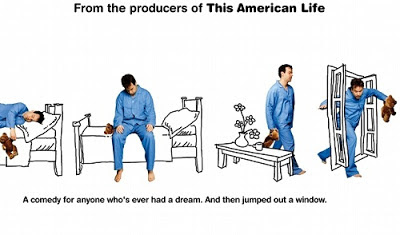
Goldthwait and Odenkirk are near-legends in the comedy industry at this point (though neither really for their directing talent) while Mark Duplass is quite solidly shoring his foundation as a multi-talent (and a gifted comedic improviser as seen on FX's The League).  This final film comes from yet another comedian, one less experienced before (or behind) the cameras.  Mike Birbiglia's Sleepwalk With Me is an intensely personal and hilarious story which Birbigs has worked into multiple formats over the years.  It started as a one-man-play, became a book, a recording of the show was released on CD and, thanks to his exposure on the highly popular radio program This American Life, it's now a movie (co-produced by TIL's host Ira Glass).

Birbigs (as he's known to his friends and fans) has this material down pat, and despite having no previous directorial credits, he has a very assured hand here behind the cameras.  His confidence with the story he's telling must have tempered any anxiety he might have had, as the film not only tells the story incredibly well, but the little flourishes Birbiglia puts in throughout, such as the driving narration and the dream sequences intercut with reality are quite brilliant.

There's a relatable intimacy to Birbigs' story, about being in a relationship that just isn't working for him despite every indication that it should, about being unhappy with his current station in life and reaching for any opportunity that can even marginally advance it, about being so stressed out by these things that his subconscious starts manifesting physically, and dangerously so.

I've read the book, and I loved it.  I've heard Birbiglia's live performance and it's just as good.  This film measures up equally well, and I adore it.  It's thoroughly Birbiglia's tale (only, for some reason, names are changed, most distractingly for me, as a fan,  was his inexplicable change of his own to Pandamiglio) and it's true-life nature, as well as Birbiglia's storytelling skills, make it fascinating and often hilarious.  It offers an  astute comedy about relationships falling apart, as well as a look inside the difficult world of a working stand-up comic, as well as a bit of psychological exploration.  It's a rich and deep story that is deceptively simple, in part due to its highly refined nature.  I can't recommend it enough.

Saturday, March 31, 2012

3 short paragraphs: Cedar Rapids

2011, Miguel Arteta -- Netflix

The main character of Cedar Rapids, Tim Lippe (Ed Helms), is a bit of a drip, a stunted man-child who has never ventured outside of his small farming town.  Unlike most comedies of the Adam Sandler or Will Ferrell variety where the stunted man-child is the butt of the joke, here we're ask to sympathize with Lippe as we come to know his somewhat tragic past and understand how it is that he came to fear the world outside his small town and find himself still wide eyed and naive.  Despite his emotional underdevelopment, Lippe isn't incompetent or a buffoon, as were so used to seeing in this sub-genre of comedy, as he holds down a job as an insurance agent, and exceeds quite well at it.  When his co-worker unexpectedly dies in a freak sexual accident, Lippe is forced by his boss (and surrogate father figure) to go to a regional awards conference and lobby for his agency's third straight award.

Leaving behind his lover/ex-high school teacher/surrogate mother (played by a game Sigourney Weaver), Lippe hesitantly ventures to the conference where he's quickly adopted by a motley trio, including the resident loudmouth whom his boss warned him away from (John C. Reilly) and an adventurous, spirited woman (Anne Heche) who Tim is destined to sleep with the moment he sets eyes on her.  What naturally occurs is Tim Lippe's coming-of-age in rapid fashion.  The more people he encounters, the more his peurile worldview is chipped away at, until eventually it just crumbles.  Over the course of a weekend Lippe's parental figures disown him, his faith in honesty, fair play, and equality are rocked, and he is forced, for the first time, to address his own sense of self.

Cedar Rapids is, in many respects, a smaller-scale Up In The Air, where the main character has a set way of life and people from outside break through and change it.  The romance between Helms and Heche mirrors that of Clooney and Farmiga, but it's actually handled with far greater maturity here, despite Lippe's immature reaction after sobering up.  This isn't a raucous comedy, but a character-driven one, though there are still some good laughs to be had.  It's genuine and engaging with likeable characters, even the abrasive Reilly, who quickly establishes himself as unfiltered but trustworthy.  There are no cheats here, and characters aren't sacrificed for the sake of plot or comedy, which may not make it as appealing as other man-child comedies, but it does distinguish itself in that regard.