Saturday, March 20, 2021

Zack Snyder's Justice League

2021, d. Zack Snyder - HBOmax

[Preface - written prior to watching]

I have no love for the Snyder/Whedon hybrid Justice League from 2017, because, let's face it, there's little to love about it.  It's messier than a sloppy joe served on a napkin.  In my review of that release, I said "I don't even like Snyder's vision, and somehow I still kind of wish it were allowed to be completed."

The reality is Batman v. Superman: Dawn of Justice was garbage as a Superman movie, not great as a Batman movie, and incomprehensible as a prologue to introducing the Justice League in what was then an already interminable DC Cinematic Universe.  But at least BvS was interesting in its wrongheadedness, it had a vision it was trying to achieve no matter how utterly ridiculous that vision was.  As such, I've been certain a Snyder cut of Justice League (no matter how much I don't really care if it exists or not) would be better than the hatchet job that came out nearly 4 years ago.

I've been a DC Comics fan nearly my entire life.  I've been waiting for a big ensemble superhero movie that had all the spectacle and grandeur in live action that the comics have on the page.  Justice League 2017 was not it, but I know for certain, without even seeing it, that neither is the "Snyder Cut" (as it's been called, but not actually named).  Snyder, we've learned from Man of Steel, BvS and even what remains of his vision in JL'17, has no idea what makes DC's heroes special.  He has his own motivations and half-baked philosophical discussions he wants to have utilizing these characters, and you know what...fine.  Countless people have had their way with these characters over the years, but it's just weird that, at any time the powers that be at Warner Brothers were like "yeah, sounds good Zack, you do what you want with them, make Superman grimdark and Batman a murderer."  

Since JL'17 we've gotten Avengers: Infinity War which is just about the greatest assemblage of comic book characters on screen that we're ever going to see, and not only that, it's a tight, captivating, fun, funny, epic rollercoaster of an event that ends on one of the biggest cliffhangers of all time, resulting in a follow up film that diverges from spectacle to delve into the emotional... all built on the back of a decades worth of set-up that didn't know what it was leading to.  It's comic books on screen as I've always wanted it to be.  Nothing about what Snyder has done, whether it be Watchmen, Man of Steel or BvS at all feels like comic books on screen.   I still want the DC version of Infinity War, but I don't think it will ever happen, and Zack Snyder is not the one to deliver it to me.  I'm ready to eat crow... but I don't think I will be.

[---Graig watches all four hours of Zack Snyder's Justice League with multiple breaks and one pleasant night's sleep in between---]
Spoilers?


It opens almost where we left off in BvS, as if it were a TV show continuing on from last week... with Superman dying (in slow motion) in his battle with Doomsday and screaming, sending a literal sound wave that's heard around the world.  We follow the sound wave as a device (a little Gaspar Noe Into the Void nod?) to see what's going on around the DC Cinematic Universe at this time.  Hey, there's Luthor in a wading pool with Steppenwolf (the adversary of this film), and Cyborg moping, and Atlanteans and Amazons watching as their hidden Mother Boxes (the macguffins of the film) awaken (it's speculated in the film that Superman's death awakens them but there's never a reason given why it would do that). Snyder's Amazon's are not the bright and powerful figures from Patty Jenkins' film, but rather female versions of his 300 Spartans, all shadowy and grainy with impressively defined musculature and rage faces.  The effects throughout this opening sequence, and much of the film, are not always the best, clearly the 70 million DC spent to let Snyder have his 4-hour epic was spread pretty thin.  An unnecessarily protracted fight between Steppenwolf, Parademons and the Amazons looks about on par with the arena battle in 2002's Star Wars: Episode II: Attack of the Clones in terms of how the many many performers handle squaring off against imaginary creatures.  And the subsequent chase on horseback, 90% CGI, is less big screen Avengers: Endgame, more small screen Game of Thrones.

There's a hubris to this production, presented in 4x3 aspect ratio (black bars down the sides) with the expectation of any eventual cinematic presentation being in IMAX (not sure how some of these effects will hold up on that big a screen).  The opening credits roll over a droning JunkieXL score, the camera panning across a desolate Nordic tundra, beautiful but cold and muted (the Snyder filter at its chilliest), following a traveler on horseback putting Bruce Wayne in a Nordic setting looking for the Aquaman.  I remember this scene from JL'17 and it was light, pithy, and full of bad green screen.  This one, not so light, certainly not pithy, but works (and looks) a lot better as it all takes place in a natural setting.  The hubris returns as Snyder pauses on a grateful village singing in their native tongue as Aquaman swims out to sea for a full minute.  Clearly this is a film not indentured to any running time and it's an early warning for laborious things to come.  It also drives home that there will be improvements upon what was done prior, but still not necessarily anything we were clamoring to see.

I still can't get over the empty weight of Superman's death in the previous movie, but the grand importance Snyder tries to imbue it here.  It was a tonal disconnect Whedon's version tried its best to acknowledge quickly, then ignore.  A set piece involving a group of terrorists introduces maybe the fourth and fifth slow motion sequences of Justice League, barely 20 minutes into the film (the first of literally dozens upon dozens of slo-mo shots we'll see over four hours), only to move into some sort of hyper-speed as Wonder Woman's actions against the badguys need to be superhuman.  It doesn't look good, and is unsurprisingly at odds with how we see this same Wonder Woman through Patty Jenkin's eyes in both her films, especially considering the blood splatter, swearing and aggressive violence.  A Justice League or Superman or Wonder Woman movie that can't play to children, and hiring someone whose vision is such, is just an outright mistake.  This is not for kids.  It's a hard PG-13, excessively violent for what it is and laden with swearing. 

An anxious, brooding Batman frantically tries to assemble a team, stating that he "spent too much time trying to divide us, I need to bring us together and make this right."  It sounds like a mea culpa from Snyder...but is it?  It's really not.  He doesn't do well at team building (Snyder nor Batman), considering it's more than 2 hours into the film before there's actually a team, and another 30 or 40 minutes before they resurrect Superman... and then another 45 minutes before Superman actually joins them.  There's a lot of time spent on the importance of Batman building, basically, a flying troop carrier, and when it finally takes flight, it's destroyed within minutes.  It's funny, but not intentionally so.

There's no economy to Snyder's storytelling here.  Points are labored over, and over, and over.  (The Amazons' fight with Steppenwolf ends with Hippolyta noting to send the flare that invasion is coming. We return to Paradise Island two scenes later to witness them sending the flare.  We go to another scene for Diana to learn about the flare's existence.  Another scene later Diana visits the sight of the flare to confirm its existence, which then leads to Diana discovering a cave that tells the story of Darkseid's first invasion.  This is intensely laborious when we got the point so much earlier.)  Many sequences are basically orchestrated to be music videos that maybe deliver tone, but not purpose (Aquaman walking out along a stone pier drinking whiskey for a minute...). Of course Snyder's been given free reign to do what he wants in his editing, as was his deal with Warner Brothers.  He didn't get paid, just free reign.  Without restrictions you get matchstick houses like Zack Snyder's Justice League.  It's 4 hours long, but it's not bloated, as it's not really full of anything.  It's empty and flimsy devoid of any direct purpose.

There are multiple flashback/storytelling sequences in the film which are real momentum killers (were there any true momentum to kill).   At the hour mark Diana shares with Bruce what she just learned of a great battle between the champions of Earth (Atlanteas, Greek Gods, the Amazons, a Green Lantern) and Darkseid's invading forces.  It's a sequence extended dramatically from JL'17, and is superior in it's excitement, but Gadot's voiceover feels phoned in (possibly literally) and it seems completely detached from the scene that bookends it.  It seems like it should have been the entrance point for the film, not Diana's storytime.  Similarly, Cyborg's father leaves him a recording in which he narrates Cyborg's capabilities, his powers over top a montage of images, some of them Lawnmower Man grade, but all of them handled with Snyder's usual subtlety, which is to say not at all. It's bizarre but not in a good way, portentious.


The biggest benefactor to ZS'sJL is Cyborg.  I can see why Ray Fisher was so dissatisfied with what resulted in JL'17 (on top of the behind-the-scenes issues with Whedon).  Cyborg is pretty much a non-existent character in what was released to theatres.  Here he is the only character with a genuine story arc and is the most integral member of the team (despite all the weight given to Superman's involvement this is really Cyborg's show).  Even still, his origin story is told shortly after Flash's introduction (a truly pointless sequence) and features the second car crash in less than ten minutes.  Again, economy of storytelling is not this film's strong suit.

Flash in this movie... well...he's a choice that's being made.  There's no attention paid to how he got his powers (I'm not sure we need more than one origin story in the film) but it's not the "crime lab technician gets doused in chemicals and hit by lightning" origin from the comics because here he's a college kid struggling to even find a job.  His speed powers, as presented in his many scenes, are not consistently visualized, which is maddening as Snyder doesn't seem to care for consistency in presenting how they work, only that they look cool (and Ezra Miller's floppy wristed "running" style still looks just as goofy as it did in JL'17).  So when Flash breaks his only rule late in climactic showdown, it's like...what rule?

This film assumes you know a lot more about this world and these characters that you do.  When JL'17 was released, Wonder Woman had not yet released, Aquaman was still a year and a half away, and planned Flash and Cyborg films still haven't happened.  A Ben Affleck Batman movie went through multiple iterations and directors before being scrapped altogether and there's not been any serious talk of another Henry Cavill Superman movie.  But this film acts like you know all these characters, and know who their peripheral supporting players are and what they might mean to them.  Alfred, Martha and Lois we met in BvS but have very little to do here.  Lois particularly is just a moping void waiting for Superman to return...and when he does...she gives him a hug.  That's what they paid Amy Adams to do...hug Superman (hey, I'd take that job too, but I'm not an Academy Award-winning actress). Commissioner Gordon is iconic enough, but he's not a character here (even with J.K. Simmon's adept mugging).  Martian Manhunter, played by Harry Lennox, is just a head scratcher... does anyone but the die hard fans remember him as the General from Man of Steel?  We don't even see a human face.  Aquaman's supporting cast make no impression unless you've seen the Aquaman film, same with Wonder Woman's cast.  It's putting the cart before the horse, and it does.not.work.  Even in hindsight, Justice League is at odds with what comes after it.

The problem with Justice League wasn't that Snyder was removed from it before it was completed.  The problem with Justice League is Snyder himself.  He's a great visual stylist, but a poor storyteller and a bad editor.  He should be taking photos, maybe shooting music videos, not being given hundreds of millions of dollars to make movies about characters he neither cares for nor understands (Zack, if you want to continue this story, buy some Hot Toys action figures and make photo comics).  Seriously, tell me what the purpose of Zack Snyder's Justice League is (besides an ego trip)?  Story wise, very little happens to advance any of the characters here.  Steppenwolf has no arc, but is at least given a bit more motivation than from JL'17.  Batman has no arc, he ended BvS promising to form a team, so he forms a team.  What did he learn? To be part of a team? Wonder Woman has no arc except she's reminded of a home she can't return to.  And to be part of a team?  Aquaman I guess learned...to go talk to his dad...and be part of a team?  Flash learned to ... be responsible maybe, and be part of a team?  Superman learned to...come back to life and not be a rage monster?  He didn't even learn to be part of a team.  Cyborg has the ONLY character arc here (and I'll admit, it's okay).  


As a film, it nudges forward Snyder's overall "grand arc" story only a smidge.  There's one brief reference to Bruce's Knightmare sequence (from BvS where Superman's gone bad and Darkseid has taken over the world) midway through the movie, and then an extended 10 minute sequence in the very long coda to the film.  The Knightmare sequences indicate a major threat coming but we're now 6 1/2 hours into Snyder's story and we've advanced that plot almost not at all.  The whole Mother Box chase in this film was ultimately irrelevant.  This film's Knightmare sequence (as out of the blue as it is) gives the team and its members (consisting of Batman, Cyborg, Flash, Mera, Deathstroke and Joker) a very specific motivation, and even some unique character motivations.  But in terms of where this film ends, it seem light years away... not even close to the horizon.  And Batman's conversation with the Joker (Jared Leto, in better form here than in Suicide Squad) in that sequence seems like a fan-made youtube video and not something a major studio would produce with it's most valuable intellectual property.

I've waited nearly a lifetime for a big budget Justice League movie.  This is not what I've been waiting for.  I haven't watched JL'17 since seeing it in theatres and will probably never watch it again.  Likewise I don't see any situation where I'll watch this again.  This... is not for me. 
It's the opposite situation as The Last Jedi. An exceptionally well told movie certain fans don't like because it contains scenes and situations that they don't like.  This is a very poorly told movie that certain fans will like because it contains scenes and situations they think are just really cool.
If you're down with it, more power to you, have at it all you want.

[---RANDOM THOUGHTS---]
- My favourite scene - Diana with Alfred.

- "What's your superpower?"  "I'm rich."  Still the funniest line of both cuts.

- Cyborg, looks like a Michael Bay transformer, moves like a Ray Harryhousen skeleton.

- Every time Wonder Woman performs an action the same damn chanting music sting is played.  It gets especially annoying in the final battle

- Martian Manhunter looks awful.  He's a main character on Supergirl and he looks far better there. On a CW show.

- Steppenwolf, supposed to be an intimidating, scary figure, has the most adorable little monkey face. I just "awweed" every time they did a close up. His armor gets a serious upgrade from JL'17, and looks nifty.

- The coda to the film is about 25 minutes, the first third sort of tees up where the heroes might be going to next in their solo features (...but obviously not really...) as well as insinuating Ryan Choi, Cyborg's dad's colleague, has a larger part to play.  Snyder's so bad at storytelling he couldn't even work in a good easter egg about him becoming the Atom.

- One final note on how Snyder just doesn't understand these characters. Superman beats Steppenwolf to a pulp and heat visions off one of his horn-things... you know how Snyder's Superman just loves to maim and disfigure.  Then when Superman punches Steppenwolf so hard he's sent soaring back towards a Boom Tube to Apocalypse, Wonder Woman leaps and severs his head in midair...apparently because Steppenwolf taunted Wonder Woman and said he killed her mother.  Ugh.


Thursday, March 18, 2021

Tenet

 2020, d. Christopher Nolan - rental

I proclaim to love Christopher Nolan movies, and I do...I think they're pretty rad.  But at the same time, I don't rewatch Christopher Nolan movies.  I think the most I've seen any of his films is three times... The Dark Knight and Memento, I'm pretty sure.  I want to go back and watch them all, I just don't.  While I enjoy his films tremendously as both technical accomplishments and experiments in storytelling, emotionally they're a little hollow.

A dear friend of mine who passed away years ago used to argue this point, that Nolan's films lack human connection, and were soulless.  I used to argue back that how do you deny the spectacle of what Nolan is presenting, the sheer thrill of the action he accomplishes and the mastery of his lens.  He's a craftsman through and through.  But, Braz would argue back, that many a craftsman can put together a fine piece of furniture, or a tasty meal or a realistic painting, but they can also be devoid of heart and emotion.

I love these posters. They done
sell the story of the film at all
but they do sell its style
With Tenet, I see that now.  It stares you right in the face and delivers endless lines of dialogue that explain the conceit of "inversion" and "entropic devices" and advance the espionage tale along at a breakneck pace, but there's no warmth behind it, no sentimentality, no personal connection between the players or the audience.

Is there spectacle?  Of course... you're going to get spectacle after spectacle in a Nolan film.  And they're often awe-inspiring, but Tenet is so deep in the weeds in technical logistics, narrative complexities, and mental gymnastics it kind of forgets there needs to be characters at the center of it.

John David Washington (BlacKkKlansman) is absolutely a star.  Here as "protagonist", he is the point of view the entire film follows (save for the occasional diversion where Elizabeth Debicki is our necessary POV), and he just commands the screen.  His dad is Denzel, so he's certainly inherited the gift, but he has his own presence and he uses it well.  We don't get to know "protagonist" at all personally, but we learn about him as the movie progresses.  He's not James Bond, he's not suave and horny and pithy or violent and vengeful.  Instead he's dedicated to his mission, no nonsense, comfortable in any surrounding (even if he doesn't blend) but also has a moral ground where he doesn't want the innocent to get hurt.  Unfortunately by using Debicki's Kat to get at her estranged, weapons-dealing husband (Kenneth Branagh) he finds his mission somewhat compromised in putting her in harm's way.

Where a normal espionage film would really lean into a romantic entanglement between it's two leads, Nolan has no time for love, Dr. Jones. There's to much pseudo-science babble to get through.  Instead Washington and Debicki sort of form a respectful alliance (not even really a friendship, but one gets the sense that "protagonist" doesn't really do friendship, at least in the traditional sense) where he looks out for her and she's willing to help him save the world.

That dynamic is the easier part of the equation of Tenet to understand, even if it's abnormal for this kind of story.  The complexities lie in, well, everything else.  Early on in the film Nolan introduces his conceit of "inversion" through some comic book science technobabble.  And less cries of "show don't tell" ring out, he shows you while he's telling you what this all means, and it's still a lot to make sense of.  Things can be "inverted" so that they effectively operate backwards.  Guns catch bullets, a shattered glass puts itself back together.  But there has to be intent to use these inverted objects.  It's a difficult conceit to wrap your brain around generally.  But they're just pieces of a larger puzzle, about a cold war with the future, and a maguffin about a physical algorithm that could end the world.

Once the reverse-entropy is introduced, the film takes on a life of its own which either will engage those with more puzzle oriented minds or put off anyone who shuts down when timey-wimey mental gymnastics come into play.  It helped me knowing in advance that at some point the film would hit a point where it was going to "invert" itself, so I was already looking out for those ideas at play.

Even still knowing what Nolan was *trying* to do, and then attempting to follow along with him and his story proved difficult.  Nolan's always been fascinated with non-linear storytelling as well as temporal physics, and this is past the line of toying with those conceits and getting an audience to engage with it.  I can just see that the WB studio heads were saying to themselves, I don't get it, but Nolan has been money in the bank every other time, so let's see how it plays out. And it's true, in the past his films, though monkeying with time or perception of time or narrative order, have all been huge successes.  But this pushed it too far, and he will no doubt be reigned in next time if he doesn't do so on his own.

Attempting to follow along with say the highway chase (both times) or the end battle (shot and orchestrated far better than nearly every "end battle" in recent memory) proves so difficult because, as the film keeps reminding the audience, you've got to stop thinking so linearly.  But we're built to think linear, to live in our present, to see the future as ahead of use and our past as behind us.  Toy with that, to try to understand that the opposite could be true is a brain breaker, and Tenet lives in that reality, where people can move backwards and forwards through time, and so what we see on screen is often things moving both forward and backwards at the same time.

But even in lack of understanding, Tenet is a huge movie, and Nolan, reteaming with cinematographer Hoyte Van Hoytema (Dunkirk, Interstellar) delivers another undeniably gorgeous film.  Even in its quieter moments its still just a marvel to watch.  Ludwig Gorannson (The Mandalorian) delivers a score that is as essential to the film as any performance or special effect.  It's pulsating with energy and tension, yet rarely calling attention to itself.  Nolan loves to heighten ambient noises in his movies and they blend with the score to create its own reality...not to mention Gorannson's also playing with music moving backwards through time as well.

Washington, as noted, is already proving to be a reliable performer in any situation, and to bring any life to such a void of a character is largely on him.  Robert Pattinson is easily forgotten because he's so giving.  For such a big name, Pattinson is so very comfortable in supporting roles, and literally supporting the lead. He's appealing but he's never taking away from what others are doing to shine himself up.  Elizabeth Debicki is one of my favourite working actresses.  I love how vulnerable she allows herself to be, while also conveying an intense amount of strength.  Likewise I appreciate how she can slap on three inch heels even further accentuating her stature and Nolan let her loom over Washington and Branagh.  Branagh, for his part, makes a meal out of his role.  Everyone else is so restrained letting Branagh just masticate every line in his broad Russian accent.  He's a beastly cartoon of a bad guy, and it just makes it so apparent that Nolan's truest wish is to just make a Bond movie, but only on his own terms.

I understand completely the chilly reception to this movie.  I don't love it myself, and yet, I liked it quite a bit.  I giggled a lot as I could see Nolan's monkeyshines at work, even if I didn't always comprehend what I was seeing (which was often).  It's going to take a few viewings to really "get" inversion, both how it plays out in the visual telling of this film, but also what it means for the overall setup of the story.  It does feel like an introduction, as if Nolan has at least one more of these in mind, if not a whole trilogy, but at the same time I think he'll be okay if it doesn't come to fruition due to lack of interest (or understanding). 

[Toasty-post on Tenet: we agree fully!]

Wandavision

 2021, d.Matt Shakman - Disney+

[Minor spoilers below]

It was about 1 year ago, mid-March 2020, that we were told to lock down because of COVID-19.  My wife and I had plans to take the week of work (which was also supposed to be March break for the childrens) and just enjoy doing stuff.  Instead of doing stuff, it turned into a blitzed re-watch of all the Marvel movies (we skipped only the Incredible Hulk).  At that time we had no idea what COVID-19 was going to be, how virulent it was, how it would evolve, how it would decimate populations and economies, nor how far away a vaccine or treatment would be.  We didn't know when our next Marvel movie would be, or when we would see the next Marvel feature, Black Widow, which was slated for the start of May 2020 (but is now reslated for May 2021).

We were supposed to get the first Disney+ series in August 2020 when Falcon and the Winter Soldier was originally slated to debut, but the 'rona shut down production on everything for a time and so the Captain America spin-off was held off.  Wandavision originally slated for a November or December release, was shooting in much more controlled, studio spaces so it pick up production much faster and became the first Marvel project on Disney+ instead. 

The last Marvel Cinematic Universe feature was Spider-Man: Far From Home which debuted July 2, 2019, which meant there was 18 months between Marvel releases, easily the longest gap since the nearly 2 year wait from Incredible Hulk to Iron Man 2.  To say anticipation for a return to the MCU was high was an understatement.  There hasn't been a lot to look forward in the past year, but not only did Wandavision fill the hype void, it also delivered on both hugely cultural Lost-style week-to-week mystery deconstruction and a surprising amount of weirdness.


The commercials and advance talk had painted Wandavision as a sort of traipse through the history of family sitcoms, but I don't think anyone expected the first episode to be a through-and-through pastiche of The Dick Van Dyke Show, with Elizabeth Olsen as Wanda absolutely nailing the rhythms and cadence of Mary Tyler Moore and Paul Bettany as Vision acting note perfect in the clueless dad role.  The first episode is scripted and produced with authenticity in mind.  Though shot in black and white they had to colour the sets (and makeup and wardrobe) for B&W contrast as well they actually shot with a live studio audience and utilized classic TV wire and in-camera effects.  The comedy, in all unlikelihood, somehow worked very well, both as pastiche of the comedy of the times as well as character-specific humour.  Though never huge players in the Avengers films, we did see enough of Wanda and Vision to know their basics which is all we need to start out.  The episode ends coming out of its 4x3 frame into full-screen colour to show that they are, in fact, on a TV show called "Wandavision".  The questions begin.

The second ep, debuting the same day, jumps them into a 60's Mary Tyler Moore Show/Bewitched-style magical sitcom, again with Olsen shifting her style and performance to mirror that of Elizabeth Montgomery.  Small moments in the conventional sitcom start to break the facade, haunting undercurrents of darker emotions start to creep forth from the leads as well as supporting characters.  Little cracks that break the fourth wall start to indicate that there's something magical and mysterious at play.  Little splatters of red, a curious sigil, and a mysterious visitor emerging from the sewers all contribute to serious creepy vibes lurking under an otherwise pitch-perfect 60's sitcom re-creation.  The question still is what is happening and why...as well as who is causing it...and where are they.


The third episode shocks into colour, and morphs the set once again into something that resembles the Brady Bunch.  Vision, still the clueless dad starts to clue into the fact that something is wrong, and attempting to address it with his wife leads to diversions and distractions.  There's no serious on a sit com silly.  But suddenly pregnant, and evolving quickly, Wanda is having a hard time keeping her magic under control and under wraps.  A nosy neighbour (Teyonah Parris) is cast out of town for asking too many questions, questions that threaten to snap Wanda's safety bubble... and its our first glimpse that this fictional construct of Westview, New Jersey, maybe isn't so fictional afterall.

Episode 4 breaks from the sitcom evolution to backtrack and explore just who this character Teyonah Parris is playing.  It turns out she's the now grown-up Monica Rambeau, last seen as a 10-year-old in Captain Marvel.  The episode starts with chaos in a hospital that's kind of the opposite of the opening moments of The Walking Dead or 28 Days Later where characters wake up in a desolate hospital...instead here Monica returns from the snap, along with dozens of others into absolute chaos.  The Snap from Infinity War and the return snap from Endgame are barely addressed in the MCU to date, save for the post-credits of Infinity War, a bit of Endgame and a brief sequence in Far From Home.  This is our first real grounds-eye-view of the return and it's as much of a nightmare as I'm sure the initial snap was.  


Monica's mother, Maria, helped found and run S.W.O.R.D. as a replacement for S.H.I.E.L.D. but has passed away in the years between the Snap and the return, and the new director seems to be very concerned about Monica's intentions.  But Monica is assigned to work with Jimmy Woo (Randall Park, last seen in Ant Man and the Wasp) about Westview New Jersey's sudden disappearance.  This eventually leads to meeting physicist Dr. Darcy Lewis (a return for Kat Dennings to her Thor character) who discovers the signal that gives a view into the not-gone-but-shielded Westview.  

Venturing outside the bubble was both a welcome deviation from the norm but also changed the structure of the show.  I quite loved the fully engrossed pastiche of each episode being an era of a sitcom.  Episode 5 returns with a Family Ties/Growing Pains/Full House pastiche, once again, Olson evolving her personality to fit the times while Vision's dad persona doesn't seem much different.  It's a pointed note, showing how women's roles have evolved while it seems man's role has stayed fairly stagnant...or at least the archetype is.  But it's clear now that we are actually viewing "Wandavision"  (the show within the show) from the outside, along with Jimmy, Darcy and Monica, there's really something wrong here and Wanda is the center of it.  She and Vision (and perpetually nosy neighbour Agnes, played by Kathryne Hahn) seem to be the only one with some sense of self-awareness.  Monica when she was within the "hex" also maintained her awareness it seemed, so is Agnes from the outside too?  What is Monica doing.  


Vision begins questioning his existence and the question is asked whether Wanda is bringing people back from the dead.  Is everyone in Westview dead? Wanda is seemingly in control, but isn't quite aware exactly what it is she is doing or why....but she knows for certain she's not bringing people back from the dead.  And then her brother Pietro (killed in Avengers: Age of Ultron) shows up at the door...only it's not Aaron Taylor-Johnson, but rather Evan Peters who played Quicksilver in Fox's X-Men series.  It's at once a confusing and inspired choice to confound expectations and add even further uncertainty of what's happening into the mix.  Plus, fan circles were going nuts with theories as to what it could all mean.  All of them wrong.  But the idea that it could be toying with the multiverse and be a seedling for the upcoming Doctor Strange and the Multiverse of Madness (in which Olsen's Scarlet Witch co-stars) seem to make some kind of sense.

It's this kind of toying, not just with audience expectations, but also with their perceived foreknowledge that is missing with the all-at-once style of season drops on Netflix.  Though week-to-week has remained a thing, it seems like we don't want to engage with most programming on that front any longer.  The need for immediate gratification is where our culture has landed, so it's good to get a reminder of the old ways, and it's only a little surprising that it's Disney that is giving it to us (it's not anything other than a way to ensure continuous subscribership on Disney's part, really).


A wonderful Malcolm In The Middle pastiche leads into Episode 6 and finds Wanda wrestling with what Pietro's "return" means, what it all means, and it's really this episode that we're really getting to the meat of what's happening, Wanda's grief after losing Vision, her brother, her country, her family, not to mention the chaos her powers have caused... it's been a tumultuous time for one Miss Maximoff.  Episode 6 is also the "Hallowe'en Episode" where Vision, Wanda and Pietro dress up in somewhat accurate version of their comic book costumes (Wanda's is note perfect, Vision's is sort of a Luchador spin, while Pietro's is charmingly home-made).  Meanwhile, Darcy, Jimmy and Monica challenge the powers that be on the outside

Episode 7 takes on a Modern Family/The Office confessional-style format which is fabulous in how brutally it messes with the logic of the show, and yet, it allows so much additional insight into our leads and what they're working through.  It's the last pastiche for the show to land on, and really where is there to go.  Not that Modern Family is an outright family comedy, but they're few and far between now where they were once everywhere, so it's hard to see where they could go from here with anything with the same notoriety.

The final two episodes are effectively a two parter that start really deep diving into backstories and how we wound up to where we are now, culminating in a big magical showdown that brings everything home, and while episode 8, which finds Wanda exploring her past, It's A Wonderful Life style, is extremely emotional, episode 9 seems like it's just lasers in the sky and feels like such a standard Marvel house-style battle that carries such little weight or creativity.  I was really hoping for something spectacular that tied the series' themes and its television themes together...it keys sort of into the former but not so much the latter.  But that episode 8 exploration of Wanda's history of trauma puts a lot into context.  Wanda has experienced a tremendous amount of loss, not the least of which was having to kill Vision herself in Inifinity War, only to have time rewound and to watch Thanos kill him instead.  It's no wonder she's kind of unconsciously out of control.

I loved Wandavision thoroughly through it's first half. But once it started mixing its "outside" aesthetic with the inside, we lost some of the stylistic flavour of being fully entrenched within an era-specific sitcom and it felt less audacious.  Once the scripts became more Marvel-flavoured, less sitcom structured, it just didn't seem to connect the same way.  Yet, I admire that they persisted through to the 2000s with the structure, including unique (and absolutely marvelous, no pun intended) theme songs for each era with point-perfect credits running underneath.  As well it still maintained its commercial breaks, and the sort of "in-universe" nods were maybe devoid of larger specific meaning but were fun fanspotting.

[spoilers in the video]


This was absolutely a story worth exploring, and if anyone was worried about the star-power of the MCU with Evans, Downey Jr. and Johansson's departures, I think Olsen has proven her undeniable presence here, showing incredible diversity, range and skill.  She holds the bulk of this series on her shoulders and you can't even see her sweat.  


Vision still may not be the most captivating character, but Paul Bettany is just endlessly charming in the role and certainly provided a needed presence.  One can see why Wanda would be so in love with a robotman in the way that Bettany flashes his pearlescent smile, glances with such warmth, and delivers his lines so soothingly.

While the story inside the hex was note perfect, up until the final battle, that is, outside the hex it felt somewhat messier.  Darcy, Jimmy and Monica were doing their own Scooby-gang thing sneaking around and pissing the director off, but it felt pretty ancillary.  There weren't any stakes for them as characters, so it left them feeling pretty hollow at the end.  Of course, Dennings is always a delight, Parris only leaves us wanting more, and Park's Jimmy Woo needs his own show.

In terms of how the show stacks up against its cinematic fare, it's a possible top ten contender.  Though runtime may be somewhere in the range of two long movie's worth of content, it doesn't work as a movie, it's the first MCU-controlled show and comes out demanding that it be presented as a serialized program, and presents a very tough act to have to have to follow.

I Saw This!! What I Have Been Watching: A Long Look Back: C (Saw)

 I Saw This (double exclamation point) is our feature wherein Kent(!) or Toasty attempt to write about a bunch of stuff they watched some time ago and meant to write about but just never got around to doing so. But we can't not write cuz that would be bad, very bad.  2020 bad.

What I Have Been (or Am) Watching is the admitted state of me spending too much time in front of the TV. But what else was 2020, and 2020-Extended (2021 on the calendar) about? Well, beyond baking bread and not cutting hair. Didn't do much on the former, and only one cut in one year, on the latter.

A is here. B is there. 

C is for Binged, because I am not clever.

If any show is more "what we needed for 2020" than Ted Lasso then I don't know one. And this is from someone who has no interest in sports nor any interest in fiction about sports. I may even say that this is the best show I saw in the last year or so.

Ted Lasso spawned from a TV commercial, about an American football (football) coach who comes to the UK to manage a football (soccer) team. Problem is that he knows very little about football (soccer). Why is he invited? Because he has a reputation for pulling terrible teams out of the gutter, and because the new owner of the team, who acquired it in the contentious divorce from her philandering husband, actually wants the team to fail miserably, destroying what her husband loves dearly. Ted is amiable, unflappable and seemingly a loveable American buffoon. But there is something there behind his bright smile, something few see, and thus he and coach Beard (his co-coach) begin to shape the team earnestly.

Ted has some die hard ideas on what a team should be and do and act like, that remind me of those "everyone wins" mentalities in pre-school "sports" teams. Or at least that is how we are meant to see it, I gather. I know very little about sports and sports teams, so in a way, Ted's approach means more to me. But really, the approach he takes is not what makes the series so good, but Ted himself and the way people end up reacting to, and eventually supporting him. Along with Ted, I was entirely surprised by the stand-out performance from Juno Temple, whom I know mostly playing ditzy girlfriends, which is exactly what she is here, but again, like Ted, she is so so much more.

And then there was the show I liked a whole lot more than I expected to, even though it was right down my alley, starring & created by people I like a lot, but I just wasn't expecting Truth Seekers to be any good. 

And then I enjoyed it. Immensely so.

Nick Frost is Gus, the best installer at the nation-wide UK broadband internet service provider Smyle. Gus's boss is David (Simon Pegg, Shaun of the Dead) who trusts Gus implicitly, and wears an astoundingly obvious toupee. Gus lives with his grumpy father-in-law (minor joke, he calls him Dad and it takes a few episodes to learn he is dad-in-law) Richard (Malcom McDowell, The Mentalist). Gus's new partner (Samson Kayo, Timewasters) Elton John (yep) has a mysterious past, which connects to Gus's real passion -- investigating supernatural events for his podcast/YouTube channel.

It begins as a simple "let's investigate a ghost" show, half-hour run, amusing but unassuming, and that is all I expected. But then it digs deeper, adding plot layers and conspiracies and intricacies not just to the story, but the characters and their connections. Frost deftly plays the lead, but really it was his supporting cast that allowed it to rise up higher. You would think McDowell would be wasted in a role like this, but no, it really is one of his best, TV-wise. And the brief appearance by Kelly Macdonald (Brave) is just hilarious.

I liked it more than I expected, and more than Kent, I guess.

Utopia is another one of those shows which suffered from unfortunately being released during a pandemic, but even if it hadn't, probably wouldn't have done any better. Also, being a remake of a British cult classic, didn't help.

I admit, I went into this version of it, expecting it to be all meta, as in, an American remake of a British cult-series, wherein the new version was referencing the original British series, sort of a reboot-meets-sequel. Alas, it was just a run of the mill remake. Even saying that, I did enjoy it while also being simultaneously utterly disturbed by it. It was not a good viewing choice for the heart of the 2020 pandemic paranoia "what could happen next" mindset.

The plot begins with a bunch of geeks dedicated to an old, beautifully illustrated graphic novel attending a CON where they believe they can purchase the latest issue, or more precisely the original artwork for a never published final issue. Meanwhile the emergence of the new issue also spawns two assassins working for a shady figure, who.... well, kill everyone involved with selling the issue. It gets very dark very quickly, not fun & quirky like a nouveau Dirk Gently as I was hoping. 

The central plot, and yeah I am spoiling something which IMO was pretty obvious, involves a megalomaniac corporate visionary (self-styled) and cult leader manufacturing an epidemic, so after which he can also become the heroic purveyor of the vaccine, wherein it will contain something that sterilizes most of the world. So yeah, antiVax support on steroids. 

The graphic novel is the coded ravings of a scientist who worked with the cult leader, and who created his own pseudo-cult, centered around his own daughter who would fight the BBEG. The geeks are obsessed with the codes in the comics, but let's say, while they end up the central heroes of the story, very little works out for them. It is bleak, bleak bleak bleak, so yeah maybe not the best viewing for the Spring/Summer of 2020. But the performances were good, and the beats of the story were solid. So, skillfully crafted if somewhat unfortunate timing.

Meanwhile NEXT was just not very good at all, not in skill nor craft nor ... well, anything, beyond being solid, mid-grade thriller TV. But I am always charmed (that's a weird word choice) by an Evil AI story, so I persevered, just to see where it was going. It never really ever went anywhere.

John Slattery (Mad Men) is our eccentric tech mogul who Ted Talks about the need for cautions around AI. But when he speaks about AI, he does not mean Machine Learning, as we IRL know it, but big, spooky, self-aware computers that always want to wipe humans out. His own company, he himself in fact, created some code that he worried was going to become Eeeevil. So he shelved it, but now, after he has been ousted from his own company by his brother and a shady Board of Directors, have resurrected it.

This idea was done well in Person of Interest but that show took its time laying out the probability and outline as to how an advanced program could... evolve. This one just throws it into our faces by episode two, as people and systems are manipulated to death, and the code quickly talks back to us in a HAL9000 style voice. Note to coders, choose disarming voices for AI's, and no, not Alexa which the show ALSO obviously alludes to.

Anyway this paranoia-as-entertainment show was setup to be a series initially but rolls along at break-neck speed implying mini-series, as only the tech mogul and the FBI cyber-squad who believes him try and isolate the AI, or destroy it. There are some fun bits, some decent tension but for the most part the drama is ludicrous and the technology references laughable. The season ends with the AI seemingly destroyed and the world saved, but we know better don't we?

If 2020 was horrible and going to be remembered for The Pause, someone will also have to remind future historians that it was also the era of The Mandalorian. The show began in late 2019 (despite the incorrect air dates in IMDB) emerging almost at the same time someone in Wuhan, China ate a bat, regurgitated it in a lab and made the super-flu we have all come to know and love. I was able to get my 3D printed Baby Yoda before we donated the work 3D printer to a PPE coop, and we all went home. Since then, we have had the boon of a second season, a welcome respite to the bleakness that was 2020.

I unabashedly love this series. I love the central story of a Mandalorian obsessed with honour, going all Lone Wolf & Cub with a child creature that can only really be called a baby Yoda. I love the western stylistic approaches to many episodes, and in saying that, the trope filled choices for all the episodes. I love how it plays with the canon, taking place between Episode 6 and Episode 7 of the movies. I love how it ties into the other properties that Dave Filoni was central on. Mentioning this show deserves its own long post or series of posts, as Kent did, but I am not going there. Suffice to say, even if I don't call this one of the best things on TV throughout 2020 (and we rewatched S1 at least twice) it was one of the things I enjoyed the most. I mean, c'mon it was Star Wars on TV !!

Star Trek Discovery S3 came, and went, with far less enthusiasm on my part than I hoped for. While I loved experiencing the series, I felt this one suffered for what it seemed intent on doing, as if they had a Story Book they had to ascribe to, where they were supposed to end up by S3, but didn't really like any of the plot notes, so only gave them a passing nod.

S2 ended with Michael Burnham and the Discovery, crew included, being tossed into the far future, some 900 years. They hoped by dragging the "sphere data", which was embedded into the computer core of Discovery, into a far future, they would change their era's fate from being destroyed by an Evil AI that would make of use of the sphere data to become all powerful. As we know many years of Star Trek after this series, chronologically, we can only assume they succeeded, even if you consider the Kelvin timeline. 

Not sure if this was brave or foolhardy, because .... Time Travel !! Anyways, dramatic choice that actually makes use of an idea that Gene Roddenberry wanted to use, but actually ended up butchering via Andromeda, in that they are so far into the future, the Federation has collapsed and everyone is barely surviving... galactic scale.

It starts interestingly enough, in that Burnham is alone and makes her own way in a world that not only has no cohesive Federation but also a severe lack of warp travel. Many many worlds are isolated by a catastrophic event called The Burn, wherein pretty much every warp capable starship exploded simultaneously because of something to do with unstable dilithium. This is a weird world of newer tech, but also more chaotic and dangerous, as different factions vie for control of what is left. So Burnham has to find out where Discovery is, what happened AND CAN SHE FIX IT. Because, what else is her purpose but to make everything alright. She really thinks she's a main character in a YA novel.

Alas, the series reunites her and Discovery and the Federation faaaar too quickly and the season devolves into just another run of Burnham breaking ranks, doing her own thing, damning the (photon) torpedoes but always saving the day despite it. There are some great new characters, so great episodes and a lot of fun to be had, but I was still left inevitably unsatisfied, as Kent was, but for other reasons.

Oh, and I finally found a copy of the French/British War of the Worlds. I had seen the (period) British series, titled The War of the Worlds (notice the lack of 'The' in this one?) after the source material, which is set in Edwardian times, so 10 years after the original? But I never wrote about it, because it had little impact on me. I also had trouble finding this other series, until sometime in 2020 when it appeared on CBC. Set in the current era, it was also ultimately unsatisfying as it is obviously a setup for a longer series that never came to be.

The premise is rather horrific. The martians (or aliens, to be precise) send down orbs but these ones emit a signal, that once it reaches a peak, basically kills everyone on the planet, but for those fortunate few who were underground, or those with an altered brain chemistry of some kind, which protected them for unknown reasons. We are introduced to a few key families, some in France, some in the UK, who eventually end up having some connection.

It was a rather bleak, death filled show that again, I wondered why I was watchin during the height of 2020, and while I liked the intense drama of the series, as well as my usual (yes, weird) attraction to empty cities, in the end I was again left without much attachment to the series. So many final survivors being assholes to each other. The show was leading to a reveal, one that fell flat with only a minor because it only revealed that the "aliens" were somehow connected to us, but it didn't go any further. Were they from our own future? Were they capturing and manipulating humans? And given that it is never to have another series, we have no idea. The end.

Finally, a small CBC series Trickster, set around indigenous mythos, but recently marred when it came out the creator gained support and funding by identifying as Indigenous. She is not Indigenous. But the show she left behind was pretty decent.

Jared lives in small town/reserve BC with his talking-to-people-not-there mother, barely attending high school and making & dealing E (MDMA? I am not up on my street drug terms) on the side. Like Blood Quantum, the story is not afraid to show us the underbelly of Indigenous Canadian lives, a little on the seedy side, a lot below the poverty line. But like Taika's Boy, they get by. That is until Jared starts seeing and being exposed to the supernatural.

Like many coming of age supernatural stories, Jared learns of his heritage only after it comes calling for him. It's not much of a spoiler to learn that his mother got mixed up with a Trickster, and Jared is the progeny of that coupling. And the victim. Tricksters are mythological immortal beings, not quite bad, not quite good, but definitely trouble, and they can shapeshift. Jared's dad tells him he is only there to reconnect with Jared, teach the boy who & what he is, but really, he is there for himself only. Jared's mom won't have any of it. But she is dealing with her own demons.

I found the show really compelling, both for the characters it created but also for the not-entirely-myth mythology it presents. These are beings that have been around for a long long LONG time, and just happen to be tied to the Indigenous folk of North America, well, because they were here as well, when the white men bulldozed their way in. This show doesn't shirk away from the damages done, but also doesn't dwell on them, letting the stories and the characters stand for themselves. Too bad it had to be marred by someone pretending to be something they weren't, weirdly much like the Trickster in the story...

And finally, finally The Stand 2020, as I finished watching it while this post was sitting in drafts mode, after having forgotten entirely of its existence and pretty much binged watching it over a week or so.

During my King days, The Stand was my favourite, an ensemble quest story of Good vs Evil in an empty world. I have always had a post-apocalyptic fascination; apocalypse as well, for that matter. Captain Trips was terrifying and overwhelming but the story that followed was completely in my wheelhouse. I even read and enjoyed the 90s retrofit King did, despite it not being entirely successful. Those were the days when publishers thought King could do no wrong.

And then there was the 90s TV mini-series which I don't really recall too well, but do remember disliking and loving it in equal parts. I just didn't feel the book could be portrayed in the PG world that TV allowed for back then. So when it was announced that a new series would come around, I was enthralled. Then we got our own pandemic and I was less enthused. Again, bad timing, dudes.

That said, having powered through it, and surprised they actually did as much ending the world plague story as they did, I am once again in the "liking some bits, meh about other bits" boat I was for the first series. All in all it seemed to suffer from being a mini-series of its own, as vast amounts of characterization and plot seemed washed away to further moving the story along. King's characters have always been his main strength and while the portrayals are great here, especially the casting of Amber Heard as Nadine (which allowed many to immediately dislike her) and Alexander SkarsgÃ¥rd as Randall Flagg, the actual presented characters lacked incredibly. Its like we were just given enough of each character to know their place in the story, and that was about it. I just felt... nothing for any of the characters. In the end, it all felt rushed and not very committed to the horror and awe (magic, religious or otherwise is real) it was supposed to depict.

Wednesday, March 17, 2021

Sorry To Bother You

 2018, d. Boots Riley - Netflix


I have to feel bad about not seeing Sorry To Bother You in the theatres.  It wasn't for lack of desire.  I could tell from the trailers it was "my kind of film", but I truly had no idea how much of a "my kind of film" it truly was.   It just kind of passed me by and I never made the time for it.  Even when it was on one of the cable channels I kept putting it off, and it's been on "my list" on Netflix for months, unloved. By the time I actually put it on, I had kind of forgotten what the film was actually about, only to dial into its swirling surrealism instantly.

Cribbing directly from Wikipedia --  Boots Riley describes the film as "an absurdist dark comedy with aspects of magical realism and science fiction inspired by the world of telemarketing" - which sums it up quite nicely, but not totally.  

We first meet Cassius "Cash" Green (Lakeith Stanfield) trying way too hard to get a telemarketing job.  To his interview he's brought with him a trophy and a placard supposedly representing triumphs from previous employment, only for the hiring manager to call out his bullshit references and accomplishments, but then confide that they will literally hire anyone.  Dashing expectations that this would be a cringe comedy about awkward telemarketing conversations, Riley's imaginative storytelling style imbues the film with a lively comedic energy, as Cash and his work desk slide in-person into his he caller's household interrupting everything from dinner to sex, only to be hung up on in short order.

If you have ever thought about telemarketing work, I'm sure it just sends a shiver down your spine.  You know there's a level of desperation when entering that field of employment, one that's about as high status as working at McDonalds.  There's a relatively easy and dispiriting movie to be had in the grind and misadventures of telemarketing, but that's not what this film or Riley is at all interested in doing. 

Instead there's a whole race and class context, where, in order to succeed, Cash starts employing his "white voice" (provided by an extra nasally David Cross).  The "white voice" isn't necessarily directly about code switching so much as employing an attitude that the listener is not only receptive to but envious of.  Cash starts succeeding very far, the newest golden boy in the organization.

In the background there's a thread of the employees unionizing, as well as a few cues about an organization providing housing and food for life, in exchange for a lifetime supply of cheap labor, promising to take all the complications out of life for those feeling run down and downtrodden.  These two threads start to collide into Cash's reality and he wants nothing more than to look past it, like his most successful colleagues but invariably he has a conscience.

Still he has to learn about a pretty gnarly conspiracy (you will NEVER see that twist coming) and mingle with the worst of the worst (it would appear that Armie Hammer's character in this film is pretty much Armie Hammer in real life) before his morals supplant his greed.

I love an absurd satire of capitalism, especially one that goes to such extremes as this does and yet isn't actively working to alienate its audience with its weirdness.  I think of How To Get Ahead In Advertising as a similar model, only with more of a Terry Gilliam-at-his-peak playfulness.  It's as savvy as the best Black Mirror episodes, but plays in a much more heightened reality.  It has such a clean logic that it's a film very easy to follow along with, and the parallels to reality are easily equatable despite all the crazy twists.  It's extremely funny, constantly surprising, and visually delightful.  Riley's debut has instantly entered him into my "must watch" directors list, and the only disappointment is in finding that Riley has no other films to catch up on or look out for. 

Stanfield, was on the cusp of stardom when this came out, and it launched him over the wall, which we've seen bear fruit over the past few years with his many various roles, but I can't help but feel this is still his brightest performance so far.  It will be interesting to see him return to Atlanta whenever Donald Glover decides to pick it up again.  The film is also stacked with stellar performances from Tessa Thompson (her art gallery scene is a mindbender), Jermaine Fowler (still just waiting for him to explode), Steven Yeun (an Oscar nod this year!), Terry Crews, Danny Glover and Omari Hardwick with voice work from Patton Oswalt, Forrest Whitaker and Rosario Dawson.

An instant favourite.

Thursday, March 4, 2021

10 for 10: Lockdown entertainment

[10 for 10... that's 10 movies which we give ourselves 10 minutes apiece to write about. Part of our problem is we don't often have the spare hour or two to give to writing a big long review for every movie  we watch. How about a 10-minute non-review full of half-remembered scattershot thoughts? Surely that's doable? ]

In this edition: things I watched relatively recently for a change.

The Aerial [La Antena] - 2007, d. Esteban Sapir (AmazonPrime)
Midnight Sky - 2020, d. George Clooney (Netflix)
Let Them All Talk - 2020, d. Steven Soderbergh (HBOmax)
Locked Down - 2020, d. Doug Liman (HBOmax)    
I'm Your Woman - 2020, d. Julia Hart (Amazon Prime) 
To All The Boys: Always and Forever - 2021, d. Michael Fimognari (netflix) 
Boy - 2010, d. Taika Waititi (tubi)
Underwater - 2020, d. William Eubank (Crave) 
Space Sweepers [Seungriho] - 2021, d. Sung-hee Jo (netflix) 
Sound of My Voice - 2011, d. Zal Batmanglij (Disney+/Star)
Hell or High Water - 2016, d. David Mackenzie (Netflix)

aye-yup...

---


In my news feed there's this one website that keeps cropping up that says something like "You MUST watch this sci-fi film before it leaves Netflix" or "The best unknown sci-fi film on Amazon" and the like.  Real attention-grabbing, urgent sounding clickbait that drives me mental and is everything that's wrong with the internet.  And yet, that's how I found this film.

La Antena is an Argentinian film that attempts (and succeeds) at replicating the sci-fi films of the silent movie era.  It's certainly a pastiche, a tribute and homage to the imaginative works of the 1910s and '20's from directors like Fritz Lang and Georges Méliès,  It captures that rough-hewn graininess, and replicates in-camera effects as well as crafts elaborate sets, and cakes on make-up on its performers crafting a severe surrealism.

The story is about a manufacturer that has taken over the city by being the only provider of food.  The city has somehow lost its voice, and so there's magic over the airwaves with music and the sole singer who can still make noise.   An electronics repairman gets embroiled in a conspiracy involving a mysterious child and an even more nefarious plot.

It's definitely a unique and bizarre picture, but it's certainly intriguing and very watchable.  Just like vintage B&W science fiction, there's a sense of awe in the technical accomplishments, which may seem rudimentary by modern standards, but still hold tremendous wonder.   

[10:34]

---


I mostly agree with the Toasty-post on The Midnight Sky.  It's not a great movie.  It's not even a good movie.  It's got a budget and ideas, but it's really two movies in one and there's a serious disconnect between them until late in the third act...and certainly way too late really for the meaning to come into play.

There's a catastrophic something happening in the world and the Arctic space observatory is abandoned except for Clooney, who is dying anyway so he wants to spend it doing what he loved.  As we see through flashback throughout the film, he perhaps loved it too much, staring into the sky and missing what Earth had to offer him.  Maybe it would be a more potent metaphor if it managed to relate it back to us watching too much TV.  Alas, COVID/pandemic/lockdown/nothing else to do. But there's not really any intended metaphor here.  There's a manufactured adventure about having to tell a long-distance space research vessel not to return home, and a left-behind little girl that Clooney has to look after.  There's not really enough meat here for a whole feature, but a somewhat charming little adventure does take place... somewhat charming...

But we intercut with Clooney and the kid with that space research vessel which winds up feeling like pretty much every other mission-in-space-where-things-go-wrong movie ever.  There have been SO MANY of these that they start to blur together and it gets very hard to make the adventure unique.  I never thought I'd be so bored of space adventures but at this point when you've seen one, you really have seen most of them.

Despite having Felicity Jones, David Oyewolo, Kyle Chandler, Demián Bichir, and the standout Tiffany Boone on board, it's still just your business-as-usual space adventure.  It looks good... the effects work is very well done, but it's not very interesting, as its own part or as a whole.  Something about Clooney's direction and the editing fails to excite.

There is a third act twist, and here's where Toasty and I differ... I thought it worked.  Not tremendously well, but I think it suddenly put the whole film into a different perspective that made things somewhat more worthwhile.  It doesn't save the movie entirely, but it lessens its tepidness.

[23:35]

---


Meryl Streep, Candice Bergen and Dianne Wiest are estranged college friends, reunited by an all-expenses paid journey on the Queen Mary 2 cruise liner that takes them from New York to London.  Streep is a Pulitzer Prize winning author who is having difficulty with her latest manuscript.  Bergen is still upset with her for basically using her life story for Streep's most famous work decades ago.  Wiest is the woman in the middle, just trying to enjoy herself.

The opening scenes of the film are difficult to swallow as Streep's author is exceptionally pretentious and entitled.  There's a detachment from reality that it seems like her new editor (Gemma Chan) is more than willing to feed into by kowtowing to every demand, including the cruise and the arrangements for her old friends to join her.  

Once we get on the ship, however, the film becomes a crackling light drama, full of subtle humour and a little interpersonal intrigue.  What is the deal with their friendships?  Why do they keep bailing on each other?  Who is the man Streep is seen with repeatedly on the ship? What's up with the mystery author they keep running into? 

Her nephew (Lucas Hedges) is Streep's personal aide and their dynamic is loving but at times severely businesslike. He's asked to basically spy on Streep by Chan who has clandestinely joined the cruise which puts him in an awkward spot.  But clearly there's something going on between them, isn't there?

I've never been a fan of cruises, but the opulent "not-a-cruise" Queen Mary 2 is a fantastic contained setting for a film (for many films).  Soderbergh, having retired and returned, is really in full blown quick-and-cheap filmmaking mode, but somehow his quick-and-cheap style works so very well at capturing the intimacy and emotion, and he manages to work with the ambient lighting tremendously well.  I wonder if this was another of his films-shot-on-an-iPhone (like High Flying Bird).   

This is truly a wonderful little movie, that feels so much bigger than it is.  It not only sucks you in but gives you a true sense of who these people are, what they've experienced in their lives, and what makes them who they are in these later years of their lives.

[40:39]

---

[already wrote about it...moops]

[45:12]

---


Rachel Brosnahan (The Marvelous Mrs. Maisel) is a completely unknown entity to me.  I've never seen anything she's been in before this film, but she holds the screen quite well.  Even still I have to say the star of this film is the 70's aesthetic, which is dynamite in its recreation.  Hart and her cinematographer Bryce Fortner are just in love with the style, design and feel of the 70's.  The filters they apply to the film give it a very era-specific vibe, accentuating the earth tones and buzzy yellows of fluorescent bulbs.  

I may have confused this film with the similarly titled and highly praised Promising Young Woman, but I was drawn in, mostly by the film's aesthetic.  Brosnahan plays Jean, the wife of a guy who makes a living in non-specific crime.  When he betrays his boss, a man shows up at Jean's house and advises her to take her baby and run.

She's protected by Cal (Arinzé Kene) for reasons that don't become clear until the third act, but he comes and goes as he has his own unseen life to attend to.  The film effectively puts us in Jean's desperate plight, one which she's not sure how to escape.  It shows her full of fear, as well as finding her own strength in light of what she's going through.

However, the film fails Cal and his wife Teri (Marsha Stephanie Blake) by teasing out their history, their life, their story, and only in the context of how it relates back to Jean's tale.  Both Cal and Teri are very intriguing and both Kene and Blake are very alluring on-screen presences.  I would have really loved to have seen how the events of this film played out on their end as well, from their point of view.  It would have made for a much richer, and even more engrossing experience.  

[1:00:04]

---

The Netflix stable of teenage romance movies (they're not really funny so I can't call them rom coms) are really not targeted towards me as an audience, yet, I can't help but find them very, very enjoyable.  There's a whole slew of films on the streaming service that have looked to the best of the past, and brought that style of teenage drama and romance to the modern day.  I don't know that the To All The Boys series is the best of them, but they're pretty wonderful.

Having churned out three of these in less than four years, it's creates a tightly serialized narrative of the relationship Lara Jean (Lana Condor) and Peter (Noah Centineo) have together.  The first film brought them together, the second film challenged them with another possible love interest, and the third brings in the biggest threat to a relationship...growing up and moving away.  

I absolutely love that the romantic triangle is not with another man, but with Lara Jean falling in love with New York and wanting to go to school there.  High school romance is fraught with hormones and misunderstood emotions, and this film series kind of ignores the impetuousness of youth.  Instead it arms its leads with an emotional intelligence that hopefully the (most likely) young women watching this take note of.  The way Peter and Lara Jean react to honesty, and relate honestly is such a rarity in film and TV culture.  The idea that one has to react badly to something that is positive to someone else is thrown to the wayside.  Being supportive of someone you love, even if it means hurting yourself, is such a rewarding thing to see on screen.

This third entry brings the series home (and away).  It really ties a nice bow on the whole story, and yet, I still want more.  I want to see what the college years bring Lara Jean and Peter and how their relationship is tested by their long distant relationship. 

I like the globe trotting nature of this film (it's only three settings but it's so much bigger than most teen romances) as it jumps from Korea, to California to New York and back again.  It's a very full, fun, and rewarding film, that's totally not meant for me.  But I like it all the same.

[1:10:49]

---


There was a recent Toasty-post about Taika Waititi's second feature, Boy, and once again we agree.  

I really like Waititi's sensibilities, his sense of comedic timing and storytelling.  He's a fascinating director with maybe not the strongest visual acumen but his sense of empathy through the camera lens is second to none.  

His films don't always share a consistent tone, but there's a trilogy of sorts to be found with Eagle vs. Shark, Boy, and Hunt for the Wilderpeople.  They're kind of the "Rural New Zealand" collection in Waititi's overall repertoire.  

This rural setting isn't a point of fascination to him, so much as familiarity.  He sees a weirdness there that he can exploit for humour, but also a commonality that can transcend borders.  There's very human stories to be told in any rural setting.

Here the title character is named "Boy", and he is still very much a boy living with his grandmother and siblings in an impoverished situation.  There's not much wealth in his community at all and yet there's still a sense of social standing and he seems to be towards the bottom of the rung.  Perhaps it's because his father is in prison...  or was in prison.

Before Boy's father turns up, he's been lionized by Boy into some mythic figure.  But when he does show up (played by Waititi) disrupting the usual flow of life, it turns out he's still very much a boy himself.  He's playing at being a gang leader, he tells tall stories that Boy believes only because he wants his father to be much better than he is.  Waititi's characterization is one of zero self awareness, and 100% posturing with absolutely nothing to back it up.  His whole purpose for returning is not to see his children and become a responsible father, but to find the stolen money he buried...in a field...somewhere.  

It's a film is somewhat about how daydreaming of a bigger life when in an isolated, poor situation is one of necessity, but also if you can't escape the daydream and face reality there's nothing but problems ahead.  It's also about taking responsibility, which Boy eventually does and his father cannot. 

It's really, really charming, as is to be expected of a Waititi prodution.

[1:24:18]

---


 Toasty-post on Underwater we kind of disagree (but I also agree with what he says...so)

The film opens with a long tracking shot following a tube down to a building at the floor of the Marianas Trench. Immediately it seems like such a bad idea to have a structure down there because the pressure has got to be immense. One flaw and the whole thing would implode. Roughly four minutes later, the film confirms that very thought, and the small band of survivors must escape the wreckage, only to find horrid creatures are hunting them.  It's two very extreme dangers making for a rather brisk and satisfying escape thriller. It has a ticking clock element which means it never has time to stop and navel gaze (though you can navel gaze at KStew's navel if you wish, it's out there).  

It's a film thin on character building, somewhat disinterested in world building (like... was the organization behind this, or at least certain people within it, *trying* to release an elder god?), as if the bigger picture was intended then cut out.  Even still, few films proceed at such a breakneck pace as this, and for that I respect it.

The final act reveals the threat they were facing all along and it's hilariously awesome. It was spoiled for me and it really was the only reason I wanted to watch the film. It was an even more delightful payoff than I had hoped. It's not the most original or deep (no pun intended) movie, but it's pretty damn fun. Which reminds me, what did the fish say when it kept hitting the brick wall?

[1:33:26]

---


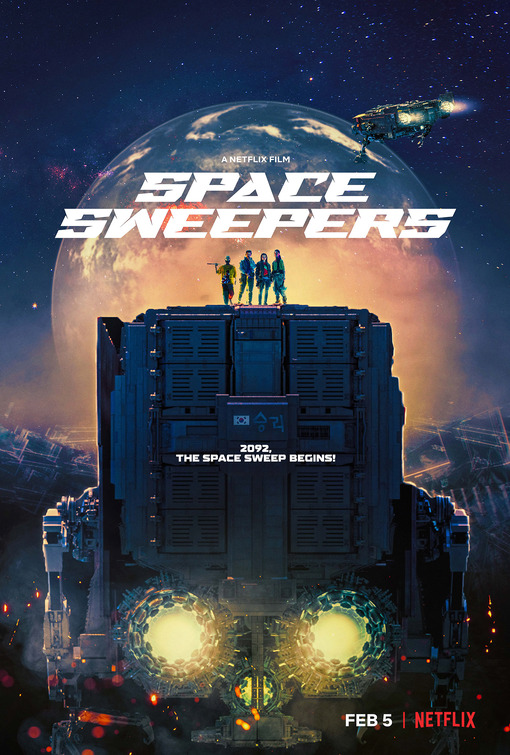
The trailer for Space Sweepers presented this Korean sci-fi as something absolutely bonkers.  I couldn't really make sense of what the actual plot was about, but the setting was a ruined Earth, a society in space, and the blue collar workers who scavenge space debris for cash.  Plus there's a robot.

The actual film, to my surprise and disappointment, far more conventional.  

Yes, there's a ruined Earth which is becoming more impoverished, more destitute, more desperate as time goes on.  There's the space sweepers who clean up debris in orbit of Earth for cash that barely covers their operating costs.  There's an Elysium-style orbital society where only the elite get to inhabit and there's a nefarious corporation behind it that is terraforming Mars as a permanent home for said people.  And then there's a missing little girl that all of society is on high alert for as they're told she's a rebel bomb.  Turns out she's the key to everything, Fifth Element-style.

This film cribs from so many other films and sci-fi stories, I lost track of them all.  It's a vibrant and well animated adventure put it falls prey to tired cliches and overused tropes.  But even with its lack of freshness there's still much to enjoy.

I found the international sensibilities of the film surprising, and I like how they incorporated multiple cultures into the film, speaking in their native tongue, explaining that everyone has ear pieces that automatically translate, so everyone understands each other.  Richard Armitage is the main bad guy and he's in gritted teeth mode, not so much chewing scenery as refusing to.  You can basically see him cashing his check.  The main cast is much more invested, however, including the snarky robot who is saving their cash to get synthetic skin and appear as human.  I like that robot.

There's a few action set pieces that are decent but not exceptional, spare the opening action set-piece which is headache inducing and nonsensical.  Yes the ships are doing things at a very high speed but the ability to process the action and orient where it's taking place is far too brain-breaking to be enjoyable.

The plot is, as you may expect, about saving the girl, but there's also a good thread about one of our leads who lost his little girl in an accident and so he is both distant towards this new girl, but also hypersensitive about her.

Altogether, a very watchable if overly typical sci-fi picture.

[1:46:52]

---

the poster teaches you
(part of) the secret cult
handshake, one of the more
ridiculous aspects of the film


I watched the first episode of The OA years ago and never went back to the rest of the series despite my intrigue.  I found some of it very captivating but much of it also very frustrating, and that frustration seemed to be centered around actor/writer/co-creator Brit Marling.  I've seen Marling in a few other things and she's a difficult presence.  She always seems kind of aloof and disconnected.  With only a few exceptions almost all of her performances have been in films she's had a strong hand in creating.

Sound of My Voice is one I hadn't heard of, and predates The OA by around 6 years, and yet it seems like it's the template for which The OA was built upon.  Marling plays the leader of a cult, and she tells her followers she's from the future...like 2050 or thereabouts.  Why she's leading this cult, what she's preparing them for, what she's alerting them to or warning them about, her actual purpose for having a cult is completely unknown, and it's a very bad choice for this movie to leave so much on the table as it's a sorely unsatisfying watch.

The film centers around a documentary filmmaker who had experience with cults at a young age and his privileged but troubled girlfriend.  They're attempting to infiltrate and expose the cult, but the question of the film is constantly "are they getting sucked in"?  At the beginning of the second act we are introduced to a mystery woman who later turns out to be a government agent, looking for Marling's character.   The film ends with a double reveal about who Marling's character is, basically obfuscating our belief in what we've seen.  It's a pseudo-Shyamalan-esque "twist" that only frustrates in leaving everything intriguing entirely unexplored.  It's effectively 2/3 of a film.  Where is the third act?

It kind of makes me want to return to the OA.  Even though Marling's character in the OA is bringing a much different message there's enough connecting threads to what I saw that I suspect it might cover similar ground, yet provide actual answers.

[2:00:56]

---

[the substitute]


All the thrills of an intricate heist movie with all the bitter melancholy of our depressing reality. The slow, agonizing death of rural culture, and the animosity it breeds towards modern society at large is laid bare. Where there used to be a wistfulness for days-gone-by, there are now only generations who have known only the poverty of small town life.

Hell or High Water film is about scrabbling, tooth and nail, to capitalize on whatever opportunity presents itself, to claw one's way out of that poverty and secure a future for their family.

The only outright "bad guy" in this film is the banking system that preys upon the people of small towns, more than aware there's no hope for debt repayment and in the end it's these institutions that wind up inheriting what should be family land (or moreover belonging to the ancestral tribes that live there before the Europeans settled it). 

But there are still bad guys. Chris Pine is robbing banks, and though he wishes no actual violence on anyone, where guns are involved, there will be violence. Where his brother, lifetime criminal Ben Foster, is involved, there will be violence. Foster is a bad guy. But even as a bad guy, he still defies the usual "crazy brother/partner" cliche...he's not educated, or thoughtful, but he does have some charm and intuitiveness.

Jeff Bridges is a Texas Ranger, nearing retirement and the way he behaves towards his partner (Gil Birmingham), half Native American, half-Mexican, is pretty deplorable. Despite having legit affection for his partner, he has zero sensitivity and thinks employing every stereotype or slur on record in his "playful banter" is somehow acceptable. Birmingham seems to just be counting down the days until the old coot is gone. Yet Bridges has a preternatural sense of human behavior and is zeroed in on what the brothers are doing. He's a great Ranger, just not a great person.

The film lives in Texas culture, with no direct judgements made. It's a slyer indictment through subtle comments and actions. It seems like every other person is strapped with a weapon and just too eager to use it. Every one of them wants to play cowboy, not out of any sense of civic duty, but more for the thrill and self-satisfaction. So not only does robbing a bank pose the risk of getting caught but alsonhaving to face off against dozens of armchair Dirty Harrys. God bless Texas?

It's a sharp, taut and complex film, fully in control of its characters and narrative.

---fin---

Monday, March 1, 2021

3 Short Paragraphs: Monster Hunter

 2020, Paul WS Anderson (AVP: Alien vs Predator) -- download

I grabbed the game, Monster Hunter: World a while ago and never really got into it. I am not surprised, because despite my affection for so many things Japanese, I cannot find interest in the stereotypical Japanese video game style. I cannot put my thumb on it, but while I love the world building and visualizations of most of their games, I cannot get into the gameplay. I thought that this one, that centered on slaying dragon-like monsters, and building better weapons & armor from their corpses could be fun, so grabbed a cheap PS4 copy. Alas, once I saw the looting animations depicting merely wiggles and motions, taking visually shapeless masses from the monsters, my interest waned. But still, that world is intriguing.

And surprisingly, Anderson was pretty faithful to that world, even recreating elements of the opening scenes from the game I have in the movie, albeit altering them for cinematic desire. The movie begins with a cadre of monster hunters sailing the sand sea when they are attacked by fiery kaiju and one main character is lost. Switch to Anderson alumni, his wife Mila, leading a group of soldiers in some nameless desert in some nameless American intervention when they are magically whisked away to the Monster Hunter World. They all quickly die but Mila and she must learn how to survive, and kill monsters in this new world, so she can find the source of the magic and eventually return home to our world, and kill more monsters.

Despite Mila doing an abysmal job of convincing us she is an American soldier, the centre act of the movie, where she learns about the world and how to fight the monsters from Tony Jaa (Ong Bak), is fun and exciting. The CGI monsters are horrific and terrifying and  the ludicrous bravery the two show when going hand-to-hand with kaiju sized monsters is very much the video game. The final act is just dumb dumb with pointless fighting and losing (the newly introduced monster hunters are as useless as her soldiers were) but tons of "ooo, that's from the game!" scenes that serve nothing for the movie. All of this was just so that we could return to our world and show how Mila and her electro-daggers are worth a 1000% more than an entire army of conventional weapons. In that I know what I am getting in the Anderson/Jovovich movies, this was about on-par with some of the lesser Resident Evil movies, i.e. not good but some fun.