Showing posts with label stunt. Show all posts

Wednesday, October 14, 2026

KWIF: The Furious (+4)

 KWIF=Kent's Week in Film. Not as much watching happening this past week as I'd have liked, but there was turkey and pumpkin pie and time with friends...so... hard to really complain.

This Week:
The Furious (2025, d. Kenji Tanigaki - Crave)
Blue Heron (2025, d. Sophy Romvari - Crave)
The Girl Who Cried Pearls (2025, d.  Chris Lavis and Maciek Szczerbowski - Crave)
Mad God (2021, Phil Tippett - Tubi)
The Devil At Your Heels (1982, Robert Fortier - CFB/youtube)

---

I still have a strong recollection of going to see The Raid with Toasty back in 2012, and being thrilled by the visceral hand-to-hand combat that was its raison d'etre, as well as the video-gamey tower crawl aspect to it. I also recall Toasty was kind of bored by it, numb from the repetitive violence and lack of real plot.  The Raid 2 was an even more visceral and gruelling affair, one that Lady Kent compared to pornography.  It's been a minute since we've had a big crossover hit like those Raid films, but The Furious is most definitely the latest and possibly greatest.

The Furious is a pan-Asian action film that tries to build a bridge between the bone-crunching ultra-violence of The Raid and the playfulness of classic Jackie Chan action movies, and it both succeeds and fails in making that connection.

The plot finds Wei (Xie Miao), a mute Chinese tradesman with a mysterious past working in an unnamed Southeast Asian city (we could never be certain if we were talking Hong Kong or somewhere in the Philippians or elsewhere). His daughter Rainy (Yan Enyou) has been visiting him from her grandmother's in China, but they're soon to be separated again. There have been a spate of child kindappings in the city, and a reporter, Matia Pham (Jeeja Yanin), investigating the disappearances has gone missing herself.  

When Rainy is abducted, Wei, with a particular set of skills, goes in pursuit. Along the way he meets Matia's husband, Navin (Joe Taslim) who is following his wife's research in search of her.  Together, with a tremendous amount of physical exertion, they start pulling apart the criminal empire that keeps getting higher up the social food chain in the city.

The draw of the picture is, without a doubt, the fight choreography.  Within the visceral and sometimes bloody brawls of the film, there's also a classic sort of balletic nature to the rhythm and flow of the movements. Point-counterpoint-counter-counterpoint. The performers, all tremendously gifted, and the stunt team have doubtlessly taken inspiration from the way Jackie Chan uses his environments (or, rather, sets up his environments to be used) and so there's frequently a clever playfulness to how the fighting progresses.  

While our protagonists Wei and Navin are obviously going to the be the special characters of this film who take an absolute drubbing but keep on moving, Miao and Taslim still perform the injuries they receive and we do see the fallout of some of the attacks on them.  Likewise the bad guys and especially the mobs of bad guys don't go down with one punch or hit, they keep on getting up and making a nuisance of themselves.

The two best fights in the film feature Brian Le (Everything Everywhere All At Once) as Ho, the idiot son of the human trafficker, Mr. Song (Sahajak Boonthanakit).  Le is a bull of a man, and is shockingly agile, which is usually counter-intuitive for larger men. The first fight is in a two-tier loading bay, and finds Wei and Navin taking on Ho together while Song is firing a shotgun at them.  The next time they meet, Wei and Navin are already taking on the big bad of the film and his bow-and-arrow-and-knife-wielding henchmen in a multi-level police station when Ho inserts himself into the fight and it becomes two-on-two-on-one-on-four. It's a dizzyingly delightful display of fight choreography as the men all switch between fighting partners and at any given time are fending off more than one attacker while also meting out their own choice strikes.

The only thing that holds The Furious back is its plot. Our central protagonists are great, the bad guys are sufficiently nasty, and almost every performer, whether in English, Cantonese or another language all are pretty solid to exceptional (even the child actors are quite good). There's the appropriate investment in the characters to show who they are and why they care about what they're doing, why they're willing to go to such lengths, that the plot is decently involving. And yet, the action is often so playful that it's hard to fully have fun with it all when child trafficking is the main thrust of the story. 

The team behind this delightfully spans the continent, with Chinese, Indonesian and Thai performers, a Japanese director and stunt team, shot in Thailand with Hong Kong funding. I would really love to see this whole cast reunited for an adventure lighter in tone, something I couldn't imagine with The Raid crew.

---


I have been trying to make a point of partaking in more Canadian content this year. Part of it is souring on America as a result of its current state, from its global influences, the wars its started, and tariffs its levied, to the continued promotion of capitalism above all and the many, many, many civil right abuses.  There's something wrong with America, and it's not new.  Whenever I watch a film or television show, old or new, that flirts with "Americana", I flinch.   Part of that is the familiarity. A steady diet for nearly half a century on American media, I have seen all this before, but now I'm all too keenly aware of the darker underbelly of Americana and where it leads. 

What I haven't had as much media exposure to is Canadian content, and in my concerted effort to ingest more CanCon, I've been finding it very rewarding to see how Canadian filmmaking is so often so different from the Hollywood system, especially if the filmmakers are letting go of any pretension of trying to present as American.

Blue Heron was being lauded by critics earlier this year, and, in the choices I made in the time of its theatrical release locally, I didn't manage to see it because I watching other stuff. But it remained on my watchlist, despite it being ...well... not my usual type of escapist fare.

The story of Blue Heron is segmented into two halves of a connected whole. The first half is set in the mid 1990's on Vancouver Island, while the second half is set modern day across the water in Vancouver. 

In the first half we open with a family of four moving into their new home on the island.  The mother and father (Iringó Réti and Ádám Tompa) are Hungarian immigrants, but their children - teen Jeremy (Edik Beddoes), non-identical twins Henry and Felix, and youngest Sasha (Eylul Guven) - are all very English-speaking first generation Canadians. 

Much of the film delivered from Sasha's perspective, though scenes extend out to her parents and the conversations they have in private. Jeremy has a personality disorder, categorized by an otherwise unhelpful psychiatrists as oppositional defiance disorder (it is as it sounds, he's defiant of authority figures and seems to take at least a modicum of pleasure or amusement in challenging the norms set out for him).

Americanized films live in the heightened drama of such stories, but here writer-director Sophy Romvari, working from her own personal experiences, lives in the memories and the moments of life with a family member having a mental health crisis. Sasha, being around 9 or 10, doesn't seem to have full awareness of what is happening around the house. To her, there's a sense of normalcy to it all. Jeremy has always been like this so she doesn't know his behavior is abnormal. Romvari sits with the conversations of the parents, the anxiety and exhaustion, the hurt and despair, the fear and tension that Jeremy's behaviour impacts upon them and their efforts to find help. But Romvari is also clear to highlight that there are good times as well with Jeremy, that he is, after all, family, even if he seems distanced from it.

Through one of the most effective, efficient, and elegant of time-jumping transitions committed to film, we find ourselves with Sasha in her 30s (Amy Zimmer), now making movies and trying to reckon with her memories of her brother. She arranges a case study of her brother, and has a team of psychotherapists approach the subject from a modern standpoint. Sasha engages with her brother's therapist from that era, and talks with her mother for her point of view. You could almost believe you stepped out of a drama and into a documentary.

But then Sasha goes back to her childhood home, and the eras merge as Sasha's memories are reawakened of that time, of the time the social worker came to visit and take Jeremy away.  This blending of time, of having Sasha visit her family in the past is a sort of spiritual, metaphorical journey, not a literal one, but cinematically it's so exciting. The hairs on my arms stood up on end.

Romvari's short film work, apparently, has delved extensively into crossing the streams of documentary and fiction. Blue Heron is a logical feature length extension of that idea. This film is so pointedly specific and contains such emotional truth, that it's evident the director has deep familiarity with the familial struggles, the subject matter, and the feelings on display. And yet there's a veil in front of the lens that adds a layer of distance, allows for some beautiful filmmaking, some subtly pretty cinematography, clever editing, and powerfully understated storytelling.

What makes this so Canadian is its reservedness, it's lack of desire to go big or go broad in its drama (that, and it's inclusion of the House Hippos ad as well as a choice bit or two of 90's Canadiana in its soundtrack). There are no immediate stakes, no big performances, no massive outbursts, no over-statements at all. It's a story about a time, a place and the people who inhabit it, the emotions of the time and the lingering effect it can all have.  Yet, it still makes some daring storytelling swings which pay off so wonderfully that this may be my favourite film of the year.

---

The Girl Who Cried Pearls is a Canadian animated short film clocking in around 25 minutes in length that went on to win its directors their second Academy Award this year (in the animated short film category, naturally... their first was in 2008 for Madame Tutli-Puttli).

Their medium of choice is stop-motion animation and the first thing that I notice whenever watching a stop-motion animation is the fine details, and here we enter the film into a large, elegant chamber...an office or personal library of someone quite wealthy (a clear view of the Eiffel Tower out the window). A little girl is exploring the space, a particular jewellery box catching her eye, when the creak of the floorboard and a shadow in the doorway send her hiding under the desk.  

The room is beautifully decorated and immaculately curated, all of it had to be produced in miniature and an active environment for hands to get in and manipulate the figures and space as need be.  It's beautiful craftsmanship to be admired.

The shadow turns out to be the girl's grandfather, who proceeds to tell her the story of what's in the jewellery box. He tells of his poor, orphan life, scraping to get by on the rough streets, hiding out in a half-condemned house right next to a poor family. He falls in love with the young daughter who cries herself to sleep every night, witnessing her increasingly tragic conditions through a crack in the wall. At night, her tears turn to pearls, and in the morning she sweeps them into the cracks of the walls before anyone can notice.

The boy then takes the pearls to a pawnbroker, a nasty, greedy man who short changes the kid and validates the pearls with a local jeweller, and is then pressured to bring more. But the boy just wants the girl to be happy, and uses his gains to buy her a present... with no more pearls to come.

There's a twist to all this, but suffice to say there's a real beauty to the stop motion, even when we are in the poor, desperate lives of these children, the settings still feel so alive with character. The characters on the other hand are relatively expressionless, their mouths and eyes not even moving, like puppets.  The colour and texture, though, of the characters, their skin, aping the overall colour palette of the movie, is a melange of earth tones, like stepping out of an Edvard Munch painting.

It's a very unique, visually captivating production, so it's all the more a shame that it has one of my greatest storytelling pet peeves (which I share with Lady Kent) which is when a character is telling a first-person story but then relaying details of scenes where they were not present. It happens twice in the film, including it's big climactic reveal and it's just like needles in the back of my brain.

Not not recommended, but also not fully endorsed either.

---

Animation is an arduous process regardless of the format but stop motion seems to be the most painstaking because of the tangibility of it all, that all the characters and environments and props and details must exist in real space, in reality, and that, most of the time, they have to be hand crafted for the project.

Phil Tippett is a master and innovator of stop motion and digital special effects, having worked on Star Wars, Robocop, Starship Troopers and many more. Mad God was a project he started in 1990 and wouldn't wind up finishing for over 30 years (when he returned to it, he Kickstarted the project for funding and completed it with the aid of band of volunteers).

The result of all that effort is a dialogue-free surreal exploratory adventure into a playfully nightmarish reality that may be a post-apocalyptic world or some kind of underworld (or more than likely a collision of the two).  There's not so much a plot to the story as there are connected events that give you a sense of this reality and the tumultuous cycles of violence and madness that it is stuck in.

As nasty and sometimes gross as the world of Mad God is, it doesn't seem to be striving to be offensive. It's playful in how it tortures and mutilates and squishes its denizens, like in a demented vaudevillian manner.  The soundtrack is mostly tranquil and atmospheric from Dan Wool, accompanying the ample sound effects and grunts and groans.

There appears to be a clear dividing line in the film though from Tippett's earliest efforts to his return to the project after learning digital effects and the result, for me, is that the second and third acts are that much less appealing than the first. Once Tippet starts incorporating live action performers into his sets and scenarios and using digital effects more extensively in the sequences, it kind of loses some of it magic.  Still, so much of it remains marvellous to behold, a rare example of pure creativity on screen.

I have to wonder about the title. Is the god angry, or crazy? Is Tippett, the creator and torturer of all these creatures within in actuality the titular character?

---

Last week I wrote about The Stunt Driver, in which Jay Baruchel plays Canadian stunt driver Ken Carter as he attempts to bring to life his dream of jumping a rocket car over the Saint Lawrence River. It may sound like an absurd comedy, but Ken Carter was a very real person, and the stunt was a very real one.  That film, directed by Michael Dowse, was directly inspired by The Devil At Your Heels, a documentary film from Robert Fortier, produced by the National Film Board of Canada.

I only just learned that the NFB has made their library of films available on-line, both via their website and on youtube (and perhaps other portals as well), which meant I had no reason not to follow up my viewing of The Stunt Driver with The Devil At Your Heels.

While I really liked The Stunt Driver it's hard to escape the fact that it's not quite reality. What Dowse's narrative film does is expand some of the peripheral people in Carter's life (like his wife, Gloria, or Dick Keller, the engineer of the rocket car) as well as contract and consolidate people and events of the story to simplify the narrative.

What The Devil At Your Heels reveals is that truth is indeed stranger than fiction, and the roller coaster ride Carter went on to try and stage his big stunt is much wilder in reality than what's actually in The Stunt Driver.

As much as Dowse and Baruchel try and give you a sense of who Ken Carter/Kenneth Gordon Poleschuck actually was (with Baruchel in his first really transformative role), they capture the broad strokes (and elaborate on those strokes) while this documentary really lets you wriggle around inside the man's brain.

Director Fortier (also a major supporting character in The Stunt Driver) really got in deep with Carter, it seemed the man had few walls up when it came to talking about how he felt in any given situation. Carter was a resilient man, physically, and a daring man, one who was very conscientious about the risks he was taking, and was more than willing and ready to take them.

The drama of The Devil At Your Heels is in the timing. Taking place in five sections (years one to five), and it is very much a procedural on how to actually get a stunt of this magnitude made. It takes a lot of money and a lot of people, it takes investors and inventors, it becomes for a day or two or three, an industry all its own.

The culmination of the stunt, which is told from a more fictionalized perspective in The Stunt Driver, is shocking here, the players involved are quite different.  It's exciting and sad and terrifying all at once. Where often a documentary makes a nice companion piece to the narrative film, I think it's quite the opposite here. The Stunt Driver makes for a fun companion to The Devil At Your Heels.

The Devil At Your Heels is an utterly captivating, incredibly structured, very well shot film with Fortier perfectly embedded with his subject to create a tremendously Canadian profile of a tremendous Canadian.


Friday, October 9, 2026

KWIF: stunts meet concrete

We interrupt the 31 days of halloween for a temporary respite into non-spooky, non-scary territory. 
KWIF=Kent's Week(ish) in Film. I tend to write these things on weekends, but I also watch most films on weekends and sometimes time doesn't allow for both. There was appointment viewings in theatres this past week, movies that I suspect would come and go rather briskly that I really wanted to see, so I made a point of getting to them before some of the bigger films of the fall (eg. Primetime, Digger), and also getting Lady Kent out to them as well (a rare but enjoyable treat). And then I did a bit of companion watching.

This Week:
The History of Concrete (2026, d. John Wilson - in theatres)
The Stunt Driver (2026, d. Michael Dowse - in theatres)
The Stunt Man (1980, d. Richard Rush - tubi)
Stunt Rock (1978, d. Brian Trenchard-Smith - tubi)

---

I really, really enjoyed the HBO series How To With John Wilson (Season 1 | 2 | 3) and it's still so sad to me that we've been without more John Wilson for three years now.

If you didn't watch the show, well... how to describe? Wilson is an avid videographer, travelling with his camera running capturing unique details and keeping meticulous notes on what he's captured. In How To... Wilson would explore (sort of) a "how to" topic (kind of) through an array of edited-together images from his vast library of footage, to punctuate (or counter-punch) a point, while pontificating on the topic at hand in voice-over in his uniquely dry, humorous, stammering fashion (his episode on scaffolding has resulted in Mayor Mamdani taking action). He would also have interviews set-up to discuss the subject matter at hand, but would also talk to strangers he encountered on the streets and wind up deviating from the topic at hand into these curious and unique tangents, which he would then attempt to bring back around to the topic at hand. How To... was a wholly unique and neurodivergent lens (I'm not even certain Wilson is neurodivergent, but his storytelling style very much is) with which to view our world.

With only a few Wealthsimple ads to tide us over in the years since, Wilson finally returns with a full length feature (101 minutes) that isn't a How To... movie but, you know, basically is.  

The History of Concrete, technically, is a documentary, but what it's documenting isn't really what it says on the label, and how it's documenting it is pretty singular (unless taken in the context of Wilson's prior work, at which point, it's more of the same...and that's not a negative, far from it).

Every episode of How To... would open with Wilson's voice over welcoming us by way of images of the city he loves: "Hey New York" is bascially Wilson's catch phrase at this point. This film opens with Wilson delightfully playing with such. For the familiar and the fans, it's like a door being opened and welcomed into a friend's house. They may have redecorated and moved things around, added an extension on back and slapped on a coat of paint, but it's still familiar, and inviting.

Wilson's entry point into thinking about and exploring concrete comes from his pitiful attempt to self-patch some concrete outside his house in hopes of preventing so much basement flooding during heavy rains. His poor patch job, critiqued harshly by a neighbour, sparks the idea for a film project...and then he has to pitch to get funding. There's no tension here...it's clear that we're watching a film that's been made, but it does start the narrative that even Wilson's ambling camera is still answerable to someone.

Exploring the cement thread, both its strength and frailty, takes Wilson to Rome to look at ancient concrete structures and ask strangers who don't speak English as to the secret of how the structures have lasted so long to futile effect. Returning home, he encounters in Queens a "spiritual" 52-day, 3100 mile marathon run on the cement sidewalk around a high school and returns throughout the film to check in on its progress. He visits a concrete convention in Vegas, and ponders New York concrete structures that are coming apart. 

Wilson's approach to the topic is both humorous and informative, but also hardly being hard-hitting investigative journalism. His interest takes him deep into industry as well as onto the surface, including the only sidewalk-gum-removal business in the city, and then tangentially, like into tattoo preservation (unless you're already familiar with this practice, you're not ready for it when you see it).

The History of Concrete returns Wilson to the more personal nature of How To...'s first season. Wilson's gateway into the world of concrete, but he's also documenting his career successes and failures, like being at a celebrity dinner hosted by GQ as one of their "Men of the year" and also losing a Depends advertisement gig. The decision to make a documentary feature, in the current environment, finds purse strings clutched tight unless it's about murder or a musician... and so Wilson goes out in search of a musician to document, a tangent that gets simultaneously dark and hopeful, presented with both humour and empathy.

It doesn't matter if you've seen How To... to enjoy The History of Concrete. Sure there are a few nods in the early minutes to, well, Wilson's life as presented previously in How To... that will get knowing "ahhhhs" out of fans but really, just like any episode of How To... it stands as a singular document that works just fine on its own, but also better as part of the whole.

Does The History of Concrete truly elevate itself to "cinematic" status, does it truly differentiate itself from from what we've seen on HBO or Vimeo? No, not in any major way, but that's the sign of Wilson making his art authentically. While some AI may have stolen his voice, I don't think there's any way to truly emulate Wilson's collages, or his ability to connect (or disconnect) with people, and to go where the vibes take him and his camera. There will no doubt be emulators, weirdo kids who grew up on Wilson's style and try to replicate that, but I don't know if Wilson's work will ever not feel unique.

---

The trailer for The Stunt Driver plays like it's a "Heritage Minute", which, if you're not Canadian you're probably not familiar with. "Heritage Minutes" are 60-second full-cast productions that present snapshots of Canadian history, like Jacques Cartier misunderstanding what the natives were saying and thinking the land was called Canada, or Joe Shuster handing off a drawing of a man in tights to his friend Lois as he boards a train.  

"Heritage Minutes" have never really gone away, but they hit sporadically, and they've been cropping up in theatres lately, both classics and newer ones. There were little tip-offs in The Stunt Driver trailer that this wasn't legit...mainly because there was so many scenes edited together. 

I thought The Stunt Driver, based on the trailer, would be a retro-styled mockumentary, following a very hoser-accented Canadian in the late-1970s as he dares to be daring, and aspires for a big jump over the St. Lawrence River. It seemed so heightened and silly and embracing the era with all the hair and polyester and wood panelling and stubby beer bottles... and, Jay Baruchel in the lead... like, this had to be a comedy right?

But it turns out The Stunt Driver is based on a very real person, stunt driver Ken Carter (Kenneth Gordon Poleschuk), and his big idea to jump the St. Lawrence was very, very real.

It also turns out I had some memory of Ken Carter sitting deep in the recesses of my brain. I don't remember much, but little pieces of trivia were sitting there that kept smacking me upside the head as I watched this dramatic-but-with-a-light-touch film about this specific period of time in his life.

Carter (Jay Baruchel), "The Mad Canadian", performed his stunts around the world, and like pro-wrestlers and football players, put his body and his life on the line for entertainment. In his late 30's, hobbled by injuries but undeterred, he scoffed at cross-border rival Evel Knievel's attempt to "jump" the Snake River Canyon in a rocket, and was determined to have his own, more inspirational (and successful) jump.

He gets rocket car designer Dick Keller (Ed Helms) to help him on his crazy quest, and enlists sports agent Bill Wilkins (Dan Bakkedahl) to sell the TV rights to ABC's Wide World of Sports. Carter's wife, Gloria, is fully supportive, though they both dream that the success of such a stunt will be enough for a comfortable retirement.

What follows is a string of setbacks that start to sink Carter into a hole, both financially and emotionally.  Time twists on and Carter can't seem to quite get off the ground. Literal years pass, but the dream never dies... that is until his first successful test of the rocket car shakes him to his core and he never quite recovers.

Presented in a 4:3 aspect ratio with, most likely digital cameras with a digital grain process added to make the film look like TV of the era (with actual footage of Carter's jumps, and crashes, judiciously cut in), the film feels incredibly Canadian, as it should. It's not a film that's mythmaking or putting an idol on a pedestal, it's a film about a very human man, and I found Carter's motivations and fears very touching.  

It's also a film about failure, and about having to live with the spectre of failure, something that Carter really couldn't shake. A couple of points in the movie, Carter states that he does what he does to be remembered... but he was forgotten anyway. Director Dowse and Baruchel -in his first really transformative role- do a really great job at resurrecting his memory, but, unfortunately, there were only 7 people at my screening. Hopefully its jump to streaming gets more eyes on it.

While Evel Knievel has cemented his place in American pop-culture history, Ken Carter didn't ever reach the same place of notoriety in Canada. In some respects films like The Stunt Driver, just pure Canadiana, are essential to our entertainment ecosystem. I have yet to watch the NFB documentary The Devil At Your Heels from which much of this film was derived, but I imagine that there were more than a few elements added or excised for dramatic and comedic effect.  This is a truly solid, stoic, entertaining piece of Canadian cinema that respects its subject when it could have pushed the comedy to real extremes, perhaps to bigger success, but less authenticity.

---

The Stunt Man was given three Oscar nods at the 1981 Academy Awards. Richard Rush was tipped for best director, Peter O'Toole as best actor, and best writing (adapted) for Rush and Lawrence B. Marcus. I wasn't aware of this film until six or seven years ago. I had added it to my watchlist in letterboxd very early on in using that app, though I don't remember exactly when I did so or what triggered it.

Based on the novel of the same name by Paul Brodeur, it finds Cameron (Steve Railsback), a Vietnam veteran, on the run from the law. We don't really learn why until deep into the third act. He narrowly escapes arrest and, while running, finds himself on a bridge facing a car that's seemingly trying to run him down. He lobs a piece of scrap at the windshield and dives out of the way. The car disappears into the river below... but it's not long before people and vehicles and helicopters start appearing...Cameron's on a film set and he sort of just killed the stunt driver.

But not to worry, for auteur director Eli Cross (O'Toole), the show must go on. It cannot afford the shut-down time of a police investigation nor any other delay.  The only reasonable answer is for Cameron to pose as the now deceased stunt man, with promises of excellent pay and a ticket out of country when the shoot is all said and done.

But it's hard to hide something like a car going off a bridge, and the local police are already agitated about the film shoot's disruptions to the community. For Cameron, it feels like the walls are closing in. And Cross, well, his intentions start to seem more and more suspect. He seems to be intentionally torturing Cameron, dangling hope and security in front of him. It's been so long since Cameron has had good things in his life, he doesn't know how to relax.

And then there's Nina (Barbara Hershey), the starlet of the film, who for some reason takes a liking to Cameron, despite his outbursts and wild eyes. He's a bit of a wounded puppy, and a bit of a rabid dog. He's out of his depth with her, but she doesn't mind, at least for now.

The Stunt Man is a satire about filmmaking while also offering a commentary on the mistreatment of America's soldiers during and after the war, as well as examining the effects of PTSD (though, somewhat naively). It flirts with being a drama and a comedy, and the film-within-a-film is a war film and so there are elaborate WWII sequences requiring extensive stunts that are shot both from the view of the camera within the film and our external POV. There's a bit of a mystery to Cameron's backstory, and intrigue and suspense around Cross' true intentions (is he really intent on making snuff fillms?).

The Stunt Man tries to do it all and only succeeds at some. It seems to know intimately how films are made (as an experience filmmaker like Rush should) but also shorthands some things (like shooting full action sequences in one take), deceives the audience in many ways, and sometimes portrays a reality that is so obviously false that it's hard sometimes to buy into the reality of the film.

Railsback as Cameron is an uncomfortable fit. As the film shifts -- sometimes frantically -- through its genres, Cameron is meant to as well, and I'm just not sure if it's Railsback who isn't up to the task of navigating them, or if anyone really could. Hershey, likewise, has a hard time finding consistency in this picture. She doesn't have as much heavy lifting to do as Railsback, nor does Nina face as much whiplash, but for a 1980's woman, she seems decades behind.

It's O'Toole who steals the show (but definitely not the lead). As Cross he gets to be shifty and playful and confounding and melodramatic and mysterious and dangerous, and does so with easy consistency. It's a terrific performance, in an ambitious, but messy film.

It feels like The Stunt Man could not be remade today, not without being a period piece. It seems so impossible for someone to disappear if they wanted to. But also if The Stunt Man were to be remade, it would be the rare instance where it would be better suited as a TV show than a movie. The depths of the characters could be better explored, the themes of reality versus fiction could be given greater weight, as could the exploration of trauma and even a proper reckoning with post-Vietnam America. There's also an extensive cast on the periphery here that is given so little screentime, there's room for an ensemble to develop out of this.  But would I actually watch it...?

---

As we conclude this impromptu "stunt week" (I had plans on rewatching The Fall Guy and Hot Rod but didn't get to them) the "Ozploitation" mock-doc Stunt Rock no doubt got added to my watchlist during a lazy Sunday afternoon scrolling through Tubi and watching its preview clips.  

Stunt Rock is not a documentary, nor is it a mockumentary, but somewhere in between. It's honestly not too dissimilar in tone to the prior year's Australia-set ABBA: The Movie, where it was sort of a concert film that was totally disinterested in being a concert film.  Stunt Rock is disinterested in really being a stunt film, and instead wants to be a concert film, but all these stunts just keep getting in the way.

It's a truly bizarre hybrid, where Australian stunt performer Grant Page makes his way to America to perform on a totally made up TV show starring Dutch actress Monique van de Ven. When he gets Stateside, he meets up with his cousin, Curtis Hyde who performs with the band Sorcery. Sorcery's schtick is mediocre hard rock whose stage show includes Hyde and Paul Haynes performing as duelling sides of darkness and light in a display of pyrotechnics and stage magic.  Honestly, it's not a bad sight, but is stage magic stunts?

The moments where we see Page stunt performing, there's some pretty big set-ups, but almost all the stunts he's performing are done so simply for the sake of being stunts. There's no narrative here, there's no plot objective, just a "can we do it?" attitude. And so, with stunts being performed with no direct intention, it's not that they're not impressive, but they're also kind of boring, and lacking theatricality. Perhaps that's why Page felt the need to cede half the movie to a rock band and a magic show... the devil-vs-wizard magic show is somehow far more enticing and entertaining.

There's no story to Stunt Rock. There's little threads about a reporter following Page and they hook up, or van de Ven nagging Page to let her do stunts, or Page trying to contribute to the Sorcery stage show... but that's not a plot, those are just events.

Stunt Rock is not unentertaining but it also feels somewhat quaint, which I hate typing because it really undermines the talent and professionalism of everyone involved. But it's not even close to the thrill of watching, say Jackie Chan outtakes, or parkour videos.


Tuesday, June 4, 2024

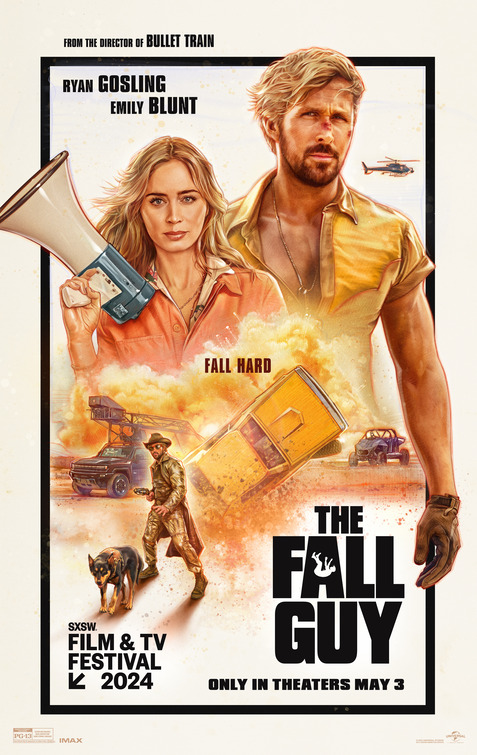
3 Short Paragraphs (Or Not): The Fall Guy

2024, David Leitch (Deadpool 2) -- download 

Oh look, its a new David Leitch movie. We like David Leitch and his style of action-comedy. We like Ryan Gosling and we like Emily Blunt. We will definitely enjoy this.

"Wait, pause that for a second. Based on the Glen A Larson TV show?" says the Peanut Gallery, aka Marmy.

Wuuuut?!? Rewind and confirmed. Yes, this movie is based on that post-Million Dollar Man Lee Majors TV show where he was a stunt man who moonlighted as a bounty hunter. I can fully admit that I probably haven't thought about the show in decades, and was not expecting it to ride the nostalgic reboot wave. And yet, here we are.

You don't have to mention the Heather Thomas poster BTW. Shite, I think we just did.

So, yeah, despite not having any great nostalgic fondness for the original series, I can freely admit I loved it at the time so it kind of made me squee to know this movie was loosely, VERY loosely, based on the show.

Colt Seavers (Ryan Gosling, Barbie) is Hollywood's greatest stuntman, and stunt double for Hollywood's greatest action hero Tom Ryder (Aaron Taylor-Johnson, Godzilla). But during a fateful fall stunt, from great heights, he breaks his back. A year and a half later Seavers is recovered, physically, but not mentally, working as a valet driver for a Mexican restaurant when he is caught in someone's social media post. He looks more than a little lost.

His old producer friend Gail Meyer (Hannah Waddingham, Ted Lasso) finds him and convinces him that his old girlfriend, camera operator Jody Moreno (Emily Blunt, Oppenheimer), whom he abandoned after he got hurt, needs him on the set of her directorial debut, the latest scifi actioner from Tom Ryder. Of course, she doesn't even know he is coming, and seeing him dredges up all sort of hurt feelings.

But Gail has brought him to Australia to do more than perform stunts for the movie, but also to find Ryder who has gone missing. I guess this is the analog to the bounty hunting? Anywayz, the hunt for Ryder sets off all sorts of excuses to do fight scenes and action stunts, to really play up the meta elements of a stunt man actually doing all the over the top jumps and crashes and punches and window smashes and .... and, well the kind of stunts actual actors (like Gosling) get other people to do. And in doing so, he uncovers the real conspiracy plot behind the point of him being brought to the movie set of Metal Storm.

Kent said, "As a crime/mystery story, the more it reveals itself, the dumber it gets." Yup. I was thinking, by the time they were blowing up boats in the harbour to the stylings of the Miami Vice Action Spectacular (a Universal Studios attraction show which Gosling's character was supposed to have built his early career at) they should have gone even more meta, and had the movie Tom Ryder was shooting be a crime-caper action movie instead of a terrible scifi flick. The actual mystery behind the movie doesn't really add to the movie, and its more about the fun of the set pieces, and chemistry between Gosling and Blunt. While I didn't really buy into their tortured romantic relationship, they just get along so wonderfully in the movie, its fun to watch. And the idea that two actors... in... their... 40s... are given top billing as beautiful, exciting people. Wow, like age appropriate!

That movie. Its supposed to be the latest blockbuster in Tom Ryder's long career, but the plot is so fucking ludicrous, its almost a mockery of scifi summer blockbusters. The closest I can come in comparison to it is the Wachowski's Jupiter Ascending with its wolf-boy male lead on his sky-skating roller blades.

In the end we have a fun fun movie that kicks off a summer with something appropriate, and yet still is not getting bums in seats. Kent and I talked a lot about where the industry is heading, and while I am part of the cause and not the solution (I did not see in theatre), I still feel a bit sad to see this world die slowly, especially considering all the supporting people who end up out of work, including stunt performers.

Sunday, May 12, 2024

KWIF: The Fall Guy (+5)

KWIF is Kent's Week in Film where each week (uh huh) Kent has a spotlight movie in which Kent writes a longer, thinkier piece about, and then whatever else Kent watched that week (or maybe a month ago and forgot about) Kent does a quick little summary of my thoughts. Just not in third person.

This Week:
The Fall Guy (2024, d.  David Leitch - in theatre)
Millennium Actress (2001, d. Satoshi Kon - the shelf)
Witness (1985, d. Peter Wier - the binder)
Operation Fortune: Ruse de Guerre (2023, d. Guy Ritchie - AmazonPrime)
Clear and Present Danger (1994, d. Phillip Noyce - the binder)
Blackhat (2015, d. Michael Mann - the binder)

---

I don't know if I can really write a longer, thinker piece about The Fall Guy because it doesn't seem like much thought was put into the film itself. 

I'm being rude. 

The Fall Guy was a film I actually had a good time with, largely based on the explosive and almost effortless chemistry between Emily Blunt (Gnomeo and Juliet) and Ryan Gosling (Young Hercules) -- two extremely attractive people that look even more attractive together. Do Eva Mendes and John Krasinski need to be worried? Or at least extremely jealous?

This film is director, and former stuntman, David Leitch's love letter to stuntmen and stunt crews, wrapped in an action rom-com. Leitch over the years has proven his action-directing chops with Atomic Blonde, Deadpool 2, Hobbs & Shaw, and Bullet Train. Each of those films may not have the greatest of stories, but the action tends to be really fun. 

And the action is fun here. There's a great "tripping balls" fight in a nightclub, and a swing arm garbage truck chase/fight sequence through the streets of Sydney that strive to stand out. I think the problem with post-John Wick action-heavy films is the action is too heavy and so nothing really stands out, and the same goes here.

What's more, I found the fact that we were watching a lot of stunts from the perspective of a film crew, seeing all the cameras and cables and tracks required, which was necessary as part of the film's narrative, but it ruins the illusion and lessens the impact of the stunts (most stunts, really, should inspire at least a bit of awe, but we've seen and know too much now, and they've become a little commonplace, undervalued).  I do appreciate that Leitch lets everyone in on the action, with the welcomed, if under-utilized Stephanie Hsu and Winston Duke each getting a sequence of their own, and Blunt reminding us she's more than capable of throwing fists when needed.

As a crime/mystery story, the more it reveals itself, the dumber it gets. It's a real nonsense plot which requires an acceptable amount of suspension of disbelief to start with (the star is missing, Colt is asked to discreetly track him down only to find a dead body and have things go even more wrong for him from there. But there's no real world logic to how wrong it gets, and the more you pick at it, the more it bleeds. There's only so much belief I could suspend and this stretched it to its breaking point.

What eventually made my suspension of disbeleif snap, though, was the film-within-a-film. A sci-fi epic called "Metalstorm" that looked, at best, like a sequel to Battlefield Earth. It looked like a mid-budget remake of the Barry Bostwick 80's b-movie Megaforce. This film would have you believe it was the next Dune or Star Wars, and it just looks like trash. The Fall Guy is a pretty good looking film. It really needed "Metalstorm" to look incredible, or play into it being B-movie action trash, not say it was an A-tier movie, but look like B-tier trash.

As a romcom, this is aces. I was in for every sleepy and/or doe-eyed stare that Colt and Judy give each other. Their dialogue was charming, funny and seemingly effortless in its delivery, and that split-screen sequence was terribly cute. Gosling and Blunt, all day, every day.

---

Watching Perfect Blue last week felt like a revelation, like there was a piece of cinematic language missing from my vocabulary all these years which I now understood. Millennium Actress couldn't compete with that type of lifting of the veil.

It also didn't help that I just wanted to sleep the entire time it was on. 

I didn't fall asleep, though, which is a testament to how engaged I was with it (I did fall asleep while writing this post).

Once again director Kon proves his mastery at the transition and edit. Where Perfect Blue was a Giallo-tinged suspense thriller, Millennium Actress is a romantic drama that, all at once, tells us a character's life story and steps us through seventy years of Japan's cinematic history through which we get a staggering sense of Japanese history.  Let me tell you that as a viewer having a very limited amount of knowledge of Japanese history -cinematic or otherwise- it does this film a disservice.

The story is of a studio executive and a young cameraman visiting a famous, but long-retired, reclusive actress to interview her after the demolition of the studio of which she was a big part of building. The exec, who you would expect to be forceful and entitled, is instead a gushing fanboy with nothing but the utmost respect and reverence for the actress.  He presents her with a key which the actress thought lost years ago, and the totem unlocks a lifetime of memories.

The actress recounts her birth, how she was discovered by a producer, her first film, but also her encounter as a teen in the 1930s with a young artistic rebel whom she helps escape by shielding from the law. She is instantly smitten by him, a soulful artist, and the key was a gift from him which she was made to promise to return to him, what became her life's mission.

Her real life blurs into her acting roles as she describes them. Like Perfect Blue the transitions between real life and her acting are seamless and, at times, difficult to discern.  Her roles, or at least the ones that matter to her in retelling her life, are the ones of a young romantic longing for an unseen man who she desperately wants to find. The roles step through the eras and genres of film, from samurai to geisha to Kaiju to sci-fi.  All the while as she recounts her blurred story of life and work, the producer and cameraman are present in the story, the producer injecting himself into roles in the films he clearly knows so well. It turns out, he was a young production assistant during her later films at the studio and was, once or twice, a part of her story.

It's a surprising film in how down to earth it is. It is a film that deceptively seems like it should have been live action, but to have the actress span the ages she does is almost impossible for a single performer, and to have the scale of adventurous productions in her repertoire would make for an expensive film.  Plus, I don't know that any live action director alive has a handle on seamless transitions like Kon.

---

For four years I had an art teacher in high school who loved Peter Weir films, and would play them in class while we were toiling away on our sketches. I've seen Dead Poets Society, Green Card, and Fearless numerous times. Of the three, only the latter did I actually like.  If you look at the release dates of those films, you can tell which years I went to high school (accounting for the delay between theatrical and home video release). I don't know why, if he was such a fan, we never saw The Cars that Ate Paris, Gallipoli, Picnic at Hanging Rock, The Mosquito Coast, or Witness.

I have just assumed all this time that I'm not a Peter Weir fan. And I'm not. But I've spent some time thinking I'm opposed to Peter Weir, and, after watching Witness for the first time, it turns out I'm not. 

Witness is a surprisingly patient movie from an era of filmmaking where its action movies were increasingly bombastic and its thrillers were full of sex, violence and cliches. This lacks almost any bombastic action, and there's no sex, an anti-violence message, and its cliches are tossed out the side of the horse-drawn buggy. 

It's got plenty of Amish. And I thought this story of a police man protecting a young Amish boy (Lucas Haas, Mars Attacks) who witnessed a murder would be full of crude, reductive stereotyping of the community instead places Harrison Ford (Working Girl) as Captain John Book within the community where he is largely respectful of its traditions, keen to help out, and even finds a bit of peace while he's there. 

He also starts falling for Rachael (Kelly McGillis, Stake Land) the boy's mother, but also keeps his hands to himself, respectfully remembering they are people of two very different worlds.  There is an intense attraction between the two of them that just builds until, following the climactic conflict between Book and the bad guys, deflates like a balloon. The scene of Rachael looking out her window to see Book chatting up his police pals by their cop cars, smoking a cigarette, it is just an incredible moment that reinforces the gulf that separates the two of them. The thread of attraction that seemed to grow inot a bridge made out of stone turns out to just be a wispy thin thread.

Along with the film's climax -- where Weir, instead of delivering that oh-so-American release of catharsis and shooting up the bad guy instead ends with an appeal to his humanity -- proves the director isn't interested in the most satisfying ending for the audience, but the one that feels most real.

This is a pretty great movie, held down by a drone of a score that might as well not have been there at all, and one of the most awkward impassioned kissing scenes I've seen.

---

One of the dumbest titles in recent cinematic history, Operation Fortune: Ruse de Guerre finds Guy Ritchie delivering a script with plenty of charming flourishes, and leading a cast where everyone seems game (even Jason Statham (The Beekeeper), well, at least for the first 20 minutes where he flirts with the idea of adopting a character before he falls back into default Statham mode). 

Josh Hartnett (Halloween H20) does that "proof I can be funny" supporting role mid-life crisis thing that modern actors have done since Tom Cruise appeared in Tropic Thunder. He's good, and handsome, and, yes, funny playing a pompous, pampered superstar actor (if we're comparing, he does a better job than Aaron Taylor Johnson in the same role in The Fall Guy).  Aubrey Plaza (Ingrid Goes West) sometimes feels like she's in the wrong movie, but I would watch that movie. Cary Elwes (Robin Hood: Men In Tights) gets some good cracks, and Hugh Grant (Wonka) genuinely seems to be enjoying himself. 

There is that odd take in the elevator with Hartnett where Grant breaks after barely delivering his line... which speaks to one of the larger problems of this film: it feels unrefined. There's a lack of care, and certainly a lack of flair to the overall production. It doesn't look great, it looks barely a cut above, say, Burn Notice or some other action TV series. This obviously wasn't a cheap movie, so why then does Ritchie's work on Netflix's The Gentlemen TV series look so much better? The editing here proves serviceable but we've been so locked into the idea that Ritchie movies are highly stylized, that this largely doesn't feel like a Ritchie movie. 

Ritchie already did his take on Bond with Man from U.N.C.L.E., while this feels like his riff on Mission Impossible if it were done by Asylum. It's certainly inessential to his repertoire.  I think the director just likes to work, he's found a mid-range groove and he's maybe going to coast there for the rest of his career.

---

The third entry in the Jack Ryan "series" (and the second with Harrison Ford [Cowboys & Aliens] in the role) finds Ryan becoming embroiled in the "War on Drugs". The PotUS's friend is found murdered alongside his whole family, the culprits being the Cali Cartel. The President wants swift retribution, under the guise of the War on Drugs, and discreetly has his national security advisor run an off-the-books operation to take out the head of the cartel.

When Ryan's friend and mentor Admiral Greer (James Earle Jones, Conan The Barbarian) falls ill, Ryan takes his place as Deputy Director of Operations in the CIA. He is dispensed to Columbia to try and find other means to cutting off the supply chains to the US.  He petitions Congress for more funds, and Congress agrees so long as no military engagement is enacted. Little does he know he is set up to be the fall guy for it.  

The film is a pretty taut political thriller that falls apart only with a jingoistic third act that finds Ryan single handedly going to Columbia to bring back the soldiers left behind by the NSA.  It turns into a ridiculously out-of-place rescue-the-POWs action sequence that neuters the political intrigue that had been the film's raison d'etre up til that point. 

The finale of the film finds Ford's Ryan dressing down the President ("How dare you, sir!") by holding the most powerful position in the land to a standards of decency and responsibility that have absolutely been abandoned in the past decade. It's perhaps the most upsetting (and unintentional) note of the film.

---

In the past dozen years of massive disastrous box office performances, Blackhat still stands out as one of the biggest bombs, recouping under 20 million of its 70 million dollar budget.  

It's not just that the film tanked at the box office, but it was both critically and socially derided at the time. That beautiful brick wall of a man, Chris Hemsworth, Thor himself, playing a nerdy master computer hacker. It was laughable in its very conception.

But a funny thing happened in the years since, the Michael Mann fans have managed to drown out the knee-jerk reactionaries and get the film into a "reclaimed" status. Certainly the podcasts and socials I feed into have been saying as such for a couple years now.

Having seen the film (then forgetting to log it) I have to say, bluntly, not bad. In fact, good. Not great, certainly flawed, but good.

My biggest gripe with the film is how Mann shot it.  It's a film that puts Mann in Steven Soderbergh mode, using a lot of different types of digital cameras and lenses and I found jumping between them quite distracting.

The film begins with a nuclear power station melting down. It was hacked and the cyberwarfare arm of the People's Liberation Army want to find the culprit. Captain Chen (Leehom Wang) of the division aligns with the FBI in the US, needing genius-level hacker (and his college roommate) Nick Hathaway freed from prison in order to sniff out whomever was capable of such an attack.  A subsequent attack on the stock market only exacerbates the need to find the culprit.  

It's a pretty taut globetrotting cyber-thriller all told. It takes some tense and scary turns as it leans into just how reliant we are upon technology, and just how vulnerable that technology is to malicious interference.

I can ignore the sketchy accent, and I can even buy into Hemsworth as a hacker, but how did Hathaway get so adept at knife fighting and shooting guns? There was a lot of nonsense in the film, questions raised and never answer, but I still just rolled with it and enjoyed the ride.

I had just watched Decision to Leave the night before watching this, so I was pumped for more Tang Wei and this did not disappoint in that regard. Loved the cast which also features Holt McCallany and Viola Davis.


Monday, April 11, 2022

10 for 10: Migraine

[10 for 10... that's 10 movies which we give ourselves 10 minutes apiece to write about.  Part of our problem is we don't often have the spare hour or two to give to writing a big long review for every movie or TV show we watch.  How about a 10-minute non-review full of half-remembered scattershot thoughts? Surely that's doable?] 

In this edition:
The Mask of Zorro - 1998, d. Martin Campbell (Netflix) 
Jumanji: The Next Level - 2019, d. Jake Kasdan (AmazonPrime)
F9 - 2021, d. Justin Lin (rental)
Turbo Kid -  2015, d. François Simard, Anouk Whissell, Yoann-Karl Whissell (AmazonPrime)
Dog Days - 2018, d. Ken Marino (on demand)
Unstoppable - 2010, d. Tony Scott (Disney+/Star)
Charade - 1963, d. Stanley Donen (Netflix)
Police Story - 1985, d. Jackie Chan (Crave)
Police Story2 - 1988, d. Jackie Chan (Crave)
Wing Chun - 1994, d.  Woo-Ping Yuen (dvd)

---

I really wanted nothing to do with a Zorro movie when it came out 20+ years ago. The property was so old-world to me, that I questioned why, why revive a property that had been long in the tooth even 15 years earlier? I now realize that the franchises of any era are built on the childhood nostalgia of the producers who are in their 40's and 50's at the time, so with pulp heroes like The Phantom, The Shadow, Dick Tracy and Tarzan all getting a go in the 90's, of course Zorro was an option. 

Also no property is ever dead if there's the possibility of making money off it. 

Even at that time, 1998, I knew there was something off about casting British (Hopkins) and Spanish (Banderas) actors as a Mexican folk hero (especially when the Spanish are the enemy in the film).  Were this made today there would certainly be some noise about it (I think there was even at the time but calling out that kind of casting barely made a dent back then).

But, you know, that aside, (if you can put such things aside) it's a pretty fun romp about legacy and choosing to serve greater good over self, and of course both Hopkins (who I assumed was a mistake) and Banderas are just charismatic as fuck.  Zeta-Jones, though a big part of the film, is basically the cliched reactive female of these sorts of things.  I was hoping she would have a more to do.

It's perhaps a smidge overlong, but quite, quite watchable, a testament to Campbell's keen sense of adventure and a script that plays nicely with themes of legacy.

---


Jumanji: The Next Level
 is a surprisingly entertaining return to the video-game reality established in Jumanji: Welcome to the Jungle. Spencer, having seemingly come out of his shell after the last Jumanji adventure finds that his newfound bravado was short lived, and he longs for the Rock-like strength and willpower he had in the game.  After he disappears into the game his confused romantic interest Martha joins him, but so do his grandpa Eddie (Danny Devito) and Eddie's antagonistic friend and former business partner Milo (Danny Glover).  And unfortunately for Spencer, it's Eddie in Rock's body and Milo get into Kevin Hart's compact frame.

Honestly, after many months, I can't really tell you too much about the events of the film, except to say that Dwayne Johnson's Devito impersonation is great fun, but it's Hart's Danny Glover impression made me laugh every single moment on screen.  The avatars of Jumanji are a suitable mask to explore the emotional subtext of the exterior world, the only problem being we don't really care so much about those characters in the exterior world.  While Spencer's feelings of disappointment and insecurity are pretty much expected, it was the emotional underpinning of Eddie and Milo's septuagenarian friendship that really lifted this movie out of its middle ground.  There's a whole body-swapping bit in the middle of the picture which gives all the main performers a chance to play as each other, with Karen Gillen getting to really show off her versatility.

There's a plenty of action, most of it fairly non-descript and excessively video-gamey (apt for a video-game movie but not altogether exiting).  Overall, enjoyable, but, like the first one, ultimately forgettable, or, at best, kind of indistinguishable from one another.

---


F9, the Fast and Furious Saga
, just as with each film in the series before it, takes things to another level.  Somehow the budgets get bigger, the action more unbelievably ridiculous, the mythology more intricately (though far from delicately) woven, and the family keeps expanding.

In F9, we get our first ever flash-back sequences, to a young Dom Teretto and his heretofore unheard of brother Jakob as they help their father as pit crew for his race car.  But when Dom learns that Jakob helped his dad rig his car to fail, thus throwing the race, but causing a fatal accident killing their dad, well, family apparently doesn't mean enough to young Dom.

Now, the world's in danger because Jakob (in the form of John Cena, supposedly Vin Diesel's older brother) has allied with some maniac and a returning Cypher (Charlize Theron in a veeery bad wig) and only Dom can stop him.  There's some other nonsense with the rest of the gang too, including bringing back supposedly dead Han and, independently of that, some of the other crew from Tokyo Drift who are now rocket scientists for the sole reason that they'll need to launch Roman and Tej into space.  Yeah, they go to space... in a car... what of it?

Helen Mirren gets a driving sequence (and wakes Vin Diesel out of his acting coma, seriously there's infinitely more heat between Mirren and Diesel that between Diesel and any of his other female co-stars in any of his other films...he kind of lights up when she's around...but I mean, who wouldn't?) and there's a whole wonderfully absurd sequence involving magnets that has to be seen to be believed (but even then you won't believe it).  Dom at one point even pulls a whole building down upon the dozens of bad guys rushing him because he performs herculean feats now.

I'll pull no punches, this movie is insanely dumb, but it knows it's dumb and doesn't care.  In fact it embraces it, and has fun...it's really only Diesel, for the most part, who is taking the whole thing seriously, bless him.  I can't believe they make these films. I can't believe I watch these films. I can't believe I like these films. I can't believe so many other people like these films too.

---


Toasty really seemed quite taken with Turbo Kid in his review years ago, and it stuck with me.  But I couldn't get past the very Canadian appearance of it's poster...plus Michael Ironside is who Canadian low-budget filmmakers get to add gravitas (because they can't afford Bruce Willis or Nic Cage). As I've established many times in this blog, I have Canadian inadequacy issues, and it keeps me from even attempting to enjoy most Canadian film and television.  

But, sometimes all one really wants is something familiar, but also new.  You know, a simple order for a Sunday afternoon.

Turbo Kid is a post-apocalyptic science-fiction adventure film about a lone teenager who manages to survive the roving gangs and toxic lands with dreams and aspirations of being a hero like Turbo Man from his comic books.  He meets a quirky, perky, yet completely capable girl named Apple who follows him around like a lost puppy despite his protestations.  They get in trouble with the big mob boss of the wastelands (Michael Ironside) but team up with a rambling vigilante to fight him change the landscape of the wasteland.

The aesthetic of the film is intentionally retro 80's futuristic, as it's post-apocalyptic time period is 1997, which for a film made in 2015 is just so cheeky but they do a great job with it.  While being a pretty clean adventure film with a young protagonist, the storytelling aesthetic is paired with a ridiculously cartoonish level of gore.  It takes what would otherwise be a PG movie into a hard R rating.  It's quite absurd, the blood spray and kill gags which seem so out of step with this otherwise kind of innocent seeming po-ap-for-kids story.  I think it's ultimately what distinguishes it, but it's also quite a barrier to get over.

---


Dog Days
 is yet another quasi-anthology/ensemble cast romcom in the vein of Love, Actually or New Year's Eve or Valentine's Day or any of those other holiday themed romcoms.  Here, it's centred around people with dogs (or people without dogs, as it were). 

Nina Dobrev (Love Hard) is a morning news show host who has a big time will they/won't they with her new cohost (Tone Bell) which becomes more "they will" when their  dogs take a shining to one another.  Meanwhile, Vanessa Hudgens (The Princess Switch) is a coffee shop employee crushing on the cute veterinarian (Michael Cassidy) who patronizes her establishment, but befriends the dorky Jon Bass (who has been crushing on her) and starts volunteering at his animal care shelter.   Eva Longoria and Rob Coddry are new parents to an adopted 9-year-old with whom they are having trouble connecting, but when a stray dog is brought home, the girls starts to open up.  But that stray dog is the beloved pet of lonely widower Ron Cephas Jones, who winds up befriending his nuisance teenager, Finn Wolfhard as he helps him look for the dog.  

These are the main threads, but the cast is stacked with others in LA's comedy scene (and from the sketch comedy troupe The State which director Ken Marino was a part).  These include Adam Pally, Jessica St. Clare, Thomas Lennon, Lauren Lapkus, Jon Gemberling, Ryan Hansen, David Wain and Tig Notaro.

Given the talent involved, this should be a far funnier film than it is, but it's not actually trying to lean into the rom or the com.  It's just trying to be like every one of these romcom anthologies, which means it's just the same mixed bag that they all are.  It's not an outright disaster but it leans too hard into the sentimentality and tries too hard to tug at the heart strings and you can see the results coming a mile off.  The main Dobrev story is weakend by the terrible attempt at recreating a morning talk show vibe (they're typically unscripted and this is so scripted).  Hudgen's arc is much better mostly because, well, it's Hudgens, but it suffers a bit with just how dorky Jon Bass plays his role...it's supposed to be charming, but always smacks a bit of desperation.  The adoptive parent story and the runoff into the Jones/Wolfhard story are both emotionally resonant, but don't fit well into the romcom mainline vibe. 

It's not the worst of this style of film.

----


In 2010, Tony Scott made a movie about a runaway train with Denzel Washington and Chris Pine called Unstoppable.  Through a series of silly misfortunes, a train manages to take off, gaining speed, without a conductor.  It's carrying hazardous materials, and at a certain point it will hit a bend which will cause it to tip over and contaminate a whole Pennsylvanian town. The events of the film follow the various employees and the corporate train overlords, as well as a couple of hero conductors as they all independently plot on what to do about stopping that dang train.

It's not an outright silly movie concept, and were it made in the 70's there would be a very grounded feel to it, as well as a very modest amount of action.  In Tony Scott's hands, this thing just keeps ramping up, with the train crashing into things and helicopters and hopping from train to train and all sorts of blue collar heroics.

The film tries very very hard to feel like it's at the blue collar level, peppering the dialogue with "train speak" and union talk, and it looks to speak directly to the blue collar workers of America.  But how many of them look like Chris Pine, Denzel Washington or Rosario Dawson? There's got to be a few right, and of course if anything bad were to happen, the prettiest ones would step up to save the day.  But that's Hollywood.  Scott wants this to be both grounded in lower-middle class America and also have all the glamorous facade of Hollywood.  He achieves both but they really don't fit together well.

I don't know if this film birthed the term "peril fatigue" - describing how the increasing stakes and dangers of a story ultimately become tiresome and tedious - but it definitely fits the bill.  I found this film to be more exhausting than exciting.

---


I'll be honest, I started writing this, the last 10-for-10 ever (or so he says), about 6 weeks ago.  I also stopped writing it about 6 weeks ago.  Why? Because I've kind of forgotten everything about Charade, which I watched over half a year ago now.

Looking to pilfer what I wrote in Letterboxd, all I came up with was:
Is it worth watching Audry Hepburn and Carey Grant be witty and playful with each other for almost two hours? Yes, it absolutely is.
Seriously, it's like a charm duel between these two, and everyone's a winner.
I mean, I kinda just want to watch it again.

I just took another 5 minutes to read the Wikipedia synopsis which did remind me that, yes, in spite of my failing memory, I had seen the film.  The plot is fairly fleet involving death and deception, but it's sort of a pithy comedy.  On the romantic side, Hepburn and Grant should seem like an ill-suited pair, given their age difference, and yet, they basically speak the same language the same way, so the attraction quickly becomes palpable. 

It's obviously not keenly memorable -- visually, nothing sticks out in memory -- but it remains quite enjoyable nearly 60 years later.                                                                                                                                                                                                 
---

The other day I was thumbing through my "Diary" on letterboxd to see just how many movies I gave 5* to, and the results were...well, not many, but more than I thought.  Star rating is not something we do here on the blog, because I think Toasty and I agree that those kinds of ratings systems are problematic.  I mean how do you give a classic like The Third Man 4 stars, and also give a cheapy holiday romance like Under The Christmas Tree the same 4*.  Well...it's because it's not the same 4*.  Those two movies are ranked on completely different scales in relation to one another. 

Much in the same way a decent, if forgettable, holiday romance would get 2* but also Jackie Chan's classic stunt-fest Police Story also only gets 2*?  It's a Criterion selection, and the letterboxd average puts the film at a 4.0?  What's going on here?

Well, here's the deal.  Police Story isn't a very good movie.  It's not even a good movie.  It's a very bad movie with some amazing stunts.  

I was so very excited to watch Police Story and I was definitely not expecting what I got. I tried so hard not to view this with the detached western ironic gaze but I couldn't help but laugh and laugh at so much of the early scenes, but the police breakdown of the targets, the subsequent bungled surveillance mission and resulting clusterfuck of a shootout. I often couldn't tell the difference between what was intentional comedy and what wasn't. That made me feel bad.

It's an ugly looking movie with an atrocious soundtrack, but obviously everything to do with Jackie Chan's physicality  --and the life-endangering stunts by he and his team -- are always marvellous to watch .  They are absolutely the draw and Chan's comedic abilities should also never be undervalued, with all the skills of a silent film master. But the majority of this was just so painful to watch, and I don't mean in the "oof, that's gotta hurt" kinda way. That courtroom scene was so cringe inducing. 

If you were to just watch the compilation of stunts on youtube, you wouldn't be missing anything.  


I was told Police Story 2 is superior, and well, that's true, it is, as reflected by my letterboxd rating of 3 1/2 (which puts it squarely in league with the top tier cheapo holiday romances) but if you were to ask me what stood out, what I took away, it would mainly be that Chan's character Chan Ka-kui is such an awful boyfriend to Mai (a fully put-upon Maggie Cheung) and it makes him rather unlikable.  

The comedy in this second feature is certainly much more heightened (and perhaps more obvious) than in the first, as well the characters here are much better defined (even if we like them less as a result).  Even the storytelling is more cohesive and not *just* a framework for building towards stunts.  The production quality is better, but Chan is only marginally a better director than the last go around.

I really like Jackie Chan's on screen persona, he's got a million-dollar smile, and his energy is infectious.  His physical talents and comedic sensibilities are beyond reproach, and yet I really don't like either of these films.  I appreciated more attention to story on the second, but it seems to have come at the expense of stunts, and the first one's singular fixation on phyiscal gags makes the story a slog to get through.

The third police story co-stars Michelle Yeoh, and though I have yet to see it I can absolutely declare it the best of the franchise....

---


I've had a little crush on Michelle Yeoh since first seeing her in Tomorrow Never Dies, but cemented when someone, not long after, invited me to a screening of Wing Chun.

If you're not absolutely steeped in wuxia films all the time, then I have a sneaking suspicion that your favourites are almost always going to be the first few you see.  Wing Chun, Iron Monkey, Legend of the Drunken Master, and Zu Warriors from the Magic Mountain are going to be hard to ever top, because they are cemented in my mind as the best of the genre... maybe it's because they were presented to me as such.  I don't watch wuxia often (or often enough) and I find it tedious to wade through the melange of cgi messes in order to find the gems that still get made (I'm sure).  I don't even watch classic wuxia enough because I don't really have a guide to help me wade through the miasma of dreck that surround the stone cold classics.  And I don't even watch the ones that I have genuine affection for enough, because my precious screen time these days is so given over to watching new things.

That all said, I think Wing Chun is my favourite.  I dig it so hard.  And it's not just that Michelle Yeoh is so pretty, and graceful, and badass in this movie (ok, yeah, it's mostly that) but it's also really, sincerely funny.  It's basically a 1980's style sex comedy/rom com in wuxia form that dabbles in misguided, backwards gender politics but comes out the other side sort of ok.  I mean, it's patently absurd that Wing Chun's childhood best friend (I mean, Donnie Yen, c'mon!) would return some ten years later and both not recognize her but also mistake her for a man... I mean...Michelle Yeoh, one of the most beautiful women in the world...a man... right.  

Directed by master choreographer Yeun Woo-ping, this is just an astounding display of what he does best.  I like the wire work here better than The Matrix or Crouching Tiger...better than most movies.  The cast here does everything asked of them perfectly (no matter how regressive it may be),  and in the end the three female characters are decidedly the strongest of the feature, each in their own distinct way. 

---
I started this post months ago with a migraine, and now I'm ending it with a headache, so...progress?
As noted (somewhere) this will be the last 10-for-10.  It's proving to be more inhibitive to posting than helpful in getting more reviews done. I'm sure I start some other similarly stupid means of trying to crank out more posts that won't hold water after the first few attempts....

-fin-