Showing posts sorted by relevance for query mythic quest. Sort by date Show all posts

Friday, June 27, 2025

KsMIRT: well...maybe I do

 KsMIRT=Kent's Month in Reviewing Television in which Kent (that'sa me) reviews the television series he watched in the past month (*cough* April *cough*) in the patented 1-1-1 format. I have been writing these things rather expediently at the beginning of each month and yet, for some reason, sitting on them for weeks (and weeks), and posting them at the end of that month, so they're, like, a month behind (*cough* now, like, three *cough*). Whatevs. Let's do this:

This Month:
The Residence (8/8 episodes, Netflix)
Mythic Quest Season 4 (9/10 episodes, AppleTV+)
Yellowjackets Season 3 (7/10 episodes, Crave)
Dark Winds Season 1 (6/6 episodes, Crave)
Daredevil: Born Again Season ? (9/9 episodes)

---
created by Paul William Davies

The What 100: There's been a murder in the White House (not the president this time) during a state dinner with the Australian Prime Minister. The victim is the Chief Usher of the White House (Giancarlo Esposito) and the suspects are plentiful with, like, 60 staff members and residents plus nearly 200 guests. Given the sensitivity of the issue the chief of the Metro PD calls in a favour and brings world renowned detective Cordelia Cupp (Uzo Aduba) on the scene where she takes control locking the premises down for as long as she can against mounting opposition and unrest.

(1 Great) I haven't ever really considered myself a big fan of murder mysteries, but the recent spate of eccentric detective mysteries like the Poirot films, Knives Out mysteries and, especially, Poker Face have certainly brought me closer to fandom. Uzo Aduba makes for a wonderfully eccentric detective, as Cordelia Cupp obsesses as much about her birding as she does the case, and often applies her vast knowledge of the birds of the world to the case at hand.  She is exceptionally observant, patient, and never gets ahead of what she knows (she never identifies a suspect, more just persons of interest). She's certainly not a people person, but at the same time, Aduba manages Cordelias frankness as something more charmingly humorous than rude or abrasive. She puts some very powerful people in their place.  8 episodes is a long time to maintain a murder mystery like this given that most of these kinds of stories are done in a 2 hour movie or 1 hour TV show format, but the show makes it less a whodunnit and more about Cordelia's process.  She's an exceptional detective and she knows it, and has a little bit of an ego about it, but it's also clear she enjoys the challenge the work brings.  I also appreciated that amidst it all she remembers that there's an actual person who lost their life in all this. It's a pretty breezy watch.

(1 Good): I do find myself enjoying these big ensemble murder mysteries, and here we have a sizeable cast of recognizable faces. They're not all big, big stars, but if you've watched any TV/streaming in the past decade (or even just the 80's) you're bound to recognize at least a half dozen faces, if not more. You've got Jane Curtin (3rd Rock From the Sun), Jason Lee (My Name is Earl), Bronson Pinchot (Beverly Hills Cop), Isiah Whitlock Jr. (The Wire), Randall Park (Aquaman), Ken Marino (Party Down), Taran Killam (Saturday Night Live), Al Franken (Saturday Night Live), Eliza Coupe (Happy Endings), Mel Rodriguez (Last Man on Earth), Mary Wiseman (Star Trek: Discovery), and even Kylie Minogue as herself, among so many others. It's a sprawling cast that makes you point and say "heeyyyy!" over and over again throughout the first episode or two, and nobody is so obviously outsized compared to the rest to be the immediate obvious choice for who did it.

(1 Bad): I really did enjoy the show, quite a bit, and found it really, really easy to digest. Buuut... it was too long, and there were obvious points in the show that felt like padding. There were at least three lengthy cold opens that take place outside the central mystery, starting with the opening of episode 4 which finds Cordelia on Hawaii teaching her nephew birding. It's a nice mini-story in itself, but it really hastens the narrative thrust of the central mystery.  Likewise, the framing device of a Congressional hearing about White House security turns the whole story into a retelling, and, again, it was unnecessary. It is where we get former actual senator Al Franken and Eliza Coupe sparring with each other, but I don't think any aspect of this framing device was really servicing the story. This could have been 6, or even 5 episodes easy. 

META: The final episode is almost 90 minutes, so, movie length. The majority of this episode is Cordelia assembling her shortlist of persons of interest (not suspects) and then walking them painstakingly through the events of Chief Usher A.B. Wynter's death. It really is a tremendously convoluted mystery and there's no way the casual observer could figure it all out given the clues presented, because there's still clues revealing themselves in this final episode that tie it all together. It mostly works, but if there are more Cordelia Cupp adventures, it can't be a repeatable formula.  I would hope a future series might be movie length individual adventure (Columbo/Sherlock-style) or a series of shorter, tighter mysteries.

---

season 1 | season 2 | season 3


The What 100: Ian and Poppy have returned to Mythic Quest but are the runners-up to their former protege Dana who has a massive hit on her hands with Playspace -- a game development tool and user-developed-game sharing hub -- and developed a massive ego along with it...but is seeing none of the monetary rewards. Jo and Brad have gone all-in on backing Dana, but find even their considerable abilities to manipulate David has its limits. David and Rachel are called before Congress regarding an inquiry on whether Playspace is actually child labor. It goes poorly. Oh and Poppy has a boyfriend...and then gets pregnant, and Ian just can't handle it.

(1 Great): This season of Mythic Quest has been, generally, quite fine, and consistently so. It's settled into its character types and their dynamics pretty well and knows how to get the mileage out of them for a lot of chuckels, chortles and laughs. The season's best episode, though, is "The Fish and the Whale", episode six, which finds Brad attending a poker night at David's house thinking he can completely shark David, and win Dana a release from her contract. David's space, vintage 70's decor through-and-through is perfection, and the local first responders that he's assembled as his poker crew, who genuinely admire him no less, baffle and dismay Brad to no end. Danny Pudi's narration certainly recalls the classic "My Dinner With Abed" episode of Community, mainly in how it stands out from the normal structure of the show. Pudi usually only gets the spotlight once a season, but he always makes it count, and David Hornsby is really the show's secret weapon. He's the Charlie Brown of the series, so it's always tremendous when he actually gets to kick that football.

(1 Good): The second best of the season is "Villain's Feast" where the gang are summoned to a murder mystery party by a mysterious benefactor, and sussing out the benefactor becomes more of the objective than the murder mystery. Everyone's dressed up and the manor that the episode is shot in is perfection. It's a real work-outing detour of an episode which allows all the main cast to interact with each other and to really hit those dynamics hard. As noted above with The Residence, I'm liking a good murder mystery and this one is so silly and fun.

(1 Bad): It's not a bad season, but the past three seasons of Mythic Quest have all had a definite highlight in their stand-alone episodes which usually travel back in time and explore characters and subject matter almost tangentially related to the show. Lady Kent and I were really anticipating such an episode this year, and it kept us waiting later in the season than ever, episode 8, "Rebrand"...and it wasn't really worth the wait. It's not a bad episode but it's also decidedly not as good or emotionally impactful as any of the three prior standalone episodes. This one focuses on a now late-teens Pooty, Ian's estranged son and massive YouTube celeb. He's a kid who has everything he could want but realizing that money doesn't buy happiness or a genuine connection with his father.  I dunno, I just don't really care about the struggles of a YouTuber, and even though it finds an emotional core, it still doesn't resonate very strongly. 

META: David might be the glue of Mythic Quest, but the dynamic between Ian and Poppy is what the show has grown to revolve around. It's the heart and the muscle of the show. This season does a really solid job of showing Poppy wrestling with life decisions (ugh, the dreaded pregnancy), and then showing how Ian is wrestling with those same decisions that are Poppy's to make, and thinking he has a say in any of it.  The end of episode seven land like a meteorite, just threatening to crater the show, and I was really curious as to what that would look like, but after stepping back for the Pooty episode, we return to ...not really face the fallout, and to just get back to Mythic Quest's usual chaotic "who's in charge" nature. It's all quite fine, but not the strongest of the show's run.

After writing (and sitting on) this "review" it was announced that Mythic Quest had been cancelled by Apple, but they were giving the show a chance to re-edit the season finale to provide different closure. [edit: the change, it turns out, was the tweaking of the last scene. In the original "airing", Ian and Poppy share a kiss to which they immediately a confusedly recoil from, while in the edit they simply get back to work. I did not like that first ending and was glad for the re-edit]. After writing this I had been thinking how Mythic Quest was a rare show in this streaming age that was surviving beyond the two or three season run, only for it to then be cut down. I will miss it.

---

season 1 | season 2 

created by Ashley Lyle and Bart Nickerson

The What 100: In fallout of Nat's death last season, Misty looks to solidify her friendships with Van, Tai and Shauna, but to no avail. Lottie burdens herself on Shauna, only to turn up murdered? The 'jackets investigate. Shauna is harassed by an unseen person, but blames Misty. Back in the 90's in the woods of Ontario, the 'jackets have forged a new life and society  in the wake of the cabin fire that left them unhoused. But finding coach Ben once again starts creating schisms in the group as they put him on trial. And the woods present new surprises.

(1 Great): I can't talk about the surprises that the woods present at the end of episode 8, but it's a fantastic reveal, which leads into episode 6 which may be my favourite episode of the show since season one. I just didn't see it coming, and it's the shake-up the show needed. I had started to tire of the woodland rites and rituals of the now savage 'jackets, but Coach's trial was certainly unexpected and the fallout from that trial (which carried on longer than I thought but mercifully not as long as it could have) is pretty wild and surprising. 

(1 Good): I'm sorry but Shauna and Tai, in the present day, are outright villainous, and Misty, the diagnosed psychopath, is somehow now the most sympathetic character of the modern day crew (you would think that would be Van, given the cancer and, well, being saddled with Tai...but she's kind of riddled with inaction). I've grown up watching Christina Ricci grow up and I've basically had a little crush on her the whole time, and it persists. With Misty she threads a fine line between too much and wounded bird, with woman-of-action wedged right in the middle and she's a delight to watch no matter what's going on. 

(1 Bad): Shauna seems to be getting pushed further and further into being the most awful character on the show in both time periods after, seemingly, being ostensibly our protagonist in the first and second season. I'm feeling a bit jerked around by it all and she's becoming an increasingly frustrating character to watch in both time periods...whether that's self-destruction, the show setting up specific stakes for later payoff, or just the complications of the trauma she's experience, it's all very, very hard to look at her the same way we once did.That her daughter Callie calls this out directly shows an awareness that the show

META:  The weirdest part of the show this season is Lottie's sudden murder. It seemed so out of the blue and not anticipated. It all happened off camera in episode 4 after Lottie being rather present for the first three episodes. It was just weird. Dark Taissa makes another return and she's an unsettling figure...but I find regular Tai to be even more disturbing, just a purely unhinged woman.  These 'jackets survivors are severely fucked up.  I feel like after a very rocky start the first half of the season, the second half really rebounded, capturing some of the wild, go-anywhere sensibility of the first season.

[Edit: In the spirit of honesty, I had written the above write-up thinking I had just finished episode 9 with only one episode to go, when I had in fact just finished episode six. The radical turn of events that happen in episodes 7 through 10 rather reinvigorated my interest in the show. The writing team upended the status quo twice in those four episodes and, yeah, they quite clearly are painting Shauna as the wickedest of the bunch. That twist at the end of episode 6 perked me up on the show when I was feeling pretty down, and then a special guest star shows up for two episodes that rocks the status quo even further.  The creative team also introduce a new "facing who you were" motif that bridges the character's pasts and presents in an uncertain metaspace that, once again, toys with the metaphysical in a way that is so typically non-committal of the show, but seems presented with real intentionality as to where it's all leading.  For the first time since the earliest of episodes of season 1, it feels like creative is in control and know where it's all going.]

---
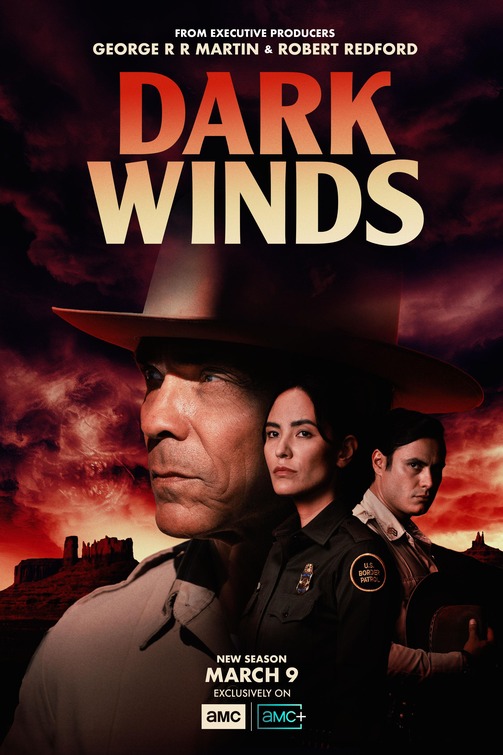

created by Graham Roland

The What 100: It's the early-mid 1970's and a bold armored car heist in Gallup, New Mexico has drawn the feds to the nearby Navajo reservation.  Lieutenant Joe Leaphorn of the Navajo Tribal Police is trying his best to investigate a murder where the only witness is a blind woman, but he doesn't have the resources. Enter the FBI, who give him a "you scratch my back..." offer if he will investigate the heist. The Feds plant a new deputy in the form of Jim Chee, who seems uncomfortable being out of the white man's world, but slowly finds connection he didn't know he was missing.  

(1 Great): Ever since season 2 of FX's Fargo, Zahn McClarnan has been an actor I'm always on the look out for, and just adore watching him perform. There are some actors who elevate any material they touch, some actors who don't know how to fail in a role. That's definitely McClarnan, and here as Joe Leaphorn, the center of the show, the question is how did it take so long for him to lead a series? (Answer: systemic racism, of course.)  He is the center of gravity upon which this show spins, and he's never seemed more comfortable, like he's been ready to be up front and in charge this whole time. We've seen him play dangerous, we've seen him play goofy, we've seen him play paternal, and here he's playing stoic, intelligent, observational, but with, so clearly, a deep wound inside him that he's pushing through every day. The scenes he has with Deanna Allison who plays Ellen Leaphorn, his wife, are a new take on the strained relationship of a cop and his domestic partner, one that has its own history and strains, but there's still a connective bond that refuses to separate them.

(1 Good): The tone of Dark Winds is integral to what makes it so special. It's a show that is proactively putting Native American culture and heritage as well as trials and tribulations specific to its community front and center. It's containing most of its show within the confines of the Navajo reservation, but the ugly influence of the white man's world - capitalistic greed, systemic oppression - it all is weight in the subtext, as the characters and community can sense it. But it's not a show that buries itself in weight,it's not a message show outright. It's still a detective procedural in its own way. In the sun-drenched New Mexican desert lands - often shot beautifully, and just as often shot with intensity - the subtext is just the sweat running down one's back.  

(1 Bad): This is really nitpicky. Some of the sequences feel under-baked, lacking vision, and so the edits or the framing might feel cheap or out of place in what seems to otherwise be a prestige drama. I'm curious to see if those awkward moments show up in the second or third seasons, or if it was just a matter of the crew learning as they go.

META: My expectations for Dark Winds were set, oddly enough, by an episode of Netflix's Unsolved Mysteries.  Season 3 featured an episode that put the spotlight on the rangers of the Navajo Nation, and the rangers who investigate paranormal activities reported by residents across the grand span of the land. If ever there were a new take on the X-Files that needed to be a series, this was definitely it. I thought Dark Winds would be, if not outright be a paranormal-only show, at least have a foot in the paranormal door, kind of like True Detective.  The interesting thing (and not actually disappointing) about the show is that it's never overt about anything metaphysical, but it's there, they acknowledge that there are aspects to life and culture that have unexplained origins, even if, at least in this season, there's nothing paranormal at all about the events. It's a very human drama.

---

created by Dario Scardapane, Matt Corman, Chris Ord

The What 100: Wilson Fisk is elected Mayor of New York City, because, hot take, all elected officials are criminals. He's instilled a ban on costumed vigilantes and assigned a task force of the NYPD's most unhinged and morally bankrupt officers to take down anyone who would dare do some masked crimefighting. Thankfully for Matt Murdock, he's already hung up his horns after the death of Foggy Nelson pushed him to the brink, and Karen Page left, unable to stand by and watch him self-destruct (again). But a series of event in Matt's professional lawyering life force him into doing more on the streets of Hell's Kitchen again, including taking on a mass murderer and paying Frank Castle a visit. Matt also dates a psychiatrist who also happens to be Fisk's marriage counsellor.

(1 Great): It is remarkable how much goodwill there is out there for Charlie Cox's Matt Murdock/Daredevil. He was in three wildly uneven seasons and one definitively not-great crossover series on Netflix in the mid 2010s, but nobody ever questioned how good Cox was in the role. And when Cox turned up in Spider-Man: No Way Home for a brief cameo, people lost their shit, and many cite his appearance in She-Hulk as the series highlight. So it really is just great to have Cox in the role back on the screen any time he wants to play it. It's a pretty comfortable glove for him and he wears it very, very well.

(1 Good): Born Again is not "Season 4" of the Netflix series, nor is it a reboot. It is a hybrid sequel that takes what it can of the past while seeding its characters and setting much more firmly into the MCU, and you know what? I liked it a lot. Fisk making a comment about Spider-Man, Matt getting invited over to Kamala Khan's house for dinner, callbacks to characters from Hawkeye... yes to all. Shared universes still make me giddy (maybe less so than they used to, but I can't help it).

(1 Bad): While I generally enjoyed Daredevil: Born Again it definitely does not hang together as a whole. It fails to find a thematic through-line to build its season around, even though it has so many options. Talking about corruption at the highest levels of government and the people who support them and how just punching and kicking will not take it down would be one theme it could explore. Another would be talking about police brutality and the injustice that takes place when the men in blue use their influence to protect even the worst of their kind. Another could have been just exploring trauma, both Fisk's post-near-death experience and Matt's grief over Foggy (and his fear of his own rage in response)... dating a psychiatrist should have yielded so much more. It winds up taking these elements and more and tossing them into a pot of soup such that no individual piece has its own flavour anymore.  The story arcs are ill-defined, which, in a way, gives it a very 1980's comic book feel, back when serialization was still kind of experimental, but it was somewhat unsatisfying as a week-to-week experience overall.

META: Born Again began life as a much longer project, it was intended to be Disney+ and Marvel's longest single-season series (it was to clock in at 18 episodes) and be more forthright a continuation/season 4 of the Netflix series, last seen in 2018. But around half-way through production, Marvel execs could see that either what they had wasn't working, or what they had wasn't working for the new direction they wanted to pivot to. And so the head writers/showrunners were let go, a new team brought on, new scenes and episodes filmed, and never is that patchwork more noticeable than in the first episode.  But it continues to be felt throughout the entire series where the total whiplash can really wreck your brain.

There's definitely more Daredevil to come, I just hope there's a better plan (and more actual Daredevil in costume) next time around. And I want to see Matt at the Khan's for dinner.

---


Friday, June 24, 2022

What I Have Been Watching (Kent Edition) - sitcomedies, sit

Toast's latest hat-on-a-hat-on-a-hat entry pulling more of our subfeatures together than ever before (or ever recommended) made me laugh but exposed that many of our subfeatures have a tendency of overlapping.  So I'm stripping out a lot of the other subtitles and just going with the What I Have Been Watching feature (which is a feature all about the admitted state of spending too much time in front of the TV.  There are too many streamers, too much content, and it drives me bonkers just even thinking about it anymore.  Here's some of what I saw in the comedy category in, let's say, the past year of television)

This is a grammatical nightmare.

In this edition:
The Kennedys (1 season, 2015) - amazon
Murderville (1 season, 2022) - Netflix
The After Party (Season 1, 2022)- AppleTV+
Grand Crew (Season 1, 2022) - Global/NBC
Reservation Dogs (Season 1, 2021) - d+/star
Our Flag Means Death (Season 1, 2022) - Crave
Mythic Quest (Season 1, 2020) - AppleTV+
Kids in the Hall: Death Comes To Town (1 season, 2010) - AmazonPrime (rewatch)
I Love That For You  (Season 1, 2022) - Showtime
----


The Kennedys
 seems to be a British take on, like, The Goldbergs or Fresh off the Boat or Everyone Hates Chris or Young Rock, a period-set sitcom that takes a look at a real person's amusing childhood experiences and family life, but, you know, turns them into sitcom fodder thus wearing away most of the autobiographical sensibilities that the show is premised upon.  In this case, it's actress and comedian Emma Kennedy telling tales about growing up in the late 70's in the Jessop Square subdivision.

Young Emma is played by Lucy Hutchinson who at about 12 years old has some pretty impeccable comedic timing.  As the series lead she's surprisingly capable and naturalistic.  She doesn't feel like she's acting or putting on a performance and she convincingly feels of the era, talking about Star Wars and whatnot.  Her mother,  Brenda (played by the IT Crowd's Katherine Parkinson) is the show's powerhouse, though.  A rampant feminist but still unaware of her own trappings in the patriarchy, she's defiant to a fault of her role as mother and homemaker.  She's a boldly entertaining character, both for her lack of hubris, but also not lacking in love or kindness.  Patriarch Tony Kennedy (played by Dan Skinner) is kind of an oblivious lunk, never quite sure what anyone is saying to him or why.  Not stupid, just not always present in the moment.  The family is best friends with the unwed couple Tim (Toast of London's Harry Peacock) and Jenny (Emma Pierson), the former a womanizing drunk, the latter a preening mess of a woman, unsure of what she wants out of life.  

Most of the episodes take place within the neighbourhood and over its six episodes starts to build up familiarity with its surroundings for the audience.  The comedy is multifaceted and quick, with a lot of wordplay, as well as utilizing the sort of late-70s naivety as a hindsight joke machine, and then a whole bunch of non-sequitur side-swipes, which seem to be the fashion of this nostalgiac subgenre of sitcom.

I was shocked to see that there were only 6 episodes in this series.  It's quite funny, well-produced, and exceptionally well acted with recognizable faces.  It's not innovating anything but it's rocksolid in what it's trying to do, and that's usually good for two or three seasons, at least in British terms.

---


I don't want to talk about Netflix as an entity.  It's too complicated for this space.  But lets just say they've spent a lot of money trying stuff, most of which is forgettable and didn't work.  The odd thing is transcendant.  Murderville is somewhere in the middle.

It's a fully plotted, largely improvised comedy about a bumbling homicide detective who keeps getting a new partner each week and has a murder mystery to solve.  The partner is a real world celebrity (in this case Conan O'Brien, Marshawn Lynch, Kumail Nanjiani, Annie Murphy, Sharon Stone and Ken Jeong fill the role), playing themself, coming in cold to the situation and having to act along.   The episodes that pop are the ones in which the performers are actively playing along, versus the performers who are lost, sitting back, and just watching things happening around them.

Leading them along the way is Will Arnett as Terry Seattle, who is in the midst of a divorce with his precinct Chief (Haneefah Wood) and is, most apparently, living out of his office.  Seattle drives a pristine looking El Camino (so awesome) which seems to be the only light in his life.  He still mourns the loss of his partner (who is only ever seen in a photo hanging on the wall as Jennifer Aniston) 15 years ago, and puts his grief and anxiety upon the unsuspecting rookie.

Surprisingly the show, for all its improvisational set-up, has an arc.  It's not necessarily a thoroughly satisfying arc but it's surprising that they even attempted it within the format.  It's an enjoyable show, with even the lesser episodes still providing some good laughs within.  It's certainly strange, and unlike anything I've seen done before, but I could see some refinement of the formula into something that's consistently great fun.

---


The one series I was most looking forward to on AppleTV+ when I started the service this year was The After Party.  It's the brainchild of Christopher Miller, one half of the great Lord and Miller comedy directing/producing team known for their ability to exploit genre tropes adeptly and shrewdly for maximum entertainment value (see Clone High, Cloudy with a Chance of Meatballs, the Jump Street movies, The Lego Movie).  

This series I was hoping would be the next great one, a murder mystery in which each episode takes a look at one of the accused but from a different genre standpoint.  It sounded fantastic, and the cast, featuring some of the most underhyped comedic talent going (Sam Richardson, Ilana Glazer, Ben Schwartz, Ike Barinholtz, John Early) all held down by Tiffany Haddish's under-the-gun detective.   The crux is superstar Xavier (Dave Franco) is murdered in his own home during the afterparty following a high school reunion.

Well, I mean, I liked the series, quite a bit.  I enjoyed tremendously the performers, and I liked the characters, and I enjoyed the murder mystery angle certainly enough to eagerly come back from week-to-week, but my expectations of the genre-busting Miller were not quite lived up to.  True, each episode did focus on a different suspect, and leaned towards a specific genre/subgenre/storytype (like a Fast & Furious Movie, highschool drama, musical, animated comedy, psychological thriller) but the realities of trying to uphold a single story through these different genres meant the genres couldn't be exploited to their full potential.  So the show, while fully entertaining, doesn't hit that next level I had hoped for.

Season 2 is in the works.  I'll be there.
---


You can't really rely upon network television to deliver anything innovative or surprising.  They are hanging on for dear life in this era of the streaming wars, and know that their key to survival is reality competition shows and programming that appeals almost exclusively to the Boomers, doling out of-the-week dramas in every possible high-stakes professional situation.  At this stage network comedies are life support, and even the mighty Chuck Lorre's laugh track adherence is failing to save them.

So when something like Grand Crew sneaks out quietly, and just as quitely maintains a consistent tone of hilarity and fun, well, it's always a shock.  Brooklyn Nine-Nine was the last great network comedy, and Grand Crew has the potential to be the next.  It's a dead simple premise, a group of Black friends hang out at a wine bar when not living their lives.  It's basically a modernisation of Cheers and Friends  but a lot less dependent on that single situational environment.  It's also thoroughly a Black-led and run show, from creator Phil Augusta Jackson, but it's also inherently accessible as any network comedy should be.  It's a Black-centric show, thus many jokes are very specific references to of Black culture, and I'm a middle-aged white guy so I may not catch all these references, aptly so, but being hyper-specific in comedy is always the correct way to go.  When I do get the references (which is more often than not), they are gold, so I can only imagine how good the deep cut ones I'm not getting are.  But the general sensibility of the show's humour is straight-up character silliness, like Brooklyn Nine-Nine or Happy Endings.  It really leans into the characters goofball traits, and their unique personas for the majority of the humour, and it's great.

The cast is tremendous.  Echo Kellum (Arrow) is the lead of the ensemble, a flitty, hopeless romantic who just broke up with his girlfriend and is learning to live without love for a while, despite his impulses.  His sister Nikki is played by Nicole Byer, a hypersexual alpha who's also a realtor.  Carl Tart plays the perpetually unemployed, always calculating, boisterous Sherm while his roommate Aaron (Anthony Jennings) is the buttoned-down professional accountant who has to be the responsible yin to Sherm's yang. Then there's married friend Wyatt (Justin Cunningham) who is a stay-at-home husband (and still uncertain how he feels about it).  They make a new friend who works at the wine bar in Fay (Gracie Mercedes), who is relatively new to L.A. but still uncertain about her place there.

This is very much an episodic show, with only a little bit of character and/or relationship development happening from episode to episode.  They're a tremendously fun crew, some might say "grand".  Even when the show tackles the impact of yet another tragic murder-by-police shooting of a black youth, they still manage to find some levity within the resonance without dipping into "very special episode" terrain.  A second season is on its way, thankfully.  The current 10 episodes just isn't enough.  Grand needs a nice long life.

---


Reservation Dogs
 is a comedy in the vein of vanity projects like Atlanta, Master of None, or [edited...let's not go with that suggestion, apt as it was].  Normally "vanity project" has a negative connotation, but for creative performers like Donald Glover, Aziz Ansari and [redacted] their vanity projects give them a chance to hone and showcase all of their skills, including writing and directing, as well as delve deeper into more thoughtful exploration of subjects that aren't explored elsewhere, and certainly not with their point of view.  These projects take on their own rhythm, their own style, even though they're of a type together, they feel the impact of their creators' visions in letting creativity be the star.  Episodes tend to feel more like mini-movies than serialized television.

With the support of producer Taika Waititi, Reservation Dogs was given life at FX from director and sketch comedian Sterlin Harjo, but unlike many a vanity project, Harjo remains off camera and uses the platform as an showcase for Native American performers, writers and more (both Ansari and Glover, though, it should be noted, use their platforms to elevate others too, but the talk of those shows is still centers so much around them).

The show is a comedy (but also has some weight behind it) about life on an Oklahoma reservation, following the "Reservation Dogs" crew, four teenage friends who steal shit to make money for a good cause, getting the fuck off the reservation and going to California.  They recently lost one of their crew to suicide, and the loss haunts them each in different, sobering ways. Things get further complicated when the NDN Mafia, a rival quartet of teens arrives on the scene and start taking shots at them.  What could have been a very straightforward series based off the setup quickly reveals itself within its first three episodes as something much more contemplative than that.

The episodes all vary in tone and subject matter and even who is starring in them, but they're all amazing, exploring so many different facets of res life, Native heritage and culture.  While there are some amazing guest stars (Gary Farmer, Zahn McClarnon, Jon Proudstar, and Kaniehtiio Horn among may) throughout the season, the stars are the four young members of the Dogs.  Devery Jacobs is Elora, the de facto leader of the crew, and the one who maybe feels the most outwardly motivated to leave the res.  Her spotlight episode finds her attempting yet again to get her drivers license only to get embroiled in her instructor's whole side deal.  Bear is played by D'Pharaoh Woon-A-Tai, an awkward young man who needs the gang to bolster his sense of confidence and masculinity (but he also has a bold but equally awkward spirit guide, hilariously played by Dallas Goldtooth).  Bear's spotlight episode finds his estranged father, a successful rapper, returning to the res for a charity event, and Bear's mom tries to brace him for disappointment, but he starts spending the California money to try and look a big shot for his dad which raises tensions with Elora.  Willie Jack, played by Paulina Alexis, is tough-talking and hard-as-nails but is very connected with her family and was hit hard by her cousin's Daniel's suicide.  Her spotlight episode finds her going hunting with her father, but flashing back to memories of hunting trips with Daniel, and it's a very emotional journey that explores the problems of depression on the res, and the lasting impacts they have.  The final member of the crew is the youngest, Cheese (Lane Factor).  Quiet and laid back, he gets on with everyone and just kinda of seems to tag along with the dogs with no personal agenda.  Cheese's spotlight episode is actually more a spotlight for McClarnon's Officer Big and a showcase for the town as he has the young man as his ride-along partner for the episode.  

As many shows have keyed into over the past decade, you get a lot of mileage out of building out the population of your environment.  What used to only be seen as a thing in prime time animation (The Simpsons primarily) has now become a staple for all the great network comedies in recent years, and the same occurs here, with the res feeling full of interesting and fun people.  

It's a fantastic series. 

---


While Waititi only served as producer (and co-writer on the pilot) for Reservation Dogs -- thus his influence is limited -- Our Flag Means Death is a Waititi production through and through, catering much more to the comedic writer/director/performer's goofier sensibilities.  Here he has developed a semi-epic, 1700s-set, pirate comedy that kicks off with a soft, upper crust man abandoning his family for a life of skullduggery on the high seas.  It is a life for which he is ill-equipped, using his money to buy his ship and hire a crew of largely inexperienced scalliwags.

Taking to the seas, Stede Bonnett (Rhys Darby) and his ensemble pretty much immediately are boarded by the Royal Navy, led by an acquaintance from Stede's aristocratic past. Stede kills him accidentally, but it's unknown to the crew, and he earns at least a little of the respect that was missing from his men.  Stede's general management style and general world outlook could be considered progressive (adopting a lot of current managerial philosophies) but this all seems counterintuitive to a pirate crew, and the general amount of high seas piracy, kidnapping and murder is kept pretty much to a minimum.  Things like forced vacation days, a flag-making competition and a talent pageant, not to mention bedtime storytime (in which Stede reads the crew a story) all seem kind of...soft...for the lifestyle.  Stede gets nicknamed The Gentleman Pirate, which isn't meant as a compliment, despite how he takes it.

Things get more complicated when the Revenge encounters Blackbeard's ship.  The crew is direly intimidated by the men of Blackbeard's crew, and of course, of Blackbeard himself (Waititi performs the role).  A strange turnabout happens, however, when Blackbeard takes a shining to Stede's erudite lifestyle, moreover he wishes to escape the pirate's life and live a more humble existence in the world of high society. Stede offers to teach him about high society in exchange for lessons in piracy.  A deep kinship is borne, much to the dismay of Blackbeard's grizzled right hand, Izzy Hands (Con O'Neill).  Izzy conspires against the pairing only to his own detriment, as the rest of Blackbeard's crew start to glom onto Stede's way of leadership.  Of course, the Royal Navy is pursuing Stede with ruthless abandon, and things come to a glorious head in the final three episodes after threatening an amusing status quo.

This is, on top of it all, a large ensemble piece, which includes Ewen Bremner (Trainspotting), Samson Kayo (Truth Seekers), Vico Oritz, Christian Nairn (Hodor from Game of Thrones), Nat Faxon, and many more, with guest appearances from Rory Kinnear, Leslie Jones, Fred Armisen, Claudia O'Doherty, Kristen Schaal, Nick Kroll, Kristen Johnson and Will Arnett among others.

The crux of the series, though, comes down tot he different ways people express love to each other, and particularly the relationships between men and how they show affection for one another, whether it's platonic, idolisation, as brothers-in-arms, or as lovers.  It's not dissecting these with any great zeal, but it seems that love, and how people care for each other, is the great unifier of most of these episodes.

I don't have a great affinity for pirates, but Waititi's style, as upheld by his writing staff and his remarkably unique cast of performers, helps the adventure of it all go down smoothly.  It's kind of telling that the bits that take place on land (like at Spanish Jackie's pub or Stede and Blackbeard imprisoned at the Royal Privateering Academy) were my favourite parts of the series, thought he finale where Stede returns home to his family was easily the best episode for its wildly unexpected twists.

---


After basically writing it off after its initial announcement as another dumb workplace comedy on a topic I have little investment in (MMORPGs), it took all of one episode for AppleTV's Mythic Quest to hook me in.  It's a damn funny show.

From Always Sunny in Philadelphia creatives Charlie Day and Rob McElhenney with Megan Ganz (writer on Community, Always Sunny, Modern Family), and starring McElhenney as the self-aggrandizing creative head of the Mythic Quest Massive Multi-player Online Role-Playing Game, I was expecting a tepid retread of The Office but with more nerd shit.  

I'm not a devoted follower of Always Sunny but from what I've seen of the show (a couple dozen random episodes) I shouldn't have been surprised at how whip-smart Mythic Quest is, and how it knows how to present an egomaniac as a fool (Always Sunny is basically a show about watching a crew of sociopaths get their come-uppance episode after episode).  What's also most immediately surprising is how tailored the show is as an ensemble piece and not a solo showcase for McElhenney.   Even as the creative head of Mythic Quest, his Ian (pronouced, annoyingly, "eye-ann") is still not the top dog.  He has (unseen) corporate overlords that he has to appease, an ineffective middleman to patronize in stammering beta David (David Hornsby), and he of course needs the support of his hyper awkward development lead Poppy (a transcendent Charlotte Nicdao).  Then there's the borderline psychopathic head of monetization, Brad (always great to see Dany Pudi), David's full-on psychopathic assistant Jo (Jessie Ennis),  the head writer, legendary 70's award-winning, over-the-hill sci-fi novelist C.W. Longbottom (F. Murray Abraham doing great work...at least on camera), and repping hard for the female gamers, game testers Rachel (Ashly Burch) and Dana (Imani Hakim).

The show quickly eases into its status quo.  It finds its groove rapidly in its first two episodes, and it feels like it's going to have a nice long life of great nerdy jokes (with a full understanding of the world it's operating in), great character conflicts, and gentle world building (its game, the economy and society that surrounds it, and the meta world around Mythic Quest as a company and property).   But by episode t it rapidly upends any expectation of what it should be.

Episode 5 is a full detour in the life of a female game developer and her relationship with her boyfriend-turned-business partner-turned-husband.  The episode is a mini-movie spanning three decades, starring Cristin Milioti (Palm Springs) and Jake Johnson (Stumptown) as the lead couple in this romantic comdey-drama that really takes you through a tour of the highs and lows of video game celebrity and evolution.  It has an impact on the world of Mythic Quest but in a way that is not immediately apparent, and takes some time to reveal its ultimate point within the show.  It's a special thing, though.

Following that episode, Mythic Quest emboldens itself to actually embrace some dramatic storytelling within its otherwise riotous framework.  There's a gutpunch of an episode that introduces Ian's son, and a COVID special that stands as one of the best snapshots of what the first wave lockdown really felt like.  

There's something tremendously special about Mythic Quest, as such I haven't binged it like I normally would a series I enjoy this much... I savour its episodes, and they root down in me with the time that I give them to breathe.
--- 


Amidst the new Kids in the Hall series appearing on Amazon and my ongoing rewatch of the original series (plus the recent acquisition of Brain Candy on blu-ray) I thought it time to revisit the Kids' 2010 serialized mini-series Death Comes to Town.

I caught a few episodes of the series as it aired originally but its scheduling on CBC was a mess as it was interrupted by the Winter Olympics, and I had to purchase the series on Apple in order to watch the rest.  I don't recall loving the series and had little desire over the past dozen years to revisit it.  But with time comes fading memory so I was going into the series with near-fresh eyes.

And a rapid 175-minutes later, I did not come out with triumphant adoration for the series.  It does not feel unfamiliar to Kids in the Hall (more akin to the tone of Brain Candy than sketch comedy), but at the same time it lacks a specific drive.  It's effectively a murder-mystery, but it's a murder-mystery that's kind of disinterested in the fact that it's a murder-mystery.  It really wants to build characters and build a character out of the town of Shuckton, but with the death of its mayor (who everyone seems to idolize) in the first episode, Shuckton loses the one thing that really seems to define it.  As much as the series wants to build characters, it has a much harder time with building relationships between the characters.  Sure, it finds connective ties for the characters to share with each other, mostly as comedy, but few of the characters have any real, defining traits to their relationship with other characters beyond forgetful delivery lady Marnie (Kevin McDonald) and disgraced hockey wonderkid Ricky Jarvis (Bruce McCulloch), now obese and housebound.

Scott Thompson takes the ill-advised role of Crim Hollingsworth, adopting a Native Canadian patois, and adorning himself in style and symbology of, supposedly, Ojibwe culture, of which Crim puports to be 1/16th heritage.  I'm not sure why Thompson, of all the kids, tends to be the one in brownface all the time, but there's a trend.  It's an uncomfortable pattern.  While it's not necessarily mocking any culture, and there is the sense of trying to develop a character, it never seems the right thing to do, particularly inexcusable for 2010.  Likewise the amount of fat jokes and sight gags about Ricky Jarvis seem like they should have ended with Fat Bastard in Austin Powers.  And then there's the weird references to trans people, in a way that seems to be meant to be inclusive, but is edited with comedic timing to be a punchline.  This stuff has aged poorly and in much faster time than most KitH sketches.

There's plenty of silliness and a lot of conceptual comedy within Death Comes to Town but it does tend to be overshadowed by the sheer lack of laugh-out-loud comedy within.  Besides their post-Brain Candy
disbanding, this is a real low point for the troupe.  Not embarrassingly bad, but certainly not meeting up to expectations (even when they're low).
---


And if this wasn't a long enough post already, we ploughed through I Love That For You with reckless abandon.  I didn't want to.  I put it off for some time.  I mean, I liked Vanessa Bayer as an SNL cast member and have enjoyed her in her cameos in other things like Barb and Star Go To Vista Del Mar and Brooklyn Nine-Nine, but the setup for this series felt just...too...cringey for me to want to sit through.

Created by Bayer (and Jeremy Beiler), the story of I Love That For You finds Bayer as Joanna Gold, a lifelong fan of the SVC home shopping network.  She would watch religiously as a child while going through chemotherapy for leukaemia, and as a remarkably awkward adult, she seems her most comfortable and confident selling people seemingly worthless things.  She's always had a manipulative streak in her, but it's not malicious so much as a coping mechanism for her trauma.  She finally gets her shot at an open casting call for SVC and absolutely nails the audition.  She's elated to find she's gotten the job, only to blow it on her first on-air showcase.  As she's getting fired she blurts out that she has cancer, and there are dollarsigns in  network owner Patricia's eyes.  Joanna is suddely the new "it-girl" at the network, to the delight of some, like her idol Jackie (Molly Shannon) and to the chagrin of others she's displacing, like the preening, self-obsessed Beth Ann (Ayden Mayeri).

The show then has to deal with Joanna going deeper and deeper into her lie, and what should be unbearably cringe is somehow, in Bayer's hands, nearly effortlessly watchable and just straight up amusing.  Bayer has always been fantastic at being uncomfortably awkward in her performance without being cringe about it.  She does this by way of acknowledging she's aware of her own awkwardness, and Bayers one of the few people who can do this with just a look, but she's also equally clever at delivering lines that highlight how aware she is of her own social ineptitude.  Even within the show, this winds up endearing Joanna to her colleagues more than alienating her, but it never lets her off the hook for her lying, and she knows she's not capable of keeping it up forever.  It's more of an "I'm in too deep, and I don't know how to get out" kind of situation.

I enjoyed the show, even though I found the whole cancer-ploy of Joanna really held the show back from being a proper workplace sitcom.  It's a time bomb just waiting to go off, and so you can't ever rest or rely upon the dynamics as they're set up.  When the bomb goes off in the penultimate episode you have to wonder how the show could possibly set up a second season given what the fallout *should* be.  Yet, it does its thing, and finds a way, and things are perhaps more awkward for Joanna than ever as the season closes out.

The show struggles with it's shopping network within the show.  It doesn't know whether it should be lampooning hope shopping channels and the products they sell, or if it should be earnestly presenting something possible, something real.  It often wavers between the two in a gentle fashion, and it never feels comfortable.  When the hosts start being goofy or unprofessional on camera (and they all do it), it really diminishes what Joanna initially got fired for and thus betrays the whole crux of this first season.  At the same time, when the sales pitches are completely po-faced, it's not very engaging and I want them to move faster through those parts.

There's a solid supporting cast, topped by Jennifer Lewis as the no-nonsense Patricia is credibly intimidating but gets the best through-line in the show, and Punam Patel as show producer Beena develops into a complete scene stealer with both her micro- and macro-agressions (and her beautiful Bernese Mountain Dog who's always at her side).

It was a pleasant surprise of pleasantness, especially give to how easily it could have been full-bore cringe.
 

Saturday, April 1, 2023

1-1-1's - Another One (plus)

"Another One" is quick thoughts on subsequent seasons of things I've already watched/reviewed on the blog.  I'm going to reread (and link to) my review(s) of previous seasons and see what, if anything, different I have to say about them in comparison....

---

For All Mankind Season 2 & Season 3 - AppleTV+
[season 1]


The What 100:
 As this alternate reality view of the space race continues we venture into the 80s, where a moon base has been established, and then the '90's, where the Cold War has reached the Red Planet, but it's not just USA and Russia out there, a third-party capitalist has thrown into the race.

1 Great - in the second season, shit goes down on the moon. It's really freaking intense. In the third season, there's three ships racing towards Mars, and, well, things don't go well as the contention to be "first" sees the crews pushing their vessels to their limits (or beyond).  There's some incredible space-based (and space base) tension.

1 Good - The unexpected shake-ups that the show gets into are really what make it worthwhile. It's not a completely predictable show, which makes the tension very palpable. Being an astronaut (or in the proximity of an astronaut) is just a dangerous existence, and it's good to be reminded of it.  When you're accelerating as quickly through time as this show is, the characters can't be held so preciously. It did feel like a few characters were being cycled back into rotation a little unbelievably at times, but there's still dramatic narrative to service.

1 Bad - I still think the decade leaps from season to season really, really help keep the show cracking along from season-to-season, but that still didn't eliminate the core problem of the show, being its hefty cast (it rival Game of Thrones for the amount of players on the board), which it largely keeps around from season-to-season. The finale of season 2 cleared a few players of the board, and season 3 a whole bunch more, but given there's been a nearly 40 year time-span, it's hard to buy that some of these characters are still around in the capacity they are.  As such it gets a little lost in its narrative thrust as it spins wheels circling around character drama, particularly in the second season (oh, and those Stevens boys in Season 3...gah!)

META:
There's a particular hump to get over in season 2, where the melodrama gets slathered on way too thick, and we had to take a good long break and psych ourselves up for a return partway through our bingeing of the series. But the latter third of season 2 crackles with tension, like everything is ready to fall apart any second (and it does).  The third season is much more pulpy, and the better for it. The melodrama still persists, but it never overshadows the narrative's desire to keep moving forward at a rapid clip.  Very enjoyable.

---
Mythic Quest Season 3 - AppleTV+
[season 1| season 2]


The Plot 100
: Ian and Poppy's new business is failing to materialize, and their friendship is suffering for it. David, now in full control of MQ, is a see-saw of power-mad and ineffectually anxious. Rachel takes on a new role, Dana takes on a new role, Brad takes on a new role, Carol takes on a new role, and Jo keeps redefining what her role is.  CW dies.

1 Great - Every season of MQ has their 1-off episode which is essentially a short film that don't really feature any of the regular cast. Here it's a step back into Ian's difficult childhood with an adoring but manic-depressive mother, and Poppy's childhood where she has to negotiate the push-pull of a strict mother and a fun-loving dad.  Each of these 1-offs are absolutely fantastic, stepping outside of the sitcom setting and getting some resonant emotional backstory for these otherwise comedic character (season 1 was sort of a backdrop for the workplace, while season 2 gave us CW's backstory).

1 Good - What has worked for the past two seasons, more than anything, is the fraught relationship between Poppy and Ian, as the linear-thinking coder and the free-thinking mastermind obviously put them at odds but also are necessarily complimentary in their endeavours. It's only after the 1-off episode that we get a sense of just how long these two have been working together, and how long it's taken for their professional animosity to be recognized as mutual admiration.  Whenever the show gets to the heart of Ian and Poppy caring for each other utterly platonically, I melt. 

1 Bad - There was something behind F Murray Abraham's departure from Season 3 of Mythic Quest and I don't know what it was. At this stage nothing has come out that would "cancel" Abraham (he's been involved with high profile Moon Knight, White Lotus and Cabinet of Curiosities since his departure) but even though CW has always been a sporadic presence, the show is not the same without him.

META:
But then again, the show is not the same as it had been in season 1 or season 2.  The second season, wading through the pandemic, sort brought a cohesion to the cast, tightening them up as a unit, and really making it a workplace comedy. It blew it up at the end, having Ian and Poppy leave to do their own thing, and really everyone left doing their own thing, from Rachel and Dana going to college (maybe) to Brad going to jail. Everyone's kind of apart or coupled up this season, and not in organic or often complimentary ways. It doesn't work like it once did, so hoping reuniting Poppy and Ian on the MQ floor will help rekindle the spark.

---
Slow Horses Season 2 - AppleTV+
[Season 1]


The Plot 100
: Another season, another book to adapt. Dead Lions. In this one, one of Lamb's old associates is murdered, and fingers a Russian espionage group long thought gone, or never having existed in the first place. The Cold War has been over for 30 years, but some refuse to let it go. River gets sent to rural town in the middle of buttfucknowhere undercover, and totally Slow Horses the gig up. Louisa and the new bloke need to arrange security for a meeting Spider sets up with a Russian power player. Catherine and Roddy try to prove their worth in other ways.

1-1-1
1 Great
: I mean, you can't not say Gary Oldman, right. The man seemingly gets consumed by the roles he plays, and Jackson Lamb is, I'm sure, nothing like Oldman. Crude, rude, and devilishly cunning, he's not like the others, demoted to Slough House because of some massive failure or faux pas...no, he chooses to head up Slough House because it pretty much keeps eyes off of him and he can do his own thing.  As much as he outwardly projects his indifference (the gentlest word for how he treats them) towards his people, it's clear from a sky-level view that he is fiercely loyal to them and feels they're his responsibility (far more than anyone would expect he should).  The main plot here kicks off because an old, retired colleague is murdered and, more than unfurling whatever plot is in play, Lamb wants at the very least justice, if not revenge. And he didn't even particularly like the guy.

1 Good: The twists in these stories are right solid, and unpredictable. This is spy-thriller that has burned the handbook before even reading it. It's got its own flavour (I mean, it's missions put in the hands of proven fuck-ups, so, y'know, they're bound to fuck up...James Bond they are not) and its own wry sensibility. After season 2, the biggest signal is that there seem to be no sacred trees here, anyone could be cut down. Lamb and River Cartwright may be the series leads, but I wouldn't be surprised if either one were killed.

1 Bad: It's not James Bond, so the action does tend to peter out rather than accelerate. In its unpredictability it likes to twist its action scenes (I wonder if it's fully following the novels or if it is just budget) and they can be a little raw and clunky (and perhaps a tad unsatisfying) as a result.  It's a minor quibble, to be sure, for what is otherwise a great series.

META:
There are currently eight Slough House novels and five novellas by creator Mick Garron, as well as four novels in the same world but operating outside the sequential frame of the other books in the series. There's a lot of material to mine here, and it would be wonderful if each book were adapted in the six-episode mini-series format, but if the novellas were perhaps adapted into a single or double episode length.  There's committed at least 2 more seasons, so the horses aren't slowing down any time soon.  We'll be getting Mick Jagger's awesome ORIGINAL(!) theme to the show for a while longer.

---

Reservation Dogs Season 2 - Disney+/Star
[Season 1]


The Plot 100
: Elora and Jackie have left the rez for California, but find themselves in trouble. Bear is pissed Elora left him behind, and starts looking for a job. Cheese's uncle gets raided and Cheese gets tossed in foster care. Willie Jack isn't so keen on Jackie and puts a curse on her, only to regret it. Everyone gathers in a vigil for Elora's grandma after which the aunties go to a conference and party. Big accidentally ingests drugs on duty and cracks the case of the missing catfish with help from Kenny Boy. 

1 Great: The unexpected. Each episode of Reservation Dogs is a short film all on its own. While some of the character stories may continue throughout the season, the main story of each episode is self contained, and you can never quite tell where it's going to go. It's a style of storytelling that worked very, very well for Atlanta across 4 season but I dare say Reservation Dogs has maybe figured it out even better.  Where Altanta would often have fully disconnected short films, often detached from known reality into semi-Black Mirror territory, here it's always in-world, always following the cast (though not always the main cast). In both cases, there's healthy doses of "magical realism" liberally sprinkled throughtout to add a whole other flavour level to the show, be it metaphorical, dramatic, or comedic.  

1 Good: Performances. Most of the most prominent Indigenous actors in North America are making appearances in this show, and not just fluffy cameos, but great spotlight roles.  Gary Farmer (as Uncle Brownie) and Wes Study (as Bucky) get a spotlight rivalry in the second episode which is one of the funniest things I've seen in years, especially their rendition of Tom Petty's Free Fallin' (which then gets a beautiful callback in the final episode). Kaniehtiio Horn from Letterkenny and Jana Schmieding from Rutherford Falls (rip) return, Prey's Amber Midthunder comes in for an ep to coach the kids on connecting to one another, and Tamara Podemski has a powerful role as Elora's aunt who has been estranged from the Rez for some time.  The list just goes on and on, with familiar and new faces and all the young performers who are all so fantastic. Creator Sterlin Harjo also taps into his comedy background, bringing in non-Indigenous comedic performers like Bobby Lee, Megan Mullaley, and Marc Maron.  

1 Bad: Not enough. This is a show with a massive roster of players, and, as this season has proven, there are stories to be told with each of them. Ten episodes, an improvement over Season one's eight, is still not enough.  The show's creative team makes the absolute best with every minute they do have, to be absolutely sure, but I still want more. I want to see an episode with Mose and Mekko in the spotlight, or go full magical realism into what spirit guide William Knifeman does in his off time (does he live in that gas station convenience store machine, dispensing shaky wisdom?)

META:
This is in the top ten, probably even top five best shows on TV right now. I'm not sure why I sat on it for 8 months...but hopefully the good news is it means a shorter wait until Season 3...?  I have a hard time picking a favourite episode of the season... I was about to settle in on Big and Kenny Boy's drug trip misadventures, but then I feel like Cheese's time in the group home was pretty wonderful in how that character affected those around him positively, but also the Elora's grandmother's vigil was just powerful and beautiful... and I could make a case for almost any episode here. 

The second episode really fucked up my brain a bit. Elora and Jackie's misadventures become pretty dire as they're chased by gun-toting rednecks in a truck after a half-hearted attempt to steal a car. They've lost everything on their trip, they're starving and things look bleak. They happen upon a homestead whose recently separated, lonely matriarch (Mullaley) takes them in. A white saviour. But from moment they step foot in the house the temptation of the keys to her truck is put before them. She lets them shower, gives them fresh clothes, feeds them, preys with them, and gives them rooms to sleep in, asking nothing from them.  She expresses her admiration for both of them, their freedom and liberty (hard to feel so free and liberated given their highway misadventures as young Indigenous women).  In the middle of the night Jackie steals the truck and Elora tags along.  As a white person I wrestled with this... I mean the show's sympathies are always with the girls, and not for anything, stealing the truck is their only move, and it's a justified one.  But then I think "but isn't that just playing into expectations, or even stereotype?" and I wrestle with the question. What made even more complicated is Mullaley, awake and at the window, uttering "Those little sluts" in a manner that could be construed as anger but possibly even envy.  Jackie later states she doesn't feel bad for stealing the truck, she doesn't really feel bad about anything (visiting Jackie's mom, we see why she's so detached), but also notes that "that lady seemed happy. Big ass house in the middle of nowhere, no one else around, talks to God and shit, I'd take that any day"... and it provides a sense of perspective. Mullaley's character seemed kind and well-off, but miserable, and lonely. It speaks certainly to Jackie's lack of understanding of happiness. I'm still unpacking it, with no solid conclusions. Fantastic TV.

---

The History of the World Pt II - Disney+/Star


The what 100
: Mel Brooks' classic sketch comedy anthology on the history of the world returns as an 8-episode TV series, but led by the creative team of Nick Kroll, Ike Barinholtz and Wanda Sykes.

1-1-1
1 Great: About 10 years ago a sketch comedy show debuted that viscerally chewed upon the absurdity of reality TV. It was called Kroll Show and it was created by and starred versatile comedic performer Nick Kroll. It wasn't just funny, it was brilliant. It really toyed with the media landscape of 2013, and in a smarter society, would have been the last word on TV shows about anyone shameless enough to dramatize their real lives for television. The formula was sketch, but it wasn't one-and-done sketch, it was repeating sketch, with storylines built over the three seasons as the sketches would intermittently appear, often reaching new levels of absurdity and hilarity in the process. The History of the World Pt II isn't nearly as sharp or daring as Kroll Show, but the sensibilities are definitely shared. What could have been eight episodes of one-off sketches twisting historic characters or moments into a modern context, instead follows much of the Kroll Show model of building character and story arcs across the episodes, while also allowing for one-off silly sketches to sneak in. Also like Kroll Show, it's simultaneously being ridiculous while also casting its gaze on the modern media landscape, as it has the exiled Russian tsarina Anastasia running a 1910's sepia-toned version of a TikTok live stream, while Rasputin (played by Johnny Knoxville) participates in Jackass-style extreme stunts (but with a not to Rasputin's mythos) in a series called "Jackrasp". There's ongoing tales about the Russian revolution and the Civil War, that all serve up delights and surprises by building characters that are meant for more than a single sketch.

1 Good: My favourite ongoing sketch would have to be "Shirley", a 70's Black sitcom pastiche starring Sykes as the first Black congresswoman Shirley Chrisholm, who also ran for president in the mid-70's. The visual flavour as well as the comedy stylings are bang-on of the era, even bringing Marla Gibbs in as Shirley's mothers. The apex of the "Shirley" is the "episode" where Shirley is having to run between two very different Watergate rooms as she tries to secure support for her election. One room is a feminist assembly led by Gloria Steinem, the other a Black caucus led by Jesse Jackson, all while keeping her husband contained to the hotel room.  It's classic madcap 70's sitcom hijinks and it's executed perfectly. It's not even ironic, it's post-ironic. It knows exactly what it's doing, and it's doing it lovingly. When I thought it was just a one-off sketch I thought it was pretty lacking, but it builds beautifully over time.  

1 Bad: In any sketch anthology, you're going to get a few weak-tea efforts, ones where the jokes are too easy, or the performances just don't succeed.  There are those here (the cavewomen discovering fire, or the Alexander Graham Bell crank phone call bit that goes on too long, but thankfully the rest of the show is amusing enough to offset the not great entries. Thankfully all the ongoing sketches are really fun, and at times, really sharp ("Curb Your Judaism" was brilliant).

META:
I am not a Mel Brooks guy. Never have been. His humour is too obvious for my liking. He tends to take the joke that most could see just sitting there and he makes a massive meal out of it. He's also fond of over-the-top silly...and I like silly, but over the top silly, most slapstick, just doesn't strike me as funny. So I had no interest in HotWpt2, because I haven't even seen HotWpt1, nor do I really care to.  But upon hearing that Kroll, Barinholtz and Sykes were leading it, not Brooks, I saw the potential.  They're definitely trying to lean into Brooks' style, but it's still flavoured heavily with their comedic senses (which I much more receptive to).  Good fun.

---

Star Wars: The Bad Batch season 2 - Disney+
[Season 1]


The Plot 100
: The Bad Batch continue doing jobs for a small-time crime maven named Syd, but they tire of the risks, the low reward, and the lifestyle. Opportunity presents itself for the crew to escape and just live, but once they start catching wind that the Imperials are kidnapping and experimenting upon Clones, they start to think that maybe they have a larger mission before retirement.

1 Great: Honestly, the best part of Bad Batch is Kevin Kiner's music. He's been getting more and more experimental with his Star Wars scores in recent years and I love hearing what he's come up with. He's dealing with a lot more synths and tones rather than Williams-esque orchestral, angling more towards Blade Runner's Vangelis-composed score.  As the Empire continues its dystopian spread across the galaxy, these sounds are more ominous and weighty, accompanying well the brutalist architecture starting to prevail.

1 Good: After threatening us with the tedium of mission-of-the-week story structure, the show does move forward and start to tease out ideas related to one of the biggest questions raised by Lucas' prequels: what happened to all the clones? Where are they? The answer does not appear to be a very bright one for them. It's pretty bleak in fact (the Empire considers them "property" with which they can do as they please).  It also ties very loosely into the cloning sub-plots of both The Mandalorian and The Rise of Skywalker.

1 Bad: The early episodes are a bit of a slog, as they are truly "mission-of-the-week" structure. They're tedious and after a couple of them in a row, I was ready to quit the show. But a surprise mission involving a Wookiee and a story set on their planet of Kashyyk was enough to swing me back on board. 16 episodes may be too long for a season of The Bad Batch it seems, as it a similar problem I had last time.

META: 
I like the Bad Batch, but I want to like it more. I wish it were spending more time exploring the changing universe instead of dabbling in the character-centric stories it's striving for. Any time they want to sit with the characters and their feelings, it just kind of drags and the sentimentality feels hollow.  But the weight and oppression of the Empire, when it's felt, packs a real punch, and I guess the show has to balance between that heaviness and remembering it's a cartoon that is meant to appeal to all ages. (It annoys me any time the Bad Batch go into a firefight with their guns set to stun...like, who are we fooling?


Monday, November 21, 2022

I Saw This!! What I Have Been Watching (Kent Edition) - *Another* Another One

I Saw This (double exclamation point) is our feature wherein Kent(me) or Toasty attempt to write about a bunch of stuff they watched some time ago and meant to write about but just never got around to doing so. But we can't not write cuz that would be bad, very bad.  60 hour work weeks at work bad.

What I Am/Have Been Watching is the admitted state of typically Toast, but in this case, Kent, spending too much time in front of the TV. But what else has the pandemic been about if not toobin? Sure, we got a few breaks from being confined at home, and might have actually gone outside (gasp!) and socialized with (double-gasp!) human beings (faint-dead-away) but we always ended up back on the sofa, flicker in hand, trying to find something to watch amidst the many streaming services pillaging our credit cards every month...and yeah, Kent still has cable.

"Another One" is quick thoughts on subsequent seasons of things I've already watched/reviewed on the blog.  I'm going to reread (and link to) my review(s) of previous seasons and see what, if anything, different I have to say about them in comparison....

The Flight Attendant Season 2 - HBO/Crave

I was incredibly satisfied with Season 1, an utterly compelling, delightful surprise of a murder-mystery/substance abuse/personal trauma/espionage comedy-thriller.  Yeah, it juggled a lot of balls and it did so expertly.  By the end of the first season it closed off the main threads that a second season didn't really seem at all necessary.  When you have something this complete, this good, you almost hate to go back to it and ruin it with more. I had intended to just avoid season 2, but I believe a lull in the schedule and perhaps a snippet of a trailer was enough to pique my interest and bring me back in.  

Season 2 is definitely not as tight as season 1.  It has an exceptionally strong, resonant story about Kaley Cuoco's titular flight attendant having relocated from New York to California, and working through a recovery program to stay sober... and failing, all while working as liaison to the CIA (and circumnavigating said work for her own interests).  It's the glue that holds the season together and absolutely the most compelling aspect.  Where it doesn't quite gel is in the comings and goings of the returning cast from the prior season.  Despite the fact that the mystery/espionage aspect centers much around an on-the-run Rosie Perez, Perez isn't much of a focal character, to the point that when they do decide to focus on her and the family she abandoned it feels more like filling time than an honest attempt at character exploration.  A lot of this awkwardness can be chalked up to COVID shooting, and a great deal of Cuoco's scenes have her performing against herself (as she battles with her darker urges and wrestles with exploring her past traumas more deeply).  I don't know what's left for a third season (and there's certainly nothing at the end of this season demanding such), but I'm genuinely invested in the character, and I think it would be fairly blank slate for pretty much anything to happen in a return season.

---
Never Have I Ever Season 3 - Netflix


I absolutely love the first two seasons of Never Have I Ever.  In my opinion it's Netflix's best original situation comedy.  I've watched the first season three times and the second twice, and the third season was hotly anticipated, to the point that we effectively binged the entire season in one marathon sitting.  It's almost unfair to the show to binge it so hard, just mowing down, barely tasting the comedy, or the drama, rather than savouring it one or two episodes at a time over multiple days (or weeks even).  But it is a show that is so dramatically propulsive that it demands binge watching.

This season starts with Devi and Paxton as an honest-to-gosh item, but it's very clear (as it has been in the past) that they're not a perfect match.  They're very different people, but also each struggling with their own insecurities that prevent them from having an honest relationship.  The great thing about the series is Devi doesn't keep repeating her same mistakes from prior seasons...no, she just finds new ones.  

We spend more time this season with the broader cast, though Devi is still the main focus.  There's another Ben-centric episode and Paxton feels more fleshed out as a person, rather than just eye-candy.  Nalini, Kamala, Fabiola, and Eleanor all seem to have their own growth moments and entertaining sub-plots that seem to share equal time.  The device of John McEnroe narrating Devi's innermost thoughts is still paying very strong, very hilarious dividends. But it's still Maitreyi Ramakrishnan as Devi leading this all.  She's been good from the outset, but she's downright amazing this season, just fully in control of the emotionally out-of-control Devi.  Just a massive, massive talent.  This may not be the strongest season story-wise, but it is Ramakrishnan's finest outing yet.

This season seemed to end almost on a note that it was wrapping things up...but mercifully it looks like a fourth season is on its way next year.  I cannot wait, but I can always rewatch in the interim.

---
Only Murders In The Building Season 2 - Disney+


Much like The Flight Attendant, the first season of Only Murders In The Building was such an effective surprise, with an equally satisfying resolution, that I didn't necessarily need another season.  Unlike The Flight Attendant I wasn't worried about a subsequent season treading on the goodwill imbued by the first, since the real draw was the trio of Steve Martin, Martin Short and Selena Gomez.  They're each such radically different performers and personalities that their blending in this show is just some potent alchemy.  

The end of the first season had the "Only Murders" podcasting gang being the top suspects in another murder in the building, of the recently "retired" head of the tenant board, Bunny.  The death of Bunny leads to very public exposure for the trio, which brings new people into their sphere (some old faces from their past), as well as a very meta podcast about their podcast from on of the top true crime podcasters (a returning Tina Fey).  The police release them after interrogation but continue to monitor them, meanwhile it's revealed that they may have a more personal connection to this then just being wrongfully accused.

The mystery isn't as strong this season, but it does effectively provide the jumping off point for investigating our leads at this very moment.  The show also manages to weave in some very effective returning guest spots from the prior season (thinking that perhaps we wouldn't see much of these characters again), and those become some of the finest moments of the series.  On the only really negative side, the inclusion of Amy Schumer as a version of herself as the new penthouse suite tenant (taking over from Sting) pulled me out of the show every time she appeared.  I generally like Schumer, but this appearance just didn't feel organic in the slightest.  The guest spot from Shriley MacLaine, however: magnificent.  Great fun.  Season 3 is teed up, and looks like a blast.

---
Mythic Quest  Season 2 - AppleTV+


As I write this, the third episode of Season 3 just dropped on Apple.  It hasn't been that long since I watched season 2, but already the memories are fading.  One of the threads finds Jo (Jessie Ennis) abandoning David (David Hornsby) to instead be Brad's (Danny Pudi) protege.  Jo going from David whom she can utterly manipulate like a puppet (but then David is such a beta pushover, anyone can do so) to the keen understudy of Brad's Sith-like teachings made for great comedy, but the power dynamic shifted in a great episode where Brad's brother comes to visit, and he's proves even more devious than Brad, and Jo thinks she has found an upper hand.

Another fantastic episode takes a step 40 years in the past to the mid-70s at a science fiction magazine where new recruit C.W. (F. Murray Abraham, but here portrayed by Josh Brener) finds likeminded souls in two of his fellow copy editors, all aspiring to be the next Asimov.  The story is a light drama (much like season 1's historical side-step into a tangential fore barer to Mythic Quest) but it pays off with a tense reunion between two of the three, featuring William Hurt's final performance, and honestly, it can draw a few tears.

The rest of the season stays exceptionally witty, the core of Ian (Rob McElhenney) and Poppy (Charlotte Nicado) strained relationship as co-developers evolving beautifully, their egos waxing and waning throughout.  It's wonderful to see what is basically a marriage story about a discontented couple who never stop arguing about their kid, only this couple is a game design partnership and the child is a game.  There's no "will they/won't they" here, the relationship they have is almost too much.  The season ends with a massive shake-up that could easily serve as a series finale, but it's intent was just fuel for season 3.  

---
What We Do In The Shadows Season 4 - FX


Nandor (Kayvan Novak), still very much looking for love after the last season, gets a little push with the help of a Djinn who grants him 52 wishes.  Thinking deep back in his past, he asks the Djinn to resurrect his harem of 37 wives to see if any of them are his soul mate.  It surprisingly doesn't take long for Nandor to find the one, but then it's a pretty rapid road to discontentment.

Nadja (Natasia Demetriou), meanwhile, opens a vampire nightclub with the help of The Guide (Kristin Schaal returning, yay).  Things are wonky as she deals with labour troubles (those damn wraiths), faulty blood sprinklers, celebrity guests (Sophia Coppola and Jim Jarmush drop by for a spill), and money issues.

Guillermo (Harvey Guillen), looking after the house (which has fallen in disrepair quite dramatically) starts to look for happiness for himself, having a new long-distance boyfriend. Nobody ever lets him rest though, as he tries to keep all the plates spinning including hosting his living family for dinner with his vampire family.  It doesn't go well.

But the big event of the season is Lazlo (Matt Barry) raising Baby Colin (the uncanny valley of Mark Proksch's head on a baby or toddler or child's body as he rapidly grows this season).  The dynamic is so surreal and hilarious.

The best episode, however, finds stand-up duo the Sklar Brothers performing ala The Property Brothers and hosting a faux home renovation show as they fix up the homestead.  Despite the show already being a mocumentary format, switching to a home reno format is its own specific style that is clearly differentiated.  

---
Rutherford Falls Season 2 - Showcase


After having expected Season 1 to have more of an edge, but kindness porn winning out, I was better prepared for season 2, knowing that it's a gentler show with the only agenda of telling funny stories with a heavy (but not exclusive) Native American cultural focus.   

With Nathan Rutherford (Ed Helms) having learned that history is often told from a tainted lens, and been exposed publicly on a podcast for perpetuating the lies of his family's past, he disappeared from town for 6 months, and Reagan (Jana Schmieding) has taken over the town history museum with Bobby's (Jesse Leigh) help.  But Nathan turns out to have been hiding in a hidden room the whole time and Reagan draws him back out into public life just as an election for town mayor is called.  It's imperative to Terry's long-term plans for the town that his anti-progress nemesis, and front-runner, Feather Day (Letterkenny's Kaniehtiio Horn) isn't elected, so he looks to Nathan for support.  But Nathan instead nominate's young Bobby, who, despite their youth, seems more than up for the challenge.

As a whole, the season is very focused on the character journeys - Reagan finding love and trying to get land on the Res despite not being married or having a family; Terry having to confront his own limitations and start asking other people for help, despite the bruises to his ego; Nathan coming to grips with having no focus in life, and learning his fling with the former mayor has resulted in a pregnancy - yet each individual episode does tend to feel a little disjointed.  Even still, it's a charming show from start to finish each episode, and there's such warmth even when there's conflict.  There's absolutely no shame in kindness porn, and in fact we need more of it.  Sadly, Rutherford Falls was cancelled by Peacock... the streaming wars are going to see a lot of casualties over the next two years, mark my words.

---
Resident Alien Season 2.5 - CTV Scifi


The second half of this second Season of Resident Alien tried to go big, but ultimately it pulled back understanding that, even facing the end of the world, it's not a big show.  At its heart its story comes from a small town mentality, and it thrives off the connections between its populace.  

For me, the specifics of what happens in the show are almost negligible.  The over-arcing story isn't especially unique or satisfying, it's all character dynamics here.  The story is basically something to hang this hour-long comedy-drama upon.   This season did really pushed past the first in the scope of storytelling though, with a global conspiracy of another invading alien race, and a whole message sent from the future, plus deepening the connections of alien abductions to the characters of Patience, and some threads of parent-child relationships.

I like most of the characters on the show and where I typically find the stuff with Mayor Ben very dull his history of sleepwalking turning out to be a result of recurring alien abductions was a nice twist for him to spice him up more.  A whole storyline about developing a resort in town, causing friction between Ben and his wife, seemed to be filling time, as did the story of Darcy's addiction to painkillers tanking her first stable relationship.  I like the ongoing story of Asta and the daughter she gave up for adoption...it's exceptionally well done with potent, soulful performance from Sara Tomko, and Corey Reynolds as Sherriff Mike gets a lot more to chew on this season, including a deeper backstory, a romantic entanglement, and some parental issues. 

But every week I come back for one thing, and one thing primarily: Alan Tudyk's absolutely incredible portrayal of Harry Vanderspeigel/the Alien.  It's absolutely the best comedic performance on television, and I laugh harder at Harry than almost any other character on TV.  He won't ever get recognized for it, as the show is too under the radar, but it never fails to make me hurt laughing.

One final season to come.

---
Big Mouth Season 6 - Netflix


Here's the surprising truth: I think I prefer Human Resources to Big Mouth.  Human Resources is like filthy Pixar, like Monsters Inc. or Inside Out where something very conventional or intangible has this whole entire infrastructure backing it up.  Human Resources was built out of 5 years of Big Mouth so its rich world of hard coded job descriptions and whatnot didn't just arrive out of whole cloth, it owes Bit Mouth everything.  So coming back to Big Mouth and having to deal with Nick (Nick Kroll) and Andrew's (John Mulaney) shtick once again was a little less enticing this time around.

However, Nick really took a back seat this season.  Jesse (Jesse Klein) really took the co-lead alongside Missy (Ayo Edibiri), Matthew (Andrew Rannells) and Andrew.  Jesse was dealing with her hatred towards her pregnant stepmom and her fear of the looming sibling replacing her, to the point that she indirectly develops a yeast infection.  Missy starts dating a new boy, Elijah (Brian Tyree Henry), who discovers he's asexual.  Matthew is very much into dating Jay, for some reason, but that relationship starts taking its toll on both of them.  Andrew finds himself in love with Bernie Sanders (Kristin Schaal) and gets a new love bug (Chris O'Dowd), at the same time his parents (Paula Pell and Richard Kind) relationship seems to be falling apart. Meanwhile Maury is very pregnant, and Connie still wants nothing to do with the baby.

The world of Big Mouth has become so huge that each episode feels pretty jam packed, and somehow it keeps clicking.  It's hilarious, shocking, gross, and sometimes exceptionally poignant and sentimental.  Talking genitalia are still all over this beast, and unexpectedly seeing too much of everything is to be expected.  It's still got a lot of legs, so long as it keeps recognizing the diaspora of sexuality and the stories that can result.
 
---
Unsolved Mysteries Volume 3 - Netflix


The first episodes of Unsolved Mysteries this season upset me to the point that I would wake up in the middle of the night dreaming about it and then not be able to go back to sleep thinking about the particular horrors that were experienced (both by the victim, and by those who found her) and the mystery behind it all.  You really feel for the family, wrestling with so many questions about the loss of their loved one, and the gut-wrenching empathy you have for them, and the victim... you can feel sick to your stomach afterwards, and helpless.

The nature of the show is that these mysteries are unsolved, so after spending an hour with each case and the facts involved, there's no closure so you're left thoroughly unsatisfied by these stories.  I have to say, as challenging as these are to watch, as emotional as they can get, as heavily as they can weigh on me afterwards, I much prefer this format, which is much more documentary-style, interview-heavy, with timeline graphics and maps when needed, and less reliant on recreations and quick little facts vignettes that the old show would employ.

This season features one episodes on a mass sighting of UFOs that were documented by the local police department and the man operating the weather radar at the time.  It also features a story on the Navajo Nation rangers who would investigate paranormal phenomena on the reserve...everything from UFOs to poltergeists to Bigfoots.  The retired ranger concludes, at the end of the episode, that these things likely bleed from another dimension, a parallel reality.  The Navajo Nation Rangers paranormal investigation unit is a scripted TV series just waiting to happen. (Following this episode is the story of "What happened to Josh" a college student who disappeared a decade or so ago while walking between dorms one night... the answer was not UFOs but that was my immediate thought, connecting the dots before me.)

The theme song still gives me the willies.

---
Harley Quinn Season 3

In Harley Quinn's third season of destroying all the mystique of Gotham City, Harls and Ivy are now a solid, if oddly matched, item... in love and making it work despite their differences.  Harley has to deal with a great many things before her, including an over-eager Batgirl wanting to be her friend, her ex-abuser the Joker (now reformed) running for mayor, and discovering the secret of Bruce Wayne and being kind of cool about it.

The show takes the piss out of costumed vigilantes and costumed villains alike.  Harley, being an agent of chaos and straddling the line between them, seems like the only sensible person in a world of madness...until she's not.  Kaley Cuoco (The Flight Attendant) is so damn confident in the role, and just nails every note perfectly.

Meanwhile Clayface gets a job on the set of The Thomas Wayne Story, working with director James Gunn and lead actor Billy Bob Thornton...until he accidentally kills BBT and takes his place, just hoping to high hopes hi isn't found out.  Just like in Resident Alien Alan Tudyk knows it's a go-big-or-go-hope type of performance.  Clayface is not as eccentric as Harry Vanderspeigle, but with that "master thespian" voice with a hint of lyricism to it.  

The jokes, as usual, come fast and heavy, some obvious, some so sly you almost miss them (or maybe I did miss them, because they're so sly).   I sometimes have to brace myself for the level of piss-taking the show takes with characters I otherwise take seriously in the comics, but it's important to remember these aren't actually sacred things and it's okay to make fun of them.  It (hopefully) doesn't dispel their dramatic impetus in other venues.

---
The Crown Season 5 - Netflix


The third watch has stepped into The Crown and it's maybe its most powerhouse group yet, with Imelda Staunton as Elizabeth, Jonathan Pryce as Philip, Lesley Manville as Margaret, Johnny Lee Miller as John Major, Dominic West as Charles, and Elizabeth Debicki as Diana.

Clearly in this time period of the 1990s, Charles and Diana are just falling apart.  Andrew and Sarah have already split, and the country is starting to really question the necessity of the Royal Family more than ever.  So things are not going well at all, and it's hard to see them improving, as Diana starts lashing out publicly, via a tell-all novel (though disguising her participation, it's obvious) and doing a BBC interview coaxed through a lot of false claims and deceptive tactics by the interviewer to fuel Diana's paranoia.  Debicki is utterly magnificent as Diana, capturing the well known head tilt and soft-spokenness, but really humanizing her, showing all her complexities and in no way deifying her.

Notably handsome man Dominic West (McNulty from The Wire) is a curious choice for Charles, but through posture and mannerisms he manages to evoke the Prince (now King, eh) quite adeptly, showing a side to him that is much stronger and savvier than we've seen from Charles in the past seasons, but also still retaining some of that naive vulnerability.

Staunton's Elizabeth is a much harsher Queen than Olivia Coleman or Clare Foy.  It's understandable, after 40 years as sovereign she's rather entrenched in her role, and her sense of what her duty is has remained unwavering...unfortunately the world has changed around her as she has remained steadfast, and it does come with a bit of reckoning.  Philip spends his time with a new love, horse carriage racing, which he brings his godson's wife into after she loses a child.  It's a reunion of Pryce with Natascha McElhone who costarred together in the underappreciated classic thriller Ronan and that same paternal relationship is rekindled here.

The standout episode of the season is almost devoid of the royals altogether as we find ourselves following Mohammad Al Fayed as he first sees the Duke and Duchess of Windsor in Egypt in the 1946 and becomes entranced by the elegance of British royalty.  As he ages, it's his greatest desire to rub shoulders with the god-like beings, and he accumulates wealth and status in very pointed maneuvers, including purchasing the Harrods, and Duke of Windsor's French estate, to bring him ever so close to them.  The most affecting part, however is the relationship Al Fayed forges with the Duke's former valet, Sydney Johnson, who he then hires as tutor in the ways of all things royal. An incredibly sweet platonic romance results. 

With seemingly no expense spared it's frequently "wow"-inducing, and with the in-house drama reaching its heights, exceptionally compelling viewing.