Showing posts with label addiction. Show all posts

Monday, June 23, 2025

KWIF: Materialists (+2)

 KWIF=Kent's Week(end) in Film.

This Week(end):
Materialists (2025, d. Celine Song - in theatre)
I Like Movies (2022, d. Chandler Levack - Netflix)
Postcards from the Edge (1990, d. Mike Nichols - Hollywood Suite)

---

In Materialists, Dakota Johnson plays Lucy, a matchmaker for a high-end matchmaking firm in New York City. Her clients are, not unexpectedly, pretty much the worst. They have impossible standards that they want to be met, which, as Lucy points out, comes down to ticking boxes and math. Dating is just a numbers game for her, and she's pretty good at negotiating that game for her clients.  She knows that if enough of the boxes get ticked, and the chemistry is agreeable, there might be something long term there, and she also knows that for the boxes that don't get ticked, there's some salesmanship that needs to happen. 

The type of people who use a high-end matchmaking service do so to meet people who are like them, shallow, vapid, materialistic, arrogant, with a certain level of wealth and status that they don't want to be challenged by trying to date anyone in an lower tax bracket. 

The men Lucy needs to interview are ugly human beings, just vile and entitled and very wealthy, and it would seem it's only through gritted teeth that Lucy would dare set them up with one of her female clients, except for the fact that most of her female clients are just as equally withering at their core. Of course, this is all in the context of people searching for the "ideal" partner, and mostly the ideal doesn't exist. Lucy's job is to set expectations while also providing hype. She really is very good at her job.

If this were a romcom, Lucy would be on the outside looking in, being the "everywoman" character who hates and makes fun of her clientele, who is morally above all the shallowness because she believes in love, and then there would be the complication of her falling for one of her rich clients while the poor ex-boyfriend who was the love of her life reenters at the same time.

But Lucy isn't above it all. Lucy is a titular materialist, she wants fancy restaurants, silk sheets, a 2000 square-foot Manhattan apartment, so in a way she relates to her clientele fairly deeply. But she is not proud. Where does love fit into the equation? In Lucy's profession, it's very much a product of the box ticking, a promise for the future, and not, like, the first box that needs to be ticked. 

Materialists is not a romcom, though it could very easily be twisted into one (without much twisting at all). It is a romantic drama that explores the idea of dating and relationships as something that can happen in a quantifiable manner.  In the backstory, despite loving her poor actor boyfriend John (Chris Evans in his best role and best performance in seemingly a very long time) she couldn't stand being so poor and she hated herself for it. Five years later at the same time she runs into John working catering service at her clients' wedding, she meets Harry (Pedro Pascal), who is kind, smart, thoughtful, considerate, rich as fuck, handsome, ticking every damn box (a "unicorn") who, unlike his contemporaries is looking for a woman who is her own person, is smarter than he is, and will challenge him and make him better. Together they are ticking each other's boxes, but romantic stirrings of an unresolved relationship complicate the scenario (not that there's much time at all spent on screen gnashing teeth over this). 

In a typical Hollywood romance, these two men would be vying for her affection in direct competition, but this is not that film. The film explores Lucy's relationship with each of them, and deepens our understanding of both her character and theirs along the way. There's no competition, as Lucy has full agency over what she's doing with her life and with whom.

I am not much of a Dakota Johnson fan. I find her very reserved, almost robot-like on-screen persona very cold and unappealing. She is often hard to read emotionally, or very constrained in her emoting, which means her range as an actor has always seemed very limited. This is pretty much the perfect role for her, where she is, by nature and profession, very calculating, and the lack of big emotional reactions means that the smaller ones have a much greater impact. I still can't help but think how much more charming a movie this would have been if Celine Song's Past Lives collaborator Greta Lee were the lead of the film, but nothing about Johnson is actually detracting from the production, which, if you haven't guessed, I liked quite a damn bit.

Hollywood has, for a long, long damn time celebrated and revered lifestyles of the rich and wealthy, and it's only in recent years that the "eat the rich" mentality has creeped its way into the on screen discourse, but this film isn't actively chomping down on those corpulent, cash-rich bones, and it's not directly engaging in class warfare, but it is more than making its point that wealth cannot buy either love or happiness. It is also very directly calling into question how money changes one's nature, how commoditizing people, whether as potential romantic partners or as subjects reduced to checklists, can have pretty brutal consequences, especially if you have any ethics or emotions at all.

Good movie!

---

It's a tough slog hanging out with 17-year-old Lawrence, who says he "likes" movies but has built his whole personality around loving movies and being smarter or more knowledgeable about them than anyone else in Brampton. His hyperfixation has led to a superiority complex over something most people don't really care about, and his obsession has isolated him from others, while that isolation has fueled a need to feel superior, that his knowledge of and experience with films somehow means he has talent and a future that matters more than others. It means none of these things, except that Lawrence is pretty much a narcissistic asshole most of the time to most everyone. Thank god this was a period piece because if Lawrence had youtube and twitter he'd be sucked right up into the manosphere, whining about what he is owed for literally doing nothing, how every problem in his life is someone else's fault and how hard it is for people to like you when you have a terrible personality and refuse to work on changing it.

In 2003 there was still hope fore people like Lawrence, still hope that when someone called you out on your toxic bullshit you would actually, you know, take it in and, just maybe try to be better.

We all know or knew someone like Lawrence, some of us were in danger of being Lawrence, and that make Lawrence a very, very difficult protagonist to get behind when virtually everything that comes out of his mouth makes you want to slap him across the face. But just when you're ready to give up on this obnoxious, aggravating shitheel of a person, writer-director Levack humanizes him again, showing him having a panic attack as the egocentric bubble spring a leak, deflating faster than the hot air he can give it.

It's a bold performance from young Isaiah Lehtinen, who weaves between being a snotty petulant ignorant jerk and a puddle of vulnerability with mastery. Krista Bridges as his mom, Terri, is able to deliver a mother's unconditional love through gnashed teeth, clearly unable to figure out how her little boy became this petry, insignificant tyrant, and how to undo it. Romina D'Ugo is the film's stealthy weapon, as Alana, Lawrence's boss at the video store. She's taken pity on this kid whose passion has warped him in a way she seems to recognize and be more than able to handle. From what we learn, it sounds like Hollywood is filled with Lawrences and it doesn't need another. Alana is the deepest performance in the film, her motivations much trickier to figure out than anyone else's, but clearly acted with purpose.

I Like Movies is painfully enjoyable, but ultimately rewarding, full of nostalgia triggers, Canadiana, and wonderful performances, as well as a coda that is far more hopeful than the Jordan Petersen-tinged future it seemed to be barrelling towards.

---

It was only after Carrie Fisher's passing that I finally got around to reading some of her books. She was an amazing writer, telling stories of her life with a terrifically sardonic, biting sense of humour, being self-deprecating and playfully vicious.  In reading a few of her memoirs, I got a small sense of her life before, during and after Star Wars, and what a rocky road that was to her. She touched on being the child of famous parents and what that did to her, but it was never blame so much as origin story.

I didn't read Postcards from the Edge when I was in this little reading binge, but I had added it to the "someday" watchlist of movies to see. For the screenplay, Fisher adapted her own book which I didn't realize until doing a little "research" following the film wasn't another of her memoirs, but a fiction that had loose parallels with her own life in the "hey, write what you know" vein. 

Throughout the runtime I couldn't escape trying to place what I saw on screen into what I knew of Fisher's life, only to learn later it was a bit of a fool's errand. 

The story finds the 30-something, established-yet-still-proving-herself actress Suzanne Vale (Meryl Streep) overdosing while on a night out with a new (not-so-)gentlemanly acquaintance, Jack (Dennis Quaid). When she won't wake up he rushes her to the emergency and drops her off anonymously, where she has her stomach pumped. She's forced into rehab by her doctor and mother, of which we only see a little. A month later she's signed on to star in a new gig but the film's insurance company will only sponsor her if she is under the observation of a responsible party, so either stay in rehab or live with her overbearing, alcoholic show-biz legend mother, Doris (Shirley MacLaine). She reluctantly chooses the latter.

The sober life, both on set and off is difficult for Suzanne, temptations ever present and addictions supplemented. She is pushed and pulled and prodded and denegrated every which way by her producers, co-stars, director, mother and the re-emergence of her gentlemanly acquaintance Jack seems like a fantasy as he sweeps her off her feet, only to find that relation-ship is full of holes and sinks fast.

Given how Fisher wound up living next door to her her mother, Debbie Reynolds, for a decade and a half before they both passed away within one day of each other, I was thinking that Postcards would center around their relationship, maybe how their recovery from addiction wound up in much healthier co-dependency.

But the film is unfortunately much more unfocussed than that. Where a whole film could be sustained around a celebrity's time in rehab (maybe John Mulaney will write that one), or the pressures of performing and creating while struggling with addiction, or a toxic Hollywood romance that starts out like a dream and ends in near slapstick... Postcards instead tries to do it all. It's not that it does any of these stories badly, it just doesn't give them the time or space they deserve. (Apparently in the novel, Suzanne's mother is barely present at all).

Could Meryl Streep act badly if she tried? It would probably be a good performances of someone trying to be a bad actor. She just can't fail. And here she clearly spent time with Fisher and picked up on her tone and mannerism, even if physically they look very different. It was hard not to hear Fisher's voice in her performance, and even though it was performed very well, it didn't fully seem natural. MacLaine, on the otherhand, is a powerhouse through and through and through. She was locked in, and you always get the sense of a proud, loving mother, but also riddled with flaws being the product of the showbiz system for so many decades.

There's small roles for Gene Hackman (in a beautifully tough yet tender role as Suzanne's director), Annette Benning, Richard Dreyfuss, Rob Reiner, Oliver Platt, CCH Pounder and more than a few other recognizable faces, but it highlights again the scatter shot nature of the film overall as none of these characters ever develop or have lasting presence in the story.

The film features three musical performances, two featuring Meryl singing which I always forget she can do (one performing live with Blue Rodeo over the end credits), and one finding MacLaine wringing out a Sondheim number. Music in the film is by Carly Simon.

There's a lot that is remarkable about Postcards, but it needed tighter focus. In the end it's got Fisher's fingerprints all over it and it makes me miss her. Time to read a few more of her books.


Monday, May 20, 2024

KWIF: Next Goal Wins (+4)

KWIF is Kent's Week in Film where each week Kent has a spotlight movie in which he writes a longer, thinkier piece about, and then whatever else he watched that week, he just does a quick little summary of his thoughts instead of calling his mother. He must have been an evil bebe. 

This week:
Next Goal Wins (2023, d. Taika Waititi - Disney+)
Delicatessen (1992, d. Jean-Pierre Jeunet et Marc Caro - AmazonPrime/the binder)
Nemesis (1992, d. Albert Pyun - Tubi)
Requiem for a Dream (2000, d. Darren Aronofski - the binder)
Tokyo Godfathers (2003, d. Satoshi Kon - the shelf)

---

There is a consistent rhythm to the dialogue of Taika Waititi's residents of American Samoa which is not to dissimilar to the rhythm of the Maori denizens of most of his New Zealand films... full of charm, good nature, and prepetual sense of positive optimism. That type of dialogue, and general nature, is something that Michael Fassbender's reluctant, angry, drunken, heartbroken, belligerant coach just is incapable of joining in on. In part because that is what the role calls for, and partly because this type of comedy is definitely not Fassbender's baileywick.

It results in the character of Thomas Rongen, a real life man who was basically left no other options than to coach the worst national team in international soccer/fütböl, taking a very expected white man's journey of learning and growing by embracing a culture other than his own. It's a true-ish story but that doesn't make it any more played out as a story. 

The thing is, knowing exactly what the journey would be deflated almost all expectations of true drama, and so the film  left with promoting the charms of the various actors playing the denizens of American Samoa, and every single one of them seems like someone you would just delight in being in their presence. It speaks to the dark place Coach Rongen had to be in to take so long to embrace it.

Waititi's film isn't a triumphant return to form by any stretch. It's a pretty wobbly narrative, a skeleton of story upon which hangs mere ribbons of characters, most of whom are teased with inner lives, but really none of which are not explored to any satisfaction. Yet it's not the nearly unwatchable mess of Thor:Love and Thunder, which was about as big a narrative and tonal misfire as we've gotten in the past 5 years.

I laughed a lot, and even cried a couple times. When a character explains to Coach the third gender of the island -- fa’afafine -- as a flower that makes our lives more beautiful, that got me real good. It takes Coach a little longer to come around, and given the increasingly crass and dangerously incendiary attacks by political and religious leaders on the trans community as a mode of riling up and distracting their followers from real issues affecting them, it makes for the film's most direly uncomfortable moments. The film takes place in 2011, which in the course of trans awareness was an eon ago, so Rongen at first is dismissive or insensitive or even aggressive about it, before befriending and mentoring Jaiyah (played by the stunning and charming Kaimana in what should have been a breakout role) as team captain, embracing her as its clear her community does.

I can see the editing lines of the film, the truncated drama, the expurgated character arcs, and half-remaining narrative framework in the remnants of Next Goal Wins. What is left is a mostly breezy picture about a group of people aiming for a low-stakes victory and probably being quite fine whether accomplishing it or not. I'm not sure I want to see the no doubt 30-minutes-longer version whose island breeze levity gets dragged down by too much emotional weight.

It's fine! Really!

---

Delicatessen is a film I've been meaning to watch for 30 years, and, in fact, have had a DVD of it in the binder for 20 (but, sadly, in another region format).

In an amber-drenched, wet and smoggy post-apocalyptic France, we find amidst the ruin an isolated square where, beneath a tenement house, a butcher shop sells human meat. The meat is sourced primarily by drawing in unsuspecting victims with an ad that promises room and board in exchange for building upkeep labour. The meat's consumers, primarily, are the building's odd motley of tenents.

Enter Dominique Pinon's Luison, an out-of-work clown who starts charming many of the locals (though others don't sway from their meat cravings and keep their distance). Luison makes a connection with the butcher's mousy daughter who wants to save him from his fate. She enlists the rebel Troglodites who live in the sewer to kidnap Luison, and all hell breaks loose in the building.

Until the third act, the film is largely comprised of a series of vignettes that form a picture of the people of the building and a sense of this should-be-horrible world they exist in. Yet Jeunet and Caro inject this bleak landscape with a sense of whimsy and playfulness (accompanied by a winkingly jovial Parisienne score) that undercuts any and all darkness.

It does feel like the film is biding time though to get to its rollicking third act which takes its multi-level set piece and absolutely wrecks it in gloriously practical fashion. It's wondrous to behold and elevates this film from pleasant curiousity to sheer joy.

Jeunet and Caro cast, dress and style their band of actors like human cartoons. You would think given their various exaggerated features they were shot with a fish-eye lens to further accentuate their unique traits, mais non, they are just that fascinating to look at...or at least feel that way given the directors' lovingly curious way of capturing them on film.

This would program well as a triple feature with Kung Fu Hustle and The Shape of Water.

---

I was listening to a podcast in which a trio of cult cinema fans (and professional screenwriters all) were nerding out over their love of Albert Pyun movies. Pyun has nearly 50 film directing credits (and a few uncredited efforts), of which the vast majority were released direct-to-video. The most "famous" of his features would be the Jean-Claude Van Damme feature Cyborg, and the not-even-laughably bad Captain America from 1990.

The funny thing was, as big a fan as these commentators were, they still could acknowledge that the majority of Pyun's work was, bluntly, pretty bad, but that the director has a penchant for getting putting a little more into some of his films, and getting a little more out of them, that his DTV contemporaries.

Nemesis was touted as the spotlight film for Pyun's filmmaking zeal, and, to be blunt, it's a pretty bad story about a largely nonsense war between humanity and cyborgs that is definitely riffing on both Terminator and Blade Runner, but having a fraction-of-a-fraction of the not just budget of either, but attention to detail in world building.

For starters, they get the definition of cyborg completely wrong. They call what are essentially sentient robots, "cyborgs" when the lead character, Alex Rain (the charmless Olivier Gruner), a "cyborg" hunter is himself a true cyborg, comprised largely of cybernetic parts. It's a maddening that a DTV genre movie that relies upon exploiting nerds for profit could get this one concept so wrong.

I won't go into the specifics of the story because the filmmakers didn't really seem to care, so why should I?  But within the first 30 minutes, Alex has been nearly killed and rebuilt twice, retired from his job and pulled back into it, and sent on a mission to do assassinate a "cyborg" rebel leader only to switch sides when he learns the truth. It's storytelling whiplash that would be infuriating if there was any sense of a character in Alex Rain at all.  Gruner seems to wrestle with any dialogue (it's clear English is not his first language) and cannot conjure up any sense of emotion. He does look good with his shirt off though, and it's off a lot.  

It's also insane how the film keeps pairing Alex up with characters and then killing the sidekick or companion off. It robs the film of any meaningful relationships for Alex, and pretty quickly you stop even trying to care about anyone that may pop up on screen, even plucky Max... Max Impact.

For as inane as the story is, and as checked out as I was, by the third act I was finding myself charmed by the film's action gusto. As noted, Pyun gets a lot out of his minuscule budget, and manages a pretty relentless stream of action sequences. They are not exceptionally well shot, but there are some clever flourishes amidst them, including one atop a collapsed building, one while two characters slide down a very long and wavy industrial (and very muddy) slide while shooting at each other, and a sequence in which Alex repeatedly shoots the floor out from under himself to descend four stories and escape a trap.

Then there's the big finale which results in Alex fighting a stop-motion robot skeleton which is not something you see anymore and for as silly as it looked, it was twice as charming.

Beyond Gruner, the acting is bad, but due to the script being so awful and the majority of the movie's dialogue being captured in post.  But we get small appearances from Cary-Hiroyuki Tagawa, the ever reliable Tim Thomerson, a blink-and-you-miss-it Jackie Earle Haley appearance (I didn't even notice), and even a very nude, very young Thomas Jane.

I see the appeal of Pyun's work, but if this is the best of it (as per the podcasters' claims) I don't know that I could stomach anything much further down the quality scale.

---

(filed under: horror,not horror)

I was 24 when Requiem for a Dream came out, and it was one of the scariest, most intense, viscerally upsetting films I had ever seen.

I felt scarred, yet I listened to the soundtrack (Clint Mansell with the Kronos Quartet) I don't know how many times. I couldn't brave watching it again however.

So why now? Same thing that triggers most of my movie watching these days: a podcast. The Blank Check crew were stating that Satashi Kon's Perfect Blue had an noted influence on director Aronofski, specifying that Requiem was a benefactor of Aronofski's fandom. I wanted to see if I could pick up on that now, having just watched Perfect Blue a few weeks ago.

But I don't really see it at all. Perhaps I just havn't studied either film enough to really plot the parallels.

Aronofski does have a playful lens and a feathery touch with the editing throughout the film but the playfulness lessens and the editing becomes more intense as the severity of the story escalates. I liked the splitscreening, and doubtlessly the quick cut montage of the heroin process is going to be Aronofski's most lasting contribution to pop culture.

I was sucked in by the showiness early on, thinking that it would allow me to sail unscathed through to the finale but damn that third act, as cartoony as it gets, remains scarring enough to want to wait another 24 years for another rewatch.

Ellen Burstyn is still incredible, Jared Leto is just this side of trying too hard, Marlon Wayans is great but the character gets short shrifted in the story department, and Connelly's performance breaks me. 

Oh, and how had I completely forgotten about Christopher McDonald's TV pitchman? The DVD menu screen only comes up after being forced to watch a minute of McDonald's infomercial, and then it lands on the active "order now" screen where the menu is slyly buried. One of the all-time great DVD menu screens for sure.

But is it horror? Not traditionally, but yes.

---

I can't exactly recall when it was that Toast and Marmy screened Tokyo Godfathers for me, but I would hazard a guess that it was circa November 2005, where I needed to crash on their futon for a week.

I imagine I made it clear that anime wasn't my thing, and they must have made it clear that Tokyo Godfathers wasn't your typical anime.

My recollection of the events and characters of the film was naught, but the impression it had lasted these past two decades. I tried to coax my anime-loving kid to go see the film in the theatre this past holiday season, and they passed. Mainly because I didn't sell it very well. But I was disappointed we didn't go.

I had forgotten that the godfathers were not, in fact, three older, unhoused men but only one middle-aged unhoused man, a slightly younger trans woman, and a sixteen-year-old runaway. I had also forgotten it was, in fact, a Christmas movie, with elements of Buddhism and Shintoism that occur during the same week.

In the film, this rag-tag trio discover a baby abandoned amidst the trash (there is so much trash in this film). Hana, who had just been wishing to have a baby for Christmas, is overjoyed by the miracle. Both Gin and Miyuki think they should take the baby to the police, but Hana, herself having grown up a foster child, implores them to care for the baby, at least for Christmas so as not to forever ruin the holiday for the child. Hana names her Kiyoko.

Left with a bag full of clues, the film follows the trio for a week as they do their own search for Kiyoko's family. Throughout the search, there are numerous incidences of coincidence and happenstance that would feel far-fetched if not for the fact that the film is treading heavily in "the magic of Christmas".  I think many of the coincidences would usually annoy me, but director Kon is so adept at finding themes and meaning that most of the coincidences have deeper meaning for the story or a character, or both.

It is a remarkably compassionate and considerate movie. It humanizes its unhoused characters with great empathy without hiding any of their flaws or blemishes. Gin is a drunk, Hana is an impulsive loudmouth, and Miyuki may have some undiagnosed mental health issues. These traits, along with stubborn pride, seems to be keeping these characters on the streets. Gin, for all his flaws, is riddled with regret over his lost daughter, and definitely sees Miyuki and even Kiyoko (and perhaps even Hana) with that lens. Hana is full of love and affection, and shovels it out to all three of her found family in heavy doses in her own unique way. Miyuki is a scared, lost child, and needs her surrogate parents more than she cares to admit.

On Hana, Kon sort of conflates trans and drag as being the same thing, which obviously they are not. And while Hana is called a drag queen and has a community of drag performers she is a part of, she is very, very clearly a trans woman whom Kon has a tremendous affection for. Hana confidently and unwaveringly identifies as a woman, and her drag home seems to be more a safe place of acceptance.

The "one-crazy-night"-like scenarios they find themselves in are indeed maybe a little wild and crazy, yet still feel grounded. The impulse would be to ask why this is animated, as opposed to live action?  Animation allows the audience just enough distance reality that it demands one accepts and invests more into the characters. Animation makes it easier to live in the discarded world that the Godfathers find themselves in. In live action, we would be too confronted with the unpleasantness of all we throw away, that we discard and don't want to think about anymore. 

The colour tones Kon and his team of animators use for the characters is not vibrant, a lot of autumn tones, but the lights of the city are dazzling, so there's both a dinginess and a shimmer that play off each other. It is a beautiful movie visually and in its soul. I love it, and it's long overdue as part of my holiday viewing regimen.

I have loved each of director Kon's movies so far, but this is the clear frontrunner for me, definitely the sentimental choice. Paprika is going to have to do something pretty exceptional to unseed it (and while I hear Paprika is a mind-blowing exceptional movie, I wonder if the hype is maybe too much...we'll see next weekend).

 [hey, Toasty has a review! Of course we agree!]

Monday, November 21, 2022

I Saw This!! What I Have Been Watching (Kent Edition) - *Another* Another One

I Saw This (double exclamation point) is our feature wherein Kent(me) or Toasty attempt to write about a bunch of stuff they watched some time ago and meant to write about but just never got around to doing so. But we can't not write cuz that would be bad, very bad.  60 hour work weeks at work bad.

What I Am/Have Been Watching is the admitted state of typically Toast, but in this case, Kent, spending too much time in front of the TV. But what else has the pandemic been about if not toobin? Sure, we got a few breaks from being confined at home, and might have actually gone outside (gasp!) and socialized with (double-gasp!) human beings (faint-dead-away) but we always ended up back on the sofa, flicker in hand, trying to find something to watch amidst the many streaming services pillaging our credit cards every month...and yeah, Kent still has cable.

"Another One" is quick thoughts on subsequent seasons of things I've already watched/reviewed on the blog.  I'm going to reread (and link to) my review(s) of previous seasons and see what, if anything, different I have to say about them in comparison....

The Flight Attendant Season 2 - HBO/Crave

I was incredibly satisfied with Season 1, an utterly compelling, delightful surprise of a murder-mystery/substance abuse/personal trauma/espionage comedy-thriller.  Yeah, it juggled a lot of balls and it did so expertly.  By the end of the first season it closed off the main threads that a second season didn't really seem at all necessary.  When you have something this complete, this good, you almost hate to go back to it and ruin it with more. I had intended to just avoid season 2, but I believe a lull in the schedule and perhaps a snippet of a trailer was enough to pique my interest and bring me back in.  

Season 2 is definitely not as tight as season 1.  It has an exceptionally strong, resonant story about Kaley Cuoco's titular flight attendant having relocated from New York to California, and working through a recovery program to stay sober... and failing, all while working as liaison to the CIA (and circumnavigating said work for her own interests).  It's the glue that holds the season together and absolutely the most compelling aspect.  Where it doesn't quite gel is in the comings and goings of the returning cast from the prior season.  Despite the fact that the mystery/espionage aspect centers much around an on-the-run Rosie Perez, Perez isn't much of a focal character, to the point that when they do decide to focus on her and the family she abandoned it feels more like filling time than an honest attempt at character exploration.  A lot of this awkwardness can be chalked up to COVID shooting, and a great deal of Cuoco's scenes have her performing against herself (as she battles with her darker urges and wrestles with exploring her past traumas more deeply).  I don't know what's left for a third season (and there's certainly nothing at the end of this season demanding such), but I'm genuinely invested in the character, and I think it would be fairly blank slate for pretty much anything to happen in a return season.

---
Never Have I Ever Season 3 - Netflix


I absolutely love the first two seasons of Never Have I Ever.  In my opinion it's Netflix's best original situation comedy.  I've watched the first season three times and the second twice, and the third season was hotly anticipated, to the point that we effectively binged the entire season in one marathon sitting.  It's almost unfair to the show to binge it so hard, just mowing down, barely tasting the comedy, or the drama, rather than savouring it one or two episodes at a time over multiple days (or weeks even).  But it is a show that is so dramatically propulsive that it demands binge watching.

This season starts with Devi and Paxton as an honest-to-gosh item, but it's very clear (as it has been in the past) that they're not a perfect match.  They're very different people, but also each struggling with their own insecurities that prevent them from having an honest relationship.  The great thing about the series is Devi doesn't keep repeating her same mistakes from prior seasons...no, she just finds new ones.  

We spend more time this season with the broader cast, though Devi is still the main focus.  There's another Ben-centric episode and Paxton feels more fleshed out as a person, rather than just eye-candy.  Nalini, Kamala, Fabiola, and Eleanor all seem to have their own growth moments and entertaining sub-plots that seem to share equal time.  The device of John McEnroe narrating Devi's innermost thoughts is still paying very strong, very hilarious dividends. But it's still Maitreyi Ramakrishnan as Devi leading this all.  She's been good from the outset, but she's downright amazing this season, just fully in control of the emotionally out-of-control Devi.  Just a massive, massive talent.  This may not be the strongest season story-wise, but it is Ramakrishnan's finest outing yet.

This season seemed to end almost on a note that it was wrapping things up...but mercifully it looks like a fourth season is on its way next year.  I cannot wait, but I can always rewatch in the interim.

---
Only Murders In The Building Season 2 - Disney+


Much like The Flight Attendant, the first season of Only Murders In The Building was such an effective surprise, with an equally satisfying resolution, that I didn't necessarily need another season.  Unlike The Flight Attendant I wasn't worried about a subsequent season treading on the goodwill imbued by the first, since the real draw was the trio of Steve Martin, Martin Short and Selena Gomez.  They're each such radically different performers and personalities that their blending in this show is just some potent alchemy.  

The end of the first season had the "Only Murders" podcasting gang being the top suspects in another murder in the building, of the recently "retired" head of the tenant board, Bunny.  The death of Bunny leads to very public exposure for the trio, which brings new people into their sphere (some old faces from their past), as well as a very meta podcast about their podcast from on of the top true crime podcasters (a returning Tina Fey).  The police release them after interrogation but continue to monitor them, meanwhile it's revealed that they may have a more personal connection to this then just being wrongfully accused.

The mystery isn't as strong this season, but it does effectively provide the jumping off point for investigating our leads at this very moment.  The show also manages to weave in some very effective returning guest spots from the prior season (thinking that perhaps we wouldn't see much of these characters again), and those become some of the finest moments of the series.  On the only really negative side, the inclusion of Amy Schumer as a version of herself as the new penthouse suite tenant (taking over from Sting) pulled me out of the show every time she appeared.  I generally like Schumer, but this appearance just didn't feel organic in the slightest.  The guest spot from Shriley MacLaine, however: magnificent.  Great fun.  Season 3 is teed up, and looks like a blast.

---
Mythic Quest  Season 2 - AppleTV+


As I write this, the third episode of Season 3 just dropped on Apple.  It hasn't been that long since I watched season 2, but already the memories are fading.  One of the threads finds Jo (Jessie Ennis) abandoning David (David Hornsby) to instead be Brad's (Danny Pudi) protege.  Jo going from David whom she can utterly manipulate like a puppet (but then David is such a beta pushover, anyone can do so) to the keen understudy of Brad's Sith-like teachings made for great comedy, but the power dynamic shifted in a great episode where Brad's brother comes to visit, and he's proves even more devious than Brad, and Jo thinks she has found an upper hand.

Another fantastic episode takes a step 40 years in the past to the mid-70s at a science fiction magazine where new recruit C.W. (F. Murray Abraham, but here portrayed by Josh Brener) finds likeminded souls in two of his fellow copy editors, all aspiring to be the next Asimov.  The story is a light drama (much like season 1's historical side-step into a tangential fore barer to Mythic Quest) but it pays off with a tense reunion between two of the three, featuring William Hurt's final performance, and honestly, it can draw a few tears.

The rest of the season stays exceptionally witty, the core of Ian (Rob McElhenney) and Poppy (Charlotte Nicado) strained relationship as co-developers evolving beautifully, their egos waxing and waning throughout.  It's wonderful to see what is basically a marriage story about a discontented couple who never stop arguing about their kid, only this couple is a game design partnership and the child is a game.  There's no "will they/won't they" here, the relationship they have is almost too much.  The season ends with a massive shake-up that could easily serve as a series finale, but it's intent was just fuel for season 3.  

---
What We Do In The Shadows Season 4 - FX


Nandor (Kayvan Novak), still very much looking for love after the last season, gets a little push with the help of a Djinn who grants him 52 wishes.  Thinking deep back in his past, he asks the Djinn to resurrect his harem of 37 wives to see if any of them are his soul mate.  It surprisingly doesn't take long for Nandor to find the one, but then it's a pretty rapid road to discontentment.

Nadja (Natasia Demetriou), meanwhile, opens a vampire nightclub with the help of The Guide (Kristin Schaal returning, yay).  Things are wonky as she deals with labour troubles (those damn wraiths), faulty blood sprinklers, celebrity guests (Sophia Coppola and Jim Jarmush drop by for a spill), and money issues.

Guillermo (Harvey Guillen), looking after the house (which has fallen in disrepair quite dramatically) starts to look for happiness for himself, having a new long-distance boyfriend. Nobody ever lets him rest though, as he tries to keep all the plates spinning including hosting his living family for dinner with his vampire family.  It doesn't go well.

But the big event of the season is Lazlo (Matt Barry) raising Baby Colin (the uncanny valley of Mark Proksch's head on a baby or toddler or child's body as he rapidly grows this season).  The dynamic is so surreal and hilarious.

The best episode, however, finds stand-up duo the Sklar Brothers performing ala The Property Brothers and hosting a faux home renovation show as they fix up the homestead.  Despite the show already being a mocumentary format, switching to a home reno format is its own specific style that is clearly differentiated.  

---
Rutherford Falls Season 2 - Showcase


After having expected Season 1 to have more of an edge, but kindness porn winning out, I was better prepared for season 2, knowing that it's a gentler show with the only agenda of telling funny stories with a heavy (but not exclusive) Native American cultural focus.   

With Nathan Rutherford (Ed Helms) having learned that history is often told from a tainted lens, and been exposed publicly on a podcast for perpetuating the lies of his family's past, he disappeared from town for 6 months, and Reagan (Jana Schmieding) has taken over the town history museum with Bobby's (Jesse Leigh) help.  But Nathan turns out to have been hiding in a hidden room the whole time and Reagan draws him back out into public life just as an election for town mayor is called.  It's imperative to Terry's long-term plans for the town that his anti-progress nemesis, and front-runner, Feather Day (Letterkenny's Kaniehtiio Horn) isn't elected, so he looks to Nathan for support.  But Nathan instead nominate's young Bobby, who, despite their youth, seems more than up for the challenge.

As a whole, the season is very focused on the character journeys - Reagan finding love and trying to get land on the Res despite not being married or having a family; Terry having to confront his own limitations and start asking other people for help, despite the bruises to his ego; Nathan coming to grips with having no focus in life, and learning his fling with the former mayor has resulted in a pregnancy - yet each individual episode does tend to feel a little disjointed.  Even still, it's a charming show from start to finish each episode, and there's such warmth even when there's conflict.  There's absolutely no shame in kindness porn, and in fact we need more of it.  Sadly, Rutherford Falls was cancelled by Peacock... the streaming wars are going to see a lot of casualties over the next two years, mark my words.

---
Resident Alien Season 2.5 - CTV Scifi


The second half of this second Season of Resident Alien tried to go big, but ultimately it pulled back understanding that, even facing the end of the world, it's not a big show.  At its heart its story comes from a small town mentality, and it thrives off the connections between its populace.  

For me, the specifics of what happens in the show are almost negligible.  The over-arcing story isn't especially unique or satisfying, it's all character dynamics here.  The story is basically something to hang this hour-long comedy-drama upon.   This season did really pushed past the first in the scope of storytelling though, with a global conspiracy of another invading alien race, and a whole message sent from the future, plus deepening the connections of alien abductions to the characters of Patience, and some threads of parent-child relationships.

I like most of the characters on the show and where I typically find the stuff with Mayor Ben very dull his history of sleepwalking turning out to be a result of recurring alien abductions was a nice twist for him to spice him up more.  A whole storyline about developing a resort in town, causing friction between Ben and his wife, seemed to be filling time, as did the story of Darcy's addiction to painkillers tanking her first stable relationship.  I like the ongoing story of Asta and the daughter she gave up for adoption...it's exceptionally well done with potent, soulful performance from Sara Tomko, and Corey Reynolds as Sherriff Mike gets a lot more to chew on this season, including a deeper backstory, a romantic entanglement, and some parental issues. 

But every week I come back for one thing, and one thing primarily: Alan Tudyk's absolutely incredible portrayal of Harry Vanderspeigel/the Alien.  It's absolutely the best comedic performance on television, and I laugh harder at Harry than almost any other character on TV.  He won't ever get recognized for it, as the show is too under the radar, but it never fails to make me hurt laughing.

One final season to come.

---
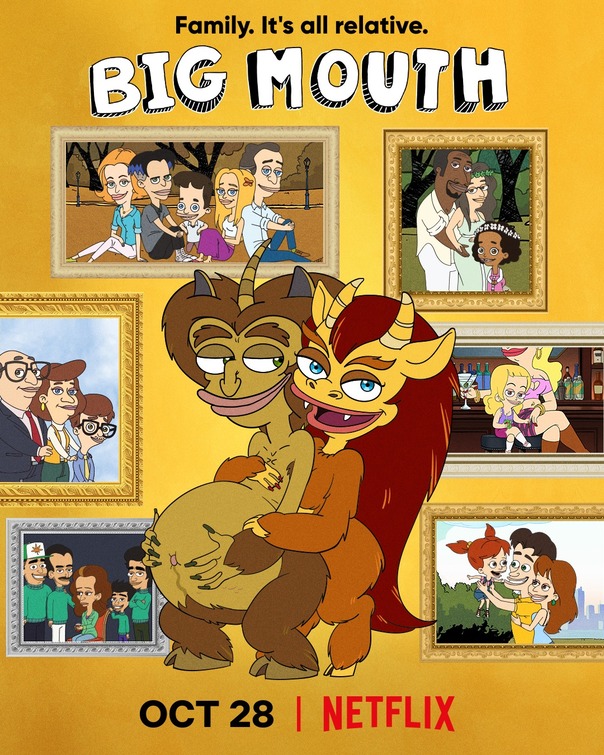
Big Mouth Season 6 - Netflix


Here's the surprising truth: I think I prefer Human Resources to Big Mouth.  Human Resources is like filthy Pixar, like Monsters Inc. or Inside Out where something very conventional or intangible has this whole entire infrastructure backing it up.  Human Resources was built out of 5 years of Big Mouth so its rich world of hard coded job descriptions and whatnot didn't just arrive out of whole cloth, it owes Bit Mouth everything.  So coming back to Big Mouth and having to deal with Nick (Nick Kroll) and Andrew's (John Mulaney) shtick once again was a little less enticing this time around.

However, Nick really took a back seat this season.  Jesse (Jesse Klein) really took the co-lead alongside Missy (Ayo Edibiri), Matthew (Andrew Rannells) and Andrew.  Jesse was dealing with her hatred towards her pregnant stepmom and her fear of the looming sibling replacing her, to the point that she indirectly develops a yeast infection.  Missy starts dating a new boy, Elijah (Brian Tyree Henry), who discovers he's asexual.  Matthew is very much into dating Jay, for some reason, but that relationship starts taking its toll on both of them.  Andrew finds himself in love with Bernie Sanders (Kristin Schaal) and gets a new love bug (Chris O'Dowd), at the same time his parents (Paula Pell and Richard Kind) relationship seems to be falling apart. Meanwhile Maury is very pregnant, and Connie still wants nothing to do with the baby.

The world of Big Mouth has become so huge that each episode feels pretty jam packed, and somehow it keeps clicking.  It's hilarious, shocking, gross, and sometimes exceptionally poignant and sentimental.  Talking genitalia are still all over this beast, and unexpectedly seeing too much of everything is to be expected.  It's still got a lot of legs, so long as it keeps recognizing the diaspora of sexuality and the stories that can result.
 
---
Unsolved Mysteries Volume 3 - Netflix


The first episodes of Unsolved Mysteries this season upset me to the point that I would wake up in the middle of the night dreaming about it and then not be able to go back to sleep thinking about the particular horrors that were experienced (both by the victim, and by those who found her) and the mystery behind it all.  You really feel for the family, wrestling with so many questions about the loss of their loved one, and the gut-wrenching empathy you have for them, and the victim... you can feel sick to your stomach afterwards, and helpless.

The nature of the show is that these mysteries are unsolved, so after spending an hour with each case and the facts involved, there's no closure so you're left thoroughly unsatisfied by these stories.  I have to say, as challenging as these are to watch, as emotional as they can get, as heavily as they can weigh on me afterwards, I much prefer this format, which is much more documentary-style, interview-heavy, with timeline graphics and maps when needed, and less reliant on recreations and quick little facts vignettes that the old show would employ.

This season features one episodes on a mass sighting of UFOs that were documented by the local police department and the man operating the weather radar at the time.  It also features a story on the Navajo Nation rangers who would investigate paranormal phenomena on the reserve...everything from UFOs to poltergeists to Bigfoots.  The retired ranger concludes, at the end of the episode, that these things likely bleed from another dimension, a parallel reality.  The Navajo Nation Rangers paranormal investigation unit is a scripted TV series just waiting to happen. (Following this episode is the story of "What happened to Josh" a college student who disappeared a decade or so ago while walking between dorms one night... the answer was not UFOs but that was my immediate thought, connecting the dots before me.)

The theme song still gives me the willies.

---
Harley Quinn Season 3

In Harley Quinn's third season of destroying all the mystique of Gotham City, Harls and Ivy are now a solid, if oddly matched, item... in love and making it work despite their differences.  Harley has to deal with a great many things before her, including an over-eager Batgirl wanting to be her friend, her ex-abuser the Joker (now reformed) running for mayor, and discovering the secret of Bruce Wayne and being kind of cool about it.

The show takes the piss out of costumed vigilantes and costumed villains alike.  Harley, being an agent of chaos and straddling the line between them, seems like the only sensible person in a world of madness...until she's not.  Kaley Cuoco (The Flight Attendant) is so damn confident in the role, and just nails every note perfectly.

Meanwhile Clayface gets a job on the set of The Thomas Wayne Story, working with director James Gunn and lead actor Billy Bob Thornton...until he accidentally kills BBT and takes his place, just hoping to high hopes hi isn't found out.  Just like in Resident Alien Alan Tudyk knows it's a go-big-or-go-hope type of performance.  Clayface is not as eccentric as Harry Vanderspeigle, but with that "master thespian" voice with a hint of lyricism to it.  

The jokes, as usual, come fast and heavy, some obvious, some so sly you almost miss them (or maybe I did miss them, because they're so sly).   I sometimes have to brace myself for the level of piss-taking the show takes with characters I otherwise take seriously in the comics, but it's important to remember these aren't actually sacred things and it's okay to make fun of them.  It (hopefully) doesn't dispel their dramatic impetus in other venues.

---
The Crown Season 5 - Netflix


The third watch has stepped into The Crown and it's maybe its most powerhouse group yet, with Imelda Staunton as Elizabeth, Jonathan Pryce as Philip, Lesley Manville as Margaret, Johnny Lee Miller as John Major, Dominic West as Charles, and Elizabeth Debicki as Diana.

Clearly in this time period of the 1990s, Charles and Diana are just falling apart.  Andrew and Sarah have already split, and the country is starting to really question the necessity of the Royal Family more than ever.  So things are not going well at all, and it's hard to see them improving, as Diana starts lashing out publicly, via a tell-all novel (though disguising her participation, it's obvious) and doing a BBC interview coaxed through a lot of false claims and deceptive tactics by the interviewer to fuel Diana's paranoia.  Debicki is utterly magnificent as Diana, capturing the well known head tilt and soft-spokenness, but really humanizing her, showing all her complexities and in no way deifying her.

Notably handsome man Dominic West (McNulty from The Wire) is a curious choice for Charles, but through posture and mannerisms he manages to evoke the Prince (now King, eh) quite adeptly, showing a side to him that is much stronger and savvier than we've seen from Charles in the past seasons, but also still retaining some of that naive vulnerability.

Staunton's Elizabeth is a much harsher Queen than Olivia Coleman or Clare Foy.  It's understandable, after 40 years as sovereign she's rather entrenched in her role, and her sense of what her duty is has remained unwavering...unfortunately the world has changed around her as she has remained steadfast, and it does come with a bit of reckoning.  Philip spends his time with a new love, horse carriage racing, which he brings his godson's wife into after she loses a child.  It's a reunion of Pryce with Natascha McElhone who costarred together in the underappreciated classic thriller Ronan and that same paternal relationship is rekindled here.

The standout episode of the season is almost devoid of the royals altogether as we find ourselves following Mohammad Al Fayed as he first sees the Duke and Duchess of Windsor in Egypt in the 1946 and becomes entranced by the elegance of British royalty.  As he ages, it's his greatest desire to rub shoulders with the god-like beings, and he accumulates wealth and status in very pointed maneuvers, including purchasing the Harrods, and Duke of Windsor's French estate, to bring him ever so close to them.  The most affecting part, however is the relationship Al Fayed forges with the Duke's former valet, Sydney Johnson, who he then hires as tutor in the ways of all things royal. An incredibly sweet platonic romance results. 

With seemingly no expense spared it's frequently "wow"-inducing, and with the in-house drama reaching its heights, exceptionally compelling viewing.