Showing posts with label celebrities. Show all posts

Monday, June 23, 2025

KWIF: Materialists (+2)

 KWIF=Kent's Week(end) in Film.

This Week(end):
Materialists (2025, d. Celine Song - in theatre)
I Like Movies (2022, d. Chandler Levack - Netflix)
Postcards from the Edge (1990, d. Mike Nichols - Hollywood Suite)

---

In Materialists, Dakota Johnson plays Lucy, a matchmaker for a high-end matchmaking firm in New York City. Her clients are, not unexpectedly, pretty much the worst. They have impossible standards that they want to be met, which, as Lucy points out, comes down to ticking boxes and math. Dating is just a numbers game for her, and she's pretty good at negotiating that game for her clients.  She knows that if enough of the boxes get ticked, and the chemistry is agreeable, there might be something long term there, and she also knows that for the boxes that don't get ticked, there's some salesmanship that needs to happen. 

The type of people who use a high-end matchmaking service do so to meet people who are like them, shallow, vapid, materialistic, arrogant, with a certain level of wealth and status that they don't want to be challenged by trying to date anyone in an lower tax bracket. 

The men Lucy needs to interview are ugly human beings, just vile and entitled and very wealthy, and it would seem it's only through gritted teeth that Lucy would dare set them up with one of her female clients, except for the fact that most of her female clients are just as equally withering at their core. Of course, this is all in the context of people searching for the "ideal" partner, and mostly the ideal doesn't exist. Lucy's job is to set expectations while also providing hype. She really is very good at her job.

If this were a romcom, Lucy would be on the outside looking in, being the "everywoman" character who hates and makes fun of her clientele, who is morally above all the shallowness because she believes in love, and then there would be the complication of her falling for one of her rich clients while the poor ex-boyfriend who was the love of her life reenters at the same time.

But Lucy isn't above it all. Lucy is a titular materialist, she wants fancy restaurants, silk sheets, a 2000 square-foot Manhattan apartment, so in a way she relates to her clientele fairly deeply. But she is not proud. Where does love fit into the equation? In Lucy's profession, it's very much a product of the box ticking, a promise for the future, and not, like, the first box that needs to be ticked. 

Materialists is not a romcom, though it could very easily be twisted into one (without much twisting at all). It is a romantic drama that explores the idea of dating and relationships as something that can happen in a quantifiable manner.  In the backstory, despite loving her poor actor boyfriend John (Chris Evans in his best role and best performance in seemingly a very long time) she couldn't stand being so poor and she hated herself for it. Five years later at the same time she runs into John working catering service at her clients' wedding, she meets Harry (Pedro Pascal), who is kind, smart, thoughtful, considerate, rich as fuck, handsome, ticking every damn box (a "unicorn") who, unlike his contemporaries is looking for a woman who is her own person, is smarter than he is, and will challenge him and make him better. Together they are ticking each other's boxes, but romantic stirrings of an unresolved relationship complicate the scenario (not that there's much time at all spent on screen gnashing teeth over this). 

In a typical Hollywood romance, these two men would be vying for her affection in direct competition, but this is not that film. The film explores Lucy's relationship with each of them, and deepens our understanding of both her character and theirs along the way. There's no competition, as Lucy has full agency over what she's doing with her life and with whom.

I am not much of a Dakota Johnson fan. I find her very reserved, almost robot-like on-screen persona very cold and unappealing. She is often hard to read emotionally, or very constrained in her emoting, which means her range as an actor has always seemed very limited. This is pretty much the perfect role for her, where she is, by nature and profession, very calculating, and the lack of big emotional reactions means that the smaller ones have a much greater impact. I still can't help but think how much more charming a movie this would have been if Celine Song's Past Lives collaborator Greta Lee were the lead of the film, but nothing about Johnson is actually detracting from the production, which, if you haven't guessed, I liked quite a damn bit.

Hollywood has, for a long, long damn time celebrated and revered lifestyles of the rich and wealthy, and it's only in recent years that the "eat the rich" mentality has creeped its way into the on screen discourse, but this film isn't actively chomping down on those corpulent, cash-rich bones, and it's not directly engaging in class warfare, but it is more than making its point that wealth cannot buy either love or happiness. It is also very directly calling into question how money changes one's nature, how commoditizing people, whether as potential romantic partners or as subjects reduced to checklists, can have pretty brutal consequences, especially if you have any ethics or emotions at all.

Good movie!

---

It's a tough slog hanging out with 17-year-old Lawrence, who says he "likes" movies but has built his whole personality around loving movies and being smarter or more knowledgeable about them than anyone else in Brampton. His hyperfixation has led to a superiority complex over something most people don't really care about, and his obsession has isolated him from others, while that isolation has fueled a need to feel superior, that his knowledge of and experience with films somehow means he has talent and a future that matters more than others. It means none of these things, except that Lawrence is pretty much a narcissistic asshole most of the time to most everyone. Thank god this was a period piece because if Lawrence had youtube and twitter he'd be sucked right up into the manosphere, whining about what he is owed for literally doing nothing, how every problem in his life is someone else's fault and how hard it is for people to like you when you have a terrible personality and refuse to work on changing it.

In 2003 there was still hope fore people like Lawrence, still hope that when someone called you out on your toxic bullshit you would actually, you know, take it in and, just maybe try to be better.

We all know or knew someone like Lawrence, some of us were in danger of being Lawrence, and that make Lawrence a very, very difficult protagonist to get behind when virtually everything that comes out of his mouth makes you want to slap him across the face. But just when you're ready to give up on this obnoxious, aggravating shitheel of a person, writer-director Levack humanizes him again, showing him having a panic attack as the egocentric bubble spring a leak, deflating faster than the hot air he can give it.

It's a bold performance from young Isaiah Lehtinen, who weaves between being a snotty petulant ignorant jerk and a puddle of vulnerability with mastery. Krista Bridges as his mom, Terri, is able to deliver a mother's unconditional love through gnashed teeth, clearly unable to figure out how her little boy became this petry, insignificant tyrant, and how to undo it. Romina D'Ugo is the film's stealthy weapon, as Alana, Lawrence's boss at the video store. She's taken pity on this kid whose passion has warped him in a way she seems to recognize and be more than able to handle. From what we learn, it sounds like Hollywood is filled with Lawrences and it doesn't need another. Alana is the deepest performance in the film, her motivations much trickier to figure out than anyone else's, but clearly acted with purpose.

I Like Movies is painfully enjoyable, but ultimately rewarding, full of nostalgia triggers, Canadiana, and wonderful performances, as well as a coda that is far more hopeful than the Jordan Petersen-tinged future it seemed to be barrelling towards.

---

It was only after Carrie Fisher's passing that I finally got around to reading some of her books. She was an amazing writer, telling stories of her life with a terrifically sardonic, biting sense of humour, being self-deprecating and playfully vicious.  In reading a few of her memoirs, I got a small sense of her life before, during and after Star Wars, and what a rocky road that was to her. She touched on being the child of famous parents and what that did to her, but it was never blame so much as origin story.

I didn't read Postcards from the Edge when I was in this little reading binge, but I had added it to the "someday" watchlist of movies to see. For the screenplay, Fisher adapted her own book which I didn't realize until doing a little "research" following the film wasn't another of her memoirs, but a fiction that had loose parallels with her own life in the "hey, write what you know" vein. 

Throughout the runtime I couldn't escape trying to place what I saw on screen into what I knew of Fisher's life, only to learn later it was a bit of a fool's errand. 

The story finds the 30-something, established-yet-still-proving-herself actress Suzanne Vale (Meryl Streep) overdosing while on a night out with a new (not-so-)gentlemanly acquaintance, Jack (Dennis Quaid). When she won't wake up he rushes her to the emergency and drops her off anonymously, where she has her stomach pumped. She's forced into rehab by her doctor and mother, of which we only see a little. A month later she's signed on to star in a new gig but the film's insurance company will only sponsor her if she is under the observation of a responsible party, so either stay in rehab or live with her overbearing, alcoholic show-biz legend mother, Doris (Shirley MacLaine). She reluctantly chooses the latter.

The sober life, both on set and off is difficult for Suzanne, temptations ever present and addictions supplemented. She is pushed and pulled and prodded and denegrated every which way by her producers, co-stars, director, mother and the re-emergence of her gentlemanly acquaintance Jack seems like a fantasy as he sweeps her off her feet, only to find that relation-ship is full of holes and sinks fast.

Given how Fisher wound up living next door to her her mother, Debbie Reynolds, for a decade and a half before they both passed away within one day of each other, I was thinking that Postcards would center around their relationship, maybe how their recovery from addiction wound up in much healthier co-dependency.

But the film is unfortunately much more unfocussed than that. Where a whole film could be sustained around a celebrity's time in rehab (maybe John Mulaney will write that one), or the pressures of performing and creating while struggling with addiction, or a toxic Hollywood romance that starts out like a dream and ends in near slapstick... Postcards instead tries to do it all. It's not that it does any of these stories badly, it just doesn't give them the time or space they deserve. (Apparently in the novel, Suzanne's mother is barely present at all).

Could Meryl Streep act badly if she tried? It would probably be a good performances of someone trying to be a bad actor. She just can't fail. And here she clearly spent time with Fisher and picked up on her tone and mannerism, even if physically they look very different. It was hard not to hear Fisher's voice in her performance, and even though it was performed very well, it didn't fully seem natural. MacLaine, on the otherhand, is a powerhouse through and through and through. She was locked in, and you always get the sense of a proud, loving mother, but also riddled with flaws being the product of the showbiz system for so many decades.

There's small roles for Gene Hackman (in a beautifully tough yet tender role as Suzanne's director), Annette Benning, Richard Dreyfuss, Rob Reiner, Oliver Platt, CCH Pounder and more than a few other recognizable faces, but it highlights again the scatter shot nature of the film overall as none of these characters ever develop or have lasting presence in the story.

The film features three musical performances, two featuring Meryl singing which I always forget she can do (one performing live with Blue Rodeo over the end credits), and one finding MacLaine wringing out a Sondheim number. Music in the film is by Carly Simon.

There's a lot that is remarkable about Postcards, but it needed tighter focus. In the end it's got Fisher's fingerprints all over it and it makes me miss her. Time to read a few more of her books.


Tuesday, June 10, 2025

KWIF: Pee-Pee Peeping

 KWIF= Kent's Week in Film. Three "films" that start with "P" completely on accident.

This Week:
Predator: Killer of Killers (2025, d. Dan Trachtenberg - Disney+)
Pee-Wee As Himself (2025, d. Matt Wolf - HBO)
Presence (2025, d. Steven Soderbergh - AmazonPrime)

---

The classic Arnold Schwartzenegger-starring Predator from 1987 was quite a successful film, as a group of mercenaries square off against a high-tech alien Predator in the jungle. It's Danny Glover-starring 1990 sequel, taking place in a sweaty, crime-addled futuristic L.A. was less successful but even more popular among the sci-fi nerds for teasing the culture of the Predators. But it was the various Dark Horse Comics mini-series in the 1990s that showed what could really be done with the Predator....

Put him at a disadvantage in a cold-weather climate. Have the Predator hunting during the first World War.  Let the Predators square off against Aliens. Or Batman. Or Tarzan. Or another Predator!

The core idea behind the Predator (their species is the Yautja...first used in the novel Aliens vs. Predator: Prey from 1994) is that they hunt those most deserving of being hunted; other hunters. Earth is so rife with skilled hunters and killers that it's a favourite hunting ground of the Yautja, but not their only one (as witnessed in 2010's Predators). The key to a good Predator story is to not focus on the Yautja much at all, and offer little to no explanation. Shane Black's 2018 travesty The Predator and the awful Aliens vs. Predator movies explained too much, tried to probe the creatures too much. So Dan Trachtenberg's back-to-basics Predator film Prey (pitting a Yautja against a Comanche warrior) came out in 2022, it paved the laneway for what future Predator stories should be... the Predator in other cultures, in other times.

The most obvious go-to would be Predator vs. Vikings, Predator vs. Samurai, Predator vs Kung Fu warrior, Predator vs Zulu warrior, etc.  So it came as a slight disappointment when the trailer Predator:Badlands dropped and it most definitely wasn't the back-to-basics follow-up to Prey I was anticipating from Trachtenberg.  What I didn't know was that the true follow-up to Prey would be Predator:Killer of Killers, stealth dropped on Hulu (in the US, Disney+ globally) last week.

At first blush, it appears to be an animated anthology film consisting of three stories: Predator vs. Vikings, Predator vs a ninja, Predator vs. WWII aerial ace, you know, the type of stories I was actually hoping would each get the full-feature, live-action treatment, not burned off in an animated tie-in. It's a movie that simultaneously offers a little more than what the typical anthology film does, but at the same time offers each conceit less than what it could have.

Set in 841 AD, "The Shield" finds a viking warrior, Ursa, leading her clan - and her son - on an assault against a foe she has been hunting for a long time.  The enemy was responsible for the death of her father a lifetime ago, but it seems revenge has been fuelling her the whole time. As she confronts the man she has hated her whole life, her son makes the killing blow, and makes him the target of the Yautja that has been observing them in action. The Predator here is a hulking beast, literally Hulk-sized, with a unique pulse emanating weapon on his right arm where his hand should be. Ursa, the Viking queen, meanwhile, fights using two shields with razor-sharp edges.  There is some wild violence and some impressive action beats in all this that allowed me to get over my disappointment of there not being more to it than there is. I feel like the emotional resonance that the story wants wasn't allowed enough time to build, both for the big confrontation the Ursa wants, and for the people she loses along the way.  I like that, like Prey, the Predator is still a more technologically advanced creature, but that technology is more primitive, clunkier than what we would see in the 20th century.

"The Sword" is set in Japan in 1609, but starts further back with two brothers, thick as thieves, who learn and train and grow up together, are forced to face each other by their disciplinarian father to see who is strongest and fiercest enough to be his heir. Kenji refuses to fight his brother, while Kiyoshi is reluctant but the disappointment of his father is too much to bear. He attacks Kenji and Kenji flees. Year later, Kiyoshi holds his father's title, and Kenji, now a ninja, sneaks into his city to get his revenge...except Kenji, for as stealthy as he is, cannot elude the Yautja observing him from behind his invisible cloak. This story, largely wordless, was everything I was wanting, except for not being live-action and feature length. It actually manages to hit the emotional resonance that "The Shield" could not, with the silence putting more emphasis of the visuals and direction, and the music providing so much of the emotional cues. As a short, it's absolutely lovely and poetic, but I still can't help want more out of it.

The end of each of "The Shield" and "The Sword" find our protagonists victorious against their alien opponent, and there's the briefest of glimpses of them in the same confined space that looks like the hold of a spacecraft. The film is teasing that there's more to Ursa and Kenji's stories than what we just saw. And then we're introduced to John Torres.

"The Bullet" is set in 1942, and finds Torres as a second-stringer aboard an aircraft carrier during World War II. Torres wants to fly, but hasn't been given the chance. When his squadron leaves to engage the enemy, Torres and his mechanic buddy discover something incredibly foreign, alien even, that's an even greater threat in the skies. He takes off in a junker plane to alert his crew to return to ship, only to have the Pred Baron start picking them off. Clearly we know Torres is successful in defeating this alien ace, but of the three stories, it's the most implausible. Torres is not, like Ursa or Kenji, so skilled, and his equipment is so outclassed it should barely be flying. Voiced by Rick Gonzalez (Arrow) Torres is a motormouth to the point of being too much, especially coming off of the quiet of "The Sword". Torres winds up verbalizing his inner monologue, which makes it feel much more cartoony than the previous for-adult-audiences entries felt.

It all culminates with a fourth act in a Yautja gladiatorial Colosseum, which I was not expecting at all. If anything I was anticipating that our three victors would wind up in the hunting forest planet from Predators. I very much enjoyed that it was something new, and there was no explaining it. We know what a gladiator arena looks like, and we know how they work, just not Predator-style, so it was full of discovery as new elements are introduced. 

All the fighting throughout the film is brutal and bloody and quite impressively choreographed. It's clean and clear what is happening in the action, although sometimes it's moving so quickly (Tractenberg using a lot of follow-from-behind or follow-in-front of the action oners) that taking in all the violent mayhem is sometimes a bit too much to process. I like how the Predator designs were all quite well thought through and how even though our protagonists were technologically outmatched, they still were smart enough to figure out how to use the Predators' technologies against themselves.

I had an absolute blast with this movie. In the end, the three opening acts come together with purpose for a rousing fourth act that, despite some pretty hand-waivy improbabilities, makes it all comes together, not just within but also outside of this film. The victories Dutch, Harrigan, and Naru all had...well, those probably weren't the end of their stories either.  Also, it should be said that at no point did Killer of Killers ever feel like it existed solely as an introduction to the forthcoming Badlands. It will be interesting to see if they do connect in any way, but even still, this feels as stand-alone as every other Predator story, which is amazing.

[Series Minded: Predator edition]

--- 

When I was a young lad, I thought Pee-Wee Herman was real. Like, maybe he didn't always look like that, in that suit, with the hair slicked back, but to me I had no awareness there was anyone underneath. Pee-Wee was a character actor like, say Ernest or Hulk Hogan or Mr. T, who only seemed to star as himself in movies and TV shows about himself as the character.  I didn't know Paul Ruebens from a hole in the ground until he was arrested at a porn theatre in 1991, and suddenly the magic was dispelled.  I mean, I was 15 at the time, and I knew Santa wasn't real, but this was the first true realization that Pee-Wee was a character played by someone not named Pee-Wee Herman.

We lost Paul Ruebens to cancer in the summer of 2023. He was 70 years old. In the year prior to his death, he agreed to participate in a documentary about himself, shedding off the layers upon layers of privacy he'd long, long held and opening himself up to examination and scrutiny in a way that seemed to frighten him previously.

We learn about Ruebens' early days, his family, his dalliances with theatre and art school in his teens, and we learn about his coming out story, which led to his re-closeting story once he started achieving success. He had a true love-at-first-sight relationship post-College, and he had formed a true bond with this man, as they shacked up and got a cat, Ruebens found himself content.  But that contentedness presented a crossroads: either live the life of love, or live the life of ambition. He chose the latter, broke his lover's heart and his own, and set out for L.A. where he joined up with the Groundlings comedy troupe. From there characters, including Pee-Wee were built, but there was something about Pee-Wee that demanded more attention, both from Ruebens and the audience.

Ruebens was committed as a performer. He invested himself in whatever it was he was doing. He knew how to steal scenes with looks and physicality more than words (but as we see in the documentary, he does have a razor-sharp comedy mind to accompany the sly-little-devil twinkle in his eye). As Pee-Wee became a bigger and bigger thing from stage to screen to Saturday morning subversive idol to children and college kids, Ruebens sheltered himself to the point that he barely existed outside of the character he played. His ambitions got the better of him, relationships with friends and colleagues fractured, and then the arrest.

A children's show host being arrested for something indecent coming out of America's puritanical 80's (where sex was evil, but violence and greed were good for all) was the death knell for Pee-Wee and Ruebens spiralled. 

The first half of this two-part documentary (each part 100 minutes long) follows Rueben's life through all these elements, with friends and ex-colleagues all talking about how amazing it was to be part of it all but also speaking truth to who Ruebens was at the time, as Ruebens himself struggles on camera to fully lay it out and cede control of his narrative to his director.

The second half is all about the fall of Pee-Wee Herman, and then his revival, and his third act, and all the messiness in between. The first half is a real rise-to-fame story, but without revealing in the triumph, since there were sacrifices along the way that have manifested as, if not regrets, then at least remorse. The second half is very much a rollercoaster, as Ruebens tries to find his footing as Paul Ruebens and it's full of ebbs and flows that must have been really tumultuous and stressful to live through, particularly the very public reaction and hurtful things said about him. Rueben's relationship with his sexuality is an integral part to the story, and probably a lot of what Ruebens wanted to get off his chest about in the documentary. 

There's a lot of great things about this documentary, first and foremost is Ruebens himself. Even at 68/69 years old, secretly dealing with cancer, he looked fantastic and vital with a precociousness about him that was so alluring to watch. His combative nature with director Matt Wolf is the B-story to the documentary, where clearly Wolf was constantly having to fend off Rueben's stabs at taking control of the project.  Rueben's jabs at the director start out quite playful and take on a bit more menace the closer they get to the more troublesome years. 

The talking heads are all fascinating, most coming from such a place of love, but a few coming from a point of pain, of regret or remorse around their falling out with Reubens (and there were a few). The sheer volume of personal films and tapes that Ruebens had around his life makes this documentary sing with not just the narrative but visual proof of that narrative, and transporting the audience into the past.  

There have been a slew of documentaries about celebrities of the 70's, 80's and 90's of late, most of them produced by the celebrities (or their family/estate) leading to pretty whitewashed looks at their lives, celebrating more their glories than their humanity. This is very much the opposite, really getting in touch with the person who hid behind a character for so long that he had a hard time finding his way out again. It should be a compelling watch if you ever had any affinity for Ruebens at all. 

--- 

I wrote a bit about Steven Soderbergh's prolific output in my Black Bag review (Toasty just published his, we agree!), so I won't rehash it here, except to say that the man put out two films in the first quarter of this year. That's insane. Even more insane is that Black Bag was a critical hit but fared poorly at the box office while Presence was pretty much ignored by everyone, but its low budget meant that it would up being a modest success.

Where Black Bag was a real adult sexy thriller starring big stars, Presence is an experiment in filmmaking with a story.  While the story's unfolding nature of discovery does lead the audience through the proceedings rather well, it's unable to escape the techniques Soderbergh employs that are simultaneously distracting and effective.

The whole film takes place inside a gorgeously refurbished 19th century home which had Lady Kent and I both salivating. It's a dream home, to be sure. The film opens with the Payne family looking at the property, and then moving in. Rebekah (Lucy Liu) is the driving force of the family, clearly successful, but there are hints that her success hasn't always been above board. She is obsessed with the wellbeing of her superstar swimmer son,  Tyler (Eddie Maday) while all but ignoring the well-being of her daughter, Chloe (Callina Lang), much to husband Chris's (Chris Sullivan) constant displeasure. Chloe has recently lost two friends two overdoses, and she's spinning out. Chris does what he can to engage, but it seems like Rebekah and Tyler just ride her and push her too hard. Tyler introduces her to his new friend Ryan, and soon Ryan and Chloe are hooking up. He seems like a good guy, and lets Chloe take the lead in their relationship, but there's also an air of menace about him. He's up to something, and it's not what you think, but the film wants you to think it.

The entire production is told from a sort of floating first-person perspective, which, it's slowly revealed, is the "Presence" of the title. Yes, it is a ghost story. It's not a horror movie, but just a drama in which a ghost is our eyes into the play. At times the spirit, who Chloe believes is her dead friend, seems to be  trying to interfere in what's happening, mostly unsuccessfully, but events that elicit a particularly strong emotion from the spirit allow it to interact with its environment.

It's a bit of a trifle of a film. It exists solely for Soderbergh to play with this first-person perspective storytelling, which doesn't have a lot of true success stories in the film world outside of Nickel Boys which earned an Oscar nomination at this year's Academy Award.  But presence is more in the "just trying something here" vein of Hardcore Henry or Gaspar Noe's Enter The Void and is about as successful as either of them. When the whole story is in service of a stylistic experiment, there's a layer that gets in the way of the audience engaging with the story fully.  

As well, the third act climax felt...very Hollywood. This took a family drama with a hint of supernatural intensity and turned it into a studio movie with a legit villain. I didn't really expect too much from Presence and it doesn't ask much either. It's fine for what it is. 

Wednesday, March 13, 2019

Double Dose: Soderbergh

(New Feature: Double Dose is two films from the same director, writer or star...pretty simple.  Today, a couple of non-theatrical releases from Steven Soderbergh).

Behind the Candelabra (2013, HBO)
High Flying Bird (2019, Netflix)


BEHIND THE CANDELABRA

It's hard to believe in the 2010s that an elaborate production about the life of a very famous person starring Michael Douglas and Matt Damon would have trouble finding theatrical distribution and be relegated to "TV movie" status by debuting as a prestige picture on HBO.  It did remarkably well in that relegation, though, gaining an audience of 3.5 million in its first night of airings and it won 14 Emmys (including outstanding mini-series or movie, best actor in mini-series or movie and best director), and counted 2 Golden Globes among its many other accolades. 

Liberace was indeed a very famous human being up until his death in 1987.  He was a larger than life character who lived his life as opulently as the richest of Middle Eastern royalty.  He was a piano virtuoso, a phenom that impressed with his skills and wowed with his showmanship for over five decades.  But as a celebrity in his time, homosexuality was just not an option, it was a career ender, and though living a very gay private life, he fought the image very publicly.  It's only been in recent years, perhaps since 2013 that out performers aren't being singularly pigeonholed or outright ostracized, and not to say that Behind the Candelabra had anything to do with that, but it certainly explored the topic of sexuality and celebrity like few other productions of this scale had.

The narrative thrust of the film is the relationship between Liberace (Michael Douglas, absolutely inhabiting the role) and Scott Thorson (Matt Damon) for six years starting in 1977.  It never dances around their sexuality, and Lee (as Liberace was known to his friends and lovers) was a hungry predator, welcoming the young, taut Scott into his fold after but a glance when introduced by mutual friend Bob Black (Scott Backula).

Scott was about 40 years Lee's junior, and shortly after their introduction there was an obvious moment where Lee's current concubine/protege knew he was on his way out, sending daggers Scott's way knowing he was about to be replaced with a younger model.  Lee wore his sexuality like heavy baggage.  In public he disavowed any inference that he was anything but the straightest of strait, dining with other prime female showpersons like Charo for aesthetics, but in private he voraciously romanced younger men and consumed porn.  He didn't care to venture into public except for his performances, instead keeping a sheltered life within his various ornate homesteads.  He had a whole support network to keep his dalliances secret, and to feed him a new supply of conquests.

Scott did not mind being a kept man, at first, having been overwhelmingly wowed and dazzled by Liberace as any member of the public would be, but also taken into his confidence and learning to love the man under all the glitz and glamor.  Lee's egocentricity and vanity was far from subtle and certainly problematic.  He even had Scott undergo plastic surgery to look like a younger version of himself (his prior protege whom we fleetingly see in the opening of the film too bore somewhat of a similiarity).  Scott's love had him willingly go along with such a bizarre plan, but in the process he becomes addicted to prescription and illicit drugs prescribed by the plastic surgeon (played by scene stealing Rob Lowe in an outrageously ghoulish performance).

But Lee's avoidance of the public life meant Scott was too kept, and too stir crazy.  He had few friends beyond his drug dealers, and had no identity of his own.  As tensions raised in the house (Lee was very disapproving of Scott's drug habits), Lee's eyes started to wander, and soon Scott was in the position of the dagger-throwing boyfriend on the outs, seeing Lee flirting heavily with a new stage dancer opening for his show.   The circular nature was incredibly well handled.

Soderbergh's attention to detail, his reverence and affection for the subjects, while also maintaining a critical eye are all at play.  This is a tragic love story as well as a love letter.  The closing moments at Lee's funeral, and Scott's vision of Liberace's departing performance is a genuinely beautiful tribute to a marvelous performer and flawed man, and also acts as the final bow for famed composer Marvin Hamlisch.  Douglas commits to the role like no other I've seen him in.  He's always been a solid actor, but this was another level (had this film had a theatrical release he no doubt would have won best actor, but he'll settle for the Emmy and Golden Globes he received).  Damon was quite good, however he's easily 20 years too old for the role, and the miscasting is its own problem.  The lack of gay voices in the actual telling of the film is another.  In spite of that lack of representation, the film was still given a GLAAD media award and Soderbergh seemed to take other pains in ensuring that he was not working in cliches or exploitation.

---

HIGH FLYING BIRD

This is the type of sports movie I get into, one that deals with the money and politics of it, the game beyond the game. It's set in the world of sports agents, where Andre Holland plays a man with his back against the wall trying to rep his clients during an NBA lockout. Nobody is getting paid and the shortsighted, monetary-focussed agency he works for is utterly disinterested in spending any more on their clients until the lockout has resolved. Likewise they look at Holland and don't see his value, what he brings to the table that's any different from anyone else. What they don't realize -- but his disgruntled friend and agency lawyer Sonja Sohn keenly observes -- is he's 20 steps ahead of everyone. Even though the film puts that right out there, the masterstroke here is it still gives you plenty of opportunity to doubt Holland and his plan.  But in seeing it come to fruition -- with some devious manipulation and a hip-to-his-playbook accomplice in Zazie Beetz (who is NOT his assistant anymore) -- is a work of beauty.

The film is, in a way, a heist movie, with Soderbergh flexing his Oceans series muscles to present a much different type of scam. The script is ludicrously sharp, the actors are all so game for what's in play (the dynamics of this cast are so good), and the deftness of putting a spotlight on systemic racial exploitation in sports sparks a necessary conversation we don't hear enough of.  Like Behind the Candelabra, Soderbergh has an empathy and astuteness towards situations that may not be of his own experience, but he has no problem conveying with authenticity.

If the film sags a little, it's in Soderbergh's experimentation with shooting the film only with iPhones, which is in stark contrast to the stylishness of his Liberace biopic.  At times he captures some gorgeous shots (acting as his own cinematographer in pseudonym) but there's a samey-ness to them, particularly the wide angles largely employed that seem more like restrictions of the filming medium than deliberate choices.  Soderbergh has always been an experimenter, and this, his second feature shooting exclusively with iPhones suffers slightly for it.

Soderbergh's name will bring people to the film, but buried in a glut of Netflix releases with little promotion, this is going to unjustly fly under the radar of most people.  Hopefully word of mouth will propel this to more people's recommended lists.

Monday, January 26, 2015

Birdman

2014, Alejandro González Iñárritu (Babel, Biutiful) -- cinema

Really? This is his only film since Biutiful ? I am surprised because that Javier Bardem movie was a solid, if not widely seen, followup to Babel. I guess I cannot fault the man for taking his time between movies, but I am surprised the machine would allow him to. Perhaps he is successfully working outside the machine? This movie proves he definitely has an opinion about said machine.

Birdman is a wonderful, eclectic, intricate view of being relevant, whether you need to be and what it means to not be. Michael Keaton, who I was surprised was not providing some auto-biographical writing to the movie, plays Riggan Thomson, the well known star of a superhero franchise called Birdman. He gave up the series after movie 3, but they are still the only thing people know him for. Insert long drawn out comparison between Keaton as Batman to Riggan and Birdman. Drawing those lines is easy, but the relevance he feels is much more pronounced. It doesn't help that the voice of Birdman is in Riggan's head, all gravel and cigarette smoke.

Iñárritu does his best Alfonso Cuarón imitation, building long running, almost seamless single camera shots. Black spots, shadows and swinging doors allow us to jump from key points to key points, letting the camera stop following one person and on to another. The scenes are lovely, focused on walking, ever forward with dialogue often being dragged along.

Edward Norton is the self-considered relevant actor who provides much of that introspective dialogue, counter spinning Keaton's banality. He hates Hollywood, hates Thomson's popularity, screaming "This is my town!" while not being recognized by a single person on the street.  Emma Stone is Sam, the neglected daughter seeking yet denying her father's attentions not hearing herself saying out loud that the only bad thing he really did was not be there and spending her entire life trying to tell her she is special. And there are the actresses (!!) and the frazzled producer; Zach Galifianakis playing wonderfully against character. Everyone is hinged on Riggan's production of a play, for one reason or another. But none so much as Riggan himself, desperate to tell the world and himself, he is a relevant actor, not just a washed up celebrity.

Is Riggan relevant? Should he go back to doing billion dollar box office sequels? Should he persevere through this small play in a small theatre to impress, really, no one but himself? Definitely not the critic who has decided to hatchet his play without seeing it. She hates Hollywood dunked in her small Broadway theatre. Should he try and be more relevant, more Twitter or more YouTube? And in the end, what does any of it matter? Without trying he gets the video, the Twitter trending, but doesn't even notice this relevance.

We all struggle with a certain amount of relevance in our lives. Are we relevant at work, at home, to the people who read out Facebook feed, to our peers in our social circle, to our peers in our career path, to our city, country or world at large? Have we done something that matters, will we be remembered for that video that got 300,000 hits or the painting we showed at the local gallery or the one book we published or the promotion we got at work or ... or ... or. The movie doesn't make the decision for us, but offers countless kernels of truth. Everyone has a point but no one's, not even the loud voice in Riggan's head, is the one certain truth.

In the end, this states one clear truthful thing. Anyone has the ability to be relevant, to someone, at some time or another. Make the most of it. Or ignore it and move on.

Wednesday, August 14, 2013

3 Short Paragraphs: This is the End

2013, Seth Rogen and Evan Goldberg -- cinema

I was nervous about this movie for pretty much the same reasons as Graig was, with one additional nag -- while the crowd of "Apatow Kids" are good in their own right, often the people they surround themselves with (as actors and creators) are far away from the type of comedy I like. I like Rogen when he is reigned in, I like James Franco in his non-comedy roles, I tolerate Jonah Hill and I outright cannot stand Danny McBride. While I loved the premise and the trailers made me giggle, I worried it would quickly degrade into fart and dick jokes. It did but it also surprised me with some of the depth it had. So excuse me while I do a weighing the scales thing with my hands while making a whiney, "Ehhh uhhhh ehhhh," sound when asked if I liked it.

The premise is The End of the World. From the trailers, we couldn't tell if it was ecological or aliens or an asteroid or all of the above. But, no, its Biblical -- The Rapture. Yes, we are taking a bunch of narcissistic amoral comedians, playing extreme versions of themselves, and presenting them with Christian salvation or ... doom. The movie works around a surprising main plot of Jay Baruchel coming to see Seth in Hollywood, as Seth is the guy who moved there and Jay still lives in Canada. Jay doesn't like the Hollywood lifestyle or Seth's Hollywood friends and feels they are drifting. So, he is not fond of being dragged to the party at James Franco's new house. He is even less fond of being trapped in the house when things fall apart around them.

Its kind of funny but the characters are pretty much played as guys like me believe these actors to be. Franco wants everyone to love him but is a bit of a stoner dick, with delusions of how great his "art" is. Seth is losing the war between embracing Hollywood while maintaining his Canadian stable outlook. Jonah Hill is a conniving little weasel and Danny McBride is just an all around terrible person. Baruchel sees himself as the even tempered fair guy but how long can you maintain that with giant swing-dick demons walking the earth? I know very little about Craig Robinson so no comments. The movie was able to give humor in these exaggerations (which I was not always fond of) but maintained a decent plot of how these people deal with a Christian End of the World scenario. I laughed but I also rolled my eyes a lot.

Monday, August 12, 2013

3 Short Paragraphs: This Is The End

d. Seth Rogen and Evan Goldberg, 2013 -- in theatre

I was nervous about This Is The End, nervous that it would be a film too "inside baseball" as they say, a film for the fans of the "Apatow Kids" from Freaks and Geeks, Undeclared, 40-Year-Old Virgin onward.  I don't think Apatow has inspired the frothing fandom of a Kevin Smith, or even the more erudite geek fandom of Edgar Wright/Simon Pegg, and so I was worried that a film like this, which appeared to be banking on a general audience being fans of the actors, rather than their acting ability, would be a later-day Jay And Silent Bob Strike Back, a movie solely reliant on in jokes and understanding fourth-wall-breaking references.  I don't know why I was so worried, after all, I genuinely loved the Rogen and Goldberg scripted Superbad, and Pineapple Express was a blast, so why shouldn't I have faith that they could pull another great comedy out?  *cough*Green Hornet*cough*.  Oh, right.

But it was a concern easily dismissed.  The film begins with Rogen picking his friend and fellow Canadian Jay Baruschel up from LAX for a solid week of catch up, and bonding over weed, snacks and video games.  Rogen drags a highly reluctant Baruschel along to a party at James Franco's new place, where Rogen's new, non-Canadian friends will be, friends whom Baruschel can't really tolerate.  During the party, the rapture happens (nobody at the party notices) and the apocalypse begins.  Chaos and mayhem and dead celebrities abound as the grounds open up and the sky rains fire.  It's all very Biblical, with a lot of blaspheming coming out of the actors mouths.  The party and the subsequent dissolving of the party is epic satire, with a clever bit of celebrity lampooning and piss-taking of Hollywood egos, but for all the hype it's remarkably short.  It's a judicious cutting, keeping the movie at a reasonable time, but I'm looking forward to DVD extras of all the deleted scenes that there must be nonetheless.

Left alive in Franco's fortified bunker of a home are Franco, Baruschel, Rogen, Jonah Hill, Craig Robinson and Danny McBride.  The sextet, largely appearing as friends, are quite clearly realizing that "Hollywood friends" are not quite the same as real friends.  The film is about them relating to one another as people as much as it's about them surviving the apocalypse and the numerous dick and fart jokes that you can draw out of such a scenario (and it's a remarkable amount).  Rogen and Goldberg seem to (generally) excel at drafting these kind of male-bonding experiences and doing so in an entertaining way.  The film succeeds in establishing these men as people and not just relying on their celebrity status to do the heavy lifting, and it's effective in getting you to care for them. or at least their relationships with each other, even if you dislike them.  The film takes aspects of the primary actors and exaggerates them for its own comedic purpose  - such as Rogen's cowardice, Hill's duplicity, and McBride's selfishness - and gets a lot of mileage from it.  It's not necessarily against type for any of them, but it plays with what's expected and pushes them to extremes.  Ultimately, This Is The End succeeds because it's damn funny, it can be silly, honest, scary, gross, bizarre and touching all at once.  The "inside baseball" jokes are there, but it's not the focus of the characters, the story or the humour, it's just one small facet of a surprisingly robust apocalyptic comedy.

Tuesday, April 30, 2013

What I [Graig] Am Watching: Mockingbird Lane/Hemlock Grove/Black Dynamite/TableTop/NHL Playoffs

Having shied away from news and rumours sites for the better part of two years, I was completely unaware that Brian Fuller was retooling the Munsters for a modern era.  The Pilot for Mockingbird Lane hit television sets just before Halloween in 2012, though NBC had already passed on taking it to series. which is too bad.  It wasn't a ratings phenom, but it did well, and it was well received.  I missed it, of course, but in the digital age, the only way you can miss something is by not looking for it.

Fuller's morbid sense of humour, which was used sparingly in Dead Like Me and took a rather twee spin in Pushing Daisies here is as broad and lively as can be.  The pilot is occasionally surprising and just as occasionally clever in its use of humour, and sometimes it's just outright cheeky, shamelessly so.  Even the tired riffs on monster cliches (not all that dissimilar to Hotel Transylvania) are so earnestly projected that they come off as charming rather than groan-inducing.   There's very little of the gothic sensibilities of The Addams Family, instead it applies a modern spin on a retro-'60's aesthetic, and Fuller's usual bright and glossy production values keep the show cheery and playful.

The cast is remarkably solid.  Jerry O'Connell made for a solid father figure as Herman, more of a normal-looking patchwork man (assembled of various parts) than a Boris Karloff Frankenstein.  Portia di Rossi as Lili gets vamp it up and look absolutely amazing doing so.  As a vampire she looks ageless, and her wardrobe is incredible.  Mason Cook is incredibly natural as Eddie, who, in the pilot, is unaware that he's the warewolf that terrorized his scout troop.  British actress Charity Wakefield plays the "oddball" of the Munsters, since she's, by all appearances and attitudes, normal.  Finally there's Eddie Izzard made up to look like Paul Williams as Grandpa, a centuries old vampire who doesn't feel that he should have to hide his true nature from anyone.  

It's a great ensemble with good chemisty, and it's unfortunate that this pilot is all we will see of them in these roles (I wonder if NBC would consider annual Halloween or seasonal TV movies? Networks don't do TV movies anymore).  But if I had to choose between Mockingbird Lane and Fuller's latest show, I'm glad Hannibal went to series. But I also have to wonder why more pilots don't make the light of day like this... surely the networks could fill their dead zone (say Friday @ 10:00 with a weekly "Pilot series" showing nothing but pilot episodes they bought but elected not to take to series.


In a just world, we would have seen 13 episodes of Mockingbird Lane on something like Netflix (13 episodes would have been a satisfying amount) but instead we get Hemlock Grove, which is not all that dissimilar to Mockingbird Lane (both even open with werewolf attacks, but this one opts for cliche and gore instead of originality), except it takes itself far, far too seriously. Hemlock Grove is like a Bizarro World/cracked-mirror version of Mockingbird Lane, where instead of being a comedy it's trying to be... I dunno, dramatic maybe?  A mystery?  Scary?  Odd?  Whatever it's trying to be it's just, frankly, painful.  It's garbage television, except it isn't television, it's a Netflix original (in the structure and style of television).

It's trash.  But if people in droves watch terrible programming like the Kardashians or horror shows starring Adam Levine then they will surely eat this crap up. It's so poorly made: terribly structured, awfully acted, shoddily visualized and it's sold as some new landmark of serialized horror (primarily by treading heavily producer Eli Roth's name) but then it doesn't have much to compete with (American Horror Story... ugh) ... except Hannibal which makes it look downright shameful.  (You getting the sense that I like Hannibal.  Because I do.  Like Hannibal.)

The first episode of Hemlock Grove opens up with a sexual rendez-vous in a sporty little car, complete with topless nudity, indicating that it will be "that kind of show", you know, the "adult" kind, except there's nothing mature about the show.  It's hammy at the best of times, with Famke Jansson finding the top within seconds and hurdling well above it.  She seems to be in her own world, turning in a performance that seems to be largely for her own amusement.  Dougray Scott, on the other hand, couldn't appear more bored with his role, the ever present look of "what am I doing here?" in his eyes.

I can't even begin to attempt to explain what the story is, since the show does a lousy job of doing so itself in its first two episodes.  The creators don't present a world for the viewer to invest in easily, they don't set out any rules and they don't provide any clarity on just exactly what type of supernatural is happening in this show and who in this cruddy town actually knows about it.  That would be all well and good if it were a mystery worth revealing, but we're thrust into the fray like we should know what it's all about, and they give us very little reason to care.  Gypsys and mutants and werewolves, and probably some other supernatural crap... and here it's really treated as crap.

I'm trying to decide if it's so bad it's entertaining, or if it's just bad.  I'm leaning far more towards the latter, but I'm certain most who become fans of the show will delight in it in the former.  I'm curious who will enjoy this in earnest, because it's a bewildering possibility.

From TV downloads to Netflix to Android/iPod apps, there's a multitude of ways to get one's entertainment than from the television itself, even though television would be my preferred method of delivery.  The unfortunate thing about television, though, its you can't always get what you want when you wanted.  It is becoming more flexible, but not flexible enough for my liking.  What's more, distribution rights and regional restrictions frequently make it very difficult to watch the things you otherwise only hear about.

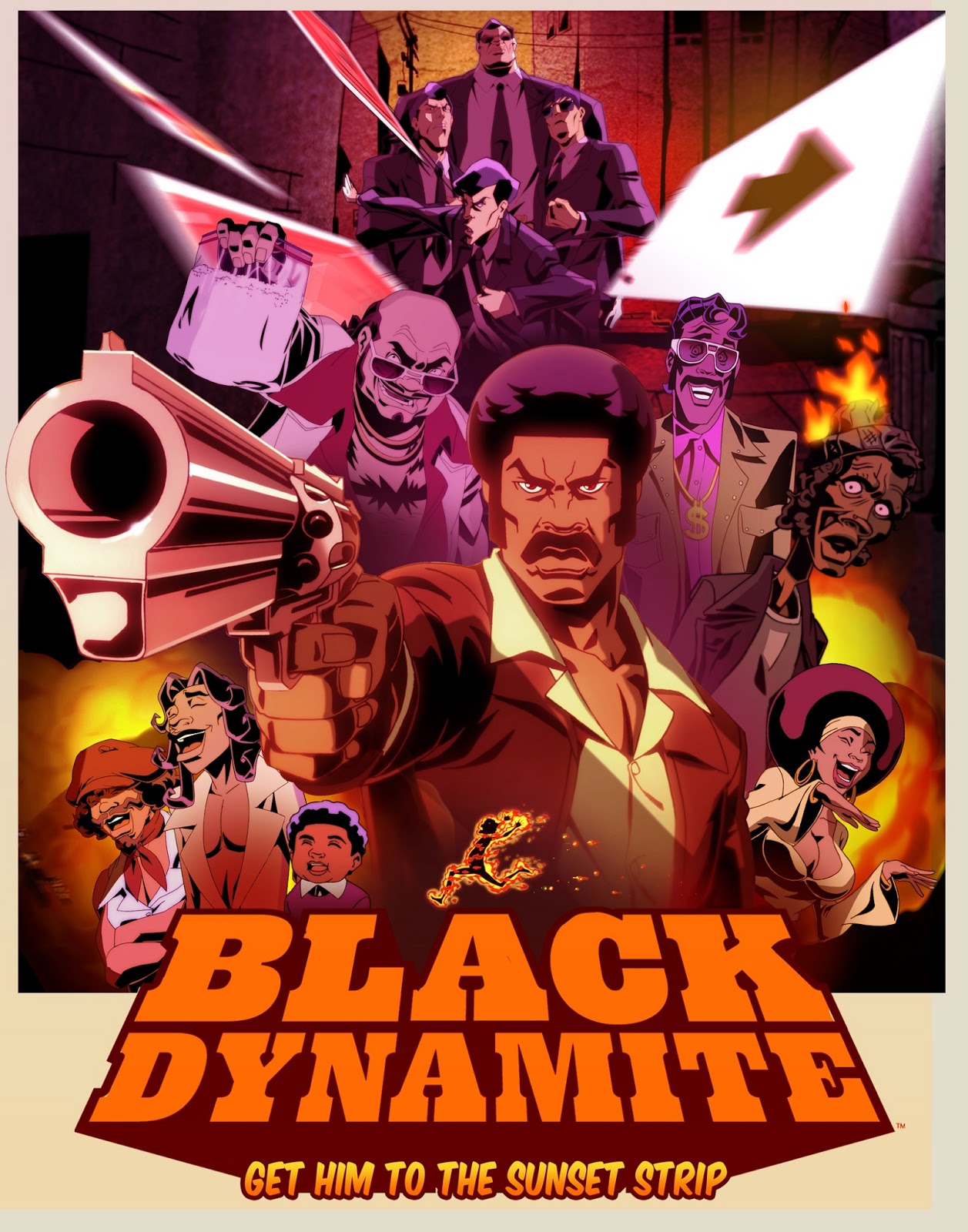
The 2009 motion picture Black Dynamite is, perhaps, my favourite movie of the past dozen years.  It's an on-point homage to Blaxploitation films, satirizing their low production values and sometimes less than professional acting, while at the same time embracing the extreme zaniness that low-budget action films frequently diverged into.  Most of all, it's incredibly funny, conceptually and in execution, in script, in action and in performance.  Everything clicks, everyone involved is in sync and seem to know what is being achieved.  It was an instant underground success, transcending cult, instead becoming pop-cult.  That it branched out into comics, weird web vignettes and animation oddly seemed natural, but I worried that the film was lightning in a bottle, unable to be recaptured twice.

The Adult Swim animated cartoon was announced shortly after the film was released and over the subsequent years I would see the odd article in a magazine or on-line about it's progress, occasionally seeing some test footage, and finally a preview prior to its release on Cartoon Network in 2012.  But, here, in Canada, we don't get the Cartoon Network, which means we don't get Adult Swim, which means we don't get some of the edgiest and wildest television comedy being made.  We have channels here that filter some of it in... Eaglehart, NTSF:SD:SUV::, Delocated, Superjail and the like have made it here, though definitely not at the same time as their airing in the US and definitely not repeated with the same frequency.  And no Black Dynamite as of yet.

But there is an app for that.  A very flaky Adult Swim app which has only five "pages" to look at which are switched out weekly, offering clips and "premium" videos (for US cable subscribers) and on occasion "5 FULL EPISODES" of some of their series like Children's Hospital or Loiter Squad. It's all welcome, but it was when Black Dynamite showed on the App that I did a little happy dance.  The happy dance was short lived though, as the (as mentioned) flaky app for some reason couldn't make it past the commercial that preceded the episode it was trying to show.   Finally, 6 days later, a Saturday if I recall, it was working, if only sporadically (it would crash every so often).  I managed to watch 2 full episodes and 2/3 of two other episodes before the App switched out its offerings later that day, and it was glorious.

The animated series is its own beast, treading in Blacksploitation tropes once more, but going well beyond that into ridiculous high-adventure, ala The Venture Brothers.  It's beautifully animated, perhaps the best going right now, capturing it's day-glo 1970's atmosphere with wondrous effect, and it's damn funny.  A handful of characters from the film are back and they're so on-model with their cinematic portrayal (with the actors reprising their roles), that it's a reminder of just how cartoony and silly the characters were to begin with.  The animated Black Dynamite takes its actions to the extreme, is rife with sexuality, drug use, swearing, and all those things those warnings before TV shows always promise you but rarely deliver.  It's also rife with pop-culture, the first episode I watched hinged around Black Dynamite taking out Mr. T who's still fighting a one-man-war in Viet Nam a few years after the war ended.  Another had Black Dynamite being chased by the IRS for not paying his taxes, and taking a security detail job protecting Richard Pryor.  It's everything I wanted from the Black Dynamite and so much more... all I could ask for is more of it (second season is coming, but that's not what I mean... where's the DVDs?)


And finally, there's YouTube original programming, by way of their partner channels, all of which seems to be the anti-television.  The only obvious restriction for YouTube seems to be overt nudity and pornographic sex.  It's a different beast to create quality programming for YouTube due to budget limitations, so programmers get creative and they get very niche.  Often YouTube channels come out of the "cult of personality" model, where one prominent celebrity (or ce-web-rity) anchors the entire lineup, and the other shows hope for spillover.

TableTop comes from Felicia Day's Geek and Sundry channel, created by Day (who made her name with the impeccable gamer comedy The Guild, the preeminent web-serial success story) and Wil Wheaton (ex of Star Trek The Next Generation, having rebuilt his name as geek icon over the past decade or so), taking the form of "celebrity game show" in a manner of speaking but instead of having one game to play, Wheaton and his guests play a different board game each week.

It's a show for anyone at all into board games, even if you haven't heard of the game in question.  Wheaton and his production crew do a remarkable job of explaining the game mechanics as well as booking a group of players (pulling notable personalities from comedy, acting, web, and gaming circles) who are enticed participants (if not keen gamers themselves).  I frequently use the show as shorthand for understanding the rules to a new game when playing with friends (I'm a terrible reader so instructional web videos are very helpful) and it works well in most cases.  Every episode isn't always great, sometimes the game doesn't interest me, or the guests don't gel together in the spirit of gameplay, but it bats about 90% winning ratio and Wheaton is a fun, competitive, but also helpful host, out to win but also to ensure everyone has a good time.  The only thing better would be playing one's self.

The latest episode sees Felicia Day and three other actresses back (for a 3rd time I think?), playing Resistance (a spy game in which two of the 5 players are anonymously trying to stymie the others), and it winds up being a rollicking good time.  It's in many ways like watching poker, only with the people involved far more lively and engaging one another with an eye towards being entertaining for the viewer.  While it may seem that one or two players have the spies in their midst all figured out, and that the spies have tells that are giving them away, by the end nobody is sure of anything.  This is easily the most enjoyable episode of TableTop, but I might be biased towards "Team Ginger" (I want a T-shirt!)


Oh, and I'm watching NHL Playoffs... without getting too deep, let's go with predictions:

EAST
Pittsburgh Penguins - New York Islanders => Pens in 4
Montreal Canadiens - Ottawa Senators => Sens in 7
Washington Capitals - New York Rangers => Caps in 6
Boston Bruins - Toronto Maple Leafs => Bruins in 6

WEST
Chicago Blackhawks - Minnesota Wild => Hawks in 5
Anaheim Ducks - Detroit Red Wings => Ducks in 7
Vancouver Canucks - San Jose Sharks => Canucks in 7
St. Louis Blues - LA Kings => Blues in 5