Showing posts with label procedural. Show all posts

Sunday, August 30, 2026

KWIF: Teenage Sex and Death at Camp Miasma (+3)

 KWIF=Kent's Week in Film. I also saw The Odyssey in true IMAX. It's a big movie on the biggest screen. I don't know that the viewing experience was all that much different than the first, other than I could see a lot more sand and sky.

This Week:
Teenage Sex and Death at Camp Miasma (2026, d. Jane Schoenbrun - in theatre)
Illustrious Corpses (or Cadaveri Eccellenti - 1976, d. Fracesco Rosi - bluray)
Pavements (2024, d. Alex Ross Perry - bluray)
Synecdoche, New York (2008, d. Charlie Kaufman - dvd)

---

Jane Schoenbrun's latest academic-cum-schlocky meta head trip opens with heavy breathing, and camera work implying we're watching from someone's specific point of view. It's every masked serial killer since... Jason? Michael Meyers? Leatherface? The intensity is ingrained when we watch from this perspective and hear the sounds of someone's breath reverberating inside a contained space. And then into view is tents and cameras and sound gear and crew, and someone steps very closely into frame and seems to be adjusting whomever it is that is behind the camera.  This should be our first indication that this isn't going to play out how we expect.

The opening credits - set to Okay Kaya's cover of R.E.M.'s Nightswimming - takes us through all the pop culture hoopla and paraphernalia of the (fictional) "Camp Miasma" horror franchise and it's vent-headed killer "Little Death". News articles, posters, video games, toys, websites, all detailing the rise and fall of the Miasma series, much like the 80's heavyweights like Friday the 13th or A Nightmare on Elm Street.  It's a series that had its day, and then it's corporate overlords kept trying to make it a thing, outstaying its welcome. 

This credits sequence is so information dense and so evocative it's easy to get lost in. As a pop culture and paraphernalia junkie, I just wanted to watch this opening on a loop five times over just to take it all in (my favourite bit is that "Little Death" released a much derided rap album). This density serves as an intentional disconnecting break from the film's initial imagery (and sounds). It's there, in part, to make us forget what we initially saw, so that when we meet Kris Williams (Hannah Einbinder) we don't suspect what the film will eventually be telling us.  

Kris stops in at a gas station convenience store, loads up on candy (so much candy, too much candy) and finds a random copy of "Camp Miasma VI" on DVD. When she checks in and asks the hotel clerk (Kevin McDonald) if there's a DVD player she could use, he lets her know he had a small part in the locally-shot film. We learn that Kris has been hired to be the director of the Camp Miasma reboot. The series has a problematic past in that its killer is problematically trans-coded and the studio execs want a queer director to reboot it for, well, optics.

Kris is in the Pacific Northwest to meet up with the original Miasma "final girl", played by Billy Presley (Gillian Anderson, adopting a thick Tennessee drawl... which I mean to say is she's doing Dolly Parton's accent...and laugh... RIP Dolly). Presley's been a recluse since declining to return for the sequels, and is basically a non-commodity, but Kris is infatuated with her, in particular the sex scene in the first Miasma film which was both a sexual awakening as well as kink origin story for her.

Billy, who now owns and lives on the camp grounds the original Miasma was shot, is introduced walking in on an obviously titillated Kris watching this scene. Billy is presented stepping out of the shadows, hair a vibrant golden yellow, lipstick a stark blood red, and an obscenely big hat, all making her look like a femme fatale straight out of a noir film.

This is all still very early in teenage Sex and Death at Vamp Miasma, and it's hard to fully describe what the actual experience of watching it is like. There is obscene, face forward product placement that, if it takes you out of the movie, it's acting as intended. If Anderson's just-shy-of-over-the-top drawl is almost too much, it's as intended. If you are, like I was, made to feel in awe of Anderson, to be reminded of how hot and iconic Dana Scully was in the X-Files then that too is intentional. It's all intentional and it's all part of the layers of artifice that this film puts on.

Kris is not at Billy's home just to recruit her for her reboot of the series, she's there for a more personal and intimate reason. She saw in a still frame of Billy's eye in that original film a look - at the crossroads of pleasure and pain - little death and Little Death. She's been fixated on this imagery and this idea and cannot get past it. Billy gets it. Kris has a kink that she's too ashamed to admit to, and she's a willing participant in unlocking that for her.  I don't think Anderson really cared for Scully being a sex symbol, but she certainly seems on board with making Billy Presley one. That there's a 30 year age gap between Billy and Kris hardly matters. There's no power imbalance, and nobody is taking advantage of the other. Consent is explicit.

The second act of the film finds Kris and Billy watching the original Miasma film, which Schoenbrun's spot-on riff on 80's slasher films (including making near-40-year-old Zach Cherry playin a teen sleepaway camp counsellor) is both entertainment and foreplay for them. The film-within-the-film (-within-the-film) explains the origins of Little Death, which dives into its own variation of the all-too-common transphobic origins of horror's cinematic murderers.

Schoenbrun examines the warping of young minds that comes with horror film's obsession with titillation and brutality, but from a feminine lens, not the masculine one in which most horror (particularly those of the 80's) were presented in. Schoenbrun doesn't cast judgement. That "Little Death" rises again and chases Kris (who intentionally doffs her clothes down to her underwear) all the way to Billy's rose-petal coated bed and skewers the both of them as they fornicate is all just part of the role play. It's not horror, it's leering and alluring. It's wrong, and yet, ok?

There's not a lot of direct horror in Teenage Sex and Death at Camp Miasma, but there is a lot of flesh and fluids, as Billy says. It is a satirical examination of horror as a genre... both a loving and biting one. It's almost a sex comedy, but also... not really.  

I am not well versed in 80's horror, nor do I have any first-hand familiarity with women's sexual awakenings (that I know of!), and though I've done some reading of trans media analysis, I too am not an expert in that to comment extensively in the context of this film (critic Willow Maclay's review is exceptional from that context), so ...Camp Miasma is, in some respects, not in any way meant for me, a straight, cisgender, horror-averse man. But at the same time, it's also not throwing a hand up to explicitly excluding me either. 

Beyond the aforementioned themes of film and sex and transphobic media, it's also asking the audience, whomever you may be, to think about voyeurism, about what it can mean to be the watcher, or to be watched. How do these different perspectives impact us? What does it mean to look...is it leering? Is it desire? Is it judgement? And what does it mean to be looked at? Is it affirming? Is it off-putting? Is it exciting or upsetting? And where does context fit into all of that?

It's only once Kris reports back to the studio big wigs her progress on the film, kicking off the third act, that we start to understand the context which the film has actually been presented to us all along. Kris insists it's not "meta" but it very much is. The artifice is also the substance. I don't think a film has thrown me for a loop this befuddling and inspiring since Synecdoche, New York. 

It's a fascinating picture, deep in thought, with multiple themes playing in concert together (including Schoenbrun taking some jabs at the Hollywood intellectual property machine), each that could be picked apart and analysed from an academic perspective, but at the same time being playful and having fun with it all, not taking itself too seriously.  

...also, fyi...miasma: a heavy vaporous emanation...
---

I have been dipping my toe into giallo movies the past little while, a very tentative dip that likes the temperature but still won't commit to jumping in with full gusto. The Italian murder/mystery subgenre of film is pretty vast with many names of directors and stars swimming in the pool (if you'll allow me to extend this metaphor), it almost feels too crowded to just dive in. Amid all the splashy titles, and the plentiful boutique physical media labels just trying to sell their wares, it's hard to know what's truly worthwhile, it's like I need a coach at the end of my lane to tell me where to turn (ok, I've lost a grip this metaphor).

Illustrious Corpses was a recommendation on the relatively new-to-me (but not new overall) podcast The Big Picture from regular Chris Ryan... a recommendation that would test whether he was a trustworthy source or not. Turns out this film isn't a giallo at all, but the recommendation was still a good one... nay, a great one.

The film opens in the real Capuchin Catacombs, looking at real desiccated corpses. It's a stark visual but not one meant to scare or frighten. The character, an older man with a real lived-in face, looks deeply into the mummified faces, intrigued and ponderous. He leaves and is promptly assassinated. It turns out he was a prominent judge. Assigned to his murder case is Inspector Amerigo Rogas (Lino Ventura, another very lived in face, but with a little more mileage left to go).  He monitors the big, stately funeral, and suspects, maybe, mafia connections were to blam. In the streets, youthful protesters decry the dead man as being connected to the mob.

As Rogas investigates, there's another murder, another judge. And then a third. Rogas starts piecing together that the three judges were connected by more than profession, there is perhaps a vengeful aspect to this string of killings. But as he digs into these men, he starts uncovering information that might not be directly relevant to the case, but certain powerful people want to keep buried.

Soon Rogas' hunt finds the tables flipped. There's potentially a conspiracy afoot, and not only isn't it something he cannot solve, he may not be able to get out from under.  

I may have mentioned in my review of Dario Argento's The Five Days  that my knowledge of Italian history is verrry slim, so the backdrop of Illustrious Corpses, the political tensions involving student protests, labour shutdowns, neo-fascism and a burgeoning communist undercurrent are all pretty new concepts to me, but director Rosi certainly captures the mood. The vociferous chants of protests are a common soundtrack to the picture tell of a country ready to explode, and more than once we catch wind of a government doing everything it can to keep such an explosion from happening, even if it means scuttling a murder investigation or three (and committing a few more of their own).

What starts out as a high profile murder investigation soon bursts into full-blown '70's conspiracy thriller, and it is pretty incredible. Ventura's Rogas starts out so cool and assured, so observant and above it all, and we slowly watch that confidence, that comfort, that sense of being untouchable erode away and, eventually, collapse into the sea.

Director Rosi and his cinematographer Pasqualino Del Santis frame everything in beautiful, massive, old spaces, as if Italy itself is constantly threatening to consume our primary characters. We often see Rome and Venice in film, but Rosi takes us to many different locals, each with their own charm, some decadent, some rugged. The camera's gaze, often, is snapshot worthy, even if the innate colour tone is almost always some shade of brown (with maybe a hint of blood red).

This was a total surprise, as I had settled in for a delightful picture about a crazed murderer and instead felt the wave of historical anxiety and tension Rosi so ably builds overtake.  It's up there with the best of the subgenre, a real damn surprise.

---

Pavement was never my band. I enjoyed the few songs I heard of theirs back in the heyday(s) of my indie-rock years (about 1993-2011), but never actively pursued them, never owned an album. I was always just happy to hear a new tune every few years, but always felt listening to too much of them would perhaps sour what I did enjoy.

I have to say, watching director Alex Ross Perry's 128 minute avant garde "documentary" on the band was the most time I've committed to the band since first hearing "Cut Your Hair" back in the mid-'90s.

In Pavements we have:
- A behind-the-scenes document of the 2022 reunion tour;
- An archival footage retrospective;
- A making of the cliche-laden Hollywood biopic;
- A behind-the-scenes telling of Alex Ross Perry's attempt to launch an off-Broadway jukebox musical adaptation of the band's music; and
- The opening of a celebratory museum gallery tribute to the band and their history.

It's a lot to string together into anything approximating a cohesive narrative, but editor Robert Greene gets pretty close, and in the end, for all the fake productions attempting to mirror reality (the Hollywood biopic is completely fake, the musical is a bit of a tongue-in-cheek cheeky production, and the museum is not entirely fake but constructed for the purposes of the film), it winds up somewhere honest and tributory without being overly sentimental or fawningly admiring.

At once pretentious and silly, there perhaps too much facade to Pavements and not enough introspection/retrospective to function as a satisfying introduction for anyone not familiar with the band, or, for someone like me who only ever flirted with them, never committing. 

It's pretty clear though, frontman Stephen Malkmus was never going to approve of anything remotely standard, nor was he going to sit for anything approximating a conventional interview, and had little interest in assessing his band's, history or his own.

As is, I think this one is for the fans.

 ---

In referencing Synecdoche, New York in the above Teenage Sex and Death at Camp Miasma review I was reminded how long it's been since I last watched the film, a time which predates this blog.

The impact of Charlie Kaufman's directorial debut never left me, although the majority of the details had long since faded. Was the comparison even apt between these two films? Am I just a fake critic who really doesn't know what he's talking about? A. Yes and yes. 

Much like Miasma, Synecdoche... is a very personal journey through the working thoughts of a director's brain. I don't think if Kris in ...Miasma or Caden Cotard in Synecdoche... are fully meant to be stand-ins for the directors of their pictures, but both are certainly speaking for the director.

While the themes are somewhat different, I still see synergy in how they approach their stories, layers of surrealism to inform the viewer that what they're about to see, that the world the characters in the film inhabit is a skewed depiction of reality.  Schoenbrun is more obvious about it in ...Miasma than Kaufman is (at first) but when Kaufman wants it to be known, he hits you with a literal house on fire.

The story of Synecdoche finds Caden (Philip Seymour Hoffman), a successful theatre director, inhabiting a life that's falling apart, but he's kind of oblivious to it, a passive player in a way. His wife Adele (Catherine Keener) is an artist who leaves him to exhibit in Germany, taking their daughter with them. She had been pretty disconnected from any engagement with him (though as we learn more about Caden, the disconnect seems to have started on his end). Caden also has had a string of maladies plaguing him that seem to reiterate his view that death is waiting specifically for him.  He flirts with Hazel (Samantha Morton) at the box office but he can't seem to take action even when Hazel couldn't be more direct about how she feels about him. His young actress from the play, Claire (Michelle Williams) is utterly infatuated with him, and at first he knows it's a line he cannot cross, but he crosses it when Hazel moves on from him. 

Caden gets a sizable grant to produce the play of his dreams, a very personal work, a play about death coming for us all, but the only story he knows to tell is his own, and so the world around Caden is largely shaped by his own reality, a mirror within a mirror within a mirror, without any real sense of identity or direction. Soon the world within starts to bleed with the world without and the become intractable. The one area of his life he proactively controls, he loses control of, and he needs someone else to step in and take over as him... and it seems the most comfort he has ever had in his life is when someone else tells him exactly what to do.

Time, in Synecdoche, New York, is the main thematic element. Kaufman lets us know without any exposition that time is passing in Caden's life and he's missing all of it, stuck in routine, stuck in ruts, stuck in his own mind, stuck in his own obsessions. The opening scene takes place over the span of the month, but plays as if it were one continuous scene. It's not obvious, but it's there. When Adele leaves, Caden thinks she's been gone a week or two, but Hazel tells him it's been a year, and she's not coming back, and the fashion magazine moments later tells us it's been two years.  Time in the film keeps moving like this, and Caden keeps losing track of it because he's so insular, so fixated on his own fixations.  The film spans Caden's life as he begins middle age to his very old age², and it seems to go by so fast.

In creating a lasting work of art, Caden misses out on actually living his life. His work misses the larger patches of what's going on in the world (things are bad outside of the confines of the warehouse he's operating out of, as implied by the increased military presence on the street, with no context given because Caden can't be bothered to pay attention to it). I'm not certain if this is Kaufman's specific point, but there's a reading that only drawing on one's own life for the sake of art can lead to one's art consuming one's life (as well as an obsession with not dying might result in losing out on actually living).

This is both a deep and purposefully obtuse movie. Kaufman is a very intelligent writer who obsesses about his own mindset and his career and the immediate world around him, and perhaps this is a self-criticism, but also with the awareness that he can't see another path for himself. Death is the inevitable. The end is prescribed at the beginning. 

I didn't really understand Synecdoche, New York when I first saw it. I understand it only a little better now, but I love the puzzle of it. A marvelous film.

---

Monday, July 7, 2025

KWIF: A Minecraft Movie (+4)

 KWIF=Kent's Week In Film.  I thought being away from home for the better part of a week with pretty much nothing but time on my hands would mean I would be watching a ton of films, but, turns out, not so much. In fact the first two films on the list below I watched before I left for my trip. But then, upon my retrun, I did a rare triple stint at the theatre in one day because I wasn't ready to return to the usual day-to-day yet.

This Week:
A Minecraft Movie (2025, d. Jared Hess - crave)
Warfare (2025, d. Ray Mendoza, Alex Garland - amazonprime)
The Phoenician Scheme (2025, Wes Anderson - in theatre)
The Life of Chuck (2025, Mike Flanagan - in theatre)
Daniela Forever (2024, Nacho Vigalondo - in theatre)
---

I really had no intention of ever seeing A Minecraft Movie. Trailers made it look like a CGI nightmare with overblown performances, and the unofficial "rowdy" screenings of TikTok kids memeifying "S
TEVE!" and "CHICKEN JOCKEY!" certainly wasn't any further enticement.  But a funny thing happened on the way to avoiding the theatre... not only was A Minecraft Movie an absolute monster of a blockbuster motion picture, but some critics who I trust...well, by all that is squarely, they enjoyed it.

Both my kids (now a teen and an adult) played Minecraft and were avid fans. Neither wanted to see the movie.(because they're now a teen and an adult), which, really, wasn't all that surprising. Maybe it was a little disappointing as it's hard to find common ground and experiences with these ones these days. But as I do, I forged onward on my own and...waited for it to hit some streaming platform that I was already subscribed to and then proceed to watch the dang thing over 8 days in at least 4 different sittings.

The opening 20 minutes of A Minecraft Movie (well, once they get past the detail-stuffed intro, anyway), I genuinely adored. Jared Hess, creator of the wonky worlds of Napoleon Dynamite and Nacho Libre was at it again, creating a kooky near-reality that's just a notch or two askew from our own world. I liked the introduction to former video-game prodigy now nostalgia marketer Garrett Garrison (Jason Momoa) and orphans Natalie (Emma Myers) and Henry (Sebastian Eugene Hansen) who are new to town.  The vibe of this part of the movie reminded me of early Taika Waititi, especially Eagle vs. Shark, which is no great surprise given that the film was primarily shot in New Zealand. New Zealander and Hess regular Jemaine Clement puts in a delicious cameo as a storage locker owner who wants nothing more than to be besties with an oblivious Garrett.

Garrett decides to take outcast Henry on as mentor, and his efforts to teach him, well, anything of use are pretty hilarious. Momoa has a specific persona he usually channels, but this is decidedly not that. Instead he seems to be calling upon Patrick Warburton's Puddy from Seinfeld mixed with Jack Burton from Big Trouble In Little China.  Whatever his inspiration, it just may be Momoa's finest comedic performance.

It's all so unfortunate then that going into the Minecraft world, encountering Steve (Jack Black), and facing off against the pig-things that are trying to take over that reality. The film basically forgets about making any of the character arcs meaningful in any way, and just goes about having a goofy time in this strange blocky world. It wavers wildly between amusing and dull and stupid-in-a-good-way and stupid-in-a-bad-way. I love Jack Black, but the script gives Steve nothing for him to hang a character off of, so he's basically just Jack Black's stage persona. (I also find it funny that "Steve" is the player character of classic Minecraft, a real blocky dude, and they hire one of cinema's most notoriously round performers to play him).

I have to admit I loved Rachel House's voice work for Malgosha, the head pig in charge. The character design for Malgosha was also pretty incredible as I was constantly questioning whether it was a practical costume, or completely digital, or a combination.  I also thought the same of the "Nitwit" villager (mind-blowingly portrayed by Oscar winner Bret McKenzie and voiced by Matt Berry) who escapes into the "real" world and is, literally, picked up by Jennifer Coolige's lonely divorcee. Those Nitwit sequences are so ridiculous, but Coolige sells the lunacy of it so well.

In a 100 minute movie, I would say that maybe 40% of it (maybe even 50%) was pretty entertaining, and at one point, early on, I was wondering if we had maybe another Lego Movie on our hands... it's not even close to being as good as The Lego Movie. That it's even as good as it is is still kind of a minor miracle. I mean...what else could a live-action Minecraft movie look like? I certainly can't think of anything much better, but I can think of far, far worse.

[Toastypost - we disagree, and yet, also agree]

---

Warfare kind of snuck into theatres unannounced, and left just as quietly, and hit AmazonPrime with about the same amount of fanfare. Recalling the war in Iraq, and specifically the American side of that war, in this year of 2025, was something most people weren't at all interested in partaking in. I should have known coming from Alex Garland that it wouldn't be "rah rah 'merica", and even still it was only with the most hesitant of clicks that I pressed play.

Warfare proved quickly to be an intense military procedural/fight for survival starring a rich swath of fantastic actors pulled straight from some of the best TV shows of the decade so far. You've got Reservation Dogs' D'Pharoah Woon-A-Tai, Shogun's Cosmo Jarvis, Joseph Quinn from Stranger Things, Daredevil: Born Again's Michael Gandolfini, Kent household favourite Noah Centineo, Finn Bennett from Season 4 of True Detective and more. It's a really impressive cast that really didn't need to be this impressive for what its acting its performers to do, but still, I'm impressed.

The real challenge here was to make a picture about the misbegotten war in Iraq that doesn't glorify it or its participants, while also not outright villifying them either, and it succeeds surprisingly well.  It is a compelling and nerve-shredding film that shows in excruciating detail the horror and intensity and violence and consequences of warfare, especially in residential sector. Still, telling the story from an American vantage point remains is the film's biggest barrier to entry in the current political climate. But the film is based on the true recollections of some of the soldiers involved in the incident, including co-director/co-writer Ray Mendoza, who Woon-A-Tai plays in the film (Mendoza happened to be the military advisor on Garland's Civil War, which is how this project came about).

The most impactful part of this movie is one word... "Why?" To which the SEALs on screen, and the film itself have no answer. 

---


Binary statements like "you either love Wes Anderson movies or you don't" have become increasingly annoying to me as they are completely incalculable, devoid of any gray area, and well  fundamentally untrue. They are statements made by lazy writers (like myself, certainly) to try to simplify arguments to two simple sides.  It's like saying "you're either liberal or you're conservative" and that takes out all the nuance of life and thought and opinion.

That said, everything within me really wants to argue that people who know Wes Anderson's work either love it unconditionally or don't understand it, but such a statement just cuts out the majority of the potential film-going audience by really only referring to the minority of people who pay any attention to filmmakers and the work they do.  That statement also presupposes that no matter the quality or content of an Anderson film, that one side of the coin is predisposed to loving said film, while the other will hate it or just avoid it altogether.

Even as I know this argument to be false -- since I really disliked Moonrise Kingdom and Rushmore does nothing for me so I know there are shades of grey in Anderson's fandom -- I still want to proclaim that if you're an Anderson fan you obviously have to love The Phoenician Scheme, and if you don't like Anderson's work, why would you even waste your time with it at this point.

I stepped into The Phoenician Scheme ready to love it by nature of just being a Wes Anderson movie. I was placing myself into the love side of the "you either love Wes Anderson movies or you don't" binary fallacy, convinced that, no matter what I would come out of the picture feeling enriched and delighted.

Turns out, not so much. If you were to ask me, right now, The Phoenician Scheme sits above Moorise and Rushmore and maybe even Isle of Dogs and Bottle Rocket, but it's definitely in the bottom half of ranking Anderson's oeuvre for me. 

The reason is largely because I had a hard time following the movie, which is not something I generally have difficulty with. I mean, I understood Tenet without even having to think about it that hard. But The Phoenician Scheme is absolutely loaded with Anderson's rapid-fire expressionless patter that moves so quickly and is so information dense that it's hard to extract, at least upon first viewing, what is important about what is being said. There's no doubt that all of it is completely sensible to Anderson, but in the conveying to the audience it is bound to overwhelm.

As well, the titular scheme upon which the film revolves around, well, I never quite got it. It's the reason that problematic industrialist Zsa-Zsa Korda and his daughter (or is she) and heir (on a trial basis) Leisl (Mia Threapleton) make the adventurous journey they do, making five stops to different investors in the scheme to try to convince them to cover the gap made after a consortium of governments raise the price of rivets to negatively impact and possibly scuttle the scheme. Zsa-Zsa, it turns out, is not really a good guy, and Leisl, a convent-raised nun-to-be, seems well aware of his reputation.

The journey, then, isn't so much about the scheme but about a father and daughter connecting, bridging the gap between cold-hearted capitalist and possible murderer, and a selflessly altruistic pacifist. The thing is, though, the scheme eats up so much screen time and dominates the balance of the film that the familial engagement seems secondary. But when the film ends, its coda makes it pretty explicit that it was about Zsa-Zsa becoming a father and finding joy in life as opposed to riches. It's an anti-capitalistic tale, I suppose, but definitely an unfocussed one.

The performances are all great. Anderson's very specific way of writing his character and directing may seem limiting at first blush, but it frees them to do some very, very silly work with the sternest of poker faces. Michael Cera is the obvious highlight, and to say why would be spoiler-y, but you will know it to see it. It's amazing he's not been part of Anderson's cabal of performers before this, but he's a natural fit. A lot of Anderson's newer stable of regular performers like Jeffrey Wright, Tom Hanks, Bryan Cranston, Scarlett Johansson, Mathieu Almaric, Richard Ayoade, Benedict Cumberbatch and Rupert Friend all have smaller but delightful parts to play in this, and longer-term Anderson regulars like Bill Murray and Willem Dafoe have basically glorified cameos. It's actually a great thing that Anderson branches out on a regular basis and doesn't rely upon the same stable time and again, as accusations of "sameness" would be further emboldened.

If ever you wondered what a Wes Anderson action-thriller would look like, well, it looks like this...a Wes Anderson movies. Alexandre Desplat's score is full of ominous and foreboding notes on either end of the piano that feels like it was ripped out a Hitchcock thriller or an British espionage tale of yore. The score both affirms the subgenres Anderson is referencing, but it's also a comedic juxtaposition to the arch tone that prevails through most of Anderson's films. It's a great score.

It's not an entirely successful movie, but if you're an Anderson fan you will enjoy it far more than if you are not.

---

If I see a movie weeks after it has released (sometimes even days after) it's hard for me not to write my reviews completely shaped around the critical commentary I've read/heard, or the reactionary headlines or Letterboxd hot takes. I'm steeped in film commentary in my podcast routine and my socials, less than some but more than your average person is, for sure. So I know that The Life of Chuck has been a pretty divisive movie. A lot of the reaction has been very positive towards it, praising it for being a rewarding, enriching, life-affirming experience, while a large amount of critical reaction has tossed it as cloying and overly sentimental.

Either way, these are not criticisms you typically hear about something adapted from a Steven King story. Nor are they really descriptions you would find for a typical Mike Flanagan project.

And yet The Life of Chuck does have aspirations to being a somewhat sentimental and life-affirming experience, despite its opening act (labelled as "Act Three") that basically presents the end of the world from the perspective of the characters in a mid-sized mid-American city and through the eyes of teacher Chiwetel Eijiofor and nurse Karen Gillan. The internet has stopped working, California has fallen into the sea, the food-producing areas of the world are being devastated by floods or fires or drought, it's all coming to an end much faster than anyone expected. It's heavy and it sucks, and people are trying to go about their daily lives, but what does any of it really matter? And yet, perplexingly, billboards, radio ads, TV ads start popping up "Charles Krantz: 39 Great Years! Thanks, Chuck!" What does it mean, as the stars blink out of existence?  It's intriguing and perplexing.

The second act steps back with narration from Nick Offerman providing colour and detail on the characters we see on screen. Taylor (Taylor Gordon) a Julliard drop-out sets up her drum kit on a Saturday, ready to perform for the day, yet after 40 minutes not quite feeling it. Meanwhile accountant Charles Krantz (Tom Hiddleston) is on break from an accounting conference and feeling a bit dispirited. And Janice (Annalise Basso) just receives a break-up text from her boyfriend who she didn't really even like that much and she storms through the town's promenade. As Chuck approaches Taylor, she starts to match his pace with her drumming. It catches Chuck's attention and draws him near. It eventually breaks into dance, and Chuck's exceptional dancing fires up Janice who joins him and they tear the street up with Taylor's amazing rhythm. It's a simple moment of people needing joy and spreading joy and it leads to a moment of connection. What you extrapolate from that is probably very individualistic, but after the end of the world, to step into something so expressive as rhythm and dance, it's genuinely moving, unless you are at your utmost cynical.

The third act steps back even further in Chuck's life. A lot happens in this "Act 1" to bridge what we've seen and been told in the previous two acts, but we witness Chuck as a child (Benjamin Pajak), his life married with trajedy, learning to love dance with his Bubbe (Mia Sara), and then take it up as an extracurricular at school and become exceptional at it. The segment centers a lot around his grandparent's house and specifically the cupola which is locked and ruled off-limits by his Zadie (Mark Hamill). Zadie tells him, one night when he's deep in his cups, that there are ghosts in that room, ghost of the past and future. It's only years later after Zadie's passing that teen Chuck (Jacob Tremblay) learns what he means. But the lesson, presented to him by a bohemian teacher, and the crux of the film, is that life should be lived to its fullest, that we can be wonderful, that we deserve to be wonderful, and we contain multitudes. It's a mantra that, we see from act 2, is hard to keep in mind as life and career and family and the world weigh on us, but if we remember, we can experience something, shape something, build something at the very least inside of us, if not outside as well.

As a production the author's voice is much more Flanagan than King's, but the story got the horror maestro's fingerprints all over it. Flanagan has adapted King enough times, and his work is so King influenced in general, that sometimes it hard to separate the two, but Flanagan's voice is unique and shows up prominently in the execution. His penchant for long monologues and his emotional connection to his characters are much more a part of his storytelling than King's as evident here.

Is it sentimental? I suppose it is, but I didn't find it overbearingly so. Is it saccharine? Not at all, nor is it cloying or preachy. But I get why it is divisive. It's a film that presents an end of the world scenario in a time where things are as challenging and bleak on a global scale as they have been since world wars were happening. It's all so overwhelming and dire, that a film like this, a movie that dares to say in the face of all of that, at this time, that there's still something about living life on this planet that is truly wonderful...I get how hard that is to accept.

And yet, the notion itself is lovely, even if I am challenged myself to accept it. I'm glad it exists, I'm glad that King and Flanagan have put it out into the world, that is is seeded there to make even one person's life a little better. I liked this movie. I was moved by it.

---

The most prominent works of director Nacho Vigalondo are Colossal [a film covered by both David and myself on this blog] and Timecrimes, a film I have seen and written about but in the world before this blog.  The former was a high concept drama that connected the troubled life of an American woman with Kaiju attacks in South Korea. Timecrimes was a twisty Spanish thriller about a series of unfortunate events that collapse in on themselves as time travel gets involved. In both cases, they are rather high concept stories, the former much more of a dramatic production and character study, while the latter was perhaps more playful and energetic.

I don't know that I loved either film, as neither sits fondly in my memory, and yet, I think I genuinely respect Vigalondo's approach to genre. Maybe his execution falters, but conceptually, there's definitely a lot of meat on the bones and he clearly isn't interested in repeating what already exists.

His latest film, Daniela Forever, is more akin to Colossal than Timecrimes. It is a high concept sci-fi story rooted in character drama, executed with a lower-budget, but never lacking for ambition. Here Henry Golding plays Nicolas, a British DJ living in Madrid who has recently lost his girlfriend, Daniela (Beatrice Grannò) after she was hit by vehicle. A year has passed since she died but he is still deep in grief and depression. He is recommended by a friend to an experimental drug trial which is designed to engage the user in a new form of Lucid Dreaming. Nicolas doesn't follow the treatment plan and the dream cues provided to him, instead he learns he can build a world in his mind, one where Daniela still exists.

But the deeper into his trial regimen he goes, the more time he spends with this construct of Daniela in this construct of Madrid, the more it starts to escape his control.

Unlike The Life of Chuck, I went into Daniela Forever totally cold, having not even seen the trailer nor read or heard a single review. It's a rare experience where a film has every opportunity to surprise me, and it never truly did. It never lost my interest, but I also never felt it pushed itself or its concept like I wanted it to. At its root, Nicolas is lost before the story even starts, there's no hope for a positive outcome for him. I've seen too much Black Mirror for this to go well. And that is this film's biggest challenge... distancing itself from Black Mirror. 

We've seen enough stories of loss and grief and reviving loved ones through technology in Black Mirror, this story does the same but through chemicals. So there's a familiarity to the story and a sense that we know where it is going, even though we shouldn't, even though it should really be a story that exists in a constant state of revelation.  I couldn't help but find it a little predictable.

What Vigalondo does to distance itself from Black Mirror is all in style. The director makes the choice to film the "real world" sequences using (I don't know the technical specs here), like, 1970's TV cameras. They are presented in a 4:3 ratio, staged and composed like soap operas, and every second the format was used I was questioning why. It looks, flat out, terrible. It's a terrible aesthetic. When it was the only TV aesthetic we had, we were conditioned to it, but in this high-def 4K world we live in, it's so hard to look at. I found it highly distracting and unpleasant. The dream-state however looks gorgeous, Madrid looks lovely, even the areas that Nicolas has never seen that are "greyboxed", like TV static.

Golding has to do all the heavy lifting here as our central character and he really succeeds at times, yet goes a step or two beyond what's necessary in some scenes. It's hard to tell whether those are a result of directing, script or performance, but there's times where there seems to be a lack of control. Grannò has the harder task of performing a character who is a construct, easily manipulated by the man whose mind she exists in (there is a darker edge to this story that it never actually reckons with). 

The film end (or attempts to end) on a high note, but it comes at the expense of ambiguity and obfuscation that I believe the director wants to leave the audience with something to think about but I don't think provides the right keys to unlock it. 

As much as I sound frustrated with it, I did like it more than Colossal, in part because even the weird stylistic factors engaged me. I wish it were more twisty and fun like Timecrimes (a movie I really need to watch again) and I wish I could trust that the director really knew everything that was going on in his story. At the same time I appreciate Vigalondo's desire to create a sci-fi story that is small but feels ambitious. I applaud the effort if not all of the results.

Friday, June 27, 2025

KsMIRT: well...maybe I do

 KsMIRT=Kent's Month in Reviewing Television in which Kent (that'sa me) reviews the television series he watched in the past month (*cough* April *cough*) in the patented 1-1-1 format. I have been writing these things rather expediently at the beginning of each month and yet, for some reason, sitting on them for weeks (and weeks), and posting them at the end of that month, so they're, like, a month behind (*cough* now, like, three *cough*). Whatevs. Let's do this:

This Month:
The Residence (8/8 episodes, Netflix)
Mythic Quest Season 4 (9/10 episodes, AppleTV+)
Yellowjackets Season 3 (7/10 episodes, Crave)
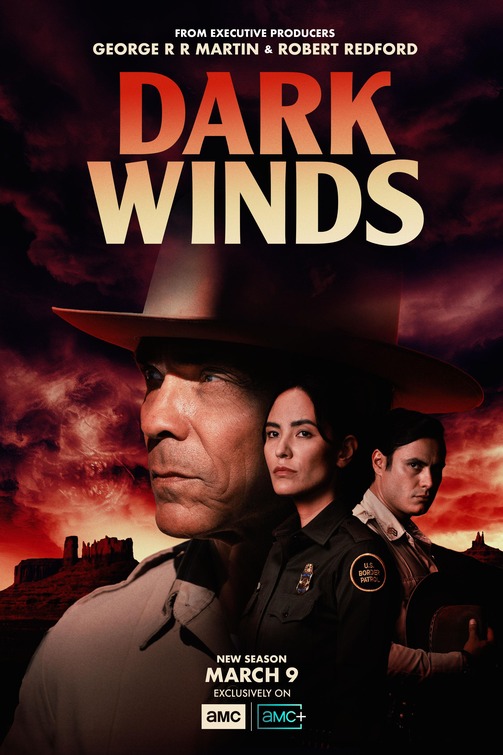
Dark Winds Season 1 (6/6 episodes, Crave)
Daredevil: Born Again Season ? (9/9 episodes)

---
created by Paul William Davies

The What 100: There's been a murder in the White House (not the president this time) during a state dinner with the Australian Prime Minister. The victim is the Chief Usher of the White House (Giancarlo Esposito) and the suspects are plentiful with, like, 60 staff members and residents plus nearly 200 guests. Given the sensitivity of the issue the chief of the Metro PD calls in a favour and brings world renowned detective Cordelia Cupp (Uzo Aduba) on the scene where she takes control locking the premises down for as long as she can against mounting opposition and unrest.

(1 Great) I haven't ever really considered myself a big fan of murder mysteries, but the recent spate of eccentric detective mysteries like the Poirot films, Knives Out mysteries and, especially, Poker Face have certainly brought me closer to fandom. Uzo Aduba makes for a wonderfully eccentric detective, as Cordelia Cupp obsesses as much about her birding as she does the case, and often applies her vast knowledge of the birds of the world to the case at hand.  She is exceptionally observant, patient, and never gets ahead of what she knows (she never identifies a suspect, more just persons of interest). She's certainly not a people person, but at the same time, Aduba manages Cordelias frankness as something more charmingly humorous than rude or abrasive. She puts some very powerful people in their place.  8 episodes is a long time to maintain a murder mystery like this given that most of these kinds of stories are done in a 2 hour movie or 1 hour TV show format, but the show makes it less a whodunnit and more about Cordelia's process.  She's an exceptional detective and she knows it, and has a little bit of an ego about it, but it's also clear she enjoys the challenge the work brings.  I also appreciated that amidst it all she remembers that there's an actual person who lost their life in all this. It's a pretty breezy watch.

(1 Good): I do find myself enjoying these big ensemble murder mysteries, and here we have a sizeable cast of recognizable faces. They're not all big, big stars, but if you've watched any TV/streaming in the past decade (or even just the 80's) you're bound to recognize at least a half dozen faces, if not more. You've got Jane Curtin (3rd Rock From the Sun), Jason Lee (My Name is Earl), Bronson Pinchot (Beverly Hills Cop), Isiah Whitlock Jr. (The Wire), Randall Park (Aquaman), Ken Marino (Party Down), Taran Killam (Saturday Night Live), Al Franken (Saturday Night Live), Eliza Coupe (Happy Endings), Mel Rodriguez (Last Man on Earth), Mary Wiseman (Star Trek: Discovery), and even Kylie Minogue as herself, among so many others. It's a sprawling cast that makes you point and say "heeyyyy!" over and over again throughout the first episode or two, and nobody is so obviously outsized compared to the rest to be the immediate obvious choice for who did it.

(1 Bad): I really did enjoy the show, quite a bit, and found it really, really easy to digest. Buuut... it was too long, and there were obvious points in the show that felt like padding. There were at least three lengthy cold opens that take place outside the central mystery, starting with the opening of episode 4 which finds Cordelia on Hawaii teaching her nephew birding. It's a nice mini-story in itself, but it really hastens the narrative thrust of the central mystery.  Likewise, the framing device of a Congressional hearing about White House security turns the whole story into a retelling, and, again, it was unnecessary. It is where we get former actual senator Al Franken and Eliza Coupe sparring with each other, but I don't think any aspect of this framing device was really servicing the story. This could have been 6, or even 5 episodes easy. 

META: The final episode is almost 90 minutes, so, movie length. The majority of this episode is Cordelia assembling her shortlist of persons of interest (not suspects) and then walking them painstakingly through the events of Chief Usher A.B. Wynter's death. It really is a tremendously convoluted mystery and there's no way the casual observer could figure it all out given the clues presented, because there's still clues revealing themselves in this final episode that tie it all together. It mostly works, but if there are more Cordelia Cupp adventures, it can't be a repeatable formula.  I would hope a future series might be movie length individual adventure (Columbo/Sherlock-style) or a series of shorter, tighter mysteries.

---

season 1 | season 2 | season 3


The What 100: Ian and Poppy have returned to Mythic Quest but are the runners-up to their former protege Dana who has a massive hit on her hands with Playspace -- a game development tool and user-developed-game sharing hub -- and developed a massive ego along with it...but is seeing none of the monetary rewards. Jo and Brad have gone all-in on backing Dana, but find even their considerable abilities to manipulate David has its limits. David and Rachel are called before Congress regarding an inquiry on whether Playspace is actually child labor. It goes poorly. Oh and Poppy has a boyfriend...and then gets pregnant, and Ian just can't handle it.

(1 Great): This season of Mythic Quest has been, generally, quite fine, and consistently so. It's settled into its character types and their dynamics pretty well and knows how to get the mileage out of them for a lot of chuckels, chortles and laughs. The season's best episode, though, is "The Fish and the Whale", episode six, which finds Brad attending a poker night at David's house thinking he can completely shark David, and win Dana a release from her contract. David's space, vintage 70's decor through-and-through is perfection, and the local first responders that he's assembled as his poker crew, who genuinely admire him no less, baffle and dismay Brad to no end. Danny Pudi's narration certainly recalls the classic "My Dinner With Abed" episode of Community, mainly in how it stands out from the normal structure of the show. Pudi usually only gets the spotlight once a season, but he always makes it count, and David Hornsby is really the show's secret weapon. He's the Charlie Brown of the series, so it's always tremendous when he actually gets to kick that football.

(1 Good): The second best of the season is "Villain's Feast" where the gang are summoned to a murder mystery party by a mysterious benefactor, and sussing out the benefactor becomes more of the objective than the murder mystery. Everyone's dressed up and the manor that the episode is shot in is perfection. It's a real work-outing detour of an episode which allows all the main cast to interact with each other and to really hit those dynamics hard. As noted above with The Residence, I'm liking a good murder mystery and this one is so silly and fun.

(1 Bad): It's not a bad season, but the past three seasons of Mythic Quest have all had a definite highlight in their stand-alone episodes which usually travel back in time and explore characters and subject matter almost tangentially related to the show. Lady Kent and I were really anticipating such an episode this year, and it kept us waiting later in the season than ever, episode 8, "Rebrand"...and it wasn't really worth the wait. It's not a bad episode but it's also decidedly not as good or emotionally impactful as any of the three prior standalone episodes. This one focuses on a now late-teens Pooty, Ian's estranged son and massive YouTube celeb. He's a kid who has everything he could want but realizing that money doesn't buy happiness or a genuine connection with his father.  I dunno, I just don't really care about the struggles of a YouTuber, and even though it finds an emotional core, it still doesn't resonate very strongly. 

META: David might be the glue of Mythic Quest, but the dynamic between Ian and Poppy is what the show has grown to revolve around. It's the heart and the muscle of the show. This season does a really solid job of showing Poppy wrestling with life decisions (ugh, the dreaded pregnancy), and then showing how Ian is wrestling with those same decisions that are Poppy's to make, and thinking he has a say in any of it.  The end of episode seven land like a meteorite, just threatening to crater the show, and I was really curious as to what that would look like, but after stepping back for the Pooty episode, we return to ...not really face the fallout, and to just get back to Mythic Quest's usual chaotic "who's in charge" nature. It's all quite fine, but not the strongest of the show's run.

After writing (and sitting on) this "review" it was announced that Mythic Quest had been cancelled by Apple, but they were giving the show a chance to re-edit the season finale to provide different closure. [edit: the change, it turns out, was the tweaking of the last scene. In the original "airing", Ian and Poppy share a kiss to which they immediately a confusedly recoil from, while in the edit they simply get back to work. I did not like that first ending and was glad for the re-edit]. After writing this I had been thinking how Mythic Quest was a rare show in this streaming age that was surviving beyond the two or three season run, only for it to then be cut down. I will miss it.

---

season 1 | season 2 

created by Ashley Lyle and Bart Nickerson

The What 100: In fallout of Nat's death last season, Misty looks to solidify her friendships with Van, Tai and Shauna, but to no avail. Lottie burdens herself on Shauna, only to turn up murdered? The 'jackets investigate. Shauna is harassed by an unseen person, but blames Misty. Back in the 90's in the woods of Ontario, the 'jackets have forged a new life and society  in the wake of the cabin fire that left them unhoused. But finding coach Ben once again starts creating schisms in the group as they put him on trial. And the woods present new surprises.

(1 Great): I can't talk about the surprises that the woods present at the end of episode 8, but it's a fantastic reveal, which leads into episode 6 which may be my favourite episode of the show since season one. I just didn't see it coming, and it's the shake-up the show needed. I had started to tire of the woodland rites and rituals of the now savage 'jackets, but Coach's trial was certainly unexpected and the fallout from that trial (which carried on longer than I thought but mercifully not as long as it could have) is pretty wild and surprising. 

(1 Good): I'm sorry but Shauna and Tai, in the present day, are outright villainous, and Misty, the diagnosed psychopath, is somehow now the most sympathetic character of the modern day crew (you would think that would be Van, given the cancer and, well, being saddled with Tai...but she's kind of riddled with inaction). I've grown up watching Christina Ricci grow up and I've basically had a little crush on her the whole time, and it persists. With Misty she threads a fine line between too much and wounded bird, with woman-of-action wedged right in the middle and she's a delight to watch no matter what's going on. 

(1 Bad): Shauna seems to be getting pushed further and further into being the most awful character on the show in both time periods after, seemingly, being ostensibly our protagonist in the first and second season. I'm feeling a bit jerked around by it all and she's becoming an increasingly frustrating character to watch in both time periods...whether that's self-destruction, the show setting up specific stakes for later payoff, or just the complications of the trauma she's experience, it's all very, very hard to look at her the same way we once did.That her daughter Callie calls this out directly shows an awareness that the show

META:  The weirdest part of the show this season is Lottie's sudden murder. It seemed so out of the blue and not anticipated. It all happened off camera in episode 4 after Lottie being rather present for the first three episodes. It was just weird. Dark Taissa makes another return and she's an unsettling figure...but I find regular Tai to be even more disturbing, just a purely unhinged woman.  These 'jackets survivors are severely fucked up.  I feel like after a very rocky start the first half of the season, the second half really rebounded, capturing some of the wild, go-anywhere sensibility of the first season.

[Edit: In the spirit of honesty, I had written the above write-up thinking I had just finished episode 9 with only one episode to go, when I had in fact just finished episode six. The radical turn of events that happen in episodes 7 through 10 rather reinvigorated my interest in the show. The writing team upended the status quo twice in those four episodes and, yeah, they quite clearly are painting Shauna as the wickedest of the bunch. That twist at the end of episode 6 perked me up on the show when I was feeling pretty down, and then a special guest star shows up for two episodes that rocks the status quo even further.  The creative team also introduce a new "facing who you were" motif that bridges the character's pasts and presents in an uncertain metaspace that, once again, toys with the metaphysical in a way that is so typically non-committal of the show, but seems presented with real intentionality as to where it's all leading.  For the first time since the earliest of episodes of season 1, it feels like creative is in control and know where it's all going.]

---


created by Graham Roland

The What 100: It's the early-mid 1970's and a bold armored car heist in Gallup, New Mexico has drawn the feds to the nearby Navajo reservation.  Lieutenant Joe Leaphorn of the Navajo Tribal Police is trying his best to investigate a murder where the only witness is a blind woman, but he doesn't have the resources. Enter the FBI, who give him a "you scratch my back..." offer if he will investigate the heist. The Feds plant a new deputy in the form of Jim Chee, who seems uncomfortable being out of the white man's world, but slowly finds connection he didn't know he was missing.  

(1 Great): Ever since season 2 of FX's Fargo, Zahn McClarnan has been an actor I'm always on the look out for, and just adore watching him perform. There are some actors who elevate any material they touch, some actors who don't know how to fail in a role. That's definitely McClarnan, and here as Joe Leaphorn, the center of the show, the question is how did it take so long for him to lead a series? (Answer: systemic racism, of course.)  He is the center of gravity upon which this show spins, and he's never seemed more comfortable, like he's been ready to be up front and in charge this whole time. We've seen him play dangerous, we've seen him play goofy, we've seen him play paternal, and here he's playing stoic, intelligent, observational, but with, so clearly, a deep wound inside him that he's pushing through every day. The scenes he has with Deanna Allison who plays Ellen Leaphorn, his wife, are a new take on the strained relationship of a cop and his domestic partner, one that has its own history and strains, but there's still a connective bond that refuses to separate them.

(1 Good): The tone of Dark Winds is integral to what makes it so special. It's a show that is proactively putting Native American culture and heritage as well as trials and tribulations specific to its community front and center. It's containing most of its show within the confines of the Navajo reservation, but the ugly influence of the white man's world - capitalistic greed, systemic oppression - it all is weight in the subtext, as the characters and community can sense it. But it's not a show that buries itself in weight,it's not a message show outright. It's still a detective procedural in its own way. In the sun-drenched New Mexican desert lands - often shot beautifully, and just as often shot with intensity - the subtext is just the sweat running down one's back.  

(1 Bad): This is really nitpicky. Some of the sequences feel under-baked, lacking vision, and so the edits or the framing might feel cheap or out of place in what seems to otherwise be a prestige drama. I'm curious to see if those awkward moments show up in the second or third seasons, or if it was just a matter of the crew learning as they go.

META: My expectations for Dark Winds were set, oddly enough, by an episode of Netflix's Unsolved Mysteries.  Season 3 featured an episode that put the spotlight on the rangers of the Navajo Nation, and the rangers who investigate paranormal activities reported by residents across the grand span of the land. If ever there were a new take on the X-Files that needed to be a series, this was definitely it. I thought Dark Winds would be, if not outright be a paranormal-only show, at least have a foot in the paranormal door, kind of like True Detective.  The interesting thing (and not actually disappointing) about the show is that it's never overt about anything metaphysical, but it's there, they acknowledge that there are aspects to life and culture that have unexplained origins, even if, at least in this season, there's nothing paranormal at all about the events. It's a very human drama.

---

created by Dario Scardapane, Matt Corman, Chris Ord

The What 100: Wilson Fisk is elected Mayor of New York City, because, hot take, all elected officials are criminals. He's instilled a ban on costumed vigilantes and assigned a task force of the NYPD's most unhinged and morally bankrupt officers to take down anyone who would dare do some masked crimefighting. Thankfully for Matt Murdock, he's already hung up his horns after the death of Foggy Nelson pushed him to the brink, and Karen Page left, unable to stand by and watch him self-destruct (again). But a series of event in Matt's professional lawyering life force him into doing more on the streets of Hell's Kitchen again, including taking on a mass murderer and paying Frank Castle a visit. Matt also dates a psychiatrist who also happens to be Fisk's marriage counsellor.

(1 Great): It is remarkable how much goodwill there is out there for Charlie Cox's Matt Murdock/Daredevil. He was in three wildly uneven seasons and one definitively not-great crossover series on Netflix in the mid 2010s, but nobody ever questioned how good Cox was in the role. And when Cox turned up in Spider-Man: No Way Home for a brief cameo, people lost their shit, and many cite his appearance in She-Hulk as the series highlight. So it really is just great to have Cox in the role back on the screen any time he wants to play it. It's a pretty comfortable glove for him and he wears it very, very well.

(1 Good): Born Again is not "Season 4" of the Netflix series, nor is it a reboot. It is a hybrid sequel that takes what it can of the past while seeding its characters and setting much more firmly into the MCU, and you know what? I liked it a lot. Fisk making a comment about Spider-Man, Matt getting invited over to Kamala Khan's house for dinner, callbacks to characters from Hawkeye... yes to all. Shared universes still make me giddy (maybe less so than they used to, but I can't help it).

(1 Bad): While I generally enjoyed Daredevil: Born Again it definitely does not hang together as a whole. It fails to find a thematic through-line to build its season around, even though it has so many options. Talking about corruption at the highest levels of government and the people who support them and how just punching and kicking will not take it down would be one theme it could explore. Another would be talking about police brutality and the injustice that takes place when the men in blue use their influence to protect even the worst of their kind. Another could have been just exploring trauma, both Fisk's post-near-death experience and Matt's grief over Foggy (and his fear of his own rage in response)... dating a psychiatrist should have yielded so much more. It winds up taking these elements and more and tossing them into a pot of soup such that no individual piece has its own flavour anymore.  The story arcs are ill-defined, which, in a way, gives it a very 1980's comic book feel, back when serialization was still kind of experimental, but it was somewhat unsatisfying as a week-to-week experience overall.

META: Born Again began life as a much longer project, it was intended to be Disney+ and Marvel's longest single-season series (it was to clock in at 18 episodes) and be more forthright a continuation/season 4 of the Netflix series, last seen in 2018. But around half-way through production, Marvel execs could see that either what they had wasn't working, or what they had wasn't working for the new direction they wanted to pivot to. And so the head writers/showrunners were let go, a new team brought on, new scenes and episodes filmed, and never is that patchwork more noticeable than in the first episode.  But it continues to be felt throughout the entire series where the total whiplash can really wreck your brain.

There's definitely more Daredevil to come, I just hope there's a better plan (and more actual Daredevil in costume) next time around. And I want to see Matt at the Khan's for dinner.

---


Wednesday, September 18, 2024

3 Short Paragraphs (Or Not): Mr Monk's Last Case: A Monk Movie

2023, Randy Zisk (Monk) -- Amazon 

We never actually watched the show during its run, but since we have become more open to light procedural in the last ten years or so, maybe a post-COVID movie about an OCD investigator with major germaphobia could be interesting.

OK, things I guess we are supposed to know as fans of the show. Apparently in the series finale he solved the case of his own wife Trudy's murder, the murder that originally sent him spiraling into his OCD/phobic personality state, that ended his career as a celebrated detective in San Francisco (years later, with some coaxing, he ends up consulting to the police force, thus the show). With her murder solved, his symptoms abated somewhat. We are not filled in on what he is doing from 2009 onward, but when the Pandemic hits in 2019 he joins the rest of the world in going off the deep end, but Monk-style (Tony Shalhoub, Men in Black II).

One of the things derailed was his book deal, memoirs of his years as a consultant. He had hoped to use the advance to fund his step-daughter Molly's wedding. Molly (Caitlin McGee, The Marvelous Mrs. Maisel) was Trudy's illegitimate child from an affair before they were together, assumed to have died in childbirth but in fact, had been adopted and was now an adult. This movie is 15 years further on, and Molly is basically his proxy daughter. Not being able to pay for her wedding is devastating to him, especially since the unbearable state he has been in since 2019 has him planning to take his own life.

I thought this show was a comedy? This is kind of dark....

And then Molly's fiancé dies in a bungee jump accident. But this is a crime-solving show/movie, so yeah, he was murdered and the primary suspect is a Musk-Bezos billionaire analog who was having a tell-all piece written by Molly's fiancé. At first he is not convinced it was murder, but with a little coaxing from all his friends who came for the wedding, he digs into it.

Again, kinda dark?

The movie, as I guess the show was, is pseudo-comedic, usually around just how fucking annoying Monk can be. Sure he is has a bunch of neuroses and conditions, but he's also more than a bit of a dick. I have a feeling this is why I never watched the show. I have low tolerance for asshole main characters unless they go into the parody end of the spectrum -- for example, I absolutely love The Vulture from Brooklyn 99 (OMG, I was expecting we would have at least a writeup of the final season of this show, but not, the only post is Kent's hesitant but positive viewing of season one; from a decade ago!).

There are some jarring, IMO, asides where Monk hallucinates his Dead Wife (Melora Hardin, Monk; I commented out loud while watching that I would love if the show said undisputedly he was actually seeing a ghost) as she tries to convince him to Not Kill Himself, because there are so many more people (dead people) he could continue helping. The murder mystery is not all that compelling, nor is the evidence gathering nor reveal. To the fans of the show, I am sure seeing all the old (OLD!), familiar faces was fun, and Shalhoub is always more than fun to watch, but it was a big ol meh from me.

Of note, there was a web-short from 2020 that was probably the inspiration for this post-pandemic movie. To repeat, the show ended in 2009, long before pandemics were a thing, but the idea of doing a 4 minute "in Zoom" short about how utterly panic stricken Monk is about what's going on (remember, he is supposed to have been "cured" now) was actually amusing. This movie's gimmick was a followup on that, as in The World We Live in Now, but stretched super thin in order to be a movie.

Monday, August 19, 2024

Watching: Will Trent S2

2024, Disney

Wrote about Season 1 in the old TV format. I cannot recall if we didn't bother watching this week-to-week for a reason or just forgot about it until it appeared, in full, on Disney. Most of the shows we write about here have a seasonal continuity, but in procedural police shows, everything after season one, and the background being set, the season often ends being mostly a "and this happened" and "that happened" tied together by some tenuous threads or theme.

What 100. Will researches his mother's family, while also dealing with the vision of his younger self and the guilt of not being able to save one of his foster moms. Ormewood deals with the consequences of being an asshole to his entire family. Angie deals with the consequences of getting too involved with a victim. Amanda's past comes back to haunt, shaking Faith's ... faith in her. Its a mixed bag season focused on family and not an easy thing to summarize, as character based procedurals tend to be.

1 Great. Honestly, its the theme of the season -- making family from the people you love. Will Trent (Ramón Rodríguez, Battle Los Angeles) was the product of a serial rapist/killer, rescued by a cop but lost to the state foster system. In there, as a child, he connected with Angie (Erika Christensen, Parenthood), and they dealt with life's worst. She's a recovering addict, in an on and off again relationship with Will. They are both each other's greatest strengths and weaknesses. Ormewood (Jake McLaughlin, Quantico) is a classic overt-machismo cop who cheats on his wife and is distant from his kids, until his wife has a breakdown and leaves him. Faith (Iantha Richardson, This Is Us) is Will's single mom partner raising an adult son she had as a teen. Her surrogate mother is also her boss Amanda (Sonja Sohn, The Wire), a harsh but loyal woman. They are all damaged goods to one degree or another, but make a tight knit family, also adding in Nico (Cora Lu Tran, Paradise), once a crime suspect, but now mainly house & dog sits for Will. Said dog Betty is also a stray from a crime scene that Will adopted. 

2 Good. The episode to episode procedural crime investigations are usually solid independent stories, always leaving enough breathing room to allow for full season threads to run between them. As Will investigates his past he finds an uncle from Puerto Rico, and begins to learn Spanish -- must be fun for an actual Puerto Rican actor to pretend he's terrible at Spanish. Angie deals with the fallout for claiming to have killed an abusive father, letting the daughter go free, and it could unravel her entire life. 

3 Bad. The shows desire to tie up loose ends from Season 1 leads to some... well, filler episodes so we can dispense with a few side characters. Also, the season opener is supposed to be a heart-wrenching episode, but ended up leaving me asking, "Why the fuck did you fridge what could have been a cool add-on character?"

Further to what I started saying above... its hard to write about a show like this, beyond "I liked it as I was watching it, but it does not leave anything impactful beyond that I like the characters."

Tuesday, February 20, 2024

KsMIRT: ice and fire

 K'sMIRT is Kent's Month in Reviewing Television, where each month(ish) I step through the TV series I completed watching each month in the 1 Great-1 Good-1 Bad format. Behold, finished in February.

This month:
True Detective season 4 - HBO/Max 6 episodes
Mr. & Mrs. Smith season 1 - Amazon Prime 10 episodes

---

I had watched Season 1 of True Detective way back in 2014, but I honestly cannot tell you what I thought of it. The reason I write this blog is to record my thoughts on some of the pop culture I consume because otherwise those thoughts will be lost to the ether. My little peanut brain can only hold so much information... like a peanut-sized amount. I treat this blog like Guy Peirce's skin in Memento. If it's not tattooed here, I'm not really going to remember it.

What I know is I didn't watch Season 2, nor Season 3.  I don't know if that reflected as much on a dislike of Season 1 or if it was just the critical drubbing Season 2 received prior or early in its release was enough to put me off the subsequent seasons.  

What I recall of season 1 is thinking Alexandra Daddario was far too young to be having sex with Woody Harrelson, and also something about Lovecraft's King in Yellow being mixed up in all of it. Again, I don't know if those little impressions were good or bad.  Show creator Nic Pizzolatto did not become "a name to look out for", one way or the other.

But this new season of True Detective, subtitled Night Country, starring Jodie Foster and MMA fighter Kali Reis, hooked me from the first commercial. First, it's set in the depths of winter in the far north (Alaska), and desolate, wintery settings are my favourite. Second, it's set in the 30 days of night scenario, where, because of the location on the Earth's axis, there's no sunlight for a month every year. It's a conceit that hasn't been used nearly enough (the opposite setting, of days of no darkness has been used I think more often). Third, well, it's not Pizzolatto in charge, so, maybe the critical disappointment from Season 2  that probably tainted the reception of Season 3 would be scrubbed clean. And fourth, I mean, Jodie Foster, incapable of delivering a bad performance.

Issa Lopez acts as showrunner, writer (or co-writer) and director on every episode of the season and that creative consistency is everything. This is rock-solid storytelling from start to finish, with everything, and I mean everything, feeling entirely consistent and unified for the whole run. While six episodes, it really does feel like it could be a 5-hour movie because of the visual uniformity.  There's also no downtime, no filler, no stalling for time.

The first episode wastes no time in introducing its more metaphysical elements, and it definitely isn't being cagey or shy about it. But it's also very sharp in how it incorporates into the story. The setting is a Native American community that has expanded because of mining operations, but the mine's environmental impact on the town has been having increasingly severe repercussions. The ancestral community and the new community clash over protests around the mine.  With a large indigenous cast of characters, it would have been easy enough to lean into just Native spirituality, but it's clear that there's more going on beyond that, and the bleed between them makes it hard to distinguish, intentionally.

 It's a murder mystery, it's a horror story, it's a political statement, it's a police procedural, and, by nature of a largely female cast and writing crew, it's a complex feminist story as well. 

The story starts with a singular mystery, the disappearance of all members of a remote research station, only to be found naked, frozen together in the ice, looking like a mutated mass of flesh. But as Foster's Chief Danvers investigates this crew, it dredges up a cold case from years earlier that wound up severing her partnership with Reis' Navarro, who moved on becoming a State Trooper. 

The reunion of Danvers and Navarro is enough of a story on its own, but this True Detective tale encompasses the whole town, and there is a pretty broad cast of characters that we meet, and have some role to play in everything involved. It feels like we've met half the town by the time the series is finished, and we certainly have a clear idea of the politics at play, and the conflicts that persist.  

We get deep into Danvers and Navarro's family life, as well as Danvers' new protege, Officer Pete Prior (a breakout performance from Finn Bennett), whose dad (John Hawkes) was originally slated to be Chief before Danvers was assigned, and the contention is palpable.

Night Country is an incredibly deep and thoughtful series, presenting hard edged, flawed characters with a richness that allows you to dislike them, but understand them, and root for them to not just figure out what's going down, but also figure out their own lives as well.

This was an incredible series from start to finish, and watching week to week was somehow both frustrating and satisfying. Each episode is so densely structured that they're filling on their own, but that still doesn't stop them from just seeming like a course of the overall meal.

The finale could have went many different directions. It had the potential to go full blown action or horror spectacular, but it instead goes the detective route without forgetting that the metaphysical still is woven completely throughout the story. It does wind up being satisfying in its resolution without demystifying its paranormal aspect. 

I may not remember Season 1, but this one will stick with me for a long time. Foster does not disappoint in the slightest, playing an exceptionally traumatized character (and hurt people hurt people) while Reis is just an incredible presence who should be allowed to do whatever she wants after this. An immediate favourite performer. I'm very likely buying this one on Blu-ray, because it's worth revisiting.

---

Speaking of not remembering things... the 2005 Doug Liman-directed, Brad Pitt and Angelina Jolie-starring film Mr. & Mrs. Smith holds absolutely no space in my brain. I recall seeing it in theatre when it came out, but I've never revisited it. What I recall is the conceit of the film, two mercenaries, married to each other, are advised they need to kill one another. Watching a film where Brad Pitt physically fights his wife has not aged well as a concept. 

There was a Mr. & Mrs. Smith Hitchcock film in the 1940's but that was a screwball comedy about a warring couple. Then there was a short-lived Mr. & Mrs. Smith action/espionage series in the 90's starring Scott Bakula and Maria Bello that finds two special agents having to pretend they're married and do missions. 

Strangely, this latest Mr. & Mrs. Smith, created and developed by Donald Glover with Francesca Sloane, is deemed to be based off the 2005 film, which gave no credit to the 90's series, even though there's direct parallels there.

This series seemed to come out of nowhere. It's a problem with AmazonPrime where they seemed to have put all their promotional money into a failed Lord of the Rings series and nothing else in the year since. I never seem to know when anything is debuting or returning to Prime. It was actually a TV reviewer I follow that tipped me off to Mr. & Mrs. Smith's premiere two days before it dropped.

I'm always up for more Glover. The love for the Community cast runs fairly deep. But Glover's Atlanta was one of the most creative and experimental series in the past decade that fanned that flame of fandom. Mr. and Mrs. Smith doesn't take a lot of creative risks certainly not as many as Atlanta, but enough to feel elevated from, say, a network action-oriented series.

Glover is the known quantity, the draw, but his co-star, Maya Erskine, is the kaboom, the mind-blowing explosive stick of dynamite that makes the show feel revelatory.  It is a two-hander of a series, where both performers receive top billing, but it does feel like Erskine's show. She seems to be doing the heavier lifting acting and character-wise.

Jane and John Smith are each, independently recruited to a non-descript organization to run high-risk operations. They are selected and partnered and given their new identities as well as a gorgeously renovated brownstone in New York that seems well outside almost everyone's affordability rating.  They are given their missions by an unknown contact they call "HiHi". The first mission is a literal cake walk, but not what it seems and gives them a sense of what they're in for, as well as the tidbit of 3 fails remaining.

Across 10 episodes, the Smiths actually develop feelings for each other, and a genuine partnership is formed, but the missions start exposing their weaknesses as a couple and threaten to tear them apart in the end. Ultimately, if you're aware of the "source" film, they're going to start trying to kill one another, but when it happens it's still pretty shocking, because they do such a good job of wanting these crazy assassins to work it out.

I loved this show. It's full of wonderful action, comedy, romance and intrigue bits, plus it sets up the stakes from the get-go that play out delightfully. Glover leans into his charm, wearing it as a mask with just cracks of vulnerability beneath. He's playing at being a cool agent, but once we really come to realize what a mamma's boy John is, it really spells out his personality. Erskine is, as noted, an explosive performer... she sells everything she needs to sell, including her diagnosed psychopathy, yet it's the way she plays her detached coldness that makes Jane so completely likeable. We're going to be flooded with Erskine as a result of this.

There's some wonderful guest stars in this, including Parker Posey, John Turturro, Michaela Coel, Sarah Paulson, and more, but my favourite was Ron Perlman who is the Smith's escort mission in Italy. As they're young in their "marriage" the conversation of kids comes up, and, hilariously, Perlman basically acts like a toddler throughout the episode, testing both of their parenting mettle. It's a freaking delight, and Perlman kills the assignment without being too cartoony about it.

It's a great looking show, handing the romance and the action with equal style and verve. The globetrotting aspect must have made it an expensive shoot, but all the different locations are shot beautifully. Each episode has a mini-movie feel, but they also all chain with each other so that consuming them is all too easy.

The first season leaves a second season teased up and a full possibility. Hell, we still know absolutely nothing about the organization they work for by the end of the final episode.  With Amazon dropping the whole season in one shot, it just means the wait for another season is going to feel that much longer.  Lady Kent and I wanted more immediately upon completion.