Showing posts with label military. Show all posts

Wednesday, March 25, 2026

3 Short Paragraphs (Or Not): War Machine

2026, Patrick Hughes (The Man from Toronto) -- Netflix

I can hear the blurb now, "Predator but with a big ass robot instead of an alien. But its also an alien."

We begin with a flashback.... or an establishing scene in the past? Whatever the filmic term is, its a Gulf War and Our Hero (Alan Ritchson, Reacher) is a military engineer pulling up to a convoy. His brother has fucked up his Humvee again requiring some quick repairs and brother to brother manly banter. They both talk about trying out for the Marines Army Rangers. And then they are ambushed. Everyone is killed except Our Hero and his barely alive brother, who he tosses onto his shoulders, and begins to walk.

Years later, he wakes up from the dream, of above, on a bus to RASP, the Ranger try-outs. Of course, he does really well, but for the not-sleeping and human interaction components. Because of his refusal to show leadership, the regiment leaders (toss away cameos from Esai Morales, Titans, and Dennis Quaid, Reagan; the latter channeling his very MAGA self) try to drum him out, but he refuses and they angrily assign him Team Leader to the final test -- a play-mission recovering a downed pilot in enemy territory. Meanwhile, in the background, on TV screens, there is news of a large asteroid passing near the Earth. In these movies, we know what that will entail.

Our Hero is 81. Its a cute gimmick in that all the characters have been assigned only numbers during training. No names allowed. Which is fine, because we wouldn't remember most of the names and the numbers are clearly displayed on their uniforms. Of course 81 doesn't bond well with his teammates but at least one of them recognizes his competence. Things go well until they find a weird scifi pile of junk in a riverbed. While 81 scouts out the surrounding area, some of the others prepare to blow that shit up, as per mission parameters. That is when 81 discovers the actual mission objective, the downed plane. Whatever that is in the river, its not what they came here for. And setting off explosives doesn't destroy it, it just makes it mad wakes it up (probably makes it mad, too). It should also be noted that because this was a training mission, they do not have real weapons.

And then begins the Predator style kill-off of each of the trainees. Of course, a bunch are kill in the initial sortie, so we can get a good look at the CGI robot monster machine, sort of a big chicken-walker without head, but with big, broad shoulders, and glowing red, which is never a good colour. The remaining soldiers are going to escape to the base of operations of their training mission opponents. There is a neat establishing scene where 81 puts together the news shots & stories with the big hole seen in a distant mountain -- this thing came down from space. 

The tension of this movie comes in knowing that the point of it is to actually kill off some, if not all, of the trainees. You get to know them, disliking some, bonding with others. But at any point, they can get blown up or shot. And the movie doesn't shirk from toying with you. Once they reach the training base, which has already been destroyed by the robot during its initial landing, they get some actual weapons -- they don't really help much. It takes some Arnie-covered-in-mud energy to take the thing down.

For what it was, this was a pretty effective movie. Ritchson is coded to be a depiction of military power these days, but also is capable of reflecting the emotional energy that is required of this character. And good action requires pacing, tension and exciting effects. I always feel like I have to apologize to the That Guy in my head that nothing about the movie broke new ground -- we've got mashups of a few other movies going on here -- but honestly, as long as they do the mechanical components of this genre well enough, I am invested. And entertained. And distracted from my own head for the briefest of moments.

Snarky aside. Red Glowing Lights say "Bad Guy" to us, while Blue Glowing Lights say "Good Guy" or at least calm & peaceful. What if you mashed up the Pink Glowing Lights from horror movies of a few years ago with this mechanical light emittance? What cinematic mind's eye would you unlock? Fuck AI Gone Evil movies, how about a Robot Possessed by Cosmic Horror?

Monday, July 7, 2025

KWIF: A Minecraft Movie (+4)

 KWIF=Kent's Week In Film.  I thought being away from home for the better part of a week with pretty much nothing but time on my hands would mean I would be watching a ton of films, but, turns out, not so much. In fact the first two films on the list below I watched before I left for my trip. But then, upon my retrun, I did a rare triple stint at the theatre in one day because I wasn't ready to return to the usual day-to-day yet.

This Week:
A Minecraft Movie (2025, d. Jared Hess - crave)
Warfare (2025, d. Ray Mendoza, Alex Garland - amazonprime)
The Phoenician Scheme (2025, Wes Anderson - in theatre)
The Life of Chuck (2025, Mike Flanagan - in theatre)
Daniela Forever (2024, Nacho Vigalondo - in theatre)
---

I really had no intention of ever seeing A Minecraft Movie. Trailers made it look like a CGI nightmare with overblown performances, and the unofficial "rowdy" screenings of TikTok kids memeifying "S
TEVE!" and "CHICKEN JOCKEY!" certainly wasn't any further enticement.  But a funny thing happened on the way to avoiding the theatre... not only was A Minecraft Movie an absolute monster of a blockbuster motion picture, but some critics who I trust...well, by all that is squarely, they enjoyed it.

Both my kids (now a teen and an adult) played Minecraft and were avid fans. Neither wanted to see the movie.(because they're now a teen and an adult), which, really, wasn't all that surprising. Maybe it was a little disappointing as it's hard to find common ground and experiences with these ones these days. But as I do, I forged onward on my own and...waited for it to hit some streaming platform that I was already subscribed to and then proceed to watch the dang thing over 8 days in at least 4 different sittings.

The opening 20 minutes of A Minecraft Movie (well, once they get past the detail-stuffed intro, anyway), I genuinely adored. Jared Hess, creator of the wonky worlds of Napoleon Dynamite and Nacho Libre was at it again, creating a kooky near-reality that's just a notch or two askew from our own world. I liked the introduction to former video-game prodigy now nostalgia marketer Garrett Garrison (Jason Momoa) and orphans Natalie (Emma Myers) and Henry (Sebastian Eugene Hansen) who are new to town.  The vibe of this part of the movie reminded me of early Taika Waititi, especially Eagle vs. Shark, which is no great surprise given that the film was primarily shot in New Zealand. New Zealander and Hess regular Jemaine Clement puts in a delicious cameo as a storage locker owner who wants nothing more than to be besties with an oblivious Garrett.

Garrett decides to take outcast Henry on as mentor, and his efforts to teach him, well, anything of use are pretty hilarious. Momoa has a specific persona he usually channels, but this is decidedly not that. Instead he seems to be calling upon Patrick Warburton's Puddy from Seinfeld mixed with Jack Burton from Big Trouble In Little China.  Whatever his inspiration, it just may be Momoa's finest comedic performance.

It's all so unfortunate then that going into the Minecraft world, encountering Steve (Jack Black), and facing off against the pig-things that are trying to take over that reality. The film basically forgets about making any of the character arcs meaningful in any way, and just goes about having a goofy time in this strange blocky world. It wavers wildly between amusing and dull and stupid-in-a-good-way and stupid-in-a-bad-way. I love Jack Black, but the script gives Steve nothing for him to hang a character off of, so he's basically just Jack Black's stage persona. (I also find it funny that "Steve" is the player character of classic Minecraft, a real blocky dude, and they hire one of cinema's most notoriously round performers to play him).

I have to admit I loved Rachel House's voice work for Malgosha, the head pig in charge. The character design for Malgosha was also pretty incredible as I was constantly questioning whether it was a practical costume, or completely digital, or a combination.  I also thought the same of the "Nitwit" villager (mind-blowingly portrayed by Oscar winner Bret McKenzie and voiced by Matt Berry) who escapes into the "real" world and is, literally, picked up by Jennifer Coolige's lonely divorcee. Those Nitwit sequences are so ridiculous, but Coolige sells the lunacy of it so well.

In a 100 minute movie, I would say that maybe 40% of it (maybe even 50%) was pretty entertaining, and at one point, early on, I was wondering if we had maybe another Lego Movie on our hands... it's not even close to being as good as The Lego Movie. That it's even as good as it is is still kind of a minor miracle. I mean...what else could a live-action Minecraft movie look like? I certainly can't think of anything much better, but I can think of far, far worse.

[Toastypost - we disagree, and yet, also agree]

---

Warfare kind of snuck into theatres unannounced, and left just as quietly, and hit AmazonPrime with about the same amount of fanfare. Recalling the war in Iraq, and specifically the American side of that war, in this year of 2025, was something most people weren't at all interested in partaking in. I should have known coming from Alex Garland that it wouldn't be "rah rah 'merica", and even still it was only with the most hesitant of clicks that I pressed play.

Warfare proved quickly to be an intense military procedural/fight for survival starring a rich swath of fantastic actors pulled straight from some of the best TV shows of the decade so far. You've got Reservation Dogs' D'Pharoah Woon-A-Tai, Shogun's Cosmo Jarvis, Joseph Quinn from Stranger Things, Daredevil: Born Again's Michael Gandolfini, Kent household favourite Noah Centineo, Finn Bennett from Season 4 of True Detective and more. It's a really impressive cast that really didn't need to be this impressive for what its acting its performers to do, but still, I'm impressed.

The real challenge here was to make a picture about the misbegotten war in Iraq that doesn't glorify it or its participants, while also not outright villifying them either, and it succeeds surprisingly well.  It is a compelling and nerve-shredding film that shows in excruciating detail the horror and intensity and violence and consequences of warfare, especially in residential sector. Still, telling the story from an American vantage point remains is the film's biggest barrier to entry in the current political climate. But the film is based on the true recollections of some of the soldiers involved in the incident, including co-director/co-writer Ray Mendoza, who Woon-A-Tai plays in the film (Mendoza happened to be the military advisor on Garland's Civil War, which is how this project came about).

The most impactful part of this movie is one word... "Why?" To which the SEALs on screen, and the film itself have no answer. 

---


Binary statements like "you either love Wes Anderson movies or you don't" have become increasingly annoying to me as they are completely incalculable, devoid of any gray area, and well  fundamentally untrue. They are statements made by lazy writers (like myself, certainly) to try to simplify arguments to two simple sides.  It's like saying "you're either liberal or you're conservative" and that takes out all the nuance of life and thought and opinion.

That said, everything within me really wants to argue that people who know Wes Anderson's work either love it unconditionally or don't understand it, but such a statement just cuts out the majority of the potential film-going audience by really only referring to the minority of people who pay any attention to filmmakers and the work they do.  That statement also presupposes that no matter the quality or content of an Anderson film, that one side of the coin is predisposed to loving said film, while the other will hate it or just avoid it altogether.

Even as I know this argument to be false -- since I really disliked Moonrise Kingdom and Rushmore does nothing for me so I know there are shades of grey in Anderson's fandom -- I still want to proclaim that if you're an Anderson fan you obviously have to love The Phoenician Scheme, and if you don't like Anderson's work, why would you even waste your time with it at this point.

I stepped into The Phoenician Scheme ready to love it by nature of just being a Wes Anderson movie. I was placing myself into the love side of the "you either love Wes Anderson movies or you don't" binary fallacy, convinced that, no matter what I would come out of the picture feeling enriched and delighted.

Turns out, not so much. If you were to ask me, right now, The Phoenician Scheme sits above Moorise and Rushmore and maybe even Isle of Dogs and Bottle Rocket, but it's definitely in the bottom half of ranking Anderson's oeuvre for me. 

The reason is largely because I had a hard time following the movie, which is not something I generally have difficulty with. I mean, I understood Tenet without even having to think about it that hard. But The Phoenician Scheme is absolutely loaded with Anderson's rapid-fire expressionless patter that moves so quickly and is so information dense that it's hard to extract, at least upon first viewing, what is important about what is being said. There's no doubt that all of it is completely sensible to Anderson, but in the conveying to the audience it is bound to overwhelm.

As well, the titular scheme upon which the film revolves around, well, I never quite got it. It's the reason that problematic industrialist Zsa-Zsa Korda and his daughter (or is she) and heir (on a trial basis) Leisl (Mia Threapleton) make the adventurous journey they do, making five stops to different investors in the scheme to try to convince them to cover the gap made after a consortium of governments raise the price of rivets to negatively impact and possibly scuttle the scheme. Zsa-Zsa, it turns out, is not really a good guy, and Leisl, a convent-raised nun-to-be, seems well aware of his reputation.

The journey, then, isn't so much about the scheme but about a father and daughter connecting, bridging the gap between cold-hearted capitalist and possible murderer, and a selflessly altruistic pacifist. The thing is, though, the scheme eats up so much screen time and dominates the balance of the film that the familial engagement seems secondary. But when the film ends, its coda makes it pretty explicit that it was about Zsa-Zsa becoming a father and finding joy in life as opposed to riches. It's an anti-capitalistic tale, I suppose, but definitely an unfocussed one.

The performances are all great. Anderson's very specific way of writing his character and directing may seem limiting at first blush, but it frees them to do some very, very silly work with the sternest of poker faces. Michael Cera is the obvious highlight, and to say why would be spoiler-y, but you will know it to see it. It's amazing he's not been part of Anderson's cabal of performers before this, but he's a natural fit. A lot of Anderson's newer stable of regular performers like Jeffrey Wright, Tom Hanks, Bryan Cranston, Scarlett Johansson, Mathieu Almaric, Richard Ayoade, Benedict Cumberbatch and Rupert Friend all have smaller but delightful parts to play in this, and longer-term Anderson regulars like Bill Murray and Willem Dafoe have basically glorified cameos. It's actually a great thing that Anderson branches out on a regular basis and doesn't rely upon the same stable time and again, as accusations of "sameness" would be further emboldened.

If ever you wondered what a Wes Anderson action-thriller would look like, well, it looks like this...a Wes Anderson movies. Alexandre Desplat's score is full of ominous and foreboding notes on either end of the piano that feels like it was ripped out a Hitchcock thriller or an British espionage tale of yore. The score both affirms the subgenres Anderson is referencing, but it's also a comedic juxtaposition to the arch tone that prevails through most of Anderson's films. It's a great score.

It's not an entirely successful movie, but if you're an Anderson fan you will enjoy it far more than if you are not.

---

If I see a movie weeks after it has released (sometimes even days after) it's hard for me not to write my reviews completely shaped around the critical commentary I've read/heard, or the reactionary headlines or Letterboxd hot takes. I'm steeped in film commentary in my podcast routine and my socials, less than some but more than your average person is, for sure. So I know that The Life of Chuck has been a pretty divisive movie. A lot of the reaction has been very positive towards it, praising it for being a rewarding, enriching, life-affirming experience, while a large amount of critical reaction has tossed it as cloying and overly sentimental.

Either way, these are not criticisms you typically hear about something adapted from a Steven King story. Nor are they really descriptions you would find for a typical Mike Flanagan project.

And yet The Life of Chuck does have aspirations to being a somewhat sentimental and life-affirming experience, despite its opening act (labelled as "Act Three") that basically presents the end of the world from the perspective of the characters in a mid-sized mid-American city and through the eyes of teacher Chiwetel Eijiofor and nurse Karen Gillan. The internet has stopped working, California has fallen into the sea, the food-producing areas of the world are being devastated by floods or fires or drought, it's all coming to an end much faster than anyone expected. It's heavy and it sucks, and people are trying to go about their daily lives, but what does any of it really matter? And yet, perplexingly, billboards, radio ads, TV ads start popping up "Charles Krantz: 39 Great Years! Thanks, Chuck!" What does it mean, as the stars blink out of existence?  It's intriguing and perplexing.

The second act steps back with narration from Nick Offerman providing colour and detail on the characters we see on screen. Taylor (Taylor Gordon) a Julliard drop-out sets up her drum kit on a Saturday, ready to perform for the day, yet after 40 minutes not quite feeling it. Meanwhile accountant Charles Krantz (Tom Hiddleston) is on break from an accounting conference and feeling a bit dispirited. And Janice (Annalise Basso) just receives a break-up text from her boyfriend who she didn't really even like that much and she storms through the town's promenade. As Chuck approaches Taylor, she starts to match his pace with her drumming. It catches Chuck's attention and draws him near. It eventually breaks into dance, and Chuck's exceptional dancing fires up Janice who joins him and they tear the street up with Taylor's amazing rhythm. It's a simple moment of people needing joy and spreading joy and it leads to a moment of connection. What you extrapolate from that is probably very individualistic, but after the end of the world, to step into something so expressive as rhythm and dance, it's genuinely moving, unless you are at your utmost cynical.

The third act steps back even further in Chuck's life. A lot happens in this "Act 1" to bridge what we've seen and been told in the previous two acts, but we witness Chuck as a child (Benjamin Pajak), his life married with trajedy, learning to love dance with his Bubbe (Mia Sara), and then take it up as an extracurricular at school and become exceptional at it. The segment centers a lot around his grandparent's house and specifically the cupola which is locked and ruled off-limits by his Zadie (Mark Hamill). Zadie tells him, one night when he's deep in his cups, that there are ghosts in that room, ghost of the past and future. It's only years later after Zadie's passing that teen Chuck (Jacob Tremblay) learns what he means. But the lesson, presented to him by a bohemian teacher, and the crux of the film, is that life should be lived to its fullest, that we can be wonderful, that we deserve to be wonderful, and we contain multitudes. It's a mantra that, we see from act 2, is hard to keep in mind as life and career and family and the world weigh on us, but if we remember, we can experience something, shape something, build something at the very least inside of us, if not outside as well.

As a production the author's voice is much more Flanagan than King's, but the story got the horror maestro's fingerprints all over it. Flanagan has adapted King enough times, and his work is so King influenced in general, that sometimes it hard to separate the two, but Flanagan's voice is unique and shows up prominently in the execution. His penchant for long monologues and his emotional connection to his characters are much more a part of his storytelling than King's as evident here.

Is it sentimental? I suppose it is, but I didn't find it overbearingly so. Is it saccharine? Not at all, nor is it cloying or preachy. But I get why it is divisive. It's a film that presents an end of the world scenario in a time where things are as challenging and bleak on a global scale as they have been since world wars were happening. It's all so overwhelming and dire, that a film like this, a movie that dares to say in the face of all of that, at this time, that there's still something about living life on this planet that is truly wonderful...I get how hard that is to accept.

And yet, the notion itself is lovely, even if I am challenged myself to accept it. I'm glad it exists, I'm glad that King and Flanagan have put it out into the world, that is is seeded there to make even one person's life a little better. I liked this movie. I was moved by it.

---

The most prominent works of director Nacho Vigalondo are Colossal [a film covered by both David and myself on this blog] and Timecrimes, a film I have seen and written about but in the world before this blog.  The former was a high concept drama that connected the troubled life of an American woman with Kaiju attacks in South Korea. Timecrimes was a twisty Spanish thriller about a series of unfortunate events that collapse in on themselves as time travel gets involved. In both cases, they are rather high concept stories, the former much more of a dramatic production and character study, while the latter was perhaps more playful and energetic.

I don't know that I loved either film, as neither sits fondly in my memory, and yet, I think I genuinely respect Vigalondo's approach to genre. Maybe his execution falters, but conceptually, there's definitely a lot of meat on the bones and he clearly isn't interested in repeating what already exists.

His latest film, Daniela Forever, is more akin to Colossal than Timecrimes. It is a high concept sci-fi story rooted in character drama, executed with a lower-budget, but never lacking for ambition. Here Henry Golding plays Nicolas, a British DJ living in Madrid who has recently lost his girlfriend, Daniela (Beatrice GrannĂ²) after she was hit by vehicle. A year has passed since she died but he is still deep in grief and depression. He is recommended by a friend to an experimental drug trial which is designed to engage the user in a new form of Lucid Dreaming. Nicolas doesn't follow the treatment plan and the dream cues provided to him, instead he learns he can build a world in his mind, one where Daniela still exists.

But the deeper into his trial regimen he goes, the more time he spends with this construct of Daniela in this construct of Madrid, the more it starts to escape his control.

Unlike The Life of Chuck, I went into Daniela Forever totally cold, having not even seen the trailer nor read or heard a single review. It's a rare experience where a film has every opportunity to surprise me, and it never truly did. It never lost my interest, but I also never felt it pushed itself or its concept like I wanted it to. At its root, Nicolas is lost before the story even starts, there's no hope for a positive outcome for him. I've seen too much Black Mirror for this to go well. And that is this film's biggest challenge... distancing itself from Black Mirror. 

We've seen enough stories of loss and grief and reviving loved ones through technology in Black Mirror, this story does the same but through chemicals. So there's a familiarity to the story and a sense that we know where it is going, even though we shouldn't, even though it should really be a story that exists in a constant state of revelation.  I couldn't help but find it a little predictable.

What Vigalondo does to distance itself from Black Mirror is all in style. The director makes the choice to film the "real world" sequences using (I don't know the technical specs here), like, 1970's TV cameras. They are presented in a 4:3 ratio, staged and composed like soap operas, and every second the format was used I was questioning why. It looks, flat out, terrible. It's a terrible aesthetic. When it was the only TV aesthetic we had, we were conditioned to it, but in this high-def 4K world we live in, it's so hard to look at. I found it highly distracting and unpleasant. The dream-state however looks gorgeous, Madrid looks lovely, even the areas that Nicolas has never seen that are "greyboxed", like TV static.

Golding has to do all the heavy lifting here as our central character and he really succeeds at times, yet goes a step or two beyond what's necessary in some scenes. It's hard to tell whether those are a result of directing, script or performance, but there's times where there seems to be a lack of control. GrannĂ² has the harder task of performing a character who is a construct, easily manipulated by the man whose mind she exists in (there is a darker edge to this story that it never actually reckons with). 

The film end (or attempts to end) on a high note, but it comes at the expense of ambiguity and obfuscation that I believe the director wants to leave the audience with something to think about but I don't think provides the right keys to unlock it. 

As much as I sound frustrated with it, I did like it more than Colossal, in part because even the weird stylistic factors engaged me. I wish it were more twisty and fun like Timecrimes (a movie I really need to watch again) and I wish I could trust that the director really knew everything that was going on in his story. At the same time I appreciate Vigalondo's desire to create a sci-fi story that is small but feels ambitious. I applaud the effort if not all of the results.

Thursday, September 12, 2024

KsMIRT: August wind-up [part 2]

K'sMIRT is Kent's Month in Reviewing Television, where each month (or mebbe twice each month?!?) I step through the TV series I completed watching each month in the 1 Great-1 Good-1 Bad format. 

This (half) Month:
Unsolved Mysteries Volume 4 (2024, 5/5 episodes, Netflix)
Batman: Caped Crusader Season 1 (2024, 10/10 episodes, AmazonPrime)
G.I. Joe: Renegades Season 1 (2010, 16/26 episodes, Tubi) 
Time Bandits Season 1 (2024, 2/10 episodes, Apple TV+)
Derry Girls Series 3 (2022, 7/7 episodes, Netflix)

---
Unsolved Mysteries Volume 4

The What 100:  The big pappy of true crime series returns with five new yet-to-be-solved events of a suspicious nature. These include new looks at Jack the Ripper and the mothman (having now migrated from its usual West Virginia stomping grounds to Illinois' Chicago area), as well as a "who did it?" in Calgary, a "whose head is that" in Florida, and a cold case of a murdered college student on campus in the late 1970s.

(1 Great) Having watched many a season of the vintage Robert Stack-led Unsolved Mysteries giving myself many a night terror as a result, I have to say the new, host-less, hour-long, true crime documentary-style format is pretty great. For the most part, I like how this format frequently teases out the mystery for a good while. The storytelling, the editing is exceptionally good, and as a result a lot of these stories have a stickiness to them that make them hard to easily forget or let go of. I puzzled over "The Body in the Basement", a captivating highlight (and gut wrenching tragedy) for days before my brain settled in on there being no answers to the questions it was asking. Did she fall or was she pushed? If those are her own footprints in her blood, why did she stop short of going upstairs? What happened to her phone? Was the door locked or not? Why were there no paw prints in the blood? So many questions that make no sense.

(1 Good) I like that even though it's using this new, host-less, hour-long, true crime documentary-style format, it's not just going with murder/death mysteries, but still exploring the paranormal phenomena the original series did with the same documentary-style lens as the other stories. The Jack the Ripper bit was probably the least intriguing because we're no closer to answers than we were two decades ago, but this was all about dispelling myths. "The Mothman Revisted" episode, though, was neat for how it cited the classic Stack episode on the Mothman, but had something definitely new to talk about. The middle episode, as well, neither a murder/death mystery, nor a paranormal mystery, but instead, a found embalmed head and the people trying to identify it. Curious.

(1 Bad) What's missing from this series that the Stack series had was updates. It directs you online for submitting any tips or info on the subjects at hand and for updates, but the old series used to do updates on repeats or in a subsequent episode, if there were updates to be had. There was something very satisfying about them. In this host-less, hour-long, true crime documentary-style format on Netflix, there's not the same space for updates that there was in a 20+ episode season of a weekly TV series. That said, they could drop Unsolved Mysteries updates on Netflix at any time, as part of a season or just stand alone.  I don't know why they haven't unless nothing material has come of any of the cases yet.

META: I don't really do a lot of true crime... I've dipped into a podcast or two, I watch the occasional documentary film or series, but it's not a regular part of my diet. Still, I actively look forward to each "Volume" of Unsolved Mysteries. Something about having a dose of the unresolved in my diet is very stimulating mentally, even if the subject matter is disturbing.  I can't explain it.
... Wait.... there's a podcast?!? And Volume 5 is coming... October 2nd!

---
Batman: Caped Crusader Season 1
The What 100: It's a new Batman animated series from the co-creator of Batman: The Animated Series...Bruce Timm. He's backed by The Batman writer-director Matt Reeves as well as J.J. Abrams and his Bad Robot production company. It's a more mature animated series set in a vaguely 1930's/40's noirish reality, and early in Batman's career as a vigilante. The over-arching stories are about district attorney Harvey Dent's fraught campaign for mayor, and corruption in both politics and the legal system.

(1 Great) As jarring as they may be, I absolutely love the swings this series is taking. Actually being set in the 1930's (ish) rather than the "neo-'30's deco-styled modern Gotham" of The Animated Series allows it to establish a very specific tone, that of the hardboiled, noir stories of the era. On top of that it plays fast and loose with established Batman lore. The Penguin who pops up in the first episode is not at all like any Penguin we've seen before, but I think she's incredible. Same with the divergences for Harley Quinn or Gentleman Ghost or Firebug, among others. 

(1 Good) It's a show aimed less at satisfying the comic book geek and instead scratching the pulp origins itch that clearly Timm always had and never shook.  It's aged up in terms of tone, for a cartoon it's happier with the darker corners of its world and emotions. It's not unapproachable for children, but it's not softened for them either. Batman's kind of a dickhead (every time he coldly calls Alfred "Pennyworth" I die inside just a little...but there's that moment of redemption in the finale that shows there's room for character growth in this series). They're also not afraid of finite ends to their stories or characters, so tread lightly with your expectations.

(1 Bad) As much as I understand the series is not much interested in a world of spandex, and that it's creating its villains as if they were out of 30's and 40's cinema, I still desperately want the mythology to flesh itself out. I want hints that Barbara is going to be Batgirl and Renee will become The Question. They're both agents of upholding the law, but they're both becoming more and more aware of how the system fails, and I wonder how long they can keep at it before they become disillusioned and join Batman in his style of justice?

META: If one is doing a new Batman for TV, it either needs to be a bold reset, or a near-continuation of what has come before. Rarely is it ever a near-continuation of what has come before, and bold resets can lead to disgruntled fanboys (is there any other type?). The word on the street for The Caped Crusader (despite the creatives saying otherwise) was that it was a continuation, or maybe a prequel to The Animated Series. It is not. If anything, though, because TAS was so art deco inspired and had that feel of the 1930s, it's almost like this didn't veer far enough away from that aesthetic to fully distinguish itself. I think that's what many fans who may wind up disliking this are feeling. But I dig it.

---
G.I. Joe: Renegades

The What 100:  Scarlett recruits Duke, Roadblock, Tunnel Rat and Ripcord on a secret mission to infiltrate Cobra Industries and expose it for what it is, not a multinational manufacturer of diverse goods and services, but a secret military with designs on taking over the world with experimental, illegal technology. Not only do they have their hands in seemingly everyone's pockets, but they have their own 24 hour news network to spread whatever lies and disinformation they want. And so, our heroes, in trying to uncover this new world-class evil, are instead brandished as terrorists and outlaws and are on the run from their very own military employers.

(1 Great) I clued in during the initial two-parter that it seemed kind of A-Team-ish in its construction, and then the third episode rolled out its new opening credits:
"Accused of a crime they didn't commit, a ragtag band of fugitives fights a covert battle to clear their names and expose the insidious enemy that is... Cobra. Some call them outlaws. Some call them heroes. But these determined men and women think of themselves only as 'Ordinary Joes'. And this is their story."
Yah, it's the A-Team all right. Each episode is mostly just the Renegades roll into town, find the townspeople embroiled in something Cobra Industries related and they try to help out or expose it. It's formulae, and it's nothing groundbreaking, but it's pretty great.  

(1 Good) I was genuinely surprised by the episode "Homecoming Part 1" which jumps into flashbacks of the origin of Duke's rivalry with Flint which is some pretty deep character building for ostensibly a kids' cartoon. There's a lot of nuance introduced into their dynamic which then pays off in "Homecoming Part 2" where the Joes are captured by the military, with straight-laced, by-the-book Flint maybe seeing a crack in his worldview.

(1 Bad) I do get why this didn't resonate with Joe fans. Despite being exceptionally well animated, it's too divergent from the core G.I. Joe idea, that of a highly trained special mission force who are in an open battle against terrorist organization Cobra. The silent war of Renegades is so 2010, of anti-capitalism, and illicit behind-the-scenes dealings, of there being forces in the world so large that nothing will change in the way the world works unless they decide it should change... it's heavy shit, and G.I. Joe isn't really that known for its heavy shit.  Plus, like Batman: The Caped Crusader all of the characters are some type of reinvention of their previous incarnations. Snow Job, Shipwreck, Dr. Mindbender, all of them, with the exception of Snake Eyes and Storm Shadow (again with this ninja shit) seem pretty vastly different from how they've been portrayed elsewhere. It's hard to just sit back and enjoy it, and not want it to just get over its "on-the-run" business and become outright Joes vs. Cobra.

META: It's G.I. Joe, but the A-Team! It seems incredible to me - the me of 2024 - that any regular series would so blatantly rip off the formulae of an old TV series (uh, like Poker Face did Columbo?) but a cursory look at 2010 and yeah, the Liam Neeson-led A-Team movie had just hit, and I think this was made in parallel production. I bet that they had banked on the A-Team movie being a massive success (where the first G.I. Joe live action movie truly wasn't) and they would look like geniuses for reformulating G.I. Joe in that manner. But the A-Team failed (not dismally, but not inspiring a whole new generation of A-Team obsessed kids) and so did Renegades. Even the long-running G.I. Joe action figure line produced a wave or two of figures styled after this cartoon (pretty great looking figures) but failed to ignite much fervour (much of it went on clearance, though they've since become pretty collectible). I'm just picking off episodes here and there, but I will definitely complete it (and probably be sad there isn't more when I'm done).

---
Time Bandits Season 1

The What 100: A reimagining of the 1981 Terry Gilliam film by Taika Waititi, Jemaine Clement and Iain Morris. Young, talkative, nerdy Kevin is 10 years old and not very well liked by anyone. He's bullied at school and by his sister, and his parents, obsessed with their phones, don't understand why their unusual, curious, intelligent child isn't into "normal" stuff. When a  troupe of time traveling thieves with a stolen time map use his bedroom as a passageway, he finds himself swept up in their journey, much to the chagrin of the Bandits.

(1 Great) The show, by and large, looks pretty good. There are some interesting sequences, displays of effects (both practical and digital) that are quite eye catching or stimulating.

(1 Good) Jemaine Clement plays a ruler of demons, a sort of devil, one might say, that is very interested in the bandits and their time map. The scenes of Clement in his ample prosthetic make-up and the absurd hellscape sets he's in are pretty imaginative.

(1 Bad) We only made it two episodes in.  Both episodes were written by Clement, Morris and Waititi with Waititi directing. We have ample love for Waititi and Clement, both individually and together Lady Kent and I do, and yet this did not work at all for either of us. There were a few chuckles but no real laughs, there was a twinge of interest, a glimmer of adventure, but most of it fell flat. Kevin is supposed to be annoying and young Kal-El Tuck really gets it, but there's too much of this riding on his nascent shoulders. The leaderless bandits are led by Lisa Kudrow's put-upon Penelope, but it's Kudrow's sense of smart-idiot quirk that doesn't jibe well with the sensibilities of Waititi and Clement as I know them.  Unlike Our Flag Means Death or What We Do In The Shadows, the writers and performers do not give their individual bandits enough unique character or charisma to stand out. They are a unit that all seem to behave much the same way, they're not very fun.  

META: I have only seen Gilliam's Time Bandits once as an adult, and it didn't resonate with me. At this point it's a vague memory. I more recently read the Marvel comics adaptation (like maybe last year even) and I can't remember that at all. Perhaps it's the property that doesn't work for me.  But specifically here, I look at the repartee of Our Flag... or The Completely Made-up Adventures of Dick Turpin and there's a template there for these types of characters and how to make them funny and subversive and for some reason these very talented creators just couldn't figure it out.  But is it the writing, or the casting? I'm not sure any of the bandits besides Kudrow stands out, and she stands out for the wrong reason. It just doesn't work and I'm feeling completely uninspired to return to it.

---
Derry Girls Series 3

The What 100: One final go for the girls from Derry, their families, and Sister George Michael. As The Troubles reach their revolutionary turning point in the mid-1990s, the girls come of age, ready to graduate and it seems all of Ireland is ready to move on to the next moments of their lives.

(1 Great) The best episode of the series is "The Reunion" which finds the moms and aunties and their friends reuniting for their high school reunion. This leads to all the old anxieties, hurt feelings, and pubescent emotions rushing back, with long buried secrets trying to crawl out of their grave and embarrass everyone. It's an episode replete with flashbacks of the women in their younger years of the late-70's with the obvious parallels to the main young cast of Derry Girls providing the most rewarding threads (especially considering that Mary used to behave exactly like Erin does and yet she comes down on her so hard for it). The whole long-buried (literally) secret is a great through line and provides a little mystery to unfold to really suck in the audience. It's a wonderfully crafted, hilarious episode.

(1 Good) After two highly, highly successful seasons, Series 3 seems to break out of its small-scale shell and go much, much bigger with every episode. It's almost like a different show, the scale of production seems that much larger, and the writing that much better at balancing the adventures of the young cast and their parents, grandparents and teachers such that it doesn't just feel like a teen comedy anymore.  In some ways it could be seen as a betrayal of what was established before, but in other ways it feels like it's finally coming into itself, somewhat unfettered by its previous limitations. Most of the episodes this season take place on location, whether it's another town, or on a train, or at a police precinct with Liam Neeson in charge.  My initial impulse is to bristle a things like appearances by Neeson or Fatboy Slim, but they're really just damn good fun.

(1 Bad)  Episode six finds the teens trying to get tickets to a Fatboy Slim concert being held in town. When they come up in the line to buy tickets, Clare has a meet-cute with the ticket girl, except they are the last tickets available. The street toughs behind them aren't pleased and accuse them of jumping the queue and then want to fight James for the tickets. Things take a turn, and later Michelle goes on a sob-story-leads-to-wish-giving TV program and lies about James getting beaten up and their tickets being stolen. This leads to the Girls being VIPs for the concert but Clare the whole time is just fixated on meeting up with the ticket girl. The Girls have another encounter with the street toughs, while Clare makes out with ticket girl, and they get thrown out, yet it's still pretty triumphant overall. A rollicking episode. Except Clare's dad dies and it ends with her big gay triumph undercut by weepy memorial for her Da.  Why? What does this serve, like, at all? Did we ever even meet Clare's dad in the series? Why decimate this triumphant moment for her like this? Even if it's something true from the creator or staff writer's lives, there's no time in this show for this rapid mood swing in the storytelling. It's the most bizarre creative moment of the series and leaves a real bad taste for the penultimate episode.

META: As I mentioned when I last wrote about this show, each series is too short. Even at 7 episodes it's not nearly enough. There's only a total of 19 episode in the entire run. There's something to be said about not milking a premise or quitting whilst one is ahead, but when you have this great of a setup there's so many possibilities for storytelling. I feel like they barely scratched the surface and we barely got to know these characters. Their growth from series to series seemed so spontaneous.  And it's not like you can just do a revival, since these performer are only getting older (Saoirse-Monica Jackson in The Decameron now looks like a grownup, no longer a viable teen), so they needed to do more when they could have. It's a shame.  Like, why not just a Sister George Michael spin-off show then?


Friday, August 9, 2024

Knowing is half the battle: G.I. Joe: A Real American Hero and G.I. Joe: The Movie

G.I. Joe A Real American Hero Seasons 1&2 (95 episodes, 1983-1986, DVD) 
G.I. Joe: The Movie (1987, 

As a lad of the 1980s, of course I had a few G.I. Joe action figures and vehicles, but they weren't my focal or go-to toy line. Star Wars, Super Powers and Masters of the Universe all were far more dominant in my play cycle. I had a best friend across town with whom I would play Joes when there were sleepovers at his place (we would play Star Wars when the sleepovers were at my place), and I had a neighbour two doors down I played with who had more Joe stuff (and just more stuff) than anyone I knew.

I mainly had a few Joes kicking around just to contribute something when playing with these friends, I doubt if I even had a dozen figures. The only vehicles I had were the H.A.V.O.C. and the Maggot, acquired late in my toy-playing adolescence (age 10 to 11-ish), and by that point my friends were distancing themselves from playing with toys (the saddest transition in life...cue the sad Randy Newman song) and it would be another year or so before I would give it up (despite not really wanting to).

Perhaps the reason I only had this passing interest in G.I. Joe was a result of the cartoon not airing on local Thunder Bay (or even cable) television when I was growing up. As a syndicated series it would be up to either one of the Canadian networks (CBC/CTV), or one of the three Minnesota-then-Detroit affiliates we were patched into for NBC/ABC/CBS to acquire and broadcast the show, and to my knowledge none did. (All the Joe fans I knew in my hometown seemed to find their investment through the comics, and I was too fixated on DC superheroes to let Joe comics take up space in my collection.)

At some point in my teen years, I acquired a copy of G.I. Joe: The Movie on videocassette and if I watched it more than once I would be surprised. I...didn't get it. Who were these characters? What was this Cobra-La fantasy garbage?

When Lady Kent and I were getting to know one another, I learned that Joes were one of her nostalgia tugs, having had a massive Joe collection (via her younger brother) and avidly watched the cartoon (clearly something more accessible in her Toronto-area broadcasts). I bought her the complete G.I. Joe: A Real American Hero DVD set when it came out in the late 2000s, and I don't even recall if it was a birthday or Christmas gift, or if it was just a spontaneous "love you" gift. Lady Kent wound up curating some episodes for my viewing pleasure, but beyond the character Dusty calling a middle eastern person a "camel jockey" (oof) not much really stuck with me. 

I've read many, many Joe comics since those days, and seen the live action movies, watched some of the other cartoons, and I've been collecting G.I. Joe Classified Series figures since 2020 so I'm *not* not-a-fan anymore, but the cartoon remained a pretty big gap. So, in the June lull of new TV, I suggested to Lady Kent we do a complete rewatch, and she was more than in.

We skipped the five-episode mini-series, since it's not her favourite story, and dove into the second five-episode mini, "The MASS Device", I had to admit that I really enjoyed seeing an 1980's kids cartoon explore serialized storytelling. I mean, it's not refined storytelling by any stretch as it's still serving the dual purpose of selling toys and appealing to kids, but for what it was, it was quite enjoyable.

It was the five-episode arc that kicks off the A Real American Hero series proper, "The Pyramid of Darkness" where I think I truly came to appreciate the show and its creative team. At one point, Snake Eyes, the mute ninja commando long considered the most badass character in all of Joe lore, enlists the aide of a pop star named Satin to help him elude a Cobra patrol. In doing so, Snake Eyes, his pet wolf, Timber, and fellow Joe Shipwreck's pet parrot, Polly, all don disguises found on the bus and it's gloriously stupid as well as utterly hilarious.

It was then I came to understand that the talented writers of the show were not creating serious adventures for adult viewers, but rather absurd stories that would entertain themselves and the rest of the writing staff. A solid 40% of "A Real American Hero" is just straight off-the-wall bonkers storytelling with the writers clearly aware of everything they were doing and getting away with. This will make sense to comic fans, as story editor for season 1, Steve Gerber, was also the creator/writer of Howard the Duck, an irreverent satirical comic in an era dense in superhero staunchness.

Produced by Marvel Productions with Sunbow Entertainment, the animation is richly detailed with all the nuances of the action figures and vehicles, which must have driven the animators nuts. These are not simple designs. 

The first full season was 55 episodes, with the follow-up season clocking in at 30 episodes, and in that labor-intensive output there were bound to be slip-ups... and there are plenty. Mis-timed dialogue at times make it look like the wrong character is speaking with the voice of another (or mouthing the words along with them like a bad actor). Sequences clearly worked on by multiple animators will abruptly change styles throughout the edits of the sequence, or certain characters will swap places, or a character's costume will change entirely back-and-forth between cuts. These things are an absolute delight to spot and make it really fun to pay close attention.


Perhaps the most intriguing aspect about A Real American Hero is that there's no main character, there's a rotating cast of leads that get mixed and matched throughout. I realize I'm no expert on 80's boys adventure animation but I think this is pretty rare. Usually there's at least a focal character to pivot the show around... like I don't know that there's a single episode of He-Man and the Masters of the Universe without He-Man...even if they center an episode around another character, He-Man still pops up. There's nobody called "G.I. Joe" to pivot this show around.

Even "leaders" like Duke or Flint are frequently absent for episodes on end as we focus on a Shipwreck adventure or Airborne, or Quick Kick (these character-specific episodes typically involved a family member getting entangled in a Cobra plot). It's a rotating door, and while that's jarring at first, it does create a sort of "anything goes" sensibility that I wound up really liking, and beyond that it creates a core group of about 15-20 characters that we see mixed-and-matched throughout the first season, and we generally like most of these protagonist figures.

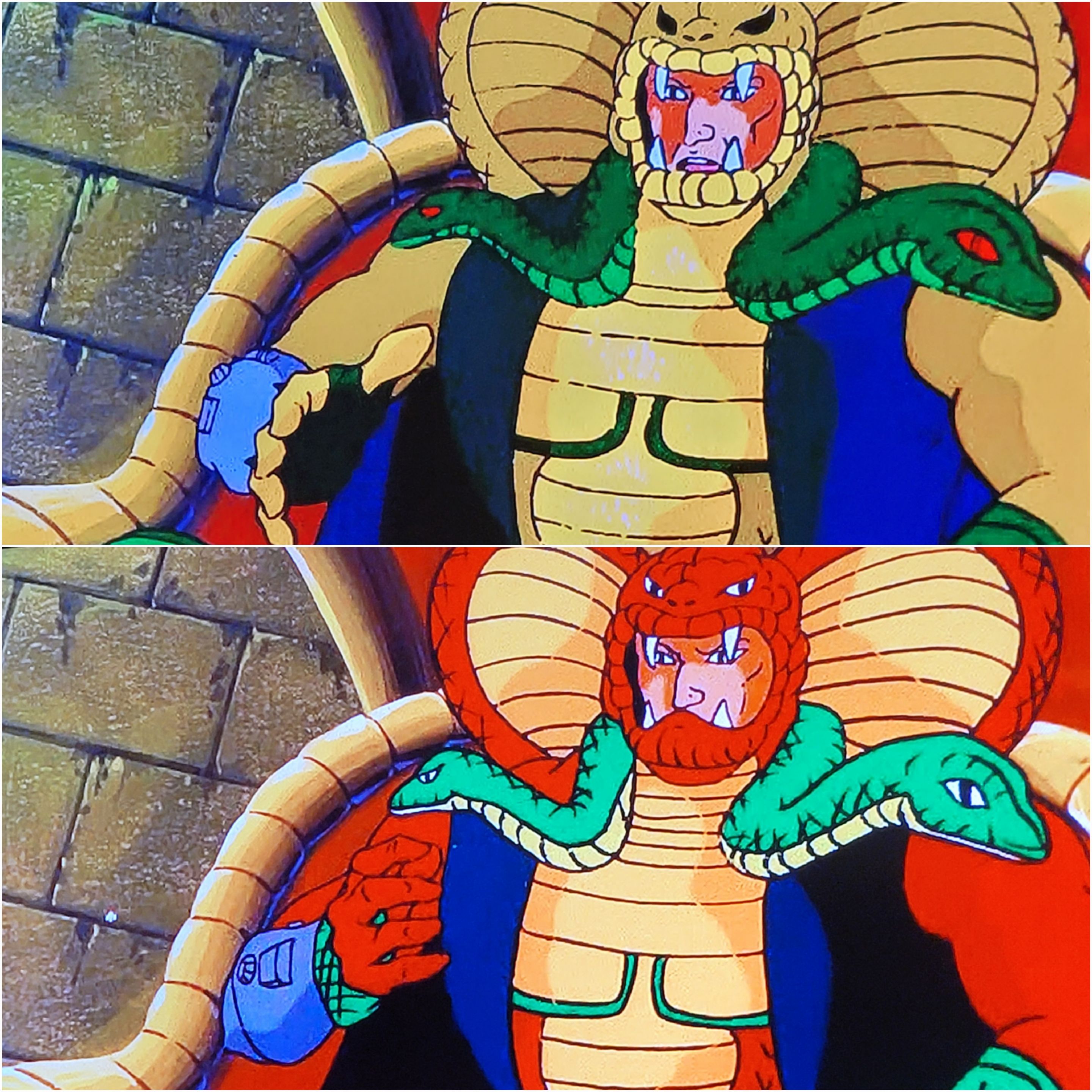
The bad guy side was disappointingly more limited. While Cobra Commander, Destro and Baroness would have grand machinations that would be foiled by the Joes, half the time it was just freelancer Zartan and his dipshit Dreadnoks who were the antagonists for the Joes, and boy did those turds get real tired pretty quickly. The biggest ongoing joys were the routinely petty exchanges between Cobra Commander and Destro, which is why it was always a drag when we would see the Three Stooges antics of the Dreadnoks instead. Where the cast of Joes was sprawling, named Cobra characters seemed quite constrained.

Everything changed in the second season, starting with the five-part "Arise, Serpentor, Arise" which saw Cobra Commander's command of Cobra get usurped by the genetically designed superhuman Serpentor. CC wound up taking a backseat, and so he and Destro only appear in a handful of the 30 season 2 episodes. (At least Serpentor, and his right-hand aide, the pervert Dr. Mindbender, was just as jolly as as all 80's villains, cackling maniacally at any opportunity.)

Similarly the cast we'd become so familiar with in Season 1 are largely rotated out in favour of all new characters who feel either like carbon copies of characters we already have or are just less developed. It wouldn't have been so bad if it weren't so abrupt. "Arise, Serpentor, Arise" sidelines both Flint and Duke in favour of Hawk and pro-wrestler/drill instructor Sergeant Slaughter, and somehow perpetually balaclava'd Beachhead is third in charge, where I think Scarlett was in that position the prior season.

The first season admirably had three female badass protagonists in Scarlett, Lady Jaye and Cover Girl, and it really seemed like Scarlett and Lady Jaye were right at the head of the food chain as respected leaders (except by Shipwreck, who seemed incapable of not making a pass any anything with curves, but the ladies thankfully didn't take his b.s.), so it seemed like a real demotion for them when all these new characters like Sci-Fi and Cross Country (sporting a confederate flag on his belt, eep) started taking up all the oxygen. On the Cobra side, all of Baroness' master-of-disguise roles were eaten up by Zartan's sister Zarana.

The battles in the series are ridiculous, but enjoyable so. Blue and red laser beams fly across the screen from sci-fi guns, H.I.S.S. tanks and trouble bubbles and sky strikers and rattlers.  The toys are up on screen and it is quite fantastic. The vehicles seem to explode at the slightest provocation (both Cobra and G.I. Joe's budgets must be astronomical, explains why Cobra needs to hold a telethon in a fantastically absurd mid-second season episode) but the animators make pains to show everyone always escaping every exploding ride (maybe it was just to sell toy parachutes). The fact that there's never any casualties have led Lady Kent and I to speculate that every Cobra vs Joe battle is a prearranged gathering with playground rules applying.

The series developed some good romantic relationship dynamics, with Duke and Scarlett and Flint and Lady Jaye paired off, but some of the characters wind up in relationships with people outside the Joe team who make subsequent appearances. And in one of the all-time episodes Mainframe and Zarana make a real star-crossed connection that pays off again in a later episode. And, of course, Destro and Baroness (if you kissed Destro in the winter would your lips freeze to his?)


As I've noted, there are a few characters/traits/design choices/casting decisions/lines of dialogue that don't age well, but by and large the show was actively multicultural by design and overall pretty inoffensive for the time. The writers seemed keen to push the boundaries of absurdity rather than push for topical humour.

Season 2 ended with 1987's G.I. Joe: The Movie hot on its heels. Originally intended as a theatrical release, it got scuttled when Hasbro's prior animated movies (Transformers: The Movie and My Little Pony) were tanking at the box office. So The Movie went straight to home video instead, with a most notable change. There was a pretty heady outcry from the Transformers fanbase when they killed off Optimus Prime in Transformers: The Movie (spoilers!), so when Duke was to go out in a blaze of glory in G.I. Joe: The Movie, instead he fell comatose only to awaken off screen in the film's conclusion.

G.I. Joe: The Movie opens with a newly composed version of the G.I. Joe theme song, this time with added bars to give voice to the Cobra side of the battle. The song amps up the volume a notch or two and the singer (can't find the credit) really, really, really belts out the final bar, just holding that "O" singing "G.I. Joe" for an epic length of time.  


The animated opening to season 1 and the revised intro to season 2 were both much better animated than the main series, and they each represented an epic battle between Joes and Cobra, with the Joes ultimately victorious. This level of animation from those openings is about what G.I. Joe: The Movie's animation is like, so it's pretty quality stuff. But the animated opening for The Movie is next level, and it's so action-packed and frenetic, the camera swooping through the big-screen-worthy action, it can be too much to take in. It's unfortunate, but between the super-glossy action and the ultra-rousing theme, the opening is the film's peak, and it's all downhill down a rocky slope from there.

It's not a rapid decline at first, with the first few minutes being eaten up by a battle and then, following Cobra's loss, petty bickering between Cobra Commander and Serpentor, complete with betrayal from CC's most trusted aides, Destro and Baroness (love those petty bitches), but when we make it back to Joe headquarters, Hasbro decided rather than gently incorporating some new characters in the mix of already beloved crew, they would just force feed us a new quintet (Jinx, Tunnel Rat, Chuckles, Big Lob, and Law & Order) and center the movie around Duke's godawful half-brother Falcon, who should be tried for crimes no less than treason, insubordination, sexual harassment, reckless endangerment, and just being an entitled prick (he's voiced by Don Johnson, so they wanted the name talent to be the central figure). As soon as the film turns its focus on this crew, it's cooked, and can't recover.

Subject to much mockery by Joe fans for ages, I find the Cobra-La aspect of G.I. Joe: The Movie much more palatable, even if this ultra-fantasy/sci-fi stuff doesn't quite fit seamlessly with the military/espionage angles of the series. Characters like Golobulous, Nemesis Enforcer and Pythona are comic book supervillains with superpowers, and their bug-like alien society with their tekno-organic vehicles and weapons seem to vastly overpower the Joes, but that's what makes them interesting as an amped-up adversary for a movie...it takes the threat to another level. And as much as the designs aren't military-esque in the typical G.I. Joe toy fashion, they are pretty wild and well done.

Where the detour the film takes early on with its new Joe cast stalled momentum, the film's late second act  detour into a similar situation just kills it outright. A washed-out Falcon is sent to train under Sergeant Slaughter and they introduce yet another 3 or 4 new characters we will spend even less time getting to know. It was all about toy sales, this film, and it's very easy to understand why it wasn't well received. Despite the glossiness of the animation, it has so little of the panache of the regular series even at its worst.

What's most surprising about G.I. Joe: The Movie is that A Real American Hero was normally at its best running multi-part, larger-scale story lines. There are four five-part story arcs in the series and a number of two-part episode, so the writers already knew how to do larger-scale stories. The Movie doesn't feel like an assembly of five episodes, but I wonder if it would have worked better if it were. And it didn't end with one of G.I. Joe's famous public service announcements, which seems a missed opportunity to talk about the dangers of concussions.

This was the last animated G.I. Joe film, surprisingly. There have been three underwhelming live-action G.I. Joe movies in the past 15 years, but not another animated one. (Everyone's still dreaming of that G.I. Joe/Transformers animated movie.)  

Following G.I. Joe: The Movie, the production of the ongoing animated series moved from Marvel/Sunbow to DIC, which effectively ended the first generation of G.I. Joe cartoons. The DIC cartoons were more cheaply made, and the reduction in quality seemed to have led it to being pushed aside and treated even less favourably than later Joe animated productions, while A Real American Hero remains quite well beloved and well-regarded by fans, and remains a pretty accessible and fun entry point to the toys and mythology.

Now you know. 


---
Favourite Episodes:
"The Pyramid of Darkness" (5 parts, pure ridiculousness)
"The Greenhouse Effect" (it's Cloudy with a Chance of Meatballs, but with G.I. Joe)
"Lights, Camera, Cobra!" (Cobra attacks the filming of a G.I. Joe movie)
"Cobra's Candidate" (uh... did this set the template for the alt-right incursion into politics? Gross)
"Money to Burn" (Cobra destroys all physical currency then issues their own Cobra bucks)
"Worlds Without End" (2-Parts, G.I. Joe goes to a parallel world where Cobra rules)
"Eau du Cobra" (Destro develops a mind control perfume in an effort to steal an heiress' riches)
"Memories of Mara" (the Joes discover Cobra is making fish-people, and Shipwreck falls for one of them)
"The Wrong Stuff" (It's like SCTV, but the "C" stands for "Cobra")
"Cold Slither" (Cobra plans to take over the world with a one-hit wonder rock band comprised of Dreadnoks)
"Computer Complicatoins" (Mainframe and Zarana meet cute)
"Cobrathon" (Cobra holds a telethon)
"Ninja Holiday" (Cobra Commander looks to have Serpentor assassinated)
"The Most Dangerous Thing in the World" (Cobra hacks the military systems and promotes three inept Joes to being in charge)
"Nightmare Assault" (Dr. Mindbender's nightmare machine leads to some disturbing cartoonery)
"Joes Night Out" (The night club is a Cobra rocket!)
"Not a Ghost of a Chance" (Predicting alt-right disinformation tactics. Gross)
"Into Your Tent I Will Silently Creep" (the inspiration for Community's "Bottle Episode"?)


Saturday, July 8, 2023

KWIF: Indiana Jones and the Dial of Destiny (+4)

KWIF is Kent's Week in Film, where each week (or so) I have a spotlight movie, of which I write a longer, thinkier piece about, and then whatever else I have watched that week I do a quick little summary of my thoughts.

This week:
Indiana Jones and the Dial of Destiny (2023, d. James Mangold - in theatre)
Asteroid City (2023, d. Wes Anderson - in theatre)
J.S.A.: Joint Security Area (2000, d. Park Chan-wook, tubi)
Sympathy for Mr. Vengeance (2002, d. Park Chan-wook, plex)

---

With the Mutt-tinted, jungle-vine-swinging, giant-fire-ant-crawling bar set pretty low, the latest Indiana Jones adventure delivered a far more engaging and entertaining movie than I thought possible with an octogenarian Harrison Ford. Although he does seem pretty creaky, the still dashing and far from frail-looking Ford seems to be delighted with some of his more recent co-stars, like the cast of Shrinking (most specifically young Lukita Maxwell) and definitely Phoebe Waller-Bridge. He seems to - like we all should - bask in the luminous presence of a fiery, energetic talent, absorbing their energy like rays of the sun (I haven't watched 1923, but I can only imagine he does the same with Helen Mirren).

Waller-Bridge here plays Indy's estranged goddaughter, Helena Shaw. As the film reminds us, Indy is terrible at family, and if you pay close attention to Raiders of the Lost Ark, he's kind of not a good guy, despite being the hero of the piece. Helena enters the picture as a seemingly chipper acolyte of the Indiana Jones brand, but very quickly proves that her allegiances are her own, as are her less-than altruistic intentions. She draws a mournful, self-loathing Indy out of his funk and back onto an adventure that he wouldn't otherwise survive if not for having good fortune, good friends, whip-smarts and a smart whip. 

Helena gets to be the action hero stand-in for moments where old-man Indy would otherwise seem far-fetched (and has to play the rescuer of her aged godfather on multiple occasions, not unlike Indy had to with a still robust Sean Connery back in The Last Crusade), but that does not deprived Ford of his own adventurous moments as well. Indy is definitely not "along for the ride", but the film, both in world and in a metatextual sense, is well aware Indy is not the man he used to be.


If that's a sticking point for the fans, I get it. It's painful to watch your heroes age and be sort of shadows of what they once were. One could look at Star Trek: Picard, or Rick Flair wrestling at 75, or Top Gun:Maverick (or, as a recent knock-off action figure called it, "Top Pilot Maverich"), these kind of sad attempts to recapture the boomer magic, or one's youth, or to validate ones worth as they see themselves replaced. I didn't feel that with Dial of Destiny. Mangold, with Logan, seems to understand the melancholy of aging, how to let it exist within a story without ignoring it when it nor overwhelming it. He seems to get how to present it as the flavour text of an action-adventure film. If you just don't want to see it, or dislike seeing it, that's understandable, but it is well done here.

The film opens with a cracking half hour, an end-of-war 1945 set piece that feels like prime Indiana Jones. It's a pretty satisfying short on its own. After the terrible, godawful, upsetting CGI face-swapping effects of The Flash, the deaging/deefakery of this film is pretty solid (seriously guys, we need to stop complaining about the quality of deepfaking in films, because it's just going to incentivize "them" to try and perfect it, and then we'll be in serious trouble when we can't actually tell). The alternative would be throwing Alden Ehrenreich in there (former Young Indy portrayer Sean Patrick Flannery is almost 60 now, and River Phoenix would've been 55). It's *barely* distracting, at least to me, your milage may vary.

With both Crystal Skull and Dial of Destiny I've heard heaps of complaints about going too far with the finale, as if aliens or time travel are any more fantastical or unbelievable than the wrath of god, hearts being pulled out of chests in ritualistic sacrifice, or meeting a centuries-old knight guarding they holy grail. What Dial of Destiny maybe doesn't get right is it spends too much time there, and the longer it spends the more problematic it becomes (especially from an archeological standpoint). It could have been more swift and clever but it ultimately didn't bother me in the viewing, nor in hindsight

Timing is a problem with much of the film, action sequences or set pieces do have a tendency to  overstay their welcome. There's a chase to kick off the second act that takes us through the streets of Tangier that seems to be exploring every street and alley the city has to offer. Earlier this year, Dungeons & Dragons put on a masterclass on setpiece economy, and a lot of films could stand to learn from it, this one included.

Like with the sequel trilogy of Star Wars, this film will please or displease depending on your ability to accept characters having moved past their heroic archetype mode into more complex people. If you love the Indy series from the 80's and always wished there were more adventures of the characters you love from the time when you first loved them, well, that's really not going to happen, at least not on film, and not with the performers who made the roles what they are. Is it better to let sleeping dogs lie than to watch your heroes become old and fragile, and possibly die on screen? Why are we okay with heroic sacrifice of the young in films, but seeing them age, and confront their flaws is a step too far? Does it ruin what came before to see where they wind up? Or does it just expose our own discomfort with acknowledging the years have crept up on us too? Should our escapist movies be total escapism, or can't something real, even meaningful, not slip through? 

This is a legitimately fine, enjoyable, often fun adventure movie, with sharp dialogue and John Williams giving one last horn-filled kick at the can (it's not his best or most memorable work, but it helps carry the through line of the series). Even better, it's a legitimately fine, enjoyable, often fun Indiana Jones movie that at least closes out the series with a truly beautiful moment that made me weepy.

Letting go of nostalgia, this is total middle of the road, but having seen Indy at its most offensive, middle of the road will certainly do.  I'd rank it 3rd in the series. Certainly not better that Raiders or Last Crusade, but Far less problematic than Temple of Doom, much less aggravating than Crystal Skull, and far less ridiculous than either (but with the right level of ridiculousness for an Indiana Jones movie).

The Flash Scale: better than The Flash

---

Asteroid City is the new Wes Anderson movie. If you like Wes Anderson movies, there's a pretty good chance you'll like this one as well. If you despise Wes Anderson movies, this won't change your mind.

Where often an Anderson movie can dazzle with ornate imagery, full of precision details that kind of boggle the mind, the nesting-doll structure of Asteroid City with it's mid-50's setting, is much more spare but exactly as precise. In the theatre setting that frames the film, the stage is evocatively decorated, rather than built up to the nines in usual Anderson fashion, all coded perfectly to pop in black and white. In the story-within-the-story of the town of Asteroid City, it's a very orange-saturated midwestern desert landscape with not a lot to see along the vista but a few clouds and mountains.  A (puppet? stop-motion? cgi?) road-runner darts across the screen from time to time, eliciting a "meep-meep" implying this exists within a surrealist Looney Tunes environment.

The massive cast of Anderson devotees and new conscripts descend upon the town where five brainiac children who have created wild inventions of science are being given an honour from science and/or military (there's a point to be made about how often advancements in science tend to be as a result of military backing) as well as gathering to witness a unique solar phenomenon.  When that solar phenomenon attracts a strange visitor, and word leaks through the military lockdown, pandemonium happens. But that's all the story within the story. The ur-story is about the writer of "Asteroid City", his casting process, fears and triumphs, which are displayed as a stage play that surrounds the making of "Asteroid City" as a stage production itself. This tier has Bryan Cranston in a Rod Serling-esque role standing outside of it all, narrating from a distance creating yet another level of separation from the telling.

The common thread between both the story and the story within the story is the connection between characters, how they interact and relate, which is all in that expected Anderson dead-pan snappy patter. The fact that both levels are still presented as fiction seems to allow Anderson to push this rapid-fire dialogue even further away from emotional performance.  What I noticed here, and can likely be applied to most, if not all Anderson films, is everyone is forthright and honest. There's little to no inference nor subtext to the dialogue. People speak their truth in an Anderson world, which I think is what makes it so disarmingly funny, but also what Anderson haters likely rebuke.  If one were to accuse Anderson of artificiality, it's not a false accusation, it's kind of the whole point. I have to wonder if Anderson is trying to understand human emotion, or if he understands it so intimately it allows him to explore it with such dispassionate interest.

I found Asteroid City an absolute delight, full of all the usual hallmarks, but also many, many surprises. I came out of it wondering what exactly Anderson was trying to say through the artifice and still have no idea. But I have no problem just enjoying what is presented at face value, and maybe, upon repeat viewings, it will unveil itself.

The Flash Scale: you better believe it's better than The Flash

---

Being a comic book nerd, I took notice of J.S.A many many years ago, because to me "J.S.A." means "Justice Society of America", the original superhero team from the golden age of comics. Here, "J.S.A." means "Joint Security Area" as in the bordering area between North and South Korea where each side have their own military police, but the location is administered by United Nations Command.  Not quite the same thing.

I don't think I ever knew, until quite recently, that J.S.A.: Joint Security Area was a Park Chan-wook film, nor did I have any concept of what the film was about. I knew it was a record-setting film from South Korea, but I gauged that film against the typical American blockbuster, which is my own dumb bias. The poster/DVD cover looked pretty drably like S.W.A.T. or some other cliched police action drama, so I never bothered to explore what the film was actually about.

Turns out its a fascinating dramatic tragedy about cross-zone agents from both sides who wind up becoming incredible friends, but can't ever seem to fully shake the conditioning that each of their respective governments have instilled in them about the "other side". Eventually they are discovered, and an incident erupts.  This brings in neutral forces from the U.N. to investigate the incident.  

The film opens with Lee Young-ae's Swiss-born, but of Korean descent, Major Sophie E. Jean as she starts her investigation, with persons of interest on both side of the border having delivered clearly fabricated, conflicting reports of the incident.  Sophie's investigation takes up the first act of the film, but is almost an extended red herring as to what the film is actually going to be.  Where we think it's to be some form of investigative procedural, the second act backtracks to the beginning and through the development of the friendships between the North and South Korean men, and then the third act is largely about the incident, and how the fallout impacts the men, as viewed through Sophie's eyes.

It's a surprisingly delicate story that ponders the complicated history between the Koreas, and really wants to assess how the two countries view each other. The point, I think, is to portray both sides as human, and not as something "other".  I don't know that the procedural element of it is fully necessary, and, aside from providing some key history about the post-war division tied to Sophie's origins, I don't think it contributed much.  But, overall, a captivating, enlightening, and heartbreaking film, though light on the visual flourishes that would become benchmarks of Park's directorial style.

The Flash Scale: better better than The Flash

---

Park had done two poorly-received films prior to J.S.A. which caused him to quit directing for a time (during which he returned to film criticism).  The success of J.S.A. really bolstered his confidence and boosted his career, and led him into the torturous revenge dramas that would come to be known as his "Vengeance Trilogy".

Old Boy is Park's most famous film (in North America, at least), the one that crossed over, and Lady Vengeance is seen as the, let's say... enjoyable one of the trilogy, but Sympathy for Mr. Vengeance really set the tone for what Park's career would become. It's clear from J.S.A. and Sympathy that Park is really fascinated by tragedy, and while J.S.A. takes it very, very seriously, Sympathy is a whole different beast altogether.

The "Mr. Vengeance" of the title isn't a single individual. The story of the film is a two sided coin, always connected but one side cannot see the other. The first side finds Ryu (Shin Ha-kyun), a deaf-mute factory worker laid off just as he's trying to save his ailing sister with a necessary kidney transplant. Ryu is not a match, and so he "trades" his liver for another, only to wake up post-surgery to find he's scammed. Ryu's anti-capitalist, revolutionary girlfriend, Yeong-mi (Sens8's Bae Doona) convinces him to kidnap his ex-boss's daughter, with the promise that they won't be evil kidnappers but to have the child love hanging out with them.  Without saying too much, things don't go well. 

The flipping point finds the boss, played by the impeccable Song Kang-ho (also from J.S.A. and Oscar-winner for Parasite) out on his own mission of vengeance against the Ryu and Yeong-mi, with its own disastrous consequences.

It's all just a pile-on of misfortune and misery, but it's (attempted at least) to be tempered with an exceptionally irreverent sense of humour throughout. This would be devastatingly funny if director Park weren't so good at elevating the tragedy out of the surreal. As is, it's too painful to laugh.  It's a visually stunning picture, with shot composition and colour sense that still seem utterly unique 20 years later.  Park is clearly criticizing the health care system in South Korea with this film, as well as satirizing its capitalistic nature. It's clear he's not a fan of either, but without more knowledge, I'm not well versed on the true impact of the critique, except to say that I felt it.

I didn't like watching this movie, I found it challenging to enjoy, but it's so purposeful and well crafted that  it's really, really hard to dislike, and impossible to dismiss.

The Flash Scale: can't really even be put in the same conversation as The Flash. It's like comparing apples to The Flash.