Wednesday, April 5, 2023

1-1-1: Swarm

2023, d. Donald Glover, Adamma Ebo, Ibra Ake, Stephen Glover
7 episodes - AmazonPrime
created by Donald Glover and Adamma Ebo

The Plot 100:


Dre is the consummate "weird girl", the one who doesn't seem to fit in, who doesn't seem to get normal social cues, who stares too long at things, who moves oddly, who dresses strangely...who fixates...and Dre is fixated on superstar Beyonce-stand-in Ni'Jah. Dre lives with Marissa, her best (and only) friend, who looks out for her, but that's a full time job, and Marissa is trying to live her own life. A confluence of events unhinge Dre, sending her on a low-key murder spree across America.

1-1-1
1 Great: Dominique Fishback has been a power player as supporting actress in movies like Judas and the Black Messiah and Project Power but in Swarm the spotlight is all on her. Her performance as Dre is captivating, full of incredible nuance in physical presence, facial expression and line delivery. Fishback delivers a dead-eyed stare that will send a cold shiver up your spine like few others ever have.  Dre is barely tethered to reality when Marissa is grounding her, but without Marissa around, Dre is let loose on the world. 

As part of "The Swarm", the collective of Ni'Jah fans who shout down any naysayer or troll online, Dre takes the next steps to protecting her queen.  She goes to great lengths to hunt down the online trolls and murder them. It takes a special performance to sell the leap into murder, but not only does Fishback sell it, she makes it seem both the logical and inevitable next step for Dre. There's a fearlessness to the character, and to Fishback's performance. It's a very, very difficult thing to be funny and sympathetic in a performance that is also supposed to be terrifying, Fishback manages to be all these things in different combinations. Never is this more clear than in the second episode where Dre has taken a gig stripping and is mesmerisingly bad at it, and doesn't seem to care. She just kind of clomps around on stage in a teddy, a vacant look on her face, bewildering the one onlooker who seems like a deer in headlights.  She's not going to kill him, but he's definitely her victim.

It's hard to really like Dre, but in script and production, there is empathy for the show's protagonist, and since she is our only POV character, we always kind of want Dre to get what she wants, even if logically we know she just needs to be stopped. There are a couple instances of Dre killing an awful person, but she is by no means a sympathetic vigilante...she is a sociopathic murderer and her killings are just as often whims as they are pre-planned. 

I watched the 7 episodes in 2 chunks, the first three episodes, and then the final four about a week later. Between viewings, I was constantly thinking about the show. There was nothing in particular I was thinking about, but it was just more kind of haunting me. It would find myself thinking about Fishback's slack-jawed gaze, or her stilted physicality, or her line reading of "who's your favourite artist?", which becomes just as ominous a line as "do you like scary movies?" Perhaps moreso.

1 Good: Donald Glover's Atlanta [Season 1, Season 3, Season 4] was a unique production, a series of mini-films that sometimes featured the main cast, and were sometimes fully detached from even its own reality. The first episode of Swarm felt like it could have been one of Atlanta's one-off episodes, except that it didn't feel as self-contained, that it was building something. Each episode of Swarm has a tonal synergy with Atlanta, a quietness, a patience, but also an intensity and a sly sense of humour.  

This isn't solely Glover's baby, Janine Nabers (UnREAL), but the style seems very much guided by what Glover and team did for Atlanta with much success. Though a graduated story, each episode does stand alone as a unique thing. Episode 4, for instance finds Dre taken in by a commune led by Billie Eilish, which really twists the knife...you kind of want Dre to run, but at the same time, she's probably more trouble for the commune, and maybe you just want them both to self immolate. It takes some psychedelic turns.  The final episode is a love story, which, like every episode of Atlanta, you're just waiting for it to turn.  The thing with Atlanta was it only turned like 40% of the time. You can bet any good thing for Dre is going to tun 100% of the time.  It's like watching Dexter or Barry, where you just utterly sympathize with the love interest and want them to get the hell away, but at the same time that little glimmer of hoping the sociopath can learn to be happy and let go of their darker instincts. It never works out.

Each episode opens with the title cards "This is not a work of fiction. Any similarity to actual persons, living or dead, or actual events, is intentional." It's Glover and Nabers "Fargo-izing" the series, which then leads to Episode six, which is a documentary news program covering the "real" story of Dre, and the detective who pieced together that there was a Black female serial killer operating in America.  While trying to be a "real" documentary, its scripted-ness gives itself away (kind of like Atlanta Season 4's "The Blackest movie of all time" documentary on A Goofy Movie).  

1 Bad: Not really bad, but more a stylistic thing that I had a hard time parsing. There are a couple instances of Dre going into a sort of hallucinatory trance, and we see the world from this perspective. As such we're not really clear on the events that are occurring.  Mainly the climax of episode 3 and the series climax of episode 7.  

Episode 7, in particular, is titled "Only God makes happy endings" and it ends with Dre having her greatest dream come true. But clearly it's not true, just a delusional state that they're in. Episode six actually tells us the "real life" ending that we don't see in the show. It actually seems much darker a spin to even attempt a happy ending for Dre. If she gets her greatest desire, given her cross-country killing spree, what does that even mean? It's certainly provocative. The whole show is provocative.

META
It's kind of shocking how under-the-radar Swarm is right now. It doesn't seem to be getting promoted very intensely nor does it seem to be popping up in television discourse very much. It's a difficult show to market because it isn't the most accessible story, but it's, at its heart, elevated horror. It very well could fit cozily within A24's slate of genre films, and Amazon should be reaching for the same market.  It's an intense, unconventional show, defiantly not for everyone. 

I only heard of it in passing, with a brief mention of Donald Glover. That was all I needed. 

Tuesday, April 4, 2023

Series Minded: Scream (I through V)

[Series Minded is an irregular feature here at T&KSD, wherein we tackle the entire run of a film, TV, or videogame series in one fell swoop] 

Scream, 1996, d. Wes Craven
Scream 2, 1997, d. Wes Craven
Scream 3, 2000, d. Wes Craven
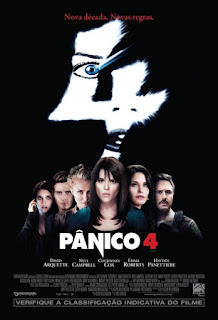
Scream 4, 2011, d. Wes Craven 
Scream, 2022, d. Matt Bettinelli-Olpin / Tyler Gillett

[Hey, FYI, I haven't watched Scream VI (2023, d. Matt Bettinelli-Olpin / Tyler Gillett) yet., also I'm going to spoil all these films, so if you care...you've been warned.]


When Scream debuted in 1996, it was one of the first real "meta" works in the mainstream. It was so innovative largely because of Kevin Williamson's script which had teenage fans of horror movies knowing all the tropes, which allowed the film the delight of playing into tropes and subverting them, but also, sigh, explaining them.

Five sequels later, Scream is a total ouroboros, choking down its own tail.  The franchise has developed its own tropes, which it fully acknowledges, and its own internal meta-narrative of a Scream-like franchise within the world (the "Stab" series) modeled after the "real events" in Woodsboro.  Having basically binged the series in the span of two weeks, the tropes of the series wear me down. There are definite elements I like to the series, but the samey-ness of the series gets tedious when watching back-to-back-to-back(-to-back-to-back-to-back).

WHODUNNIT


The first Scream is, without a doubt, a masterpiece. Of all the films in the series, I am most familiar with the original and how it plays out. With that knowledge of what happens, to whom, and how, you can see how the film is built up so cleverly around it.  Every film in the series has a "whodunnit" element, for better or worse, but Craven's use of visual cues timed with the dialogue throughout Scream actually tells the audience exactly whodunnit.  It's not just the masterful use of camerawork, but also editing, sound design and musical cues that tell on Billy Loomis and Stu Macher at almost every turn.  I enjoyed watching Scream again (for the first time in probably 20 years) for many reasons, but it was astonishing to see just how precisely the film was put together to lead into the reveal of the kilers.

With Billy and Stu, there's definitely an element of psychopathy (Billy has personal reasons for tormenting Sydney, Stu is just a maniac) but at the same time, there's a level of misogyny to the killings, starting with the off screen murder and assault on Sydney's mom.  It's not just that Ghostface refers to women as "bitch", but the tone in which he says it that seems to mean something...maybe Billy's resentment over his mother leaving.  But also, Billy seems to be sexually frustrated to an uncomfortable degree in his relationship with Sydney, that may be coming out in Ghostface. It's all terribly uncomfortable.


The "whodunnit" of the sequels are diminishing returns. In the second, with its metanarrative on "sequels", finds its psycho killer in Timothy Olyphant's film school student, who basically wants to live a horror movie.  He's paired with the mastermind, Billy Loomis' estranged mother.  The latter half is actually a pretty good reveal, as Laurie Metcalf's milling about as a reporter bothering Gail Weathers is a great fake-out, but Olyphant's turn is ridiculous. I can buy Mrs. Loomis' motivation (particularly if she's as unhinged as her son) but Olyphant doesn't really make sense in the narrative, except needing there to be a second Ghostface in order for the timelines to work out. The third film takes on "final chapters" in trilogies, but provides a reveal that's absurd, tying into heretofore unacknowledged history in the series, and revealing a secret, resentful sibling to Sydney. The third is the only single-killer Ghostface though. I should acknowledge that Williamson wrote the sequel but not Scream 3.

Williamson returned for scripting the fourth film, and returns the story to Woodsboro, poking at the idea of "reboots", but doesn't learn from the third's folly, and once again, it ties all too tightly to Sydney in a familial way, with her cousin (Emma Roberts) being the mastermind of the killings, primarily out of jealousy, but with a partner in crime, the film nerd (Rory Culkin), who was trying to make his own snuff film version of "Stab".  The fifth film, toying with "requel"/legasequel conceits, finds its culprits being a couple of insane horror film nerds who think the "Stab" franchise has gone stale and are trying to reboot it by giving it good "real world" representation. The two characters doing this could have been anyone in the film, it matters so very little who they actually are.
We see a lot of consistency in the killers: psychopaths and/or film nerds who may or may not be connected to Sydney.  Guessing who the murderer is, beyond the first film, is a futile pursuit. Maybe it's just that I'm not as familiar with the sequels as I am the original, but they don't seem to be as interested in having this be a solvable mystery, so much as just toying with the audience. The fifth Scream in particular really wants you to believe it could be anyone, including the main protagonist (Melissa Barrera), the illegitimate daughter of Billy Loomis, who seems to have mental health issues, seeing visions of Billy in mirrors and talking to him (though she's never actually met him...I thought it would make more sense if she saw Luke Wilson who played Billy in "Stab" in Scream 2).  The guessing game, especially in a binge, is tiresome, particularly when you know it's probably going to be two culprits, not just one.  

I honestly hate the reveals in each of these movies, even the first. The reveals, which involve a monologue for motivation, are pretty much ludicrous, each and every one of them, except maybe Billy's mom. But the level of psychopathic killings, the extremes to which these people go to are just beyond reason, it's because they enjoy it. But those levels of bat-shit-craziness don't present themselves until the reveal, which is just another part of my problem with these films.

The "whodunnits" of these films are kind of a side-point, so the scripts are more written around the kills than the mystery. Nobody ever figures out who the killers are (except Sydney cottons onto Billy before he gets fake stabbed by Stu-as-Ghostface), they always reveal themselves, and it's so unsatisfying. 

GHOSTFACE


What makes Ghostface unique in the horror pantheon is he's not a character, nor even a mantle to be passed along, but instead, very simply a costume, and a voice. He's something *anyone* can put on to become a homicidal killer. Part of the benefit of the "Stab" franchise and its popularity within the world is it presents a sort-of logical reason why people would keep dressing up and acting exactly like Ghostface in their quest to murder people. It provides anonymity, but there's also clearly a fetishistic cosplay aspect to it as well by the time Scream 2 gets going.

Even though technically nine different people, Ghostface is portrayed pretty consistently. Billy and Stu obviously concocted the character, but "Stab", within the world, defines him.  Yet, to me, this starts twisting the reality of the movie. In continuing Ghostface's phone call scare tactics, it needs to invent unreal technology of voice modifiers, and it implies that the murderers are very practised in their ability to keep up these drawn out "What's your favourite scary movie" phone calls.

I like that Ghostface never speaks in person, only over the phone, which leads to quite physical performance of the in-costume character.  I also like that Ghostface is consistently the clumsiest fucking killer ever, and that nearly every victim puts up a pretty damn good fight. It makes the murder scenes much more enjoyable when it provides a sense that the victim may actually get the jump on Ghostface.

But again, this breaks the reality of the movie for me, because the many lumps Ghostface is taking do not appear on the people when we see them. In the moment, sure, whomever is Ghostface is running on adrenaline and isn't feeling the pain, but after the fact, they should be bruised and hobbled by their misadventures.  That of course would give away the reveal, but it breaks the reality.  There's even a comment in the fifth movie after the opening attack scene, one teen mentions to the other that he's sporting bruises and they'd heard that the victim had fought back pretty hard. The bruises were explained away as football practice bruises rather easily, but that's really the only time that idea of Ghostface being banged up is brought up.

OPENING KILLS


The opening sequences, a hallmark of the franchise, features Ghostface playing a game with his first victim each film. The original's is probably the most famous of the series, featuring Drew Barrymore as a lonely teen at home alone getting harassed on the phone by a psychopath, and it still delivers a visceral punch that none of the sequels, in their many attempts to emulate it, can manage. By the fourth movie, it becomes a Russian nesting doll of a joke, as the "Stab" franchise-within-the-franchise, introduced in the opening of the second, became the driving force of Scream in the third instalment.

The second movie is differently effective. It finds Omar Epps and Jada Pinkett having a disagreement over the movie selection for their date, as they wind up at their local premiere of "Stab".  There is a rehashing of the first Scream opening, but with Heather Graham as Drew Barrymore in the "Stab" version on the big screen.  This exceptionally clever sequence finds the whole meta use of "Stab" peaking very early in the series. The theatre handing out promotional "Ghostface" masks and gowns creates for great fakeouts fast and early when the killings do start, but ultimately the opening feels sorely detached from the rest of the movie (I presume that was Olyphant's character getting his feet wet...with murder).

The Hollywood-set third movie returns to the phone-call set-up of the first, but instead finds Liev Schreiber's Cotton Weary (previously wrongfully accused by Sydney as the murderer of her mother, having been redeemed in the sequel saving Sydney, sort of, now the host of a big-mouth national talk show) receiving the phone call while driving, with Ghostface threatening him with the murder of his girlfriend.  Ghostface threatening a loved one is definitely part of the character and solidified here as part of the opening.

The aforementioned fourth entry is a series of fake-out "Stab" killings before the "real" ones happen. It's kind of an exhausting start to the movie. The fifth Scream starts with a "reboot" of the original's opening sequence, but bringing in the fact that people don't really have land lines or answer phones into the mix. This opening sequence is, more than any prior, integral to the film, because Ortega's Tara Carpenter survives the attack, and this wraps in her friend group as well as draws out her estranged sister Sam.  Tara is the first survivor of a Ghostface attack from the opening sequence.

SYDNEY


Sydney is the lead protagonist of the first Scream.  She's already traumatized from the brutal assault and murder of her mother, which she has, in her anger and grief, pointed the finger at the wrong man. She's got a shitty boyfriend in Billy Loomis, who is pressuring her to move on, mainly so that she will have sex with him, but, in hindsight, seems to be him gaslighting and psychologically torturing her. She is tormented by Ghostface over the phone, her best friend is murdered, and she witnesses many other deaths. It's a rough time. 

Already having too much attention because of her mother's death and the press coverage, plus her wrongful accusing of Cotton, along with Gail's book about the events of the first movie, and the "Stab" movie being made from it, you would figure Sydney would shy away from the spotlight...but for some dumb reason she wants to be an actor... and so the second film finds her at arts school Windsor College where she's majoring in drama, and starring (!) in a stage play.  It all seems like entirely the wrong direction for that character, and the whole movie feels off as a result.

Sidney's sort of a back-bench player for much of the third movie, and again in the fifth. In Scream 3 she's basically in hiding from the world, but working a crisis hotline and really helping other survivors. Much more plausible than acting. Her being pulled into the action is precipitated by Ghostface finding her on the crisis line, which seems unlikely, but I digress. Her place in the fourth has her returning to Woodsboro to promote her book, which, again, is putting Sydney in the spotlight, which seems as unlikely as her taking her back to Woodsboro on the anniversary of the first Ghostface killings where the town's been "vandalized" with Ghostface decorations. You would think the traumas of Woodsboro would want to be erased, but there seems to be a morbid revelry for the events that happened there that's not really acknowledged. 

Sydney has a life and a family in the fifth movie, and is not in most of the film until she turns up for the third act ready to help kill Ghostface, who she's faced 4 different times...but each being a different person, so really she has no idea what she's stepping into and whatever. It doesn't really make sense. 

Due to a breakdown in compensation negotiation, Neve Campbell does not return for Scream VI, and from my perspective, that's a good thing. The second film botched her story, the third film didn't really need her, and she added very little to the fifth film. I have nothing against Campbell, and I like how she's evolved Sydney in her performance, but I don't think Scream has needed her since the second entry.

GAIL and DEWEY


In 1996, the cast of Friends were inescapable. I was still a viewer of the show then, still in its third season, but I was already resenting their ubiquity. I certainly recall resenting Cox being in this horror movie (but at the same time having conflicting feelings, because I was already a Cox admirer from Misfits of Science, Family Ties, and Masters of the Universe, and I also wanted her to succeed).  I recall Gail being my least favourite part of the movie from my original watching.  That tune has changed, quite dramatically.

As I watch these films with my middle-aged, slightly astigmatic, Cougartown-loving eyes, I find Cox an absolutely welcome presence. Sure, she doesn't quite fit in the first film because she's not a "teenager" in the cast, and you're not supposed to love her since her tabloid reporter role makes her antagonistic towards Sydney. But through the eyes of David Arquette's Deputy Dewey, whose bashful, nebbish, schoolboy crush on Gail Weathers lets us see her as a person, not the reporter.  The film, the series, through Dewey, presents Gail exceptionally fairly, appropriately calling her out on her bullshit, but also allowing us to see her persistence, tenacity, skill and heart.  

The sparks from Dewey and Gail in the first film may seem improbable, but Cox and Arquette sell them, likely since their pairing spawned a real-life romance (they married in 1999 and amicably separated in 2010). The Gail/Dewey pairing was a far rockier one than their real life one, and to me, more than anything else in the franchise, they are the lifeblood. What I enjoyed most with each entry was returning to see where they were at in their lives... and in every sequel, it's not a good place.

In Scream 2 Gail had stayed with Dewey through his recovery, but then left him behind for her rapidly advancing career. Their reunion on the college campus is great, because Dewey is in both a tremendous amount of physical and emotional pain, and he's not shy or bashful in letting Gail know how hurt he is. The story of the movie, for me, is Gail winning Dewey back, which she does. The third film finds them having separated once again, but reuniting on the set of "Stab 3" (which advances past Gail's books on the Ghostface murders, and seems to be in a "Game of Thrones Season 7"-style spiral of creative bankruptcy) where Dewey is consulting on set, and Gail is called by the local police detective Red Herring McDreamy to consult on the new spate of murders.  That Dewey may or may not be in a relationship with fake-Gail from "Stab 3", as played brilliantly by Parker Posey, makes for a tremedously fun threesome which Sydney kind of only gets in the way of.

Scream 4 finds Gail and Dewey quietly unhappily married together in Woodsboro. Gail has quit reporting to write novels, while Dewey is now the Sheriff, with a younger, pretty bloned deputy who is real sweet on him. Gail's writing has stalled, she's frustrated, and feels hemmed in by Woodsboro. She's no longer "Gail Weathers" from the TV, but the Sheriff's wife. So when Sydney comes to town with a bestselling book, and then the murders begin again, it brings up a lot of feelings for her.  For Dewey, it's work, not just dealing with the murders, but the entire town, and trying to keep the peace, while also preventing more death.  But for Gail, the key drive is a desire to solve the murders, she's lived this story one too many times. She is the one who figures some of it out, but not soon, and not completely enough.

In Scream 5, Gail and Dewey are not together once again. Gail has her own morning show now, while Dewey has forcibly resigned as Sheriff and lives a sad life in a trailer park, where the highlight of his day is watching Gail's show. Gail, obviously miserable in Woodsboro, took a plum gig in New York, and Dewey just couldn't hack it there and ran back home. When the Ghostface murders start back up again, Dewey hesitantly helps the new kids out, and Gail is back on the scene, 90% for Dewey, 10% as a reporter. Their reunion is sweet, tender, and familiar, but so full of baggage, both real world and in-world. It's absolutely wonderful. But this relationship, if it's felt doomed from the start, that's because it is. Dewey makes a stupid decision to go back and shoot an unconscious Ghostface in the head, only to be distracted by his cell ringing (a call from Gail) enough to give Ghostface the edge up. When Ghostface kills Dewey, he speaks (a rare moment), "It's an honor".  It is Dewey's death that draws Sydney back to Woodsboro, but it's not my favourite outcome. 

I wonder if I would prefer the Scream series more if had centralized on Gail and Dewey, their reunions and separations each episode coming together to be the duo that takes on any Ghostface reemergence, leaving Sydney out of the equation almost altogether.  I mean, Scream is primarily a teens-getting-murdered genre, so I can see why having two middle-aged actors as the central figures might not be what they're looking for, but I think about the Conjuring as a template, of Gail and Dewey using their expertise to help in a situation and I really like that idea a lot more than how most of these play out.

META


The Scream trilogy was the awakening for young viewers to the joys of nerding out about movies, and being referential, and self-aware. It was happening at the same time as Buffy the Vampire Slayer and the two can be seen as sort of cousins in style.  

This was all largely before the internet invaded pop culture, and the internet pop culture invaded mainstream media. You have to do more than just namecheck movies or provide trite one-line analysis of these films. By Scream 4 in 2011, dozens of very successful pop culture websites had come and gone that had dissected practically every genre film available in written online essays and reviews. In the next decade before the fifth Scream, there popped up hundreds of youtubers and podcasters who deep dive not just into film and franchise lore, but into film theory and deconstructionism.  Scream five ("ScreVm?") making references to "elevated horror' and namechecking The Babadook, It Follows, or The VVitch doesn't really hold much sway to my Letterboxd-tracking eyes. "Your cuts aren't deep enough," (ScreVm does pull out a decent Rian Johnson/The Last Jedi reference but it's in the context of a character explaining "requels" and "legasequels".  

Beyond the first film, the series' ability to play with tropes weakens when you are expecting them to play with the tropes, and especially when they're calling out the fact that they're playing with tropes. Instead of enhancing the meta-enjoyment of the film, I find it destroys the immersion, and reminds you that you're watching a movie. Every time the film thinks it has something clever to say about scary movies, it is very much announcing "WE HAVE SOMETHING CLEVER TO SAY ABOUT SCARY MOVIES! AREN'T WE SO CLEVER?!?" To a younger audience (my 13-year-old has been watching these), maybe. But to me, not so much.

I much prefer when they play with the tropes of Sequels, Threequels, Reboots, Legasequels without the announcement that they're doing so.

FINIS 


This is already a 3500 word essay on only 5 of the 6 currently available films of the Scream series. I haven't even touched on the absolute glut of young 20-something stars (many stars-on-the-rise at the time of their Scream entry) this series has stabbed to death.  What I can say in closing is I found the series to be about half fun, half exhausting. Finally free of having to shoehorn Sydney in, I am quite curious how Scream IV  plays out. I didn't love Sam Carpenter in ScreVm, much preferring Jenna Ortega's Tara (a far more compelling performer), so it's a mixed bag if they're our leads returning.  But many more teens survived ScreVm than in any of the prior films so it really does seem to be a bit of franchise building with their young cast.  Scream in New York presents certain opportunities that the contained realms of Woodsboro, a college campus, or a Hollywood studio lot do not.

FAVOURITE THINGS
Scream - it really is Craven's directing. It's just so interesting to see how he's using the language of cinema.
Scream 2 - "Stab", especially paying off the Tori Spelling playing Sydney joke from Scream
Scream 3 - Parker Posey, without a doubt, adds a vitality without which the whole film would have sunk.
Scream 4 - Hayden Panettiere...as Kirby she's fiercely rocking a short-short haircut and a leather jacket style and an attitude to match that made me want her to take over as lead of the franchise. Just owned every scene.
ScreVm - Jenna Ortega is the next great scream queen, so handing over the franchise to her, at least for a trilogy, may not be a bad idea. She's amazing at playing vulnerable.


3 Short Paragraphs (Or Not): Luther: The Fallen Sun

2023, Jamie Payne (Outlander) -- Netflix

We slogged through a rewatch of the entirety of Luther to prepare us to watch this movie. Luther is already relegated to that nostalgic fond memory section of my brain, but I do recall being less than fond of the final two series, and confirmed it. They just seemed to be retreading the character without exploring the themes of the original two series. The character study has been dispensed with to just let Idris Elba don the overcoat and do his angry, hands in pockets shuffle towards punishing those that really deserve to be punished. Despite my confirmation of "meh", I did gain a greater appreciation of Alice this time round, and was hoping she would be a prime focus on this proper movie. Alas...

From the trailers, I had assumed we would find John Luther finally facing indictment for all the laws he had bent or broken in the previous series. I mean, we do but not in the natural progression I expected, but in a shoe-horn-it-into-the-plot way that left me shaking my head in frustration. It even almost implies that the majority of the material may have been misconstrued, but whatever, it sends Luther to jail.

And almost immediately out of it. I still think it would have been more impactful to start with John already in jail, and there a good long while, until Schenk has to convince him to break himself out, because they need him. They do need him, but its all on his own terms, as The Villain continues to kill after John's arrest and instant conviction derails the capture. 

So yeah, The Villain. Whoah. They go majorly over the top with this character. The series has often, but not always, been about John dealing with particularly nasty, violent villains. They have often, but not always, had an intensity about them. This takes that model and amps it up to Movie Levels. The Villain (Andy Serkis, The Batman) is a killer with resources, charm and ambition to commit depravity at not before seen levels. He convinces people to commit suicide, based on the embarrassing details he has collected on them, while also using them to torture their family. And like movie is amping the gorey details up, his character is amping up the level of his activity, as he collects people to torture on-air for an audience, whom I assume eventually end up as part of his greater blackmail scheme. 

I am not sure the whole Go Bigger worked for me. They went to Norway because... they wanted a big, flashy set-piece covered in fake snow? A vast frozen lake they could fall into? A place they could go from UK classic Not Noticeably Winter to a place covered in snow & ice? All of the above, I assume, but it just seemed tacked on showy. They could have covered the visceral ground of the final act without it, just like they could have covered the showy nature of untethered Andy Serkis via  lesser known actor. But this was The Movie, so showy was in the cards. I would have preferred if they had just touched on the classic notes of the Luther series, but with more budget, a more in-depth exploration of setting, and broad characterization. 

And no Alice. Boo.

Kent's take.

Monday, April 3, 2023

KWIF: Dungeons & Dragons: Honor Among Thieves (+3)

Kent's Week in Film is this: each week (or so) I have a spotlight movie which I write a longer thinkier piece about, and then whatever else I watched that week I do a quick little summary of my thoughts... just to speed things along. This entry covers the past two weeks, less my watching of the Scream series which will get its own entry.

This week:
Dungeons and Dragons: Honor Among Thieves - 2023, d. John Francis Daly & Jonathan Goldstein - In Theatre
Marcel, the Shell With Shoes On - 2022, d. Dean Fleischer - Crave
28 Weeks Later - 2008, d. Juan Carlos Fresnadillo- Disney+/Star
Dressed to Kill - 1980, d. Brian Di Palma - Criterion Channel

---


Of all the things I'm nerdy about, D&D is not one of them. I've RPGed a time or three, but I'm by no means invested in the property. Hell, fantasy, in general, is not a genre I particularly even like....something about magic having basically no rules and being able to do anything is ever a barrier. Here, Justice Smith's awkward and sometimes ineffectual mage, Simon, literally has a retort about the fact that there are rules and magic can't just do anything. I appreciated the sentiment, but magic kinda just does what ever it wants in this film, ultimately. Yet, the magic here, like in the game, is just one facet of the world. It's not all about magic. There be monsters, beasts, creatures, dragons, critters...different races and classes, all of which just coexist in this realm without excessive exposition (if any at all).

D&D:Honor Among Thieves starts by introducing us to a pair of partners in crime -- Chris Pine's bard, Edgin, and Michelle Rodriguez's latest badass character, the barbarian Holga -- on the date of their fantasy-realm-equivalent of a parole hearing. Edgin has the gift of gab, regaling the parole board with his backstory and how he and Holga came to be in their prison. Holga is far more stoic (having already proven herself an ace fighter) and chimes in bluntly when she needs to. This does follow, quite precisely, the show-don't-tell rule as it cuts back and forth between enactment and retelling in an amusing manner (almost too amusing, threatening to overpower even the mildest sense of drama, but the writer-directors know quite what they're doing). It's a deft move, repeated multiple times in the movie, characters breaking into story, cutting to the flashback, all evoking the effect of a player character providing other players around the table top background info on either the character or the campaign.

Edgin has a daughter, Kira (Chloe Coleman), to return to but she's ostensibly been raised and brainwashed by his ex-band-of-thieves-mate Forge, who has reached lofty status after helping send Edgin and Holga to prison. He's also collaborating with a red wizard, Sofina (Daisy Head with a bald head) the worst of the worst denizens of the land, and has the fugitives taken away. They escape, enlist the help of their mate Simon, and a tiefling (sp) Doric (Sophia Lillis) before formulating a plan to rob Forge and get Kira back.


It all leads to one adventurous sequence and/or fantastical sequence after the next which then leads them to a remarkably subdued but ridiculously entertaining paladin in the very charming and handsome form of Rege-Jean Page. If there was a doubt as to Page's on-screen charisma, consider it quashed. He literally steals the show for the second act (and he's a lawful good, not a thief!).

Every new adventure and every twist in the journey is a delight. I found myself enjoying the film increasingly more and more as it progressed, and where I may have questioned the tonal balance early on, it's just crackling with energy and parading forward to the end to the point that I could only enjoy the ride, no questions. By the time the credits rolled, I felt good...like...invigorated and satisfied. As much as I can enjoy a Marvel, leaving the viewer at the end with a tease for the future sometimes just leaves the viewer puzzled or tantilized in an unsatisfying way. Here, the film, the journey, the story is a complete one and it feels damn good to have that sense of completeness. Nothing is left dangling. In this age of franchises, to have a done-in-one massive picture is such a rarity (and for it to be so entertaining is a blessing).

I liked the cast, but I loved the characters. Each gets their shining moment and their own arc, and most are pretty satisfying. There's a seeming kismet to this assembly, everyone working so perfectly in their role. Lillis manages to be both slight and imposing, Pine is charismatic and self aware, while Rodriguez negotiates being the tough badass and having a deep sense of love for people that isn't buried and doesn't need to be drawn out, she wears both quite ably at the same time. Smith, as he did so adeptly in Sharper, manages to be appealingly vulnerable, and then grow into his strength in a captivating way. Grant, for his part, is just playing his Paddington 2 role again, just in a different setting, and hey, if it works, why not?

John Francis Daly, once the D&D nerd on Freaks and Geeks, has fulfilled his destiny in creating an unbelievably enjoyable motion picture out of a property where others have tried and failed so miserably. With long time collaborator Jonathan Goldstein, they've topped any of their prior directorial efforts (the strongest next contender being Game Night a distant second) and this screenplay rivals their Spider-Man: Homecoming (one of the MCU's best). Just...awesome. Love a geeks-make-good story.

If say another one of these does get greenlit, as much as I love this group of characters, I hope Daly and Goldstein create a whole new roster of players to send out on a new adventure.

---


I first heard about "Marcel, the shell with shoes on". When I started really getting to know Jenny Slate as a comedic performer (I recalled her from her short stint at SNL [where she said "Fuck" live on TV back when people still gave a shit if you said "fuck" live on TV], but she started to pop in her small roles on shows like Parks and Recreation, before really popping in Kroll Show and starring in the indie angel factory romcom Obvious Child). I looked into it briefly, but it didn't strike in any particular way. But it was a viral hit in the fledgling days of YouTube, and people really dug it.  Slate made only three videos, each under 4 minutes, with Dean Fleischer-Camp directing and animating, the last one appearing in 2014, but there was obviously enough cache behind the series to get both a kids book and a feature film made. 

The feature was critically praised but not a breakout success by any means. Having finally caught up with it, I can see why. It's a quiet, bizarre little movie about a little creature and the guy who films him. The people who own the home in which Marcel lives have split up and vacated the property, turning it into a short-term rental (AirBnB-style), and in the process of leaving accidentally took most of Marcel's family with them, save for his Nana (Isabella Rossellini). Dean (largely an off-screen/behind-the-camera/question-asking persona, having just gone through a break up himself), is renting the place and has discovered Marcel, and begins filming him and posting about him online, leading to a bit of a Marcel craze, that makes both Marcel and Dean quite uncomfortable.

If there's a journey, it's much more about Dean, primarily an off-screen persona, than Marcel. Marcel is an open book, talks about anything, where as Dean is closed off and wants the detachment of the lens to keep a barrier between him and the world. Marcel's sensibility is a trifecta of naivety, deep empathy, and zen-like acceptance for what is, and Marcel's point of view begins to affect Dean's world view but in really, really small ways. Nothing excessively large happens in this film. Marcel learns about the Internet and gets invited to be on 60 Minutes (the Shells' favourite show) and also takes a ride in Dean's car for a first trip into a much larger, mind-blowing world.  

It's a sweet, delicate film that feels like it could just fall over and shatter at any moment, but it's also so blazingly different from pretty much any other all-ages entertainment out there, that it's hard not to get charmed by its uniqueness, even if I'm still not stricken with it.

---


I'm not a zombie or horror guy, but I was a Danny Boyle for a long time so 28 Days Later was sort of a thing for me. It was an awakening of my mid-20s self to understanding that I could tolerate horror in a way I hadn't before.  I liked the film, a lot.  I saw 28 Weeks Later in the theatre, and found it to be more action-oriented, but also kind of nerdier in its examination of a kind of post-zombie contagion England. 

Where 28 Days Later started in media res, this one manages to both be a sequel and a new beginning, kickstarting a brand new wave of the pandemic, ultimately resulting in a fairly good follow-up. In a COVID-is-our-reality existence, but effectively demonstrates how a highly transmissible virus can spiral out of control, and even the most extreme efforts to contain it appear futile. It's fucking bleak.

The rage virus is still the most intense and scary of the "zombie" plagues, and I'm absolutely shocked that after, like, 10+ years of The Walking Dead, there still hasn't been another "28 X Later" sequel, or prequel.  You'd think Fox would just crank these things out. But no. There's still talk from Boyle and Alex Garland about making another one. They really should.

I'm not keen on the handheld style of filmmaking here from Fresnadillo, but it wares on me less the more the film goes on.  It's got a phenomenal ahead-of-its time cast with Imogen Poots, Rose Byrne, Jeremy Renner, Idris Elba, Harold Parrineau, and Robert Carlyle. It's just straight up solid.  I recall Renner really standing out when watching this in the theatre in 2008, like I remember distinctly thinking "should I know him?"  The Hurt Locker was only a year later and then he would be Hawkeye... coulda used him in the zombie apocalypse.... Oh wait, they did.

---


I probably shouldn't hold an 80's film up to modern standards of representation of mental health and gender identity, but it's hard not to. As it stands, Dressed to Kill could have been a lot worse, but it also doesn't escape Trans panic. The film's murderous character is never formally described as having a split personality, (which they clearly do), and the identities are then conflated with being transsexual rather than a mental health crisis, which sends a pretty awful message.

It was a recommendation from the Tarantin/Avery podcast "Video Archives", as part of their "American Giallo" profile. As a production, it's a gauzy yet stylish movie, that goes big and hard on the melodrama, sometimes to ludicrous excess, and manages more than a few effectively tense sequences. It does fit a giallo mold.

I'm not certain any of the performances in this film are particularly good...Angie Dickinson seems uncertain of her provocative, outwardly sexual role (looking far more fetching in that white dress than masturbating nude in the shower), while Nancy Allen never quite sells her toughness as the savvy sex worker. Michael Caine seems a little bored (sometimes works, sometimes doesn't), while Keith Gordon's gadget-wiz teen isn't really given time to develop a personality. Dennis Franz was born to play a douchebag cop, but it borders on parody here.

It all comes together to form a compellingly bizarre film that is at once in confident filmmaking hands, in a genre DiPalma seems really tapped into, but also working with subject matter(s) way out of their frame of reference.


Sunday, April 2, 2023

3 Short Paragraphs (Or Not): We Have a Ghost

2023, Christopher Landon (Happy Death Day) -- Netflix

I spent too much of this movie pondering the diversity elements of the movie, more so distracted by my own train of thoughts about us being in 2023 and still seeing a wide gap between race & representation in greater North American pop culture. On the forefront, this wasn't a "black movie", it was just a movie starring popular Anthony Mackie and a supporting cast playing his family. But almost immediately, I commented on how in most movies, the teenager grumpy about having his family once again transplanted to a new house would have been a white goth or rocker teenage girl in most movies, but it was a refreshing choice. I don't shirk away from my own age old thoughts on diversity, but its annoying that we are still in that place. Was it me noticing choices made by the purple suits, or was it just me over-thinking things because I am an aging white guy who cannot escape his own prejudices, which hopefully never stopped being chipped away at?

Any way, it was a nice, fun little movie that kind of suggested that maybe Landon should be given the reins of another Ghostbusters movie?

So, yeah Dad (Anthony Mackie, Outside the Wire) is a bit of a loser, always chasing get rich quick schemes, losing out and being forced to move his family onto the next opportunity. Thus, they buy the haunted house, which comes cheap and without the disclaimer its haunted. By the books setup. Grumpy Teenager Kevin (Jahi Wilson, The Dead Don't Die) likes rock & roll and plays guitar, and sings with a pretty good voice. We thought that would be a setup for something tied to the ghost, but... no, its just a thing to make him a loner. Not sure why; even black kids who like rock & roll (as opposed to Hollywood cliché rap or R&B) and perform it well would be considered cool in a lot of circles. And almost immediately he meets our Ghost, Ernest (David Harbor, Stranger Things). But he's not afraid, more amused and captured by the cool factor. They become friends.

Then his Dad and family get involved, and Dad goes down his usual path of finding a way to make a buck off it, using social media and all the usual venues 2023 provide.  Of course, paranoid low- rent Fox Mulder / Ray Stantz stand-in, Dr. Leslie Monroe (Tig Notaro, Star Trek: Discovery) catches wind of it, and resurrects her government funded project to capture ghosts so they can be used for military purposes... oh, gawds just stop me now. The more I write the basic plot of this movie, the more I realize how much I dislike this bad copy of 80s plot devices. So, yeah every trope in the book. Notoriety leads to family issues, leads to running away, leads to government chases, buddy road trip, dark histories revealed, pew pew ghost lasers, family bonding, etc. If anything, it was well constructed and executed to be mildly entertaining. 

But there is not a lot of heart to this movie. You already know well that I am all for easily digested entertainment, especially genre entertainment. But for me to say, "I Liked It" requires that something stand out a wee bit more than just Harbor's ghost act; it really was the only truly enjoyable bit part in this whole movie. 

Saturday, April 1, 2023

1-1-1's - Another One (plus)

"Another One" is quick thoughts on subsequent seasons of things I've already watched/reviewed on the blog.  I'm going to reread (and link to) my review(s) of previous seasons and see what, if anything, different I have to say about them in comparison....

---

For All Mankind Season 2 & Season 3 - AppleTV+
[season 1]


The What 100:
 As this alternate reality view of the space race continues we venture into the 80s, where a moon base has been established, and then the '90's, where the Cold War has reached the Red Planet, but it's not just USA and Russia out there, a third-party capitalist has thrown into the race.

1 Great - in the second season, shit goes down on the moon. It's really freaking intense. In the third season, there's three ships racing towards Mars, and, well, things don't go well as the contention to be "first" sees the crews pushing their vessels to their limits (or beyond).  There's some incredible space-based (and space base) tension.

1 Good - The unexpected shake-ups that the show gets into are really what make it worthwhile. It's not a completely predictable show, which makes the tension very palpable. Being an astronaut (or in the proximity of an astronaut) is just a dangerous existence, and it's good to be reminded of it.  When you're accelerating as quickly through time as this show is, the characters can't be held so preciously. It did feel like a few characters were being cycled back into rotation a little unbelievably at times, but there's still dramatic narrative to service.

1 Bad - I still think the decade leaps from season to season really, really help keep the show cracking along from season-to-season, but that still didn't eliminate the core problem of the show, being its hefty cast (it rival Game of Thrones for the amount of players on the board), which it largely keeps around from season-to-season. The finale of season 2 cleared a few players of the board, and season 3 a whole bunch more, but given there's been a nearly 40 year time-span, it's hard to buy that some of these characters are still around in the capacity they are.  As such it gets a little lost in its narrative thrust as it spins wheels circling around character drama, particularly in the second season (oh, and those Stevens boys in Season 3...gah!)

META:
There's a particular hump to get over in season 2, where the melodrama gets slathered on way too thick, and we had to take a good long break and psych ourselves up for a return partway through our bingeing of the series. But the latter third of season 2 crackles with tension, like everything is ready to fall apart any second (and it does).  The third season is much more pulpy, and the better for it. The melodrama still persists, but it never overshadows the narrative's desire to keep moving forward at a rapid clip.  Very enjoyable.

---
Mythic Quest Season 3 - AppleTV+
[season 1| season 2]


The Plot 100
: Ian and Poppy's new business is failing to materialize, and their friendship is suffering for it. David, now in full control of MQ, is a see-saw of power-mad and ineffectually anxious. Rachel takes on a new role, Dana takes on a new role, Brad takes on a new role, Carol takes on a new role, and Jo keeps redefining what her role is.  CW dies.

1 Great - Every season of MQ has their 1-off episode which is essentially a short film that don't really feature any of the regular cast. Here it's a step back into Ian's difficult childhood with an adoring but manic-depressive mother, and Poppy's childhood where she has to negotiate the push-pull of a strict mother and a fun-loving dad.  Each of these 1-offs are absolutely fantastic, stepping outside of the sitcom setting and getting some resonant emotional backstory for these otherwise comedic character (season 1 was sort of a backdrop for the workplace, while season 2 gave us CW's backstory).

1 Good - What has worked for the past two seasons, more than anything, is the fraught relationship between Poppy and Ian, as the linear-thinking coder and the free-thinking mastermind obviously put them at odds but also are necessarily complimentary in their endeavours. It's only after the 1-off episode that we get a sense of just how long these two have been working together, and how long it's taken for their professional animosity to be recognized as mutual admiration.  Whenever the show gets to the heart of Ian and Poppy caring for each other utterly platonically, I melt. 

1 Bad - There was something behind F Murray Abraham's departure from Season 3 of Mythic Quest and I don't know what it was. At this stage nothing has come out that would "cancel" Abraham (he's been involved with high profile Moon Knight, White Lotus and Cabinet of Curiosities since his departure) but even though CW has always been a sporadic presence, the show is not the same without him.

META:
But then again, the show is not the same as it had been in season 1 or season 2.  The second season, wading through the pandemic, sort brought a cohesion to the cast, tightening them up as a unit, and really making it a workplace comedy. It blew it up at the end, having Ian and Poppy leave to do their own thing, and really everyone left doing their own thing, from Rachel and Dana going to college (maybe) to Brad going to jail. Everyone's kind of apart or coupled up this season, and not in organic or often complimentary ways. It doesn't work like it once did, so hoping reuniting Poppy and Ian on the MQ floor will help rekindle the spark.

---
Slow Horses Season 2 - AppleTV+
[Season 1]


The Plot 100
: Another season, another book to adapt. Dead Lions. In this one, one of Lamb's old associates is murdered, and fingers a Russian espionage group long thought gone, or never having existed in the first place. The Cold War has been over for 30 years, but some refuse to let it go. River gets sent to rural town in the middle of buttfucknowhere undercover, and totally Slow Horses the gig up. Louisa and the new bloke need to arrange security for a meeting Spider sets up with a Russian power player. Catherine and Roddy try to prove their worth in other ways.

1-1-1
1 Great
: I mean, you can't not say Gary Oldman, right. The man seemingly gets consumed by the roles he plays, and Jackson Lamb is, I'm sure, nothing like Oldman. Crude, rude, and devilishly cunning, he's not like the others, demoted to Slough House because of some massive failure or faux pas...no, he chooses to head up Slough House because it pretty much keeps eyes off of him and he can do his own thing.  As much as he outwardly projects his indifference (the gentlest word for how he treats them) towards his people, it's clear from a sky-level view that he is fiercely loyal to them and feels they're his responsibility (far more than anyone would expect he should).  The main plot here kicks off because an old, retired colleague is murdered and, more than unfurling whatever plot is in play, Lamb wants at the very least justice, if not revenge. And he didn't even particularly like the guy.

1 Good: The twists in these stories are right solid, and unpredictable. This is spy-thriller that has burned the handbook before even reading it. It's got its own flavour (I mean, it's missions put in the hands of proven fuck-ups, so, y'know, they're bound to fuck up...James Bond they are not) and its own wry sensibility. After season 2, the biggest signal is that there seem to be no sacred trees here, anyone could be cut down. Lamb and River Cartwright may be the series leads, but I wouldn't be surprised if either one were killed.

1 Bad: It's not James Bond, so the action does tend to peter out rather than accelerate. In its unpredictability it likes to twist its action scenes (I wonder if it's fully following the novels or if it is just budget) and they can be a little raw and clunky (and perhaps a tad unsatisfying) as a result.  It's a minor quibble, to be sure, for what is otherwise a great series.

META:
There are currently eight Slough House novels and five novellas by creator Mick Garron, as well as four novels in the same world but operating outside the sequential frame of the other books in the series. There's a lot of material to mine here, and it would be wonderful if each book were adapted in the six-episode mini-series format, but if the novellas were perhaps adapted into a single or double episode length.  There's committed at least 2 more seasons, so the horses aren't slowing down any time soon.  We'll be getting Mick Jagger's awesome ORIGINAL(!) theme to the show for a while longer.

---

Reservation Dogs Season 2 - Disney+/Star
[Season 1]


The Plot 100
: Elora and Jackie have left the rez for California, but find themselves in trouble. Bear is pissed Elora left him behind, and starts looking for a job. Cheese's uncle gets raided and Cheese gets tossed in foster care. Willie Jack isn't so keen on Jackie and puts a curse on her, only to regret it. Everyone gathers in a vigil for Elora's grandma after which the aunties go to a conference and party. Big accidentally ingests drugs on duty and cracks the case of the missing catfish with help from Kenny Boy. 

1 Great: The unexpected. Each episode of Reservation Dogs is a short film all on its own. While some of the character stories may continue throughout the season, the main story of each episode is self contained, and you can never quite tell where it's going to go. It's a style of storytelling that worked very, very well for Atlanta across 4 season but I dare say Reservation Dogs has maybe figured it out even better.  Where Altanta would often have fully disconnected short films, often detached from known reality into semi-Black Mirror territory, here it's always in-world, always following the cast (though not always the main cast). In both cases, there's healthy doses of "magical realism" liberally sprinkled throughtout to add a whole other flavour level to the show, be it metaphorical, dramatic, or comedic.  

1 Good: Performances. Most of the most prominent Indigenous actors in North America are making appearances in this show, and not just fluffy cameos, but great spotlight roles.  Gary Farmer (as Uncle Brownie) and Wes Study (as Bucky) get a spotlight rivalry in the second episode which is one of the funniest things I've seen in years, especially their rendition of Tom Petty's Free Fallin' (which then gets a beautiful callback in the final episode). Kaniehtiio Horn from Letterkenny and Jana Schmieding from Rutherford Falls (rip) return, Prey's Amber Midthunder comes in for an ep to coach the kids on connecting to one another, and Tamara Podemski has a powerful role as Elora's aunt who has been estranged from the Rez for some time.  The list just goes on and on, with familiar and new faces and all the young performers who are all so fantastic. Creator Sterlin Harjo also taps into his comedy background, bringing in non-Indigenous comedic performers like Bobby Lee, Megan Mullaley, and Marc Maron.  

1 Bad: Not enough. This is a show with a massive roster of players, and, as this season has proven, there are stories to be told with each of them. Ten episodes, an improvement over Season one's eight, is still not enough.  The show's creative team makes the absolute best with every minute they do have, to be absolutely sure, but I still want more. I want to see an episode with Mose and Mekko in the spotlight, or go full magical realism into what spirit guide William Knifeman does in his off time (does he live in that gas station convenience store machine, dispensing shaky wisdom?)

META:
This is in the top ten, probably even top five best shows on TV right now. I'm not sure why I sat on it for 8 months...but hopefully the good news is it means a shorter wait until Season 3...?  I have a hard time picking a favourite episode of the season... I was about to settle in on Big and Kenny Boy's drug trip misadventures, but then I feel like Cheese's time in the group home was pretty wonderful in how that character affected those around him positively, but also the Elora's grandmother's vigil was just powerful and beautiful... and I could make a case for almost any episode here. 

The second episode really fucked up my brain a bit. Elora and Jackie's misadventures become pretty dire as they're chased by gun-toting rednecks in a truck after a half-hearted attempt to steal a car. They've lost everything on their trip, they're starving and things look bleak. They happen upon a homestead whose recently separated, lonely matriarch (Mullaley) takes them in. A white saviour. But from moment they step foot in the house the temptation of the keys to her truck is put before them. She lets them shower, gives them fresh clothes, feeds them, preys with them, and gives them rooms to sleep in, asking nothing from them.  She expresses her admiration for both of them, their freedom and liberty (hard to feel so free and liberated given their highway misadventures as young Indigenous women).  In the middle of the night Jackie steals the truck and Elora tags along.  As a white person I wrestled with this... I mean the show's sympathies are always with the girls, and not for anything, stealing the truck is their only move, and it's a justified one.  But then I think "but isn't that just playing into expectations, or even stereotype?" and I wrestle with the question. What made even more complicated is Mullaley, awake and at the window, uttering "Those little sluts" in a manner that could be construed as anger but possibly even envy.  Jackie later states she doesn't feel bad for stealing the truck, she doesn't really feel bad about anything (visiting Jackie's mom, we see why she's so detached), but also notes that "that lady seemed happy. Big ass house in the middle of nowhere, no one else around, talks to God and shit, I'd take that any day"... and it provides a sense of perspective. Mullaley's character seemed kind and well-off, but miserable, and lonely. It speaks certainly to Jackie's lack of understanding of happiness. I'm still unpacking it, with no solid conclusions. Fantastic TV.

---

The History of the World Pt II - Disney+/Star


The what 100
: Mel Brooks' classic sketch comedy anthology on the history of the world returns as an 8-episode TV series, but led by the creative team of Nick Kroll, Ike Barinholtz and Wanda Sykes.

1-1-1
1 Great: About 10 years ago a sketch comedy show debuted that viscerally chewed upon the absurdity of reality TV. It was called Kroll Show and it was created by and starred versatile comedic performer Nick Kroll. It wasn't just funny, it was brilliant. It really toyed with the media landscape of 2013, and in a smarter society, would have been the last word on TV shows about anyone shameless enough to dramatize their real lives for television. The formula was sketch, but it wasn't one-and-done sketch, it was repeating sketch, with storylines built over the three seasons as the sketches would intermittently appear, often reaching new levels of absurdity and hilarity in the process. The History of the World Pt II isn't nearly as sharp or daring as Kroll Show, but the sensibilities are definitely shared. What could have been eight episodes of one-off sketches twisting historic characters or moments into a modern context, instead follows much of the Kroll Show model of building character and story arcs across the episodes, while also allowing for one-off silly sketches to sneak in. Also like Kroll Show, it's simultaneously being ridiculous while also casting its gaze on the modern media landscape, as it has the exiled Russian tsarina Anastasia running a 1910's sepia-toned version of a TikTok live stream, while Rasputin (played by Johnny Knoxville) participates in Jackass-style extreme stunts (but with a not to Rasputin's mythos) in a series called "Jackrasp". There's ongoing tales about the Russian revolution and the Civil War, that all serve up delights and surprises by building characters that are meant for more than a single sketch.

1 Good: My favourite ongoing sketch would have to be "Shirley", a 70's Black sitcom pastiche starring Sykes as the first Black congresswoman Shirley Chrisholm, who also ran for president in the mid-70's. The visual flavour as well as the comedy stylings are bang-on of the era, even bringing Marla Gibbs in as Shirley's mothers. The apex of the "Shirley" is the "episode" where Shirley is having to run between two very different Watergate rooms as she tries to secure support for her election. One room is a feminist assembly led by Gloria Steinem, the other a Black caucus led by Jesse Jackson, all while keeping her husband contained to the hotel room.  It's classic madcap 70's sitcom hijinks and it's executed perfectly. It's not even ironic, it's post-ironic. It knows exactly what it's doing, and it's doing it lovingly. When I thought it was just a one-off sketch I thought it was pretty lacking, but it builds beautifully over time.  

1 Bad: In any sketch anthology, you're going to get a few weak-tea efforts, ones where the jokes are too easy, or the performances just don't succeed.  There are those here (the cavewomen discovering fire, or the Alexander Graham Bell crank phone call bit that goes on too long, but thankfully the rest of the show is amusing enough to offset the not great entries. Thankfully all the ongoing sketches are really fun, and at times, really sharp ("Curb Your Judaism" was brilliant).

META:
I am not a Mel Brooks guy. Never have been. His humour is too obvious for my liking. He tends to take the joke that most could see just sitting there and he makes a massive meal out of it. He's also fond of over-the-top silly...and I like silly, but over the top silly, most slapstick, just doesn't strike me as funny. So I had no interest in HotWpt2, because I haven't even seen HotWpt1, nor do I really care to.  But upon hearing that Kroll, Barinholtz and Sykes were leading it, not Brooks, I saw the potential.  They're definitely trying to lean into Brooks' style, but it's still flavoured heavily with their comedic senses (which I much more receptive to).  Good fun.

---

Star Wars: The Bad Batch season 2 - Disney+
[Season 1]


The Plot 100
: The Bad Batch continue doing jobs for a small-time crime maven named Syd, but they tire of the risks, the low reward, and the lifestyle. Opportunity presents itself for the crew to escape and just live, but once they start catching wind that the Imperials are kidnapping and experimenting upon Clones, they start to think that maybe they have a larger mission before retirement.

1 Great: Honestly, the best part of Bad Batch is Kevin Kiner's music. He's been getting more and more experimental with his Star Wars scores in recent years and I love hearing what he's come up with. He's dealing with a lot more synths and tones rather than Williams-esque orchestral, angling more towards Blade Runner's Vangelis-composed score.  As the Empire continues its dystopian spread across the galaxy, these sounds are more ominous and weighty, accompanying well the brutalist architecture starting to prevail.

1 Good: After threatening us with the tedium of mission-of-the-week story structure, the show does move forward and start to tease out ideas related to one of the biggest questions raised by Lucas' prequels: what happened to all the clones? Where are they? The answer does not appear to be a very bright one for them. It's pretty bleak in fact (the Empire considers them "property" with which they can do as they please).  It also ties very loosely into the cloning sub-plots of both The Mandalorian and The Rise of Skywalker.

1 Bad: The early episodes are a bit of a slog, as they are truly "mission-of-the-week" structure. They're tedious and after a couple of them in a row, I was ready to quit the show. But a surprise mission involving a Wookiee and a story set on their planet of Kashyyk was enough to swing me back on board. 16 episodes may be too long for a season of The Bad Batch it seems, as it a similar problem I had last time.

META: 
I like the Bad Batch, but I want to like it more. I wish it were spending more time exploring the changing universe instead of dabbling in the character-centric stories it's striving for. Any time they want to sit with the characters and their feelings, it just kind of drags and the sentimentality feels hollow.  But the weight and oppression of the Empire, when it's felt, packs a real punch, and I guess the show has to balance between that heaviness and remembering it's a cartoon that is meant to appeal to all ages. (It annoys me any time the Bad Batch go into a firefight with their guns set to stun...like, who are we fooling?


Wednesday, March 29, 2023

1-1-1: Shrinking Season 1

 2023, 10 Episodes - AppleTV+
created by Bill Lawrence, Jason Segel and Brett Goldstein

The Plot 100:


Jimmy is a therapist who has been grieving the sudden loss of his wife for over a year. In that time he's become frustrated with his patients and lost any sense of connection with his daughter, Alice. With the help of a new patient, Sean, a young war vet with PTSD, he suddenly snaps out of his depression by taking a different approach to therapy and maybe to life. But he will have to contend with neighbour Liz, who has been parenting Alice in his malaised absence, his boss/mentor Paul, and his coworker/late wife's BFF Gaby.

1-1-1
1 Great: The Pivot. I have enjoyed many of Bill Lawrence's co-creations, including Scrubs, Ted Lasso, Clone High, and especially Cougartown. Likewise, I've enjoyed much of Jason Segel's creative work, with Forgetting Sarah Marshall and The Muppets being two of my favourite films from the past 20 years.  And well, Brett Goldstein is fast proving himself a creative force in Hollywood after being pretty busy in British TV and Cinema for over a decade. So like half a Voltron with the world in their palm, they collide to create what may unbelievably wind up being the next great "hang" comedy of the 21st century.  

Of course, Shrinking doesn't start out with that objective.  It very much seemed to have a defined idea of what it was to be, who Jimmy was, and what his relationships with these characters would be. Cougartown was the same way.  It was established as a comedic vehicle for Courtney Cox, meant to explore the newly single life of a mid-40's mother reentering the dating scene after divorcing her philandering husband and her son on the precipice of college. But by midway through the first season, the immensely talented cast and their personalities started to dominate the show, meaning the writers couldn't just force them into a form of over-arcing story, or weave a theme around them, and the interest in exploring Cox's character's love life in a sub-par Sex in the City way was non-existent. By the end of the first season, the show had abandoned almost entirely its premise, and instead become a show about hanging out and drinking wine and being deliriously silly.

Shrinking opens with Segel's Jimmy partying with two too-young-for-him women in his backyard pool at 3am, his neighbour Liz (Christa Miller) marching over and berating him, and his 17-year-old daughter, Alice (Lukita Maxwell) looking at him scornfully. Jimmy, in full breakdown mode, has hit rock bottom, and the show's intent, I believe, was to show how Jimmy picks himself back up again, by way of Jimmy's job as a therapist. Jimmy starts to be more intrusive in his patients lives, he starts to think he has the answers to their problems, he starts pushing them into action, not just talk.  The intent I believe was part "therapist, heal thyself" and also part thought experiment on different therapies.   It does follow through on this intent, but, less and less with each episode, and by about episode 5 of this 10-episode season, it's definitely not just about Jimmy anymore.  It's sense of being a "dramedy" gives way pretty quickly.

If you look at Jessica Williams' Gaby, there's no way where she winds up at the end of the season is where she was forecasted to go. Gaby starts off the series divorcing her malaised husband, only to see him rebound quickly and become successful. There is a hint of Gaby's ex wanting her back, and I can only think there was a more serious on-again/off-again, "this therapist's life is a mess" style story originally intended, but it does a HARD pivot into unexpected territory.

By the end of the first season, every main cast member is engaged with every other cast member in a meaningful (if not necessarily organic) way, and the show lives more for the time the characters spend with each other than it does with advancing a story arc or agenda. The time the characters spend together, though, just happens to move their stories forward. What is left behind is the Shrinking-ness of it all, the need to frame the show around therapy sessions.  The writers have more to say about the characters than they do about the therapy process, and that's more than OK, it makes the show.

1 Good - Casting. What Lawrence seems to have realized with his shows is that you can have all the plans in the world for the story you want to tell, but there's basically two ways to go with an ensemble cast: 1) build an ever-expanding universe around them or 2) tighten the circle.  With the premise of therapists treating patients as a framework, the universe could be ever-expanding, but while the therapy sessions don't fully go away, the attention isn't on them.  The circle is tightened.

When Jimmy starts taking Sean (Luke Tennie) places outside of the office for therapy, the moments that work are those of connection, not of the concepts Jimmy's hoping will help. When Sean moves into Jimmy's poolhouse, from a "dramedy" standpoint, it's a bad idea, but from a comedic ensemble set-up, it tightens the circle. It pulls the characters closer. It means Sean and Alice start to engage, it means Sean and Liz encounters, it starts to centralize the show around Jimmy's home and not the workplace.  Sure, Sean could run into Gaby and Paul at the office, but it's better when they see each other around the neighbourhood.  They just have to keep finding ways for Gaby and Paul to turn up at Jimmy's...and they do.

I don't think Shrinking was meant to be such an ensemble, but instead a Segel-led production. Yet, when you have the creative pull of two of the team who made the cultural phenomenon Ted Lasso, Apple TV+'s greatest success story (not their best show, that would be Severance), the world is their oyster and they just so happened, to, god knows how, pull Harrison Ford into this damn thing as Paul.  When you get Harrison Ford for his first-ever sitcom, you can't just have him play a small supporting role.  There's likely a fear factor to getting the biggest movie star of the past 50 years to be in your TV show, and a trepidation in writing his character into too many scenes with other, less famous actors on the show, but Ford seems shockingly game to put his comedy hat on, in a rather undemanding and, probably, rewarding role.  The dramedy of Paul revolves around his Parkinson's affliction, and his relationship with his estranged daughter (sort of a worst-case-scenario prognostication for Jimmy and Alice), but the show lets the character be part of the fun, too, and it seems quick to realize that Ford wants in on it.  The best relationship in the show is Paul and Alice, as they, effectively sneak around Jimmy's back, forging a tight grandfather-granddaughter-like bond. It's a great juxtaposition to the other strained relationships each has in their lives, that they come together and are able to have the relationship with each other that they wish they had with their own family. Young Maxwell holds her own in every scene and manages a genuine connection with Ford.

Williams is a comedic performer who just dominates scenes. She's energetic, charismatic and radiant. She just shines, and the show quickly, and wisely, finds a way to fold her into other characters lives so that she can be on screen more.  It sacrifices her story arc in the process, which is a downside, and it needs to find a meaningful arc to build around her, but her presence is welcome in every scene.

You're not getting a Bill Lawrence production without Christa Miller (except Ted Lasso, I guess) so Miller's Liz as the standoffish-yet-invasive-yet-supportive neighbour seems kind of forced into the show early on. The character here seems a variant of her Ellie character from Cougartown and it needs to work at differentiating her. Miller can't be the surly one, because Ford has that down on lock.  It takes work to integrate her into the show, but they find it. Again, some of the connections here (like between Liz and Gaby, or Liz and Paul, or Liz and Sean) aren't necessarily natural, but once the ice is broken between them it opens up an easy opportunity for more.

Michael Urie seems almost an afterthought in the first few episodes, which makes me think his character Brian, Jimmy's best friend, was a late addition to the show for queer representation.  Urie's performance as Brian is spot on, relentlessly positive and a little egocentric, he's magnetic, but by the end of the first season, what hasn't been sold is the connection between Jimmy and Brian. Friends, yes. Best friends, maybe not. Had the dramedy of it all continued, I could see that connection being forged faster.  But Brian has been integrated with Gaby and Paul, and they just need to find an in to connecting Brian and Liz and Brian and Alice (they kind of missed the opportunity for him to be "Uncle Brian" for Alice).

1 Bad - Spectre. The patients that Jimmy treats were likely meant to be a greater narrative thrust for the show in its conception, but as it pivoted to being more interested in getting the characters to interact with each other, the therapy sessions fall to the side. Sean and Jimmy's relationship has gone from being therapist and patient to Sean basically becoming a part of his family. Jimmy's other patients, for the most part, are largely forgettable, to the point that the season finale has a montage to remind you of them and the benefits of his irreverent therapy has had on their lives leaves you straining to remember just who they are. It's almost like closure, the show signing off on that chapter of its storytelling, until it leaves a literal cliffhanger ending with Heidi Gardner's character, Grace, and her abusive boyfriend.  At this point the show has already pivoted into an insular hang comedy, so the sudden injection into serious real-world ramifications is jarring, far more so than when Grace's boyfriend beats the crap out of Jimmy in the second episode and Sean comes to his defence.

Therapy is so intimate, personal, and often painful, the type of comedy that comes from it needs to be more subtle and delicate, lest it lead to making fun of the people in therapy. It can lead to situational humour, or cringe comedy, and it's clear that's not the type of show this wants to be. So given the ending of the season that's become so character focused, why the need to toss this weighted plot twist that's so external to the ensemble?

META:
The first ad for Shrinking quite literally told us nothing about the show. It was straight on head shots of the actors, bouncing into frame obviously on a trampoline, against a stark, monochromatic teal backdrop, Kid Cudi's "Pursuit of Happiness" doing most of the heavy lifting tonally. Segel, Williams, Miller. Urie..faces we are familiar with, and probably even like from many, many other successful projects, certainly raising an eyebrow of interest. Citing Ted Lasso and Scrubs maybe eliciting a little "Oh?"  But then Ford walking on scene, looking disapprovingly at Segel, and one could only say "what the hell is this?"  Yes, by the time the ads started coming, Ford had already broken the TV seal with his Yellowstone expanded-universe show, but that was something specific and tangible, genre-wise...this...was intriguing.

Ford, quite literally, sells the show. I would have likely given it a chance without Ford, given the Segel, Lawrence, Williams of it all, but my attention wouldn't have been as immediate without Indiana Solo in place.

I was uncertain after the first two episodes really where it was going, and whether it was working, but when it starts to make the pivot, I really fell into it, keen to rejoin these players week-to-week. Ford being surly and vulnerable but in a funny way is a genuinely special thing, but everything that surrounds him is special too.