Monday, February 4, 2013

The Bad Lieutenant: Port Of Call - New Orleans

2009, Werner Herzog -- netflix

What a delightfully godawful, wonderfully crappy, exquisitely ramshackle-crafted piece of trash art Werner Herzog has so austerely fashioned.  I have to wonder what it was exactly that provoked Herzog, now mainly a documentarian, preferring to tell true stories than fictional one,to do this anti-sequel/anti-remake.  His direction here, his wandering camera eye, seems to be disconnected with the material at hand, as if he couldn't care more about what it was he was putting to screen.  His note to  Nicolas Cage seems to be "there's no such thing as too big" and "don't just chew on the scenery, make it a meal".

Cage has become quite renowned for going broad in his roles.  Restraints are for children in car seats.  Here he's as big, brassy, and affected as he ever was.  He's a drug-addled, pill-popping (yes, both) crooked cop with an equally crooked spine that causes him perpetual pain.  He shakes down rich college kids coming out of clubs for drugs and/or sexual favours and seems to have no conscience when it comes to his actions.  His girlfriend (Eva Mendes) is a high class call girl, and he frequently interrupts her business to shake down her clients.  Meanwhile, he's the lead investigator on a gang related retribution case in which an entire immigrant family was murdered, and the only person who seems less interested in going through the motions on it is the film's director. 

Herzog, Cage and writer William F. Finkelstein bounce the Bad Lieutenant from one messed up situation to another, whether it be looking after his recovering alcoholic father's dog to a failed attempt at a one night stand with a highway cop (a great, whacked-out cameo from Fairuza Balk), to an ill-advised road trip to an out-of-town casino with a teenaged key witness.  There's also a gang infiltration (where you're never sure if he's actually turned heel or if he's just playing everyone), his sombre connection with his alcoholic step-mother, and sticking a gun in an old lady's face at a retirement home.  And there's still more.  He's just a bad, messed up dude who does everything wrong and manages to come out of it like he's got a golden horseshoe stuck up his ass. 

The film takes a compounding pile of disparate elements to paint the picture of Cage's Bad Lieutenant, and in the end it comes together in a most unexpectedly coherent manner.  For all the insanity of Cage's performance on screen, it's all in service of the story... not necessarily the murder investigation, but the story of Terence McDonagh, an incredibly, INCREDIBLY, beyond belief complex man.  You're never really rooting for Terence to succeed... in fact, you're acutely aware that his failure would probably be better for everyone, and yet when he ultimately does succeed, and royally so, it's incredibly rewarding.

The Bad Lieutenant: Port of Call New Orleans is a solid 2 hours, which at once drags its heels but never stops moving forward.  It a feat of viewing, not in an insufferable way, but like a very exhausting high.  It's the type of film cinephiles are going to enjoy, because it's a film unlike any they've seen before.  It's also the type of film that's so disrespectful of genre and its conventions that it's daring the conventional film goer to like or even understand.  I loved it and hated it.  I admired it and was done with it after 20 minutes.  I'll probably watch it again and be even more conflicted about why I'm watching it again. 

Saturday, February 2, 2013

Double Oh...8: Live and Let Die


Live And Let Die Preamble: Alright, here we go.  Roger Moore as Bond.  My Bond.  Well, "My Bond" only in the sense that it was only Roger Moore Bond movies that I grew up with, having never seen a Connery nor a Dalton.  I suppose you could say that Pierce Brosnan was actually "My Bond" but I don't know anyone who would actually cop to that.  I have to be honest and say I don't really recall most of the Moore-era Bond movies I have watched, not fondly or at all really.  I have a vague impression of them but I really don't know that I spent all that much time with JB in my youth.  Before watching this one, I couldn't tell you whether I had or had not seen it before... after watching it, turns out I had, many times, but only half of it, consistently beginning around the Boat chase.  In fact, when I think of Moore-era Bond, this is what I think of.  I'm not sure if that bodes well for the rest of them or not.

Villains:
There's a lot of bad guys in this one, perhaps the most eclectic roster of all Bonds.  Mr. Big, I believe is supposed to be a black albino.  He's the head of an expansive drug operation in Harlem, operating out of a secret lair underneath (behind? I'm not exactly certain the spatial relation) a night club called A FILLET OF SOUL.  They also have a bunch of drug fronts, one a voodoo supply shop called OH CULT VOODOO SHOP.  Bless this film and it's corny heart.
  Mr. Big has a bunch of henchmen, most of which don't get called by their names very often, so I had to look them up.  My favourite was Whisper (Earl Jolly Brown), the hoarse henchman who seems to be everywhere at one, and consummately ineffective.  He has the oddest body shape, kind of like a Blue Meanie.
  Then there's the giant with the claw hand, apparently named Tee Hee (Julius Harris).  He smiles a lot and has a claw hand (which looks very much like he's holding onto a prop under his extended suit sleeve, which, naturally, is exactly what he was doing) and he's a freaking monolith.  He also keeps alligators and crocs (which is how he lost his arm) down in Louisiana.  He's very memorable, but he'd be even more memorable if he had a name that was actually used throughout the film.
  Bond learns that Mr. Big has connections to Dr. Kananga (Yaphet Kotto), a powerful man on the tropical island of San Monique.  Kananga is growing a tremendous amount of poppies, enough for 2 tonnes of heroin... which he and Mr. Big plan to continuously give away for free, driving all the competition out of business, leaving them and only them monopolize the marketplace.  Is so crazy it just might work!  Wait, no, it's just fucking crazy and it would never work.  What kind of junior highschooler thought up this genius scheme.  Oh, and it turns out that Big and Kananga are one and the same, that it wasn't albino skin but exceptionally terrible prosthesis.  He did look a little like Chris Noth though.
  Last but not least on the villain roster, the 7-Up uncola man himself, Geoffrey Holder as Baron Samedy, a voodoo priest who I was never quite sure was legit or just an act for tourists.  He's a delightful presence though underutilized.

Bond Girls: Solitaire is a Tarot reader for Kananga, like her Mother was before her.  She was disposed of by Kananga after she had Solitaire, since, apparently, you have to be a virgin to be a Tarot reader.  Jane Seymoure looks young...very, very young...almost child-like... too young for Bond to deflower her, thus robbing her of her power, or at least her belief in her power.  It's a particularly caddish thing for Bond to do, as deplorable as what he did to Pussy Galore, tantamount to the same thing.
  Rosie Carver comes in as his rookie CIA contact.  She a little too demure (she shrieks and screams an awful lot for a CIA agent) and definitely lacking confidence, but has just enough to tell Bond "no" more than once.  Classic Bond is as persistent as ever, wearing her down and sexing her up, just before putting a gun to her head (again classic Bond).  Rosie, turns out, is a double agent, and she's killed by one of Kananga's security voodoo totem guns.

Theme/Credits: I'm just not sure what they're going for in this opening sequence.  Is it supposed to be sexy, or creepy?  The fact that you can quite clearly see nipples in the opening sequence is totally counteracted by the fact that the woman's head turns into a flaming skull.  Later on there's some weird interpretive dance thing going on which I just don't get, and by and large this title sequence confuses me.
  As for the theme by Paul McCartney and Wings, well, Live and Let Die is a classic, manic and intense, but it's also not a very good song.  McCartney is famous for his erratic song structure, his numerous switch-ups, but these are just laughably discordant.  When groovy breakdown happens over the title sequence I expect to see Igor and the Wolfman from Hilarious House of Frightenstein dancing in front of the bluescreen, not curvy naked women.  Then there's the part where it gets all bouncy and... wow.  Terrible.  The lyrics, what little there is of them, they're not so good either...
What does it matter to ya
When you got a job to do
You gotta do it well
You gotta give the other fellow hell
Really, Paulie Mac?
I like the Guns'N'Roses version better.


Bond:  We're introduced to a new Bond as he wakes up in bed with a young Italian woman, really setting the tone for who this Bond is... a glib old creeper.  Moore was already 45 when he started in the role, and though he's very handsome, the pairing of Bond with women who could be his daughter gets kind of gross, very quickly. Bond's rather libido focused  even moreso than Connery or Lazenby were. Moore owns the role of Bond from the get go.  Having played the Saint for seven years and playing on the Persuaders just prior, he was already well versed in this kind of role.  This Bond is a little more dependent on his guns, gadgets and improvisation skills than his fighting prowess.  Also this Bond is an expert barista, with a super-duper espresso maker created by Q in his kitchen.

Movie:    Ah, Live and Let Die, the Blaxsploitation Bond.  The first half of the film is very much a product of the genre with Bond very awkwardly, but also quite knowingly inserted into the mix.  The Harlem in this movie looks like a bombed out wasteland for some reason.  Exceptionally grotty.  When Bond makes his first trip to San Monique, he enlists the help of Quarrel Jr., an odd continuity connection to Dr. No (especially since Bond basically got Quarrel Sr. killed).  Bond films have never been shy about camp, and the shenanigans at the airstrip, where Bond coaches a novice pilot around the tarmac avoiding gunfire and ultimately taking out the bad guys.  There's an odd and lengthy sidetrack during the boat race sequence (the film is keen on its comedic diversions) with Good Ol' Boy Sheriff J.W. Pepper as he tries to chase down the reckless speedboats. It's real Dukes of Hazzard type stuff.  The film climaxes on San Monique, with Solitare the victim in a hoary stereotype of a Voodoo ritual... it's totally ridiculous posing as creepy. But then, I don't think they were going for authenticity. Another shark grotto makes an appearance in a Bond movie as 007 faces off mano y mano against a knife wielding Kanaga and defeats him by feeding him a compressed gas bullet (so he inflates and pops like a balloon).  Weirder than that though... just what was that Yaphet Kotto fighting style?  As exploitative as it is, and as creepy as the Bond/Solitare dynamic is, I quite enjoy this one.


Q gadgets: a magnetic watch. bug detector. portable teletype machine, shotgun with compressed gas pellets

Classification (out of 01.0): 00.7

Thursday, January 31, 2013

3 Short Paragraphs: Creature

2011, Fred Andrews -- netflix

Picture it: three men of varying ages are hanging out, eating chili and pie, drinking beers and coctails, and playing Lovecraft-inspired boardgames.  In a fit of inspiration they search for a little televideo-based background material in a similar vein to the games that they're playing.  But nothing "old ones-ish" is to be found (and Old Dogs was off the table).  They struggle through the "horror" category, not finding anything even remotely satisfying, so the rubber-suited alien poster of Creature is chosen.

Only it's a bait and switch.  It's the 1985 poster but it's a 2011 cabin-in-the-woods, redneck swamp monster movie.  At least we still got a rubber suit. To be perfectly honest, we weren't paying full or even really partial attention to this movie.  We were gaming, so we had our priorities straight.  A stupid direct-to-video horror movie shouldn't require you to pay attention, but this one surprisingly expected you to.  It made very little sense, starting with an opening full-frontal sequence that lead into an albino crocodile attack.  It was quite obviously croc water, I'm not certain why she decided to go for a swim.

We're introduced to the cabin-in-the-woods kids, the usual group of girls and guys paired up and ready to fornicate in the woods, but first a pit-stop at the ramshackle gas bar with requisite creepy fuckers (Sid Haig!), a scene so cliche and satirized so perfectly in the recent Cabin In The Woods, that it's pretty much self-parodying now.  They get to the cabin, wisely decide to camp outside of it, and then begin a-drinkin' and a-sexin'.  Alas, a monster has emerged from the darkness to punish them for their lascivious ways, but then it turns out one of the kids is the monster and Sid Haig is his dad and... I don't really know what the hell happened in this film. Don't watch this film.  Go read the wikipedia entry and save yourself the time.

Tuesday, January 15, 2013

Django Unchained

2012, Quentin Tarantino -- in theatre

I don't know where to start talking about Django Unchained.  With the voluminous discussion surrounding it, it's evident Tarantino has created yet another intensely provocative and divisive piece of art/trash.  It is a complex film that challenges and entertains continually and consistently.  It's not a perfect movie, and it's not the best movie ever made, or of the year, or even of Tarantino's oeuvre, but it's very likely the most interesting film of 2012 and of Tarantino's career, and as such will no doubt have a longevity (both in watchability and in spawning conversation/debate) that will surpass all but one percent of one percent of films made.

The subject of slavery is a largely avoided one in cinema.  It's a shameful and horrifying aspect of America's past, and the resonance of its ill effects still permeates Western culture to this day.  It's a part of the conversation on the systemic racism that America (but not America alone) was built upon and in many regards still carries with it.  It's not deemed a marketable or bankable subject, so it gets tiptoed around or sidestepped entirely, particularly in Western entertainment.  I can think of only a few pieces of modern cinema or television that deal with it in any regard (Color Purple, Amistad, Roots, Mandingo, Lincoln I guess).  Quentin Tarantino isn't out to make a commentary piece, he's out to make entertainment.  At the same time, he's going to confront you with the evils of oppression and people trafficking and racism, flat out.  It's the backdrop of the film.  Django Unchained couldn't exist without a whole lot of racists getting all worked up about a black man on a horse.

I don't know that the audience is ever supposed to feel comfortable with the word "nigger" bandied about so prolifically, but Tarantino is well aware the power of the word, and as it's bandied about around a thousand times in the film's near 3-hour run-time I'm wondering if it's more charged or diffused.  Either way, it's just another uncomfortable and necessary part of the portrait of the racist old South that Django resides in.  Tarantino uses that racism is used in a variety of ways.  It's used for comedic effect as often as it's used for dramatic effect. It's used for suspense and body horror, it's used to provoke the audience, to offend, anger and entertain.  Tarantino flexes racism around every genre convention in such a way as to dilute or amplify its potency depending on the needs of the script.

As typical for a Tarantino film, the script is fresh in its outlook, marrying the conventions of spaghetti westerns, exploitation, and revenge drama with his gifted flair for dialogue, taking what's old and making it vital again.  The visual queues are a collage of other cinematic moments and homages, but largely left to those die-hard cinephiles to point out.  Regardless, it's a great looking film.  The structure of the script plays out in four acts, though from what I've heard, it's even been edited down despite it's current lengthy status.  The first act is the liberation of Django by Dr. King Schultz, a German dentist turned bounty hunter.  The second is the education and emancipation of Django, as Dr. Schultz teaches him his trade, and plays semantics with Big Daddy Bennett at his plantation.  The third act is Django's empowerment, as he takes control of the grift he and Dr. Schultz set to play on Calvin Candie.  The fourth act is straight up Django unleashing his fury, straight up revenge fulfillment.

Each act allows for a key scene for an actor to take over.  Christoph Waltz is brilliant, and Tarantino's dialogue dances off his tongue, he controls every scene in the first act effortlessly, with a refined charm and such absence of menace that his violent actions always come as a surprise.  The second act gives, oddly, Don Johnson the spotlight as the cartoonish Colonel Sanders-like Big Daddy.  The act culminates in a halting, yet uproariously (and still uncomfortably) entertaining sequence about hoods and eye holes.  Big Daddy is the cartoonish opposite to whom we meet in the third act.  It's owned by Leonardo DiCaprio, an actor whom I have little reverence for.  It's a testament to Tarantino's script writing as well as directing that he finally provided a DiCaprio performance I didn't just tolerate, but actively admired.  DiCaprio is filled with menace masked by a congeniality that makes him all the more evil.  The final act gives over completely to Jamie Foxx who takes Django on his arduous journey.  He largely services the actors and the sequences throughout much of the first three acts.  He provides a presence for them to discuss, to act around, but the third act it's all Foxx, as he is gifted one BAMF (think Jules' wallet from Pulp Fiction for that acronym) moment after another.  Special recognition naturally goes to Sam Jackson for his comical but viciously evil performance as Candie's longest serving slave, the reprehensible "house nigger", as Django details, who subjugates his own people for the betterment of himself and his masters.  Somewhere within Jackson's performance are other, earnest emotions that defy explanation (Stockholm syndrome seems to underplay it) yet are deeply rooted in his brilliantly complex character work.

The film is as raw and violent as any of Tarantino's pictures.  That should come to no surprise to anyone who's followed the director's career.  He has a thing for Grindhouse sensationalism, and he employs it as deftly here as he does in every other film he's done.  The mandingo fighting sequence is particularly the most shocking (out of a bevvy of shocking sequences), the casualness of the observers giving it more potency in the same vein as the ear cutting scene in Reservoir Dogs or the Gimp sequence of Pulp Fiction.  Horrible people doing horrible things with little reverence for how horrible they are.

After a few weeks of reflection, I have to say that I loved Django Unchained.  There's a raw nerve exposed all throughout the lengthy run-time of the film, one that's tweaked equally with sugar and with a bracing blast of cold water.  It's an experience that left me remarkably uncomfortable in how entertained I was.  Others will fall further down the uncomfortable side, while others still will just be outright offended.  What I was left wondering was how many were going to be entertained but for the wrong reason.  How many would identify not with the protagonist, but with his oppressors.  It's the most unsettling part to me, knowing that they're out there.  But I like a film tremendously that can challenge and spark up a lot of intelligent discussion and debate, whether about serious stuff like violence, or racism, or less immediate topics like art and cinema.  If a film can truly inspire this much smart discussion, there must be something smart about it, n'est pas?

Monday, January 14, 2013

Double Oh...7: Diamonds Are Forever

Diamonds Are Forever preamble: You know I always intend for these little write-ups to be briefer than they become... Back with Connery for another go-around.  In "researching" Bond rankings Diamond Are Forever was commonly ranked as the worst of the Connery 007 pictures (not counting Never Say Never Again, which most didn't count anyway) and it was frequently mentioned that Connery seemed bored in the role, at least, not like he was.  But we'll get to that.

Villains: Mr. Wind and Mr. Kid are a cartoon duo of convivial psychopaths apparently out to kill anyone who comes into contact with the stolen diamonds that are the story's Maguffin.  They take a great amount of pleasure (though in a very dry, droll way) of killing their victims in a creative manner.  Perhaps I wasn't paying close enough attention, but I wasn't ever sure if they were Blofeld's agents or agents of an independent party.  They came about as close to killing Bond as I've seen, stuffing him into a coffin and tossing him into a cremation chamber.
  Willard White, a Howard Hughes-ish titan of industry and notorious kook and recluse, appears to be a bad guy at first, but turns out he's been abducted by Blofield, who actually died in the opening credits but turns out he had more than a few body doubles surgically made for that very reason.  Blofeld in this picture isn't as creepy as Donald Pleasance, nor as active or slimy as Telly Sevalis.  Charles Gray doesn't have the same presence as either of his predecessors, and Blofeld comes off a little... average here. Oddly, Charles Gray played a contact of Bond's who was murdered in You Only Live Twice

Bond Girls: Bleh.  Jill St. John as Tiffany Case is exceptionally hammy with every line delivery sounding like a line delivery.  Ms. Case is a black market jewel smuggler and illicit businesswoman who, by the end of the film attempts to make good (mostly because she's found out and in over her head with the S.P.E.C.T.R.E. shenanigans).  She's not a dumb character but she's extraordinarily average and perhaps a bit too flighty for a world class smuggler.
  The only other Bond girl is Plenty O'Toole (played by Lana Wood, Natalie's sister), who has about 3 or 4 minutes of screen time but makes herself noticeable with her perky... voice.  And her impressive cleavage.  The hit pitched perk in her voice though gets very grating very quickly.  It's not long before she's topless and tossed out a window however.  Just one of many instances of near or actual nudity followed by violence perpetrated on a woman, in a disconcerting correlation.  A sunbather in the opening sequence prepares to seduce (or get seduced) by Bond, only to have her bikini top ripped of and be strangled with it.  Later at Tiffany's Vegas safe house they find a dead body in the pool wearing one of Tiffany's wigs.  There's a slow pan down her body to reveal that she's chained at the feet to the bottom of the pool, but also to reveal that her top becomes pretty sheer in water.  I'm not sure if all these were intentional, but when you put it all together like that, it's kind of gross.
  Then there's Bambi and Thumper, two Vegas carnies who beat up on Bond pretty good for a bit until he gets the upper hand on them in the pool and proceeds to drown them.  At least he didn't rip their tops off first this time.

Theme/Credits:  It's like a de Beers commercial, only with more pussy and implied nudity.  It's not very inspired though the silhouette of the girl dancing in the diamond broach, with the pan across the white diamonds within the silhouette is so endearingly cheesy.
  The song, as sung by Shirley Bassey, is total early 70's chanteuse overkill.  It sounds like the template for Kathey Lee Gifford's entire career.  Though I've got a long way to go before I've hear them all, this is a strong contender for worst Bond theme.


Bond:  Was Connery in this one solely for the paycheck?  Perhaps.  Is this why the Bond in this film doesn't really seem like the Bond of Connery's past?  Could be.  But I also posit that this script was written with a new Bond in mind.  It has more of the feel of Lazenby's Bond, more serious, more capable.  Connery's Bond previously couldn't hold a cover if his life depended on it (which it usually did,not that it mattered to him) while here, Bond stays in character for a long portion of the film and shows alarming astuteness at infiltration.    He equally shows smarts taking a moon rover over rocky terrain whilst being pursued... and proves to have excellent driving skills (since up until now, women did most of his driving for him).
  As described already, he's still a little too serious with the women.  He even firmly calls Case a bitch at one point, though I still haven't decided whether it was serious or "in character".  He also kicks a cat in perhaps the most shocking Bond moment ever.

Movie:  The opening sequence is terribly corny and confoundingly bad in its editing... as it tries to tease Connery's reveal then quite gives up.  It's supposed to be a montage of Bond's desperate and, prolonged search for Blofeld, who, if there was any continuity, he'd be terribly pissed at for killing his wife.  Alas.
  The rest of the movie is insanely corny, frequently delving in America's broadest stereotypes (as the series is so often want to do). The dialogue is so... unnatural, like how someone thinks Americans talk or as if scriptwriter only watched Sci-Fi B-movies from the 1950s.
  Bond's in Vegas, which isn't as seamy as it would become a couple decades later, nor as glamorous as it use to be.  It's kind of in it's awkward stage, gaudy but still clinging to it's former mob-infused glory.  Hey!  There's an elephant playing slots!
  For the first half, this one plays like 70's network cop drama, and rather looks like one too.  Director Guy Hamilton previously directed Goldfinger (and went on to direct the next two Bond pics after this), and seems to have a flair for goofiness which plays in this one's favor after a while.  At about the lhr mark, it kicks into another level, shedding all the pussyfooting around for secret compounds, arch nemesis and space lasers.  It does get quite entertaining in its silliness.  It's definitely not a great Bond movie, as there's not much of a plot overall, but as a ridiculous romp, getting particularly silly as they blow up an oil rig it earnestly goes for it.

Q-gadgets: Grappling gun, voice emulator, electromagnetic RPM controller

Classification (out of 01.0): 00.6

Friday, January 11, 2013

Catching Up: Comedy!(?) by Comedians!(?)


Shakes the Clown (1991, Bobcat Goldthwait) - netflix
Sleeping Dogs Lie (aka "Stay"? 2006, Bobcat Goldthwait) - netflix
Let's Go To Prison (2006, Bob Odenkirk) - netflix
Jeff, Who Lives At Home (2012, Mark and Jay Duplass) - netflix
Sleepwalk With Me (2012, Mike Birbiglia) - netflix

I had originally planned to sit down and watch all four of Bobcat Goldthwait's films, which would also include World's Greatest Dad and God Bless America, but the latter hasn't shown up on Netflix yet to complete the non-quadrology and I kind of got side-tracked.  It's definitely not that I disliked Goldthwait's films, because I enjoyed them, or, at the very least, found them enjoyably curious.  I should note here that there is a clear distinction in storytelling and maturity between the two films, obviously 15 years does a lot to change a man's perspective.  I've heard that the two films of his I haven't seen are more consistent in tone with Sleeping Dogs Lie, which was pretty emotionally heavy for a comedy, and I don't cotton to investing that much emotion in my entertainment, given my regular emotional fatigue by end of day.  But I'll get to them both at some point.  Because, as I said, Goldthwait, if not making great films, is making interesting films.


Shakes The Clown is kind of infamous to me, as it got name checked quite explicitly by Kevin Smith as an influence on him for Clerks, and I was downright obsessed with Clerks and Smith for about a decade or so.  Shakes was sold by Smith as a provocative, sometimes filthy, nasty bit of filmmaking (or that was my impression of how he sold it) so I shied away from it for this long.  Imagine my surprise to find that the film itself isn't all that provocative, or filthy-nasty, but the character of Shakes, played by Goldthwait kind of is.

The film is a cult favourite, and I can see why.  The world of Shakes the Clown is unlike any other, one where it seems like half the population are clown school graduates or drop outs, or worse, Rodeo clowns.  They're revered and despised in equal measure, like a race of humans all their own.  Goldthwait seeds in a lot of racially-inspired elements to the script, without actually ever trying to make a commentary on race or racial issues, which is kind of inspired.

The main thrust of the feature is that Shakes thinks he should be the biggest clown in town, hosting the local cable clown show on TV, and the truth of the matter is Shakes is the best clown in town, when he's sober.  But since Shakes has his demons, his chief nemesis, Binky, steals his thunder, and conspires to keep him down.

It's an off-beat, oddly-paced but inspired bit of storytelling, with fun performances from some of Goldthwate's comedy contemporaries like a more than palatable Adam Sandler, Robin Williams, Julie Brown and future Spongebob Tom Kenny.  Bobcat's direction does what it needs to do, totally servicing the plot and never getting in the way.  He actively avoids the obvious jokes, almost fighting against the comedy, keeping it almost in the vein of a hardboiled suspense drama, but most definitely not.


15 years later, Sleeping Dogs Lie finds Goldthwait exploring a provocative little nugget to its fullest dramatic extent, where it could very quickly have veered into gross-out comedy territory.  It's spoiling nothing to say that the film centers around Amy (in a wonderfully understated comedic performance from Melinda Page Hamilton) who, in a fit of boredom or some other off-kilter sense of whimsy, orally pleasured her dog in college.

The conceit right there is more than enough to turn most people off from this film, but that reaction is the exact thing the film itself explores.  Amy's quite ashamed of this decidedly socially-unacceptable thing she did, and it colors almost her entire waking existence.  It's a disgusting secret that festers in the back recesses of her brain, something she knows she can't trust with anyone.  But she's in a committed relationship with John, about to take the next step into marriage, and she's debating whether she should be totally honest with him or if it will drive him away (or if not being honest will drive him away).

Goldthwait expertly builds up this tension in the first act, as Amy musters up the will to tell John, in as much as the couple drive up to visit Amy's highly conservative parents to tell them the news of their engagement, and are still forced to sleep in separate bedrooms.  John is forced to bunk with Amy's brother Dougie, a die-hard stoner and terminally unemployed, prone to playing experimental musinc on his keyboard at 3am.  Whilst having a rendez-vous in the garage, Amy finally concedes to telling John her secret, unaware that Dougie was in the rafters.  It explodes from there into some of the most intense drama as Amy's life atomizes before her.  The air is out of the canister and there's no way to force it back in.

The second act is all fallout, while the third act is a quasi-romantic comedy that deals with Amy's new relationship, her severed familial ties, and reflecting upon the lessons she's learned about the power of an idea.  While it's not the best looking movie (it's quite cheap looking in many respects) and Goldthwait's direction rarely extends beyond serviceable, the story itself, once you get past the set-up is a rich exploration of human emotions, falling heavily into the dramatic reflection thereof, but is otherwise balanced with a lighter touch.  I quite admired Goldthwait's focus on the human side of things, rather than strictly looking for comic moments.  (And it has one of my favourite Brian Posehn appearances ever, as one of Dougies stoner friends).

While Sleeping Dogs Lie had a solid critical reputation preceding it, Let's Go To Prison is universally panned.  I remember when it came out in theatres back in '06, I was keen, after all here was a movie from Bob Odenkirk (I loved Mr. Show) and starring Will Arnett (I was deep into my Arrested Development obsession at that point), but, again, it was getting terrible reviews and it barely lasted 2 weeks in theatres, even in Toronto.  I was fine to let it drop.

Recently, while listening to one of the many comedy-centric podcasts (probably WTF or Nerdist, or perhaps Sklarbro Country) I heard Thomas Lennon (a veteran of cult comedy like the State and Reno 911, as well as a frequent podcast guest) promoting his new book (with writing partner Robert Ben Garant) "Writing Movies For Fun and Profit" in which he details how to get a script made in Hollywood (throw your ideals and your artistic morals out the window, be willing to do whatever the studios ask, and follow the paycheques).  Having written junky but popular fare like the Night at the Museum, they know what they're talking about, but Lennon mentioned when they first started they had a script they loved, and everyone who read it loved it, but nobody wanted to make it.  That film was Let's Go To Prison, which obviously did get made, and probably shouldn't have.

The film stars Arnett as a wealthy trust fund kid, never having any responsibility in his life, and no respect for anyone.  Dax Sheperd is a career criminal, having been practically raised in the prison system, put before a Judge who saw him as the worst in humanity and an example to set for society.  The judge was Arnett's father, and in his most recent release from prison, Sheperd would finally have his long-thought-out, much-planned revenge on the man who destroyed his life.  Only problem is the Judge died in the intervening years. So he picks Arnett as the subject of revenge, sets him up for a fall which takes him to prison.  But Sheperd can't just let him go and be left to the system, he has to see Arnett fall, if not partake in it further.  So he basically commits a crime, gets caught, pleads guilty and sends himself back.

As I think about the set up, on paper and in premise, I could see the grounds for comedy.  But where it goes from there, straight to lockup, it's far too dark and far too depressing to be funny.  Lennon and Garant's script, Odenkirk's direction, the actors involved all try to make rape jokes and toilet wine and vicious beat downs and shankings and intense racism and human suffering funny, and poking around only one of those bitter subject could you probably find a vein to mine, but altogether it's just way too much.  Only Chi McBride as Arnett's woo-ing rapist manages to evoke any laughter in the entirety of the film.  McBride is a comedy secret weapon.  He's not generally know for his comedic work, but here, and in Odenkirk's other disrespected (but far, far funnier) The Brothers Solomon, McBride is the hands down highlight, playing starkly against his massive and imposing figure.

There's a lot of terrible films out there that deserve to be forgotten, Let's Go To Prison, frankly is a waste of time, money, talent, space (digital and real), resources and everything about it.

The Duplass Brothers are the inadvertent creators of the oft despised Mumblecore cinematic movement, based largely on their first two films, The Puffy Chair and Baghead, largely improvised films, shot on the cheap (with a quasi Dogme-95 aesthetic).  Though Mumblecore is quite derided, it's acknowledged that the Duplass' are quite handily the masters of the form, having since pushed the basic structure to comparatively larger-scale productions with name brand actors like John C. Reilley, Jonah Hill and Marisa Tomei in Cyrus and here with Jason Segel, Ed Helms and Sussan Sarandon in Jeff, Who Lives At Home.

Given how emotionally charged Cyrus was, I was expecting a bit more of the same out of Jeff, investigating the emotional side of having a grown offspring or sibling still occupying your space and the effect it has on the family dynamic.  Basically, I was expecting more of the "At Home" part of the title to be relevant.  But the Duplass' abandon the idea of exploring an idea for instead solely exploring the characters in the film.  Segel is the titular Jeff, unemployed once again, still living at home, constantly stoned, just barely capable of looking after himself.   Jeff is given one task, to go to the home reno store and buy some glue to fix a closet door shutter, and he sets off with that goal in mind.  But high, and fixated on the synchronicity of life and the meaning of the movie Signs, he gets detoured quickly.  Meanwhile, his estranged brother Pat searches for fulfillment not from his wife (the always awesome Judy Greer) or building a family, but by giving the appearance of success, the immature prestige of owning a fancy sports car.  Their widowed mother, Sharon, long single, searches for her own sense of fulfillment, her own sense of moving on with her life by way of a secret admirer at work.

Jeff and Pat collide, and their sibling dynamic puts them at odds instantly.  Pat's life starts careening out of control, and it's Jeff's rather zen like belief in the meaning of signs that indirectly and in an entirely serendipitous fashion, that actually starts to straighten out Pat's downward spiral.  Their story collides with Sharon's in an appropriate fashion.  The more these happenstances occur, the lighter the touch of the film seems.  It's almost whimsical, but not quite that twee.  Jeff, is decidedly inoffensive and becomes quite charming, ending in a sweet and rewarding fashion.  It's surprisingly earnest, a comedy in tone more than ever in jokes and punchlines.  This is a film that's rooting for its characters, and while I wouldn't go so far as to say "uplifting", it's definitely a film that start out cold and ends up comfortingly warm.
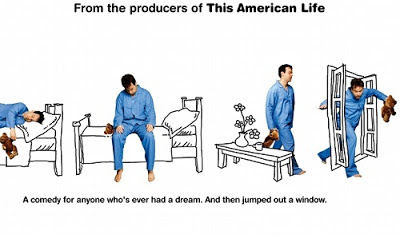
Goldthwait and Odenkirk are near-legends in the comedy industry at this point (though neither really for their directing talent) while Mark Duplass is quite solidly shoring his foundation as a multi-talent (and a gifted comedic improviser as seen on FX's The League).  This final film comes from yet another comedian, one less experienced before (or behind) the cameras.  Mike Birbiglia's Sleepwalk With Me is an intensely personal and hilarious story which Birbigs has worked into multiple formats over the years.  It started as a one-man-play, became a book, a recording of the show was released on CD and, thanks to his exposure on the highly popular radio program This American Life, it's now a movie (co-produced by TIL's host Ira Glass).

Birbigs (as he's known to his friends and fans) has this material down pat, and despite having no previous directorial credits, he has a very assured hand here behind the cameras.  His confidence with the story he's telling must have tempered any anxiety he might have had, as the film not only tells the story incredibly well, but the little flourishes Birbiglia puts in throughout, such as the driving narration and the dream sequences intercut with reality are quite brilliant.

There's a relatable intimacy to Birbigs' story, about being in a relationship that just isn't working for him despite every indication that it should, about being unhappy with his current station in life and reaching for any opportunity that can even marginally advance it, about being so stressed out by these things that his subconscious starts manifesting physically, and dangerously so.

I've read the book, and I loved it.  I've heard Birbiglia's live performance and it's just as good.  This film measures up equally well, and I adore it.  It's thoroughly Birbiglia's tale (only, for some reason, names are changed, most distractingly for me, as a fan,  was his inexplicable change of his own to Pandamiglio) and it's true-life nature, as well as Birbiglia's storytelling skills, make it fascinating and often hilarious.  It offers an  astute comedy about relationships falling apart, as well as a look inside the difficult world of a working stand-up comic, as well as a bit of psychological exploration.  It's a rich and deep story that is deceptively simple, in part due to its highly refined nature.  I can't recommend it enough.

Tuesday, January 8, 2013

Double Oh...6: On Her Majesty's Secret Service

On Her Majesty's Secret Service Preamble:  I actually have seen this one before, although only recently.  Well, "recently" compared to any other non Daniel Craig Bond film I should note.  Here's what I had to say about it December 31, 2009:
I’ve never seen this before, can you believe it. I’m not really much of a Bond connoisseur, though I like Bond films quite a bit, and you know, this might just be one of my top three favourites. People like to piss on George Lazenby but he does a remarkably good job for a credit-less actor in his first film role. The chemistry between him and Diana Rigg is painfully lacking though, however it certainly sparks between him and Joanna Lumley (Rigg and Lumley in the same film, I must be dreaming). Curiously the rhythm of this film is not all that different from the recent Casino Royale.
I think my view on the Bond-Tracy dynamic was skewed by my having heard about Diana Rigg's apparent dislike of Lazenby, and how she would sabotage their kissing scenes by eating garlic or onions beforehand.  I  also for some reason wrote that thinking Joanna Lumley was Ruby Bartlett, when it's quite clear she's not Joanna Lumley (it's Angela Scoular).  I think I liked it even better this time around than the first.

Villains: I wrote Draco, Tracy's father, down as a bad guy for he's a business man and head of a large European crime syndicate, but by the end he's quite clearly not so bad afterall, at least not anymore.  Back when "M" was in the field, he was a chief adversary and the two reminisce at Bond's funeral in a very charming moment.
  Frauline Bundt's is yet another of S.P.E.C.T.R.E.'s stern taskwomen, a severe German with little sense of humour.  She has a den of fembots (I suppose it's wrong to use Austin Powers terminology in writing about Bond, it's like the snake eating its own tail) whom we're first introduced to in a swinging, rotating lounge, all a little man starved as they've apparently been cooped up in the Bleuchamp clinical allergy research facility.
  Bleuchamp (Telly Sevalis) is a thinly veiled disguise of Ernst Blofeld, but for some reason is keen to have his familial title recognized.   His study of allergies, all with remarkably beautiful women, is merely a cover, as he plots bacterial Warfare causing infertility in plants, animals and people.  The fembots, brainwashed through nightly "treatment" sessions, are to act as unknowing agents of distribution.  Blofeld is by far the focal villain of the piece, and beyond Bundt's minimal role as attractive-lady-wrangler, there's no other notable hencment to speak of.  In fact, surprisingly (after Blofeld's last appearance), he's very active in his pursuit of Bond, chasing him down mountains like an Olympic-level slalomnist (that's a word isn't it?) and later in a bobsled pursuit (which is just as ridiculously entertaining as it sounds), he's a master sledder.  I really wasn't expecting this out of old Ernst.
  The curious thing is it's like Blofeld and Bond have never met when Bond's cover is blown.  There's obviously either a quasi-acknowledgement that each new Bond is a bit of a reboot of the series, or that there's an actual identity being passed along from one person to the next.  Either that or, as Matt Myra of the Nerdist Podcast postulated, he's a Time Lord. Whereas with Blofeld, it was quite clearly acknowledged that he had surgery to change his appearance.

Bond Girls:
Diana Rigg, the legendary Emma Peel from the Avengers, plays Contessa Teresa "Tracy" di Vicenzo.  She's the daughter of the aforementioned Draco, a crime boss, and she's long had a rebellious spirit.  She married a count, inheriting a title and little else.  She roams Europe getting in and out of trouble, largely on her own wits, but frequently with the help of strangers.  Rigg is dynamite, and absolutely stunning.  Credit to the wardrobe department, as she's flat-out stylish in every scene.  Rigg throughout never tries to be sexy, she just kind of always is. Strong, confident, resourceful, but also capable of softness.  She turns out to be a hell of a driver (as it seems Bond is often driven around by women).
  There's a wonderful moment where Bond, on the run from Bundt and Blofeld's goon squad, he sits woefully rinkside in a busy Swiss resort village, and there's a great moment of weakness, of being penned in, trapped, hopeless.  It's not like Bond to have these moments, and you know he's capable of pulling himself up and getting out of it, but for a moment there, he allows the darkness in.  Then Tracy skates up, like a sunbeam glistening off gold.  Lazenby could have sold it better, but the moment itself, he knows he's saved, and he falls in love.  He's been rescued by women before, but at the moment he needed it, she was there to pick him up.
  Of course there's a whole sequence of courtship earlier in the film which seems thrown away for the second act in which James, in disguise as a genealogist, is knee-deep in a rich variety of attractive women, and is set to bed as many of them as he can squeeze into an evening.  What he does for queen and country.  One of the women is Ruby Bartlett, a sassy, delightfully forward, flirtatious and joyously verbose Englishwoman who seems even more of a sex addict than Bond.

Theme/Credits: This is one fucknuts credit sequence.  I mean, I understand the whole "time" thing is a theme, tying in with the Louis Armstrong-sung "We Have All The Time In The World", and the hourglass, pouring down images from previous Bond films signifying that Connery's time is up (as I suppose is the whole "hanging off a clock" thing) and leaving it open for a new Bond...but at the same time, I don't think the producers realized what a backlash they were going to have when replacing Connery, and reminding the audience of past glories, in hindsight, probably not the best idea.
  Though there were silhouetted nudes prior to this, these are the most flagrant silhouetted nudes, with the small-breasted, perky-nippled figures quite prominently displayed in profile, very little left to the imagination.
  The theme that plays over is a smashing John Barry score, having a tinge of Roy Budd influence peeking in (especially in his opening sequence, harpsichord rehash of the main Bond theme).
  "We Have All The Time In The World" is a curious smash of Barry's larger-than-life orchestral composition and Armstrongs more reserved, down-to-Earth, soulful vocals.  It doesn't quite work, but it's not terrible either.  The montage it plays over is... well it's not very macho, but it's nice.


Bond: Taller, leaner, stronger, Lazenby while perhaps over-gesticulating when fighting looks more impressie and powerful than Connery (looks like a better kisser too).  He was perhaps not as handsome as Connery, nor was he as effortlessly capable of delivering the witticisms he makes after fights or someone's death (something Moore specializes in). he did certainly carried a great casual demeanour and you could see him easing into the character and defining the role as the film went on.  Lazenby's Bond is the template for Daniel Craig's Bond, exceptionally tough, but capable of emotional vulnerability.
  The little Bond-ian traits already established such as the baccarat playing, eating food that's handy (after a fight or prowl), and even his less desireable trait of slapping a woman if he needs to be "persuasive".  There's a lot of Bond still left here, despite the change in face.
  As the film starts, he's been on the hunt for Blofeld for 2 yrs with no results.   He quits petulantly when taken off the case, but Moneypenny changes his memo to 2 weeks leave, to the relief of all involved.
  His title of "Commander" is emphasized, moreso than seemingly ever before before, as well when Bond meets Sir Hilary Bray, the genealogist he's to portray, he learns a little of his own background, including his ancestor Thomas Bond's  coat of arms baring the mantra "The World is Not Enough".
  More care is put into his cover as the genealogist, and into showing Bond's capability of committing to a role in the face much distraction, a facet of Bond that Connery never really even tried to pull off.  In this case Lazenby puts together a great Clark Kent routine.  It's too bad  Lazenby quit the role, I think he could have owned it his own way, much like Craig does now.

Movie:   I have a weakness for films with snowy settings.  I don't know why.  As a kid I always thought the Hoth sequence in Empire Strikes Back was the epitome of cool.  Perhaps it was growing up in a climate covered in snow for at least half the year, it's familiar.  This film, with its key sets and action sequences set in the Swiss Alps, just sings to me.  I love Blofeld's mountain-top compound and the escape sequence of Bond being trapped in the gear room of the cable car lift is an utterly fantastic moment of derring do and danger.  The slalem chases, both of them, are still amazing to watch, and one leads to "grisliest death in a Bond movie" contender #1: Snowplow.  I had forgotten just how heartbreaking the ending is, and it's an absolutely devastating thing of beauty, despite the almost silly shot of Blofeld, Bundt and henchmen seemingly joyriding in a car together.
  First-time director Peter Hunt (though he was editor and second line director on previous films) shows some filmmaking chops, nailing the action and fight sequences, even making the often campy back-screen studio inserts work.  Late in the film there's a great shot of Bond looking solemnly out M's window, with the image of Blofeld's men digging Tracy out of the avalanche projected on the window.  There's little arty flourishes like this that show some actual thought put into the filmmaking side of things that seemed largely ignored in previous installments.
  2 things that don't work: the "this never happened to the other fellow" quip that precedes the opening credits and the abrupt tonal shift at the end when the Bond theme queues over Bond cradling Tracy's lifeless body.  Not deal breakers by any means, just bad ideas in concept and execution.

Q gadgets: Radioactive lint, with Q noting miniaturization is the new trend in super-spydom.  However Q and his mini-gadgets don't come into play.  It's like the filmmakers, for a chage, are aware how the Bond tropes they've established are sometimes a hindrance to effective storytelling.

Classification (out of 01.0): 00.9

Sunday, January 6, 2013

Double Oh...5: You Only Live Twice

You Only Live Twice Preamble: Roger Ebert recently pointed me towards this article, on the evolution (or lack thereof) of "Asian Eyebrows" and yellowface in cinema.  The writer missed one very significantly glaring example with the James Bond series (particularly the non-Asian actresses frequently made up to portray Chinese or Japanese women early in the series, not to mention perhaps the most notoriously absurd Bond-ian moment (and there have been dozens if not hundreds of them) where Bond is passed off as a Japanese man in this film. 
You may also notice that, unlike most G&DSD posts/reviews, I have not included the directors of each entry.  That's largely because these films are, so far, uniformly not well shot.  That and I forgot.  I'll catch up with this in the next entry.

Villains:  Ernst Blofeld finally rears his bald head/ shows his scarred face, though not until very late in the picture and somewhat comically as he has to lean into frame from around the thighs of his Aryan henchman Hans.


As we've established Blofeld is the big man in S.P.E.C.T.R.E., a shadowy, nebulous, kitty-stroking figure that I think proved far more intimidating as an unknown than with a face, regardless of how scarred (it looks like he's wearing a monocle, to be honest).  As frustrating as it seemed as a child to never see Dr. Claw's face on Inspector Gadget, and no matter how many bumbling rubes he had defeated by a 10-year-old girl and her dog, he still maintained an aura of nefariousness because we just couldn't see him.  Blofeld loses this mystique by revealing himself.  At the same time, Donald Pleasance's deadpan, semi-robotic performance is awesome.  He's like a living Hal 9000... the lack of emotion or intonation in his voice is effective.

His hollowed-out volcano, however, is full-on awesome.  As we know by now, S.P.E.C.T.R.E. has the best evil lairs, and a secret volcano base, capable of harboring stolen space capsules, certainly puts in mind the scale of the operation Blofeld is in charge of.  It also has a piranha grotto, complete with a trick bridge, for all your lackey-killing needs.

None of the minions or lackeys particularly stand out in this one.  What sticks out the most is how many there are.

Bond Girls: Oh, how it seemed to me that we were making progress on this front with Domino and Fiona in Thunderball, but this is decidedly a broad two step backwards, with one short shuffle barely trying to make up for it.
Ms. Brandt (Karin Dor) is, at the very least, two rungs down the command line (number 11, actually), as she servers as Osato's secretary and assassin, whilst Osato reports directly into Blofeld.  Osato's not the type of corporate head-honcho to get his hands dirty, but he will give a kill order with little contemplation.  Brandt is smart enough to see through Bond's come ons and has a thing for torture, but totally sleeps with Bond to make him think she's turned good, then abandons him to die, confined within a pilotless plane.  She fails, naturally (why they don't just shoot him in the head and dump his body I'll never understand outside the deus ex machina of it all) and feels the wrath of the piranha grotto.
Aki (Akiko Wakabayashi) is Bond's first point of contact when he hits Japan.  She's an agent of Tiger, Bond's real contact in Japan.  Bond is naturally curious of her, but unsure whether she's a good guy, bad guy, double agent or what.  All he knows is she is indeed a she and he wants some.  Aki seems smart, but is reduced and degraded by the culture she lives in (or at least this film's representation of Japanese culture, and female subservience) as frivolously useful and all too willing to fall in love with Bond. She meets a horrid end when she's killed by a fake ninja in training (don't ask).  Normally this would be the point where Bond swears vengeance on her killers, but even he seems to see how de rigueur it would be and doesn't bother.  Also, it's because he gets another girl to fake marry him as part of his ploy to be the most unconvincing fake Japanese man in existence.  The credits have her as Kissi Suzuki (Mie Hama), but I don't think I heard anyone call her by name the entire movie, which is kind of insulting, to not even have a name.  Kissi holds tough on the dwindling allure of Bond, even though they're fake married, at least for a little while, but sensing that her part is de rigueur itself, concedes to a volcano-side make-out session.
What can I really say about Kissi?  She's not much of a character, but she is a good swimmer.

Theme/Credits: Nancy Sinatra's lingering, sweeping ballad is terrific, managing to hold it's wonder uniqueness in spite of Robbie Williams co-opting its orchestral hook for whatever crap it was he spewed out a decade and a half ago.
The title sequence is an odd one, splitting the difference on two facets of the movie.  First, there's the b-reel background footage of molten lava flowing (did they have these types of green screen images in karaoke back then... he asked rhetorically), alluding to Blofeld's hideout.  Secondly there's the exoticness of Japan, specifically their eyes and Geisha culture.  Perhaps it's my lack of understanding of Japanese titillation, but, to me this opening title sequence seems to insinuate that women taking a bath in hot lava is supposed to be alluring rather than decidedly unsexy.  But then, the opening sequences to this point haven't been all that sexual.  There's an implied sexuality to them, but on the level of a 12-year-old's understanding of what sexy is, basically naked lady parts or the insinuation thereof.


Bond: At this stage, Connery is starting to show his age but not owning it yet.  This is the guy who, in the 1989 was "Sexiest Man Alive".  He just didn't seem ready to embrace it yet.  So it's either that he was starting to feel uncomfortable in the role of Bond, or he was just bored, but he doesn't quite deliver it with much gusto this time around.
Bond, generally, seems to have lost his touch,with women (Bond thinks that just because he's fake married to Kissi he can sleep with her, with absolutely no seduction or any effort put into it), with being discreet (henchmen are constantly killing the people around him, and he's always found out when sneaking in somewhere), with being undercover (posing as a businessman before Osato, he leaves the office thinking he's succeeded at his deception, only to have Osato, once out of earshot, utter "kill him")... he's really not trying to be a covert operative at all.  The whole ruse of killing Bond at the beginning was pretty much for naught, when everyone in Japan can apparently see him coming as British secret intelligence from miles away.  And then, the far more absurd ruse wherein he attempts to pass for Japanese, a head taller, distinct western features, a profoundly and undisguised hairy chest (pointedly noted by Tiger earlier).  Tiger also makes an astute comment: "The one thing my honourable mother taught me long ago was never to get into a car with a strange girl. But you, I'm afraid, will get into anything. With any girl."
One of few character tidbits to delve into his past, it's revealed that Bond placed first in international languages at Cambridge  

Movie:  In the effort to go big, and incorporate the then trendy space race, this one opens in space but the effects can't handle it believably.  Later, an equally unimpressive helicopter dogfight is staged, and it's sketchy in concept already, but looks goofy and highly unbelievable in practicality.  
Bond, in Hong Kong, is killed before opening credits, acknowledging (with all too sparse self-awareness) that Bond is for too visible as a secret agent.  This is done just in time to send him to Japan to investigate a potential landing site for a kidnapped U.S. space shuttle.  What nobody knows is that S.P.E.C.T.R.E. is attempting to escalate a war between Russia and America, for profit!
With respect to Bond's ridiculous posing as Japanese and his marriage, it tries so hard to play this angle earnestly, but to what end.  What purpose does this charade actually serve?  Only about as much and for about as long as his death did.  For all the effort, it seemed rather futile.
Key scenes: Bond is shot out of a torpedo tube.  He fights a large, obviously ex-SUMO henchman, poorly. When Bond and Aki are being chased by Osato's henchmen, Tiger airlifts the bad guys using a helicopter and giant magnet and drops them into the ocean.  Ninja training school (for what turn out to be the worst ninjas ever).  Constant screaming at the television "Why don't they just shoot Bond already?" Tiger's personal subway car is awesome.
Tiger actually would be a pretty rad character were it not for this brutal bit of dialogue: "Rule number one, never do anything yourself when someone else can if it for you... Rule number 2, in Japan, men come first, women come second."
Or this one, in discussion with Bond about his fake wife, one of Tiger's agents:
"Is she pretty?" Bond asks, "She has a face like a pig" he replies.
Or when Tiger presents Bond with a gaggle of women like a pimp.  Bond picks, "good choice," Tiger says, "she's very Sexiful."  Ugh, this movie is so unabashedly sexist, and despite all efforts to appear cultured tremendously racist.  Can you believe this script came from legendary children's author Roald Dahl?
On the other hand, Toho's technical advisor was on hand to help with the effects and miniatures used in the picture, and they're pretty awesome, for the most part.

Q gadgets: Little Nelly, a tiny personaI helicopter.  There's no reason to bring Q all the way to Japan for this sequence, especially when Tiger presents him with a rocket gun and "one shot" cigarettes later, essentially filling Q's role of gadget man, and effectively.

A nitpick, When Blofeld sees Osata's x-ray of Bond's Walter PPK, he states "only one person we know uses this gun."  Is it not established by Q in Dr. No that the Walter PPK is standard issue, both by the SIS and CIA?

Classification (out of 01.0):  00.4  

Saturday, January 5, 2013

Catching Up: Movies for Maybe Kids ?

Divorced or widowed daddies are such a jewel to Hollywood, depicting exactly how far a good man can go to support his family.  Yeah, the myth of the great man doing only what he really should be doing in the first place, is still pretty stuck in Hollywood.  Add to that the standard factor of the man having enough money to do "what needs to be done" and you get something which is probably already a trope.  We Bought a Zoo (2011, Cameron Crowe) is one such movie.

But despite my cynicism I rather liked this Happy Happy story about a man who buys a failing small California zoo and decides to reopen it.  He believes it will help his grieving / emo kid recover from the death of his mother and give his daughter another perspective on which to focus. Given that the source material is British, and I am always rather fond of these British flicks where people overcome insurmountable barriers to achieve a Happy Happy goal, it was expected I would be fond of this.  Yes, he depletes his bank account, yes he fights with his kids and yes he runs into more trouble than he is due, but with the hard work of the motley crew and a very fresh looking Scarlett Johansson, they succeed at opening the zoo (to Kevin Costner & baseball style crowds) and healing his family.  I wonder how the real zoo is doing?

Hugo (2011, Martin Scorsese) was something I should have seen in the cinema instead of Netflix. It is a grand scale mystical movie along the lines of Jean-Pierre Jeunet, where Hugo, a boy who lives in the Gare Montparnasse train station (yes, that one we see in any period movie about Paris) after his father passes away.  He repairs the clock while being obsessed with the toys sold by Papa Georges, the toymaker.  Hugo believes the toys are important to his repair of an automaton his father was working on before he died.

The movie, you might think, is going to be a journey of discovery for a boy who still understands whimsy, in a setting full of incredible sets, over the top characters and brilliant costuming (just my allusion to Jeunet) and, well, it is.  But that is not what the movie is about.  It is really about Scorsese's love of film and cinema.  It is a love story, in truth and in metaphor, for the golden age of film making before the rules were made, when everything was silent and the special effects were hand made.  Which is kind of odd, considering the grand amount of CGI used in the movie.

Speaking of CGI, do we still use that term for entirely computer generated animated movies?  Or are they now just animated movies as I don't think many are done without computers these days.  Brave (2012, Mark Andrews, Brenda Chapman) was one I was looking forward to, the latest from Pixar.  We have Merida and her nest of red hair, a princess for the 21st century, rebellious and definitely not looking for her Prince Charming.  Despite knowing of her family obligations, what she wants most in this life is to choose her own destiny. Of course, her parents need to marry her off.

I expected a movie where we focus on her being at odds with the obligations but end up with her understanding why she had these obligations while still retaining her own self-direction, all wrapped in a pseudo Celtic mythos in Hollywood Scotland / Ireland.  What we got instead was a slapstick comedy of transmogrification hi-jinx with rambunctious baby broth... bears. Most of the magic was replaced by chase scenes and a movie that mostly left me feeling flat.  Maybe a second watch will improve my impression?

Oh, at least I enjoyed catching the Pizza Planet truck. And Kent's somewhat similar view.... darn, we don't disagree much more these days :)

Thursday, January 3, 2013

More Kid Flicks

Labyrinth - 1986, Jim Henson - netflix
Return to Oz - 1985, Walter Murch - DVD
The Secret of the Sword (He-Man and She-Ra) - 1985, Ed Friedman, Lou Kachivas, Marsh Lamore, Bill Reed, Gwen Wetzler - youtubeThe Lion King - 1994, Roger Allers and Rob Minkoff - DVD
Ratatouille - 2008, Brad Bird & Jan Pinkava


Since the last batch of Kid Flicks seemed to go well, and there doesn't seem to be any end to my viewing of them, here are some others I came to watch recently, some with my kids and some without.  As you can see from those listed above, more than a few of them predate my kids, age 10 and 3 (ish), and more squarely fall into films from my own childhood or adolescence.

Despite loving the Muppets and having a strong affection for Jim Henson's output, I had never watched Labyrinth before, in part or in whole.  I'm not certain why, as I'd seen the bulk of other kid-oriented fantasy movies from the era.  It's unfortunate too, as I think if I had watched it as a kid I would have a much stronger reaction to it today.  As it stands, I was somewhat entertained, but I'm far too aware of film making and puppetry tricks to fully invest in the story of the movie, instead I focused more on the craftsmanship involved.  To be fair, the story is pretty flimsy, and the characters are largely plot driven, rather than the other way around.  Bowie has become a camp figure for my wife and I of late, and that campiness is on full and glorious display here.  He's quite fun to watch.  Jennifer Connelly, an object of my letching since the Rocketeer in 1991, is way too young (round faced and obviously still teen-aged) to letch over, but she's already a solid actress and carries the film and it's fantastical elements quite well. 

It seems to me that with Labyrinth, Henson was more interested in creature design and puppetry execution than he was with storytelling.  The story seemed more a vehicle to put the puppetry advancements on screen than servicing any sort of character, plot, or concept.  On the other hand, Henson's Workshop was primarily responsible for the creatures in the much maligned Return To Oz where they are no less impressive and far more serviceable to the story.

I was never a fan of the 30's Judy Garland Wizard of Oz, it always seemed far too precious, and frankly the actors playing the Lion, the Scarecrow and the Tin Woodsman all annoyed the pants off me even as a child.  I found their costumes silly (and they just looked like costumes) and couldn't invest in them as characters at all.  The songs are largely grating (even to my then-young ears they were) and it just seemed childish, campy and certainly didn't stack up against my many Sci-Fi, superhero, or fantasy obsessions of the time.

In the late 1980's and early 1990's, the Return to Oz was on television with seeming frequency.  Though I had no great love for the Wizard, Dorothy's return to Oz seemed a much, much, much darker journey.  The film begins with Dorothy being shipped off to an Asylum for electroshock therapy as she cannot sleep due to the nightmares following her return to Kansas.  Escaping with another girl from the asylum, they're separated as Dorothy gets swept up in a river during a storm.  When she comes to, she's in Oz, where her worst fears are realized.  Evil has swept the land, with the nefarious Mombi and Nome King having established their fiefdoms and turned all the residents to stone.  Dorothy' chicken from the home, Bellina, surprisingly can talk and acts as her chaperone.  They befriend a clockwork soldier, Tik Tok, find another in Mombi's experiment in creating life, Jack Pumpkinhead, and make their own friend out of a stuffed Gump head, a few sofas, and some rope.

It's a much darker, far more insidious adventure, but it makes Dorothy's triumphs that much more rewarding.  Whereas the classic Wizard just seemed to find the protagonists stumbling their way to victory, here Dorothy is much more proactive, far more daring and intelligent, and her connection with her friends (though puppets all) is much more endearing.  It's such a stimulating adventure, and I'm amazed that beyond it's very underground cult status that it hasn't received more attention.  It's a decidedly different film than Wizard, but that's what makes it so great.  It didn't try to repeat the successes of its predecessor and its so much the better film for it.  It's maybe a little too intense for the pre-school crowd, but 7-9 seems about the right starting age, depending on the kid.

He-Man and the Masters of the Universe was a charmingly inoffensive action-oriented cartoon made to sell toys.  It was a rich power-fantasy of a dorky prince with the ability to change into the most powerful man in the universe, fighting against a bumbling cadre of eccentric-looking villains in a barbarian-inspired fantasy world that featured wild technology alongside equally powerful magic.  It had two seasons of 65 episodes each (so that it could run daily on weekdays) and was remarkably popular despite not really featuring the assets from the Mattel toyline all that prominently (at least not in comparison to the G.I. Joe, Transformers and other such toy-based cartoons that followed closely behind its lead).  Instead of continuing with new episodes of He-Man, Mattel, the toy's manufacturer commissioned a new cartoon series from Filmation based on its spin-off toy line of girl-centric adventure heroes, She-Ra:Princess of Power.

She-Ra was designed to be He-Man's sister, but since there was no mention of her in previous cartoon continuity, the new cartoon needed to explain the association.  A multi-part "crossover" was born, which would serve to draw He-Man's fans to the new cartoon, as well as introduce She-Ra by showing her origin and extrapolating on He-Man's own.  So pleased was Mattel with Filmation's efforts that they decided to form the first five episodes of the new show into a singular, theatrically-released film.  It's a product of its time, to be sure, with the animation featuring a limited range of motion (compared to today, at least), and a quite juvenile worldview, filled with silly slapstick and no real danger presented to its heroes at all.  At the same time it's still wonderful classic cel animation, beautifully designed, richly detailed painted backdrops, and vibrant character work.  Filmation seemed to an animation house for artist keen on pushing the limits of animation (if not necessarily storytelling).  My 3-year-old has a massive crush on Skeletor and I was excited to show her a female super-hero that was just as capable of taking out the bad guys as the boys were.  She loved the movie and wanted more immediately.  It's not necessarily great at holding the attention of adults, even those filled with nostalgia for the product, but then we're not the target.  I'm happy to see that it still has some resonance with kids today because I had a great time with it in my youth.


On the flipside, until Pixar came along, I was never a Disney fan (I was more a Warner Brothers/Looney Toons kid than a Mickey/Donald/Goofy kid).  The Disney of the 1990's was so princess-centric and musical minded that it was designed to appeal more toward the under-serviced girls market.  After a couple hits like Little Mermaid and Beauty and the Beast (and the girl-centric onslaught of ancillary merchandise) this seemed to be the overall impression of Disney's direction as a studio.  Thus when The Lion King hit, and exploded, it still didn't seem directed towards me.  Because it wasn't.  I was sixteen at the time.  I was watching Pulp Fiction and having my mind blown.  There was no way Elton John tunes in a cartoon could hold up to coke-fuelled "Son of a Preacher Man" or a twist on "Girl, You'll Be A Woman Soon".  The Lion Kind was a family movie, meant for kids but also smarter, for adults.

The three-year-old developed a recent fixation with it, and has enjoyed it repeatedly.  I can't stand it.  I think the animation is absolutely remarkable, and the story is actually pretty darn smart, but the rhythms of it feel so ancient and all too familiar, so formulaic, stepping in line with Disney of the past so that it just doesn't feel unique.  Part of it may be the songs have been so overplayed in the past (nearly) two decades, but equally the the necessity of the comic relief in Disney films is one of my biggest peeves about the films of that era.  While my daughter's kind of peeved I wasn't at all sad when suddenly the DVD just stopped playing last month (with no visible scratches or marks on the disc no less).

Ratatouille, on the other hand, is brilliant filmmaking, exceptional storytelling, and endlessly watchable.  If writer/director Brad Bird had an objective with his movie, it think it was to inspire kids to cook, or at the very least, appreciate the art of cooking, the beauty in food, and the pleasures in appreciating flavour.  In the background there's the delightfully rich story of a kid named Linguini trying to live up to his legacy in his deceased father's kitchen, and of a rat named Remy trying to escape the expectations put upon him by his own father (and species).  In both cases there's a sense of each trying to forge their path despite their circumstances.  Remy has a mentor in the form of the ghost of populist cooking show host Chef Gaston (Linguini's father), while Linguini finds one in Colette, a feisty chef in Gaston's kitchen, struggling to establish a name for herself under the totalitarian head Chef Skinner.  Skinner, meanwhile, is selling Gaston's name, diluting his reputation and ultimately destroying his legacy for his own reward.

There's so much at play in Ratatouille, so many complex emotions in such a richly constructed plot that it's maybe a little too much for children to fully comprehend, but thankfully it doesn't ever even attempt to dumb it down.   At the same time, it provides everything in an exceptionally streamlined manner such that, even if they're not getting all the various subtexts involved, there's still a basic story they can follow and enjoy (my 3-year-old keeps wondering who the bad guys are).  It doesn't trigger the same sense of delight or fantasy as most kids movies, but it's near-reality setting is what I love most.


Catching Up: One Bad, One Good

I am still not sure why they did The Raven (2012, James McTeigue) but I think it had something to do with the popularity of the Robert Downey Jr's Sherlock Holmes movies.  Again, those fictional Hollywood producers had a great conversation in my head that was summed up with, "We need something period, something crime related but something more American !!"  So they grabbed a dark script about American author (yeah, I was surprised as well) Edgar Allan Poe getting wrapped up a murder mystery where someone is recreating the acts in his stories.  Yes, that was also the plot of episodes of Castle and Bones. And with this dark script in hand, they tooled it to be more ... rollicking.

John Cusack is the drunken lout and conniving Poe.  Luke Evans is Detective Lestrade... I mean, an entirely different lead detective investigating said murders.  We are in late 19th century Baltimore and I have to admit, I couldn't get over the fact that not a single character had English accents.  You see, it is dark misty period streets and yet not London!  My brain could not resolve that precedent.  And honestly, I think it was this "problem" that ruined the movie entirely.  It just felt so rinsed of any authenticity, as if a lack of some sort of period accent (even a pseudo British one) diminished the authenticity of the movie.  But that can only be in my head, right?  Its not like anything else is ever truly authentically period.  Finally, Hollywood brainwashing has done me in.

The plot?  As I briefed, while Poe deals with the difficulty of being a true artiste while his publisher expects popular fair, murders are going on around him that he cannot ignore.  So, creative killings, in the style made popular in slasher flicks and the Saw movies got their origin in Poe?  Simultaneously horrified and thrilled by what is going on, he tags along with the detective trying to solve the murders.  And that is all you need to know.  Really, its not much more than that.    Good thing we only downloaded.

Meanwhile, Looper (2012, Rian Johnson) was something I had been waiting for with bated breath.  It is a time travel movie by the guy who did Brick, an incredibly enjoyable play on noir crime in high school.  But this is not a movie where we are going to work out the particulars of time travel tech or science, but an action flick involving criminals making use of it but fully understanding it.  Their part is as executioners of people from the future; I guess crime solving has become so precise, they can
 only get away with murder if there is no body.  So, back the bodies come and boom, the dead they become. Note, it is also already the future and the executioners are seemingly the only wealthy folk in a time when poverty rules all.  The crux of this deal is that all of these executioners know they will have to someday close their loop; kill their own future self.

Joseph Gordon-Levitt is Young Bruce Willis.  Yes, definitely that for Willis is not wearing Gordon-Levitt makeup to appear as him, older, yet the movie does focus more on Levitt's life as the soulless killer and how he deals with (not) closing his own loop.  It will give you a headache if you try and figure out the particulars of the time streams (as all good time travel stories should) but basically we are shown a first run through with the question, "What if he closes his loop?" answered and then the follow-up as Old Joe (Old Gordon-Levitt ?) tries to change the outcome. In fact, he doesn't just want to change the fact he was shot by his younger self but change reality so that he never has to be sent back.  This is where things get twisty.

We have all heard the standard time travel specfic plot idea about going back to shoot Hitler? If not, read this short story called Wikihistory. Johnson has run with the plot, and I won't give too much away, but in that Old Joe hopes to eliminate someone so as to stop an event, in his past in Young Bruce Willis's future, from ever needing to happen. Moral dilemmas are faced, paradoxes are tossed like dice and the two try and kill each other.  But it is not just about the elevator pitch of the two ages of Joe trying to shoot each other.  Its about motivations and ramifications and the choices we make.

Unlike Kent, I like the story more as I think about it, but it may have something to do with my absolute fondness for world building, in that I still like to ponder these worlds of the future, of Gat Men and the Vagrant Wars, of crappy flying motorcycles and bad guys that look Amish.