Showing posts sorted by relevance for query Richard Stark. Sort by date Show all posts

Saturday, December 9, 2023

KWIF: Blue Beetle (+2)

 KWIF is Kent's Week in Film, but more like Kent's A Few Weeks Ago in Film...KAFWAF?

This Week:
Blue Beetle (2023, d. Angel Manuel Soto - Crave)
Parker (2013, d. Taylor Hackford - AmazonPrime)
Repeat Performance (1947, d. Alfred L. Werker - Criterion Channel)

---

Blue Beetle is a back-to-basics superhero origin story with an injection of Texan Mexican-American culture and family values. So, maybe not so basic.

There may not be a massive collective of Blue Beetle ultra-heads out there, but it seems writer Gareth Dunnet-Alcocer is one of them. The amount of comics-derived Beetle lore he injects into this script, and thus forcing the production to visualize all this madness, is utterly remarkable. As a guy who is one rung down from being a Blue Beetle ultra-fan myself (both Ted Kord and Jaime Reyes are on my top 5 all-time favourite superhero characters list), I delighted in every ounce of it, even when the script makes a few blatant left turns, like introducing Ted Kord's daughter(!?), and shifting the relationship Jaime has with his scarab.

I don't mind what they did with either, but I really wish, in the exploration of what makes Jaime's relationship with his family so special, they also explored what makes his relationship with the scarab so special. In the comics and Young Justice cartoon, the scarab is a super weapon intent on being a super weapon, but Jaime has the ability to keep it under control. Here, the scarab takes a marginally passive role, bending to Jaime's wishes rather quickly, but also acting as advisor to him. It's a less dramatic relationship but the film probably wouldn't work the same way with it being more contentious.  Even still, it doesn't spend enough time with Jaime and the scarab coming to terms with each other (I think about the scene in Spider-Man: Homecoming where Spidey's engaging with his onboard AI and we don't really get a scene like that here).  The alien-ness of the scarab is used a little too sparingly.

I found the humour of the film largely fell pretty flat and was very dependent on screaming (as Toasty pointed out). Given how the film leans in very heavily on these humourous moments for basically the first two acts, it's kind of a shame we're actively yelled at for much of the film's run time. But you know who likes yelling-as-comedy? The kids, if half the animate programming on TV is any indication.

The third act, where many a superhero film falls apart or descends into cgi goop, here is where Blue Beetle triumphs the most, letting all the players in on the action, giving most of them meaningful things to do, and delivering a thematically apt finale. Go Nana! 

I like that this film made little attempt to world build outside of its own neon-drenched El Paso-analog pocket of the DC Universe. A brief mention of Superman and the Flash (and calling Batman a fascist) is more than enough to tell us what world were in. Jaime's not vying for a spot on the Justice League roster, he's just a college grad, deeply in dept, looking for a job, who happens to get an alien bug weapon integrated into his spine. That old saw.

I wish I could downright love that a Blue Beetle movie exists, although I do genuinely appreciate that this one does. I've wanted for years for there to be a Jaime Reyes Blue Beetle movie, hoping it would be a smash success and see little kids wearing the scarab backpack, running and jumping around screaming "I'm Blue Beetle".  This wasn't a big enough hit for that, unfortunately. 

I think the translation of the suit from comics to screen is incredible, and I like the cast, if not all the yelling in their performances. I'm not fully enamoured with the final product but that's at least in part because, as Toasty said, superhero fatigue is real. I think 20 years ago I would have embraced this much more fully...but then Jaime Reyes Blue Beetle didn't exist until 2006 (RIP Keith Giffen). 

---

There have been a number of cinematic interpretations of Richard Stark's Parker (Stark being Donald Westlake's pseudonym for his two dozen hardboiled crime novels starring the character of Parker), played by many tough guy actors. Lee Marvin in Point Blank, Jim Brown in The Split, Robert Duvall in The Outfit, and Mel Gibson in Payback, among others. The interesting thing about these previous adaptations of Stark's Parker is that none of them featured the character "Parker". Westlake, it's siad, wouldn't permit use of the character's name unless the studio licensing his work committed to at least three films.

That Jason Statham plays a character named Parker in a film titled Parker, something Westlake's widow agreed to with the producers, somehow seems like a slap in the face to Westlake's wishes.  Maybe it only is in hindsight, given how frustratingly awful the end result is.

I'm no superfan. As I am with most things, I'm an avid tourist, just popping in, absorbing and appreciating some of the experience, without dedicating myself to it.  In this case, just prior to watching Parker I had just finished reading the omnibus of Darwyn Cooke's loving adaptations of a few of Richard Stark's Parker stories. This certainly isn't that.

It's not even that Statham's Parker doesn't at all seem to be the same character I just read, or that Statham's Parker is indistinguishable from almost any other Statham character, or even the unambitious Hollywoodizing of a Parker story (it absolutely stalls out whenever it jumps to Jennifer Lopez's character...not JLos fault, it's the script), it's that Taylor Hackford shoots the goddamn thing like its an episode of NCIS. It's one of the ugliest, sloppiest 30-million dollar production I've seen in a long while. It's got an incredibly stacked support cast (Michael Chiklis, Wendell Pierce, Clifton Collins Jr., Nick Nolte, Patty Lupone, Bobby Cannavale) that all deserve much better than to be treated like tertiary local hires. It's also got a godawful soundtrack that made me feel slightly ill, and horrendous editing that seemed to do nothing to help the story progress with any finesse.

It was very difficult transition going from Cooke's incredible passion project of delicately translating Westlake's stories and characters so precisely and creatively, with a gorgeously illustrated, stylized 50's setting, to this atrocity in which nobody at all seems to care about the quality of the final product.  

Rumour has it Shane Black's attempting a series of Parker stories with Mark Whalberg as the lead. From Black's repertoire, it's clear he can do justice to this material, but I cannot stand Whalberg, and he's an immediate deterrent for me watching a film (even more than Statham, Whalberg's a guy who can't really play anything but the same character over an over). 

Skip it all, go read Cooke's comics (or the original novels).

---

From pseudo-noir to actual noir, I recently watched Repeat Performance, a part of Criterion Channel's "Holiday Noir" selections this December. My desire was to get away from Hallmarkies for this year's XMas Advent Calendar, and thought this Noir category would be the perfect distraction. Alas, the "Holiday" of this "Holiday Noir" is New Years Eve, not Christmas.

There are still others to watch, even ones that clearly identify themselves as Christmastime movies, but I chose this one first since it features some timey-wimey shenanigans that are obviously totally in my wheelhouse.

Here Sheila (Joan Lesley) is an actress subjugated by her husband, Barney (Louis Hayward). She winds up shooting him on New Year's Eve in self-defence. She's distraught, and in the process of heading to her play's producer looking for help, she wishes she could do the year over again, and by the time she reaches the top of the stairs, the clock has rewound by a year.  It takes her a while to realize that she is not going mad, and upon returning home, seeing Barney alive, she starts trying to manipulate the timeline, to prevent Barney (a struggling playwright) from meeting Paula (a successful playwright played by Virginia Field ) and having an affair that both kills their marriage and, quite literally, kills one of them. But every effort to change the tides of fortune result in either further cementing the inevitable or maybe even making things worse.

True to Criterion Channel's assessment, Repeat Performance does feel like a prototype for The Twilight Zone complete with an opening voice over narration that sounds similar to (but isn't) Rod Serling. It's a fairly compelling film despite some pretty hammy acting (Hayward leading the charge on that one) and being absolutely drenched in sexism, both outwardly in the story and intrinsically in the script. The whole movie is really not about Sheila trying to stop the events that wind up with her killing Barney, but, instead trying to save her marriage to a drunken, depressed, jealous, washed-up, pathetic man that she inexplicably loves to the point of reversing time to try and save. It's a noir, so it sustains its fatalistic tone pretty well, but it's hard to root for a character who spends an entire year making one big mistake.

I was really hoping at the very end to find that Sheila kills Barney again, heads to the same stairs only to find herself, once again, a year earlier...stuck in a horrific time loop she can't emotionally escape. Alas, it twists the ending into a tale fooling fate, just enough to be quite satisfying.

A fascinatingly terrible story, but a good production overall.

Monday, February 2, 2015

Wintervision: New Mid-season TV

Galavant (Season 1) - Sundays @8 on ABC
Agent Carter (episodes 1-3) - Tusedays @9 onABC
Man Seeking Woman (episodes 1-3) - Wednesdays @10:30 on FXX
Schitt's Creek (episodes 1 & 3,4) - Tuesdays @9 on CBC
Young Drunk Punk (episode 1) - Wednesdays @8:30 on CityTV

---

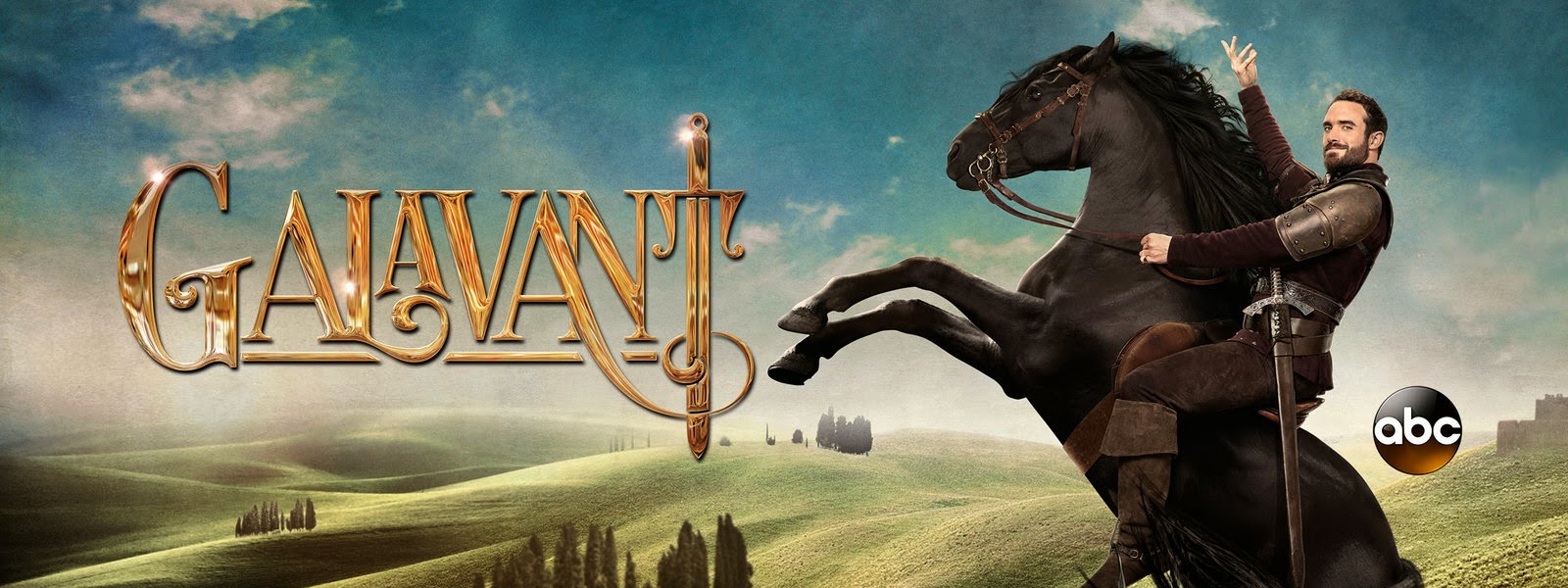
I hadn't heard anything in advance about Galavant, a 1/2 hour medieval musical comedy that ABC was seemingly trying to bury on Sunday nights in the January post-holiday haze.  I caught wind of it only the Friday before the first episode aired on some website or another noting that Weird Al, Ricky Gervais and Rutger Hauer were all set to guest star on a, well, "medieval musical comedy".  This was most assuredly going to be a train wreck.  I mean it's early evening network television, how could it not be?  Plus, ABC was apparently trying to get rid of it quickly, running two episodes a night for four weeks.  Burning it off quickly was certainly a sign of its quality, right?

I tuned in to Galavant at 11PM for the Pacific time zone airing, as my wife had already ventured off to bed and I was reluctant (and a little embarrassed) to watch the show in front of her.  It's a medieval musical comedy for the 8PM timeslot on ABC for Pete's sake.  So imagine my surprise when I found myself rolling on the floor with utter glee for the better part of an hour.  Galavant defied even my  slimmest expectations and for the following three weeks it became appointment television.  When co-star Timothy Omundson appeared on The Soup with Joel McHale between week one and two, he created a bit of an impression on my wife, and even she was on board with it.


The show ambitiously strives to be a little bit of everything, even when it conflicts with itself: it's raunchy and kid-friendly at the same time; it's a period piece, but not outside of making modern references; it's genre busting, yet also genre embracing;  it's a funny musical, but the music is incredibly well-crafted, not dispensable.  It's a rare show that achieves everything it sets out to do, without pandering.  It's a show that toys with metatext, the characters often aware that they're in a production, but it doesn't break the wall too often that it knocks it down altogether.  And the comedy doesn't solely extend from their self awareness.  Both the plot and the characters are exceptionally playful, growing in ways that convention dictates, and in ways that wink at the convention, and then also in ways that are just out of left field.  The fact is that it plays with three genres at once (being medieval fantasies, musicals, and comedies) and so it has three different ways to toy around and play with characters, story, and song without exhausting the possibilities.

It's the show's pilot that hooked me, before it even the first commercial break by breaking the knights-and-princesses story cliche.  In the opening moments we meet Omundson, playing the giddily dainty King Richard, who has stolen legendary knight Galavant's true love Marlena, forcing her to marry him.  Played by the handsome, toothy Joshua Sasse, Galavant is dashing and charming, even when he falls prey to goofiness.  Galavant bursts in on the wedding, keen to fight for his love, but Marlena (Mallory Jansen playing a comedic iteration of Cersei from Game of Thrones) finds the wealth and power offered by Richard trumps true love and voluntarily elects to continue the wedding.

From there the plot fast forwards a number of months and thickens even more, with genuine intrigue that's funny, but no less exciting.  Galavant is in a rut, heartbroken, out of shape, drunk and broke, when Princess Isabella (the pristine Karen David) asks for his help in rescuing her parents and taking back her kingdom from King Richard.  What he doesn't know is that Richard has sent her to fetch Galavant so that he may kill him, since he suspects Marlena's apathy towards him has something to do with her residual feelings for Galavant (turns out not so much, she just despises him).

With the first two episodes setting up the general thrust of the show, the middle four jockey between establishing the status quo at the castle (Richard's search for manliness with his loyal guard Gareth [a very game Vinnie Jones], Marlena's infidelity and lust for power, some asides with the chef and jester) and the road trip taken by Princess Izzie, Galavant, and his squire Sid (Luke Youngblood, pop pop!).  The final two episodes bring the whole cast together for some really rich shenanigans that jump all over the place, potentially taking a lot of the characters out of character, but making for absolutely delightful entertainment.  The penultimate episode features the show's most riotously funny musical number as Sasse and Omundson, who have spent the majority of the series apart, come together for a little ditty about regicide.

The songs (from omposer Alan Menken (The Little Mermaid, Aladdin, Beauty and the Beast) and lyricist Glenn Slater (Tangled)) of Galavant aren't particularly memorable, but they are exceptionally well executed, with the lyrics having to tow the line between genuine exposition and comedy, and faring quite well most of the time.  The best songs feature the characters singing sweetly about murder or death, or in the case of the romantic duets, mutual disgust leading to begrudging affection.  One of the smart moves the show makes with the songs is, unlike most musicals, these aren't big showy numbers.  Generally the songs remain contained to few people singing it, only occasionally breaking out into something bigger.  Beyond that, the songs act in the same way they normally do in musicals, as internal monologue, but what the show does is make them external, such that the other characters are kind of aware of what they are saying, though often not paying close attention.  It makes for a hearty giggle every time someone reacts to something in the song they're otherwise not supposed to hear.

I fell maddeningly in love with Galavant (the show, not the character).  It's truly an outstanding addition to the medieval fantasy comedy genre, that may even stack up to The Princess Bride in its ability to go for it (it will be interesting to note how well the show ages).  At eight episodes, it's really feature-film length but broken down episodically.  The cast is tremendous throughout, with Omundson the obvious breakout player, and will no doubt be seen cropping up more prominently between seasons.  The comedy doesn't aspire to be ground breaking, but entertaining, which it is, fully.  Where there's a handfull of "your mama" jokes and a play on Jon Hamm's name in the second episode that one could roll their eyes at, the show makes it clear that they know they're very silly and that it doesn't care.  It's game for anything.

Having bore witness to the majesty of Galavant, I have to wonder if the programming execs aren't actually subtly brilliant.  Burning through the show over four weeks with 1-hour blocks instead of eight 1/2 hour blocks perhaps serves the modern viewer a lot better, one more used to binge watching without waiting.  Given that Parks and Recreation is doing the same with its final season and that Agent Carter (which we'll get to in a moment) premiered with its first two episodes rather than just one, this may see a new trend on network TV.  In any case, ABC would do wise to know that too much of a good thing can spoil the soup, so the second season shouldn't go beyond 10 episodes.  Keeping the show at feature length will allow for quality songs, and tight storytelling that made the first season such a hit.  If they try to go full-season, it will burn itself out quickly.

---

With Agent Carter, I'm tempted to say "I love it" and just leave it at that.  But I can't.  I need to gush.

What a strange entity Agent Carter is.  Peggy Carter isn't exactly a prominent character in the Marvel Comics Universe, and I don't think there was any sort of fan clamor to see much more of Haley Atwell's character after the Captain America: The First Avenger film (as that film was more about getting people excited for Marvel's Avengers blockbuster).  But someone over at camp Marvel saw something special in Atwell and her performance as Peggy, commissioning her for a short film that was packaged as a special feature on the Iron Man 3 blu-ray.  After the short was well received, and the initial success of Agents of SHIELD, it was announced that Marvel was shopping around a Peggy Carter series.  The short helped sell people on the idea better, but even still it was met with some apathy.  Afterall, it's just Peggy Carter.  It's not Captain America, it's not any recognizable Marvel superhero, it's just Captain America's old-timey girlfriend.

It's that expectation that this series continually plays upon.  Peggy Carter, as a property and in the show, is completely underestimated by almost everyone around her.  The pilot episode goes to great lengths (and they are quite great) to show the audience, at the very least, what makes Peggy so special.  By mid-way through that first episode, I think everyone watching had bough in.  Agent Carter is amazing.

The crux of the show finds Peggy a low-level Agent at the SSR (Strategic Scientific Reserve), just one notch above receptionist essentially.  The SSR primary focus at the moment is finding Howard Stark, after it's discovered he had been manufacturing all kinds of dangerous weaponry and that somehow it's wound up in the hands of the enemy, a secret organization named Leviathan.  The SSR suspects that Stark sold the weapons, while Stark has secretly asked his old ally, Peggy, to help clear his name.  The conflict is obvious.  As Peggy gets deeper into understanding just Leviathan is, the more risk it poses not just to her physical well being, but to her status at the SSR and as an immigrant in America.

There's a lot of fuel for Agent Carter to mine:
First there's Peggy's past, having lost the man she loved (and not just any man, but Captain Frigging America) and her wounds still stinging.  She has a raw spot where Cap is concerned, and it's what allows Howard to manipulate her, while also keeping her from forging any bonds with anyone else.

Secondly, there's the time, set in the mid-1940s, post-war, women having had a taste of liberation during the war are being force back into the home as the men return to their jobs.  Women have proven themselves capable but are still deemed inferior.  The show manipulates this thread expertly, allowing Peggy to both stand in defiance of it, but also use it when its advantageous to her.  Her ability to stand up for herself, to handle herself in a fight, it shows her strength, but her manipulation of the institutionalized sexism and exploitation of people's misguided expectations shows her intelligence as much as her ability to piece together clues and perform fieldwork.  Atwell is an utter genius in this role.  She able to sell Peggy's toughness at every turn, but she's also equally capable of selling her intelligence.  Most times Atwell carries herself with such incredible confidence that its easy to believe she's the smartest person in the room (which she generally is).  At the same time, Peggy isn't flawless, and Atwell knows how to leave those chinks in her armor.  She's got her triggers that set her off or leave her blind, at the same time she's also not so smart as to be ahead of the story.  She's capable of failure and the stress of the work she does, the impact it has, breaks through emotionally from time to time.  How could anyone not be utterly infatuated with Atwell/Carter after watching this show?

Thirdly, the show exists in the Marvel Cinematic Universe (the "MCU") which allows it to connect with everything that has already gone on in both subtle and overt ways.  Naturally it's connected to the first Captain America movie, but it's also connected with the Iron Man series, since the world of Howard Stark (Tony's dad) plays prominently in the show.  It also pulls in elements from the comics that have yet to appear in the MCU, morphing them to the time period and giving them new life.  For the nerds in the crowd, it gives them the easter egg hunts they look for in genre adaptations, but it doesn't derail the show.  Unlike Agents of SHIELD this series manages to organically tie to the MCU and the source comics in a way that benefits the show, rather than being thrust upon it.

Not to harp upon Agents of SHIELD but where it faltered for so long was lack of purpose, lack of character clarity, lack of direction, and a general unease about its place in the world.  Agent Carter has none of that.  It knows where it fits, but it also doesn't seem to be as concerned (at least not yet) about fitting it.  From Peggy's first meeting with Howard in the pilot, it's absolutely clear what the show's mission statement is: find Howard's missing weapons, clear his name.  That it's also got a compressed season order -- only eight episodes -- means it's not farting around with side stories and tertiary character building.  It's story driven, almost cinematically, which most full-season shows can't sustain.  Likewise, it has an energy and confidence that Agents of SHIELD has strived for but never attained.  Weird that Agent Carter feels more like a Joss Whedon show (punchy dialogue, strong female protagonist) than the one he actually created.

I'm eager to see the series play out, but also just as keen to watch it again.  I'm an unabashed fan of The Flash and Arrow on the CW, and I even am modestly enjoying Agents of SHIELD, but those shows, despite my fandom, don't instill the craving to watch them over and over again.  Agent Carter I definitely want to go around again.  I hope that subsequent seasons run about the same episode order.  8 episodes allows for a much tighter series, and a much more enjoyable way to experience a different era of the Marvel CU.

---


Man Seeking Woman isn't the first comedy series about the dating life of the awkward adult male but ... wait, now that I think about it, perhaps it is.  Sure most comedies that feature single guys tend to have a heavy dating component with a revolving door of women, but those are mostly sitcoms where the situation is what the show is largely constructed around, not exploring dating and all the weird things (some) men go through emotionally and mentally throughout it.  Man Seeking Woman is a show that exclusively focuses on its lead character's dating life, much like any romantic comedy tends to do with its female protagonist.  The difference here is the show's heavy use of metaphor-as-reality to process the inner anxieties of the lead.  This may indeed be a dude's version of Sex and the City, The Mindy Project or The New Girl.

Jay Baruchel is perfectly cast as the average, somewhat awkward leading man.  I was surprised to learn that the role wasn't written with him in mind, for this is Baruchel's bread and butter (not that he can't play against type...see Goon for instance).  I was likewise fascinated to learn that this wasn't a product of the Apatow gang, instead coming from Saturday Night Live writer Simon Rich, based of his book of short stories, and produced by Lorne Michaels.  It's certainly a lot sharper and more daring than your typical SNL sketch (not that I don't have much affection for SNL).  But all that known, the show certainly makes more sense.  It does have the feel of a loosely sequential set of short stories or sketches.

The show's use of literal metaphors is what really makes it stand out.  The series picks ups as Josh, recently dumped by his fiancee, is picking up the last of his things.  He's an emotional wreck but putting on a brave face for his ex.  He steps out of her front door and it immediately starts to rain.  Pan wide and we see it's literally only raining on him.  Then a bird drops dead from the tree above, bouncing off him.  In the second vignette of the pilot, Josh is set up on a date with his sister, and she's a troll... literally a troll, but Josh, to his credit attempts to valiantly overlook this fact and engage with her, but he naturally finds it hard.  In the third act, Josh is invited to his ex's engagement party only to learn that her ex's new beau is Hitler... a 125-year-old, wheelchair bound Hitler (played under gobs of makeup by Bill Hader).  I genuinely love the way the show manifests emotional stress physically but doesn't just treat it as metaphor.  Gorbachenka the troll is aware she's a troll and has no apologies for it, and the patrons of the restaurant are well aware she's a troll and don't seem to care.  It seems to be only Josh's issue.  In synergy, the same applies to Hitler, where Josh is the only one outraged by his ex's new boyfriend (is it really because he's Hitler or just because he's dating his ex?).

The second episode uses this device expertly as Josh, wanting to text the girl he met on the train, freezes at the challenge.  His over-sexed best friend Mike (Eric Andre) keeps suggesting he send a dick pic, while his sister starts off strong but then likewise comes up clunky.  Smash cut to a war room where Josh takes in a series of suggestions from military advisers (fans of Battlestar Galactica will appreciate Michael Hogan's gruff one liners), the amount of time, angst and deliberation spent over what to say no doubt familiar to the average joe.  The episode ends after a miserably failed date with a montage of Josh's sad return home and shots of all the romantic things he did to set up, all underscored by sad 4-piece chamber music.  Josh steps into the kitchen where there's the 4-piece playing said underscore, and he tells them to pack up, that its not happening.  The exchange that follows is an utter delight.

The show delightfully toys with reality and surreality, presenting it all as real, but for the most part not unnatural.  In the third episode, Mike coaxes Josh into joining him on a club outing, but Josh knows all too well it's not his scene, so he finds distractions to prevent their outing.  "First, let just pound these beers real quick then we'll go, 5 minutes...", Josh says, and there's a goofy montage of them aggressively downing the beers to krunk music (and a barely audible aside noting "this is a terrible way to drink beer").  Then, stepping up to the club, Josh says, "We need to eat something, fuel for dancing and flirting...let's just pound some mexican food.  5 minutes?"  Cue montage in Josh's apartment with bags of groceries, a mexican cookbook, a mariachi band joining them, cooking up the burritos and serving an intricate meal.  Next in line at the club, Josh stalls once again: "Wait, let's just pound a 10,000 piece jigsaw puzzle first."  Cut to a montage of them finishing the puzzle in rapid order, mounting it, hanging it on the wall, taking a photo, adorning the cover of "Puzzle Aficionado" (it reads "Josh and Mike put it all together").  Finally entering the club, the last ones in, the bouncer lifts up the magazine in his hands, being the very same "Puzzle Aficionado" and exclaims "Oh shit, that was Mike and Josh!"  It comments on the excuses that guys put on to not get out and put themselves out there, and then delivers the comedy via an utterly absurd trio of montages that can't really be reality, but manages to present it as the reality of the show with a brilliantly unexpected tag.

One of the immediate draws of the show was that it was shot in Toronto... I always enjoy scoping out the backgrounds, seeing familiar locations repurposed... it's like a side game to the actual show.  It's not playing Toronto, because of course it's not, but it's also not playing really another setting either.  If anything it's an as yet unnamed fictional metropolis, which is perfect given the heavy fantasy-tinged elements of the show.

It's certainly an apt comedy for the FX stable fitting well as a sort of cross between Louis and Wilfred in a way.  It has a low-key, character-centric vibe to it that allows each vignette to move at its own pace.  It's not aiming for laugh-a-minute, and generally there's at least a kernel of truth behind every aspect of ridiculousness.  It's an immediate favourite.

---


Canadian television has a lot of great talent, but for the most part, that talent is wasted under low production values or scuttled off to America to actually do something worthwhile.  There's the odd breakthrough here or there, an SCTV or Kids In The Hall, a show that will be able to transcend its limitations through sheer inventiveness, but for the most part Canadian television strives to play broadly without any real panache and lacking a lot of interest as a result.  It's not just all about production values either, there's a general attitude to Canadian television, a slower pace, a decided lack of heightened reality that seem almost mandated to differentiate it from flashier materials south of the border.  We're all about moderation up here.

Schitt's Creek, in its most jaded summary, is a Canadian version of Arrested Development mashed with Green Acres, the premise of a rich family suddenly finding themselves on hard times and moving out to a rural community, in this case the aptly named "Schitt's Creek", a small town that Eugene Levy's patriarch had purchased as a joke a decade earlier for his son (played by Levy's actual son, Dan Levy).

When I first heard of the premise, this father-son cast, and it's groan inducing title, I wasn't very inclined to tune in.  The elder Levy has seemingly taken any job since American Pie, so he's not an outright indicator of quality, while the younger Levy was primarily a host on MTV Canada which isn't exactly a ringing endorsement for acting quality.  I had to wonder if the younger wasn't utilizing the cache of the elder in order to get himself a prominent role on TV.

Then I saw a few posters at bus stops around Toronto, and noticed a very persuasive additional cast member in Catherine O'Hara.  While Levy can't exactly be counted upon for starring in the best quality vehicles, O'Hara is nothing short of a comedy goddess and is always worth watching.  I was tentative still but I was definitely going to tune in.


The show is actually quite charming.  It's got the expected Canadian pacing but it's built more for an American cable-style audience (unfortunately it tries to pass itself off as set in America, though).  The addition of Chris Elliott to the cast as the town's mayor was a genuine surprise (most definitely a pleasant one as well).  The show wisely builds up its small town through its cast of supporting players, thus leaving the leads to their eccentricities (Eugene, surprisingly, the most straight-laced of the crew).  There are beats to this sort of comedy construct that seem almost unavoidable, such as the inevitable relationships formed between members of the upscale family and the rednecky townies, but it will be how the show handles its central characters in these beats that it can really differentiate itself.  So far it's not doing too badly.  The characters aren't horrendous people which is a good start, and the townies also aren't *that* rednecky.  I'm actually keen to watch this, so long as convention doesn't start to set in and O'Hara keeps doing what she does so well.

---

Young Drunk Punk is a Canadian show that makes no illusions about where it's set: Calgary, 1980.  Unlike the classic The Wonder Years, this show isn't trying for full-on earnestness.  It's a period sitcom, like That 70's Show (only more single camera, no studio audience, perhaps more akin to The Goldbergs...I dunno, I haven't seen it), taking advantage of the culture of its setting, juxtaposing, these kids deep into punk music and the aesthetic against the suburbs of Calgary and its cowboy hat-clad denizens.  

The show comes from Kids in the Hall alum Bruce McCulloch (who co-stars as the father of the main character) and it does feature a lot of his usual touchstones, although a bit more gentle.  Where his Kids in the Hall sketches that related to father-son dynamics were quite dark, here the father-son dynamic is a strained one where the two lack any real understanding of the other, it's not irreparably distant or in any way abusive.  Likewise McCulloch's sketches from his mid-20s relating to his youth featured a radical sense of anarchy and misdirected aggression, here, again, it's softer revolting, in part to make the characters not jerks and to make their antics more cartoonishly amusing.  This is not to say that the show is toothless, but rather that it's not trying to bite anything.  It's focused on being amusing, not making any grand statements or pushing comedic boundaries.  Of the Canadian sitcoms to crop up in recent years, this is the first one since Corner Gas that feels like it has any real legs.

The series opens at a fascinating point, with the lead, Ian (Tim Carlson), and his best friend Shinky (Atticus Mitchell) attending their high-school graduation, usurping the valedictorian speech for a dose of their style of anarchy (which comes mainly in the form of trying to expose their peers to greatness of punk music).  Where most coming-of-age comedies of this sort revolve around the awkwardness of high school for outsiders like Ian and Shinky, this show starts by showing they made it through, confident in who they are, but unsure of where to go from there.  In 1980, graduating high-school still primarily meant going out and getting a job, rather than considering college or university, and Ian's dad forces him out into the job market by decreeing he pay rent.  Ian's plans to go live with his sister are curtailed when she returns home after breaking up with her boyfriend (who Ian snidely nicknames "Cowboy", as he's nicknamed all her boyfriends).  The second episode finds Ian and Shinky doing pick-up manual labor, winding up working for Cowboy at a ridiculously hazardous job site full of desperate men.

The cast is quite great.  McCulloch as Lloyd is allowed to be both the authority and the oddball, playing into his strengths while also being very amusing.  Tracy Ryan as Helen, Ian's mom, is likewise given a choice role in being in charge, prim, but not your typical prude or humourless housewife (she works at Woolworths), and one has to wonder if she's oblivious or indifferent to what exactly it is her family is doing (so long as they're playing by her rules she seems okay).  It's too bad that Ian's sister, Belinda is yet another vapid, oversexed dumb bunny, but Allie MacDonald has nailed the role, and in Belinda's favour is that she's not yet a direct antagonist for Ian (they seem to have worked past that, although they're not in any way accepting of each other's lifestyle choices).  Of course it's Carlson and Mitchell as Ian and Shinky that the show hinges and both are thoroughly up to the task.  They live in the clothes like they were actually theirs and they are more than adept at delivering a well-timed one-liner as well as pulling out a physical performance.  The opening sequence of the second episode finds Ian taking punches outside a bar while Shinky watches and eggs him on (a familiar skit from Kids in the Hall) only for the reveal that they're trying out to be bouncers.  Carlson can take his lumps very well.

It's a genuinely entertaining show, upholding American-style production values and single-camera comedy pacing, but not losing any sense of Canadian-ness either.  I take some pleasure in recognizing that this would likely play just as well in the states as That 70's Show played in Canada.  It's quite accessible and fun.  I don't know if it sustains for four or more seasons how strong its legs will be, but I have no doubt that a solidly amusing first season is in store.

Tuesday, January 20, 2026

3 Short Paragraphs (Or Not): Play Dirty

2025, Shane Black (The Predator) -- Amazon

Oh. I didn't know that this was a Richard Stark / Donald Westlake Parker adaptation. Hmm. I guess this will eventually end up in Kent's project?

Anyhoo, this is a somewhat complicated, somewhat over-stuffed crime/heist movie where things just never go as planned, but that ends up being sort of the point of the movie, definitely part of the fun. I expect people to have been very confused by the plot, despite me following along rather easily, but that may be because not long after watching it, the A to B to C to D has now all escaped my memory. But I was still rather delighted by it, as I am with all Black movies.

Shane Black movies, not "Black movies". Also, is over-stuffed and somewhat overly-complicated the Black style? I think back to "Kiss Kiss, Bang Bang" and wonder if I would have described it as such when I initially saw it. I really should do a rewatch post.

It starts with the intro heist. Parker (Mark Wahlberg, Spenser Confidential), who is Not Supposed to Be in NYC, has a small crew robbing the count room of a racetrack, interrupted by an employee going back after his shift. That gets one of the gang killed, someone Parker did not like but who was someone's cousin, so he protected the stupid kid until he was dead. Aaaand just as they are hiding out in the safe house, the new girl on the gang kills the rest, shooting Parker a few times and he falls into a deep ravine with a raging river.

This whole opener was a quick bite, meant to establish Parker as a quick & tactical thinker, not adverse to killing, and a tenacious survivor. Also, there aren't any deep ravines with raging rivers near NYC but this was all shot in Australia so we can pretend nobody knows that.

So, normally, the movie would be about Parker returning, recovered but still hurting, taking the long painful route to finding her, exacting his revenge, while finding out why she betrayed them all. Instead, in a quick jump & a quip, he does find her, but just as she is about to eat a bullet, she offers him a better deal, which is the reason she killed the crew and stole their money -- to fund a BIGGER heist, in the billions, and the why is ... well, oddly political. And again, she is going to rob the robbers, but this time she wants Parker in on it, and since the robbers they will rob are his Arch-Nemeses, the crime gang that decided he should Not Be in NYC, he is in. Oh, and because its a lot of money.

You can see already why its starting to sound complicated, all layered and challenging. I am sure the "Explained" videos are in the multitude.

So, she is Zen (Rosa Salazar, Alita: Battle Angel), and in her "home country" (unnamed South American country) she was a member of a death-squad, but recently a literal treasure was lifted from the sea off the shores of their country and her corrupt leader intends on stealing that treasure and absconding with it, effectively bankrupting his own country and leaving it to rot. The gang he has hired, called The Outfit, is a gang that Parker betrayed and who still want his head. Zen is working with the military leaders to steal the treasure and set themselves up as leaders of the country.

Nothing about Zen and her compatriots says "revolutionary heroes" -- while she claims she is doing it for her country, the fact that she was a member of a death-squad meant she's part of a political system that only cares for their ideal of the country, and not the people itself. Sound familiar? And yet, Zen is played as charismatic, and yes, Sexy as Hell, setting up a pseudo sexual tension between Parker and her.

But nothing goes as planned, nothing goes as expected. The heists continually go awry forcing Parker to constantly pivot and adjust his plans. Given he is constantly in danger from The Outfit, who are also their adversaries, his only accomplices are Old Friends, people from his old life whom he trusts and who trust him. They include Grofield (LaKeith Stanfield, Knives Out), a thief who sinks his money into a failing theatre, which he seems quite happy with running absolutely terribly. And married couple Ed (Keegan-Michael Key, The Predator) & Brenda Mackey (Claire Lovering, Gold Diggers) who are all about the con & the costumes. They bring driver Stan (Chai Hansen, The New Legends of Monkey) along with them; a young but capable wheel man. 

So, as I was saying, Things Go Awry. They actually lose the bulk of the treasure when The Outfit outsmarts them, actually stealing the treasure from The UN before Parker and his team can initiate their own outrageous plan, which involves stealing a MTA "trash train". This plan derails, figuratively and literally, causing untold amount of collateral damage -- this Parker really has no qualms about who he hurts. BUT he has one last ace card up his sleeve -- the figurehead to the legendary treasure ship, which is probably one of the biggest MacGuffins in movies of late, is being purchased illicitly by an Asshole Billionaire (Chukwudi Iwuji, Peacemaker). The final act of the movie is about them conning it out of him. Almost.

Annoyingly, like most of these movies, they Don't Get the Treasure, but Parker gets enough of it to make his team happy if not "live on a beach for the rest of your life" rich, as was originally intended. And Not Like Most of These Movies, just when we think Zen and Parker might hook-up, Black reminds us he doesn't care for typical. Remember, she killed Parker's original crew, including his old friend Phily (Thomas Jane, The Expanse) and, for that, there is only one punishment.

Yup, loved the movie.

Wednesday, July 23, 2025

KWIF: Blood Simple (+3)

 KWIF=Kent's Week in Film.

This Week: 
Blood Simple (1983, d. Joel Coen - dvd)
Slayground (1983, d. Terry Bedford - dvd)
Bank Shot (1974, d. Gower Champion - Tubi)
Brick (2025, d. Phillip Koch - netflix)

---

My favourite podcast, Blank Check with Griffin and David, has started covering the works of the Coen brothers, and I am so here for it. I will be watching every film Joel and Ethan Coen have directed before each episode of the podcast drops, so buckle in for 18 weeks of Coen Bros. content. 

The trick for me then is to get my reviews written before I cave and listen to the podcast, because, undoubtedly, the podcast will shape maybe what I have to say about a movie, if not necessarily my opinion of it. Although, over time, with the amount of history and information the podcast drops about their subject, it's bound to influence what I have to say anyway. Knowledge is like that. It changes how you think. Who knew?

The Coen's catalogue of films is not the easiest to access. Only a handful of their films are currently available on any streaming service, and most of them are out of print on physical media. I've been waiting for nearly 20 years for some form of complete boxed set of the films of the Coens to get released, but I understand why it's never happened. Nearly every film was released by a different distributor than the previous (not entirely true, but if we look at their 18 films together*, they were released by 12 different distributors) which makes it hard for any physical media manufacturer to coordinate with all those different companies to form a comprehensive set. And so I've made a concerted effort to hunt for the Coens on DVD and/or Blu-ray, which after visiting a dozen different shops selling used and/or new, I'm still six films down from the set.

Blood Simple I knew was going to be one of the easy ones to get. It's part of the Criterion Collection, and thus readily available. Did I get a criterion edition? No I did not, since I found a used version of the original DVD release, and decided to save myself some cash. I had watched Blood Simple for the first time two decades ago and I had been rather enamoured with it. I've always intended to watch it again, to get a copy of it for myself, and it never happened. Over time I began to doubt if my reaction to it was legit, mostly because I forgot anything about the film entirely, except how I felt after watching it. 

This happens to me a lot, which is reason #1 for this blog's continued existence, so I can write about my experience with a film to remind me later of what I actually thought about it and why. I have to say, I think I had the exact same experience for a second time, and I kind of regret not buying the Criterion edition (it's an easy regret to correct).

Looking at Raising Arizona last week, I commented on how it felt like the prototype for the Coen Brothers to come, that everything is rudimentary, and unhoned. All the pieces seem very Coen-esque but they don't quite sing (or yodel) in harmony quite as sweetly. 

But Raising Arizona is one side of the Coen Bros. repertoire, the lighter, more humourous side that seems to be what is most memorable about them. But if you look at their greatest successes, what has garnered them the most acclaim and awards, it's their darker instincts, the noir the percolates inside them. Half their output swings one way or the other, but when that weirdness they infuse in their films becomes disturbing instead of funny, it's so damn gripping. And it's in Blood Simple fully formed. 

It's so rare that a first effort is this definitive, this strong and singular in voice or tone or style. This is a Coen Bros. film through and through (*even though Joel is the only credited director of most of their early films, up to Intolerable Cruelty), but the brothers got lucky in the people they partnered up with. Barry Sonnenfeld is their director of photography, and Carter Burwell's score is just the first of many incredible collaborations between them.  Of course, Joel's life partner Frances McDormand is the co-lead which is an absolute stroke of luck that she turned out to be one of the most talented actors of her generation.

The film opens with Abby (McDormand) on the road with Ray (John Getz). They wind up at a motel together. The phone rings. Ray picks up. It's Abby's husband, Julian (Dan Hedaya) who Ray also happens to tend bar for. They've been followed by a sleazy private eye Visser (M. Emmet Walsh) who brings Julian some tawdry photos of the couple.  

Julian tries to take matters into his own hands, but, in Coen Bros. fashion, he's not some grand crime lord, he's just a sleazy guy with an ill temper. He hires Visser to kill the pair. Visser fakes the murders to get paid, but then shoots Julian but with Abby's gun he stole. What happens after that is about an hour of pure Coens at work and play.

It's a series of assumptions, of missed clues, of mistaken identities that leads to an intense climax and an exasperated sigh of relief that is also as darkly hilarious as anything the Coens would put to film afterwards. This film ends on an absolute high watermark for the Coens careers, a note which they somehow match over and over again, if not always consistently.

The mood is perfectly set throughout and at just over 90 minutes, this film is tight as hell, and really no wasted space (the film was even edited down from the theatrical and early home video cuts by the Coens to tighten it up even more). Like how Raising Arizona is the harbinger of the Coens' comedies to come, Blood Simple establishes what it looks like when they strip away their more cartoonish impulses.  

---

One of my active long-term viewing projects is to watch and write about all the various adaptations of the Parker series of novels by Richard Stark (aka Donald E. Westlake). I've never even read any of the books in the series directly, only the brilliant comic book adaptations by the late Darwyn Cooke. Those graphic novels are incredible and instilled a deep affection for the character and the series...or at least Cooke's envisioning of it.

To date I've seen the terrible Jason Statham-starring Parker, the rock solid Mel Gibson Payback (at least one version of them at least), and the nearly note-perfect Lee Marvin in Point Blank,which are the three most readily available adaptations. The rest are all going to take a bit of hunting and keeping an eagle eye out for, like Slayground, which I found on a used DVD rack (while hunting for Coen Brothers films) and *yoinked* off the rack with the utmost gusto.

According to star Peter Coyote in an interview in the bonus features, the film is the product of British ad men who decided to try their hand at filmmaking. And it shows. It's not a bad looking film, but pacing, character, editing and story logic all suffer throughout.

I haven't read Westlake's Slayground, and Cooke didn't get to Slayground before his passing, so the plot was unfamiliar to me. In it, Stone (Coyote's Parker substitute) and a professional acquaintance meet up to enact a planned job, but their driver (unbeknownst to them) has been murdered in an unrelated incident. Rather than abandon the job, they hire a plucky young kid who likes to spin his wheels. The job goes off as planned but in the getaway their driver gets panicked and unnecessarily reckless and causes another car to flip, killing the passengers inside, including a young girl.

The girl's grieving father is a man of means and hires a professional to find the people responsible for killing his little girl... which he does. The driver is his first victim, Stone's acquaintance is next, and after a two close calls, one putting him in the hospital, Stone needs to get not just out of town or state, but the country altogether. He heads to London where a man owes him a favour, but it's not long before trouble finds him, and things come to a dark, dangerous head.

The story is definitely not the issue. There's a skeleton here that is very well engineered and moves pretty elegantly. The heist itself is pretty clever, and the set-up for the story of a bad man running from the consequences of his actions makes for a good crime film.  The majority of the issues are in the muscle tissue over top of the skeleton, they're all gnarled and knotted up. We're talking about Stone. Stone is not Parker, and that's fundamentally wrecks the character's journey.

The thing about Parker is that he's pretty much dead inside. He's a survivor, but he almost doesn't care if he lives or dies. He plots his jobs, gets his cash, lives his life like he wants to and washes, rinses and repeats. When things get complicated, Parker deals with the complications. He has his own code of conduct he adheres to which has little room for morals. Parker has had women in his life, a wife, and girlfriends, who he seems to be able to detach from with only a little difficulty (I imagine some of the tragedies in his life are responsible for his inner deadening). Stone is really none of these things, and it fundamentally breaks the story.

To start, when the substitute driver causes the wreck, Stone insists with violence that he stop the car, and Stone goes to investigate if anyone has survived. When he finds the little girl, he's devastated and mournful. Once he learns of the hitman after him, he sends his wife away to Mexico while he jets off to England because she shouldn't be around him (and when he tries to play it off coolly in a very Parker-esque fashion that she will only get in the way of his survival, she calls bullshit and sees right through him (which would not be the case for the real Parker). In evading this hitman and finding his way out of country, Stone winds up getting associate after associate killed. Parker wouldn't care, but the way Stone is portrayed, he really should.  It's all mixed up and backwards (Coyote talks about how little the writers and director wanted his input on crafting the character) and it cuts the feet out under the picture. It's trying to paint Stone as at least a noble criminal, but he's not. He's a coward, running from the consequences of his actions, and continually getting better people killed. There's something to that idea, but this film doesn't really know what to do with it nor how to reinforce it.

I do love a continent-jumping production, and there's something about watching an '80's crime drama/thriller that originates from an American, is produced by Brits, but starring an American and shot on both sides of the pond. It's a real melange of the two in largely a positive way. As much as it doesn't hold together, I was still fascinated watching it crumble apart.

---

Speaking of Westlake, in searching the streamings for more Parker fuel, I expanded my search to other Westlake novel adaptations and happened upon the 1974 heist comedy, Bank Shot. Not only is Bank Shot a film I've never, ever heard of before, it's ostensibly a sequel to the 1972 Robert Redford vehicle The Hot Rock...which I've also never, ever heard of before. Both films are adaptations of Westlake's "Dortmunder" series, which by all accounts seems to be "Parker, but funny".

Bank Shot stars George C. Scott as Walter Ballantine, a master heist planner. When we meet Ballantine he's in a hard labour prison camp under Warden Streiger (Clifton James). An accomplice of his, Al G. Karp (Sorrell Brook) poses as Ballantine's lawyer and informs him of a particular job that only he can score. He's hesitant but intrigued, so he busts out of prison...with style. He's met by vivacious El (Joanna Cassidy melting the screen) who helps him elude the cops, and they're on a private plane to Los Angeles. (It turns out El is the "money man" backing the job, but it is never explained where El gets the money from, nor is it truly clear why she is backing the job. She's conspicuously fixated on Ballantine, sexually if not romantically, but we're never given any sense why. Ballantine for his part seems to want nothing to do with her, which is both perplexing and pretty funny).

In L.A. they meet up with Karp and Karp's ex-FBI nephew Victor (Bob Balaban), who's into old, old cars, and paranoia. They don't really know that hot on their tail is Warden Streiger and his FBI attached Andrew Constable (G. Wood) although they're just as good at chasing their own tail as following any leads.

The job is a bank heist, but one of serious opportunity. See as a local bank is in the process of building their new facility, they have a temporary trailer that acts as the bank, and once a week the deposits have to be held overnight for plot reasons. The heist, as Karp and team have planned is garbage, but Ballantine figures out the solution: don't rob the bank, steal the trailer.

They set about their preparation and planning and it's tense, but comically so. By the time the big day comes they set out their distractions and off they go with their prize. But Warden Streiger knows how Ballantine thinks and he's often only one step behind, but that's all Ballantine really needs. The only problem is, the safe in the bank is no easy nut to crack, so time in a stolen trailer isn't on their side. All roads lead to...well, the ocean, really.

Bank Shot isn't a lost classic, but it ages surprisingly well compared to other comedies of its era. It's not really punching down on anyone, which most comedies were prone to doing at the time. The script is fun, with a bevvy of unique and eccentric characters, each portrayed by game actors with a real take on the role. Scott is a gifted comedic actor, able to sell sincerity within being straight-laced while still making it funny. He's just shy of being hammy but never goes over the line, he's an intuitive performer an knows the limit. 

The story has many set pieces which all range from competent to well-shot, though perhaps limited by budget and practical effects. The story itself relies upon the ineptness of the police and FBI, which is never not funny even if it's not realistic. 

There's a little bit of slapstick, plenty of visual gags, wacky one-liners, and some straight up character-based comedy. It's striving real hard to be a good time, and it mostly is.

The major drawback is a score that seems to have been inspired by turn of the century circus music, and it's pretty grating. It's striving for whimsy but the film calls for something a lot less obvious.

The tone director Gower Champion establishes is a comedic one, and though his experience as a film director was limited to this and a TV movie, he was a celebrated stage director, which shows in the way he gets his ensemble moving in the frame. His use of foreground/midground/background is often a very strong contributor to the fun of the movie. It's at times halfway to Airplane or The Naked Gun-style comedy. But it never reaches it because the script and the execution are at odds with each other.

The script wants to be a lighthearted romp, while the director wants it to be a full-out farce, and it toggles between the two in a somewhat dissatisfying manner. They both contribute to the levity, but they're at odds with each other. Overall it was a good time but somehow unsatisfying. The payoff didn't quite pay off. 

---

Tim (Matthias Schweighöfer) is a video game developer who has been putting his all into his work, to the point of shutting out his wife, Olivia (Ruby O. Fee). She miscarried and it's depressed them both, but rather than bring them closer in their grief it's put up walls. Olivia quits her job and wants to head out on a dream vacation and a head start, Tim's work seems to be nothing but pressure and misery but he can't imagine following suit. So Olivia packs up, ready to leave with or without him, and if she goes alone, she's not coming back... except, without them noticing, literal walls have gone up containing them in their second floor multiplex home.  

It's the strangest material that seems unaffected by any form of impact... hammering, drilling, fire, nothing phases it. It's covered the door, the windows, and even drilling through the exterior walls reveals that it's there too.  But the inner walls, to the neighbouring apartment are fair game. And so Olivia and Tim start connecting with the drug-loving, and most in-love Air BnB couple next door, and then make their way beneath them, encountering more neighbours they barely know (if at all) and discovering a little more about what happened. Of course, one of the neighbours is an unhinged crackpot conspiracy theorist and will go to extremes to stop the gang from attempting to escape their prison, which he's convinced is there to keep him safe.

It's a low-budget, high-concept film that is completely boilerplate sci-fi, that delivers all the expected complications and resolutions, both to the plot and the character conflict. It's got a very watchable sense of discovery even if it all feels so A-to-B-to-C-to-D in its execution. There's some comfort in the familiarity of execution, but very little satisfaction. It's all competently produced and well acted, but it doesn't have any real...zing to it. There's no magic and no surprises. It even ends exactly how I thought it would, because I've seen enough of these to know that every single one of these types of movies owes a debt to The Twilight Zone. Whether the bricks are alien, extradimetional or experimental(/experiment-gone-wrong), the ending was all but assured. No matter what, the story outside was bound to be more interesting than what we followed inside.

If a story is going to be this route one, it needs some real visual pinache to elevate it and it doesn't. I most enjoyed the idea of tearing through walls and floors connecting people together, but it doesn't use that to its fullest advantage, nor really revels in how distinct a conceit it actually is.  


Monday, May 27, 2024

KWIF: Furiosa (+4)

KWIF is Kent's Week in Film where each week Kent has a spotlight movie in which he writes a longer, thinkier piece about, and then whatever else he watched that week, he just does a "quick" (ha! ahahaha! ha!) little summary of his thoughts. 

This week:
Furiosa: A Mad Max Saga (2024, d. George Miller - in theatre)
Point Blank (1967, d. John Boorman - Criterion Channel)
Purple Noon (or Plein Soleil, 1960, d. René Clément - Criterion Channel)
The American Friend (or Der amerikanische Freund, 1977, d. Wim Wenders - Criterion Channel)
Paprika (2006, d. Satoshi Kon - the shelf)

and, go!

---

Following Mad Max: Fury Road, about as beautifully artistic and mentally and viscerally stimulating a post-apocalyptic action movie as we're ever to get, I was keen to say that Warner Bros. should just cut George Miller a blank check and make another one, whatever way he wants.  I believe it was during the press junket for Fury Road that Miller intoned he had written a full backstory script for Furiosa, the character played by Charlize Theron in the film.  I was more than ready for that.

As time passed, the realization dawned on me that Furiosa's back story would have to be a pretty bleak one, given how in Fury Road she was headed to The Green Place from which she was abducted as a child. Was that something we really wanted to see? The abuses set upon a young girl in a very toxic and masculine society?  We're aware of Immortan Joe and his harem of "wives" (barely more than breeding livestock as far as he's concerned) so it could get real, real dark. Did we want that?

What we really wanted was more Fury Road.

And you know what? That's almost exactly what Miller delivers with his new entry in the "Mad Max Saga".

In this nearly two-and-a-half hour extravaganza, told in five parts, we first meet Furiosa (Alyla Browne) in the fabled Green Place, a beautiful crevasse in the dead center of Australia (for the first time in the "Saga" were given an actual birds eye view, confirming, yes, this is Australia). A couple of marauders from the wastelands have found the place, and Furiosa, along with a younger sibling or friend raises the alarm. She attempts to sabotage the marauder while help comes but finds that, more than anything else in this lush refuge, she is the most valuable prize.  Our first chase begins as Furiosa's fierce mother (Charlee Fraser) pursues the kidnappers through the desert, and yeah, it's relatively bare bones, but also completely intense. Furiosa is no hapless victim and finds her own ways of sabotaging the marauders.  

Furiosa's story is one of tragedy, so things don't go so well against the vast forces of Dementus (Chris Hemsworth, Ghostbusters: Answer the Call). Furiosa is charged with protecting the location of the Green Place, while she is lobbed between Dementus and Immortan Joe.  Realizing what fate has in store for her in Immortan Joe and his creepy family's care, Furiosa (now Anya Taylor Joy, The New Mutants) hides herself, disguised as a mute boy and a mechanic, she listens and learns. She observes the creation of Immortan Joe's first war rig, and sees the glory of its driver, Praetorian Jack (Tom Burke, The Lazarus Project [@Toasty...where's that review?]).  Through a series of events, Jack becomes her new mentor. He's a hard, but kind man who wants nothing more than to help Furiosa be fully capable of surviving their horrid reality.  As the two plot their long-term plan for escape from Immortan Joe, the two get swept into an increasingly urgent and brutal war between Immortan Joe and Dementus, which leads to more and more loss for Furiosa, but gaining an all-consuming thirst for vengeance.

If we look at the prior films in the overall Mad Max "saga" they are all structured differently. The original film is pretty much a series of vignettes, while the second film attempts a more conventional three-act structure (that I can recall). Beyond Thunderdome is more two distinct stories, and Fury Road is basically one long act. I like how Miller keeps you guessing with this series and the only thing you can really expect is to have an epic time with some crazy stunts.

While there was some themes to Thunderdome and Fury Road, Furiosa is pretty much a straightforward action movie. It maybe juxtaposes how different people deal with tragedy differently, but it's certainly not the driving force of the movie. Each of its five acts captures a day or so in Furiosa's life that shows her resolve and willpower in the face of intense combat and overwhelming odds against.

The acting is all exactly what it needs to be. Browne playing young Furiosa for the first hour of the film was unexpected but she was incredible. By the time we meet Joy's Furiosa she's been keeping herself hidden for years so her toughness is very quiet and reserved, until it shows itself in a very raw, emotional form. Praetorian Jack teaches her to control her rage and enhances her skill set, with Burke making Jack a very welcome reprieve from all the letcherous, vainglorious, egocentric and ugly men of the various worlds she's forced to inhabit. 

Furiosa has about as much dialogue in this as Max did in Fury Road, which isn't much at all, so both Bowne and Joy's performance of the character is all in the physicality and the eyes. Conversely, Hemsworth is all words. While Dementus is a dangerous man, he's also a charismatic fool. He leads his people to ruin, but he has the distinct capability to always sucker in more people under him. Hemsworth's charm factor is so high, even when playing this despicable man. He has more dialogue than I think every other character combined, including a riveting monologue in the final act that is the flailing desperation of a thoroughly defeated egomaniac.

I liked how Miller and co-writer Nico Lathouris side-stepped a lot of the world building. Rather than shift its lens off Furiosa, it held tight with her throughout the film. It didn't spend more time with the society of the war boys, and didn't provide an origin story for "Witness Me" or even recycle any of the catchphrases from the prior film. Certainly they are a part of the story, but there is no character there to explore their culture through like Nux from the last film. Been there, done that. We really don't spend time with Dementus' crew as well because, as we learn, Dementus' crew is mercurial.

I found Furiosa: A Mad Max Saga to be a highly invigorating experience. I wanted to throw my arms up and cheers so many times, and I clapped with glee to see the war rig manufacturing process. It's a worthy prequel to Fury Road even if it is not quite its equal. I doubt anything can be.

---

One of my ongoing viewing projects is to watch all the various adaptations of Donald E. Westlake's Parker novels (written under the "Richard Stark" pseudonym). Though I've never read any of the novels, I became a rather immediate fan upon reading Darwyn Cooke's loving graphic novel adaptations.  To date I've only managed to catch the awful Jason Statham-starring Parker and the director's cut of 1999's Payback, starring Mel Gibson.  Of the eight adaptations of various Parker stories, arguably the most famous is the 1967 crime thriller, Point Blank, starring Lee Marvin.

Based off the first Parker novel The Hunter, it finds Marvin's "Walker" (as Westlake notoriously refused anyone using the name without committing to multiple pictures) trying to come to grips with how he wound up in a prison cell with two bullet holes in his abdomen. The answer: betrayal. He got pulled into a job by Reese, a man in desperate need of money to pay off his debts, but the job wasn't a big enough score to pay Walker the split he was promised. Reese, having seduced Walker's wife, Lynn, sets him up for the fall. His only mistake was in making sure Walker was dead. Walker pulls through his injuries and sets out to not so much get revenge as collect what he is owed by any means necessary.

"The Hunter" is the same story Payback was based off of, and the rhythms of the story are almost exactly the same. Some of the characters shift in their personality and story, but inconsequentially. The real difference is in style. Payback is a very 1990's production, Cooke's comic adaptation is very firmly in the 1950's, while here it's so very 1960's Los Angeles, and it's glorious. I have to think everything Quentin Tarantino was trying to achieve visually in Once Upon A Time...In Hollywood stems from this film. I can't exactly put my finger on it, but the aesthetic of this film, from the streets of Hollywood, to every hotel room, office and mansion homestead are so exquisitely of the era, and it all just sings beautifully.

If I had to place the aesthetic it's that in the 1960's technology was just starting it's advancement into commercial sales, hi-fi stereos and phone intercoms, and doors that open and close with the press of a button. The ostentatiousness of the 1960's resulted in such heavy investment in electronics and mechanized devices that there wasn't the same sense of investment in making everything gold or highly ornate. Environments were very much wood framed with the brushed chrome of technology as an accent. Colours were pastel bases, muted, yet still vibrant.  The buttoned down suits of the 1950s gave way to more mod suits in the 60's and the women adopted patterns and colours galore.  There are times when I watch the film and wish I could tour around the setting more. This is a film where I wish I could just dive right in and live there.  

I was about to say Lee Marvin as Walker was maybe a decade too old to play the character, but I just looked it up and he was 43! Five years younger than I am now. And he looks like he's cresting 60 in the film.  Man that era of sunbathing, heavy drinking and smoking was hard on one's looks.  That said, he's almost perfect for the vision of Walker, a big, broad man who can stop you dead in your tracks with just a look.  There's a weird flashback where Lynn talks about when she met Walker, and it shows Marvin being playful and smiling with her, and oh, it threatens to undermine the entire image of the character. It's early enough on in the picture that Marvin has time to rebuild his image, but it takes a bit.  The most immediate thing about Marvin's Walker that seems to deviate from Parker is his code of ethics. It seems at first like Walker is really trying to get revenge, it's not for a while where he really starts hammering it in that he's actually just after his money.

Angie Dickinson (Police Woman) is in the film as Lynn's sister, Chris, and she is everything to this film. She is a love interest for Walker, but definitely not the conventional "love interest" role. She is versed in working hard and doing what must be done, and as much as she wants to resent Walker for asking her to do so, she can't help but see a guy who very much does the same...only he's kind of an emotionless automaton. He frustrates her so much (as witnessed by the incredible scene where Dickinson goes full ham on Marvin until she's utterly exhausted and collapse to the floor) and yet it's clear she's got an incurable thing for him in spite of herself. She plays it so well. Her roles seems beefed up from other versions of this story, but maybe it's just that Dickinson does more with it. She has presence, and her character feels lived in, in a way maybe no other character does.

Boorman and his editor (Henry Berman) do weird collages throughout the film, mostly as flashbacks, which are not unwelcome but seem so ...primitive as a storytelling vehicle. Sometimes they work very well, acting as Walker's inner conscience or a dreamscape, but sometimes they feel like too much.  There's a magnificent scene of Walker walking down a hallway, his ADRed footsteps "clop-clopping" away, setting the rhythm for Johnny Mandel's score to kick in, paired with some of that collage editing and it's just an masterful senses-grabbing scene that has been cribbed so much since, but probably never bettered.

---

Another kick I've been on is watching any adaptation of Patricia Highsmith's Ripley series. I just did an obscenely long look at the 1999 version of The Talented Mr. Ripley in comparison with the new Netflix series, and this drew me to re-subscribing to the Criterion Channel so that I could catch up on two earlier adaptations of Ripley stories.

1960's Purple Noon (not Purple Moon as I keep wanting to say) is a very French adaptation of The Talented Mr. Ripley, starring notoriously handsome actor Alain Delon (Le Samourai) in the title role of Thomas Ripley. I could go into a very detailed list of "differences" between this and the other adaptations of the novel, but I'll spare that in favour of just the broadest strokes.

The first big shift is how the film begins in media res, with Tom and Philippe Greenleaf (changed from Dickie) already best buds and hanging out in Rome. Philippe  is already aware that Tom was sent by his father and Tom seemingly doesn't hide the fact from Philippe his criminal ways. The two are very boys' boys as they horse and pal around and fuck with other people for their fun. They pick up a woman and both make out with her (well it's more Philippe making out and Tom trying to get in on the action). Did I mention this film is so French. Marge likes Tom just fine but her relationship with Philippe seems strained by his cladding about with Tom. Tom covets everything about Philippe, his wardrobe, his carefree lifestyle, and his women.

Obviously this is the second big change. Tom's intoned homosexuality is completely absent from Delon's performance (and the script). When he kills Philippe, takes over his life, kills Freddie and returns to being Tom, he heads back to Marge and they start a relationship, and Tom seems genuinely happy. He has Dickie's life and he doesn't have to pretend to be him.

But as much as the story and performance are absent of any gay undertones, the lens in which we view the film is very queer indeed. The camera isn't in love with Delon, it is obsessed with him. Where in other productions the camera provides us largely Tom's point of view of events, lets us understand the story through his very warped eyes, here the camera is very disengaged from Tom's point of view and instead just ogles him. Though Tom is clearly covetous of Philippe's life, through the lens we see Tom as the ideal. He's much more attractive than anyone else on screen (and Maurice Ronet is not a bad looking guy, but pales compared to Delon) and we can never forget it.

Remember that old Late Night with Conan O'Brien bit "If they mated" where they would take two celebrities and show us what an adult offspring would look like if they shared their DNA? In Delon's case, he would be the "If They Mated" of Zach Efron and Jared Leto in their primes. Just the most piercing blue eyes and carefree floppy hair and fit-but-not-buff body. Just total ah-ooh-gah.  I don't know what makes the lens gay male gaze as opposed to female gaze, but it's definitely feels like one and not the other.

The final big distinction of the various versions is the ending, in which Tom doesn't get away with it. And it's kind of clever and unexpected how they did it. Innocuous, sudden, and yet logical. I understand why in such an era they needed crime to be punished on films, but it does lessen the story, but so does the removal of the homosexual undertones.  It's a very good production overall, but of course it is. As I stated before, the source material is one of the greatest, sure to be adapted over and over.  Yet, it's the lesser of the three productions for not even daring to challenge the norms of the time.

---


I like the story behind The American Friend (not My American Friend, as I keep wanting to say) - the late 70's German-French production from noted auteur director Wim Wenders - almost as much as I like the film. As Wenders tells it, after his first few films were road stories largely improvised from loose scripts, he was looking for a fully scripted story for his next film. He became obsessed with Patricia Highsmith's novels and attempted to option every one of them, only to find they were all unavailable. This caught Highsmith's attention and she met with Wenders and clearly, as he says it, he "passed the test", and she offered him her new manuscript for her third Ripley novel before she had even sent it to the publishers. This was Ripley's Game.

A coup for Wenders, in a way, but also a consolation prize of sorts. Wenders had approached actor-director John Cassavetes for playing the role of Tom Ripley, but he was busy. Cassavetes suggested Dennis Hopper (Super Mario Bros.) to Wenders, and Wenders came to like the idea. But when the time came to shoot the picture Hopper was still sidelined shooting Apocalypse Now. Hopper came off the set of that feature a practical zombie, drinked and drugged out of his mind, barely able to engage with the material and his co-stars.  Bruno Ganz (The Boys From Brazil) was a popular stage actor who had only one screen credit, but Wenders convinced him to take the role. Ganz prepped endlessly and was very invested in the part. A few days into working with Hopper, who was very laissez-faire and freewheeled his lines, the men came to blows. Wenders let them fight it out, which led to an evening of drinking and a mutual understanding with Ganz softening his over-prepared stance and Hopper committing to starting each day prepping with the director.  

It's a wonderful story in a way, I just wish it paid off on screen. Hopper's Ripley, wearing a stetson and cowboy boots most of the time, is certainly not the mind's eye view of Thomas Ripley, not akin to any other interpretation we've seen on screen. But aesthetics aren't everything.  My chief complaint is that Hopper's performance just feels like he's in a completely different movie every time he's on screen. 

Thankfully (I guess) in the first hour of the film, Ripley only has two or three short scenes which seem quite outside the main plot. Ganz plays Jonathan Zimmerman, a framemaker whose wife works at an auction house where Ripley peddles his illicit art wares. When the two are introduces Jon slights Ripley which causes him to spread a rumour that Zimmerman's rare blood disorder is terminal and that he's having money problems. 

This catches the attention of some criminal types who are in a feud with other criminal types. They start to gaslight Jon into believing his disorder is terminal, and convincing him that he should be doing what he can to ensure the stability of his wife and son after his passing.  All he needs to do is kill someone.  It's very Highsmith in a Strangers on a Train but in a fun house mirror sort of way.

The job is done, and it's an intense set pieces that is wonderfully shot (no pun intended). There's a dangling thread of Jon having been caught fleeing the scene on camera but it's never picked up (and I'm not sure why). Ripley later encounters Jon at his frame shop, perhaps to taunt him, but Jon apologizes for his behaviour in their initial meeting and is very friendly. Ripley feels guilty. When he finds out the goons are trying to force Jon into another hit, Ripley tries to stop it before it starts, but ultimately can only intervene and help out. It's a very clumsy, blackly comedic, and similarly intense sequence on a high speed train.

Jon's secrecy with his wife and the weight of his deeds starts fracturing his marriage, but Jon thinks it's all too late. Ripley notes that the bad guys will try to clean up any loose ends, and they're going to have to go on the offensive. The film's final big piece once again plays out unexpectedly, with some irreverent turns that carry just as many nerves.

If not for Hopper, this is otherwise an really great film.  It's not a terrific Ripley story, as the character is largely absent from the first half, but at the same time, given what we see of Ripley in the various adaptations of the first of Highsmith's novels, the character profile of an art dealer with criminal connections seems absolutely fitting. I just wish almost anyone else was playing him, but I think a 15-years-later Delon would have been perfect, as the film ventured between Hamburg and Paris.

---

Paprika is the final film made by Satoshi Kon, and what many regard to be his masterpiece. Having just seen all four in the past month, it's hard to not say they are all his masterpieces.  He was such a thoughtful, incredibly curious and inventive storyteller, and as very much a latecomer to his career, it's still resonates as a huge tragedy that he died still quite evidently in his storytelling prime.

That all said, at least in first watch, Paprika is my least favourite of the quartet. It is so primarily because of my typical reaction to typical anime, which is a flinching revulsion.  Where Kon's prior films seemed to defiantly break from typical anime styles and forms, Paprika seemed to be a sudden dive right into them, as if Kon just caught up on the prior ten years of anime that he had missed.

It's probably an unfair assessment.

And yet I kept wincing as I watched this. It started very simply with the character Paprika's haircut. Something about it screamed so loudly in my face, the way the curl of the hair covers over the cheekbones to both accentuate the jaw and highlight the eyes...almost more helmet than hair. It was the visual equivalent of chewing tinfoil or fingernails on a chalkboard to me. Just set me on edge.

A lot of anime (not a genre, I know, but...) has this thing where its action scenes or often entire stories operate in a stream-of-consciousness manner, because you can do anything in animation. But should you? The stream-of-consciousness side of this entertainment shouldn't bother me (I like Twin Peaks after all) but it's often just nonsense.  Of course, I have limited exposure and so limited experience, but that is my experience and it does not appeal to me.

So when Kon's movie opens with a very intentional stream of consciousness-style dream sequence I was getting itchy, despite being obviously wowed by the director's continued masterful control over transitions, here rapidly transitioning between different dream realms.  I basically bought into the film by the end of the incredible opening credit sequence, but my seatbelt wasn't securely fastened the entire journey.

Paprika doesn't really hold your hand. It may grab you by the shirt sleeve and give you a little tug from time to time, but it's not laying it all out for you, and it never establishes any sort of rules to what you are seeing. It's all very mercurial, dream logic.

Yet the story is nearly quite straightforward. In a near-future world, a company has invented a technology that can record people's dreams, but there's an exploit where people can actually enter those dreams using the technology.  Paprika is Dr. Atsuko Chiba's alias when she enters the dreamscape, her very superheroic alter ego. Except someone else has stolen the technology, entered the dreamscape and is doing some real harm.

As Atsuko and the other heads of the project work with a police detective to try to suss out who is poisoning people's dreams, people start losing their minds in the real worlds and killing themselves.  The news is bad, and the chairman wants to shut the project down, which would leave anyone using the dream recorder exposed to the psychopath.

This is a generalized summary and definitely not 100% accurate...as I said, it's a film that doesn't hold your hand.  I found it difficult to embrace this world without understanding it first. The film talks about the newly developed "DC Mini" but doesn't really set us up for understanding the world as changed by the dream therapy technology that seems more widespread. Maybe they're both the same thing but it doesn't make sense that they are. I dunno, I probably need to watch it again.

The film toys with dreamscape logic, which means that often characters seem to wake up but are still in a dream, and then wake up from that dream to still be in a dream etc. It is a trick dream-based movies have been using for decades before and since. It's as effective as it is annoying.

There's this whole angle to Paprika that's about filmmaking and storytelling and camera perspective and collaboration and regret that seems very personal and personally appealing to Kon, but also is verrrry inside baseball for animators and cinematic storytellers. It's a side trip that ultimately has some leanings into one of the character's back stories but it also feels like an unnecessary tangent that stalls the mid-point of the film.

The character designs in this film in general feel more animated archetypes than in Kon's previous films (as Griffin Newman pointed out, it seems like three of the main doctors were visually designed after Professor X, Toad and the Blob from X-Men, something I picked up on as well, but was likely in mind after a binge of over 100 issues of X-Men comics and the 13 episodes of X-Men '97).  I don't feel like I understood our main protagonist, Atsuko and her altar ego Paprika all that well. I don't really understand why Atsuko was doing call girl-style illicit meetings with patients where Paprika invaded their dreams. It somehow made more sense when the dream world was invading the real world and Paprika became an independent being from Atsuko, but I'm not sure why that made sense.

This wasn't a mind-twist, so much as a mind hurt. Again, maybe upon rewatch it will reveal itself more, and repulse less. I mean, there's an abundance of fat jokes and denigrating of an obese character in this so, cultural biases, along with my own anime biases, all got in the way.