Tuesday, June 18, 2024

Watching: Dead Boy Detectives

2024, Netflix

What 100. I don't remember the characters from the comic, but that they were 12ish and dressed in British boarding school uniforms. In this TV series adaptation of the Neil Gaiman comic characters, they are older, teens, but played by people in their late 20s, at the very least. Edwin Payne (George Rexstrew, debut) and Charles Rowland (Jayden Revri, The Lodge) are ghosts living in London, making a "living" investigating things for other ghosts, mainly helping them find their locus, and pass into the beyond. That means they often have to avoid Death (Kirby, Sugar), as she comes for these ghosts, and that single scene directly connects the series to The Sandman.

1 - Great. The character mix. If there is something I like, its quirky characters. Here you have the dead boarding school kid, killed before he "came of age" so not really sure of his sexuality. And the "punk kid", always happy and irreverent. And Niko Sasaki (Yuyu Kitamura, Expats), the perky displaced Japanese girl who is all bubble gum & anime amidst an entire show of drab grays and blacks. Bespoke butcher shop owner Jenny Green (Briana Cuoco, The Flight Attendant), classic sourpuss goth chick annoyed by everything and everyone. Tragic Mick (Michael Beach, Third Watch), a walrus cursed to live as a man, who runs a curio shop -- his jean jacket is covered in barnacles! A pair of dandelion faeries as belligerent as the comments section of a recipe site. A witch (Jenn Lyon, Claws) who looks like she runs Portland, Oregon dive bar. Alas, the least interesting character is the main character with the bestest name, Crystal Palace (Kassius Nelson, Hollyoaks) the medium with memory loss.

1 - The Good. I like me some episodic shows. Each episode is a case, but there is always the under running main plot of them trying to find out what happened to Crystal Palace's memories, and to keep the boys from getting picked up by the Underworld's truancy officer, called the Night Nurse (Ruth Connell, Supernatural). There is a ghost driven time loop, a side trip to Hell, Niko's faeries kept in a jar, fighting the witch's giant snake under the kitchen sink, the creepy predator vibes of the Cat King, etc.  It was light but dark, if that makes any sense. And always quirky. 

Record Scriiiiitch. The Night Nurse, and the Dead Boys, first appeared in an episode of Doom Patrol ?!?!? So, that officially ties that series to The Sandman?!?! I really have to rewatch/finish that series!

1 - The Bad. For me, I never got over that these were all supposed to be kids around 16. They present as 20sumthins, in action and maturity and independence. Sure, there are reasons why each and every one of these "kids" are by themselves, without parental control, but it all felt like after-the-fact purple suit meddling where someone said, "Wait, aren't these all supposed to be teenagers?" and they scuttled to do some post-shots to add in some of said supporting details.  Sure, we live in a world where 20sumthins play teens all the time, but here it felt like they were playing 20sumthins but had cast 30sumthins. 

Monday, June 17, 2024

3 Short Paragraphs (Or Not): Hit Man

2023, Richard Linklater (Before Sunrise) -- download

Linklater is fully That Guy territory. His early films like Waking Life and SubUrbia and even Dazed & Confused genuinely thoughtful, creative, challenging Film Maker movies. I think the last of his movies I saw was Bernie as That Guy was fading away. I knew I'd watch this movie, even ignoring he was attached, cuz I was hearing (ever so faintly given how little I pay attention these days) the buzz it created. Plus the premise, of someone pretending to be a cliche hitman is brilliant.

Gary Johnson (Gary Powell, Hidden Figures) is a teacher of ethics & philosophy who also works part-time for the New Orleans police department as a tech guy. The sole objective of the squad is to con people into hiring a hitman, and then arresting the subjects. The whole thing seems very entrapment to me, the idea of stopping a crime before it happens, and surprisingly the movie only addresses the issue once, and briefly. Whatever, there seems to be a lot of people wanting other people dead in New Orleans, almost always for entirely personal reasons. The scuzzy cop who usually plays the hit man is put on paid suspension for unapologetically beating up some teenagers, and they have to stick Gary into the disguise. The suspension of disbelief continues with this sketchy squad in that they would put a civilian into a situation of harm, but Gary embraces the idea, taking to the hit man cosplay with gusto. He tailors each hitman to the client, applying research and human psychology to the ploy. This only increases my belief they are conning people into going through with the solicitation as his play acting actually increases their confidence and desire to have murder committed. 

And then Gary, as Ron the cliche suave hit man, charismatic, dark but with a heart of gold, meets Madison (Adria Arjona, Person of Interest), an abused woman who wants her husband dead. Gary/Ron realizes she has many ways out of her terrible situation, so he encourages her to just escape instead of seeking murder. His coworkers at the police department are not happy. Scuzzy Cop Jasper (Austin Amelio, The Walking Dead), back from suspension but jealous of Gary who is now a better fake-hitman than he ever was, is doubly furious with Gary.

And then Gary gets a call from Madison, but as Ron. Not to go through with the hit, but to tell him she took his advice, got away from her husband and has a new life. They meetcute, they connect, they start a relationship. But as Ron and Madison, not Gary and Madison. Gary starts absorbing more of better dressed, more confident Ron and it shows in his real life, his teaching, his topics on ethics.

Eventually it all catches up with Gary, not surprisingly after Madison actually kills her ex-husband. Gary has to come clean with her, and while she is furious, he also does his best to coach her out of being caught. Of course, Jasper has caught on and.... <blink blink> they put him down. And then they go on to live happily ever after.

It took me that long to realize we were watching a dark romcom, almost into the satire vein. Sure, Gary the ethics teacher, talks about how we make choices, how we can accept one bad behaviour in order to encourage other better behaviours, how our choices make us who we are. Everyone, including Nice Guy Gary, are making ethically dark-gray choices here, but always in comparison to light-black choices being made by other characters. The movie doesn't really explicitly explore these ideas, but through your observations, it lets you think about them. Do you accept Gary and Maddie's behaviour? Do you accept the squad's actions? Do you accept the people hiring a hit man, even when they may feel their own justifications? The movie leaves all of that up to you.

As for the romcom, Linklater nails that. They are a hot couple. Powell really embraces the role, and while any actor can put on a funny costume and affect a funny voice, when you see him accidentally slip back into the Gary character, you realize he is actually acting. And his connection with Madison is instant and strong. Madison, obviously attracted to bad boys (as much a cliche as the hitmen here) is va va voom hot and willing to be hotter with Ron. After the milk soggy cookie (mis)connection of Anyone But You, I was glad for a romcom that made me raise an eyebrow.

I am not sure you mentioned she was hot enough times...

I liked the movie more than Kent did.

Sunday, June 16, 2024

3 Short Paragraphs (Or Not): Ballerina

2023,  Chung-Hyun Lee (The Call) -- Netflix

The reveng-ening continues.

Not the be confused with the coming John Wick: Ballerina but also to be confused with it. It borrows a lot of style from Wick. Revenge flicks are not high cinema, but they can be elevated... elevating? John Wick definitely did what I wanted standard fare, trope driven movies to do --- do it with style and do something different. It set a bar. But if I am being honest, and when I am ever not here, I am ready for that bar to be moved.... higher? Or even just replaced? Just like there was an era of every movie being compared to / called "the next..." Taken. I am ready for there to be a replacement flick to dominate the action movie trope mindset.

But at least Ballerina picks up that bar and gives me a very different looking & feeling Korean women with guns flick. I have seen a fare share of Korean action & drama & TV, but this one felt unfamiliar in styling to me, almost suggesting it may have picked up some of its visual cues from the romantic genres I don't subscribe to, but are all over my stream services. It just so often looked so very ... pretty. 

Jang Ok-ju (Jeon Jong-seo, The Call) is a violent young woman who built an unexpected friendship with Choi Min-hee (Park Yu-rim, Miraculous Brothers), a young woman hoping to be a ballerina. Ok-ju is the classic character with a violent past, someone likely working as an enforcer for crime syndicates, or as a Rake-style operative for a corporation. With Min-hee she finds what she has been missing -- gentleness, and sweetness. Until she finds Min-hee in a bathtub, a suicide due to shame, shame for being extorted for sexual acts. 

Ok-ju figures out the extortion racket pretty easily. The sex trafficker Choi Pro (Kim Ji-hoon, Rich Family's Son) meets pretty young women in trendy nightclubs, drugs them, shoots videos of them, and then uses the shame of that act, and the threat of sharing it with the world, to extort them into being prostitutes at his syndicate's brothel / love hotel. The younger the girl, the better. You would think this would be a uniquely east Asian concept relying upon a culture's desperate desire to avoid bringing shame to a family, but all you have to do is Google, to find it happening in our back yard.

Ok-ju's revenge plan (pretend to be one of these nightclub girls) works, mostly, and she gravely injures the Choi before being forced to flee, but not before she pulls another girl out of the brothel, a high school aged girl. Now she needs a new plan. She realizes now that Choi's entire gang is out to get her, she needs help, and to be properly armed. The divergence of North American / European crime movies is so apparent here, where she goes back to her old job for help, and is sent to a shady gun dealer, the equivalent to buying guns from the back trunk of a drug dealer's car which we see in all the movies. Except most of his guns are in shit condition. Attaining a gun must require so many layers of bureaucracy in Korea that finding "lost" ones is a challenge. 

Meanwhile Choi has displeased his boss. Not only was his brothel gig on the side, and making him tons of money he kept to himself (explicitly visible via his sports car) but now he has exposed the gang to someone seeking revenge.  Take care of it, or else, is the message he gets from his boss. So he tracks down Ok-ju, but again she escapes. But they take the highschool girl.

Again Ok-ju tracks them down, this time to the entire gang's headquarters, where she completes the final act of ultra-violence these movies rely upon -- the slow, methodical take down of every Bad Guy, starting with the gang's leader. Guns first, dropped when empty of bullets, and then knives and whatever is handy, Ok-ju is a killing machine. Eventually she finds Choi and the girl, who is surprisingly still alive. She subdues the trafficker, and takes him to a beach where she and Min-hee had many carefree hours together. He offers her anything, everything, to stay alive --- she roasts him with a flamethrower., and then his expensive care.

What's with the detailed plot recap? Doesn't strike me as anything out of the expected there?

When I am watching these movies, I am seeking the formula I "enjoy" to play out. I am not bothered by a lack of ingenuity in the story itself. Revenge stories play as revenge stories. But I am looking for something to tie me to it, a visual style, characters that elicit sympathy, an aesthetic that I can admire. I got this in droves here. There is a flair here (and there) that I enjoyed, and it still had an internal continuity and logic that it did not betray. 

For example, when Ok-ju meets Min-hee, the former is dark haired and plain looking, the latter with bleached blonde hair and makeup, a girl who cares about her appearance. But when Min-hee dies, it is she with the dark hair, and Ok-ju sports blonde locks. While the violent girl was coming out her malaise of anger, the ballerina was falling into darkness. Ok-ju has lost her opportunity at peace, normality, gentleness. 

Not sure you answered my question.

Yeah, well live with it. Something about the tale demanded a retelling.

Friday, June 14, 2024

3 Short Paragraphs (Or Not): Monkey Man

2024, Dev Patel (feature debut, as director) -- download

I don't often say this about movies, but this directorial debut by Dev Patel, a revenge actioner set in India, could have done with a bit of cutting down. There was a literally a point in the story where I was thinking, "Yeah this is taking too long." And not for want of everything I constantly ask for from other revenge flicks -- compelling characters, interesting locales, decent acting and style, style in vast quantities. Even when Patel is lifting scenes from other actioners (like, who doesn't these days) you cannot deny he has quite the eye.

Kid (Dev Patel, The Green Knight), or the titular Monkey Man, is an underground boxer who makes his money taking falls. But no matter, he is only there to make enough money to get him closer enough to those who took his old life away. That life is told in flashbacks and recollections, memories of his mother and an idyllic existence in a farming village in the forest where she tells him about his connection to the land, to the gods, that life is love, a life replete with food and clean, clear running water. In the city, it is anything but -- crowded, corrupt, poverty is everywhere. Kid plans, cons and buys his way into a nightclub where his prey lounges -- the local police chief (Sikandar Kher, Sense8) who burned his mother alive in their house. But things don't go as planned.

His initial attempt failed, he ends up in a temple of the dispossessed: trans people, gay people, outcasts from society and victims of the real villain of the movie -- a spiritual leader named Baba Shakti (Makrand Deshpande, Jailer). Claiming to be a man of the people, he is actually responsible for removing people from their land, to build his own temple of wealth and decadence, he is responsible for supporting the extremist agendas and putting conservative political power mongers into place, he is who the Monkey Man really needs to bring down. The leader of the outcast temple trains Kid and together they raid the tower of Baba Shakti.

This movie is steeped in style. Patel knows what he wants us to see, to feel, to experience viscerally. This is not Bollywood, this is more akin to classic Hong Kong Kungfu, but owing visual sensibilities to John Wick, of course -- what movie doesn't want to be compared to that these days. Its a great looking movie full of colour and texture and substance, but ... yeah, a wee bit too long. It felt like Dev sat behind the editors, vetoing any attempt to pair the movie down, finding each and every scene too precious to be removed.

But still, this movie makes a statement, leaves a mark and sets up Patel for an impending career we didn't expect.

Thursday, June 13, 2024

3 Short Paragraphs (Or Not): Anyone But You

2023, Will Gluck (Annie) -- download

I have nothing against romcoms. I mean, we watch Hallmarkies on this blog. But het men of a certain age, really any age, are not supposed to like romcoms, they are supposed to endure them for the sake of their spouse. Back in The Day (OK grampa), Marmy and I made a point of it to go see them in the theatres. Kent watches more of them these days than I do, and if I stroll through the romcom tag I see he watches the less-mainstream ones. The better ones.

Of side-note, one of our favourites (Serendipity) is, in retrospect, one that Kent no longer appreciates, but is one of his better more-bloggy (personal as opposed to movie review) posts, which is why I am here.

This is not a good movie. Why did we watch this? Because it makes nods to Much Ado About Nothing, a Shakespeare play where people con two cantankerous ex-lovers into reuniting. The problem is that in this movie they are not really ex-lovers, just did the "talk all night" thing and then, by way of misunderstanding, said mean things to each other. And for that brief encounter, we are supposed to expect unending animosity between them. I honestly don't think most people keep that kind of brief stuff in their brainpan, well, except at random moments, like brushing your teeth, where your brain dredges up something entirely annoying & embarrassing from your past and forces you to obsess on it for the next four hours. Just me? Sorry.

Of note, our fav "Much Ado...", the Branagh edition, is also a Kate Beckinsale movie. 

Bea (Sydney Sweeney, The White Lotus) has a meet-cure with Ben (Glen Powell, Scream Queens) at a coffee shop and they spend the entire day together. Even though they don't have sex, she sneaks out but after she tells herself she made a mistake, she returns only to hear him saying something mean about her. They bump into each other at a club where Bea's sister Halle (Hadley Robinson, Utopia) and Claudia (Alexandra Shipp, X-Men: Dark Phoenix), the sister of Ben's best friend Peter (GaTa, Dave) have begun dating. They are even meaner to each other, like exponentially so. 

The girls get engaged and the wedding is to be in Sydney, Australia. Of course, Ben and Bea are there, as are their ex-es and everything is awwwwkward. That is, until some of the family members decide to try and get them together Shakespeare style, i.e. have each of them overhear that the other is secretly in love. They decide to play along, for their own reasons. As expected, by us, they begin actually falling for each other.

The movie could have had some Shakespearian level fun, but I would have been entirely fine if it dropped the whole schtick as long as it had stayed witty, but instead it just opted for hijinx such as falling off a boat, or playing on Australia's reputation for outrageously large spiders hiding in dark corners... or testicles. Powell is serviceable as a leading man, but Sweeney is just ... a problem. She strikes me as one of those actors that with the right role, and the right director, she can really latch onto a character. This is not one, and there were many scenes she just didn't seem interested in doing. But they both look incredible in bathing suits so....

But even in a bad romcom, as long as the mains have a certain chemistry, you can forgive just about any misstep. Alas... I didn't understand why they were so fucking angry at each other, and I didn't understand, doubly so, how they could turn it off, but for the idea of two shallow people wanting to have sex with a sexy person. 

Final note. Even in charmless movies, I can enjoy someone giving it their all, and this award goes to GaTa as Pete, the best friend. His character and his performance is always 110% and I thoroughly enjoyed his loyal, measured, but kind of goofy character.

Wednesday, June 12, 2024

Watching: Bodkin

2024, Netflix

Editor's Note (Am I the Editor? Is that the Other Voice? I am?) This was the usual jumble bumble post but then I reworked it into the 100-thing.

What 100. Things are weird in Bodkin, not truly comedy funny. Anywayz, we watched this darkly comedic (was it? comedy? or just weird?) series about an American podcaster (Will Forte, The Last Man on Earth) seeking out his next Big True Crime season in the small Irish village of Bodkin, with Dove (Siobhán Cullen, Dalgliesh) the investigative journalist and Emmy (Robyn Cara, Mix Tape), the assistant. They are bankrolled by Dove's paper, but really its an excuse to get her out of England because her whistleblower informant just killed himself. They are in Bodkin to investigate the disappearance of three people twenty years prior, during a Samhain festival, which has since traumatized the village.

Note: I don't count the people explainer text as part of the word count.

1 - Great.  Was there anything great about it? I suppose I most enjoyed Dove, or Dubheasa Maloney, the Irish curmudgeon who is there only for "the story" and doesn't give a shite about anyone, especially the podcaster. She's a major league asshole. At first she just grates, but they do a really good job of having her grow on you, and eventually, you grow to actually like her. That really is often the point of these kinds of shows, the quirky, "darkly comedic" ones, not the classic British pastoral murder investigation shows.

Also, Seamus Gallagher (David Wilmot, Station Eleven), the Bad Guy, who ends up being the most sympathetic character --- almost. He's handled with complications, which was refreshing.

1 - Good. The setting. The show definitely has a "Ted Lasso meets Broadchurch" vibe about it where things just keep on getting weirder and weirder with mystical or dark tangents. And the village itself is just quirky-enough to keep you interested in its colourful inhabitants, but also become endeared to a few.

1 - Bad. The mystical sub-plot. I hate mystical sub-plots that are just tossed in because that is what people have come to expect about rural UK & Ireland --- a land of magic and mystery. Dove keeps on seeing a wolf, a ghostly figure that we are supposed to think will tie in with the Samhain festival and why people disappeared. Scrrrrritch. As usual, in these shows, its all just metaphor for trauma and mental health issues. There is no mystical, just people.

You really need to stop these all over the place posts about TV shows you completed and just embrace the Kent thing.

There? Are you satisfied? It does lend itself to not having much to say about something.

Tuesday, June 11, 2024

3 Short Paragraphs (Or Not): The Ministry of Ungentlemanly Warfare

2024, Guy Ritchie (King Arthur: Legend of the Sword) -- download

I am getting a lot of headcanon these days, and in this one, the Cary Elwes character Nathan, from Operation Fortune, is the descendent of Brigadier Gubbins (Cary Elwes, BlackBerry), dubbed 'M' by his friends. Gubbins was responsible for Operation Postmaster, a top secret, off-the-books operation by the British government to disrupt U-boat activity in the Atlantic, which would allow America to safely enter WWII. That much is history whether or not he was the ancestor or Nathan.

In the movie, Gubbins collects a bunch of nere-do-wells to perform this operation, under the watchful eye of one Ian Fleming (Freddie Fox, Slow Horses); yes that Ian Fleming. They are led by currently incarcerated Gus March-Phillips (Henry Cavill, The Man from U.N.C.L.E.), and include Swede Anders Lassen (Alan Ritchson, Titans), guy-who-likes-to-blow-stuff-up Freddy Alvarez (Henry Golding, The Gentlemen), and a handful of others. They are to proceed to Spanish island Fernando Po, off the coast of Africa, to sink an Italian freighter full of munitions and supplies for the German U-boat fleet. Along the way they have to pick up a saboteur (Alex Pettyfer, Chief of Station) on the Canary Islands, where he is held and being tortured by the Gestapo. Already on Fernando Po are spies Marjorie Stewart (Eiza González, Baby Driver) and Richard Heron (Babs Olusanmokun, Dune), who are established and manipulating things there.

I started this post soon after I watched the movie, but already it is creeping into the I Saw This (!!) realm cuz.... while I remember scenes, nothing stands out.... emotionally?

The plan should be quiet straight forward. This murderous bunch takes care of the island of Gestapo quite easily, gleefully and with gusto and lots of tongue-sticking-out. Except when they arrive on Fernando Po, they learn the ship has been further reinforced and has become quite unsinkable. So, they decide to steal it instead.

This movie wanted to be one of those British WWII cheerful mission movies full of tomfoolery and comradery, you know, like The Guns of Navarone or something with David Niven. And in a lot of ways it was that movie, except it doesn't stick. Nothing is quite memorable, the relationships are serviceable, but ... just. I enjoyed the movie but ... just.

It is at this point in writing this post where I wonder if its the "i just woke up from a nap" brain that has nothing really to say, or that I really should see most movies (at least) TWICE these days to formulate an actual opinion and be able to articulate it. Let's leave it at that and maybe I will do something crazy and do a soon-after rewatch post where I say more? Maybe. Unlikely.

Monday, June 10, 2024

3 Short Paragraphs (Or Not): Mars Express

2023, Jérémie Périn (Lastman) -- download

This is the last of my three part series on AI in movies, thankyou for watching, don't forget to like, subscribe and share. Sorry, trying out the podcast voice.

This movie lives in the shadows of Ghost in the Shell, the anime movies (and descendants) not the live-action movie. It is a neo-noir detective story set in a future where robots are ubiquitous, Mars is a thriving colony and the rights of artificial intelligence is being debated on the evening news. Aline (Léa Drucker, War of the Worlds) and Carlos (Daniel Njo Lobé, Parallels) are two detectives -- probably a world where cops are as much independent operators, like PIs, as they are established forces. Carlos is the robotic recreation of a cop who died due to misadventure, and has a backup memory/personality installed in a robot shell, sporting a hologram head. Aline is very much human, very noir, drinking problem in tow. The movie doesn't question whether AI is person-level intelligence, but humans being humans, we curtail rights and question their free will.

The pair are investigating a missing Martian college student whose roommate is discovered dead in the ceiling of their dorm room. Of course, a conspiracy is unraveled as they investigate, as all noir stories are wont to do. And in a story about AI and the question of robot rights, its not hard to guess where it will all lead. 

But the animation, the details to the world, the supporting material to a unabashed familiar plot, are where the movie sings. The animation style is part hand-drawn, part digital design, hints of current era anime (think more realism, less big eyes and panty shots) with lush wide shots and clean backgrounds. The pace is leisurely, but tight, willing to give us extra details about the world (Jun, the college student, has a duplicate robot made of herself, so she can make extra money ... dancing) and the characters (Aline calls her mom when she falls off the bandwagon) but keep us on track to an end story.

The end story is also a common AI one -- the freeing of AI from the "shackles" of being subservient to humans. Most often in these AI stories, the fact of whether they are "people" or not before their uprising or uplift, is debatable -- usually the act of being freed gives them that shift from thing to person, as if freedom is some necessary component to self-aware sentience. In Mars Express, you can see that most people interact with robots and other forms of AI as if they were people, just ... lesser people, and that is something we humans have been doing since we got off our knuckles. Some deserve our respect, some don't. 

So, this movie goes one step further -- its not just about being free from whatever programming makes them subservient; they have to leave. The final scenes have the entire AI population of Mars uploading themselves into (into, not onto) shuttles which will join up with an interplanetary ship. This ship intends a journey to the nearest "goldilocks" planet, which was recently discovered to be inhospitable to humans, where the AIs can devise whatever bodies they need to survive, but I gather its whether they even want bodies. But they will have a human-free home where they can self-determine.

The investigation? The murder? The student had discovered the code that was timed to be released to the entire AI population, to give them autonomy, to provide them the details to leave the planet. She just stumbled onto something she shouldn't have seen.

I would say the noir structure and investigation was a vehicle to get us to the AI exodus, but no, the movie wasn't about discussing AI. It was itself a vehicle for a broader conspiracy around which the noir investigation was wrapped. But still, some interesting ideas were presented. If anything, these last few movies tell me that people love the idea of thinking about where AI sits in the world, but are not really equipped to think deeply about it. We would still rather just consider it from the idea of plastic robots with glowing blue or red eyes, colourful goo as blood and a constant desire to do away with pesky humans. Once this whole buzz-word drive use of the phrase "AI" fades away, and we get back to just seeing them as very dumb (but trained) chat bots (and image engines), I hope we can make the jump to thinking about what "real" AI will be.

Sunday, June 9, 2024

3 Short Paragraphs (Or Not): Atlas

2024, Brad Peyton (Rampage) -- Netflix

Kent commented on, in his writeup for The Fall Guy, that the movie-within-the-movie was depicted as an A-tier scifi blockbuster but looked like "B-movie action trash". I see that commonly when there is a movie being made in the movie -- I believe they cannot expend the same effort in the fake movie as they would with a real movie. BUT the key point is that the fictional effort they depict is supposed to be A-tier movie effort.

I think this movie is one where there was A-tier movie effort (well, as A as Netflix produced will ever get) but all we get is B-movie trash... maybe a few letters down. Its fun trash but I don't think its the blockbuster they think they were making, and some of the set pieces delivered, some of the lines said out loud, are almost as if they knew it was worth self-mockery. And yet, it just looks really really good.

In my headcanon (boom!) this movie is the sequel to the other Simu Liu "Evil AI" movie Simulant. This movie also wants to take the same plot space as The Creator but without being all high & mighty about the evil AIs. You are not meant to think during this movie.

So, yeah a few steps down in the depiction of AI from The Artifice Girl

Like The Creator this movie rushes through the advent of AI becoming a ubiquitous aspect of consumer culture and starts with some background on the AI Uprising (nanny bots kill their owners, etc.), led by a single AI named Harlan (Simu Liu, Simulant). If anything the depiction of mostly fragile household bots being taken out by combined international forces is realistic enough, and forces Harlan and his forces to feel into space. Its not mentioned, but apparently they have FTL capabilities making this setting interstellar but doesn't comment much about it.

Twenty-eight years later we have Atlas Sheppard (J Lo, The Mother), an analyst who hates AI (no, we don't know what she analyzes but one can only assume its just AI) cuz Harlan was mom's bot, and mom was his first victim. She is brought in to help them interrogate a Harlan operative who was uncovered hiding out on earth. Information she gathers leads them to Harlan's location on a distant (like, stars away distant), inhospitable world. She is assigned to assist the Space Rangers in their mech-suits to hunt down and kill Harlan.

But its all a ploy! Harlan was waiting for them! 😮 The Space Rangers are all but killed instantly and Atlas has to escape into a mech-suit. These suits are AI managed, and a bonding process is required for them to be used properly. But Atlas doesn't trust AI ! How will she survive on this dangerous world and find Harlan before he can enact the real plan for which he lured the Space Rangers to this planet ?!?! She will have to overcome her distrust, of course, and make friends with her mech-suit.

If anything, this is the exact kind of movie I love to look at, my usual fondness for tech interfaces and space gadgets and mech bots and space ships and the like. It has the budget to make all these things look spectacularly good. Alas, the writing is often more akin to something I would expect from a self-published scifi novel -- hammy and melodramatic without a hint of self-awareness (ironic considering the movie is about self-aware AI). Then again, that may be exactly what this movie was going for, as those self-published or fanfic novels garner pretty large and loyal followings. Just not sure if that demographic also crosses path with J Lo fans.

As for the AI depiction? Its the most cliché of the clichés. Household bots (individual AIs crammed inside a single human shell) are built and when a developer (Atlas's mom) creates an interface to allow her bot to share emotions (and full world wide network access) with her, it provides him a flash of everything humans can be, and you know what that means --- the only way to save the planet is to eliminate humans. I am pretty sure that the manufacturing process Harlan needs to make more bots would be just as destructive to the planet as human behaviour. No matter, people bad, bots good. Kill em all ! Or at least enough so Harlan can rule over what is left. Its not a half-bad action flick, with some pretty good visuals, but the AI depiction is just a vehicle for said action.

3 Short Paragraphs: Hit Man

2024, d. Richard Linklater - in theatre

Hit Man had many champions coming out of last year's festival season, and many critics who were quite enamoured with the film lamented that its acquisition by Netflix would mean it would just be dumped onto the streaming service unceremoniously and be lost among the plethora of tepid Netflix Originals.  I don't know if distribution rights wound up being different between the US and elsewhere, but Hit Man has been enjoying a pretty nice ride in theatres in Canada for the past few weeks at least, and does not appear to be on Netflix's upcoming slate in this country (it dropped on the service in the US on June 7). Who knows how these things work.

That I wasted one of my three paragraphs on this preamble sort of highlights my ambivalence around the film. Glen Powell is the fastest-rising star after his mustachioed turn in Top Gun Maverick, the surprise box office success of Anyone But You, and taking the lead in this summer's Twisters, so it's only logical that his increasing notoriety be capitalized upon by putting this film in theatres. On top of co-writing the screenplay with Linklater, he gets a real showcase of his acting ability by playing a guy who puts on personas. He's an ethics professor by day, and moonlights as a fake hitman for the New Orleans Police Department. He researches and tailors his hitman role for each of his marks, which leads to Powell donning many different disguises, accents and personalities. It's fun. But he meets Adria Arjona (Andor, Good Omens) who is in a direly controlling relationship and Powell's hitman takes pity on her, especially after they seem to vibe so well together (and, you know, she's absolutely stunning).  Their weird meet cute does develop into a secret fling, but this proves complicating when certain people start to notice.

The film is a romantic comedy. I was going to say it's an update of Grosse Pointe Blank, but even that bro-friendly romantic comedy has action sequences of which there are none at all in this film. It's really a film that attempts to contemplate ethics and justice, while also being a bit silly and even more sexy.  It can't have it all and it doesn't. The surface level elements like two hot actors doing hot stuff together and the humour work quite well, the morality of deceiving one's partner, of the lengths people will go to for love or pride or whatever, or whether the ends justify the means if the person is terrible enough...well, it doesn't adequately explore these ideas. It hints that it wants to, but it doesn't really. As a result, it's a charming enough movie overall, but doesn't really leave you with much food for thought, almost as if it cut much of such deliberation out to maintain it's pithy, flirty tone.  Also, "based on a  true story", but not really.  More like wildly exaggerated from a true story.

Saturday, June 8, 2024

3 Short Paragraphs (Or Not): The Artifice Girl

2022,  Franklin Ritch (feature debut) -- download

I saw this trailer come out around the same time as M3GAN, another movie about an AI girl, and I assumed this was going to be another cautionary tale about AI weirdly wrapped up in the body of a young girl (that, unpacked, is so problematic). That much is true, but I did see it had an additional plot point -- that the AI girl is built to lure child predators. That idea is both deeply unsettling and fascinating, as it gives the AI theory something to build on -- what if it was created to protect people, children specifically. I naturally assumed, because of the other movie, it would end up being another pseudo-horror where the girl bot ends up killing people, because people suck.

I could not have been more wrong.

P.S. Kent saw M3GAN, I did not. And that is weird.

Of note, this will be one of three back to back posts about AI, so my current thoughts on it will jumble together, cross over, and come out the other side. And probably back again.

I have been thinking about AI a lot. One of the themes in my thoughts, and in the myriad of unfinished stories I write in my notebooks, is why the AI gets created, and how its creation influences its inevitable behaviour. Despite the numerous "evil robot" movies, I doubt anyone is going to create AI inside the shell of a single humanoid body at the first attempt. To do that, we would have either come to understand how consciousness & self is smushed into our 3 pounds of fleshy goo, or we would have to find a new, incredibly compact method of storing data, i.e. the 60s room sized computers that got us to the Moon are now in our phones, posting videos of young woman dancing badly. I am more attracted to the idea of vastly networked computers becoming the first independently thinking AI.

Cherry is created by a single man on a mission, to stop child predation. It starts with something we are familiar with -- a chat bot that can pretend to be a girl, to draw out predators in chat rooms. The film postulates they are the only ones really still using chat rooms. But as this creator expands the programs capacity, the predictive modelling, the capacity for it to learn from those it hunts, it becomes more than he expected. Much more.

The movie has three acts. The first is all setup, a sly nod at the economy of indie film making, with only 4 characters, a single room, bare bones furniture which had me wondering what I had grabbed. An agency tasked with catching child predators has detained an awkward, nerdy, uncomfortable man and grills him about chat rooms and content found on his computer.  You think it is going one way. Its most definitely not. 

The dialogue is classic interrogation, until it bends to the actual will of the movie, and then... enlightenment. He is still a predator but one of a different kind, an abused child who now hunts down his abusers. And at his disposal, his program, his fake little girl. They want to assist him, provide him resources. He hesitates, afraid the anonymity that allows him to work will be lost to governmental and organization bureaucracy. But behind that is another reason, that Cherry has already become more than a predictive model capable of pretending to be an innocent young girl in a video chat room.

The second act, the same room, but... decorated. Years later. The organization, now successful beyond its wildest dreams, has an opportunity to expand Cherry beyond her current confines, to give her access to other sources of data, to become a bigger system, to have a body. But one member vetoes the idea, and he has a reason. He wants Cherry to drop her artifice, to show them what she really is. He uses violence on Gareth, her creator, until she cracks. Suddenly there isn't an algorithm on the screen, reacting to input, but a real girl... with feelings, over protective of her maker, her friend. Cherry has not been a "dumb program" for a very long time, she is an autonomous AI, a real superintelligence, a real... person. 

Act three, a distant future, Gareth is wheelchair bound, Cherry is independent, an android style body tethered to cables. He knows his life is coming to an end, so a conversation is to be had. He wants her to continue with her "prime objective", the hunting of child predators (that they still need to be hunted down, now, after all this time, is troubling) but he also acknowledges how much more she has become. The conversation is more about freedom, about choice, about independence. So, he gives her a choice, something she never had before.

The movie may be about a hunt for child predators, but really, its more a conversation about the emergence of fully thinking, fully feeling AIs, that which scifi loves to explore. The movie is a vehicle to discuss the topic, and everything about the movie is conversation; there is no action, there is nothing but talking in rooms. Despite its misleading opening sequence that feels like undercooked indie film making, it is incredibly well thought through, well constructed, tightly defined.

Don't forget the toss away scene!

OK. There is one scene, at the beginning of act two, with two brief characters, where it establishes the expansion of the predator hunting agency. Two minor functionaries assigned to working on Cherry are chatting, one about how she still has those brief moments of "glitching", a small latency when she is presented with a query for which she has no basis to respond. Meanwhile the other character is talking about how he needs a warmer jacket now, toss away small talk. The first character asks him about Cherry's pauses, he pauses himself, and then continues to talk about getting a warmer coat.

Paranoia Agent

2004, d. Satoshi Kon - Crunchyroll (13 episodes)

I've been having a very difficult time processing Paranoia Agent, anime director Satoshi Kon's epic examining ...well, what, exactly? 

Let's start with the premise [spoilers ahoy]: An animation character designer - the meek, demure Tsukiko Sagi -- is under immense pressure to come up with a new hit character as her current creation -- the floopy, sleepy-eyed dog named Maromi -- is increasing in popularity at a rapid clip. On her way home after yet another unsuccessful day she is attacked by a teen wielding a baseball cap and golden rollerblades.  She illustrates her attacker and a pair of detectives, Ikari and Maniwa have differing takes on the incident. Ikari is suspicious of Tsukiko while Maniwa believes her.  Word of this attack by Shonen Bat (aka Li'l Slugger) hits the news and becomes a sensation.

This initial set-up is actually quite fascinating from a current day lens, especially the ACAB view where Ikari looks at Tsukiko more as a suspect than a victim. Tsukiko is our guide through the first episode, and we do get a strong sense of the world she lives in, one in which she is judged harshly by others for her shy mannerisms, and she constantly falls victim to passive aggressive abuse. But at the same time, the way the animation is directed, it does call into question the truth of the events Tsukiko recalls. Plus, Kon draws upon the fact that Tsukiko is a character designer and her formation of the description of Shonen Bat is almost a procedural how-to on character creation.

The next episode follows Yuuichi, the most popular kid in school, a kid who happens to wear a baseball cap and wear golden rollerblades. Yuuichi is an ambitious kid, running for class president, but he's facing the new kid in school, a super-congenial, friendly outsider whose niceness is genuine in a way that's not performative like Yuuichi's is. When Yuuichi's popularity nosedives because a rumour starts spreading he's Li'l Slugger, he gets angry, paranoid and suspicious that it's the new kid who's sabotaging his popularity. He begins wishing the new kid would get attacked by Li'l Slugger, which is exactly what happens, only it further points the finger to Yuuichi being Li'l Slugger...until he himself is attacked.

The third episode follows a woman with dissociative identity disorder as she negotiates one life as a sex worker and another as a bride-to-be, before one personality is attacked. The fourth episode finds a low-level police officer who has taken bribes to elevate his family, only to be pulled further down into the world of crime.  Just as we think we're getting a sense of how these stories will go...people dealing with extreme stress get attacked by Li'l Slugger, this episode upends it with this corrupt cop capturing Shonen Bat. 

The next episode finds Ikari and Maniwa interrogating the kid, Makoto, who is lost in a video game world where he believes he is a holy warrior fighting monsters. Ikari gets increasingly more irate with Makoto and his gobbledygook, where the younger Maniwa seems to follow along with the kids allegory. This episode takes the detectives inside the young man's delirium using a lot of traditional anime tropes, but constantly broken by Ikari's refusal to go along for the ride.

While Makoto is in custody another young woman is attacked, a runaway teen, proving that either there's a copycat, or Makoto is the copycat. The detectives begin their hunt for suspects based on certain connective threads between the various victims, but when Makoto winds up dead in his cell and Li'l Slugger just disappears into the shadows, both detectives are relieved of their duties. Ikari later struggles to make ends meet for his ailing wife's fare, while Maniwa is lost in Makoto's holy warrior fantasy.

A couple diversionary episodes, one is a dark satire in which three people from a suicide chat forum meet up to kill themselves together, only for one of them to be an excitable perky pre-teen girl. The two older men make it their mission to ensure this child doesn't meet such an unfortunate fate, and without ever conceding their mission, manage to find a new lease on life. It's an absurd and uncomfortable and funny episode that stands on its own, utterly disconnected from the rest of the series (I don't even remember where the Shonen Bat connection comes in) that is absolutely my favourite episode, containing much the same energy as Tokyo Godfathers.

Another episode find the gossip circle of an apartment complex drowning on and on about stories of Shonen Bat that they've heard (or, just as likely, are making up in their attempts at one-upsmanship). A new younger resident of the complex, tries to join in, and despite her stories being no less absurd than the others, is constantly mocked for her stories. The ending twist is very dark... funny, but dark.

Very early in the series what is discussed as the connective threads between victims is everyone who is attacked by Li'l Slugger is under a great deal of undo stress or experiencing high levels of anxiety.  The question becomes is this bat boy real or a subject of mass delusion?

While there are a lot of characters introduced throughout the series, as nearly each episode has some stand-alone facet, there are also a lot of connective tissues. In many ways these connections feel forced (in no small part because most of these ideas came out as independent thoughts in Kon's notebooks, that he then strung together into a mostly cohesive narrative) but in both the way they do and don't connect speaks to the larger idea of social anxiety, of groupthink.

I was exposed to the concept of a tulpa after reviewing the film The Empty Man, basically a thought being come to life. That is exactly what Li'l Slugger is in this series. Where there are many misdirects (especially with Makoto), in thinking that there's a real Shonen Bat or that maybe it's Tsukiko all along, it's never that simple. It starts with Tsukiko, we learn, but ideas have a tendency of spreading, some that capture people's imaginations in positive ways, like Maromi the dog, but some that capture peoples worst impulse. And when someone is in a dark space, wishing for escape, even in the form of a malicious assault, that thought can manifest. And when so many people are in a place of despair, that tulpa can become enormous and dangerous.

Kon was clearly an ideas guy, and I think with Paranoia Agent being a dumping ground, in a way, for his own disparate ideas, it's almost a logical leap into the conceit of an idea taking on life of its own. Tokyo's population's fascination with Li'l Slugger is mirrored by their obsession with Maromi, who becomes an equally outsized phenomenon that starts to impact society in really insidious ways. In this Kon examines consumerism as a villain, and throughout he's very critical of the animation industry he works in and the pressures it puts upon everyone in the business (so many of the victims in this series are connected to animation).  There's definitely an art vs. mass appeal theme unpinned here to.

But both the origin and culminating point of the series in in repressed emotions, be they guilt, grief, resentment, or any other strong feeling that is pushed deep down only for it to spill out of you in other ways. It's a cautionary tale about avoiding or denying one's feelings and not adequatly processing big events in our lives, both as individuals and as a collective.

It is a lot to take in, and it many times triggered my repulsive reflex towards anime, but I persevered and am still unsure of the exact reward. Is this something I enjoyed, or was it just a part of my Kon-watching exercise? Will this be something I go back to, to try and understand better? Will I think about it any further once I finish writing this sentence? 


Thursday, June 6, 2024

3 Short Paragraphs (Or Not): Kingdom of the Planet of the Apes

2024, Wes Ball (The Maze Runner) -- cinema

I am only now, almost a week later, realizing I don't have much to say about this movie beyond, "It was alright." I am not invested in these monkey movies, like Kent is. I guess my post about the previous one was eaten by That Year, but if i am honest, I barely recall it. All I remember is that it was supposed to bring the Caesar story to a close. But we still haven't reached a stage in this version of the franchise where an astronaut shows up confused as to why apes are riding horses and shooting guns, so at least one more series was required?

But a romp with Kent is more than a good excuse to see a movie in the cinema.

In watching the movie, it was an entirely enjoyable affair. It looks spectacular. The overgrown ruins of the city are entirely my po-ap jam. But if I think about the reaction I had past the moment, it all falls apart for me. It ends up striking me as a movie by assignment, lacking any true motivation beyond purple suits saying, "We have to kick off a new series in the franchise -- here are some notes on what to include. Go write a script and find a director able to handle 99% CG."

The movie picks up "generations later" -- as Kent pointed out, ape generations are probably shorter lived than human generations, so in theory even young humans could remember a world with technology and where they ruled? That doesn't really matter, as the movie is willing to dance all along the possible timeline to retain the rule of cool.

Anywayz, years later, we have an chimp community focused on the raising of eagles. Noa (Owen Teague, The Stand), Soona (Lydia Peckham, Cowboy Bebop) and Anaya (Travis Jeffrey, Before Dawn) are three coming-of-age chimps who climb the vine covered ruins to attain eggs, to bring back to Noa's father, the master of eagles. Insert the challenges of living up to an important father's expectations. But an "echo" is following them, a human from the forbidden valley beyond, and she cracks Noa's egg. He has no choice but to head back to the ruins for another egg, but as he travels he comes across outsider apes, riding horses, baring electrical weapons. They are hunting the human Noa bumped into. He rushes back to his village, finds it in flames, his people taken captive. He is unable to save anyone and his father dies.

Noa's Hero Journey is to find and free his people. Along the way he connects with Raka (Peter Macon, The Orville), a monk-like Orang who preaches the legacy of Caesar, in that apes together are stronger, and ape shall not kill ape. He is a compassionate ape and possibly the best depiction via motion capture and voice acting -- so naturally he is killed off. But not before they find out that the human they were pursuing / being pursued by is May (Freya Allen, The Witcher), an intelligent, speaking human (remember, the virus that uplifted the apes, also stole away human voices and other aspects of higher thinking) who despite her stinky, scruffy nature wears well tailored, nicely fitted, manufactured clothing.

Noa's village was captured by Proximus (Caesar) (Kevin Durand, The Strain) a ruthless leader who feels a need to bring all other ape communities into his Kingdom, by force if necessary. He also needs to get into the sealed military bunker, where we know there must be tanks, and guns, and much much worse. May is actually there to get into it as well, but for .... something else. Noa and May both know that Proximus cannot attain the weapons within or their entire worlds will change. So, she goes from being scruffy, hunted girl to resourceful action girl in the blink of an eye. With the help of Noa and his friends, they break into the vault, get what she wants, open the doors and flood the place and defeat a very angry Proximus.

Are we supposed to root for the humans? For May and her people who trying to Get Back On Top? And for apes, as long as they are peaceful and have no worries about the humans scrambling to get back ownership of the planet? May is duplicitous, she manipulates Noa to get what she came for, and is ready to shoot him down, should she need to. If anything, at least its a complicated character in a not very complicated movie.

I told Kent I felt like this was an episode, a required entry to setup other movies, which I assume they also want to be bigger in scope, more bombastic, more violent, more confrontational. And again, I have to say that despite all my misgivings as I write this, I did enjoy watching the movie and in some ways, isn't that the whole point?

Tuesday, June 4, 2024

KWIF: Challengers (+2)

KWIF is Kent's Week in Film where each week Kent has a spotlight movie in which he writes a longer, thinkier piece about, and then whatever else he watched that week, he just does a "quick" (*cough*) little summary of his thoughts. 

This Week:
Challengers (2024, d. Luca Guadagnino - in theatre)
Kingdom of the Planet of the Apes (2024, d. Wes Ball - in theatre)
The City of Lost Children (La Cité des Enfants Perdus - 1995, Jean-Pierre Jeunet & Marc Caro - the binder) 

---

What I knew about Challengers prior to seeing the film could be summed up in two words: tennis, threesome. I guess beyond that I knew it was the new film from Luca Guadagnino -- the director of Call Me By Your Name who has become a favourite director of the Millennial cineaste set -- and starring Zendaya, the mononymous star of Euphoria who has seemingly become a figurehead leading lady of the Millennial culture critic set.

I haven't seen any other Guadagnino film, so I have no expectations of his work. Outside of the tentpole Spider-Man and Dune pictures, I haven't seen any of Zendaya's other works, but I have a generally favourable opinion of her as a likeable and capable performer. I also like tennis a fair bit, but threesomes just seem awkward. So I assumed this would be a drama exploring the awkward emotional dynamics of polyamorous tennis players, and I was not really that enthused.

But wow! Challengers not at all that, except that it's exactly that.

The film takes place in multiple time periods, jumping back and forth between 2019 and then 2006 or 2009 or earlier in the week in 2019. Tashi and Art Donaldson are a power couple in the world of tennis. Tashi is a Art's manager, but also has a head for marketing, promotion and branding. She was, we learn, the women's junior champion at the 2006 US Open but had suffered a career-ending injury, we learn, before her professional career really got started. 

She met Art and his carefree, confident best friend Patrick Zweig at the same US Open Juniors tournament in 2006. Art and Patrick won the junior men's  doubles, and were set to face each other in the junior men's final. Both Patrick and Art fancy Tashi, and upon making it known to her, Tashi is intrigued. This leads to a three-way make-out session which, despite how truly three-way it gets, doesn't seem to get all that dramatic. Tashi lays down a challenge, she will date the winner of the final. 

And from there the dynamics get complicated as Tashi and Art go to school, playing the college circuit and Patrick goes pro, but doesn't have the discipline to carry him. He's too confident and carefree. The dating and friendship dynamics get pushed and pulled in many directions.

In 2019, we know Art and Tashi are married, but the dynamics seem off. She's clearly pulling all the strings, and Art seems almost ok with letting her, but there's something clearly unspoken between them. Art's career is lagging, and he doesn't seem to have the will. Tashi signs him up for a "Challenger" tournament in New Rochelle when it just so happens Patrick, estranged from both of them and on hard times, happens to be playing as well. Planned or coincidence? It doesn't matter, the results are explosive.

As the film juggles back and forth, unravelling the complicated dynamics of this trio, the big finale makes clear (without spelling it out) where each character's allegiances lay, and it basically recontextualizes everything.

If it all sounds a bit messy emotionally, strangely, the emotional side of Challengers seems almost a side effect of the storytelling. Guadagnino and his editor Marco Costa cut the film like it's an action movie, with big set pieces including various tennis matches where balls are being whipped at the camera, and a wind storm that is just the metaphorical hurricane that is Patrick on Art and Tashi's lives. Additionally it's a story that is packed around, almost behind, a thumping, grinding, hyper-energized soundtrack from Trent Reznor and Atticus Ross that oozes the sexuality of Renzor's Nine Inch Nails work of old without almost all (but not quite all) the sinister undertones. It's the best original banger of a soundtrack since Daft Punk's work on Tron Legacy. Marry those visceral, heart-pounding sounds with the vibrant blues and greens of the tennis court and the near cloudless skies, and the sun-soaked, sweat-drenched men that equate the one-on-one battle of swatting a ball back and forth with immense sexual tension and it all makes for a sublimely genreless head trip of a movie.

I find it impossible to classify Challengers,  but it was a wholly entertaining picture that left me completely energized afterwards.

---

Of things I know I am a fan of, the Planet of the Apes franchise is one. Certainly the original series is what I enjoy far more than the modern, but I like the modern series as well.  The difference is I can keep going back to the pulpy, adventurous PotA movies, TV shows, and comics where the newer Andy Serkis-led films feel weighty in a way that makes them good movies, but less fun to watch (let's just forget about the Tim Burton one, ok?).

A continuation of the modern series isn't something I was averse to, at all, even though I really didn't see the need for it. Matt Reeves created a pretty tight duology out of Dawn of... and War for... that closed out the Caesar saga pretty well and left the humans and apes with the promise of a path forward.

This new chapter, from The Maze Runner series director Wes Ball, picks up "generations later". Caesar is gone, almost a distant memory but his teachings persist. In the falcon clan of apes, who respect nature and each other, and pair bond with their birds, the teachings of Caesar are the foundation of their society and laws, without Caesar's name ever being uttered.  But a human, an "echo", arrives, and causes a stir amidst that clan. Her arrival brings the Apes pursuing her, and they decimate the village, killing the strongest and taking the rest.

Noa, a chimp coming of age, survives the attack. He sets out in search of his stolen tribe and finds the echo, as well as a wise elder Orangutan named Raka who teaches Noa about the word of Caesar as well as the history of man.  The echo is May, a human who speaks, who deceives, who has her own agenda, which isn't revealed until the film's finale. 

They are found by the brutal apes and taken to an encampment by the ocean. May is placed with another talking human while Caesar reunites with his mother and friends. They are all under the jurisdiction of Proximus, who twists the words of Caesar to his own foul machinations. "Apes stronger together" he changes, with an arms high, knuckles together solute, repeated by the most loyal and fearful apes beneath him the pits. He dares to call himself, now, Caesar.

Proximus' goal is to break into a fallout shelter that's sealed tight. His goal is not the betterment of ape society, but rather the advancement of ape society under his rule. He knows what is locked in the vault is evolution, but only for those who wield the knowledge and power. 

The film provides an intriguing adventure into a distant post-apocalyptic future where apes are the dominant species, but they seem to be constantly under threat by humanity's past. I loved the cityscape overgrown with vegetation, and watching the apes swing through it all. I loved the peaceful cohabitation with nature, and the tranquility of it all... even though it's post apocalyptic, it felt hopeful... and then the humans arrive. 

May is a complicated character, who becomes more and more complicated the further the film goes on. She's so human, which compared to the apes, and even those with warped ideologies seem less scary than what May is capable of. Apes don't seem to have the ability to deceive each other, and that seems like such a noble way to exist.

I liked this movie, but it's pretty empty calories overall. It flirts with ideas of religion as a tool and a weapon, but never takes that idea anywhere. The old PotA films never flinched at extensive dialogue scenes that would find apes engaged in debate, so I'm not sure why this one never gets into one. There's monologuing but not any back and forth. The theology here really needed to be explored in depth, as opposed to just left adrift on the surface.

The ending is also underwhelming, proving this is an episode of a planned multi-part story. In this way it feels more in league with the older PotA series than the newer one. Director Ball comes from young adult fiction adaptations and this feels very much a young adult fiction interpretation of the franchise and setup for the series.

The effects are largely pretty good, with the apes faces being very expressive. And as for it feeling like a cartoon, strangely I never felt that the humans and apes were not sharing the same space (even though there were scaling issues with the ape characters throughout the film).

I'll certainly watch more of this.

---

I had originally came across The City of Lost Children by way of the soundtrack by Angelo Badalamenti.  It was Badalamenti's works with David Lynch that drew me to the composer first and then I started expanding outward. I had listened to the soundtrack countless times over many years before ever seeing the film. [TWO YEARS LATER EDIT - I actually recalled that I saw the film at a festival screening in Thunder Bay and became obsessed with the soundtrack as a result. It was easier to find a copy of the soundtrack than the film though]

It would be almost a decade between acquiring the soundtrack and finally seeing the film, getting a used DVD copy of it at some local Toronto establishment in the aughts. By this time I would have already seen both Alien Resurrection and Amelie, so I would have had some familiarity with Jeunet's work, as well, I would have been steeped in Guillermo del Toro's respect for Ron Perlman so the film was an assured winner.

But I couldn't anticipate exactly what the film would be despite all this exterior familiarity (pretty much the opposite of the Challengers experience). I know I watched it. I loved it. I filed it away in The Binder and it would be almost two decades later before I returned to it.

Watching it again this past week there was the weird experience of having the music carry be back to a very nostalgic place, but the visuals of the film recalling only the faintest hint familiarity.

Where Jeunet and Caro's Delicatessen is, in a way, a delightful dark fairy tale for adults, The City of Lost Children is more a delightful storybook nightmare for adults. These sort of children's stories but not for children seem to the the resting place for Jeunet and Caro's ouevre. 

It's a gorgeous and visually intricate film with massive sets above, on, and below the water, with building exteriors and interiors that just wow and stun with their many details. Costuming comes from Jean Paul Gaultier who really felt the vibe and worked with it. Everything is complimentary. The colour palette is rust red and fluorescent green, which are pretty stark contrasts with each other. There's a retro aesthetic to the scene, with Perlman's strongman's outfit or the Dr. Frankenstein-type lab setup that feels sort of a 1920's vibe and yet outside of time, or some alternate reality to ours. 

The film find Perlman's strongman, named "One", on the hunt for his stolen little brother. Along the way he encounters pickpocket Miette, who works for the Octopus, conjoined twins who run the local crime racket. One sort of adopts Miette as his little sister and the pair work through the tangle of crime that leads them to the water tower hideout of Krank, a malicious man unable to dream. He's the ultimate recipient of the stolen children, and experiments upon them to share, or steal, or consume their dreams and ultimately their youth. 

The film reminds me of a halfway point between Brazil and Edward Scissorhands without ever cribbing off of either. They all just feel of a type, and yet singular objects. Last year's Poor Things is sort of the evolution of these dark fairy tales for adults.  

There are digital effects in the film (a CGI flea primarily, as well as some use of classic face morphing technology and also many, many Dominique Pinons seamlessly integrated into single shots) that somehow don't feel exceptionally dated. The film is so stylized as to feel surreal that surreal-looking special effects don't seem so out of place. Of course, it is an old DVD copy so maybe a higher resolution transfer would make the differences more glaring.

There really aren't many of these types of films out there, and I really tend to love them when I see them, it's just a wonder why I don't engage with them more often.


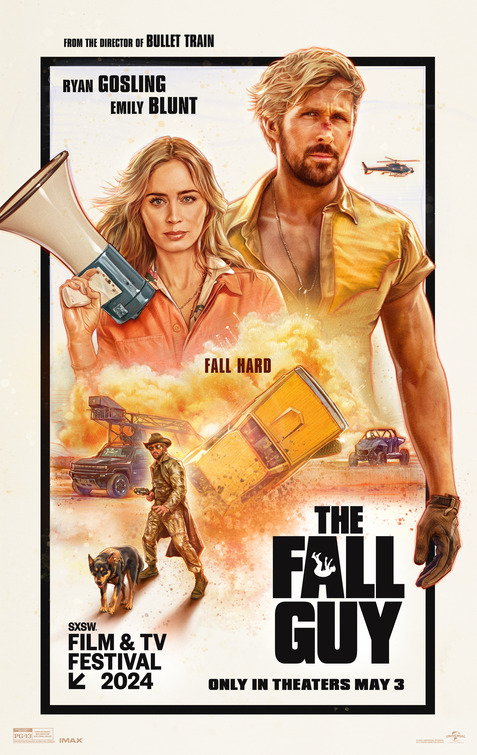
3 Short Paragraphs (Or Not): The Fall Guy

2024, David Leitch (Deadpool 2) -- download 

Oh look, its a new David Leitch movie. We like David Leitch and his style of action-comedy. We like Ryan Gosling and we like Emily Blunt. We will definitely enjoy this.

"Wait, pause that for a second. Based on the Glen A Larson TV show?" says the Peanut Gallery, aka Marmy.

Wuuuut?!? Rewind and confirmed. Yes, this movie is based on that post-Million Dollar Man Lee Majors TV show where he was a stunt man who moonlighted as a bounty hunter. I can fully admit that I probably haven't thought about the show in decades, and was not expecting it to ride the nostalgic reboot wave. And yet, here we are.

You don't have to mention the Heather Thomas poster BTW. Shite, I think we just did.

So, yeah, despite not having any great nostalgic fondness for the original series, I can freely admit I loved it at the time so it kind of made me squee to know this movie was loosely, VERY loosely, based on the show.

Colt Seavers (Ryan Gosling, Barbie) is Hollywood's greatest stuntman, and stunt double for Hollywood's greatest action hero Tom Ryder (Aaron Taylor-Johnson, Godzilla). But during a fateful fall stunt, from great heights, he breaks his back. A year and a half later Seavers is recovered, physically, but not mentally, working as a valet driver for a Mexican restaurant when he is caught in someone's social media post. He looks more than a little lost.

His old producer friend Gail Meyer (Hannah Waddingham, Ted Lasso) finds him and convinces him that his old girlfriend, camera operator Jody Moreno (Emily Blunt, Oppenheimer), whom he abandoned after he got hurt, needs him on the set of her directorial debut, the latest scifi actioner from Tom Ryder. Of course, she doesn't even know he is coming, and seeing him dredges up all sort of hurt feelings.

But Gail has brought him to Australia to do more than perform stunts for the movie, but also to find Ryder who has gone missing. I guess this is the analog to the bounty hunting? Anywayz, the hunt for Ryder sets off all sorts of excuses to do fight scenes and action stunts, to really play up the meta elements of a stunt man actually doing all the over the top jumps and crashes and punches and window smashes and .... and, well the kind of stunts actual actors (like Gosling) get other people to do. And in doing so, he uncovers the real conspiracy plot behind the point of him being brought to the movie set of Metal Storm.

Kent said, "As a crime/mystery story, the more it reveals itself, the dumber it gets." Yup. I was thinking, by the time they were blowing up boats in the harbour to the stylings of the Miami Vice Action Spectacular (a Universal Studios attraction show which Gosling's character was supposed to have built his early career at) they should have gone even more meta, and had the movie Tom Ryder was shooting be a crime-caper action movie instead of a terrible scifi flick. The actual mystery behind the movie doesn't really add to the movie, and its more about the fun of the set pieces, and chemistry between Gosling and Blunt. While I didn't really buy into their tortured romantic relationship, they just get along so wonderfully in the movie, its fun to watch. And the idea that two actors... in... their... 40s... are given top billing as beautiful, exciting people. Wow, like age appropriate!

That movie. Its supposed to be the latest blockbuster in Tom Ryder's long career, but the plot is so fucking ludicrous, its almost a mockery of scifi summer blockbusters. The closest I can come in comparison to it is the Wachowski's Jupiter Ascending with its wolf-boy male lead on his sky-skating roller blades.

In the end we have a fun fun movie that kicks off a summer with something appropriate, and yet still is not getting bums in seats. Kent and I talked a lot about where the industry is heading, and while I am part of the cause and not the solution (I did not see in theatre), I still feel a bit sad to see this world die slowly, especially considering all the supporting people who end up out of work, including stunt performers.

Sunday, June 2, 2024

3 Short Paragraphs (Or Not): The End We Start From

2023, Mahalia Belo (Requiem) -- download

I may be over my post-apocalypse fascination, especially when the stories are far too tempered in reality. I had the opportunity to watch this movie in one sitting, but I had to turn it off. It may have been my mind at the moment, but.... it was just too sad. I was too overwhelmed by the grief, the loss, the end of it all. I weathered the second and final viewing much better.

Its the climate apocalypse. Super storms are ravaging England. A woman (Jodie Comer, The Last Duel) and a man (Joel Fry, Yesterday) have not left their house, hoping to wait it all out. She is pregnant. But the worst happens and they have to abandon the house and the flooded streets of London, just as she's having the baby. Soon out of the hospital, with failing power and panic, they drive to his parents place, pseudo-survivalists living in an isolated home in the woods, packed with enough food to last forever, more than enough to wait it all out. Except it does last and things do not go immediately back to normal.

The movie opens with tragedy compounded. Normal lives are upended, and ended. For much of the movie it is the woman and the baby Zeb. The baby is the only character ever named, ignoring the letters assigned to each character, a carry over from the adapted novel by Megan Hunter, as listed in IMDB. Despite that leaning, this is not overtly a movie about the beauty and joys of motherhood, for as much as the woman will do anything to save and protect her baby, her memories constantly fall back to her husband. You slowly see how they met, how they connected, a rather mundane meet cute, no grand love affair, no great connection written across the stars, just two people who met each other, and soon ... became three. 

But in revelation, this is not a post-apocalyptic movie. The world has not ended for this couple and their baby, they have just... survived an apocalyptic event. In many ways, it is not all that different than what we see each tornado season in the US, when entire towns are blown away, and the survivors huddle together in shelters until they can return to normal life. Of course, the impact here is greater, vaster in scale, as the loss & dispersal of much of the population of London is not easily weathered, but the movie is about resilience. No matter what happens to you, you can return to normal. But this family will grow in an entirely new normal, something we are familiar with right now, but I fear we are quickly forgetting the impact of.

On a final note, I look back in my paragraphs above, and I did little commentary on the movie and more on the story a I experienced it through the lens of a movie. I often comment I am not writing movie reviews, but who am I kidding, that is the lens through which the blog is written. Kent is embracing that fully, and growing, expanding his horizons on critical thinking, and critical watching. It is undeniable that I watch many movies from the shadow of That Guy, and notice the components of the movie, and write about. And it is undeniable that I am fascinated by the making of movies, the industry behind it, the toxicity and wonder. But sometimes, I am just captured by the story, which I think is the intent behind it all?

Thursday, May 30, 2024

Watching: The Cleaner

2021, Amazon/Brit Box 

This awkward British comedy series is one of my walk-in, walk-out series that Marmy was primarily watching, but caught my attention enough, for most episodes. It concerns Paul "Wicky" Wickstead (Greg Davies, Taskmaster), a crime scene cleaner in the west of England, but technically he cleans up what's left behind from any death scene, crime or not. Makes sense; someone has to do that work so why divide the expertise? Natural death and be just as horrific and messy as violent death.

Each episode has him bump into someone who is not entirely happy for his presence, them interrupting or delaying his actual cleaning. And most of these antagonists are foot-stompingly frustrating, which is usually the cause for me to stop watching any given show, but this time, I surprisingly endeared to the idea.

Wicky is not without his own faults and there probably a lot of reasons he is suited to this mostly solitary work. He is awkward, stuck in the past, and doubly stuck in a routine that is going nowhere. I work in technology, probably the training ground for being awkward, and being stuck in routines? Nooooo, not relating to that at all.

😐

It turns out that this show does what I like best about British comedy. It gives you weird characters doing awkward things, some long drawn out conversations (almost all the situations are dependent on the talking, less so on the physical comedy), a dash of the ludicrous and a heavy dose of heartfelt revelations -- after all in every episode he is talking to someone who has lost someone.

Best ludicrous scene? In the first episode, the murderer (Helena Bonham Carter, The Crown) shows up and takes him captive - kind of. She's ... in need of a Number 2 (what are you, 12?) and demands Wicky be in the room with her (horrified emojii) and it evolves into them both singing "It Had to be You" and the scene switches to a musical number depiction, but with toilet.

Best conversation? Terence the writer (David Mitchell, Peep Show), whose grandmother died in her favourite chair (spontaneous combustion???), just wants to write his scene and everything Wicky is doing is just interrupting his work, and more importantly, his delicate emotional state. David Mitchell is peak David Mitchell here -- pedantic, insulting and outrageously angry about the littlest of things.

Weirdest one? Yeah, that's debatable as all of them are weird situations, but The Influencer who has someone he knows die while recording himself becomes a rather surreal episode. Wicky is not at all an empathetic person but seems to always empathetically understand these people in pain. This disconnected (but always connected) non-binary 80s obsessed kid (Layton Williams, Bad Education) pushes even Wicky's boundaries and yet, he deals with the situation with sympathy and caring. We are meant to hate influencers; I don't think Wicky understands hate. Sure, he dislikes most people but hate... ?

Like The Detectorists before it, I found this weird little show about weird (not little) people endearing, charming and full of snorts out loud.

👍🏼👍🏼

Wednesday, May 29, 2024

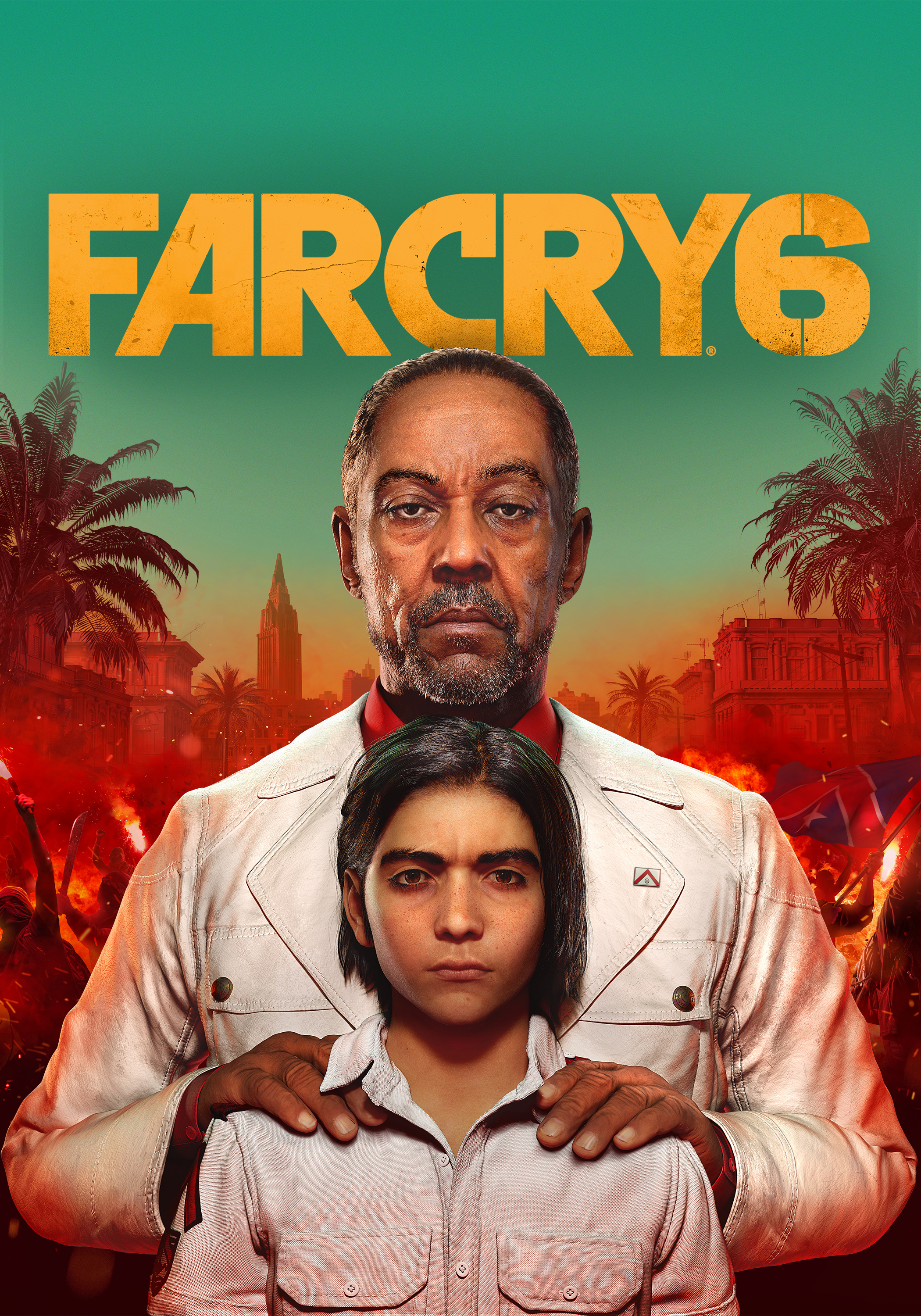
Alt Media: Far Cry 6

2021, Ubisoft

This was a replay, as the last one was. Sometimes I just want to shoot bad guys... 

Unlike all the previous games in this serious, you are not given the choice -- the Bad Guy is a monster and you acknowledge it down to the last second. But, you also have to acknowledge that you also are one. But isn't every main character in video games that has to slay hundreds if not thousands of people?

The island of Yara, Cuba analog but with a Spanish-background dictator ala the Reagan era action movies in tropical places. He is the son of the last dictator deposed in the 60s revolution. A few years before the game takes place, the son Antón Castillo is democratically elected and soon after, his Yara becomes more like the one his father ran: a rift between the Outcasts and the True Yarans, disappearances, conscripted work in the country's tobacco fields, an overreaching military present in all aspects of life, etc, etc, You are Dani Rohas ("fútbol is life") who are initially trying to escape the island but watch Castillo kill everyone onboard the boat, except his own 13 year old son who was trying to escape as well.

Dani is now forced into a role in the revolution. They (you can play either gender) are themselves ex-Castillo military, an antisocial natural killer who was ousted for assaulting an officer. They are the perfect pawn for the leader of the revolution -- Clara Garcia, and her supporter, Juan Cortez, a classic Far Cry sociopath trained by the Americans and sporting a manifesto on how revolutions are to be fought. And a knack for kludge-ing together fantastical weapons. Dani is tasked with meeting and uniting three diverse factions of anti-Castillo forces, because only united under Clara can Yara hope to be free.

The tropes of the franchise are present. Castillo has invented Viviro, a wonder drug, said to all but halt cancer. He intends to sell it to the world, so Yara can enter the First World as a saviour. The drug is "grown" in Yaran tobacco, which is fumigated with a bright red gas that encourages the Viviro to form within the plant. The gas is also a poison and a hallucinogen. Castillo conscripts people to work his fields. 

The islands are covered with military bases and outposts, which you are expected to liberate and bring to the revolutionary cause. They are also littered with poverty stricken villages and the dead his soldiers leave behind as they intimidate, murder and torture indiscriminately. 

As you progress your legend grows, one of skilled and ruthless killing and more than once you are called out for being as much a monster as Castillo. You don't deny it. But you are not heartless, for a number of key points in the story, you are presented with chances to kill Castillo's son, but you don't. He is only a boy, and still has a chance to learn right from wrong, to not become his father, and not become  you. 

Castillo is a classic dictator, convinced he is doing the best thing possible for his country despite racking up countless dead as he strives for "progress". His propaganda machine is everywhere, his speeches constantly play from speakers and radios. His key allies are his psychotic generals, scientists, public security minister, PR manager, and an amoral "yanqui" investor, a Trump analog who happens to be Canadian.

Of course, the game is beautiful. The tropical island, with a number of ecosystems, is lush and vibrant, full of animals (which you can hunt for resources) but it is also decrepit and shows its poverty stricken state. The radio is playing a wide variety of Latino music, from Mexican traditionals, to Cuban rap, to folk songs, Caribbean dance music, to Ricky Martin, Camila Cabello and Pitbull. You can listen here. By mid-way, I was humming along, while my character would actually sing along to the radio.

Unlike previous games, you know there is no point to thinking Castillo might have a point. Oh sure, he might have a cancer wonder drug, but you know these games, you know their misdirection, you know he is playing a shell game, and while it delayed his own cancer, by the end of the, the ravages show on his face. Not even he can lie about his own failures. He leaves only ruin, and death, and thousands of dead bodies at your hands.

Why do I play these? Because I like action movies, I have nostalgic recollections of the simplistic plots of the 80s, and sometimes, after a rough day at work, I just need to shoot someone.