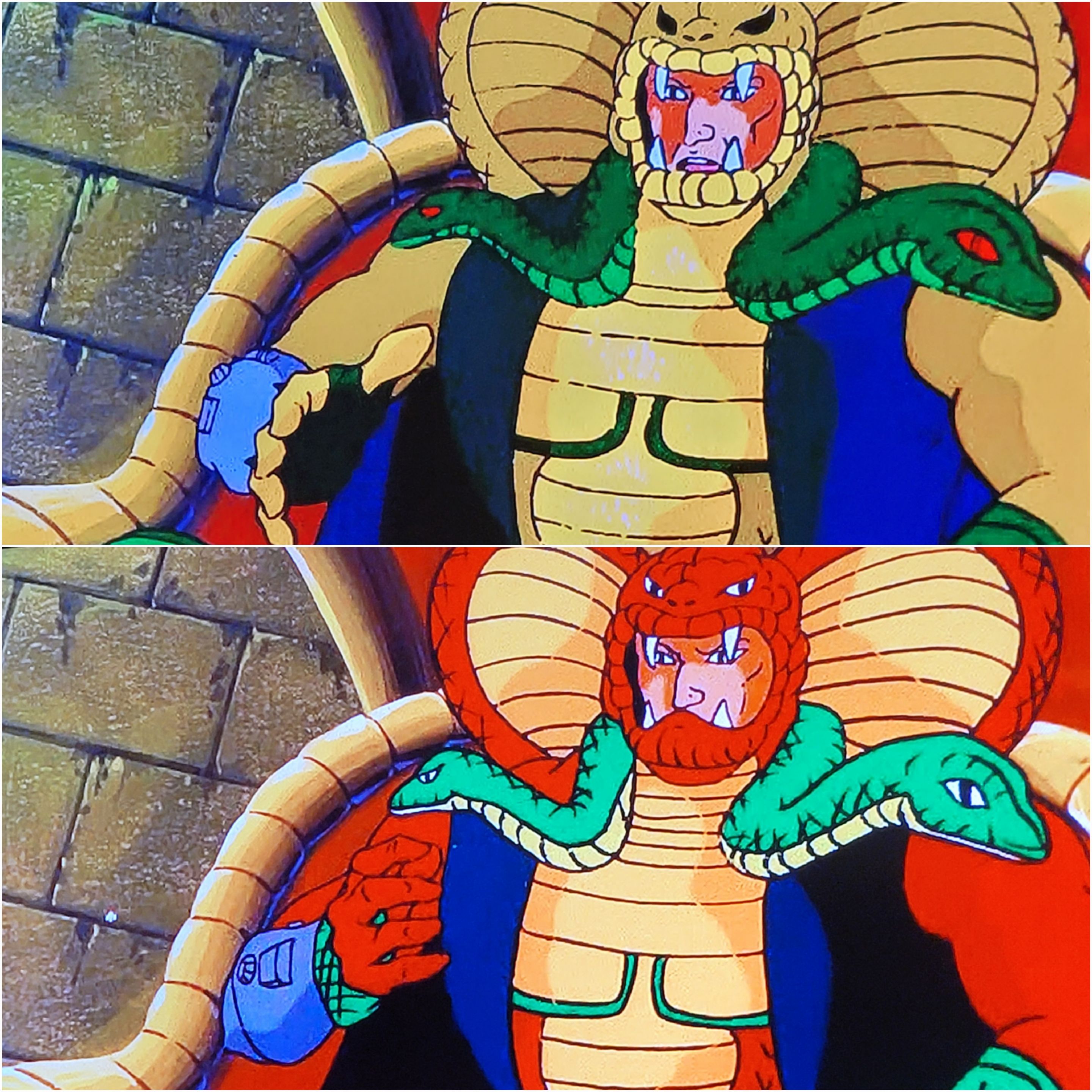
Showing posts with label toys-to-film. Show all posts

Sunday, June 7, 2026

KWIF: Masters of the Universe (+1)

 KWIF=Kent's Week in Film. The "birthday week" now comes to a close, ending with my most anticipated movie of the year, but also accompanied by so much apprehension. I came here to review movies and eat cake, and I'm all out of cake.

This Week:
Masters of the Universe (2026, d. Travis Knight - in theatre)
Backrooms (2026, d. Kane Parsons - in theatre)    

---

Masters of the Universe, the toy line, debuted in 1982. I was 6 years old. My introduction to He-Man and company was probably the TV commercials, but my obsession most likely started with issue 47 of DC Comics Presents in which Superman and He-Man teamed up against Skeletor on Eternia, the homeworld of the Masters of the Universe. I was immediately obsessed. I was as obsessed with "MOTU" (as it's known in the fan community) as I was with Star Wars and DC superheroes.

The toy line would receive more comics series from both DC and Marvel in the next few years, there would also be a fan magazine, and yes, billions of dollars in toy sales of ridiculously over-muscled broad-and-squat characters with ridiculous names like Stinkor (he stinks of patchouli), Extendar (his limbs extend), and Buzz-off (he's a wasp-man). There was an immensely popular cartoon that had two seasons with over 60 episodes each, as well as a holiday special and a spin-off series with He-Man's sister, She-Ra. 

In 1987, infamous schlock purveyors Cannon Films produced a Masters of the Universe live action movie, which, it's absolutely fair to say, was a disappointment to everyone at the time. Cannon sunk over $20 million into the film -- a sizable budget for them, but not nearly big enough to do the property justice -- and so most of the film takes place on Earth with a paltry few characters form MOTU's vast lore appearing, and the majority of the film focusing on Courtney Cox's teenage orphan and her boyfriend. It was a huge slap in every child's face that we had a He-Man movie that did not center on He-Man and felt nothing like what we knew about the property.  As well, the cartoon had ceased making new episodes almost two years prior, and public attention to the property was flagging something fierce. Toys were not selling like they used to. By 1988 the line was basically dead.

MOTU has been rebooted a bunch of times since, and the fan community is immensely supportive of the property, it's just not a huge community.  Likely in the tens of thousands, rather than millions like, say, Transformers or Star Wars.  Even the 1987 film has since become kind of a camp classic, and I personally enjoy it far more as an adult than I ever did as a kid. Still, I've always wished for a proper He-Man movie, and for the past 20 years (at least) there have been teases, over and over again, with false starts at nearly every major studio. It felt like it was never going to happen...and now it has... and... for the most part, it seemed to be what I had been waiting for, a big-budget ($200 million dollar) production that understands both how ridiculous the property is while also understanding why it's so beloved to the die hards.


Director Travis Knight came from the world of animation (as head of Laika and director of Kubo and the Two-Strings) and directed the best Transformers movie of the lot in Bumblebee, an impeccable 1980's-styled adventure in an Amblin pastiche. I had the utmost confidence that he could make a good He-Man movie. The ideal was that it would be as good as Bumblebee, or share the tone of Dungeons & Dragons: Honor Among Thieves, and that it would be a good introduction to MOTU to a whole new generation, and not just a movie for 50 year olds who can't let go of their childhood.

It genuinely pains me to say that Masters of the Universe is a highly flawed movie. It delivers on being a live-action He-Man movie in ways my inner man-child cannot deny... I had warm fuzzies in my belly often, and squealed in glee more than a few times throughout, but it's still not he MOTU movie of my dreams, and that makes me sad.

The film opens with operatic voices in harmony, "AH-AH"-ing to pulsating synths that made me think a vintage ABBA song was about to play... and the guitars kick in, and I got goosebumps. Composer Daniel Pemberton mixes in his score these elements of 70's Euro-disco with 80's guitar-rock and enlisted Queen's Brian May to provide the guitar riffs. It is most suitably epic and triumphant. If you reach back to the epic rock soundtracks of the 1980s - Queen's Highlander, Toto's Dune, Tangerine Dream's Legend - this is reaching, achieving, and in some cases surpassing those grandiose scores, while also paying homage to them (it borrows at least one track from Highlander - "Princes of the Universe"). It has a few needledrops, which are kind of on the nose in-the-moment, and yet also tone-perfect for the type of film this is, and The Darkness provides the title song "Masters of the Universe".  I was not expecting this acoustic assault, but it was so incredibly welcome, and helped elevate the film where it otherwise would fall a little further down.

The film has an extended prologue, where we meet Adam, Prince of Eternia, as a child. He's forced by his father to partake in battle training, but he's not much of a fighter. The other children in training pick on him, and Duncan (Idris Elba, Luther), the king's Man-At-Arms, is a heavy-handed trainer, though he does find ways to encourage and inspire the hapless young prince. The King, however, wants toughness, strength and determination out of his son, and is willing to traumatically embarrass him to do so. It's a tough prologue when so much of it talks about "being a man" and what that entails, and all of it has to do with strength and being a fighter. This had me perplexed as to what the messaging of the film was to be...(Pemberton plays a piano riff of "Boys Don't Cry" over one scene). It almost seemed to be promoting toxic masculinity.  

The palace is attacked by the forces of Skeletor (Jared Leto, The Little Things) and Adam is sent through a portal off to Earth, his mother's homeworld, alone, with only the fabled "Sword of Power" (there's an even earlier prologue attempting to explain just what power this sword has) to accompany him, which he promptly loses. We smash cut to 15 years later and Adam (Nicholas Galatzine, The Sheep Detectives) is an awkward, soft-spoken dork who works in HR, and has been obsessed with his past life on Eternia. He knows the Sword is his way back, and has been searching for it for a long time. When he finally finds it, it alerts his home world and a literal Beast-Man comes after him, but so too does his old friend Teela (Camila Mendes, Riverdale)

These two stretches of film account for about 40 minutes at the top of the film, and while both are called back to and play a part later in the film, they are each waaay too long. The stretch on Earth feels particularly tedious, especially as there's a nonsensical gym sequence where Adam has a nonsensical conversation with another guy working out who just happens to be Dolph Lundgren, the portrayer of He-Man in 1987. I'm not against fan-service. I'm a fan, I like to be serviced, but subtly. This scene stops the movie dead in its tracks for about 2 minutes, as Lundgren gives the young man advice, which ONLY makes sense in a Meta context, and then what little weight was had in the delivery is undercut by a dumb joke.

And that's a major flaw of this film, it's incessant need to undercut itself with dumb jokes. It's the "Marvel-model" of filmmaking that had played itself out by the time the pandemic hit, so there's no excuse as to why the script is resurrecting it here. Cut out half of these moments where the script undercuts itself with humour and you have a much better, tighter film.

This is, of course, the product of multiple screenwriters contributing to many, many drafts over the years. Four screenwriters are credited here, and it's hard not to blame all the film's weaknesses on the script.  Because, Knight's direction is pretty rock solid. The action sequences all play out quite well, with the super-powers of these characters, or the fighting skills of others all being utilized in really fun ways and not feeling super generic, or, in that sometimes Marvel way of it just being CGI characters blasting each other with laser beams. 

The film really starts moving when Beast-Man and Teela show up. The energy just starts to crackle and these characters are really well translated from toy/animation/comics-to-screen. Mendes' reveal on screen is particularly captivating, as she exudes strength, confidence and charm that I never would have expected from her CW background. She looks and feels like a movie star, and I hadn't expected that from her or this film. 

Teela brings Adam back to Eternia, but not one he remembers. It's been under Skeletor's thrall for 15 years and things have not gone well. Adam's return with the Sword has exposed the Eternian resistance and Skeletor's forces attack, but in the process, Adam turns into He-Man and a new hope for the people of the land raises... except that even with all that power, Adam is still Adam, and his first avenue is hope and optimism and looking for the best in people... but the lesson he needs is that sometimes fighting is necessary to protect the people you care for. Diplomacy is always Adam's first choice (he was always pretty good at human resources) but now he has the power (and, honestly, "the power" basically represents confidence here) to stand up and fight, and to get back up when knocked down.

Knight's path to becoming an accomplished director was not a hard one. His dad is Phil Knight, the billionaire founder of Nike. The animation studio Travis heads was bought for him by his father. But to his credit, Knight worked at his craft, and clearly has both an aptitude and a talent for directing and storytelling. One can look at him as being perfect for telling the story of Adam, of a young man (of privilege) who doesn't necessarily live up to his father's (or anyone's) expectations, and feels lost, only to find his true calling and, while not without its hurdles, excel at it.  It's not fully the story we need, but Knight found a way to make this story personal to him, and it does elevate it slightly.


It keeps coming back to the script, though. It fumbles its exploration of masculinity pretty badly. It takes a shot at it, but it doesn't just miss the target, it doesn't even know where the target is. With all the writers involved, it's like nobody thought to consult an expert, to get it right.  

But what it does get right... and it's so weird to say this... is Skeletor. Jared Leto, buried under a blue-skinned body suit, and a CGI skull with beady-red lazer-pointer eyes, is mercifully unrecognizable, and nails the assignment. Leto as a performer is sometimes insufferable, and allegations made about his off-screen behaviour makes one like him even less, but this... he got this. Skeletor is an evil, cackling villain of no redeeming virtue, and unapologetic about it. He's also freaking funny, as funny as he is intimidating, which serves to simultaneously make him more and less intimidating if that makes any sense. It's a camp performance, but one that works perfectly for both the character and the film. Alison Brie (Freelance), who plays Evil-Lyn, Skeletor's mistress and aide, and shares the most screentime with him, is a gifted comedic actress, but even she has a difficult time keeping up with Leto. It's clear she's attempting to match his tone, but only is able to get there half the time.

There are many characters from the toys and cartoons and lore that pop up in this film, and it's a bevvy of delights. It tickles me to see Fisto, Ram-Man, Mekanek, Spikor, Tri-Clops, Trap-Jaw. Roboto, Battle Cat, and so many more, alongside vehicles like the Sky-Sled, Roton, Talon Fighter and more in this picture, not to mention playsets like Castle Greyskull and Snake Mountain. What a damn treat. I was giddy in seeing it all and only wanted more. 

As there were delights, there were also let-downs, but Nicholas Galatzine was not one of them. His squeaky-voiced Adam, with posture seemingly learned from studying Christopher Reeve's Clark Kent, does exactly the job it needs to do, and when he transforms into He-Man, he still effectively conveys being Adam inside a muscle-bound barbarian's body, but also shows the character levelling up emotionally. Really, really solid job.

I could go on about the ups and downs of this movie and the wild roller-coaster of emotions I went on watching it. In the end, it's fine, but sadly, fine isn't what the property needed if it were going to be resuscitated for a new generation.  That was my greatest hope for it, that this would a super strong movie enjoyable by kids and adults alike and so exciting and entertaining and undeniable that there would be millions of children clamouring for action figures instead of phone screens. I guess we'll have to wait for Toy Story 5 to do that.

---

Kane Parsons' 9-minute Backrooms (sometimes The Backrooms) short film from 2022 currently sits with an astonishing 83 million views on Youtube. Backrooms is not just a single short, but a series of shorts made in the past few years , but none of the follow-up twenty or so videos come close to hitting that number of views (most of them have between 3 and 18 million views, which is still quite impressive). What's not so astonishing is that a studio was willing to gamble on a modestly-budgeted feature derived from the Backrooms series given the impressive numbers it's pulled...no, the astonishing thing is that the studio, in this case A24, was willing to take a chance on the feature with Parsons at the helm.

The video series itself was not the original invention of Parsons, but a product of message board groupthink in the creepypasta horror subgenre, and the idea of "backrooms" itself became its own sub-subgenre.

I wasn't familiar with any of this until very recently. But, to watch Parsons' original short, which is somewhat recreated in the prologue to the film, it owes as much to first-person shooter video games as it does to whatever developed out of message board forum. It's visceralness comes from being in an unfamiliar, relatively barren indoor space that is just an expanse of seemingly limitless corridors. There are objects in the corridors that could best be described as "random", while the hallways themselves lack any sense of logic, as the attaching corridors might be through a crevice or a hole in the floor, or a tunnel in the wall accessible only by ladder, or a doorway in the ceiling.  And the lighting is spotty, with most corridors being difficult to see fully... you never know what awaits you as you pass through a doorway, or turn a corner, or step into the shadows. (The fantastic TV series Severance was partially inspired by the conceit of "backrooms", and the spinoff sub-subgenre of "liminal spaces" inspired the video game and subsequent film Exit 8 which I reviewed last week.)

The Blair Witch style shaky cam intro to the film is as effective as it is discombobulating.  I never have a good physiological reaction to this kind of footage, so mercifully it was an in-universe video cassette of camcorder footage being watched by someone, and didn't last past the first 10 minutes.

Following this sequence we meet Clark (Chiwetel Ejiofor, Serentity). He is a failed architect who now runs a failing furniture store and is seeing a therapist, Mary Kline (Renate Reinsve, The Worst Person in the World) following his separation from his wife. What is clear from their sessions is that Clark is full of entitlement and rage, and isn't very interested in truly exploring the source of his emotional discontent.

Clark has been living in his sparsely-stocked furniture store since the separation and experiencing eerie and strange issues with the electricity in the store. The lights will flicker and blink, turning off or on all on their own, while the television will shut off or randomly show video from inside the backrooms that we saw in the opening sequence.  When checking the breaker panel one night, Clark discovers a soft spot in fabric of reality... he touches the wall and his hand passes through. He steps into the wall and comes out in a dingy yellow carpeted and wallpapered environment that seemingly doesn't end. He later describes to Mary this reality as being like a drawing of a dog, but as if someone who had never seen a dog were told what a dog looks like, and then drew their conceptualization of a dog. Everything is off.

Clark spends days exploring the space, even though there seem to be dangers present. Perhaps because he's a (failed) architect, or perhaps because there are things familiar to him in this space, he is quite obsessed with this topsy turvy alt-reality that defies any logic.  He recruits his young assistant manager (Lukita Maxwell, Shrinking) and her videographer boyfriend (Finn Bennett, True Detective: Night Country) to help him with research, and, naturally things go awry.

Outside of it all, Clark has triggered a video camera within the space, and it's being monitored by Phil (Mark Duplass, Safety Not Guaranteed) who wonders who the hell this guy is. Clark's description of this space triggers memories, traumas and nightmares in Mary of her childhood. Are they connected?

Backrooms is a horror movie, but it's also a science fiction and pscyhological thriller. It's not always scary, but it is tonally pretty intense. What is most effective about the film, and baked into the "backrooms" and "liminal spaces" sub-subgenre, is the surreal perversion of reality. Things that look almost familiar, almost like something we should recognize, but aren't quite accurate. Exploring a space like this is like venturing through a nightmare, there's nothing grounding this experience and it could take you literally anywhere one's mind can conceive.

Eventually the film reaches a point where it starts offering some answers, and the worst thing you can do in horror is demystify the threat, to explain it all away. It's frustrating not having answers, but it's less scary when you do.  Backrooms' answers, well, they aren't truly answers. There's more going one than what we know at first, but as one veil is pulled back, there are only more questions.

The audience is left to find their own answers in the information provided to them, and the information is as much there to confound as it is to illuminate. My take is that this endless reality is subconscious memory made manifest, but not of any individual. The more time you spend within, the more the realm taps into your subconscious memory, particularly the darkness you trap away, your fears, anxieties, regrets and repressed impulses. It's a theory, anyway.

I liked this movie a whole damn lot, and it's part of this year's horror explosion of fresh talent that is redefining the box office and what audiences want, what excites them, what they're looking to escape to. Twisted reflections of reality, apparently. Parsons, a teenager when he created Backrooms, is now 20 and has directed one of the biggest movies of the year, and capably so. He'd been refining this idea for four years, so it's no wonder he was so capable and assured in shooting this, but time will tell if he has the capacity for telling any stories beyond Backrooms.  I'm keen to find out.

Friday, October 4, 2024

KWIF: Inside Out 2 (+5)

 KWIF = Kent's Week in Film.

This Week:
Inside Out 2 (2024, d.  - Disney+)
Transformers: Rise of the Beasts (2023, d.  - Netflix)
Snake Eyes: G.I. Joe Origins (2021, d.  - Netflix)
The Texas Chain Saw Massacre (1974, d. Tobe Hooper - Tubi)
Memories of Murder (2003, d. Bong Joon-Ho - Tubi)
The Hidden (1987, D. Jack Sholder - BluRay)

---

I'm reminded of the scene in The Empire Strikes Back  when Luke espies a dark cave that seems to be drawing him in. He asks Yoda "What's in there?" to which Yoda replies "Only what you bring with you."

As much as I use movies for escapism, I feel like approaching every new movie is very much the same scenario as that Force Cave. What one experiences, and how one reacts, is entirely shaped by what you go in with. Because of course it is.

With Inside Out, I literally went into the film with my child who would have been six-years-old at the time. I couldn't help but see my child as Riley, despite their being younger than the child in the film, and I empathetically experienced all those primary emotions the film presented in their primordial state. I was familiar with them all as exhibited by my child. If I wasn't a father, I don't know if my reaction would have been more stilted, kept at a distance, as Toasty's was.

I approached Inside Out 2 with reluctance. Pixar has developed a pretty uncomfortable dependence on sequels, which, despite not being overwhelmingly diminishing returns, it's just unfortunate that the new ideas aren't coming as quickly in the company's second 15 years as they did in their first.  I wondered what a second Inside Out could bring to the table that the first one didn't.  Surprisingly, the answer points to Toasty's complaint about there "only being five emotions representing everything for everyone". 

In the summer between grade school and high school, Riley hits puberty, and everything changes. Introducing Anxiety, Envy, Ennui, and Embarassment.  These new emotions come in boldly and brashly, taking over the controls, supplanting the more rudimentary emotions that got Riley this far, and it couldn't be more disastrous as Riley's core beliefs start forming about herself.


Anxiety (an exceptional vocal performance from Maya Hawke) exiles Joy, Sadness, Anger, Fear and Disgust, and it dominates Riley's personality, leading her to do many an awful thing, like abandoning her friends at hockey camp to go hang out with the high schools girls she idolizes, where she perpetuates lies to seem part of the gang.  As Joy and gang try to work their way back to central control, they start to see the dramatic changes in Riley's mind with Anxiety in charge. The sar-chasm was a particularly inspired touch.

I did not watch Inside Out 2 with my child, now a year older than Riley in the film. I wish I had. The film made massive box office this past summer, and I know it clearly resonated with my child's peers (their friends were going back to theatres for second and third viewings), but they seemed disinterested, probably because it wasn't anime.  My child has General Anxiety Disorder, and so watching a film where anxiety governs the actions of a child certainly has resonance for me. I also witnessed the horrendous turmoil that the surge of pubescent hormones had on them and their peers. It was two years of excruciating, soul crushing, heart-wrenching capital-"d" Drama that swung many of those kids I've known for decades onto dark paths of bullying and fighting and running away from home because they just can't process what's happening to them.

Inside Out 2 sort of dumbs down those conflicting, raging, hormonal emotions into individualized, personified beings that mess around with an increasingly complex inner world. It doesn't provide answers so much as awareness, it provides a mirror to view those emotions one may not understand, and encourages introspection.

The Inside Out films are about connecting and relating to the emotions of adolescence, both for those going through it, and for those watching others go through it. For those who are sans children in their life, it may provide a portal to connecting to those past emotions, or it may just not connect. It is a series dealing with the inner emotionality of a girl, and it doesn't cover all bases. It may not represent those dealing with young boys, or trans children, or neurodivergent children, or account for cultural differences. Again, we can only view these through the lens of what we take with us.

I took with me my parenthood, and it delivered an experience I could very much relate to.

---

I threw on Bumblebee for Lady Kent a few weeks back, in part to share with her it's pretty radical awesomeness as both an 80's-styled throwback, an actually good Transformers movie, and a great showcase for Hailee Steinfeld, an actress we've both really come to enjoy over the years. Also, I just wanted to make sure I wasn't crazy, and that, indeed it was a good film. 

It's good, maybe even great. 

I gave up on Transformers after the second one (yet, I still reluctantly watched the third, and enjoyed it?), but since Bumblebee I've also started reading the Skybound Transformers series by Daniel Warren Johnson, and it's created a little (all)spark of fandom in me that wasn't there before.  The comic has just passed its first year of publication, so it wasn't a thing when Transformers: Rise of the Beasts came out, so I didn't have any desire to see this in the theatre. Or watch it on VOD.  Even when it first cropped up on Netflix, exported from Paramount plus, I still waffled. It certainly wasn't priority watching.

Honestly, I put it on as something to fall asleep to.  I guess to its credit I didn't fall asleep. 

Taking place in 1994, Rise of the Beasts finds.... you know what, I'm not going to bother explaining the plot in any great detail. It's overly complex and kind of dumb. It has transforming robots chasing after two halves of a Maguffin that can open up a wormhole in space (we're back to LASERS IN THE SKY in 2023!?!) and draw forth the Galactus of the Transformers universe, Unicron. It wants to eat our planet. It's ups to Optimus Prime and his small band of Autobots to team up with some transforming robot animals to save the Earth.

The film is messy. It's overstuffed with robot characters who have a bit of personality but not much else. There's no character journeys here As with all previous Transformers movies I've seen, even Bumblebee, these films seem afraid to make the robots the lead characters of these films. Instead they opt for human leads for us to invest in. Sometimes it works, but not often. 

It works here... to a point. Anthony Ramos' (Hamilton) Noah Diaz is a veteran who has returned from the service but is finding employment hard. His mother is pulling double shifts, and his little brother has a sickle cell disorder and the bills are piling up. That this film gets so heavy with systemic racism, veterans issues, economic disparity and the failings of privatized health care in its opening act was absolutely impressive. Ultimately, with Noah's brother's health failing he has no other choice but to turn to crime for money. He goes to steal a Porsche which winds up being Mirage (voiced by Pete Davidson, Bodies Bodies Bodies), a playful, trusting Autobot who takes a shining to Noah.

Meanwhile Dominique Fishback (Swarm) plays Elena Wallace, a grad student working at an intern at a museum where she has proven herself to be the smartest person in the room but her whitelady boss takes all the credit and gets all the reward. Once again, this film is very much pointing at systemic racism, though it never really examines it beyond that. It's not like it's dealing with parallel issues between the Autobots, Decepticons and Maximals.  

In this opening act, the human drama was really good, and both Ramos and Fishback were very likeable in their roles, but as soon as they come to play with the Transformers, there's a pretty big disconnect between what the humans are capable of doing versus the big shape-changing robots, and that disconnect gets bigger and bigger the more shape-changing robots appear on screen, and we have two very crunchy/squishy humans in their midst. 

As noted, the robots have so little to contribute. They're the good guys and the bad guys, but these films seem afraid to focus on them as complex beings. Optimus Prime is a total asshole in this one, and he learns a lesson about trust and allyship but it feels sooo forced.  Bumblebee gets seemingly killed shortly after he first appears, which, with this being an legit sequel to Bumblebee seems like a slap in the face ...if it actually meant anything emotionally, which it does not.  Beyond Noah's relationship with his brother, there's no emotional connection to anything in this film, and even his relationship with his brother doesn't really connect to his motivation to venture with giant robots to Peru to fight a planet-eating threat.

The film has an incredible dad-rap hip-hop soundtrack. Every track is a bop from back in my heyday of the genre. But it's all just artlessly tossed into the film, when it could have been so, so, so gooood by timing the beats to actions or connecting to the sentiment of the scene. Alas, this is not an Edgar Wright or Quentin Tarantino production.

It's passably watchable as entertainment, but not impressive in the slightest.

[ToastyPost - we agree...it doesn't suck but it's not great]

---

Oh, and just like stupid prequels/origin 
stories of old, Snake doesn't get his
iconic looking helmet until the final scene
I followed up one Hasbro property with another in the same sitting. Like Rise of the Beasts I started the stupidly backwards-titled Snake Eyes: G.I. Joe Origins expecting to fall asleep to it. It was successful, but moreso because I started it after midnight and was utterly exhausted by that point.

Of all the hundreds of G.I. Joe characters, Snake Eyes is at best in the middle, but more likely the middle bottom of my rankings list. I never connected with ninja stuff in general as a kid, and, in the 90's, he was forced down our throats as "the cool one" or "the extreme one" like Wolverine or Ghost Rider. I frequently rebel against any effort to tell me what's cool. Not sure if you noticed.

What's definitely not cool is this G.I. Joe origin for Snake Eyes. It's a spectacularly muddled mess of a film that misses the mark of pretty much everything it is trying to do. Origin story for the silent, scarred, commando ninja: modest fail. Complete reset of the G.I. Joe franchise: total fail. 80's ninja throwback movie: utter fail. Modern action-fantasy franchise movie: epic fail.

Its a film that doesn't exist to tell a specific story, but instead do everything it can to build a franchise out of that story, and it's like Hollywood never learns. The Mummy. Green Lantern. Man of Steel. Iron Man 2. Madame Web. Hobbes and Shaw. etc. etc.  With this film, the moment it tries to plug in G.I. Joe and Cobra, what tenuous treads that were holding the thing together fall completely apart. 

From the onset we learn that Snake Eyes' father was killed in front of him and he's been angry and vengeful ever since. He's developed into handsome Henry Golding (Last Christmas), but also a fierce fighter besting everyone he comes across in illegal fighting venues, until one day he is given an offer: work for this stranger and he will be given the man who killed his father.

So he works for the stranger's criminal enterprise, only to quickly betray him by helping Tommy, a spy, escape. Tommy is who Joe fans will know better as Storm Shadow. He is intended to be the leader of his ninja clan, Arashikage, who are also allies of G.I. Joe and protectors of a sacred stone of power. Snake Eyes is actually a double agent, working for the stranger to infiltrate the clan and steal said stone.  The stranger, it turns out, is Tommy's uncle who was cast out of the Arashikage for being a selfish dick...or something.

Snake Eyes wrestles with acceptance in the ninja clan, and the dangling carrot of the man who killed his father. But barely.

The film conveys through dialogue the fact that Snake Eyes is torn between his loyalty and his thirst for vengeance, but it never actually feels like the character has this turmoil, mostly because it's too busy with dumb setpieces and inane character decisions to let the emotions settle.

Spoilers, if you care, but the final act has Snake Eyes betray the clan, steal the stone, hand it over to Tommy's uncle, who is going to wield it to destroy the clan, and then give it to the the Baroness of the terrorist organization Cobra. Snake Eyes is then given his dad's killer, only to learn he is a Cobra assassin. In other words, Snake Eyes has just done the bidding of the group that killed his father. So after freeing the assassin (what?) he turns around to try and save the Arashikage with Tommy, who now hates him so much. 

Scarlett joins the fight out of nowhere (what?) and Baroness is betrayed by Tommy's uncle so she sides with Scarlett and Snake temporarily (what?) and Snake says "Yo Joe" for no reason (what?) and Tommy uses the stone to kill his uncle and is told that he's broken a most sacred Arashikage vow, and now can no longer lead them, and he's so mad and hates Snake Eyes now so much and Scarlett recruits Snake Eyes to G.I. Joe but he's got to go find Tommy first, and he's now allying himself with the Baroness, and this movie is so, so dumb.

I didn't even get into Akiko, the head of Arashikage security who is absolutely terrible at her job. She falls for Snake Eyes and does some very stupid things blinded by her attraction. Pretty much everything everyone does in this movie is because it's in the script, not because it feels true to their character. Even after spending two hours with him, I never got a sense of who Snake Eyes was as a person, what his ethics were. Nobody should trust him, yet, everyone does, and it's pretty much all of their undoing. Snake Eyes could be considered the villain of the piece, not by intention, but by action.

It's an ugly looking movie for the most part. It's shot like a cheap European direct-to-VOD action movie. The only thing that saves it (well, nothing actually saves it) are gorgeous sets and some cool motorbikes. This made my brain hurt.

---

I've blathered on too long about movies about toys that I have no energy to talk at length about the grandpappy of torture porn horror, The Texas Chain Saw Massacre.

I've avoided this film my whole life. The title in itself just sounds completely unappealing. Who voluntarily wants to see something with that title? I know there are people who do, I'm just not one of those people.

I've been pelleted with Leatherface imagery for much of my life, and that just doubled down on my "no thank you" stance towards this film.  

So what prompted me to watch this? It was Electric Boogaloo, the documentary on Canon films. In there it mentioned how the Canon-produced sequel to TTCSM was more of a satirical horror film in the Evil Dead 2 vein, and that piqued my curiosity. But in the weeks since, I forgot they were talking about the sequel and not the original.

Four college kids are in a van, going to rural wherever to visit a family-owned property. Along they way they pick up a weirdo hitchhiker who does some weird stuff before being kicked out. Then they stop at a gas station with no gas, before heading up to the abandoned house. The kids start exploring the property and two of them are killed by a disturbed man in a butcher's gown, a wig and a mask made of flesh. Then other go searching for them and are killed with a chainsaw, until only one of them is left. She is chased after, caught, and forced to sit through a torturous dinner scene with the guy from the van, the guy from the gas station, the human leather-face chainsaw murderer, and a feeble and decrepit old man who seems barely alive. She eventually escapes, frustrating the leather-faced one.

I wasn't bored, necessarily, but I found the whole movie to be tedious. I was intrigued by it initially, as the opening moments with is screeching flash-bulb imagery have been so iconic in the horror genre, but I've just never witnessed their origins. The sequences in the van, the easy, rambling conversations, then the weird encounter with the hitchhiker are well done if not necessarily well performed. There's a lot of capital-"a" Acting happening there.

I by the time the kids encounter Leatherface, I wasn't feeling the build of tension, and at no time was I ever really scared by the events. I guess watching this film after sort of knowing about it for over 40 years, it all just seems inevitable. 

The final act is 25 minutes of Marylin Burns (as Sally) scream pretty much non-stop. I'm sure if I were in a theatre witnessing this for the first time in the 70's or 80's, as a younger person less experienced with cinema, this would have been pretty intense. But now I just found it annoying. The prior kills were just so abrupt that they weren't really shocking or gruesome, and we're not really given much to invest in these characters so watching them die seems like a formality of horror filmmaking (this is how I feel about most slasher and torture porn horror). Sally's screaming ad nauseum is so grating... at a certain point what is it accomplishing? It's the only trick in her book. It is impressive work by Burns though, I must admit.

I mean, as a piece of horror history, I get its place. But what's its point? To horrify and disgust? Fine, but it didn't do that for me.

---

After two not-great toy franchise movies and a classic horror film showing its age, I needed a palette cleanser. I needed something from someone trustworthy, something stimulating. I needed Bong Joon-ho.

I had no idea what to expect from Memories of Murder. It's an evocative title, but meaning what, exactly? Is it a character study, a drama about someone who has killed? Is it a psychological suspense film about a therapist and their disturbed patient? Is it a genre picture, where someone can enter peoples memories and finds a murderer within? I wouldn't put any of these past Director Bong.

But Memories of Murder is instead the director's tribute to grotty 1980's and '90's suspense procedurals, like Witness, Bad Lieutenant, Blue Velvet, or half the Coen Bros output from the era.  

It's 1986 and a woman if found dead after an assault, left in a drainage ditch in rural Korea. The crime scene offers few clues. A short while later, after a rainfall, another woman is found, but the local police forces are so inexperienced they're unable to keep the evidence untainted and the crime scene clear. A suspect, a mentally impaired young man, is brought in for questioning, and coerced after days of abuse, into giving a confession. A new recruit from Seoul does his own investigation, leaving the dirty cops to their dirty deeds. The boy, once brought into the open, it turns out, has an alibi they didn't bother to check.

They try to catch the killer, knowing he will strike next during the rainfall, and some actual detective work yields the potential for clues, but they're just too many steps behind. It's never quite clear if the killer knows they're looking for him, but it still feels like a cat-and-mouse game, mostly as it involves two very different Detectives with two very different procedures for solving crimes. But over time Detective Park's corrupt, gut-feeling tendencies start to give way to Detective Seo's evidence and tactics based procedures. Conversely, Detective Seo, once he locks in on a target, embrace Detective Park's shadowy tendencies and it's up to Park to be the rational one.

It's not that we have not been aware of the corruption within policing institutions in the past, but it seems only in the past 5 years has it becomes part of the conversation, out in the open. Policing institutions are given so much latitude to abuse and circumvent the rules set out for them, and even calling it out changes nothing. This film, from 21 years ago is keenly aware how these abuses in the name of justice come about, and unlike a lot of American "copaganda" it's not forgiving in the slightest for it.  

It presents our Detectives as humans, for sure, but people who are allowed to let their bases impulses be acted out with impunity, and feel justified for it. It shows how the police look at everyone outside of them as something else, not equals, but others. They see a population fill with potential perpetrators, potentials suspects, potential victims. 

The tone of Memories of Murder is grim, but also blackly comical. Before Detective Seo arrives, the police are buffoonish. We can see the ineptness and laziness at play. It'd be funny if it weren't so upsetting. Plus Detective Park, ostensibly our protagonist, is pretty terrible. A misogynist, an abuser of power, and maybe even a little dumb...he's not a likeable character, and yet in the body of Song Kang-ho (a mainstay of Director Bong's work), he's compelling. You want to hate him fully, but there's just a little something there that you're kind of charmed by, even though you should know better.

If this movie has a more direct parallel than the 80's and 90's movies it's inspired by, it would be Zodiac. I have to wonder if David Fincher was directly inspired by Director Bong's work here, because they feel like kin.

---

The Hidden is an 80's cop movie that Director Bong definitely wasn't using as inspiration. 

Sgt. Beck (Michael Nouri, Yellowstone) has been chasing a man all over town, a seemingly everyday, average, genteel citizen who all of a sudden snapped and starting assaulting, murdering, robbing and terrorizing Los Angeles, often with a smile on his face. Eventually the law catches up to the man, and he winds up in the hospital in a coma, with no answers to give for his sudden shift.

FBI Agent Lloyd Gallagher (Kyle MacLachlan, The Flintstones) turns up at the precinct and has Beck assigned to him. Turns out Gallagher was  looking for the same man man...shortest lived partnership ever. Except that when the accused turns up dead in his hospital room and his roommate is missing, going on his own similarly violent and impulsive spree, things for Beck and Gallagher seem to be just getting started.

The film's not shy about it, it's an alien parasite hopping from body to body. Yeah, sounds absurd, but holy hell is it a fun 97 minutes of nearly flawless filmmaking telling the story. There are no false moves in The Hidden, at no point am I screaming "come on" at people who should know better, at no point is the suspension of disbelief I've granted the film stretched even close to the breaking point. It seems like every question that should be asked by a police detective is being asked, and even when the answers are skirted by Gallagher, it's clocked by Beck.

MacLachlan plays Gallagher like a true weirdo (like a warmup for Twin Peaks), and Nouri's glib yet analytical nature isn't ever fooled, but his intuition is telling him something.

It's not the prettiest film, but Sholder never reaches too far. He's not trying for anything fancy, he's just telling a fun story and he does it very, very well. 

In Men In Black, Vincent D'Onofrio delivers the greatest alien-in-human-disguise performance in cinematic history. In The Hidden we have the prototype for that very performance with Willaim Boyette's turn as the alien-in disguise. Boyette's physicality and verbal ticks and little nuances are all just divine. Three other performers - Chris Mulkey, Claudia Christian and Ed O'Ross - all deliver exceptionally fun performances as the skin suits.

In my memory, having last seen this film in the mid-1990s, this was a much more serious production, not the rollicking buddy cop romp where they're chasing an alien terminator through the streets of L.A. But yeah, it's a romp, just a straight up better-than-a-B-movie/not-quite-an-A-movie grand time of film, with perfect vibes.

Pairs well with: They Live, but honestly, I think it's an even superior film.

---


Friday, August 9, 2024

Knowing is half the battle: G.I. Joe: A Real American Hero and G.I. Joe: The Movie

G.I. Joe A Real American Hero Seasons 1&2 (95 episodes, 1983-1986, DVD) 
G.I. Joe: The Movie (1987, 

As a lad of the 1980s, of course I had a few G.I. Joe action figures and vehicles, but they weren't my focal or go-to toy line. Star Wars, Super Powers and Masters of the Universe all were far more dominant in my play cycle. I had a best friend across town with whom I would play Joes when there were sleepovers at his place (we would play Star Wars when the sleepovers were at my place), and I had a neighbour two doors down I played with who had more Joe stuff (and just more stuff) than anyone I knew.

I mainly had a few Joes kicking around just to contribute something when playing with these friends, I doubt if I even had a dozen figures. The only vehicles I had were the H.A.V.O.C. and the Maggot, acquired late in my toy-playing adolescence (age 10 to 11-ish), and by that point my friends were distancing themselves from playing with toys (the saddest transition in life...cue the sad Randy Newman song) and it would be another year or so before I would give it up (despite not really wanting to).

Perhaps the reason I only had this passing interest in G.I. Joe was a result of the cartoon not airing on local Thunder Bay (or even cable) television when I was growing up. As a syndicated series it would be up to either one of the Canadian networks (CBC/CTV), or one of the three Minnesota-then-Detroit affiliates we were patched into for NBC/ABC/CBS to acquire and broadcast the show, and to my knowledge none did. (All the Joe fans I knew in my hometown seemed to find their investment through the comics, and I was too fixated on DC superheroes to let Joe comics take up space in my collection.)

At some point in my teen years, I acquired a copy of G.I. Joe: The Movie on videocassette and if I watched it more than once I would be surprised. I...didn't get it. Who were these characters? What was this Cobra-La fantasy garbage?

When Lady Kent and I were getting to know one another, I learned that Joes were one of her nostalgia tugs, having had a massive Joe collection (via her younger brother) and avidly watched the cartoon (clearly something more accessible in her Toronto-area broadcasts). I bought her the complete G.I. Joe: A Real American Hero DVD set when it came out in the late 2000s, and I don't even recall if it was a birthday or Christmas gift, or if it was just a spontaneous "love you" gift. Lady Kent wound up curating some episodes for my viewing pleasure, but beyond the character Dusty calling a middle eastern person a "camel jockey" (oof) not much really stuck with me. 

I've read many, many Joe comics since those days, and seen the live action movies, watched some of the other cartoons, and I've been collecting G.I. Joe Classified Series figures since 2020 so I'm *not* not-a-fan anymore, but the cartoon remained a pretty big gap. So, in the June lull of new TV, I suggested to Lady Kent we do a complete rewatch, and she was more than in.

We skipped the five-episode mini-series, since it's not her favourite story, and dove into the second five-episode mini, "The MASS Device", I had to admit that I really enjoyed seeing an 1980's kids cartoon explore serialized storytelling. I mean, it's not refined storytelling by any stretch as it's still serving the dual purpose of selling toys and appealing to kids, but for what it was, it was quite enjoyable.

It was the five-episode arc that kicks off the A Real American Hero series proper, "The Pyramid of Darkness" where I think I truly came to appreciate the show and its creative team. At one point, Snake Eyes, the mute ninja commando long considered the most badass character in all of Joe lore, enlists the aide of a pop star named Satin to help him elude a Cobra patrol. In doing so, Snake Eyes, his pet wolf, Timber, and fellow Joe Shipwreck's pet parrot, Polly, all don disguises found on the bus and it's gloriously stupid as well as utterly hilarious.

It was then I came to understand that the talented writers of the show were not creating serious adventures for adult viewers, but rather absurd stories that would entertain themselves and the rest of the writing staff. A solid 40% of "A Real American Hero" is just straight off-the-wall bonkers storytelling with the writers clearly aware of everything they were doing and getting away with. This will make sense to comic fans, as story editor for season 1, Steve Gerber, was also the creator/writer of Howard the Duck, an irreverent satirical comic in an era dense in superhero staunchness.

Produced by Marvel Productions with Sunbow Entertainment, the animation is richly detailed with all the nuances of the action figures and vehicles, which must have driven the animators nuts. These are not simple designs. 

The first full season was 55 episodes, with the follow-up season clocking in at 30 episodes, and in that labor-intensive output there were bound to be slip-ups... and there are plenty. Mis-timed dialogue at times make it look like the wrong character is speaking with the voice of another (or mouthing the words along with them like a bad actor). Sequences clearly worked on by multiple animators will abruptly change styles throughout the edits of the sequence, or certain characters will swap places, or a character's costume will change entirely back-and-forth between cuts. These things are an absolute delight to spot and make it really fun to pay close attention.


Perhaps the most intriguing aspect about A Real American Hero is that there's no main character, there's a rotating cast of leads that get mixed and matched throughout. I realize I'm no expert on 80's boys adventure animation but I think this is pretty rare. Usually there's at least a focal character to pivot the show around... like I don't know that there's a single episode of He-Man and the Masters of the Universe without He-Man...even if they center an episode around another character, He-Man still pops up. There's nobody called "G.I. Joe" to pivot this show around.

Even "leaders" like Duke or Flint are frequently absent for episodes on end as we focus on a Shipwreck adventure or Airborne, or Quick Kick (these character-specific episodes typically involved a family member getting entangled in a Cobra plot). It's a rotating door, and while that's jarring at first, it does create a sort of "anything goes" sensibility that I wound up really liking, and beyond that it creates a core group of about 15-20 characters that we see mixed-and-matched throughout the first season, and we generally like most of these protagonist figures.

The bad guy side was disappointingly more limited. While Cobra Commander, Destro and Baroness would have grand machinations that would be foiled by the Joes, half the time it was just freelancer Zartan and his dipshit Dreadnoks who were the antagonists for the Joes, and boy did those turds get real tired pretty quickly. The biggest ongoing joys were the routinely petty exchanges between Cobra Commander and Destro, which is why it was always a drag when we would see the Three Stooges antics of the Dreadnoks instead. Where the cast of Joes was sprawling, named Cobra characters seemed quite constrained.

Everything changed in the second season, starting with the five-part "Arise, Serpentor, Arise" which saw Cobra Commander's command of Cobra get usurped by the genetically designed superhuman Serpentor. CC wound up taking a backseat, and so he and Destro only appear in a handful of the 30 season 2 episodes. (At least Serpentor, and his right-hand aide, the pervert Dr. Mindbender, was just as jolly as as all 80's villains, cackling maniacally at any opportunity.)

Similarly the cast we'd become so familiar with in Season 1 are largely rotated out in favour of all new characters who feel either like carbon copies of characters we already have or are just less developed. It wouldn't have been so bad if it weren't so abrupt. "Arise, Serpentor, Arise" sidelines both Flint and Duke in favour of Hawk and pro-wrestler/drill instructor Sergeant Slaughter, and somehow perpetually balaclava'd Beachhead is third in charge, where I think Scarlett was in that position the prior season.

The first season admirably had three female badass protagonists in Scarlett, Lady Jaye and Cover Girl, and it really seemed like Scarlett and Lady Jaye were right at the head of the food chain as respected leaders (except by Shipwreck, who seemed incapable of not making a pass any anything with curves, but the ladies thankfully didn't take his b.s.), so it seemed like a real demotion for them when all these new characters like Sci-Fi and Cross Country (sporting a confederate flag on his belt, eep) started taking up all the oxygen. On the Cobra side, all of Baroness' master-of-disguise roles were eaten up by Zartan's sister Zarana.

The battles in the series are ridiculous, but enjoyable so. Blue and red laser beams fly across the screen from sci-fi guns, H.I.S.S. tanks and trouble bubbles and sky strikers and rattlers.  The toys are up on screen and it is quite fantastic. The vehicles seem to explode at the slightest provocation (both Cobra and G.I. Joe's budgets must be astronomical, explains why Cobra needs to hold a telethon in a fantastically absurd mid-second season episode) but the animators make pains to show everyone always escaping every exploding ride (maybe it was just to sell toy parachutes). The fact that there's never any casualties have led Lady Kent and I to speculate that every Cobra vs Joe battle is a prearranged gathering with playground rules applying.

The series developed some good romantic relationship dynamics, with Duke and Scarlett and Flint and Lady Jaye paired off, but some of the characters wind up in relationships with people outside the Joe team who make subsequent appearances. And in one of the all-time episodes Mainframe and Zarana make a real star-crossed connection that pays off again in a later episode. And, of course, Destro and Baroness (if you kissed Destro in the winter would your lips freeze to his?)


As I've noted, there are a few characters/traits/design choices/casting decisions/lines of dialogue that don't age well, but by and large the show was actively multicultural by design and overall pretty inoffensive for the time. The writers seemed keen to push the boundaries of absurdity rather than push for topical humour.

Season 2 ended with 1987's G.I. Joe: The Movie hot on its heels. Originally intended as a theatrical release, it got scuttled when Hasbro's prior animated movies (Transformers: The Movie and My Little Pony) were tanking at the box office. So The Movie went straight to home video instead, with a most notable change. There was a pretty heady outcry from the Transformers fanbase when they killed off Optimus Prime in Transformers: The Movie (spoilers!), so when Duke was to go out in a blaze of glory in G.I. Joe: The Movie, instead he fell comatose only to awaken off screen in the film's conclusion.

G.I. Joe: The Movie opens with a newly composed version of the G.I. Joe theme song, this time with added bars to give voice to the Cobra side of the battle. The song amps up the volume a notch or two and the singer (can't find the credit) really, really, really belts out the final bar, just holding that "O" singing "G.I. Joe" for an epic length of time.  


The animated opening to season 1 and the revised intro to season 2 were both much better animated than the main series, and they each represented an epic battle between Joes and Cobra, with the Joes ultimately victorious. This level of animation from those openings is about what G.I. Joe: The Movie's animation is like, so it's pretty quality stuff. But the animated opening for The Movie is next level, and it's so action-packed and frenetic, the camera swooping through the big-screen-worthy action, it can be too much to take in. It's unfortunate, but between the super-glossy action and the ultra-rousing theme, the opening is the film's peak, and it's all downhill down a rocky slope from there.

It's not a rapid decline at first, with the first few minutes being eaten up by a battle and then, following Cobra's loss, petty bickering between Cobra Commander and Serpentor, complete with betrayal from CC's most trusted aides, Destro and Baroness (love those petty bitches), but when we make it back to Joe headquarters, Hasbro decided rather than gently incorporating some new characters in the mix of already beloved crew, they would just force feed us a new quintet (Jinx, Tunnel Rat, Chuckles, Big Lob, and Law & Order) and center the movie around Duke's godawful half-brother Falcon, who should be tried for crimes no less than treason, insubordination, sexual harassment, reckless endangerment, and just being an entitled prick (he's voiced by Don Johnson, so they wanted the name talent to be the central figure). As soon as the film turns its focus on this crew, it's cooked, and can't recover.

Subject to much mockery by Joe fans for ages, I find the Cobra-La aspect of G.I. Joe: The Movie much more palatable, even if this ultra-fantasy/sci-fi stuff doesn't quite fit seamlessly with the military/espionage angles of the series. Characters like Golobulous, Nemesis Enforcer and Pythona are comic book supervillains with superpowers, and their bug-like alien society with their tekno-organic vehicles and weapons seem to vastly overpower the Joes, but that's what makes them interesting as an amped-up adversary for a movie...it takes the threat to another level. And as much as the designs aren't military-esque in the typical G.I. Joe toy fashion, they are pretty wild and well done.

Where the detour the film takes early on with its new Joe cast stalled momentum, the film's late second act  detour into a similar situation just kills it outright. A washed-out Falcon is sent to train under Sergeant Slaughter and they introduce yet another 3 or 4 new characters we will spend even less time getting to know. It was all about toy sales, this film, and it's very easy to understand why it wasn't well received. Despite the glossiness of the animation, it has so little of the panache of the regular series even at its worst.

What's most surprising about G.I. Joe: The Movie is that A Real American Hero was normally at its best running multi-part, larger-scale story lines. There are four five-part story arcs in the series and a number of two-part episode, so the writers already knew how to do larger-scale stories. The Movie doesn't feel like an assembly of five episodes, but I wonder if it would have worked better if it were. And it didn't end with one of G.I. Joe's famous public service announcements, which seems a missed opportunity to talk about the dangers of concussions.

This was the last animated G.I. Joe film, surprisingly. There have been three underwhelming live-action G.I. Joe movies in the past 15 years, but not another animated one. (Everyone's still dreaming of that G.I. Joe/Transformers animated movie.)  

Following G.I. Joe: The Movie, the production of the ongoing animated series moved from Marvel/Sunbow to DIC, which effectively ended the first generation of G.I. Joe cartoons. The DIC cartoons were more cheaply made, and the reduction in quality seemed to have led it to being pushed aside and treated even less favourably than later Joe animated productions, while A Real American Hero remains quite well beloved and well-regarded by fans, and remains a pretty accessible and fun entry point to the toys and mythology.

Now you know. 


---
Favourite Episodes:
"The Pyramid of Darkness" (5 parts, pure ridiculousness)
"The Greenhouse Effect" (it's Cloudy with a Chance of Meatballs, but with G.I. Joe)
"Lights, Camera, Cobra!" (Cobra attacks the filming of a G.I. Joe movie)
"Cobra's Candidate" (uh... did this set the template for the alt-right incursion into politics? Gross)
"Money to Burn" (Cobra destroys all physical currency then issues their own Cobra bucks)
"Worlds Without End" (2-Parts, G.I. Joe goes to a parallel world where Cobra rules)
"Eau du Cobra" (Destro develops a mind control perfume in an effort to steal an heiress' riches)
"Memories of Mara" (the Joes discover Cobra is making fish-people, and Shipwreck falls for one of them)
"The Wrong Stuff" (It's like SCTV, but the "C" stands for "Cobra")
"Cold Slither" (Cobra plans to take over the world with a one-hit wonder rock band comprised of Dreadnoks)
"Computer Complicatoins" (Mainframe and Zarana meet cute)
"Cobrathon" (Cobra holds a telethon)
"Ninja Holiday" (Cobra Commander looks to have Serpentor assassinated)
"The Most Dangerous Thing in the World" (Cobra hacks the military systems and promotes three inept Joes to being in charge)
"Nightmare Assault" (Dr. Mindbender's nightmare machine leads to some disturbing cartoonery)
"Joes Night Out" (The night club is a Cobra rocket!)
"Not a Ghost of a Chance" (Predicting alt-right disinformation tactics. Gross)
"Into Your Tent I Will Silently Creep" (the inspiration for Community's "Bottle Episode"?)


Wednesday, January 31, 2024

3 Short Paragraphs (Or Not): Barbie

2023, Greta Gerwig (Lady Bird) -- download

I need a new tag: Finally Got Around To It. Maybe someday I will even watch Parasite.

This movie is a dear of the film industry, in that it is considered topical, intelligent, and made boat loads of post-digital post-pandemic cinema money. We all know the Barbenheimer legend. But was it a good movie. Thankfully, yes. But was it a great movie? Ehhhhhnnn, somewhat.

Weeks after I wrote the above, the Oscar noms (nom nom nom) come out and its up for Best Picture, Best Supporting Actors (Ryan and America), Adapter Screen Play, etc. Notably missing are Margot Robbie and Greta Gerwig. Seems... weird.

The best thing about Barbie is that it is exactly what it should be, but it is also a subversion of everything it is about. On the surface it is full of beautiful, known faces and even has a very very Barbie blonde playing "stereotypical Barbie" and one of today's most popular male faces playing Ken. It is all about the pink, and the plastic, and the so-called Great Lives the Barbies all live. It could have been just about that, as most of Hollywood would have been entirely satisfied to have a Barbie movie about the world they live in, producing a Pixels level movie about a popular toy franchise.

Instead, we get a feminism-lite subversion of what Barbie is -- the unattainable role model based entirely on looks and a life very few can have. This subversion leads to some very loudly heard but not very nuanced monologues on what it is to be a woman in the current age. It was the kind of commentary that pissed the fragile male ego off, made women around the world cheer, but also made others groan at the over simplifications made. 

In a way, it was a very tactical film, in that it played both sides but satisfied the Purple Suits well enough. The funny thing is that I don't think it diminishes what it was trying to attain. Our current age seems very determined to erode whatever progress women have made in my lifetime. At least in The West; the rest of the enlightened world is probably just facepalming hard. This is probably as loud Hollywood can be without being shutdown. This might explain the "Oscar snubs".

Wow, that is a lot said from the point of view of a cis het white male. And without even saying what the movie was about.

The movie is fun. Barbie (Margot Robbie, Birds of Prey) wakes up in her perfect world, until one day, its not so perfect. Something is wrong. Someone in the "real world" is playing with her... wrong. So, Barbie, on the advice of a Weird Barbie (Kate McKinnon, The Bubble) goes to the real world to find the little girl playing with her wrong, to set things right. Stereotypical Ken (Ryan Gosling, Bladerunner 2049) sneaks into her pink car and joins her on her Hero's Journey, but only ends up discovering Male Fragility. And horses. The real world is just as plastic as the Barbie world, just more toxic, but Barbie has escape Evil Mattell with the disillusioned little girl (actually a disillusioned mom [America Ferrara, How to Train Your Dragon]; the little girl is quite fine actually) to return to the Barbie world, only to find out Ken has returned earlier and set about an incel revolution. Together they remind the Barbies of Barbie world that they are independent, strong Barbies that run their world. The movie is fun.

I will desist from having any more "enlightened" opinions.

Kent's post.

Saturday, September 2, 2023

3 Short Paragraphs (Or Not): Transformers: Rise of the Beasts

2023, Steve Caple Jr (Creed II) -- download

Hey, that didn't suck. Why didn't that suck?

Well, relatively.

OK, so it's not a BaySplosion movie. And only barely connected to Bumblebee. In fact it felt more like a standalone movie, given it happens before all the others, yet contains many of the familiar "faces". And while it did choose to go the BaySplosion route of Big Bangs instead of logic, it just felt more... well, like a movie about toys, and the scenarios kids would build in their own head.

We open with Unicron (think Ego from Guardians 2 but machine) attacking the planet of the Maximals. I swore that the premise of the machine intelligences that made up The Transformers didn't become trains, planes and automobiles until they came to Earth, and chose those forms to hide, but apparently these Transformers (are there multiple machine intelligences scattered about the universe, like most scifi says there are humans everywhere?) have Earth-based animal forms before they ever came to Earth. That said, their planet is destroyed and they flee to Earth thru a "transwarp tunnel" with the key to creating said tunnels, so that Unicron won't have free access to the universe to eat as many planets as he pleases.

Earth, the 90s. Token Human Noah Diaz (Anthony Ramos, Hamilton) is trying to make ends meet while caring for his younger brother who suffers from sickle cell anemia. Against his own best interests, he accepts a job from the friendly neighbourhood thug and ends up not-quite stealing a Porsche 911, which turns out to be Mirage (Pete Davidson, The Suicide Squad). Bumblebee was already the focus of the 80s-set eponymous movie, but they still need a fast, hip-talking car/autobot for the Token Human to initially be frightened by, but eventually befriend. And support him when he eventually gets all mixed up in the latest reason to have the Autobots come out of hiding to do stuff to save Earth, themselves and ... now the Maximals.

I am not sure I can talk about the movie without sounding incredibly snarky about it (I thought you said it didn't suck?), because it is not the most smart movie (says the kettle). But unlike the BaySplosion versions, its not irritatingly so, but, as I said before, feels more like a movie built inside the mind of a kid playing with his (or her) Transformers. There are big set pieces, global locales, robots punching, robots shooting, and lots and lots of explosions, but thankfully very few humans involved. This is all between the giant robots, on the latest cosmic scale of destruction and planet saving.

A thing that always annoyed me about the other movies (you have a long list of "things"), beyond the humans unnecessarily involved, is that all the Transformers seemed overcomplicated in their depictions. I always felt like they would be shedding little bits everywhere, that SHOULD be found left, right and centre by bystanders after the events of the movies take place. This is tamped down in these movies, making them more characters and less portfolio pieces for the  CGI team. Still there are events and circumstances that should be noticed and documented, but won't be, cuz, y'know the FIRST first movie hasn't happened yet.

Like the pre-quellish X-Men movies, these are attempting to stand on their own while staying connected to the originals. I guess with more success? I am thinking they need to toss in some time travel shenanigans.

Tuesday, August 8, 2023

KWIF: Barbie (+3)

KWIF is Kent's Week in Film where each week (or so) I have a spotlight movie which I write a longer, thinkier piece about, and then whatever else I watched that week I do a quick little summary of my thoughts. 

This Week:
Barbie (2023, d. Greta Gerwig - In Theatre)
They Cloned Tyrone (2023, d. Juel Taylor - Netflix)
Demons (1985, d. Lamberto Bava - Blu-ray)
Demons 2 (1986, d Lamberto Bava - Blu-ray)

---


It's more than mildly amusing that one of the most hotly anticipated movies among both cinephiles and little girls under the age of 10 was a movie about Barbie, of all things.  It's not really a surprise that Barbie is a box office success, but it is a triumph for many other reasons.

The fervour around Barbie prior to its debut is a testament to just how big an impact Greta Gerwig's arrival in the director's chair -- first with Lady Bird and then with Little Women -- has had on the industry.  Critics, who by and large are a tremendously cynical bunch when it comes to big budget, IP-driven films, have been exceptionally excited for the film's arrival.  As much of the hype of Barbie comes from film nerds and professionals as it does from the Warner/Mattel marketing machine, if not moreso. 

That Barbie, in one week, grossed over a half-billion dollars and has for Warner Bros. filled up the deficit gulf created by The Flash marks a monolitic shift in perception of Gerwig as a director and writer.  Partnered with her significant other, noted indie darling Noah Baumbach, Gerwig has delivered pretty much the exact payoff that the cinephiles were hoping for: a wildly entertaining, socially intelligent, visually spectacular, culturally explosive and, above all, thoughtful film whose success may finally crack the shell of cinematic universe making that has had a stranglehold over the film industry for over a decade and push it into new territory.  Maybe.  We'll see. (Hollywood has long learned the wrong lesson about successful films, so we'll wait to see if IPs wind up the hands of creators who have a strong vision for the material, or if the studios just start making more toys-come-to-life films and wonder why they all bomb).

Barbie is not perfect, not as a film and especially not as a feminine ideal.  There are a host of criticisms that can be laid upon the high-heel crippled feet of Barbie and her manufacturers for decades worth of subliminally traumatizing and dispiriting the little girls who played with her, all in the name of commerce, and Gerwig does poke at some of them, but it's also aware of the potential Barbie, in her role as the earliest of influencers to wee lassies, can do to inspire.  It's still a film in service of an IP that needs to generate a profit for its corporate owners, so there is a limit to how damning the film can be, but what it does manage to say, it says boldly, and clearly.

The film starts (with narration from Helen Mirren) in the pinkest realm of them all, Barbieland, where 50% of the population is named "Barbie", 40% is named "Ken", and the rest are one-offs (Pregnant Midge was discontinued).  Barbies hold all the most esteemed jobs (president, astronauts, supreme court justices, doctors) as well as the important ones (construction workers, trash collectors).  Kens may have a minor function, but for the most part are there to be (hopefully) noticed by Barbie.  They want nothing more than Barbie's attention.

Our main Barbie is "Stereotypical Barbie" (Margot Robbie), who exists to have the best day ever every day. She has the best dream house, the best wardrobe, the best cars, the best life. But when Stereotypical Barbie begins to have feelings of self-consciousness and fear of death, the sheen of her plastic world begins to mar. Weird Barbie (Kate McKinnon), the one who got played with too hard, advises her that she needs to head out into the real world and find her child, and help cheer them up.  So to the real world it is, then, (it's a filmic conceit, don't think too hard about it) with stereotypical Ken (Ryan Gosling) stowing away.

Barbie is immediately affronted by the real world of Los Angeles. She's immediately assailed by the leers of salacious men, whose every ogling carry an undertone of violence.  It's a hazy, busy world, that is thoroughly upsetting to Barbie, but Ken cottons on immediately that it's a man's world and that he finally feels liberated. Scratch that. Ken, upon picking up the nature of the world, feels entitled. The world belongs to good looking, talentless men like him.


As Barbie seeks out on her journey to try and improve someone else's life, Ken starts fixating on improving his own. He ascribes immediately to the concept of the patriarchy and heads back alone to Barbie land to bestow his newfound "knowledge" upon the other Kens.

It all, obviously culminates in a battle of the sexes, but it's not a film that sets out to demonize men. It's a film that is explicitly damning of the patriarchy and exemplifies quite effectively its harm on both women and men. 

It carries pretty potent messages for the world little girls are entering into and the one grown women have to contend with. It's not deep feminist theory, but it's a powerful starting point for the uninitiated, wrapped in the form of a comedic summer blockbuster.

It's a film that, very cautiously, does not deign to think it can change the world, but at the same time, it doesn't deny that change is possible, even if it is slow in coming. 

The film is a vibrant spectacle, with a killer bespoke soundtrack that is part of its own meta ambience. It owes a debt to Toy Story and The Lego Movie but finds its own path with "toys come to life" with its own absurd brilliance. 

Barbie should be a landshift in terms of where cinema goes next, in terms of studios and IP owners understanding the power that women - as both creators and consumers - can have when the product that is made for them is made by them as well. What's more, Barbie isn't a film made for little girls alone, or for women, it's a film that anyone but the most toxic of personalities could enjoy.  

It's not critic-proof (I've read many good critical assessments about the film's feminism-lite approach, its bifurcated scripting, its inability to fully escape commercial interests, or how the humour didn't resonate) but the wonderful thing about what Gerwig has created with this film is the expected backlash from the chest-thumping Alpha-Chads will only serve to prove the film's point and further its message about the toxicity of the patriarchy and the harm it does to everyone. 

I loved it.

The Flash Scale: dug a hole and buried it, pronounced it dead and proceeds in forgetting it ever existed.

---

With a rhyming title that evokes a sense of both whimsy and alarm, They Cloned Tyrone is the debut film from director Juel Taylor (co-writer of Creed II and Space Jam: A New Legacy) that is boldly confident in its style and message, while also providing space for its three leads (John Boyega, Teyonah Parris, and Jamie Foxx) to deliver amazing performances that remind you what movie stars are.  It's a science-fiction satire that finds small time boss Fontaine (Boyega) getting gunned down by his local nemesis, only to wake up fresh and fit the next day, none the wiser.  Except pimp Slick Charles (Foxx) knows he was deader than dead, and with sex worker/Nancy Drew enthusiast Yo-yo accompanying them they begin to suss out something funky is going on in The Glen.

The most immediate effect of the movie is the grainy texture it adopts as part of its style. It hearkens back to blacksploitation and grindhouse movies of the 70's but also direct-to-video genre productions of the 80's. It's partly a nostalgia throw-back, but it also establishes a layer of dirtiness overtop of the proceedings, that is at once a lack of crispness or cleanliness, but also acts as sort of a membrane between the real world and what's on screen.  

It's a little less blacksploitation, a lot less grindhouse, and much more into 80's lower-budget scifi, and that is totally my sweet spot. It delivers a very fun romp that settles somewhere between Attack the Block (another great Boyega-starrer) and Black Dynamite, in that it's not being meta about its genre send-ups but its still sending up genre in its own way. It's taking styles of filmmaking from the past and remolding it into something both familiar and new.  This is what I wish Demon 79 from the latest season Black Mirror was more like.

 It's thoroughly engaging, really fun, very satisfying, and, like Barbie, has it's own delightfully bespoke, somewhat meta soundtrack.  For all its entertainment, though, it still has something important to say about the spaces carved out for Black and underprivileged people in America's major centers. "Projects" and "ghettos", home territories that are intentionally kept down, allowed to fester and rot by a government and taxpaying public conditioned not to care. It's the film's conceit that suddenly make these areas spaces for big sci-fi experiments, but the metaphor of how these areas are frequently subject to experiments (in planning, funding, education, zoning, or by other means) by parties both wishing to help and hold them back in equal measure.

---

In the early turn-of-the-millennium, I happened upon Dario Argento. I cannot immediately recall what got me there, whether it was Phenomena or Suspiria or Deep Red but whatever it was, my affection for his work was immediate. I had many of his 70's and 80's films on DVD (I want to say they were Anchor Bay releases) but I had to cease with the acquisitions to get my finances in order.  As well, I loaned out the collection to the friend of my then fiancee, who a short while later was no longer my fiancee, and I never got the collection back.  It was (and remains) the biggest (and only) regret of that break-up.

Smash cut to 18 years later and I've just started getting my Argento collection back. It's going to be a slow process, as I endeavour to build a collection of physical media for films and directors that I've been ignoring during the heyday of streaming.  

In my impetuousness (and lack of research) I placed the Demons duology high on my acquire list, not realizing that Demons, nor Demons 2 were Argento films...or at least ones in which he was in the director's chair.  He produced them and definitely had a hand in writing them, but the style is all wrong.  In his place is Lamberto Bava, son of the great Mario Bava (another director whose repertoire I'm slowly collecting).

 Lamberto clearly learned from both his father and Argento, but doesn't show the same artistic aptitude as these two great Italian genre directors. Demons and Demons 2 aren't artless, but they don't have anything approximating Bava senior's bold colour palette, and he doesn't share Argento's flair for challenging camera movement.  He can strike a bold visual scene in these films, just not consistently.

Seeing as I didn't even know who the director was, it wouldn't surprise you to learn I also had no idea what these films were. I know Demons had a reputation for being pretty gory, but that's about the extent of it.  There's not really a plot to these films... demons possess people, and the more the scratch and maim and kill, the more demons are created. I learned from the special features on this Synapse Films release, that Demons started out as a piece of an anthology, and it would make much more sense as a 40-60 minute production than as a 90-minute feature.

There are not really main characters to either of these films of any concern or note. Cheryl, the character we first meet in Demons has zero development or defining characteristics, and after meeting George at the movies, he becomes the de-facto heroic figure, not her.  Even then, it doesn't really care about him beyond his bravado and machismo.  The first film takes place almost entirely in the movie theatre, and insinuates there's some ties between the possessions and media but never actually explores this idea.  There's no mythology presented really in either film, and the characters, in between shrieking or relaying verbally the events happening on screen, don't really seem to want to explore the whys or hows of it all.  It runs off zombie logic (becoming a "demon" seems to be an infection, and the demons don't seem terribly sentient).

Demons feels like The Evil Dead without personality. It has a lot of gross-out gags (there's an immense amount of goopy goo splattering and oozing all over the place) and some above average creature effects (the growing nails and teeth are particularly fun), and as vapid a piece as it is, it's still pretty fun.

Demons 2 borrows liberally from the apartment complex terror of Cronenberg's Shivers and full on cops the acid blood and chestbursting of Alien, but it's all to lesser effect than those films and to its predecessor. Demons 2 hits the reset button from the nihilistic ending of the first film, and then starts all over again as the demons emerge from the TV this time, rather than the cinema (and it doesn't make a lick of sense).  Again, if there's a metaphor, the film is decidedly not interested in exploring it. It's out for cheap shocks, and that's about it. Demons 2 has the added prestige of being in a post-Gremlins world, and creates and ludicrous and ugly sequence where a really silly looking puppet monster attacks a woman that seems like a knock-off-of-a-knock-off in the puppet-horror genre.  It's "hero" character is a square jawed charisma-less lunk who the film seems as disinterested in spending time with as the audience. His wife is pregnant and, had they learned anything from Cronenberg, there was some real body horror to get into with demon possession there, but, again, they take the least interesting path with it.  Even the goopy-goo is toned down, so the silly violence is that much more toothless.

They're both kind of bad movies, but in differing ways. Demons has a bad-meaning-good verve to it that Demons 2 is lacking. There's a particular heavy metal attitude in the first that seems watered down into synth pop popcorn fun for the sequel.  Neither film is particularly scary and the gross-out funnel is really on effective for so long in the first.

The Flash Scale - equal to or less than.