K'sMIRT is Kent's Month in Reviewing Television, where each month (eh..?) Kent steps through the TV series he completed watching each month in the 1 Great-1 Good-1 Bad format.
This Month: The Penguin (2024, HBOMax, 8/8 episodes) Shrinking Season 2 (2024, AppleTV+, 5/10 episodes) What We Do In The Shadows Season 6 (2024, FX/Disney+, 8/11 episodes) Creator: Jemaine Clemen
---
The Penguin Created by Lauren LeFranc
The What 100: Oz Cobb has been a background figure in Gotham City's crime scene for decades, but with his boss Carmine Falcone dead, Oz sees an opportunity. He kills Carmine's son, pins it on rival boss Sal Maroni, and gets ready to start operating, when Carmine's daughter Sofia returns from Arkham Asylum to take her place at the head of the family. Oz used to be her driver, but he ostensibly had her committed 10 years earlier (without cause) as a play to move up in the ranks. Meanwhile, Oz is still trying to make his Ma proud, though she suffers from dementia, and also takes a timid, stuttering kid, Vic Aguilar, under his wing, as he sees himself in him.
(1 Great): I was surprised to find that Cristin Milioti (Palm Springs) stole the show from under Colin Farrell (Daredevil). I had thought Farrell, who was utterly unrecognizable as The Penguin in limited screen time in Matt Reeves' The Batman, might emerge more here, but nope, never once did I see Farrell under all that prosthetic and behind the accent. It's a transformative role that he absolutely kills, and is compelling every moment on screen, eyes darting ever so subtly side to side as he processes the many, many, many predicaments he finds himself in and, somehow, climbs his way on top.
But for as goddamn great as Farrell was, Milioti as Sofia is maybe even better. Like Oz is called pejoratively "The Penguin" because of his waddle due to a club foot, Sofia is called "The Hangman" because she was a disturbed serial killer who murdered a dozen women. Okay, maybe not quite the same. Over the first half of the series we learn that Sofia was framed, given a false psych evaluation, and locked up. A particularly harrowing but incredible episode is dedicated to Sofia unfortunate journey 10 years earlier. Sofia is not the murderer everyone (including the audience) is led to think she is. Except Oz's role in her life continues to test her, and she very much might become exactly who everyone believes her to be. Milioti weaves between shrinking violet and embattled empowerment. She has to walk a thousand miles in Sofia's shoes over the course of the series and we see so many facets of the character. While Oz isn't one-note (he's entirely too two-faced for that to be true) Sofia is so rich and fascinating and heartbreaking and scary. Milioti handles every facet with care and nuance. She gets an exceptionally striking wardrobe in this series, very sexy plunging necklines on perfectly tailored gowns, but both the camera and the performer know Sofia is wear these outfits not for others, but for herself. There's no ogling, just increasing confidence.
(1 Good): When Oz meets Vic (Rhenzy Feliz) and takes him under his wing, it feels like the show is immediately showing us Oz's good side. Oz has a club foot, which we see in full prosthetic only once early in the show, but it's enough to know that he has a complex about it. So the stuttering kid, the softness in Oz's eyes as he looks at him, it's endearing. We similarly see a softer side to Oz with his sort-of girlfriend, Eve (Carmen Ejogo, Fantastic Beasts and Where To Find Them). She is a sex worker, but also her own boss, and looks out for her girls in an ugly world, and Oz it seems has no issue with her profession, nor has any desire to influence her profession by taking control or forcing her out of it. And then there's his Ma, to whom he is utterly devoted. He keeps her hidden in the suburbs, and none of his criminal colleagues are aware she's alive. She's suffering from a form of dementia, and he has such sympathy and tenderness for her, but she also, in her more lucid moments, surprisingly, seems to be the driving factor of his criminal aspirations. All these relationships Oz has, as I said, seem to show a softer side of him, but eventually we see the screw turn, and there's always something darker underneath, but it's in how that screw turns that is so engrossing.
(1 Bad): I'm not going to be that fanboy and say "No Batman" because, by the end of it, I don't see anywhere for the Batman to fit. I don't even think there's a mention of The Bat at all in the series, which, in a past life, I would have found completely unacceptable. But as a mature viewer with some sense of understanding of world building and storytelling, even mentioning Batman would take focus away from what is happening in this very gnarly street-level crime drama.
Instead, my initial gripe was about Gotham not looking much at all like the Gotham of The Batman. A large part of that is location. They shot The Penguin in New York, while the film was shot in London, Liverpool and Glasgow. Very different settings. And I wanted to see a bit more of the aftermath of the devastation as a result of Riddler's destruction of the levees in The Batman, and we do, but still not enough for my liking.
Also, Mark Strong replaced John Turturro as Carmine Falcone, which I thought would be a bigger deal, but Carmine only has a few scenes in Sofia's flashback episode so it wasn't as crucial as I thought.
META: I don't like mobsters and crime dramas, generally. They're not my thing. I don't like watching bad people do bad things, and for absence of anyone "good" we're forced to sympathize with one of the bad guys. I don't like sympathizing with the bad guys. I wasn't sure I was going to like The Penguin for that very reason. I worried they were going to just go Sopranos or Godfather pastiche (not that I would really know if they did, having never watch either). And while the crime element didn't really excite me much, the character side of things did. What Lauren LeFranc and her writing team did with the relationship dynamics in this show was so great. How they get us to alternately root for Oz or Sofia and then pull the rug out from under us only to get us to root for them again, only to tug another rug once more. It creates a lot of conflict in the viewer as it forces us to examine these rather full characters as a whole and search in ourselves what it is we actually like about them, and how far sympathy should go in excusing or even support some pretty nasty behaviour. Of course Vic is our heart and soul in the series, with Feliz delivering a really charming performance as a kid in over his head but finding his way above it. It's a painful journey though, as he seems so genuinely nice that you just want him to leave it all behind but you also have to respect his loyalty and devotion.
---
Shrinking Season 2 Created by Bill Lawrence, Jason Segel and Brett Goldstein
The What 100: Jimmy (Segel) and Gaby (Jessica Williams) sleep together, but it's not a good fit. And Jimmy naturally fucks it up. Jimmy must let Sean (Luke Tennie) go as a patient, as he's too involved in his life outside of therapy. Jimmy coaxes Paul (Harrison Ford) to let down his guard with patients, with his girlfriend (Wendie Malick) and his daughter. Jimmy must mend bridges with best friend Brian (Michael Urie) while working on helping free his patient Grace (Heidi Gardner) from prison after she pushed her abusive boyfriend off a cliff. The drunk driver who killed Jimmy's wife, Alice's mom, reaches out to each of them to make amends, and Alice (Lukita Maxwell) takes it real bad.
(1 Great): It's almost unfair to this exceptionally talented cast that Harrison Ford is in the show, because he's going to steal all the attention, every time. In 50 years of Hollywood stardom, we never did get much Harrison Ford in comedies (Working Girl, Sabrina) but his rather limited history of talk show appearances always highlighted how sardonic and funny he was. His role as Paul here seems like talk show Harrison Ford, but in a scripted sitcom.
(1 Good): For a sitcom, it's really, really bold to bring in the drunk driver who killed Tia (Lilan Bowden) into the story, as there's so little comedy to be mined from that. It's really just pain. But having that guy be Brett Goldstein, who has the sorrowful face, he immediately gives the audience a pang of sympathy for his remorse, and conveys very well the burden of living with having done something so awful that cannot be fixed. In a show about healing mental and emotional wounds, that's a pretty big one.
(1 Bad): It's a pretty big cast of characters on this show and they don't all seem to have a place within it. I think Michael Urie's Brian is a particular outsider in all of this and I'm still not sure that the friendship between him and Jimmy really works. They're supposed to be best friends but I never get that vibe from them. Whereas his dynamic with Jessica Williams' Gaby is so effortless, that they should have been best friends. Rather than Gaby being Jimmy's wife's best friend, Brian should have.
META: We only got halfway through the season before my sister cancelled her AppleTV+ subscription. We'll pick up the rest of the season when we subscribe for Severance Season 2 starting in January (I think).
---
What We Do In The Shadows Season 6 Created by Jemaine Clement
The What 100: It's on last hurrah with the gang of goofy vampires. Guillermo (Harvey Guillén) gets an office job, so Nandor (Kayvan Novak) and Nadia (Natasia Demetriou) decide to help him climb the corporate ladder by joining him at the office. Laszlo (Matt Berry) makes himself a "Cravensworth's Monster", frankensteining some body parts together and resurrecting the dead tissue, and also deals with the ghost of his father (Steve Coogan). Old roommate Jerry (Mike O'Brian) returns from a too-long slumber, only to find the vampire's lack of takeover of America very disappointing.
(1 Great): I don't know that I will ever get tired of how Matt Berry pronounces words funny. I saw a clip on Insta recently where Berry explained he gets bored doing retakes of the same lines so he plays with the words for his own a-mee-use-ment... but it's ours too. And this season Laszlo is in prime form, creating his monster, dealing with his dad, and showing off his pseudo-Ghostbusters gear.
(1 Good): I always enjoy seeing neighbour Sean (Anthony Atamanuik), and delight in Laszlo's deep affection and admiration for this totally underwhelming and unremarkable person. The neighbours next door really put Sean through the wringer over the past 6 seasons, and why stop now. When Sean is laid off, he calls Laszlo's bluff and asks for a opportunity at the railroad Laszlo and Nandor claim to work at. So Laszlo and Nandor set up a whole fake railroad office, staffed with paid actors, to keep the ruse going. Another episode, Sean is in the throes of March Madness, but Laszlo thinks he's possessed, and the only way to get rid of one demon is to use an even scarier demon, so he summons one (Jon Glaser) who turns out to be just as big a March Madness buff.
(1 Bad): This is the final season of the show, at time of writing we're 8 episodes deep in a 10 (nope, sorry, 11) episode order, and there's no sense of finality to this at all. There's no winding down, no sense that we're going to visit or revisit past glories for the fans, and little sense of paying off the long-running (but never prominent) story threads. Which is to say this feels like any other season, and gives the impression it's not the end, which should make me happy, but I have to really wonder if the finale will give any sense of closure. And will we see The Baron and Jerry together? Will Jerry's plan for the vampire dominance of America kick off, or will he fall sway to all the many recreational distractions America has to offer too. Also, what's the point of having Kristen Schaal on the main cast if you're never going to use her?
META: Now that it's coming to an end, I think I'm appreciating it much more.
K'sMIRT is Kent's Month in Reviewing Television, where each month (or mebbe twice each month?!?) I step through the TV series I completed watching each month in the 1 Great-1 Good-1 Bad format. These are shows I finished (or was finished with) in the past few weeks two months.
This Month: Star Wars: The Acolyte Season 1(?) - Disney+ (8 episodes) The Bear Season 3 - Disney+ (10 episodes) Derry Girls Seasons 1-2 - Netflix (12 episodes) Resident Alien Season 3 - CTV Sci-Fi/SyFy
I have, in recent months, been very reluctant to start watching any new TV series. The commitment to watching 5, 10 or 20 hours seems wildly unappealing to me now. The 2023 writers and actors strikes finally took its toll and new show starts this spring and summer have been at, like, a quarter volume of what they were a year ago. That's not necessarily a bad thing, as there has been too much content being cranked out since the streaming wars began in 2019. But with less choice, it also seems like we're being left to contend with the dregs. I know that's not true, but sometimes it's hard to escape the feeling.
On a personal side, there's been a lot of sadness and tragedy this year, a lot of stress and a few changes that have occupied my brain space. I don't think I'm terribly receptive to long-form, dour murder shows (Natalie Portman's new Lady in the Lake looks good but I'm not able to psych myself up to watch it) and all the nerdy fantasy/sci-fi stuff like House of Dragons, Interview with a Vampire, Silo I already passed on last year and really don't feel like playing catch up.
My preference is easy, fluffy distraction. I can watch Taskmaster all day every day in all its many forms (I'm about ready for a full rewatch), I have gotten really into the Olympics after a few days of not paying any attention (all the beauty and the bloodshed), and we thought a binge watch of nearly 100 episodes of the old G.I. Joe cartoon was a smashing idea (and it was). These are the shows that I've watched over the past two months (except Resident Alien which I watched months ago, but thought it was just on a break, only to learn the season was indeed only 8 episodes long).
---
Star Wars: The Acolyte Season 1
The What 100: 100 years before The Phantom Menace, in the age of the High Republic, child-of-force witches Mae is out for revenge on the Jedi for what happened to her and her coven in the past. Her twin sister, Osha, was taken (some might say rescued, but some might be wrong) by the Jedi and trained, only to leave the order for a quiet mechanic's life. Osha's former master, Sol, brings her back into the fold on the hunt for Mae, only to discover there's an even darker force pulling her strings and to find the Jedi have a dark secret of their own....
(1 Great): Lee Jung-jae as Jedi Master Sol delivers an incredible performance. He carries himself with wisdom and gravitas, while also being compassionate and caring. He is everything a Jedi Master should be, and yet he harbours a secret, a secret he's been keeping from Osha for years, and it's only in Mae's return does it come to the surface. [Mild spoiler] In the revelation of his secret, and the secret shared by all the Jedi Mae and her dark master have killed, it's not that we see Sol as an evil person, but a truly complex man who made an error or two in judgement and rationalized his actions to himself. Lee Jung-jae's performance throughout the show (which he learned English for) is so endearing that even when he reveals everything you can't help but feel for him, even with what we know. His tormented confession, when the wracking pain and guilt he's suppressing come to the surface, his tortured questioning of his own belief in the validity of his actions... it's a powerful, powerful moment that sticks with me.
(1 Good): There's a lot of good in this good show, but I will state that there are a couple of pivots this show makes that really surprised and delighted me. The first is in the fourth episode that is largely one big fight. Mae and her dark master take on a squad of Jedi and, despite the constrained surroundings on a more limited TVstreaming budget, it's a very epic lightsaber fight, and it's pretty well executed. Again, a limited TVstreaming budget means it's not perhaps cinematic, but it's choreographed very well, it's shot well enough but it's the editing, cutting between different events happening at once which sells it all so well. Plus, some things happen that I really wasn't expecting.
(1 Bad): I'm still wrestling with how I feel about how the show was structured. Episodes 3 and 7 were both flashback episodes, telling the story of the Jedi's encounter with Mae and Osha's coven from two different points of view. These flashbacks are the full episode and interrupt the narrative flow of the main story. These are total "show-not-tell" moments, and is the instigating incident that spirals into the events of the series, but I can't help but wonder if they would have been better served scattered throughout the series, ala Lost's flashbacks. As well, the choice to not sustain any true mystery (beyond Sol's guilty deeds) was a clever decision, but at a certain point, I was saying to myself "oh, we're not going to tease this out either"? Like, is Osha the killer, no, by the end of the first episode we know it's her twin Mae. Who is Mae's dark master? Exactly who we think it is and it doesn't take long to figure it out. And more
Meta: I wanted to make the "bad" the discourse around this show, but that's really the "meta" of it all, and doesn't represent the quality of the show at all. There are, loosely considered, four camps to Star Wars: (1) toxic "fanboys" of the alt-right variety who think a universe full of fishmen, bug people and Wookies should for some reason not include people of any skin tone other than pale, and are very loud about it on the internet, (2) old-heads who think Star Wars=Luke, Han, and Leia and anything else is an unforgivable violation worth being angry over, (3) actual Star Wars fans who just like seeing new Star Wars (some who are more forgiving of quality than others), (4) the general populace who just watch Star Wars sometimes and have little to no ongoing investment in it. Star Wars has thankfully given up on trying to appeal to the first group, as they should. At a certain point they will have to move past appealing to the second group, because the actors are either old or dead, and recasting has proven to be a quagmire. So Star Wars is left with the rest, which, frankly, is not insignificant, but it requires a difficult balance between appealing to the nerds who really want to dive into the shit the universe has to offer, and keeping things accessible and simple enough that the casual viewer can join.
I think The Acolyte did very well at striving for an appealing, character-based story that could satisfy both the fan and the general public. The setting of the High Republic era has been "fans-only" terrain since it started appearing in books and comics a few years ago, but bringing it to live action brings this whole new style and type of Jedi-as-space-cops era to the public at large. I like the reinvisioning of Star Wars technology but 100 years earlier. There are less droids around, and the ones there are seem more simplistic. The space ships are bulkier and seem slower, but I really like the designs the show presents even if none stick particularly large in memory. The story starting sort of as a murder mystery, or police procedural was an interesting and smart way to rope an audience in. I would love a Jedi-driven "Law & Order in space" type procedural, but I get why the investment is too high for an "of-the-week" type show like that.
I liked the show quite a bit. I spent much of the series paying attention to the structure trying to determine if it was a series or a mini-series, and I'm still not certain. It definitely concludes its story premise, but it also sets up more character things and universe building. If it's a mini-series, then a sequel mini-series is definitely needed. If it's ongoing, then season 2 has to be a hard pivot in terms of tone and structure, given the resolutions. Or, it's entirely possible it all just gets picked up into books and comics and doesn't see any more live action, which would be a shame. This series seemed like an affirmed middle finger to the trolls, and I would like that to continue.
---
The Bear Season 3
The What 100: The Bear, the restaurant, is up and running. But as busy as they are, it's not a success...yet. Carmy struggles with what he's given up to make the restaurant a success, and can't tell which of the lessons he learned as an up-and-coming chef are the ones he needs in his kitchen. He's also warring with Ritchie, while remaining unaware that Sydney is feeling overshadowed and is contemplating her long-term commitment. Sugar is stressed trying to hold the back-end together while very, very pregnant, and Uncle Jimmy is threatening to pull the plug if the big review from the Tribune they know is coming is bad. Tina is trying to bring something more to her role, while Marcus reels from his mother's passing. Things get tense, like...always.
(1 Great): This third season of the show is perhaps its most assured, and yet also its weakest (we'll get to why shortly), but it never stops being compelling. This cast is nothing short of phenomenal every episode, and you never know who will be the episode's MVP because they're (almost) all capable (I don't know that Matty Matheson or Ricky Staffieri as the Fak brothers are going to capture MVP status, despite being reliably great comic relief [your mileage on the Faks may vary, but I enjoyed them always]). The winner of the season though is, once again, Jamie Lee Curtis as Carmy and Sugar's mom Donna. Her appearance in last season's flashback episode "Fishes" was probably the best performance on TV last year and bound to get Jamie Lee halfway to her EGOT, and she's just as great in this season's "Ice Chips", where Sugar, suddenly in labor, can't get hold of anyone else. What we know of Donna is reflected in every mention of her in the show. She is a difficult person with mental health issues that have traumatized her children, so she's obviously the most terrible choice for Sugar to call, except there's always more to someone besides their disability... and "Ice Chips" is triumphantly heartwarming while constantly heartbreaking at the same time.
(1 Good): The opening episode of the season, "Tomorrow", is not dialogue free, but it might as well be a silent film. It's a montage running across 37 minutes that takes cuts between past and present, showing the fallout of season 2's finale, and vignettes of Carmy's entire career as a chef. It's all mood, all vibes, accompanied by the tranquil-yet-haunting tones of Nine Inch Nails' "Together" (which is yet another reminder of just how built Trent Reznor and Atticus Ross are for soundtrack work). It's tormented and beautiful, and one of the most unexpected episodes of TV that reminds us the golden age might be over but there's still going to be great television.
(1 Bad): I'm still not certain whether this was Season 3 or the first half of Season 3. Reports seem to conflict one another. But either case, presenting these ten episodes, in the manner they did, with the ending as it played out ...well, it was frustrating. The season sets up a lot, and resolves none, other than Sugar's pregnancy. We do have a lot better understanding of the characters (we get a wonderful flashback episode focusing on Tina and how she wound up at the Original Beef, assuredly directed by Ayo Edibiri) but it comes at the expense of progress. To leave the show where it did, with nearly every plot thread dangling was a bit of a slap in the face to the audience and then telling us "you like that". It's sadistic. Episodes 6 and 9, particularly, feel like filler episodes, even though they're not. They're more like catch-up episodes with more workplace engagement from the whole cast, bringing everyone together where the episodes in between feel more singularly or individual-focused.
Meta: I am an anxious person. It's not crippling, but it's always there and it does sometimes make it very hard to get through the day. The Bear is a show about opening and operating a high end restaurant which comes with a lot of pressure and stress, and it conveys that very well. Too well. It's triggering. It sets my anxiety off each episode, to varying degrees. But it's beautiful because it's intent is not just triggering the anxiety in the audience, but examining the effects of anxiety, trauma, grief, and other psychological impacts on its characters, showing both the triumphs in working past these issues, and the failures in succumbing to them or not being able to see past them. It's a show, I hope, that is ultimately about healing, about learning to grow, about resilience, about self-discovery, about coping, and about acceptance of self and others. There are hints throughout that it's the journey it wants to be on, but it is a character-driven show and not everyone is able to move past or through their issues. We shall see, but the journey has been worth it so far.
---
Derry Girls Season 1-2 The What 100: Set in Derry, Northern Ireland, the show follows four teen girls and one teen boy as they navigate their family, their all-girls catholic high school, and The Troubles in the mid-1990s. It's a comedy.
(1 Great): Siobhán McSweeney plays Sister George Michael (like Arrested Development, the name is George Michael, but there's no joke there beyond it just being her name), the headmistress of the all-girls Catholic School who seems to downright loathe everything she has to do and everyone she has to deal with. She has no patience, and no filter. Her inside thoughts are always outside and she doesn't really seem to care. At first she appears to be the stern headmistress that everyone's rightfully afraid of, but it becomes quite evident that she's not bitter and angry, she's just over all of it and doesn't even want to have to deal with any of it. She's prtty cool, for a nun. She is the Fonzie of the series, not really humanized to a great degree, just a comedy-generating machine that never seems to fail.
(1 Good): The best joke of the series is part of the set up of the show. Best friends Erin, Claire, Michelle and Erin's cousin Orla are saddled with Michelle's English-raised cousin James after his mother gets a divorce, returns from London to Derry, only to promptly turn around, and leave James behind. James, being raised (and sounding) English in Northern Ireland is basically walking with a huge target on his back, and so, in order to keep the poor boy safe, he's sent to the his cousin's all-girls Catholic school instead of the usual all-boys one. And they don't have a boys bathroom. The Derry Girls clique he's by default fallen into, at least for the first season, mock him senselessly, being utterly dismissive of anything his English-sounding voice has to say, and actor Dylan Llewellyn has the best resting perplexed face.
(1 Bad): The season length of Derry Girls is only 6 episodes so it's unfortunate when they use one of these precious slots for retreads of tired comedy tropes like an Irish-Asian student transferring to their school to be fetishized by the girls as an outsider they need to take in (it would be different if the girl, from Donegal, after all the well-intentioned-but-still-micro-aggressions she faced, wound up as part of the ongoing cast, but no she's off the show by the end of the episode), or the fake out of one of the titular Girls leaving the show only to triumphantly return at the end of the episode.
The show is at its best when its using its settings - the Catholic school, The Troubles, Northern Ireland, the 1990s - to do things that are unique to those settings. The Catholic school does a lot of charity things which sees the Girls get competitive with other girls and each other, or when they have an exchange where refugees from Chernobyl come to stay with them for a brief stint. Learning about the Protestant "Orange Walks" and finding the cast attempting to evacuate Derry while the riotous celebration takes place, only to find an IRA lad in the boot of the car outside the city... what other show is going to find the comedy there? And using the time period to have the girls run away to see a Take That concert in Belfast, or to welcome Bill Clinton to town with knock-off American flags sold by their thrifty convenience store clerk, the show generally use its settings to pretty great effect.
Meta: My wife loves Derry Girls, and has watched through the series a number of times. She implored that I should watch it, and that I would enjoy it. She's not wrong. I don't think I've slipped into the same rabid love for it that she has, but I do find it charming and the cast are all pretty great. Saoirse-Monica Jackson who plays the lead character Erin has one of the best reactionary faces on television (which she's also putting to great use in The Decameron at the moment). The Rick-and-Jerry-like relationship between Erin's dad Gerry (Tommy Tiernan) and Grandfather Joe (Ian McElhinney) is a never-fail dynamic (even when Gerry does something wonderful, Joe is right there to cut him off at the knees). Erin's cousin Orla (Louisa Harland) is a complete space cadet, but so is her mother (Kathy Kiera Clarke) so she comes by it honestly (I'm not sure how seven people live comfortably in that house either). And the show has the cutest baby who delivers some of the wildest reaction shots which I know are completely happenstance but, just wonderful when they happen. It could be 20 different babies for all I know. I'm not paying that close attention.
As a huge old fan of Father Ted, I love all the Catholic jokes in here that are absolutely inspired by the 90s show. It's not as irreverent as Father Ted overall, but it's certainly finding that space of being loving, critical, and absurd about all the Catholic ...stuff.
While I still have 7 episodes of season 3 to watch, it's sometimes bizarre to me how UK/Irish sitcom seasons are sooo short, especially when they're so successful, like this one. I'm always surprised that when they're so huge that the second or third seasons aren't at least double the length. As stands, Derry Girls is only 19 episodes long in total, which isn't even as many episodes as one season of The Office or Seinfeld, yet is probably just as beloved in the UK/Ireland as those shows are Stateside.
---
Resident Alien Season 3
The What 100: Harry and Asta have learned that the Grey Aliens are secretly colonizing the Earth and have been diligently working at shaping the ecology to be more habitable to them (ultimately making it inhospitable to humans). Despite working with the black ops alien-tracking division of the military, Harry keeps this from them. Meanwhile, one of the Grays goes on a date with Asta. D'arcy faces her demons. Ben and Kate are both victims of repeated abductions (Kate having had her baby stolen and mindwiped into forgetting she was even pregnant), but as they each become aware of their history, they hide it from one another...and when Harry finds out, he typically manipulative. Liv begins exploring her own history with UFOs, and Buck finds, and loses, love...as does Harry.
(1 Great): As always, Alan Tudyk's Harry Vanderspeigle is a non-stop, gut busting comedy machine. His now willful ignorance of societal norms, his ridiculous turns-of-phrases, and his general selfishness and pettiness are a non-stop delight. He could easily be a detestable character, given his traits, but portrayed by Tudyk as a simpleton give him all the leeway (despite the fact that he's kind of a genius in other ways).
(1 Good): Finally Ben (Levi Fiehler) and Kate (Meredith Garretson) aren't the most unnecessary characters on the show (this is not to critique the performances in the past, just the use of the characters). Up until this season, any time the show has focused on their story, it's been tedium, making me scream "get back to Harry!" But now that they are intricately tied to the plot, their abductions not just causing them grief, but also being used by Harry for his own devices, these two characters have real purpose beyond just being the parents of the kid who can see through alien disguises. I'm happy they now have purpose.
(1 Bad): Speaking of the kid-who-can-see-through-alien-disguises, Max (Judah Prehn) sort of gets the short shrift this season, with his best friend Sahar (Gracelyn Awad Rinke) leaves town in the first episode (she does come back in the last episode) and Max is left to mostly his own devices. The childish sparring that Harry gets into with Max is never tiresome, and it's sorely missed this season Max's journey finds him picking up a thread from the prior series as the new Alien Hunter, which seems an absurd thing for a pre-teen (teen?) to take on, especially alone. Sahar is dearly missed
Meta: It's true, I've spent nearly four months wondering when Resident Alien will return with the rest of its third season, especially since the second season was broken into two disparate parts of 8 episodes each with a large gap in between. You can understand my confusion.
While being an hour long sci-fi show, it's still largely a comedy. It's more of a comedy than The Bear, that's for sure. Like Letterkenny or Parks and Recreation it's a show that has built up a whole town of supporting characters that recur every so often, and I think shows like this are so inviting, because it feels like a community. When we're at the diner, there's Asta's dad or if we're at D'arcy's bar we're bound to run into party girl Judy or at the clinic where grumpy nurse Ellen works, or even seeing Buck's beloved French bulldog Cletus. It's all part of the fabric that just seems to sprawl outside of the town with the real Harry Vaderspiegel's estranged wife and daughter, or Harry's alien child, or the regular members of Linda Hamilton's black ops squad. This season even gives Harry a bird-alien girlfriend (their bizarre mating habits put on uncomfortable display). I love the expansive cast, it's always a joy to see characters return (there's a surprise reappearance or two this season). I also love the continued inclusiveness of Native America culture as a prominent part of the show's experience, and it seems to be tying some of the cosmic nature of the show into spirituality, which was genuinely unexpected, but impactful.
2023, d. Donald Glover, Adamma Ebo, Ibra Ake, Stephen Glover 7 episodes - AmazonPrime created by Donald Glover and Adamma Ebo
The Plot 100:
Dre is the consummate "weird girl", the one who doesn't seem to fit in, who doesn't seem to get normal social cues, who stares too long at things, who moves oddly, who dresses strangely...who fixates...and Dre is fixated on superstar Beyonce-stand-in Ni'Jah. Dre lives with Marissa, her best (and only) friend, who looks out for her, but that's a full time job, and Marissa is trying to live her own life. A confluence of events unhinge Dre, sending her on a low-key murder spree across America.
1-1-1 1 Great: Dominique Fishback has been a power player as supporting actress in movies like Judas and the Black Messiah and Project Power but in Swarm the spotlight is all on her. Her performance as Dre is captivating, full of incredible nuance in physical presence, facial expression and line delivery. Fishback delivers a dead-eyed stare that will send a cold shiver up your spine like few others ever have. Dre is barely tethered to reality when Marissa is grounding her, but without Marissa around, Dre is let loose on the world.
As part of "The Swarm", the collective of Ni'Jah fans who shout down any naysayer or troll online, Dre takes the next steps to protecting her queen. She goes to great lengths to hunt down the online trolls and murder them. It takes a special performance to sell the leap into murder, but not only does Fishback sell it, she makes it seem both the logical and inevitable next step for Dre. There's a fearlessness to the character, and to Fishback's performance. It's a very, very difficult thing to be funny and sympathetic in a performance that is also supposed to be terrifying, Fishback manages to be all these things in different combinations. Never is this more clear than in the second episode where Dre has taken a gig stripping and is mesmerisingly bad at it, and doesn't seem to care. She just kind of clomps around on stage in a teddy, a vacant look on her face, bewildering the one onlooker who seems like a deer in headlights. She's not going to kill him, but he's definitely her victim.
It's hard to really like Dre, but in script and production, there is empathy for the show's protagonist, and since she is our only POV character, we always kind of want Dre to get what she wants, even if logically we know she just needs to be stopped. There are a couple instances of Dre killing an awful person, but she is by no means a sympathetic vigilante...she is a sociopathic murderer and her killings are just as often whims as they are pre-planned.
I watched the 7 episodes in 2 chunks, the first three episodes, and then the final four about a week later. Between viewings, I was constantly thinking about the show. There was nothing in particular I was thinking about, but it was just more kind of haunting me. It would find myself thinking about Fishback's slack-jawed gaze, or her stilted physicality, or her line reading of "who's your favourite artist?", which becomes just as ominous a line as "do you like scary movies?" Perhaps moreso.
1 Good:Donald Glover's Atlanta [Season 1, Season 3, Season 4] was a unique production, a series of mini-films that sometimes featured the main cast, and were sometimes fully detached from even its own reality. The first episode of Swarm felt like it could have been one of Atlanta's one-off episodes, except that it didn't feel as self-contained, that it was building something. Each episode of Swarm has a tonal synergy with Atlanta, a quietness, a patience, but also an intensity and a sly sense of humour.
This isn't solely Glover's baby, Janine Nabers (UnREAL), but the style seems very much guided by what Glover and team did for Atlanta with much success. Though a graduated story, each episode does stand alone as a unique thing. Episode 4, for instance finds Dre taken in by a commune led by Billie Eilish, which really twists the knife...you kind of want Dre to run, but at the same time, she's probably more trouble for the commune, and maybe you just want them both to self immolate. It takes some psychedelic turns. The final episode is a love story, which, like every episode of Atlanta, you're just waiting for it to turn. The thing with Atlanta was it only turned like 40% of the time. You can bet any good thing for Dre is going to tun 100% of the time. It's like watching Dexter or Barry, where you just utterly sympathize with the love interest and want them to get the hell away, but at the same time that little glimmer of hoping the sociopath can learn to be happy and let go of their darker instincts. It never works out.
Each episode opens with the title cards "This is not a work of fiction. Any similarity to actual persons, living or dead, or actual events, is intentional." It's Glover and Nabers "Fargo-izing" the series, which then leads to Episode six, which is a documentary news program covering the "real" story of Dre, and the detective who pieced together that there was a Black female serial killer operating in America. While trying to be a "real" documentary, its scripted-ness gives itself away (kind of like Atlanta Season 4's "The Blackest movie of all time" documentary on A Goofy Movie).
1 Bad: Not really bad, but more a stylistic thing that I had a hard time parsing. There are a couple instances of Dre going into a sort of hallucinatory trance, and we see the world from this perspective. As such we're not really clear on the events that are occurring. Mainly the climax of episode 3 and the series climax of episode 7.
Episode 7, in particular, is titled "Only God makes happy endings" and it ends with Dre having her greatest dream come true. But clearly it's not true, just a delusional state that they're in. Episode six actually tells us the "real life" ending that we don't see in the show. It actually seems much darker a spin to even attempt a happy ending for Dre. If she gets her greatest desire, given her cross-country killing spree, what does that even mean? It's certainly provocative. The whole show is provocative.
META It's kind of shocking how under-the-radar Swarm is right now. It doesn't seem to be getting promoted very intensely nor does it seem to be popping up in television discourse very much. It's a difficult show to market because it isn't the most accessible story, but it's, at its heart, elevated horror. It very well could fit cozily within A24's slate of genre films, and Amazon should be reaching for the same market. It's an intense, unconventional show, defiantly not for everyone.
I only heard of it in passing, with a brief mention of Donald Glover. That was all I needed.
2022, d. Mohamed Diab, and Benson & Moorhead - Disney Plus created by Jeremy Slater
Moon Knight holds a weird place in my comics fandom: there's a strange, deep-rooted affection for the character from my childhood even though I never read a single issue of the comic. Oh, as a tot I once bought a single issue of the series, but the issue disappeared, only to be discovered, after a frantic search, in a garbage can... torn in half (my mother objecting to the comic's content). I have a vague image in my head of what the cover of that issue looked like, but I've yet to ever actually see that cover again. This nominal trauma cemented into my brain that I was a Moon Knight fan, only to find out some 20 years later, reading a random issue of a more recent series that I knew absolutely nothing about them. I read some of the original run, but nothing much sticks in my memory save Bill Sienkieweicz's dramatic linework and the character's multiple personality disorder.
As such, watching the new Moon Knight Disney+ series, I was in the strange position of having no idea what to expect out of a superhero property, yet still having some expectations. I really can't speak to the character of the comics, but my impression always was he was a brutal vigilante, falling somewhere between Daredevil and the Punisher on Marvel's scale of ruthlessness in the war on crime. To show how little I know about the character, I had next to no awareness of Moon Knight's connection to Egyptian mythology, so the show tying itself so heavily into it came as a bit of a shock.
The series introduces us Steven Grant (Oscar Isaac), a London-based museum gift shop employee who has a super-keen interest in all things Egyptian. He's a real submissive, beta character type, showing little confidence in himself, except when it comes to his knowledge of Egyptian stuff. He cheerful and outgoing, only awkwardly so. He sleeps with a circle of sand around his bed and his ankle chained to his bedpost. He calls his mom to leave voicemails regularly. You know, Steven is just your average shlub.
The sand and ankle restraint are there because Steven thinks he sleepwalks, not realizing that, in his downtime, Marc Spectre, a different personality takes over. Steven is completely unaware he has dissociative identity disorder, and never aware of what he's up to in his nocturnal sojourns. Things come to a head though when he wakes up, not chained to his bed, but in a field outside a remote village in Austria. There he encounters, face-to-face, cult leader Arthur Harrow (Ethan Hawke) who seems to run the village. People willingly submit themselves to him and allow him to cast judgement upon them by way of a scales tattoo that, if balanced one way or the other means subservience or death.
Steven's escape from the cult leads to the show's most engaging sequence as the intensity ratchets up. Steven continually blacks out, only to wake up in an even more intense and chaotic situation. The effect here is highly entertaining and well orchestrated, one of the freshest action sequences in a long time, despite some choppy special effects.
Eventually Steven learn's of his other persona's existence and that Marc Spector is the Fist of Khonshu, the Egyptian moon god, and protector of travellers of the night ... and also married, as Layla (May Calamawy) comes looking for Marc after he disappeared on her some time ago, to serve him divorce papers. The plot of the series is Khonshu's directive of stopping Harrow from freeing Ammit, who, through her vessels, will judge everyone on Earth not for their sins, but possible sins. But the real story of the series is Steven and Marc coming to terms with who they are, two vastly different identities in one body, and the many, many secrets Marc holds that are key to understanding who, and why, they are.
Among the many things I didn't know about Moon Knight was how long it would be (6 episodes, turns out) and how tied into the MCU it would be (not at all...perhaps the first MCU product in a long time to not acknowledge its a part of a larger universe of events and heroes).
Following the intriguing first episode, I found it to be an uneven experience. The aspects of Steven discovering his other life is the emotional core of the series, including his relationship with Layla, but the psychological drama didn't seem to marry well with the adventure-heavy aspects of squaring off against Harrow.
The manifestation of Khonshu in their minds (voiced by F. Murray Abraham) led to revelations that there are avatars for many of the Egyptian gods, and there's a whole (underwritten) structure to their existence. Khonshu is seen by the rest as a wild card, not to be trusted, so they do not heed his warnings of Ammit's impending escape. Khonshu and his powers, and by proxy the powers of the Moon Knight (or Mr. Knight if Steven's in charge) are kind of whatever the script needs them to be and not well defined in the show either (like...he can fly? Khonshu can rewind the sky?) There are a few leaps here that feel awkward even in the reality of the MCU.
The fourth episode is largely an old fashioned, straightforward tomb-raiding adventure and finds its own rhythms within, forgetting almost entirely it's a superhero show. Likewise the fifth episode finds Marc and Stephen's body near death, and they're trapped within a mind-prison that threatens to ferry them into the afterlife for good. It's a twisty, unexpected, and emotional journey as Steven learns of his own creation, the show unflinchingly delving into Marc's abuse as a child at the hands of his mother.
The final episode sits with these revelations but puts Marc and Steven at peace with each other, and in a much better place to aide Khonshu with his mission, and then, hopefully, be free of his manipulative influence.
In the finale of the series, it feels like a whole piece, only it leaves with one thread dangling, ready to be tugged on, which it then does in a mid-credits sequence, revealing itself to not be stand-alone. Effectively, this is not "Moon Knight", but rather "Moon Knight Season 1".
As an MCU piece, it's shockingly singular. Its predecessor Disney+ shows all spun out of the movies, and future series that have been announced all have connective tissue with what came before, so it's amazing that this tale of gods didn't make any effort to tie into, say, the Eternals (just to learn that a planned Eternals cameo was excised late in production). It works well at being its own thing.
It's also largely disinterested in superheroics. What does their life as a vigilante look like? We don't know, it's never examined. The Moon Knight costume only appears in three of the show's six episodes, and not for long stretches (although it does the highly annoying Spider-Man 3 thing where it flits back and forth revealing Oscar Issac's face in case we forget who's supposed to be under there). Isaac, for his part, is good at playing both Marc and Steven, at giving them each defining physicality and mannerisms (beyond one having an American accent and the other having a not spot-on British accent, but obviously there's reason behind that), but perhaps because Steven is our POV character, I found Marc to be a bit harder to invest in. Hawke is good at being sage, but menacing, but it's a role that doesn't need much.
This really could have been a movie though, and old-school, self-contained, solo film. They could have hit upon most of the main points that are here but in a much condensed fashion. But at the same time, the weighty episode 5 would have lost much of its potency.
2016, d. Daniel Scheinert and Daniel Kwan - amazonprime
Swiss Army Man entered my consciousness when it was making its festival rounds years ago. It sounded weird, like a riff on Castaway but instead of Paul Dano talking to a ball, he instead talks to a corpse, who responds with farts. Daniel Radcliff, already half a decade away from the role was still trying feverishly to shake Harry Potter off of him. What a better way to do so than playing a dead, farting guy?
One of the big moments of the film that critics cited, sometimes in praise, and sometimes in damnation, is the moment where Dano's Hank rides atop Radcliff like a jet ski, the farts be so powerful as to propel them through the water at a surprising clip. I have to admit, it sounded too weird to me, which was a sign I was getting old. 20-year-old me would have rushed to the theatre to witness such a spectacle.
Truth is, it is a truly weird aspect of the film, and yet from that we get a beautiful bit of movie magic about a depressed man becoming friends with a flatulent corpse and learning to actually love himself. It's also about learning that even trash can become something, if not beautiful, at least clever and interesting, not worthless, if the right bit of inspiration is applied.
Hank and the corpse, "Manny", have an adventure together as they make their way back to civilization. Manny does start to talk which was a huge surprise to me, as after half an hour I thought that Radcliff was going to just commit to being the Bernie of the film. Manny also proves exceptionally useful, his finger when snapped together create sparks, and he has a sort of karate-chop action that can splinter wood. He does come true to the film's title, a swiss army man. But, is it all in Hank's head? Probably, but maybe not. There's perhaps just a little bit of magic to life.
Has Hank's many days of isolation skewed his perception of reality? Absolutely, but that new perception somehow leads him to a much healthier place than where he was before.
Along the way Hank and Manny start discussing a woman Hank has a picture of on his phone, but has never met. It's uncomfortable the level of investment Hank (and by proxy) Manny put into this woman who doesn't even know they exist. There's a romantic fantasy there, but it's a film that's aware that it's an unhealthy fantasy.
Is it cool to obsess about someone you've never met (or even someone you have met) and put feelings and emotions and personality upon that person without their knowing? Never. It happens, though, and it's important to understand that it's unhealthy and not real and that beneath that obsession is usually deep seeded unhappiness or other psychological issues. It's a tad oversimplified here as Hank states (she) "seemed so happy, and I wasn't". Hank (and likewise the film) doesn't really reckon with his fixation, mainly because he's moved past it by the time it blows up, and the true emotional center of the film is between Hank and Manny, who may or may not be a construct of his own imagination.
This is a surprisingly deep and rewarding journey while also being absurdly funny and strange. The farting frequently makes for good comedic punctuation, but it surprisingly has much more than the one use. Radcliff really nails the demands of the performance (the odd moment where he seems too alive aside), but this is the first time I've really, really liked Paul Dano. He's soft, internal, and warm which hasn't been my experience with him before. I usually find him off-putting. He tends to take more agressive, or darker, unlikable characters, but it was really nice to see his congenial, sympathetic (rather than pathetic) side.
Directors, the Daniels, certainly had a vision for this film, and they achieved it pretty precisely. They navigate their very unusual waters with exactly the right tone, never going too broadly comedic, and never getting too deeply dramatic. It has the exact right weight it needs to have.
Perhaps my favourite podcast over the past few years is Blank Check with Griffin and David, which finds actor Griffin Newman and critic David Sims covering the entire filmography of a director (one film per episode) specifically those who were given a blank check at some point in their career to make whatever passion project they want. It's an entertaining, inviting, insightful, thoughtful and incredibly well researched podcast which goes into deep (and sometimes juvenile) conversations about the director and actors and productions of the films they cover, frequently to the point where the podcast episodes are longer than the films.
They've just closed out covering the filmography of Jane Campion, a director I know primarily by name only, having only been exposed (no pun intended) to The Piano and Harvey Keitel's pecker in a high school art class (at least that's my recollection...I'll need some of the Hartviksen Heavies to chime in on that memory). It's only been with their recent Carpenter series and this Campion series that I've actually attempted to follow along, watching the films week-to-week before the podcast dropped. Fortunately the New Zealand auteur's earliest films were available on The Criterion Channel, unfortunately, 3 of her next 4 films, multiple-Academy Award-winning The Piano included, were not readily available for streaming. As such I will only be able to comment on 5 of her 8 films. They are:
Two Friends (1986) - Criterion Sweetie (1989) - Criterion An Angel at my Table (1990) - Criterion In The Cut (2003) - Netflix The Power of the Dog (2021) - Netflix
---
Two Friends was a TV movie Campion made for Australian television that was screened at the Cannes Film Festival that year. It's the unassuming tale, told reversely in time, of two best friends who became distant. There's not any major stakes, just the simple falling apart of teenagers as they start taking different paths and pursuing different interests.
What Campion does to liven the proceedings up is both structural and visual. Telling the story in a reverse chronology, opening with the parents of one of the girls attending the funeral of one of her contemporaries, instantly disarms the viewer's expectations of what's happening (did the other friend die? Spoiler, no.) Campion also tells the story frankly from a female perspective, never delivering anything that could be considered expected or shocking. It's a grounded tale, to the fault of perhaps being too normal, too unassuming, not dramatic enough. Campion, with her limited budget, uses space to give her frames visual intrigue, something she does even more in her follow-up, Sweetie.
Being a mid-40s Canadian kid, I grew up on National Film Board-produced films playing on the CBC filling up those Can-Con hours. They were all of a sort, usually very slice-of-life because that's about all you could do on the meagre budget, with outdated equipment and production values, making for a cheap, unenticing production. It's clear there's an Australian equivalent to the NFB of Canada, they just happened to have a director with a sensibility that was capable of accomplishing a little more than the budget they gave her.
---
Campion's theatrical debut, then, is Sweetie, an off-beat family drama (though Campion calls it a comedy) about the impact the undiagnosed mental health disorder of the title character has on her family. Which isn't entirely true. We don't even see Sweetie, aka Dawn, for the first 25 minutes of the film. Instead we follow her sister, Kay, who is such a grating drag of a person.
"You're abnormal!" Dawn's boyfriend shouts at her late in the film. She sure is
"It's your voice dear, it agitates him," her psychic says, referring to her intellectually disabled son. Me too.
I understand Dawn. She has a mental illness in a time where such things were still not generally understood and help was not easy to obtain. I understand the stress on mom and dad, and what's happened in their fractured relationship (well, somewhat...not sure I get the dude ranch mom was hanging out at, a very curious aside).
But Kay, I don't understand her at all. She's abnormal, and her voice agitates me. There's a Kids In The Hall recurring sketch with two characters with drab voices, deep frowns, bad posture and hangdog eyes with the catchphrase "Nobody likes us." Kay could be their third.
Everyone in this movie is so damn ineffectual, they have such an utter inability to deal with the world around them or affect any meaningful change in their lives. The characters will tell each other what to do and they'll do it, so long as nobody tells them to do anything differently. It's no wonder Dawn is the way she is, nobody seems to have done a damn thing about it, they just threw their hands up in the air and said "this is how it is."
There are some good, subversive comedic beats in this film, but they do get lost in these loping cartoon characters. The dialogue is so very stilted, and that stiltedness is often spotlighted by the edits Campion makes jumping between her oddly-framed portraits. I found the pacing of the film and timing of the actors to be nearly intolerable. But the weird artfulness that Campion brings is hard to ignore. The spare use of space as she will frame a figure in maybe one eighth of the frame is one of the more captivating elements.
---
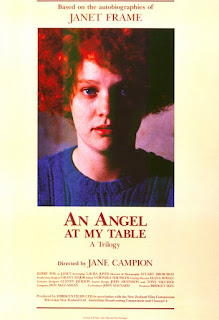
Campion's next film is a time-hopping, globe-spanning epic, at least in comparison to her earlier features, as she adapts New Zealand author Janet Frame's three early autobiographies into one film.
An Angel At My Table is a frequently tedious, often uncomfortable, occasionally upsetting, sometimes uplifting adaptation of Frame's work (each given a chapter designation in the film). Campion's visual acuity is without question, but as a biopic it misses the mark by wanting to cover it all, leading to a film that feels like a barrage of vignettes rather than a cohesive story. I'm not sure it earns its near-160 minute runtime. I came to learn later this was designed for TV, to be presented in 15-minute increments, which really makes more sense to me. Visually it feels cinematic, but structurally it felt more TV.
It seems that Campion, in putting her attention towards trying to relay as many aspects of Frame's life (from childhood to her 30's) lost the ability to draw focus to themes or commentary. Things are presented in an "as they are" way, with little insight or reflection as to why they might be (maybe this mirrors Frame's writing? I can't say). There is definitely a throughline to me made of the detrimental influence of the patriarchy on Frame's life, and how beholden or deferential to it she increasingly becomes to it, but it's never reflected upon. It almost seems incidental, where it really should have been pulled into focus. Perhaps it's because, at least where we leave her, she hasn't escaped it, or even really identified it.
It's hard to convey adequately, even in a two and a half hour movie, the overwhelming impact of an abusive father, the death of a sibling, misdiagnosed schizophrenia leading to 8 years of incarceration and shock treatments, more death, being shuttled from New Zealand to England alone, being domineered by a neighbouring man with ill designs for her, a first time love affair with (presumably) an older man, and yet more death. The only time I really felt the weight of all this upon Frame was when she actually experience joy or happiness or elation in spite of it, otherwise the heaviness is present but it's like she's not aware of it.
By the end, despite spending so long with Frame, I still don't feel like I know her, or really, fully understand her motivations, or feel like the film version of Frame understands herself in any way. It's got plenty of memorable moments but ultimately it's unsatisfying.
---
After the massive success of The Piano and the underperformance of her follow up with another period drama, Portrait of a Lady, Campion tried her hand, for the first time, at a modern story. Not only that, but a psycho-sexual thriller, a notoriously difficult to pull-off genre. In The Cut bombed hard, both critically and commercially.
In 2003, nobody wanted to see Meg Ryan, America's other, lesser, sweetheart, playing a horny, sweaty, terse professor who gets wrapped up in a string of gruesome serial murders. Ryan was the rom-com lady, the heart Tom Hanks had to win over. She wasn't the get drunk, handcuff a detective to a radiator and fuck him senseless on screen vixen. She got pigeonholed.
As flawed as In The Cut is, Ryan's performance is pretty great. She's an extremely nuanced character, with tics and curiosities and anxieties. This was a role originally intended for Nicole Kidman, and it seems exactly like a Nicole Kidman thing to do, but it's only more interesting because it's Ryan, and because she does pull it off so well. I've never been a Ryan fan, I just have no attraction to her romcom persona, but I thought she was so engaging here. She's so in control despite being out of control, it's a high-wire act which she negotiates perfectly up until the sloppy final act (which, I learned, is actually very much telegraphed from the beginning, and apparent upon rewatches...but it still feels rushed and messy).
There's a lot going on in this movie. I mean, Kevin Bacon's in it... unbilled! Mark Ruffalo is the red herring love interest, and the film teases constantly the idea that his detective investigating the murder may well also be the murderer. Unfortunately this whole tension rests on the fact that Ryan withholds a key piece of information until the climax of the film. In between, they have a lot of sex and talk a lot about sex and look at gruesome murders and connect somewhat and stuff. The sex and nudity is more menacing than hot, but it has such a different energy than the usual male-directed or American erotic thriller, there's a comfort and confidence you don't usually see. Rather than feeling like "aww, Meg Ryan", it was more "good for you Meg Ryan".
Unlike Campion's earlier films with a lot of perfectly framed and positioned shots, here she has a roving lens, getting distracted but also taking in information. My favourite shot of the movie finds Frannie riding in the back seat the detectives' car, having her focus suddenly drawn to a woman darting down the sidewalk and around the corner. There's a similar moment, just a strong visual curiosity, when Frannie is on the subway, and at a stop stands a bride, groom and some of the wedding party on the platform, the bride's makeup all smeared as if she were crying. There's dozens more just ancillary shots like this, so many that they intentionally obfuscate meaningful information happening in the background. Kind of ingenious.
In the Cut is a recent reclamation project for a few critics, and it makes sense. While its many disparate nuances may not all hang together it's still a really engrossing watch and a great entry in the genre.
---
Going into this film, armed with but one semi-spoilery tidbit of "all is not as it seems", I could telegraph much of where it was going from the onset...which could be a criticism if this were supposed to be a film of twists, but it's not. It's two "surprises" are laid pretty bare if, like Peter, you know how to use your eyes in ways other people can't.
The opening hour is largely establishment, and I admit to being a little distracted during this part, as we do nowdays with phones in hand. But the second hour, once Smit-McFee's Peter reenters the picture, and that crackling "what's really happening here" dynamic sets in with Cumberbatch's filth-lord Phil, it just sizzles with curious tension. I was rapt.
This is a commentary on identity, as it relates to masculinity, as well as queerness, and how these change and evolve from one generation to the next, yet how often the older generation gets stuck in their perceptions of how things have to be.
I like how Plemon's George knows Phil's whole schtick is just an act, unlike the others he's neither afraid of nor charmed by his brother, but he's also incapable of affecting his behaviour. He seems to know there's a mask his brother puts on but he's not entirely sure how to explain why (or perhaps he doesn't want to admit it), if he did perhaps he could have saved Rose a lot of grief).
Dunst's Rose, unfortunately, gets short shrift here as a character. Fragile and anxious, she succumbs to Phil's psychological intimidation, and has nothing but nerves when it comes to her sudden shift in status. She spends most of her time with her nose in a bottle which only seems to diminish her even further in Phil's eyes. I maybe missed a few tidbits about Phil's relationship with women in the past, unless it was just that bit about his mother getting him a prostitute at a young age, ensuring without a doubt he would be a man, but Phil clearly hates women, and has little use for them.
Campion's lens is back to being so focused here, studying intensely. The vistas and colours are gorgeous. Greenwood's score pulsates, enhancing the uncertainty of what you're seeing, hinting at something moving under the surface, muscles knotting under the skin.
This one's going to simmer in my mind for a while I can tell. As often as I picked up on what Campion was foreshadowing, I still felt the energy of not fully knowing what was happening between these characters. I'm curious if, on rewatch, if knowing exactly where it's going changes how it plays.
Sarah's family has a history of mental health issues, and lately Sarah has been having spells of lost time, troubled sleep and sleepwalking. It's also possible she's being abducted by aliens and experimented upon.
It's the specificity in Sarah's character that I like so much about this film. She's sweet and awkward, but obviously nervous because of the emotional traumas she's experienced. Those specifics are a necessary part of the film's deft obfuscation of reality. Is it her psychosis that we're seeing or is she really being abducted?
I honestly think the time is trying to say why can't it be both. It's certainly saying that this is Sarah's truth, whatever we may think of it. Sometimes it's hard to have understanding of someone's struggle with mental health, but it doesn't mean we can't have compassion. I think that is ultimately what this is about. It's not about accepting or relating to Sarah's truth but having compassion for what she is experiencing.
Alison Brie is phenomenal, delivering a complex and rich performance which, as co-writer, doubtlessly is something she's been needing to get out. I won't say risky or brave, instead it's confident and self-aware.
I haven't been exceptionally pleased with any of Jeff Baena's films I've seen so far (Joshy, The Little Hours), but there's exceptional growth here as a filmmaker, if still a little clunkiness that I'm sure increased budgets and more technical experience will smooth out.
It's a twisty, mysterious, boggling and beautiful film, resting
somewhere between mumblecore drama and retro-90's thriller, but
certainly not everyone's cup of tea. Sort of the trippy, experimental
80's sci-fi vibe if not quite as beholden to aesthetic as, say, Beyond The Black Rainbow or Under The Skin.
I have this list of films (& tv) I watched, and yet did not write a review for. I thought perhaps it was a list made up of films (and TV too) I watched in 2018 (the dark year), but in 2018 (the dark year) I actually did much of my film writing on ye olde Letterboxd account (no tv writings though). Letterboxd was a dalliance with dark app magic that hasn't really stuck... not like this hire trusty blogge. But I digress... the list below represents many things watched, mostly, in 2017 (maybe a little before, maybe a little after [the dark year]). Toast was keeping the blogge spirit alive back then, I was too mired in some bullshit or another to put thoughts to 1s&0s. I may have made comments in the blogge about such movie (und T.V.) thinges hence, but perhaps not. I am too lazy to do a search at this time.
Given the passage of time, most of these things will not have taken up much space in my memory, so I may not have much to say... but then again, I may have far more to say than I think. So in this grande experiment, I present to you, quick and addled musings of mostly-forgotten experiences of 2017 (and beyonde!).
---
Fast & Furious Franchise - I got into F&F with Fast Five, and was quite taken with its rather brazen tomfoolery. It's big budget action filmmaking that started off as one thing, tried to morph into something else and then wound up becoming something much different, much bigger and much better than its origins would insinuate:
- The Fast and The Furious(2001, d. Rob Cohen - blu-ray) - it started off as a knowingly cheesy Point Break knock-off with illegal drag racing and substitute penises instead of skydiving and other extreme activities. Little wooden boy Paul Walker (RIP) goes undercover with Vin Diesel's criminal gang of souped up street race drivers as they steal truck loads of dvd players (yeah, it ages real well). There's lots of car porn in here and a lot of short shorts and halter tops. Cohen spends most of the movie using his camera to ogle tires and titties. Yet knowing where it's heading it's already got its stupid charms in place. It's all about family, bro.
-2 Fast, 2 Furious (2003, d. John Singleton - blu-ray) - yeah, fucking John Singleton directed this stupidly titled movie. I honestly can remember what happens in this one (and if I'm being honest, I can't really remember what happened in the first one...as with most of the entries in this entire post, I won't remember most of what I watched), but I seem to recall enjoying it more than the first one. I think it uses a lot more CGI, and the absence of Vin Diesel means the acting game is actually stepped up a little in this one (Diesel has screen presence, I'll give him that, but he's a terrible actor). It goes against the grain but I think I would watch this one over the first one.
-Fast and Furious(2009, d. Justin Lin - blu-ray) - I skipped the third one (Tokyo Drift) because it's not really part of the series. Not to get too stuck in the weeds but Tokyo Drift takes place after Fast & Furious 6, if you're trying to sort out the chronology. But really Tokyo Drift is kind of the Halloween: Season of the Witch of the F&F franchise, the one where they tried to do a standalone anthology type thing that just didn't work.... BUT, with his feet already wet, Justin Lin was (ahem) fast figuring things out and set the real prototype for the franchise to follow with the murky fourth entry Fast and Furious, in which he tries to bring together all three of the previous films canonically, while also pushing forward into globetrotting espionage type storytelling with a gang of streetracing thieves with a code of ethics and a strong makeshift familial bond. It's a messy, messy movie, but it certainly started something that Fast Five paid off like gangbusters (...you know, gang busting, like Paul Walker in the first film).
- Fast and Furious 6 (2013, d. Justin Lin - blu-ray) - Fast Five is a legit good time for anyone who has never seen any other F&F movie and it's the legit entryway into it all. Viewing order of F&F should be 5, 4, 6, 1, 2, 3, 7, 8. But anyone coming into F&F may immediately want out with F&F6 since it really ouroboroses it up. Lin just goes for broke and makes a crazy dumb (yet fun) spy movie that brings almost everything from the past right back up front, including resurrecting the dead and tying things back together from Tokyo Drift. It's a film that needs more out of Vin Diesel than he can give, and it overstretches itself with its universe building, yet still certainly enjoyable.
- Furious 7 (2015, d. James Wan - TMN) - And this is where the shit hits the alchemic fan and turns to gold. Jason Statham and Kurt Russell enter the fray of an already ballooning cast. Sadly, Paul Walker died while filming was ongoing and his specter looms hard over the proceedings, creating an honest to god sentimental moment about family in its finale. It's a big, big movie and it goes for broke quite spectacularly. Again it ties itself heavily with the previous three entries, but at this point this ongoing "family" thread is what gives these films connective tissue when otherwise it would just be ridiculously entertaining car stunts.
- The Fate of the Furious(2017, d. F. Gary Gray - TMN) - they may have lost Paul Walker but they gained Charlize Theron and Helen Mirren (yes, fucking Helen Mirren). Never one to let a good adversary stay a good adversary, the bad guy of the previous film (Jason Statham) is reformed as a good guy here (setting up the Hobbes and Shaw spin-off) and it's easily the Statham/Dwayne Johnson chemistry that carries the bulk of the entertainment factor here. Vin Diesel is blackmailed by Theron into being a bad guy who the rest of the team has to take down, and it's kind of a drag, because Diesel, the stunted bad actor that he is, can't play the character as a man trapped pretending to "break bad" but instead just plays a shitty heel figure in the proceedings.
These films, at this point, exceed James Bond levels of action set pieces, and this is the first one that takes major pains to kind of lose the car shtick.... to do other big action set pieces that aren't *only* about cars. It's another turning point in an ever evolving and expanding franchise. There's no way, looking back at that kind of dumb, DVD-stealing crew from the first feature that it would wind up in to the almost-superhero universe it's become. I don't blame anyone for thinking these things are totally stupid dumb and not worth the time. They are totally stupid dumb, but that's what makes them so entertaining. They have absolutely no pretenses about them which is why they are so successful. ---
It's been established that I'm not a big horror movie guy. I can dabble but I'm not very entertained by the cruel nature of horror. I don't get a lot of pleasure out of seeing people tortured or the gags of guts and viscera meant to shock and/or amuse. So when I say that these two films are the best horror films of the decade, you have to qualify that as, like, the sentiments of a guy who really hasn't watched that many horror films this decade. And yet, not only are these two of the best horror films of the decade, they are two of the best films, flat out, of the decade. Two masterfully crafted productions that will stand up for decades to come.
Get Out (2017, d. Jordan Peele - In Theatre) channels so much racial tension, modern and historical, that it's at times unbearable and viscerally upsetting. It's psychotropic horror, a film that doesn't so much as startle you as keep you in a perpetual state of uneasiness. It's a masterful debut from Peele that may have been a big surprise to Key & Peele sketch comedy fans who weren't paying close enough attention to how often those skits descended into some kind of absurd terror.
It Follows (2014, d. David Robert Mitchell - Netflix), in the loosest sense, is about a killer STD. But that's way oversimplifying things. It's a metaphor for shame and guilt around sex, especially in teenage years. Mitchell crafts a film that feels like it's part of the 80's horror explosion, a saturated blueish hue and very specific styles, locations and vehicles all create a bit of a throwback aesthetic with a pulsating synth soundtrack that is brilliant on its own but even more effective in combination with the film. Yet for all its retro homage, it's still a very modern film, thoughtful, sensitive, yet still very, very frightening. An absolute classic.
---
*Smooth transition from horror to children's movies*
Finding Dory (2016, d. Andrew Stanton - blu-ray) - Finding Nemo is a brilliant, beautiful, highly entertaining film with a huge heart, an animation classic. A sequel was probably inevitable but hardly necessary. While not quite the equal of its predecessor, Finding Dory does manage to hold up to Pixar's highest standards, delivering another beautiful, highly entertaining film with a huge heart. Dealing with Dory's forgetfulness/disorder and retracing her past makes for a different experience than Finding Nemo while holding onto its structure.
Captain Underpants: The First Epic Movie(2017, d. David Soren - in theatre) over the past dozen years of my kids' lives I've been exposed to the rather wondrous worlds of cartoonist Dav Pilkey. The Captain Underpants series is absurd humour for younger readers, but still quite entertaining for adults reading along with their child. The "First Epic Movie" has moments of real inspiration but exposes kind of how juvenile the concept is. It seems to aim for a sort of Spongebob or Lego Movie vibe but misses the mark.
Despicable Me 3 (2017, d. Pierre Coffin, Kyle Balda - in theatre). I haven't actually seen any other Despicable Me movies, so perhaps this one was just lost on me without prior investment, but I find the animation ugly, the minions annoying, and the humour tepid. I recall asking myself frequently "who is this joke for?" In a word: inessential.
Moana (2016, d. Ron Clements, John Musker - netflix) There was a period there where my daughter was refusing to go to the movies, so we didn't see Moana on the big screen. We didn't even wind up seeing it together. She saw it at school or at a friend's birthday party, so I watched it without her. I rather adored it, but the vistas and scale of the picture would have been so much more impactful watching on a big screen. It's an absolute darling of a movie though, truly lovely and adventurous.
Chitty Chitty Bang Bang (1968, d. Ken Hughes - rental) I don't remember what the impetus was for watching this. I think the wife and I were talking about films that scared us as a child (see next entry) and she mentioned how terrifying Chitty Chitty Bang Bang was for her as a young'un. This is a weird 145-minute long (!) quasi-musical live-action children's film about a possibly sentient super-car that helps a family survive their ramshackle adventure through a despotic alternate reality. From James Bond creator Ian Fleming, adapted to screen by Roald Dahl, it's fucking bizarre. It's not great, but there's absolutely something surreal and captivating about it. I can see how that surreality was terrifying to kids, for sure.
The Peanut Butter Solution (1985, d. Michael Rubbo - blu-ray) There was no tit-for-tat in our traumatizing childhood movie exchange. I had to watch this one on my own. But I did so happily. To rediscover this film -- about a kid who goes bald after getting massively frightened when exploring an abandoned house, then receiving a mysterious recipe for hair-growth formula (the titular peanut butter solution) from a ghost, and then being kidnapped by his nefarious art teach so he can use his perpetually-growing hair to make the world's softest paint brushes -- was an absolute blast. I saw this film many times as a kid, as it was frequently played on Canadian television, and it was great to be able to fill in the gaps of my memory on it. It's a weird-ass movie, with typically Canadian production values which makes it almost more endearing. It's like Cronenberg-for-kids.
---
I can't be bothered to sub-categorize the films any longer. Hot takes a-comin:
Oh Hello on Broadway (2017, d. Alex Timbers, Michael John Warren - netflix) Nick Kroll is responsible for two of the best shows of the past decade, the hilarious coming-of-age-and-sexuality animated Big Mouth and the reality TV satirizing sketch comedy of Kroll Show. The septigenarians New Yorkers George St. Geegland (John Mulaney) and Gil Faison (Kroll) emerged from Kroll Show (as well as other appearances online, in podcasts and elsewhere) as a fully baked comedic duo, telling ribald stories of past glories, and questionable decisions they've made along the way. A stage show on broadway was a surprising next level for these hilarious and unlikeably charming characters... I wouldn't think the mass appeal would be there to sustain such a run, but toss in a loosely structured script for Kroll and Mulaney to bounce around inside of, and bring out a surprise celebrity guest interview each show and it just started buzzing. If filming it for Netflix has a problem, it's that one wouldn't want to watch the same show twice, but instead see as many of the shows as possible. It was probably more fun live, but it's still a great time.
GLOW: The Story of the Gorgeous Ladies of Wrestling (2012, d. Brett Whitcomb - netflix) This doc cropped up on Netflix in the lead-up to their original scripted comedy-drama GLOW. I watched and loved the first season of GLOW and was intrigued to see what they actually took from the source. Not surprisingly, they took very little, beyond the comraderie, a few of the archetypes, and the sense of struggle. But seeing the real performers reminisce and then reunite creates for a quite enjoyable and emotional ride. It's a sweet documentary even if you're not sure how much wrestling matters in the grand scheme of things. Mountain Fiji's story is the centerpiece of much of the movie, as she's so loveable and her struggles so touching. There's never a wrong way to celebrate an absolutely endearing, wonderful, kind-hearted person like her, and where it could feel like it was focusing on her at the expense of the other performers, it actually brings them together and further exemplifies their sense of community.
Fantastic Beasts and Where To Find Them (2016, d. David Yates - blu-ray) I thought for certain that I had already written at least once, if not twice about FB&WTFT, but no dice. I only have a letterboxd entry for The Crimes of Grindlewald. I like Harry Potter fine, but I'm not a huge fan, magic just isn't my thing, y'know. And the first time around with FB&WTFT I thought it was trying too hard to be something different, and to be something bigger than it really was. But the second time watching it, I actually responded rather intensely to the characters and their journey, to the point that I was really, really, really looking forward to seeing them again in the sequel. Well, here's how that went. Anyway, I quite like this first one. It really grows on you.
Trump: The Art of The Deal (2016, d. Jeremy Konner - netflix) Johnny Depp plays Trump in this satire of the man's life and his business ethos. It's not as funny or scathing as it needs to be, and it's only clever by half. Perhaps if he didn't become president it would have been more amusing.
Girlfriend's Day (2017, d. Michael Stephenson, - netflix) A cheeky detective noir starring Bob Odenkirk about a down-on-his-luck greeting card writer who gets embroiled in murder and conspiracy around a new fake holiday, Girlfriend's Day. There's probably a good short film in here, but it makes for a bit of a slog at full-length.
The Polka King (2017, d. Maya Forbes - netflix) / The Man Who Would Be Polka King (2009, d. John Mikulak, Joshua Brown - netflix). Jan Lewan was practically a legend when his extravagent lifestyle and inflated ego started overtaking his reality. Unable to sustain himself with his music or business, he starts grifting his fans and his community with a Ponzi scheme. The Polka King is a lightly dramatic retelling starring a delightful cast -- including Jack Black, Jenny Slate,Jason Schwartzman, and JB Smoove -- while the documentary is a little dry but still heartbreaking when it affirms the reality of the hurt Lewan inflicted on people's lives (but also a little frustrating how trusting people were in giving him money to start with). Not essential viewing but rather engaging as a pair (the doc runs just over an hour)
Don't Think Twice (2017, d. Mike Birbiglia - netflix) Comedian Mike Birbiglia is a very gifted storyteller. He's a captivating and hilarious orator and author. It's a bit surprising then that he's rather far from that as a filmmaker, but maybe it's just the story he's trying to tell. Don't Think Twice is a story about an improv comedy troupe dealing with reality when one of their members becomes famous but the rest are left struggling. It's such a narrowly defined reality that even someone like myself, who loves standup, sketch, improv comedy in all its different distributions, could care less about this story or the characters within it. The cast is a great one, with Gillain Jacobs pulling the MVP role within it, but it has no real meat to it, not for lack of trying.
Keanu (2016, d. Peter Atencio - TMN) The transition from sketch to feature has been hard for almost all sketch comedy group, Monty Python excepted. The more successful moves to feature-length scripting tend to find a coherent story formed out of what are effectively a series of sketches. Unfortunately, with Keanu, Keegan Michael Key and Jordan Peele's first foray into the cinemas as a duo, either the sketches were too restricted by the story of the film, or they weren't intended to be sketches at all. Either way, the film doesn't really work. It's attempting to be a buddy action comedy, and it hits those notes, but they're almost all fairly mundane and and familiar notes. Key and Peele aren't offering anything here that surprises or is memorably quotable, unlike so much from their sketch comedy. It's not a terrible movie by any stretch, but it's missing the sparks of brilliance we had come to expect from the duo.
The Nice Guys (2016, d. Shane Black - TMN) This is Shane Black's thing. Two kind of down-and-out professionals of a type, getting on each other's nerves but developing a respect and friendship along the way. These two guys are Russell Crowe and Ryan Gosling... not exactly the dynamic duo on the forefront of everyone's mind, but it works so well. Both are quite into it and Black produced a hilarious and charming script about losers with more style and craft than any of his other outings. A great little movie, worthy of rewatching.
The Late Shift (1996, d. Betty Thomas - TMN) Based on the book, a dramatic retelling of the tensions between David Letterman and Jay Leno following the announcement of Johnny Carson's retirement from The Tonight Show. HBO has been investing in these niche stories for a long, long time, and while it looks painfully like a film made in 1996, it's still actually a very engaging watch. There's no reason anyone should really care about what went on behind the scenes of the Tonight Show any longer, and yet, there's something legendary about this fued which makes this sometimes goofy imagining of it captivating. Kathy Bates playing a ball-busting agent is worth the watch alone.
Arrival (2016, d. Denis Villeneuve - blu-ray) Villeneuve announces himself here as the next great director of big screen science fiction. Next he takes on Blade Runner and Dune, showing that he has little humility in the face of his ambitions. But he produces beautiful looking movies, cast with amazing actors who he draws out commanding performances. This is a procedural, of sorts, which finds linguist Amy Adams discovering how to break through and communicate with a very alien sentience that arrives on Earth. It's not an action film, but the intensity is high, and the depth of emotion is perhaps even more suprising than the aliens.
Fire & Ice (1980, d. Ralph Bakshi - Amazon Prime) This type of fantasy, swords, sandals, beards and crystal balls is not my thing. I find these types of stories tedious and dull. But beyond the tedious story is beautiful hand drawn animation which kept me in admiring awe throughout. There's a stiffness and lack of fluidity at times, but that's somehow part of its charm.
The Lost City of Z (2017, d. James Gray - Amazon Prime) Colonialist epics are a thing of yesterday, unless you can present a story that is absolutely aware of its place within modern cultural norms. The Lost City of Z does have its cake and eats it too, by telling a story spanning three time periods, three adventures in the the Amazon, where explorer Percey Fawcett (Charlie Hunnam) discovers evidence of an advance tribe from eras past. The British aristocracy finds any intonation that any non-white civilation would have superior capabilities heretical, but Fawcett, more concerned with truth than politics obsessively forges forward to find further proof, with his family left behind to bare the brunt of his herecy. It's a very tranquil and meditative film, with moments of tremendous intensity, and a few moments of maddening truth regarding our forefathers' ignorance. Robert Pattinson, Tom Holland, Sienna Miller and Ian McDiarmid co-star.
Jim & Andy (2017, d. Chris Smith - netflix) Jim Carrey played Andy Kaufman in the 1999 film Man on the Moon. It left him a little scarred. This documentary examines Andy Kaufman's life through Jim Carrey's experience trying to completely inhabit another man's skin. It's a fascinating if inessential documentary that provides interesting perspective on Kaufman, but also insight into the craft of acting and how it can be psychologically dangerous to pretend to be someone else for a while. Now all we need is the meta-movie that is the dramatic retelling of this story.
Black Panther (2018 [the dark year], d. Ryan Coogler - in theatre) Turns out I actually wrote a review in 2018 but never published it (all I had to do was attach some pictures). I corrected that and published it now. I've watched the film a couple times since, and it's in my top 10 of all time superhero films.
Creed (2015, d. Ryan Coogler - TMN) I saw at least some of Rocky III and probably all of Rocky IV when I was a kid, but I wasn't that big into boxing movies then, and I'm still not now. I don't really care. I skipped the chance to watch Creed for free on the big screen when it came out (well, actually, arrived late and was locked out of the theatre) but it was my hyped reaction to Black Panther that made it a must-see. I love it. It's a tremendous movie. I've seen it a couple times now and I'll watch it again. Michael B. Jordan is magnetic, his chemistry with Stallone and Tessa Thompson is incredible, and Coogler's direction is amazing (that seamless one-shot of the boxing match is viscerally engrossing). It's a story about legacy, something I love in superhero comic books, and this is really just a comic book superhero of a different type.
The Cloverfield Paradox (2018 [the dark year], d. Julius Onah - netflix) - You can look elsewhere on the internet for the backstory on how this project came to be, and how it came to be on netflix. My hot take is that its incredible cast - Chris O'Dowd, Gugu Mbuthu-Raw, David Oyelowo, Elizabeth Debicki, Zhang Ziyi, Daniel Bruhl - is kind of wasted on such an incredibly badly executed story about parallel dimensions. It's a film that couldn't quite figure out what it wanted to be, sci-fi or horror, not doing either all that well with split focus, and then got shoehorned into a film franchise that isn't a film franchise. There's a few inspired entertaining seeds here but it just doesn't come together. Can we get the cast together again for a do-over?
Ghost in the Shell (2017, d. Rupert Sanders - netflix) There's so much content in the world you have to make blanket concessions somewhere. For me it's books and anime. I've never seen the original GitS so everything in this film is new to me. I get the controversy surrounding it, and I do agree with it: ScarJo wasn't the appropriate casting choice. Moving past the whitewashing (if you can, understood if you can't), the film is quite striking visually and I found the story is very engaging. There's only really one scene, in which ScarJo meets her Japanese grandmother, where the whitewashing becomes so brutally flagrant, but otherwise it's not a constant offense throughout the film (unless to you it is, which is valid).
The Disaster Artist (2017, d. James Franco - rental) Is Franco now cancelled or can we still talk about him with some appreciation? I haven't been keeping up on all the cancel culture news. I know The Room mainly from podcast talking about it and a few clips I've watched obsessively online. Tommy Wiseau is a fascinating personality, and the story of his creation of The Room is bountifully as bizarre as he is. Franco takes one step past impersonation here, capturing Wiseau's strange mannerisms and injecting his own sense of his personality, trying to creating a flesh-and-blood living being out of such an enigma. Dave Franco then, playing Wiseau's de facto best friend and naive partner in crime Greg Sestero, has to do much of the emotional heavy lifting, but since it's a film based on Sestero's book of the same name, it's built for such a focus. It's a very entertaining film about a film that's possibly way more entertaining depending on your disposition. But it serves as a great entryway into The Room for the uninitiated and also a fun dramatization for fans of Wiseau (winking or otherwise).
I, Tonya (2017, d. Craig Gillespie - in theatre) If you were a teenager or older in the early 90's then you knew all about Tonya Harding. Or, at least, you thought you did. She was the "bad girl of figure skating", as the media liked to sensationalize her. She came from lower-class rural America, she liked to perform to hard rock and wore outfits that weren't as refined or standardized as other skaters. She was a curvy, muscular girl, with crimped dirty blonde hair that seemed borderline unmanageable. Everything about her flew in the face of the sport's typical pageantry. So she was stigmatized and villainized by the media, especially when compared to her chief competition, Nancy Kerrigan. Kerrigan was a Disney Princess come to life, long and lean, with flowing, shiny brown hair, doing everything by the book. Of course, as the story goes, Harding kept some pretty bad company (her domineering mother most extremely) and it eventually led to the legendary kneecapping incident that got Harding banned for life from the sport. This is a tragi-comedy featuring both the absurdity and the abuse in Tonya's life, with magnificent performances from Margot Robbie, Allison Janney, Sebastian Stan and Paul Walter Hauser.
Annihilation (2018 [the dark year], d. Alex Garland - in theatre) Perhaps the most intense and legitimately frightening film that isn't an outright horror movie. It's a bit of a puzzle that when pieced all together still requires some thought on behalf of the viewer to get to a resolution. It's got serene moments of beauty, and start moments of terror, with many emotional thoughts in between. It's a film that demands rewatching, but may be too intense for some to actually want to. It's wonderful, one of the best genre films of the decade.
The Shape of Water (2017, d. Guillermo del Toro - in theatre) My dirty nerd secret is that I don't really like del Toro's films all that much. The big benchmarks in his career, Pan's Labyrinth and The Devil's Backbone are probably my least favourite entries in his repertoire. But Oscar darling The Shape of Water is a strange delight. It's as much a tribute to the history of cinema as it is about a deaf lady falling in love with a fish-man, which explains why the Oscar voters keyed into it so much. There's little else Oscar loves more than films about film. There's just too many beautiful, romantic even, moments in this film to not get swept up, even when it gets cartoonishly heavy handed (intentionally so) and it's so precise (as all del Toro films are) in its details that it's such a marvel to behold. Plus, it's basically an Abe Sapien from Hellboy spin-off in everything but name.
---
OH NO! Unwritten about TV shows. Blerg.
11.22.63 (Hulu) - A mini-series adaptation of the Stephen King novel about a guy (played by J*cancelled*o) who finds a time vortex in his closet and goes back in time to stop Kennedy's assassination with disastrous consequences. Kind of fun in the moment, pretty forgettable afterward. The Night Manager (Amazon Prime) - A John LeCarre adaptation about a night manager (Tom Hiddleston) at a hotel who gets recruited into being a spy, infiltrating the organization of a previously untouchable global weapons dealer (Hugh Laurie). Olivia Coleman plays Hiddleston's handler. Elizabeth Debicki plays Laurie's girlfriend. It's a great cast and an interesting story, but it plays too rhythmically like a book, so it feels like it gets distracted frequently from the main thrust. It would probably have made a tighter movie.
The Defenders (Netflix) - Blerg. This was what five seasons and 65 episodes of TV was leading to, the uniting of Daredevil, Jessica Jones, Luke Cage and Iron Fist. But the most boring part of the Netflix Marvel was the ninja mob The Hand, and that's the main adversary of this series. The show relishes every scene where characters meet characters from a different series but Elektra and the Hand have them dragging their feet through the mud. Sigourney Weaver is also a main adversary in the show, but mostly separated from everything else going on as we get insight into her terminal illness and how it affects her...she doesn't ever feel like she belongs in this story. What a waste of time and effort. GLOW Season 1 (Netflix) I've written about Season 3 already, but going back to the beginning and remembering Ruth and Debbie and the gang as they were at the start, it's been a remarkable journey for them all. It's really a show about camaraderie, about unity, feminine spirit, and it all starts with Ruth sleeping with her best friend's husband, getting found out, and then having to face that person every day in a challenging, close-knit environment, where failure would be the last straw for all of their careers. There's comedy, which is great, and there's drama, which is even better, and there's wrestling, which is terrible, but in a very fun way. It's ridiculously charming, the cast dynamic is perfect, and it doesn't shy away from having difficult conversations. Its mid-80's trappings are painful reminders of a gaudy, ugly era of fashion, but it certainly gives the show a distinct feel as it leans heavily into the neon style. Ghosted (Fox) Craig Robinson and Adam Scott join a secret organization to fight supernatural entities. It was a rough start. I think I lasted four episodes. I'm certain it could have gotten better (and apparently it did) but a rough start more often than not leads to cancellation rather than patience as it finds its footing. The comedy wasn't sharp or original enough and the characters Scott and Robinson were playing felt like exactly that, characters they were playing. Both leads were better than the material.
Runaways season 1 (Hulu/Showcase) I don't even remember at this point if I lasted out the season. The joke about Runaways, now in its third season, is that it took them an entire season to become the titular runaways. The show got way too mired in the dynamics of the parents and kept harping on the squabbles between the adults, and the tense and/or awkward relationships they had with their kids. I loved the first run of the comic by Brian K. Vaughan and Adrian Alphona, and the show uses almost everything that was there but tries to build out and extend the story to exceptionally tedious results.
Mindhunters S1 (Netflix) I've already written about season 2, so looking back on season 1, I notice that we've completely dropped Holden's love life in the second season, which is great, because it had done all it needed in season 1. Season 2 did drop the ball a bit on Wendy, Anna Torv's character, who was a real highlight of the first season. Season 2 had a more focused story, but season 1's building of an entirely new method of investigation, of criminal profiling, through the gathering of data by interviewing serial killers was gripping television, specifically the interviews with Ed Kemper, a massively imposing man with impeccable manners and a complete emotional detachment from the horror of his crimes. It's not a show for the faint of heart, that's for sure.
Manhunt: Unabomber (Netflix) - a mini-series trying to fall into the American Crime Story vein, a modestly successful stab by the Discovery Channel to enter the premiere scripted television era. It's an engaging story if told a little bit cheaply. It's important to understand that Sam Worthington's character of Jim Fitzgerald is a bit of a lie...he is a real person, but in the show he represents a whole team's worth of activities, so a lot of the actions he takes and conclusions he makes in the show were performed by others in reality. That said, it's certainly bingeable watching and Paul Bettany's Ted Kaczynski is pretty riveting. It makes for a good pairing with Mindhunters, although the latter's production values are so much higher, making this look like a 90's TV show.
American Vandal seasons 1 and 2(Netflix) - I didn't know what this was until I watched it. I had heard raves about it but still thought it was yet another Ryan Murphy or Ryan Murphy-type season-long anthology project. While it is kind of a season-long anthology, it's also one of the funniest shows on TV. Taking inspiration from all facets of true crime documentation and investigation, this show embraces and exploits the tropes to maximum comedic effect while still actually managing to create some genuinely interesting and engaging characters and a reasonable amount of dramatic tension. The first season finds our intrepid duo of high school documentarians investigating the vandal who scratched dicks into the paint of every car in the school's parking lot. One student was suspended for it, but did he really do it? The second season revolves around investigating who put a laxative in the cafeteria lemonade, causing much of the school to poop themselves. These subjects are very silly, and it's the treatment of them with dire seriousness that only heightens their hilarity. It's a shame this only lasted two seasons, but at the same time it's better than none. Worth revisiting.
Black Lightning season 1 (Netflix) you know, I covered season 2 already and that pretty much expresses my feelings about the show overall.
Toast of London seasons 1-3 (Netflix) Have you ever had to ask the question "Can you hear me?" And did someone respond, rather oddly, with "Yes, I can hear you Clem Fandango", leaving you quite puzzled? Watch Toast of London to find out why and laugh yourself silly. Matt Berry is the egocentric Stephen Toast, a thespian of ill-repute struggling to find meaningful work (or any work for that matter) in modern London. This is an exquisitely crafted comedic persona, Berry infusing all sorts of vocal quirks, physical mannerisms, plus curious psychological and emotional boundries into the character creating for truly off beat and bizarre but always hilarious and usually unpredictable scenarios for the character to fall into. He has a chief nemesis in Ray "Bloody" Purchase (the cuckold whose wife Toast frequently sleeps with), an apathetic supporter in his agent Jane, and a confidant in fellow aged thespian/flatmate Ed. It's hard to overstate just how commanding Berry is in this show, which offers the actor/writer/musician the luxury of a new song each episode to punctuate the emotional aspect of a particular scene but also to afford the show some sheer creative lunacy. There's frankly not another sitcom like this. It won't be to everyone's tastes for sure (just seeing Berry's whinnying sex face is enough to put anyone off who doesn't get the hilariousness of it) but it's worth it for the Jon Hamm episode in season 3 and every Clem Fandango appearance.
Jessica Jones season 2 (Netflix) Is there really a reason to continue watching a show where the lead character learns nothing and continues to alienate the people around her. I mean, most shows with a toxic lead tend to have characters surrounding them who either enable that toxicity, dismissive of that toxicity, or absolving of that toxicity. In Jessica Jones, Jess' toxicity does drive the people away from her and even though she could help it, she doesn't, and it's kind of heartbreaking but also extremely annoying. Season 2 dives deeper into Jess' troubled psyche, some of which has to do with her mother, who reappears with superpowers and is a total murderer. This causes Jess some more psychological distress on top of her already potent PTSD. I struggle to understand just what the show is getting at with Jess, what they want us to glean from her... is it that it's okay to still look for the good in someone who acts so awful? Season 2 was a real fucking bummer, with all the performers killing it in their roles, but creating an end product too unpleasant to enjoy too much. Jessica Jones is a great character, and Krysten Ritter excels at playing her, but the showrunners needed to find another note or two for her to play.
Lady Dynamite season 1 (Netflix) With this new golden age of television, so many comedians are being given the opportunity to create a television show with their own unique vision. Too often those visions are too limited by what's come before, and there's a lot of redundancy or familiarity in the outcome. But Maria Bamford's vision is so uniquely her own that it's amazing that Lady Dynamite was even a thing allowed to come into existence. Bamford's comedy is one that explores the diverging topics of mundane life and mental health, and her show is a representation of that kind of schism. It's a quasi-manic time-bounding story that takes place in at least three different time periods, one being the present day with a semi-successful Bamford finding love and cohabitation rather challenging, another time frame being her return to Los Angeles and the cutthroat world of acting and comedy after having a mental breakdown, and the third time period taking place at the tail end of that mental breakdown where she's in and out of the hospital and dealing with her well-meaning-if-not-always-helpful parents (a wonderful duo in Ed Begley Jr. and Mary Kay Place). It's a hilarious but also challenging show to watch, as the time jumping isn't always obvious so it's left to the viewer to sort out what reality we're in, but I think that's a deliberate move on Bamford's part, just a simplified viewport into her brain. It's also got one of the best title credit sequences of the decade. I've been watching this very slowly over the past few years, most of season 2 remaining, but not for lack of enjoyment.
Collateral (Netflix) is a murder mystery mini-series starring Carrie Mulligan as a sleepy London detective inspector trying to navigate a sticky web of intrigue after a pizza delivery driver is murdered. I remember next to nothing about this story. I recall I was somewhat engaged with it at the time, but even then I found the story overly complicated with not enough meat to Mulligan's character to get totally invested in it. If it were any longer than four episodes I probably wouldn't have continued watching past the first episode.
Star Wars Rebels season 4 (Disney XD) - if there are people out there convinced that Disney killed Star Wars, then they haven't watched Star Wars: Rebels. What started out as seemingly a kiddie-fied cartoon set in the pre-A New Hope days evolved into a glorious action adventure drama starring a makeshift-family that grew and grew and grew in scale to something glorious. If there was any burden for the show it was the expectation that it would ultimately dovetail into established Star Wars canon, be it Rogue One's climax or A New Hope's Battle of Yavin. But it found its own path, and its ties to established canon ran much deeper than just, say putting the crew of the Ghost in conflict with the Death Star. The character building reached its apex in Season 4, with each character continuing to evolve, or fulfil their ultimate destiny in exciting or heartbreaking ways. The journey with the cast of Rebels truly is an epic one, as much the equal of any Skywalker or Solo family memeber, and perhaps even more rewarding. This season continues to build upon the understanding of the force, as well as providing insight into the scale of the fight the rebels have against the empire. It comes full circle, bringing together things learned in previous seasons to show that liberal fluidity is more powerful than conservative rigidity. It's a show that further bridges the prequels to the original trilogy, it reinforces the importance of the Clone Wars cartoon in the pantheon, and it gives us some of the franchise's best characters (in a franchise already full of great ones). Thanks to Dave Filoni and the creative crew for this amazing ride.
Star Wars Resistance season 1 (Disney XD) As one series ends, another begins. This time however, it's set in the era of the sequel trilogy, season one ends colliding with the events of The Force Awakens. But unlike Rebels, which seemed to have a mission to further explore the nuances of the galaxy it inhabits, Resistance is a small show with small dreams. It's still spearheaded by Dave Filoni, but Filoni's interest here seems to primarily be channeling George Lucas' love of slapstick and physical comedy. It's central character is Kazuda Xiono, a bumbling Jack Tripper-type who bumbles his way through his espionage mission aboard an outer rim refueling station that the First Order is courting influence with. The selection of Kaz as their spy is the first of hundreds of absurdities that this show asks its audience to believe in. The supporting cast features few likeable figures, and it gets so mired in its sitcom-like setups each episode that it never feels high stakes. The show works best when Poe Dameron shows up, Oscar Isaac's confident performance as an actual competent agent elevating everything about the show, and lending it its only air of authenticity. The First Order is full of threats, with scattered appearances of Captain Phasma, but the only actual menace they actually generate is when the show dovetails into Starkiller Base's destruction of an entire system. The show, it's bad. It's a bad show. The animation is weird, but not unwatchable, which is more than I can say for the rest of the show. I don't like it. Season 1 basically ends where, all things being equal, it really should have began.
---
And that's it. The long list of 2017 (and a bit of 2018) in the bag. Some good thoughts, but mostly half-hearted ramblings about things I've mostly forgotten. But that's not all that unusual for this blog now is it.