Showing posts with label film-to-tv. Show all posts

Saturday, November 30, 2024

KsMIRT: ...into November (Part 1)

K'sMIRT is Kent's Month in Reviewing Television, where each month (eh..?) Kent steps through the TV series he completed watching each month in the 1 Great-1 Good-1 Bad format.  

This Month:
The Penguin (2024, HBOMax, 8/8 episodes) 
Shrinking Season 2 (2024, AppleTV+, 5/10 episodes) 
What We Do In The Shadows Season 6 (2024, FX/Disney+, 8/11 episodes) Creator: Jemaine Clemen

---

The Penguin
Created by Lauren LeFranc

The What 100: Oz Cobb has been a background figure in Gotham City's crime scene for decades, but with his boss Carmine Falcone dead, Oz sees an opportunity. He kills Carmine's son, pins it on rival boss Sal Maroni, and gets ready to start operating, when Carmine's daughter Sofia returns from Arkham Asylum to take her place at the head of the family. Oz used to be her driver, but he ostensibly had her committed 10 years earlier (without cause) as a play to move up in the ranks. Meanwhile, Oz is still trying to make his Ma proud, though she suffers from dementia, and also takes a timid, stuttering kid, Vic Aguilar, under his wing, as he sees himself in him. 

(1 Great): I was surprised to find that Cristin Milioti (Palm Springs) stole the show from under Colin Farrell (Daredevil).  I had thought Farrell, who was utterly unrecognizable as The Penguin in limited screen time in Matt Reeves' The Batman, might emerge more here, but nope, never once did I see Farrell under all that prosthetic and behind the accent. It's a transformative role that he absolutely kills, and is compelling every moment on screen, eyes darting ever so subtly side to side as he processes the many, many, many predicaments he finds himself in and, somehow, climbs his way on top. 

But for as goddamn great as Farrell was, Milioti as Sofia is maybe even better. Like Oz is called pejoratively "The Penguin" because of his waddle due to a club foot, Sofia is called "The Hangman" because she was a disturbed serial killer who murdered a dozen women. Okay, maybe not quite the same. Over the first half of the series we learn that Sofia was framed, given a false psych evaluation, and locked up. A particularly harrowing but incredible episode is dedicated to Sofia unfortunate journey 10 years earlier. Sofia is not the murderer everyone (including the audience) is led to think she is. Except Oz's role in her life continues to test her, and she very much might become exactly who everyone believes her to be. Milioti weaves between shrinking violet and embattled empowerment. She has to walk a thousand miles in Sofia's shoes over the course of the series and we see so many facets of the character. While Oz isn't one-note (he's entirely too two-faced for that to be true) Sofia is so rich and fascinating and heartbreaking and scary. Milioti handles every facet with care and nuance. She gets an exceptionally striking wardrobe in this series, very sexy plunging necklines on perfectly tailored gowns, but both the camera and the performer know Sofia is wear these outfits not for others, but for herself. There's no ogling, just increasing confidence.

(1 Good): When Oz meets Vic (Rhenzy Feliz) and takes him under his wing, it feels like the show is immediately showing us Oz's good side. Oz has a club foot, which we see in full prosthetic only once early in the show, but it's enough to know that he has a complex about it. So the stuttering kid, the softness in Oz's eyes as he looks at him, it's endearing. We similarly see a softer side to Oz with his sort-of girlfriend, Eve (Carmen Ejogo, Fantastic Beasts and Where To Find Them). She is a sex worker, but also her own boss, and looks out for her girls in an ugly world, and Oz it seems has no issue with her profession, nor has any desire to influence her profession by taking control or forcing her out of it. And then there's his Ma, to whom he is utterly devoted. He keeps her hidden in the suburbs, and none of his criminal colleagues are aware she's alive. She's suffering from a form of dementia, and he has such sympathy and tenderness for her, but she also, in her more lucid moments, surprisingly, seems to be the driving factor of his criminal aspirations. All these relationships Oz has, as I said, seem to show a softer side of him, but eventually we see the screw turn, and there's always something darker underneath, but it's in how that screw turns that is so engrossing.

(1 Bad): I'm not going to be that fanboy and say "No Batman" because, by the end of it, I don't see anywhere for the Batman to fit. I don't even think there's a mention of The Bat at all in the series, which, in a past life, I would have found completely unacceptable. But as a mature viewer with some sense of understanding of world building and storytelling, even mentioning Batman would take focus away from what is happening in this very gnarly street-level crime drama. 

Instead, my initial gripe was about Gotham not looking much at all like the Gotham of The Batman. A large part of that is location. They shot The Penguin in New York, while the film was shot in London, Liverpool and Glasgow. Very different settings. And I wanted to see a bit more of the aftermath of the devastation as a result of Riddler's destruction of the levees in The Batman, and we do, but still not enough for my liking.

Also, Mark Strong replaced John Turturro as Carmine Falcone, which I thought would be a bigger deal, but Carmine only has a few scenes in Sofia's flashback episode so it wasn't as crucial as I thought.

META: I don't like mobsters and crime dramas, generally. They're not my thing. I don't like watching bad people do bad things, and for absence of anyone "good" we're forced to sympathize with one of the bad guys. I don't like sympathizing with the bad guys. I wasn't sure I was going to like The Penguin for that very reason. I worried they were going to just go Sopranos or Godfather pastiche (not that I would really know if they did, having never watch either).  And while the crime element didn't really excite me much, the character side of things did. What Lauren LeFranc and her writing team did with the relationship dynamics in this show was so great. How they get us to alternately root for Oz or Sofia and then pull the rug out from under us only to get us to root for them again, only to tug another rug once more. It creates a lot of conflict in the viewer as it forces us to examine these rather full characters as a whole and search in ourselves what it is we actually like about them, and how far sympathy should go in excusing or even support some pretty nasty behaviour. Of course Vic is our heart and soul in the series, with Feliz delivering a really charming performance as a kid in over his head but finding his way above it.  It's a painful journey though, as he seems so genuinely nice that you just want him to leave it all behind but you also have to respect his loyalty and devotion.  

---

Shrinking Season 2
Created by Bill Lawrence, Jason Segel and Brett Goldstein

The What 100: Jimmy (Segel) and Gaby (Jessica Williams) sleep together, but it's not a good fit. And Jimmy naturally fucks it up. Jimmy must let Sean (Luke Tennie) go as a patient, as he's too involved in his life outside of therapy. Jimmy coaxes Paul (Harrison Ford)  to let down his guard with patients, with his girlfriend (Wendie Malick) and his daughter. Jimmy must mend bridges with best friend Brian (Michael Urie) while working on helping free his patient Grace (Heidi Gardner) from prison after she pushed her abusive boyfriend off a cliff. The drunk driver who killed Jimmy's wife, Alice's mom, reaches out to each of them to make amends, and Alice (Lukita Maxwell) takes it real bad. 

(1 Great): It's almost unfair to this exceptionally talented cast that Harrison Ford is in the show, because he's going to steal all the attention, every time. In 50 years of Hollywood stardom, we never did get much Harrison Ford in comedies (Working Girl, Sabrina) but his rather limited history of talk show appearances always highlighted how sardonic and funny he was. His role as Paul here seems like talk show Harrison Ford, but in a scripted sitcom.

(1 Good): For a sitcom, it's really, really bold to bring in the drunk driver who killed Tia (Lilan Bowden) into the story, as there's so little comedy to be mined from that. It's really just pain. But having that guy be Brett Goldstein, who has the sorrowful face, he immediately gives the audience a pang of sympathy for his  remorse, and conveys very well the burden of living with having done something so awful that cannot be fixed.  In a show about healing mental and emotional wounds, that's a pretty big one.

(1 Bad): It's a pretty big cast of characters on this show and they don't all seem to have a place within it. I think Michael Urie's Brian is a particular outsider in all of this and I'm still not sure that the friendship between him and Jimmy really works. They're supposed to be best friends but I never get that vibe from them. Whereas his dynamic with Jessica Williams' Gaby is so effortless, that they should have been best friends. Rather than Gaby being Jimmy's wife's best friend, Brian should have. 

META: We only got halfway through the season before my sister cancelled her AppleTV+ subscription. We'll pick up the rest of the season when we subscribe for Severance Season 2 starting in January (I think).

---

What We Do In The Shadows Season 6
Created by Jemaine Clement

The What 100: It's on last hurrah with the gang of goofy vampires. Guillermo (Harvey GuillĂ©n) gets an office job, so Nandor (Kayvan Novak) and Nadia (Natasia Demetriou) decide to help him climb the corporate ladder by joining him at the office. Laszlo (Matt Berry) makes himself a "Cravensworth's Monster", frankensteining some body parts together and resurrecting the dead tissue, and also deals with the ghost of his father (Steve Coogan). Old roommate Jerry (Mike O'Brian) returns from a too-long slumber, only to find the vampire's lack of takeover of America very disappointing. 

(1 Great): I don't know that I will ever get tired of how Matt Berry pronounces words funny. I saw a clip on Insta recently where Berry explained he gets bored doing retakes of the same lines so he plays with the words for his own a-mee-use-ment... but it's ours too. And this season Laszlo is in prime form, creating his monster, dealing with his dad, and showing off his pseudo-Ghostbusters gear.

(1 Good): I always enjoy seeing neighbour Sean (Anthony Atamanuik), and delight in Laszlo's deep affection and admiration for this totally underwhelming and unremarkable person. The neighbours next door really put Sean through the wringer over the past 6 seasons, and why stop now. When Sean is laid off, he calls Laszlo's bluff and asks for a opportunity at the railroad Laszlo and Nandor claim to work at. So Laszlo and Nandor set up a whole fake railroad office, staffed with paid actors, to keep the ruse going. Another episode, Sean is in the throes of March Madness, but Laszlo thinks he's possessed, and the only way to get rid of one demon is to use an even scarier demon, so he summons one (Jon Glaser) who turns out to be just as big a March Madness buff.

(1 Bad): This is the final season of the show, at time of writing we're 8 episodes deep in a 10 (nope, sorry, 11) episode order, and there's no sense of finality to this at all. There's no winding down, no sense that we're going to visit or revisit past glories for the fans, and little sense of paying off the long-running (but never prominent) story threads. Which is to say this feels like any other season, and gives the impression it's not the end, which should make me happy, but I have to really wonder if the finale will give any sense of closure. And will we see The Baron and Jerry together? Will Jerry's plan for the vampire dominance of America kick off, or will he fall sway to all the many recreational distractions America has to offer too.  Also, what's the point of having Kristen Schaal on the main cast if you're never going to use her?

META: Now that it's coming to an end, I think I'm appreciating it much more.

---


Friday, February 18, 2022

Peacemaker Season 1

 2022, d. James Gunn, Jody Hill, Rosemary Rodriguez, and Brad Anderson - 8 episodes - HBO Max
series created by James Gunn


I loved James Gunn's The Suicide Squad.  I know it's not the best movie of 2021 but it's probably my favourite (in tight competition with Barb and Starr Go To Vista Del Mar).  It's the first film in a very loooong time I have actually sat an watched with the audio commentary, and I just ate up every other bonus feature on the blu-ray.  

That blu-ray exposed how James Gunn likes to make a film, how he likes to interacts with his performers, and how much fun everything seems on his set.  The technical challenges seem to be at an exceptionally high difficulty level, but with Gunn in command, everyone is game and giving it their all.  He seems to cultivate an atmosphere that rewards hard work with a good time.  But my biggest takeaway was how Gunn likes to play music during the scenes he's shooting.  

Like a lot of directors of the post-Tarantino era, cultivating a killer soundtrack is a major part of the film.  But for Gunn, it seems, he gets clearance on the music for his productions before he even starts shooting, because the tracks are used during the shoot to capture the mood, to get the total vibe of the scene across to the performers just as it does to the audience watching.  It's a tangible thing in his movies, and even more tangible in The Suicide Squad spin-off series Peacemaker.

The soundtrack is a mix of vintage 80's hair metal and the modern Eurotrash version of it, but it ever present throughout the series 8 episodes, starting with the completely unexpected, but never more welcome opening credits where the cast perform a choreographed dance on a pink-neon lit soundstage to "Do You Really Want To Taste It".  I cannot underestimate how much that opening sequence sets the tone for the entire series.  It's both hilarious and serious, silly and deadpan, tough yet vulnerable, aggressive and delicate.  The cast, all do their best, and some get it down more than others, but it doesn't matter.  It's charming as fuck, and it's endlessly watchable.  Watching Peacemaker week-to-week, I eagerly (Eagly?) looked forward to each instalment, but even more was just amped to watch the opening credits again, even though I can (and have) watched them outside of watching the show over and over.


But unexpected is kind of Peacemaker's whole deal. If you were to take one character out of The Suicide Squad to follow, John Cena's Christopher Smith would have been, like, fourth or fifth choice at best.  Cena certainly was entertaining as Peacemaker in the movie, but he was a raging asshole, and kind of one of those guys you find amusing only for so long.  There was a real big chance this was a huge miscalculation on Gunn's part.  But I've seen enough of Gunn's work to know that the man knows what he's doing.  More than anything, even more than the music, the action, the comedy, he finds the beating heart of his characters and stories.  This is the guy who got us to deeply love a talking raccoon and a living tree who only ever says the same three words (not his creations, but he adapted them for the masses into something beloved).

Peacemaker then digs into what makes Christopher Smith who he is.  Coming out of a coma after the events of The Suicide Squad Smith returns home to his abusive, racist father (who also happens to be his armourer) to get more weapons as well as his best friend, Eagly, his pet bald eagle.  But before he knows it, he's conscripted once again by Amanda Waller (Viola Davis) to work on a special assignment alongside John Economos and Emilia Harcourt (Steve Agee and Jennifer Holland, respectively, both returning from The Suicide Squad) with new recruit Leota Adebayo (Danielle Brooks), who is, unbeknown to them, Waller's daughter.  They're operating to uncover the conspiracy behind Project Butterfly, an alien invasion that seems to have gone completely unnoticed.

Almost every character in this show is, somehow, amazing.  Christopher Smith is humbled by his experience from the film, having killed a good man, and having had his "peace at any cost" mantra challenged by that man's dying words.  Smith's backstory, the trauma he experienced as a child, and clearly the father he was raised by, have formed who he is, a man who has nothing but a pet bird and a cause.  That he's not a white supremist is a miracle, but it's clear his path here is one of realizing that maybe there is meaning in connecting with other people, and that using self-satisfying humour or abusive rhetoric to push people away isn't the course of action he wants to take anymore.  Cena is hilarious in the role, but also soulful.  He finds the humour and the pathos in the character, sometimes at the same moment, delivering one of Gunn's crushing lines (or even one of his own ad-libs) while his face or physicality betray the truth of the man.  

Adebayo is another gem of a character.  Being Amanda Waller's daughter, she's had training all her life to be a badass secret operative, but it's not anything she's ever been interested in.  Having lost her job recently, she took her mother up on an offer for work, and kind of regrets it immediately.  She connects with Smith in a way that nobody else has, because she sees his pain, she sees past and gets through his defence mechanisms almost instantly like nobody else has.


I could spend hours dissecting the cast of characters here, because they're all so richly formed. As someone pointed out on a podcast recently, it seems like every character, even the tertiary characters, all have their own lives and stories outside of the one we're seeing here.  They don't just exist to facilitate an end game, which is a far cry from the majority of stories told. 

Much of that exists in the form of Gunn's dialogue, which constantly takes off in unexpected ways, into frequently hilarious tangents that just as often reveal layers to the speaker as they do become weird non-sequiturs Vigilante, aka Adrian Chase -a neuro-atyipical, pretty much psychopath, who calls Peacemaker his best friend and follows him around like the hyperactive little dog to Cena's big dog - is the king of these in the series.

It's a comedy-action-scifi-superhero story that, just like The Suicide Squad, found complexity in its bad guys, well the butterflies at least, and in the end the mission of the butterflies reflects Smith's own mantra of "peace at any cost".  Smith's racist dad (Robert Patrick) is a whole other matter. 

As much as the story is about a group of disparate, isolated people coming together and finding, if not likeminded souls, companions who remind them that being emotionally cut off from the world is lonely and sad, it's also making a statement that some things in life are just hard to shake.  The teachings of a parent, the attitudes and unintentional thought processes, can haunt us, no matter how we try to distance ourselves from them.  It also, by the end, states that ugliness in the world, like racism, can't just be simply killed off.  It will linger and still haunt.  We may not want to acknowledge it, but it's there.

As I said, I eagly looked forward to Peacemaker each week, opening dance number and beyond.  It was a delightful romp from start to finish, and also thoroughly satisfying.  As much as I have really enjoyed all the Marvel Disney+ shows, they spend so much time universe building in them that I come out of them more excited for more than satisfied with what I got.  Here, if these 8 episode were it, I would feel satiated.  

But it's not it.  Season 2 has been greenlit, and I hope Gunn has the time and energy to crank out another season of scripts on his own.


Friday, October 29, 2021

10 for 10: Something Something TV Something Something

  [10 for 10... that's 10 movies  TV shows which we give ourselves 10(ish) minutes a piece to write about.  Part of our problem is we don't often have the spare hour or two to give to writing a big long review for every movie  TV show we watch.  How about a 10-minute non-review full of half-remembered scattershot thoughts? Surely that's doable?]

In this edition:

  1. Never Have I Ever s2 - netflix
  2. The Bad Batch s1 - D+
  3. MODOK s1 - D+
  4. Black Monday S3 - Showtime/Crave
  5. Clickbait - netflix
  6. Brooklyn Nine-Nine S8 - NBC
  7. Locke & Key S2 - netflix
  8. Wellington  Paranormal S1 - 3 - crave
  9. Lego Masters Season 1&2 - fox/ctv scifi
  10. Doom Patrol S3 - space

GO!

---

 Oh boy do I ever love Never Have I Ever.  It hits all the teen rom com sweet spots for me and teen rom coms are kind of my least favourite of the rom com genre (because teens are kind of awful). 

I indeed loved season 1, so much so that I happily did a binge re-watch of it just as season 2 was hitting Netflix, after which I was SO excited for season 2...which I was already SO excited for.

The problem now is, I'm writing about it and I can't remember much of what happened...oh, except Devi tried to date both Paxton and Ben at the same time, which wound up in her losing both of them rather quickly, returning Ben to nemesis status. Then her mom starts thinking about moving them to India to be closer to family, and also Devi having a crisis of identity when the new cool girl in school, Aneesa, is also Indian like her but kind of better in every way (or so she thinks).  She accidentally starts a nasty rumour about her which she has to atone for.  It all leads to Devi being forced to reconcile her behavior towards Paxton, Ben, her mom and all her friends, as well as finally addressing the trauma of losing her father last year. (Mississauga native Maitreyi Ramakrishnan is a powerhouse this season as Devi).

Meanwhile Nalini (Devi's mom) discovers that maybe India isn't going to be the supportive return home she's looking for.  So back in LA, she starts getting closer to a super-handsome competitive dermatologist (played by Common) much to Devi's disgust.

Devi's BFF Fabiola starts dating, but hides that she's queer from her mom.  Devi's cousin Kamala, now in a seemingly happy relationship with the man her family arranged to marry, starts having issues at work and he seems less than supportive (traditional roles get examined, and feminism within tradition prodded).  Paxton gets a spotlight episode (with Gigi Hadad doing the narration), and Ben and Aneesa start dating, which sets off alarms in Devi's head?

It's all complex drama, and watching Devi handle these twists poorly over and over, yet still learning from them is both frustrating and rewarding.  She's a fascinating central character, but a complicated one for sure (which is what makes for interesting, entertaining television).  John McEnroe providing her inner monologue is still the most entertaining thing, and he's such a bang-on suitable choice because of his own hot-headed temperment, and his asides into his own personal tennis accomplishments - sometimes related, sometimes not - is just good comedy.

I love this show.  Repeat viewings needed. More episodes needed.  I kind of want to go rewatch it all right now.

[16:14]

---

Time was I could spend hours upon hours thinking and writing and talking about Star Wars, any Star Wars.  I have thoughts and feelings about all of it, and a lot invested into that crazy universe.  But, I don't have a lot to say about Star Wars: The Bad Batch.  I don't have complex feelings.  I like it.  It entertains me.  But it doesn't rock the boat, and maybe that makes it just a little... bland.

Picking up from the recent Disney+ release of The Clone Wars Season 7, The Bad Batch follows a quintet of, let's say, aberrant clone troopers at the dawn of the Galactic Empire.  The clones are Hunter (an expert tracker with a strange face tattoo), Tech (he's got super smarts and is good with gadgets), Wrecker (who is big, abnormally strong, and kind of dim), Crosshair (a sniper with a chip on his shoulder), and Echo (a "regular" clone who was experimented upon and decided to join with the Bad Batch).  

In the pilot, the Batch meet their sister, Omega, who was not rapidly aged as they were so is still a pre-teen girl.  Together they escape the dismantling of the cloning facility by the Empire, as well as manage to avoid the effects of Order 66.  Except that Crosshair swears loyalty to the Empire, and becomes their number one enemy/pursuer.  They take on mercenary work-for-hire roles, including rescuing a rancor and facing down bounty hunters (Cad Bane returns).

There's a lot of emphasis on found family, and they meet new friends along the way (Rhea Perlman plays their handler, and she's great).  The show operates within the era of the building of the Empire, so it's intriguing to see that in its nascent form, an element I wish they would hit even harder.

I was iffy about Omega at first (as I always am when Star Wars introduces a youthful character) but she fast becomes utterly endearing and is never grating (the New Zealand accent is one of my favourite things).  This show is almost entirely devoid of The Force which makes it stick out from most other Star Wars.  

I like what happens in this show, but I'm not as enamored with it as I was with Rebels.  It's very much a continuation of Clone Wars, if only more focussed.  The animation picks up much of the Clone Wars aesthetic with a bit of a paintbrush feel.  It often looks outstanding, there's some great set and environment designs.

[30:44]

---
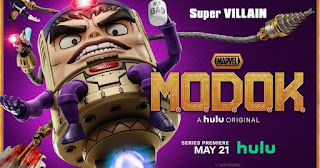
The animated series MODOK is, of course, an anomaly in the current Marvel catalog.  Since Disney+ launched, basically all Marvel programming has fallen under Marvel studios careful watch.  All other programs that were running had stopped and any in-flight productions were cancelled (RIP New Warriors...they robbed me of a live action Squirrel Girl).  

MODOK (as well as a handful of other projects, including the upcoming Hit Monkey) were announced around the same time as all these other things were winding down, and the new slate of Marvel programming at Disney+ was ramping up.  These shows would not be Disney+ shows, but airing on rival streaming service Hulu (in the US at least), and all would be adult animation.  It was a weird decision, but not an unwelcome one.

Behind MODOK is comedian(/actor/writer) and nerd extraordinaire Patton Oswalt along with Jordan Blum and produced with Stoopid Buddy Stoodios who also make the long-running animated action figure sketch comedy Robot Chicken.  The series uses the stop-motion puppets that Soopid Buddy has perfected, and employs a lot of the physical comedy language that series has used for over a decade and a half.

The story of MODOK, the "Mental Organism Designed Only for Killing", is surprisingly a dual family/workplace comedy.  It follows MODOK as the leader of AIM (Advanced Idea Mechanics) where he has no shortage of rivals looking to usurp him, and no shortage of minions who he feels are completely undermining him.  At home, his marriage is falling apart, and his children have no respect for him.

What could have been a bog standard animated show, which resets its norm after each episode is instead an ongoing character study of this very, very unusual man, as his life crumbles before him and he needs to build it back up.  He gets his greatest enemy in himself (thanks to some wonky time travel) and manages to team up with his former greatest enemy, Iron Man (Jon Hamm).  He also has a rivalry with Hollywood superstar superhero Wonder Man (Nathan Fillion) who starts dating MODOK's wife.

It's a funny show, featuring occasionally extreme puppet violence that somehow is surprisingly endearing in painting a portrait of a sad-sack killing machine, but it's one for the nerds...like me.

[42:39]

---

I just recently wrote about Black Monday Season 2, which was a wild, sometimes very bloody mess of a run set in the fast-times world of a Wall Street stock brokerage firm in 1990 (and rapidly expanding outside of that).  Season 3 we watched hot on the heels of Season 2, and it presented a story of even greater scope and ambition, with more extremes, that managed to somehow still feel overly contained.

Dawn (Regina Hall) is fresh out of jail.  Mo (Don Cheadle) is running his own record label now, and ready to settle down with Dawn.  But the nature of their relationship makes progressing it a very painful experience and Mo winds up engaged to one of his new musical prodigies instead.

Blair (Andrew Rannells) meanwhile, is now a politician (sacrificing all dignity and integrity posing as a Republican gay) but gets shot at a rally. Following the attempt on his life is more attempts on his life as well as a few more successful attempts on the lives of others in the orbit of the "Jammer Group".  Oh, yes, there's a serial killer on the loose.

So the gang, having all fractured by late in the season (as they do every year) must come together and devise an absurd plot to out the killer.

Stepping away from the Wall Street satire, Black Monday does lose a sense of purpose, but it doubles down on its characters and the arcs in presents them.  Thinning out the peripheral cast by killing them off just further emphasizes the show's commitment to this likeable if nothing-but-flawed group of not-friends.

I like Black Monday a lot.  I want to love it but it's characters maybe a little too cruel, and too lacking in self awareness, and the outlook a little too bleak to be something I want to celebrate and view over and over.  That said, it is pretty damn outlandish, and there's not a lot of that type of comedy going around (at least in live action).

[56:58]

---

Clickbait  was HUGE for Netflix a few months back, one of those limited series that people binged in one or two sittings, just pulled through its tawdry story, and ironically a viral sensation.

But it's also one of those shows that's all empty calories, a tasty meal you don't even remember having a couple days later.

So what the hell is Clickbait?

Ah, right.  This guy (Adrien Grenier - Entourage) is kidnapped, and his kidnappers put him up on a video on a youtube analog, with him holding signs saying "I hurt women" and that at 5,000,000 views, he dies.

His family, and the police and others start digging into his past, into his web history, into his accounts that start to reveal a history of joining dating sites and carrying on relationships with women who are not his wife.  There's also insinuation that may something inappropriate happened between him and one of the college-age volleyball players whom he is a sports massage therapist for.

This is a critique on the nature for people to pile-on to a situation with only the thinnest of information, to form judgements without facts, and to treat clickbait headlines as "all the information I need to make a decision".  It's actually pretty sharp in that regards, though the series needs to work some serious gymnastics to get to the ultimate reveal and then pile on some stakes that, seriously, just don't feel right, or earned.

That said, it is a compelling view, one that deliberately pulls you through it. Each episode shifts point-of-view to a different character, hitting harder that idea that even with multiple perspectives you may still not be getting the whole truth, the whole story.  There is a savvy statement underneath this pulpy, trashy show.

It's not a must watch, but it certainly fits the bill if you want something propulsive and bingeable...it's the TV equivalent of a bag of potato chips.

[1:06:24]

---

I can't believe that Brooklyn Nine-Nine has run for 8 years, and that it's over.  I still remember putting it down as a show to watch in a Fall TV Preview back in 2013.  Looking at the other shows that I listed along with it, only a few lasted more than a season or two, and none of them lasted as long as B99...and none of them I really enjoyed except B99.

About 2 or 3 years ago, I let my daughter start watching it, and she immediately became obsessed with it.  She's watched every episode at least three or four times over, some of her favourite episodes I'm sure she's seen dozens of times.  It was really hard for her to let go of the show.  She put off watching the final 2-part episode, until I convinced her of its greatness and sat down and watched it with her.  There were tears.  Michael Shur has given us three of the greatest series enders with B99, Parks and Recreation, and The Good Place.  He's figured out how to close out a long running/beloved show with satisfaction and sentimentality, without being treacly.  He knows how to deliver series enders that feel important, grander than just another episode, yet still fit as part of the whole.  

Here he does that with one of the show's famous "heist" episodes (where the key players of the department participate in a friendly competition that means more to all of them than it logically should).  I might even say that it's perhaps the best of the heist episodes, and they're all highlights of the show.

Even before the two-part finale, the show had a lot to deal with coming back: Black Lives Matter, defund the police, COVID-19... they all are brought into the series opener, and then put down a thread underneath the show that is not just story beats, but actual resonance with the characters.  The stress of BLM and systemic racism in police structures took a toll on Holt and broke up his marriage to Kevin (poor Cheddar lives in two homes now).  Of course Jake makes it his mission to reconcile them but it's not as simple or easy as he thinks.  Rosa quits the police force and becomes an advocate for marginalized individuals who experience police harassment.  They face off against a police officers union representative (John C. McGinley in a most disgustingly earnest repeat role), which hits its climax when Jake makes a wrongful arrest, and has to decide whether he wants to fight via the union or accept a semi-just punishment... does he take advantage of a broken system or set an example no one will notice or follow?

B99 still stayed funny and absurd in spite of the weight of the changing world on its back, and not a lot of sitcoms have ever managed serious issues without sacrificing the comedy for the "very special episode".  I'll miss you B99, it was a good run, but it was your time to go.

[1:23:12]

---


I wrote my history with the comics of Locke and Key in my season 1 10-for-10 write up, my general sentiment being that the show did some things the comic did well and did its own things well but had a general problem with tone.  Was I excited for season 2 of Locke and Key? Not so much, and the first episode was a big soggy noodle of an episode that threatened to stop me watching altogether.

Season 2 returns with an all-teen-drama all-the-time episode that just drove me bonkers.  I turned to my wife and said "I'm here for the magic keys and demon fightings, not teen drama".  The show used the first episode as a cleanser as well as a refresher for the second season, a way to establish that Tyler's girlfriend Jackie is aging out of her understanding of magic, that Kinsey is still painfully unaware that Gabe is Dodge (and some other love triangle crap), that Bodie is lonely, that Uncle Dunc is having trouble adjusting to life in Keyhouse, that Nina, having put her alcoholism into remission, needs something else in her life, and that Gabe is escalating his plans... he wants to make his own key.

These threads then play out over the subsequent 9 episodes, and there's a lot of fun magic key action.  What's frustrating is the sheer ineptitude of the Locke family to use the keys effectively.  I mean, it's believable enough that these kids aren't warriors, they're not really experienced in fighting demons or crafting elaborate plans, but geez.  They're the new "Keepers of the Keys" and they manage to lose SO MANY of them to demons who can't forcefully take the keys from them.

The actor playing Gabe/Dodge, Griffin Gluck, I've liked in other projects, and last season he was fine as Gabe (before we knew he was also Dodge), but here when he has to go into menacing he only sometimes pulls it off.  He looks like a young Joseph Gordon Levitt, and there's not a lot of sinister happening in that face.  That all said, you really do just want to give him a smack all.the.time.

There's some absolutely great moments of intensity this season, some real pulse pounding sequences of the Lockes putting themselves into jeopardy, not because they're being stupid, but because they're being daring.  There's also some good creepiness here, but the show's production design doesn't really lean into it.  It was part of the complaint about season 1, that horror should be a definite element of the show and it's by and large side stepped.

The first episode not-withstanding, as well as a late in season 2 flashback episode that really doesn't tell us anything we don't already know, this was really quite fun.  Not perfect, but fun.  It deviates wildly from the comics while still utilizing much of what the comics established, so it's not feeling like a retread. I've come out feeling more positive about season 2 than I did season 1.

[1:38:12]

---

It's always hard to write about comedy in a way that actually sells the comedy and does it justice.  I have in the past described whole scenes or tried to detail jokes which I know don't really serve the actual comedy well.  Comedy is not meant to be explained.  Explaining why something's funny only dulls the potency.  

So, that said, for the three seasons, 18 episodes (so far), of Wellington Paranormal, I'm just going to hit upon some touch points that will either give you the reader an "I'm in" or "Pass" result.

Wellington Paranormal was created by Flight of the Conchords' Jemaine Clement and super-director Taika Waititi.  Clement acts as showrunner, I believe, and has a more active hand in the series, while Waititi is just an executive producer.  It is actually an offshoot of What We Do In The Shadows, the 2015 movie (which itself spun off into the ongoing FX series of the same name).

Wellington Paranormal is set in Wellington, New Zealand and follows O'Leary and Minogue, two police officers who have been tasked by Maaka, their Sergeant, to head the "Paranormal Crimes" division.

Wellington isn't a super metropolis so the type of crime that Minogue and O'Leary are used to facing is mostly domestic disturbances, street crime, break-ins that sort of thing.  They have a very particular demeanor when handling people they encounter in these situations (it's asking a lot of rhetorical questions) and they approach the paranormal with the same casualness, until situations escalate and Minogue typically freaks out.

The same conceit of What We Do In The Shadows is employed here, which is that the officers are being followed by a documentary crew.  Toasty mentioned in a recent review how he prefers found footage to this documentary style, but for comedy (not necessarily horror) it works well enough (see also The Office, Parks and Recreation, Modern Family etc).  The thing that Wellington Paranormal does with its documentary footage that is unique, however, is it acknowledges that documentary footage is/has been captured (in one episode in season two and another in season three, the cops reference the fact that they've seen the documentary What We Do In The Shadows, which I love).

I found the series to be hilarious from the get go, right in my wheelhouse humour-wise.  I giggle incessantly during the show.  The storytelling and the types of paranormal encounters they experience get ever more creative as the series progresses, to the point that season three has many of the series highs (though I did like the pod people of season 1 and the follow-up episode even more...there's actually some continuity).

The show is goofy, silly comedy, relying a lot upon the officious mannerisms of O'Leary and the denseness of Minogue, but it also is very often exceptionally clever with its use of paranormal activity and later episodes toy with horror convention much more than the earlier ones do.

This will go on the "rewatch often" pile.  I think it's funnier than What We Do In The Shadows.

[ok, one joke... one of my favourite lines in the show.  Sergeant Maaka asking his assembly of officers if anyone has seen his missing box of jam donuts his grandma made. "My name was clearly written on the side of the box! 'Maaka' written in marker."  The New Zealand accent truly is one of my favourite things.]

[1:53:57]

---


 I'm long past my point of enthusiasm or interest in "reality TV".  There are some people who subsist almost solely on them for their entertainment diet, and I pity them. In recent years the only "reality TV" I have watched/binged is Nailed It, a baking show where the contestants are knowingly set up to fail in trying to bake elaborate cakes and things beyond their capacity, yet try their best anyway (in a time too short to *actually* accomplish it) with hilarious results.  But I'm not here to talk about Nailed It.

Lego Masters I started PVRing for my stepson, who is a Lego buff and seemingly more so as he ages.  I thought the show would be something he would really be keen on, programming directed directly at him.

Alas, he mostly plays video games, and occasionally watches murder procedurals.

I just put an episode on while killing time, just to see, and while all the usual manipulative bullshit editing of reality TV is still there (just show me the people building!) by the half hour mark of this hour long show the projects are built and the judging commences.

And wow, what some of these people build is outstanding, and like any specialty form of art, whether it's cakes or blown glass or metal forging or home renovating, you have to have at least a passing interest to really care, but it's probably possible for anyone to appreciate the skill and craft put into these Lego diaramas or constructs.

Lego Masters is a rare show where it's relatively clear who are the strong and who are the weak each episode.  There's no upset-for-sake-of-drama, and the contestants are all very, very supportive of one another.  The challenges they face are frequently very challenging and even though they may sometimes cater to a strong skill of one designer or another, it doesn't guarantee anything.

Some of the challenges, my favourites actually, involve stress testing the designs, whether holding up in strong winds, or to a shaking foundation, or to weight put atop them.  It's impressive what those little plastic bricks can do.

We watched about half of season two before catching a marathon of Season 1 (only catching the latter half of Season 1) and then finishing season two.  They're immensely interesting to watch, to see what they're asked to do and to see what each team comes up with.  Will Arnett hosts and is amiable enough to not be annoying, and smart enough to know when his dumb jokes are dumb, and play into them.

I kind of got hooked.

[2:06:06]

---

Doom Patrol, season 3 baby!  It's still airing as I write this, but I'm just so enthused that I have to say that the best special effect on the show is Brendan Frasier's swearing.  

As the series progresses, the showrunners seem to be on a mission to have the most swears per minute of any form of entertainment ever (they've got to have beaten Deadwood by this point).  Frasier is the king of swearing in the show (and now in real life), but he's obviously been training the rest of the cast because all of them have gotten very, very good at hitting those swears for maximum comedic punctuation.

But Frasier's voice coming out of Robotman/Cliff Steele is just one of the absolute best things on Earth.  The way Cliff swears makes me laugh every.time.  It's like when a child swears not knowing that what they're saying is inappropriate...that's how Cliff swears.  And he does it so, so much, and with such gusto. [Edit.  Just watched episode 8, and there is, what may be, the best scene on TV this year, with Robotman (the guy in the suit) meeting a physical subconscious entity of Cliff Steele (actual Fraser) and the "What.the.fuuuck?" exchange is fucking goddamn deliriously fucking glorious.]

This season has been an interesting affair, with a lot of plot lines that don't seem to really go anywhere and a main plot line that has unseen purpose.  The arrival of Michelle Gomez to the cast has been a fucking delight.  She's just an absolutely compelling presence with the driest of dry British humour.

The show has sent Rita, in search of purpose, time traveling.  It's sent Larry off into space and back again with a little lump inside him.  It's solidified Cliff's reunion with his daughter and welcomed in a grandson he loves to bits, but also given him something more serious to avoid (or deal with irrationally).  As for Jane, she's trying to liberate her host, Kay, to help her be well and take control, but the other personalities are ready to go to war in a fight for self-preservation. Cyborg struggles with his identity, and identifying the trauma of what his father has done to him.  Oh, and Chief's dead, and the Sisterhood of Dada are brought in as their main ...not antagonists, but, rather...thing... for this season (with the Brotherhood of Evil, led by a petty, petty Brain [he's a brain in a big, immobile, metal skull] and Monseur Mallah [a French-speaking gorilla wearing a beret] rearing their heads).  

[Edit: episode 8, even ignoring the great Robotman/Cliff "what the fuck?"-off, is maybe the best episode of the series yet as each character has to face off with their subconscious self, and it gets, real, real deep.  It's a potent, but still very very wild episode].

Doom Patrol is not a superhero show.  It's a comic book show, yes, and it features people with super powers, yes, but they're quick to point out they're not superheroes.  Early in the season one of them points out that they won't bother to intervene in something bad happening because they seem to just make things worse whenever they do... so they're just going to sit it out and veg, loaf, whatever.

It's a bizarre entity but always unexpected, and even if a particular plot doesn't resonate, man all that swearing will elicit more than a few hearty chuckles.

[2:18:29] (only 60 minutes over..sigh)

---FIN---

Monday, June 7, 2021

The Falcon and the Winter Soldier

 2021, d. Kari Skogland - Disney+ (6 episodes)


 It's hard for me to see past my wife's uber-fandom for the Marvel Cinematic Universe's Captain America and Winter Soldier, to not see her unbridled enthusiasm for The Falcon and the Winter Soldier as an endorsement of quality.  If she's enjoying it this much clearly there's something here.

Which is all to say I found The Falcon and the Winter Soldier ("TFatWS) hard to watch objectively with someone experiencing such joy beside me.  

The show opens with a big, bold, cinema-worthy action sequence, an incredibly well executed comination of stunt-coordination, green screen, and digital effects simulating aerial combat like we've literally never seen before.  But it's a solo mission for Sam Wilson (Anthony Mackie), and the titular team-up doesn't happen until episode 2 which just seems odd.

Episode 1, following its big set piece, is largely catching up with our two leads, and the Marvel Cinematic Universe.  The last MCU movie before The Pause was Spider-man: Far From Home which made some jokes about the people returning from "the snap" (in Avengers: Endgame) but it didn't really deal with it.  TFatWS was intended to be the first Disney+ MCU show/mini-series, but due to the impact of the coronavirus, it was leapfrogged by Wandavision which only briefly dealt with the return snap.  So after nearly a year an a half, it's TFatWS that picks up the thread, and builds its central conflict around it.

The adversary here is a collective called the Flag Smashers.  It's told that after half the Earth's population disappeared at the end of Avengers:Infinity War the world started coming together, slowly erasing its boundaries and its prejudices, really fulfilling the vision Thanos set our for it.  In returning everyone five years later, there is a lot of disarray.  People had moved on, new lives started, new agreements and treaties and borders made.  Many returning from the snap are basically refugees, the life that they knew gone.  Likewise many of the people who had forged new lives in new lands are displaced by those returning to properties still theirs, complex decisions about re-appropriation made.  The Flag Smashers are watching a world in pain trying to return to the mess it was before the snap, and they want the world to be as one, to erase all borders and to give everyone a home wherever they would like to have it.  It's idealistic, but the film undercuts the idealism with increasingly extreme acts of terrorism.

This subject alone would be a lot for our two protagonists to ponder and chew on for five hours, but this isn't a political drama, it's a comic-book action-adventure show, so this whole plight becomes set-dressing and character motivation while a half dozen other elements drag Sam Wilson and Bucky Barnes (Sebastian Stan) around the globe.

Sam has a return to his home and family in Louisiana, where he wants to swoop in and play the hero rescuing the family fishing business, but finds the limitations of his celebrity don't extend to banks where the racism is clouded as "risk-aversion".  Despite having been snapped out of existence for 5 years, the show doesn't really show much of the impact on Sam, except a nagging need to fix everything. On top of that Endgame left Sam in the position of taking the mantle of Captain America, with Steve Rogers passing down the shield.  It's a heavy responsibility, both living up to the legacy of an idol, and in being a living representation of a country, a country that has an ugly history in its treatment of its Black citizens.  Sam gives up the shield to the Smithsonian for a Captain America exhibit, not ready to take on the weight of it all.

Bucky, meanwhile, is over 100 years old at this point, having lived much of his life cryogenically frozen, so his memories of existing all have dramatic gaps in time.  Being blinked out of existence for 5 years is par for the course for him.  Outside of his frozen dreams, much of his life was as a brainwashed puppet, a killing machine that caused a lot of damage in that controlled state, all of which he remembers, and it haunts him.  He was trapped inside his own body, with no control.  To top it off, his only connection to the past, the only happy life he's had, Steve Rogers, left him behind (again), leaving him alone in a strange time where he doesn't feel he belongs at all.

Here are two characters who are well built to approach the modern world and the chaos that plagues it, each with very clear and differing perspectives on what it means to them.  As well both are veterans of multiple wars, which, along with being friends with Steve, connects them as people.  But previous films established that they have a very antagonistic relationship.  Bucky perhaps a little resentful of Sam as Captain America's most trusted ally and Sam perhaps a little wary of this killing machine he's faced in action more than once.  There's more than enough here for a whole show to be built around, but again, that would insinuate that this superhero action show was ready to just delve into the drama of its world and people, but it's not.


It also introduces John Walker (Wyatt Russell), a well-decorated soldier, as the new, government sponsored, Captain America... complete with Steve's shield, which the government considers their property (so many want to stake their claim to that thing).  It's Walker's very public debut that brings Sam and Bucky together, if at first just for an airing of grievances.  But the Flag Smashers demand their attention, and they partner up.  Walker and his partner Lemar Hoskins, aka Battlestar (Cle Bennett) are also sent out on the trail of the Flag Smashers, so doubtlessly paths collide.  That Walker is potentially unstable, suffering from severe PTSD and an almost crippling inferiority complex, further complicates matters.  (Walker does something particularly heinous late in the series that he just sort of walks away from which the show really needed to deal with more, but there's just not enough time to do so).

Again, the complexities start to abound, as it becomes clearer that Walker perhaps isn't entirely stable, and that the Flag Smasher are somehow enhanced with the super-soldier serum.  As was warned in Captain America: Civil War one super soldier like Bucky can upset the status quo, a small army of them could take over the world. 

That warning came from Helmut Zemo (Daniel Bruhl) who is kind of shoehorned into the proceedings, as a worryingly enthusiastic ally to Sam and Bucky.  Bruhl kind of takes over the show for two episodes, stealing every scene he's in, which makes for very delightful viewing but pushes its two leads to the side in an already complex story.

In freeing Zemo - if you recall he was responsible for the death of King T'Chaka in Civil War - this brings the Dora Milaje to shadow them, specifically Ayo (Florence Kasumba) who had become close with Bucky when he stayed in Wakanda for de-programming.

Further adding to the mix a returning Sharon Carter (Emily Van Camp) who was last seen helping them and Steve out in Winter Soldier to the detriment of her own carreer, and suddenly there's yet another character vying for attention in an already cramped mini series (plus a very, very distracting "mystery" in "who is the Power Broker?" that proved a quite unsatisfying bit of fan service/comic book easter-egging)

But we're not done.  Sam is introduced by Bucky to the Captain America of the 1950's, Isaiah Bradley (Carl Lumbly), one of many Black soldiers who was experimented on with another super soldier serum. Bradley had his life stolen from him, and finds no sympathy from him in his regret of giving up the shield.  Bradley's story, a parallel to the real world Tuskegee Experiments, has real weight in the story but still can't help but only be the brightest fish in a very crowded pond.  I was hoping for at least a flash back set piece of Bucky (as Winter Soldier) meeting a younger Bradley in battle (but I suppose the show wanted to wait for Mackie's inevitable reveal as the first time we see a Black man as Captain America).


The divergences all have a flow to them (except maybe the sudden introduction of Julia Louis-Dreyfus as a mysterious, Nick Fury-esque contessa who enlists Walker into her service...it's a real show stopper, though not unwelcome) that gives them a reason to exist in the story, but it makes the whole mini-series overly complicated.  In a shared universe of comics, this depth of crossing-over and calling-back is the norm, but because the characters live across titles and years, it's easier to accept them in a larger story arc.  In the limited realm of cinema for over a decade there's only been a limited amount of space to develop some of these characters, which means there's more of a burden on a series like this to spend much of its time on further developing these otherwise limited characters.  

Again, it all works in its own way, but it detracts from ostensibly the leads of the show, the two characters with their names above the title.  They introduce a lot in the first three episodes of the show, and the worry was constantly that it wasn't going to pull together.  They keep introducing more in the latter three episodes, but mercifully things do start tying together, just not as satisfying or as neatly as I had hoped.  It's very possible that the sudden limitations because of COVID-19 meant that aspects of the show and its story's conclusion had to be redrafted to accommodate travel restrictions and protective measures.

Wandavision was pretty laser-focused, with Wanda and Vision as its center.  The world building (and its utilization of supporting MCU cast like Darcy, Jimmy Woo and Monica Rambeau) likewise proved a bit distracting and didn't have the meaningful impact to the events that maybe they should.  The same thing happens here except to a much greater degree where all this universe build-out just means Sam and Bucky are often lost as the centers of the show.  In comparing to Wandavision, that show also didn't have the same reliance/burden of the past. So much of TFatWS demands that you be brushed up on your MCU Captain America and Avengers history.  These things are just part of the fabric in my household, but I could see more casual viewers being a little lost by this show constantly referencing past events as major story plots.  It's certainly very comic-booky in this fashion, both to its credit and detriment.


But even with the focus often pulled away, Mackie is still the undeniable lead, even above Stan. Though clearly a man of action, Sam has no superpowers and knows his greatest weapon is his empathy.  He doesn't just resort to his fists or his wings or his weapons, they're a last resort when words don't have their desired intent.  Even Steve Rogers, who people always seemed ready and willing to rally behind, wasn't nearly as dynamic in his speechifying as Sam, but it also goes to show what kind of man Sam is, and what differentiates him from other heroes, particularly the Captain(s) America that came before him.  By episode six of the show, Sam's exploration of race, citizenship, legacy and identity earn him the title of Captain America, and he owns it.  Similarly, Mackie builds the confidence along the way from being a right hand man in the MCU to being not just a viable, but necessary lead.  I have no idea what a Mackie-led Captain America movie would be but I'm eager to find out, because the there are so many possibilities.

Where Stan and the Winter Soldier wind up after this, it's hard to say.  It seems like Bucky, in the end, is trying to find a sense of peace, so if we never see him again that seems okay (but now that we've finally come to know him as a character it's a sad thought).  If a second "Captain America and the Winter Soldier" mini-series were to come, I would certainly welcome it.  I just hope it will be a little more focused.


Thursday, June 25, 2020

10 for 10: TV Ketchup

[10 for 10, that's 10 tv shows which we give ourselves 10 minutes apiece to write about.  Part of our problem is we don't often have the spare hour or two to give to writing a big long review for every movie or TV show we watch.  How about a 10-minute non-review full of half-remembered scattershot thoughts? Surely that's doable? ]

In this edition:
1. Supergirl Season 4
2. His Dark Materials Season 1 (HBO)
3. Locke & Key Season 1 (Netflix)
4. Titans Season 2 (Netflix)
5. Avenue 5 Season 1 (HBO)
6. Queen Sono Season 1 (Netflix)
7. The Last Dance (Netflix)
8. SNL at Home (NBC)
9.Star Wars: Clone Wars Season 7 (Disney+)
10. Shrill S2 (Crave)

aaaaallonz-y
---

The DC-CW shows (colloquially referred to as "The Arrowverse" because Arrow was the launching point for all of it) have become... how best to say... cumbersome I think.  There's a lot of them with more on the way, each with differing season lengths, but most of them running longer than necessary.  With the end of Arrow, I've felt exhausted with the majority of them.  Short dips back into the Flash continue to be more aggravating than enjoyable; Legends of Tomorrow has gone on a non-superhero path I don't really love (though it does have a great tone and fun stuff); Batwoman I fell off of early and haven't been able to get back on; and Black Lightning I tend to leave for summer binging on Netflix.  Which leaves Supergirl.

Supergirl is the show I watch with my daughter but she's become a binge watcher and doesn't like to wait, so I had to find time to set aside so we could catch up.  As I write this, Season 5 is just shy of its finale, withheld because of COVID-19, but we only just caught up on Season 4.  We got a few episodes in when they originally aired and then were sidetracked for, like, a year.  It wasn't anything to do with quality or content, as I think Season 4 may be the best yet for the show.

The season features a very heady anti-immigration storyline, where an angry and xenophobic professor starts up both a street gang under the guise of Agent Liberty, and later becomes a right-wing mouthpiece talk show host, followed by a political opportunity under Bruce Boxleitner's equally xenophobic presidency (ripped from the headlines!).  The show handles this subject matter tremendously well.  It's upsetting the level of manipulation and lies that anti-immigration mouthpieces perpetrate, but the show makes it clear that the root their hatred is actually better recognized as fear. 

Meanwhile at the DEO, Alex and Kara have to deal with their new boss, a woman who is so buttoned down as to be impossible to read or guess her motivations or actions.  She's very much a duty-over-dignity, follow-chain-of-command type, even when it disagrees with her.  She expects the same of her subordinates.  It creates a lot of meaty conflict for the team to work through.  Especially when your commander-in-chief is obviously in the wrong, do you follow your conscience or your sworn duty.

The season careens into left field in the final third as they deal with the Russian copy of Supergirl created during the "Elseworlds" crossover, and Lex Luthor enters the fray.  I don't think anyone thought Jon Cryer would make for a good Luthor, turns out we were all wrong.  He, dare I say it, may be the best live action Lex of all time.  He's absolutely phenomenal, and even showing he's been pulling the strings of almost everything all season still doesn't satisfy the fact that there are so many xenophobes still calling for aliens to go home and ready for violence against them, but it just shuts down their most prominent propagators.  It's definitely a subject Supergirl can't just muscle her way through.

[12:20]

---
I initially gave up on His Dark Materials after two episodes.  It was plodding and kind of boring.  I didn't understand the rules of the world or the intent of what I was being shown.  The book series by Philip Pullman has a very good reputation but the Daniel Craig/Nicole Kidman film was panned both by critics and fans of the series, and this HBO series was supposed to get it right.  If this dull intro was getting it right, I wasn't sure I could stay in.  I thought better to wait for the series to complete, so I could binge it, rather than try to follow week to week.

It took its time, but I suppose it did do justice to the source.  I've never read the books, but just past the halfway point, the series took on incredible weight, and what seemed like misguided kiddie fare turned into a deeply disturbing, dark roam through alternate realities.  I'm not sure how to get to where they did by the end, showing all the crushing disappointments and disasters in Lyra's life, without first taking her through the early journey, as tedious as it was.

I still don't fully understand some of the fantastical structures of the world (namely the sort of spirit animals everyone has, things the book likely clarifies outright), but the religious authoritarianism, and the callous disregard for life and well-being in their pursuit of suppressing thought and exploration of heretical ideas is literally bone-chilling.  This isn't Harry Potter-style high-adventure magic, it's a deeply tragic world that's devoid of really any humour and it's only Lyra's perseverance through the darkness that sheds any light.  The young cast is really great, and of course Ruth Wilson is always compelling to watch.

What I find most curious is, in the midst of world building this entire other reality, the story also introduces a character in "our" reality, an Earth more familiar to us, and another character who has found the soft spots that bridge the two.  The title sequence, hoping for - but not quite reaching- Game of Thrones highs, folds over with the idea of layers of realities, which seems to indicate that there's a multiverse happening, and that as much as anything leaves me intrigued.

It's definitely a slow, slow start, but the latter half makes for an enthralling journey overall.  It feels like there's a snowball effect at play and it's just going to get bigger and bigger from here.

[21:21]

---
The complete 6 volumes of Joe Hill and Gabriel Rodriguez Locke & Key had been sitting on my bookshelf for years, left unread by me, for no other reason than I have too many things sitting on the shelf to read with more usually coming every week.  There was a false start to adapting the series to network television a few years ago but thanks to Netflix it found a new life.  In anticipation of its release I binged, and binged hard the six volumes, finding a bit of a messy narrative but otherwise engrossing story full of weirdness and cleverness.

It's the story of the Locke family who, after the tragic murder of the family patriarch, move back to the  familial home in Massachusettes (?).  The matriarch and three kids are each in their own way experiencing PTSD fallout from the murder, and the weirdness of the family home (and some of the people in the town) are potentially just distorted images as a result. But the youngest, Bode, his imagination the most liberated, finds the strange keys around the house and their really absurd uses.  One unlocks a door that, when stepped through, turns that person into a spirit.  Another unlocks the mind, presenting a doorway that others can step into to look around.  Another still opens a cabinet that can repair anything to its original state.  And one even will open a doorway to anywhere.  The keys have powers, large and small, and there is a malevolent force in the wellhouse that wants them all.

The graphic novel series paints a history for the keys that leads into the reveal of their true origin and purpose.  The TV show does also, but has a much more difficult time negotiating the past and present, really not developing the history well at all. 

As well, the show seems to have difficulty with tone.  Where the comic book flirted with elements of adventure and horror, name checking both Lovecraft and Richard Matheson, the TV show doesn't really angle for any specific pastiche.  It just kind of happens.  It seems to lack guidance and concrete direction.  It progresses through the story but without any style or enthusiasm.  Its versions of the characters, like Tyler, Kinsey and Nina are all stripped down from the complexity of their comic book counterparts.  The graphic novel makes an attempt at exploring race issues (to muddled, potentially wrong-headed results), looks at depression, and alcoholism, where as the show pretty much avoids any difficult subjects.

It's not a very complex or challenging show, and actually not anywhere near as fun as it should be.  It wasn't uninteresting but I think reading the comics first made it harder to accept the choices the show made, even if they did make some improvements here and there.

[34:07]

---
Titans airs in the US on a streaming service called DC Universe, which gives its audience access to thousands of digital comics, and much of its back catalog of movies, cartoons and TV shows.  The big draw, however is its original programming - Titans, Doom Patrol, Harley Quinn, Young Justice and Swamp Thing all debuting on the service.  The rest of the world does not have DC Universe available to them so we have to hunt out our own sources for these shows, with Titans being the most accessible via Netflix.  However, Netflix only airs Titans after its seasons are complete on DC Universe, which means there is plenty of reviews and reactions to try and skip past online while we wait.

One of the things I noticed, though, was that week-to-week there seemed to be a lot of frustration with season 2 of show, and it's understandable.  It builds an over-arching narrative but it jumps and diverts to different characters and puts focus on side stories while leaving cliffhangers unresolved for an episode or two at a time.  On a week to week basis I can totally see this being aggravating, but in a binge situation, it's not even a thing.  In fact one of the biggest side diversions, a whole episode introducing Superboy to the program 9while we wait to see the resolution of Jason Todd's fall off a skyscraper rooftop from the end of the previous episode), is easily the series' best.

The show starts off Season 2 needing to resolve the Trigon/Rachel's Dad situation from season 1.  What seemed to perhaps be building to a new story arc is instead kind of haphazardly disposed of making for an inauspicious start to the new season.  But from there it just kind of crackles with energy and then keeps going, as it introduces new players (like Superboy, Deathstroke, and Rose Wilson), advances the storylines of older players and, more than anything, feels kind of like classic Wolfman-Perez soap-opera Titans of the 80's, but with a bit of (some might say unfortunate) Zack Snyder edge to it.   But the "fuck Batman" grit that misguided its first season is basically gone, and instead it really goes into its teen sidekick trauma, and the family that forms out of it.

We get so much, it's a loaded season, mostly centered around being unable to let go of the past, or forgive one's self for past sins, or escaping one's history.  This includes Bruce Wayne (played by Game of Thrones Iain Glen) helping Dick Grayson to resolve the issues that caused him to quit being Robin, steeling him to lead a new team; Starfire facing ghosts from her home; Hawk and Dove unable to escape from "the life"; and Jason Todd unable to escape the shadow of his own reputation.  The show gets so much right, that what it actually gets wrong makes it all the more glaring.  It's still trying too hard to be edgy with its swearing, and there's a bit too much moping about by superheroes (mopey superheroes are the worst *cough*The Flash*cough*) but it seems to slowly be crawling out of the darkness it started out in.  Despite a tragedy the conclusion leaves the promise that maybe bigger, brighter adventures are ahead next season.

[50:29]

---

Avenue 5 was a straight-up recommendation from Toast, and one I was grateful for.  I hadn't bothered to watch Veep but I did see Armando Iannucci's Death of Stalin (review sadly lost to the dark year), which was hilarious and right in my humour wheelhouse, full of clever wordplay, the sly back-biting between horrible but not unlikeable people, and grounded absurdism. 

Taking place on a galactic cruise ship, Avenue 5 has all those Iannucci trademarks that made Veep so popular (I'm guessing), but placed in a satirical future setting.  The problems on Earth are only hinted at and get shut out as the troubles on board the starcruiser become myopic.

It's been a long time since I've seen a good comedy of errors, one that manages to build in surprising and unexpected ways.  As one disaster after another occurs, the crew and guests aboard become embroiled in personality politics.  The disasters themselves range from massive to minor but it's the fallout from those that generates the intrigue and comedy.  Some disasters have silver linings, but sometimes silver linings can reflect deadly rays.  I love the character building here, and how all the characters slowly lose any pretense or artificial edifice they may have had.

Everyone is good in this, yes, even Josh GadHugh Laurie manages to escape the grizzled doctor drama and worm his way back into his comedy origins with the role as "Captain" of the ship, a role that allows him to mock his own fake American accent and grizzled persona.

Underneath the absurdity is a show that is examining class structures and how they affect modern politics.  As well it looks at the mindset of people that distrust the people in power, that perhaps is justified but which also mistakenly leads them to distrust experts in science and technology to their own detriment.  But it never hits you on the head with its commentary, it's just ugly and representational of modern times...and also funny.  The show is also not above a galactic-class poop joke.

It's certainly got its own unique tone and rhythm so I get why it hasn't caught on bigger, but it's pretty great, ridiculous fun.  Oh, and the soundtrack by Adem Ilhem is astounding, intoning horror at some of its biggest points of comedy.  It's very deftly handled.


[1:06:31]

---
You had me at South African spy.  Queen Sono follows the titular character, the daughter of a legendary revolutionary murdered when she was a child,  who has since become a top operative for the country's Special Operations Group.  She's super competent but also a little overconfident which makes her a little sloppy, and perhaps she's even a little suicidal.  Her best friend from childhood is a psychologist so she gets him to sign off on her psych evals even though something is clearly wrong.

The show works through Queen's history, her family, her trauma, but she tries to avoid working through any of it, and avoiding it seems to be causing her some serious harm.  As she starts to look deeper into her past while working on a case investigating a militant liberation group that uses her mother's name and visage as its rallying point, she starts to see inconsistencies in the story she's been told about her mother's death, lies that lead back to her own employers.

There's a tremendous character story with Queen Sono, but also its central adversarial story leads to a lot of intrigue that affects Queen and her supporting cast in different ways.  As well the story leads to some insight with South African politics and sub-saharan relations, as well as continental relations with particularly European interests.  It's not something I've been exposed much to, and with Netflix's backing it's a story told with quality production values.  Beyond that, the characters and situations have complexity, shades of grey that cause some debate as to what's really bad, and what other alternatives are there.

There are a couple drawbacks, mainly when the show tries to get invested in side stories of certain secondary characters, it's not handled very cleanly, often feeling forced and unnatural (Frederique's search for his missing sister always feels jammed in).  The other is it's very brief six-episode run leaves the viewer wholly unfulfilled as most of the balls juggled remain in the air.

The biggest revelation is Pearl Thusi who plays Queen.  She's damn charismatic, utterly captivating, fierce, intimidating and gorgeous.  Not that playing a super-spy is small potatoes, but she needs to be in a big profile superhero film, like, now. 

[1:17:30]

---
I flirted with watching basketball in high school.  I don't know if it was to fit in, or if it was out of genuine curiosity.  Lord knows I had no interest in playing it, and generally I avoided televised sports because of its lack of special effects.  But I was into hip hop, and hip hop was so integrated with basketball you couldn't see a music video without an NBA jersey, and then in '93 Shaquille O'Neal started rapping with the Fu-Shnickens (a group I really liked at the time).  Michael Jordan was everywhere, and the 92 dream team was just the most high-wattage sports star power of all time, it was hard not to be caught up in it all.

So yeah, I watched and even lived a little basketball throughout the 90's.  Not deep, deep into it, but I watched some regular season games, some playoff games, and most of the finals throughout the decade...I was still an outsider though, not fully invested.  I believed the hype, the unstoppable Bulls, the unconquerable Jordan, and I so desperately wanted the underdogs, pretty much any other team, to beat them.

The Last Dance follows Jordan and the Bulls through their 97-98 season in which they would go on to win their sixth championship in 8 years, and their second three-peat, an unheard of achievement in the history of the sport.  But in telling that story, mired with intrigue and furor internally and externally, the docu-series intercuts telling the history of its key players - Jordan, Scottie Pippen, Steve Kerr, Phil Jackson, Denis Rodman - and taking a hard profile look at each of the championship years (as well as the tumultuous two years between while Jordan was "retired".

It's a fascinating documentary, well told, despite the confusing leaping back-and-forth between 97-98 and all other periods.  In its efforts to concentrate narratives on specific players and time periods it has to tell the overall story out of sequence which leads to more than a bit of fuzziness in how it's all connected and how it all played out.  But I was rapt the whole time watching it.  We binged the first 6 rapidly then had to wait a week for two more and another week for the final two parts.  It's not like there was any question that the Bulls would win their 6th's championship, but it's the unparalleled insight into the team and its players, both from outside perspectives and from their own recollections.

Produced by Jordan, he had a hand in dispelling his own myth with this series.  He's a man of preternatural talent in the game, with unparalleled ambition and drive and that led him to be a very dominant and domineering force on the court and behind the scenes.  The astounding rise of his celebrity impacted everything around him and he had to accommodate for that.  As such he seemed distant from his teammates instead preferring the company of his security team.  He never talks about his family and we only meet his kids briefly in the final episodes as young adults.  A much as the series reveals about him, there's still a lot of mystery there.  But despite popping the bubble of his smiling, Looney Tunes-playing, Coke-shilling facade, he's still an endlessly captivating person.

[1:35:15]

---
Saturday Night Live operates in waves, talent comes in, talent blows up, talent gets lazy, talent leaves.  It's rare for the show to go from megawatt talent to megawatt talent without some waning in-between.  At this stage in its run, the current cast is largely long-in-the-tooth, most having been on board for more than 5 years, and the new talent, while good, are certainly not blowing up the spotlight.  The biggest buzz the show has these days is the Alec Baldwin impersonation of Trump (and the many many guest stars who come on as Trump cronies or adversaries like Robert DeNiro, Ben Stiller, or John Goodman), which unfortunately casts too much of a shadow over the main cast.  I struggle remembering faces and names at times, while of course Kate McKinnon has broken out as its current cast superstar, she's failed to transition that into successful other media as of yet.

What's kind of critical to Saturday Night Live is both it airing on Saturday night, and it being live from New York, in front of a studio audience.  Following the dire spread of COVID-19 in NYC and shutting the city down, SNL couldn't verily proceed as scheduled, could it?   I think we were all expecting SNL to just call it a season.  But they did perhaps the most daring thing they could do, which was let their talent be as creative as possible given the restrictions, and put together a show that was not broadcast live, nor recorded on a Saturday Night.

Veterans McKinnon, Aidy Bryant, Cecily Strong and new recruit Chloe Fineman easily shined, and seemed to garner more individual time than any of their co-stars, producing skits that seemed deeply personal (or in Fineman's case, as impressive show reel for the breadth of her talent). 

Tom Hanks, Brad Pitt, and Kristen Wiig were "hosts" of the three SNL at home episodes, but beyond introducing the show with a monologue and closing out the show Hanks (still recovering from his coronavirus infection) didn't do much.  Pitt portrayed Anthony Fauchi in an opening sketch, and Wiig managed to participate in a sketch or two, delivering perhaps my favourite sketch of all - Beauty Waves (in which she plays a beauty youtuber facing downward into a phone camera, flopping her hair about to increasingly absurd effect).  Oh, we also got a "What's Up With That" which is my all-time favourite recurring sketch, maybe even just for Jason Sudekis' dancing

Weekend update was the best its first week, with both Colin Jost and Michael Che seeming very loose and a little goofy.  Che piped in a small group into the feed as an "audience" to hilarious results.  Subsequent weeks got more produced and polished which takes away from the charm.  Che works best rolling with punches, not buttoned down (and losing his grandmother permitted him a great dunk on Jost).  Jost is never better than when things aren't going as planned.

It's not sustainable, SNL at Home, because it takes them away from their core conceit but it's a definite shot in the arm creatively and feels so much fresher than much of what they've been doing in recent years.  If SNL has been playing too into youtube-friendly sketches (ever since Andy Samberg and the Lonely Island crew jumped aboard), this may actually be the unexpected evolution, where SNL is pretty much all youtube sketches.  Perhaps the show will branch out into both maintaining its live Saturday night show, and it's "At Home" self-recorded skits from its very talented crew. 

It puts talent in the spotlight, gives them some much needed freedom to go a bit wilder, weirder and more personal.  Plus I loved gawking around their various houses/apartments.

[1:55:20]
---

Welcome back, Clone Wars, you'll be missed, again.
You know I love Star Wars.  I also like Star Wars.  And at times I'm not too happy with Star Wars.  When The Clone Wars first came out, I was in the "not too happy" camp.  So it took me a long, long time to get into.  About a decade or so.   Once I got into it, I had to get past the animation, which I only recently learned was designed to resemble Greek relief carvings.  That makes sense, but still, it's really wonky to look at.  By the end of Season 5 and the subsequent "lost Season" I was more or less back in "happy mode" with the franchise.

But if there's one thing I love about Clone Wars, it's Ahsoka Tano.   If it's another it's clone Captain Rex.  And this final season gives us plenty of both.  It kicks off with a 4-part arc, "The Bad Batch", which is a completed and updated version of the arc that ran in animatic form on starwars.com for a number of years.  I can see why they went with this, first given that it was almost complete already it's probably cost-efficient, plus it throws the viewer right back into the reality of the clones, and their complicated existence.

The second arc finds Ahsoka having a hard time, befriending a mechanic in the lower decks of Coruscant, only to become between sisters and get embroiled in a spice run gone wrong, and face down a nasty criminal empire.  To be honest, the arc is a little corny, and heavy handed at times, but in between its action and intrigue, it provides exposition as to Ahsoka's position in life, how she got there, and why she chooses to stay.  Together the two arcs successfully lead into the final arc of the series.

The denouement, however, is possibly the best in the entirety of this 7-season series.  Ahsoka has to face the Jedi council as Mandalor pleads for help in the wake of Maul's rule.  The council, already aware that the Sith are in their end game in the Clone War, cannot spare much but give Ahsoka Rex's battalion.  They take to Mandalor where civil war erupts, and Ahsoka faces down Maul 1-on-1.  It's epic, but that's just the beginning.  This arc dovetails with the events of Revenge of the Sith and the moments where both Maul and Ahsoka become aware of a deep disturbance in the Force are absolutely spine tingling.  It's not long before Ahsoka has to deal with a ship full of clones responding to Order 66, eliminate all Jedi.

The fight coordination is next level, one particular fight actually animated with motion capture with Ray Park reprising his physical position as Maul.  It's astounding.  As well, the score from Kevin Kiner is easily the highest watermark in the series.  Opting for something more "Tangerine Dream"rather than "John Williams" it's a wonderful deviation into synths instead of orchestral, and it works so damn well.  Where usually the music in Clone Wars is forgettable, here it adds to the weight of everything going on, it pushes everything making it feel even weightier than Revenge of the Sith itself.

These two characters from outside the film series are given the full spotlight here, knowing that they'll reemerge in Star Wars Rebels (and beyond?) but providing one hell of a story showing how they got there.  It closes out the Clone Wars admirably and gives us more of the two greatest characters in the whole pantheon.

[2:07:30]

---
The first season of Shrill gave SNL star Aidy Bryant a vehicle and a voice that seemed to be right where she felt at home.  It explored being a fat woman in modern America through the eyes of a journalist attempting to find some peace with herself as well as her place in the world.  There are a lot of systemic structures that oppress people, based on skin color, or name, gender or physical size or physical capabilities.  We're in a time where we're confronting those structures, more aggressively than ever, but also experiencing almost sinister resistance to it.  The first season felt the weight of that offensive - but not immovable - wall.

The second season picks up immediately after Annie has confronted her cyberbully and put a rock through his car window.  She's emboldened and empowered, but the reality is she tore her life up.  She chewed out her mom, quit her job, and settled down with Ryan, who treated her like absolute garbage when they were first just hooking up.  A month later, she's struggling with the fallout of her actions.  Her mom took off to Vancouver and isn't talking to anyone, she's cozying up in a love nest with Ryan to the exclusion of her friends, and she's more broke than ever with no one willing to give her a paying gig (offers of interships though) despite acknowledging her talent.

Season 2 of Shrill doesn't lighten up on the subject matter, but the show's tone has noticeably shifted.  I think the first season had some reliance up the source novel by Lindy West, but season two feels more like Bryant's comedic sensibilities coming through.  What could be awkward or tense situations are disarmed by their absurdity, and the performances are slightly broader comedically.  The addition of Jo Firestone (Joe Pera Talks To You) and some other spotlighted minor side characters who fill out the crazy world of the Register (with David Cameron Mitchell's egocentric Gabe being even more overshadowed by Patti Harrison's eccentric Ruthie) makes the world of Shrill feel well rounded, while Annie passes all focus to Fran (Lolly Adefope) for an amazing episode where they attend Fran's cousin's wedding and we get a peek into Nigerian-immigrant culture and Fran has to face down her judgemental family.

Maybe not Shrill's best moment, but certainly my favourite, finds Annie facing down her cyberbully again, trying to interview him for a story, and the dynamic between Beck Bennett and Bryant is probably as broadly comic as the series gets, almost too silly for an otherwise grounded show, but it's for a very pointed purpose, and also results in huge laughs.

I was a little intimidated to venture into Season 2 to start, hoping Annie's train-wreck life wouldn't continue down that path, but the tonal shift, the ability to put focus on other characters, and to truly show Annie's growth (as well as some very pointed commentaries, like the Natasha Lyonne-directed episode dedicated to the commercialization of feminism) made for truly remarkable programming that make me eager for season 3 (confirmed).

[2:18:17]