Saturday, November 12, 2022

Director Set: the Kubrick Rubric

Perhaps my favourite podcast over the past few years is Blank Check with Griffin and David, which finds actor Griffin Newman and critic David Sims covering the entire filmography of a director (one film per episode) specifically those who were given a blank check at some point in their career to make whatever passion project they want.  It's an entertaining, inviting, insightful, thoughtful and incredibly well researched podcast which goes into deep (and sometimes juvenile) conversations about the director and actors and productions of the films they cover, frequently to the point where the podcast episodes are longer than the films.  Their latest series parsed through the career of Stanley Kubrick.

A few years back (quite a few years back now) the TiFF Lightbox Theatre held a Kubrick retrospective, playing most (if not all) of his films over about a month span and hosting a gallery of memorabilia and personal collection materials.  Of the films, I saw only 2001: A Space Odyssey projected on the screen, but I did go through both the gallery, and the archival space (many many floors up) which housed records and archival materials on Kubrick's failed projects (particularly Napoleon).  

I'm not exactly certain why I felt the need to explore these things.  As much as 2001 is a seriously deep-rooted film for me (as a sci-fi nerd), it's not like I'd ever been an avid Kubrick follower.  Truth told, before this Blank Check dive into the director, I had seen only 4 of his films, and of them only 2001 had inspired me in any way.  But exiting through the gift shop at the Lightbox, I spied Warner Brothers' "Stanley Kubrick: The Masterpiece Collection" blu-ray set, which I price checked on Amazon and bought on the cheap, if only for that inevitable time when I would want to sit down and really dive into Kubrick.  Much to my chagrin, the set did not include Spartacus (which was a feature film of a different podcast series - though I did manage to catch the film on TMC, minus the last 20 minutes due to a PVR cutoff), nor did the set contain any of Kubrick's films pre-Spartacus.  No Paths of Glory, no The Killing, nor Killer's Kiss or Fear and Desire.  These I would have to try to come to on my own.

I skipped 1953's Fear and Desire despite this being the most readily available of any of Kubrick's films on streaming (Amazon, Tubi, Hoopla, Fandor and more services I've never heard of), mainly out of timing.


Killer's Kiss
 (1955 - Tubi) is not a memorable film in Kubrick's pantheon.  It's been 3 months and I can't even recall the set-up of the story without prompts.  It's a film that feels like very rudimentary Kubrick in structure and storytelling, yet Kubrick nonetheless. It's his stab at neo-noir at a point where the genre is just starting to wane.   Kubrick films are known for having such mastery over their score or song selection.  This film would be so much better if all the music were diagetic (and some of it is). Otherwise, the score can often be overbearing.  Stanley's use of media, often a huge part of his films, seems to start here with one of the better uses in any film of a media commentator spilling exposition.

The film involves an aging boxer falling for a girl who is under the thumb of her clubowner boss.  The two plot an escape from New York together, after one last boxing match, then they leave their shitty lives behind.  Of course, plans don't always work out.  It's not a deep plot, and unlike Kubrick's later film's this is mainly just a story, without much to really say.

The boxing sequence is complete garbage in terms of fight choreography, but Kubrick's shooting and editing of the fight is goddamn electric.  It doesn't cover up the terrible sparring, but it does still create energy.  The film's leads, Jamie Smith and Irene Kane may not be the best actors (all the dubbing doesn't help their performances any), but man, they are intriguing to look at and Kubrick loves lingering on them both.  Finding intriguing faces and just letting them inhabit a frame is a Kubrick hallmark. 

The first 50 of the film are a little plodding, all set up of the relationship between the boxer and the singer, but the last 20 minutes are absolutely cracking, culminating in a foot chase that just spectacular, beautifully composed. Something about Kubrick's framing of the chase makes the setting look so alien, so unreal, expansive and expensive, especially in striking black and white.  The foot chase leads to the final fight, equally amazing, just so two desperate men wildly flailing about with sharp and/or pokey things, tossing mannequin limbs and torsos at each other. You would figure a boxer would have better fighting skills...then again, they established that he's not a good boxer.  If the film stands out for any reason, it's this 20 minute stretch.


Following Killer's Kiss up with The Killing (1956) we find Kubrick's obsession with procedure taking shape. It's the story of a veteran criminal, played by Sterling Hayden, now deeply in love, wanting to escape his nefarious New York life with his new belle.  He has a plan to rob a race track, and he's got the process figured out, all he needs are the people. As much as Kubrick loves the set-up here, he's really highlighting that it's not plans that are flawed, but people, and if ever a plan fails to work it's typically the human factor that can't be accounted for, ever.

As Hayden begins to assemble his crew, we keenly aware that his entire plan hinges on an inside man, a teller at the race track, who is utterly hen-pecked and cuckolded by his domineering wife.  He's a small, insecure man, and his need to hang on to what little (completely faked) doting and affection she has for him, results in him disclosing the plan.  As a result she tips off her thug lover and they plan to hit Hayden and company after they pull off the heist.

The heist itself is underwhelming, and somehow Kubrick's editing doesn't quite pull it together into something exciting or overly tense.  I don't know that I was ever really rooting for it to go off without a hitch, and it really only becomes interesting because it starts to fall apart, but even then, not in anything entirely dramatic.  It all seems kind of mundane.  Part of it may be that Hayden is not a very captivating performer.  He's not a bad actor, but he's not an exciting one either, and Kubrick seems to have a sort of detachment from really capturing him in any emotional light, so if we root for him, it's as our default protagonist.

Part of the heist involves a very broad, hairy Italian distracting the security guards at the track bar, and it's a speed-ramped, absurdly orchestrated sequence in which the performer (Tito Vuolo) gets his shirt ripped off, and he picks up, spins around and throws men like they're in a wrestling ring.  It's easily the worst scene of the film, but Vuolo provides an interesting scene earlier in the film where this thick-accented man has to deliver basically the most insightful, thoughtful dialogue about the condition of being a criminal. 

The film ends memorably, as Kubrick films are want to do, with a turn of the screw.


Paths of Glory
(1957) was actually the last film I watched, due to accessibility.  I wound up picking up a used DVD (yes, DVD!) a few weeks back, but not really finding the time to watch it.  It's the freshest film in memory.  It's also a quantum leap in the material Kubrick would tackle from his first three films.  

Where The Killing and Killer's Kiss (again, can't speak to Fear and Desire) were really pulpy, noirish crime films, without much to say beyond the immediate story being told, Paths of Glory announces itself pretty early on as a visiting French General strolls through his trenches in the middle of the first World War, his outfit pristine compared to all the beleaguered, muddy and bloody men living there, gladhanding and token gesturing to the troops, revelling in his toady Major's accolades about how much the men respect and admire him for his presence.  It's reminiscent of King Arthur strolling through a peasant town in Monty Python and the Holy Grail. "'ow do y'know 'ee's a king." "'ee 'asn't got shit allover 'im".

Then when the General dictates to Kirk Douglas' Colonel Dax that the next they they would be assailing the "Anthill", and extremely off-handedly commenting on the immense loss of life, and dismissing the impracticality of the plan, we realize that the General's earliest lies to his own boss, about how much he cares for each individual man in his regiment (men who have won significant victories for him in the past), we realize it's artifice and bullshit.  It's posturing for politics, respect and position.

When the next day's assault goes horribly wrong, the first wave almost entirely slaughtered, and the second wave stalling in the trenches, the General feels embarrassment that his men didn't succeed or lay dead on the battlefield.  Someone has to pay, and it's not going to be him.  He forces Colonel Dax to pick out men who will pay, with their lives, for desertion of duty.  They will be tried, found guilty and face a firing squad.  Dax, in a prior life a respected trial attorney, acts as lawyer to the defendants, but it's a kangaroo court, whose only purpose is to find the men guilty, not entertain any other discussion.

Paths of Glory taken together with Full Metal Jacket is Kubrick getting to the heart of how dehumanizing war is. Both films exhibit this fully on their own, but together they form a cinematic treatise on the inhumanizing nature of war.

The final moments of Paths of Glory are its most potent -- after a harrowing battle sequence that was never likely to succeed, and the infuriating kangaroo court trial to scapegoat innocent soldiers for the debacle -- there's a sequence where a barroom full of soldiers are ravenous for some form of burlesque, and a frightened, tearful German woman is dragged up on the stage as a "spoil of war"...but as a warm up she is commanded to sing, and her soulful (if underwhelming) voice, choking back sobs, is enough to remind the men that there is still humanity, in the enemy, and even in them.

I think if Kubrick made Paths of Glory later in his career, the Kirk Douglas character would be more enigmatic and less of a central figure for the audience to rally behind, as he attempts to fight the elite leaders and their willingness to throw anyone in the line of fire if it means more accolades, prosperity and status for them. Kubrick would let these figures reveal themselves without the need for a voice to identify them (but then 1950's film was quite different from 1970s film in terms of audience expectations). 

It's a film with a few overly melodramatic moments, but potent in its message.  It's not just anti-war, but also a dismantling of hierarchies and class structures.  Subjects he will incorporate in his films again and again.


I wished to return to Spartacus (1960) once more but, time and access got in the way.  The first film of "The Masterpiece Collection" is Lolita (1962) an icky little film that its defenders will posit as a dark comedy, with the innuendo slathered on thicker than the mayonnaise on Lolita's sandwiches.

Few movies have made me feel as unclean as often as Lolita, mainly ( but not only) from watching an ogre leer and obsess over (and journal about and narrate and manipulate and control) a 16-year-old. At times it seems like Kubrck is equally obsessed and leering.

I find the early family and social dynamics of the story very fascinating and, often, entertaining. If James Mason were instead a callous, curious, and queer onlooker (he seems halfway there already, particularly in the way he rebuffs the landlady Winters' advances) and maybe Lolita were instead a college-aged boy, it could very much be a Power of the Dog situation. Alas, this isn't remotely as sharp as Campion's masterpiece.

I'm not much of an admirer of Peter Sellers. His schtick is a precursor to Robin Williams' most tiresome impulses, and he seems incapable of delivering anything related to a natural performance in this film. He's rather unbearable, and not just because his character is supposed to be a creepy pervert...and part of a Boris and Natasha-esque duo of cartoon villains .

Mason is, for the most part, a corny, clumsy actor in the role, his emoting beyond over the top. There's no inner narrative happening in his performance, no sense of conflict at all. Yes, he's a malicious, manipulative predator (yet a campy villain compared to Sellers' cartoon evil) but there's little sense of awareness, of himself or his behaviour, in his performance, no sense of right or wrong, and especially no inner conflict. 

That the film even attempts to insinuate Lolita as possibly a conniving manipulator and not the victim in all that's happened to her is its most vile trick. There something deeply misogynistic about it.

What was with the weird interlude of cot-related slaptick? It seemed intensly out of place. Add to that the bizarre Sellers' performances, that early Benny Hill-esque montage, "Humbert Humbert" (?!), and that ridiculous one-line epilogue, it's like Kubrick thought this work, largely about sexual predators, is somehow a comedy?

A product of it's time, it's utterly dependent on understanding how little regard people paid to women and girls in its time, defering always to whatever explanation a man gives about any situation. It doesn't care at all about its title character, nor have any interest in giving us any true glimpse of what her world or inner life is (for that would spoil the Quilty reveal which, if you're paying attention, was spelled out from the beginning). It's pretty abhorrent the lack of anything regarding investment in this poor girl, who seems to be just trying to figure out a way to survive all the neglect and abuse she's suffered... something that should be made far more plain but never is. In this regard, it's especially distasteful if Kubrick were attempting comedy.

It's not that this movie pushes buttons. It's not provokative, it's just a bloated, bad movie. I have to wonder if this was at least some of the inspiration for Laura Palmer's tragic tale in Twin Peaks. Leland Palmer does look a lot like Humbert Humbert. 


Dr. Strangelove (or How I Learned to Stop Worrying and Love the Bomb)
(1964) I first watched a little over 15 years ago as my then girlfriend (now wife) picked it out as a film I needed to see.  I saw it.  I didn't get it.  Perhaps I was just more into my ladyfriend than the movie at the time.

I certainly got it this time around, a pitch black comedy about the end of the world, drawn out in exacting bureaucratic detail (though at a certain point the button pushing and switch flipping did start to drag on the pacing).

Sellers, in two of his three roles, is asked to play the straight man, and he works exceptionally well in those, particularly when he's playing straight man to the other side of a phone conversation we never hear. Strangelove is over the top, clearly a Nazi scientist granted employment by the Americans, but also possessed by a Nazi demon hand? It's weird and mostly funny, but Sellers does have a tendency to push his bits one beat too far when given free reign to do so.

The best comedic performance goes to George C. Scott, and a brief scan of his IMDB profile reveals, sadly, no other comedic roles. The excessive gum chewing, that little squeak of joy in his bravado, the cooing dovetalk to his secretary/mistress, and going big with the emoting, all coalesce in an amazing, and unexpected, comedic turn. General Turgidson is a cheeky lampooning of the expected military leader tropes, bored and neutered by the Cold War.

Strangelove is the first of Kubrick's films to be hyperfocused on static shots composed like photographs, to really structure his film as set pieces around these compositions. It's his most visually striking black-and-white film, and shows a shift from utilizing existing sets to constructing his own to accomplish his vision.  It's also another in his string of anti-war films (which about half his films have some element of this statement... even 2001 had an anti-war plot element excised).

 What's left to say about 2001:A Space Odyssey (1968)? It's not without flaws, few thought they are, but over half a century later it's still one of the most unique cinematic artifacts and a viewing experience unlike  any other.  Many have tried to replicate the beauty, tranquility, and intensity of Kubrick and Arthur C. Clarke's pensive inquiry into "what's possibly out there" --  masters of cinema like Stephen Spielberg, Ridley Scott, Robert Zemeckis, Brian De Palma, and Christopher Nolan -- and none have come close to delivering an experience like 2001.  

2001 retains every element of its beauty, mystery, intensity and head-trippy-ness that it's always had.  Its mystique and allure have never left it.  It's partly because it's the first film in which Kubrick detaches almost entirely from the emotional investment of storytelling, and instead explores the curiosity of man.  

I recall the first time I saw the film. I found it utterly impenetrable.  I followed up that viewing with reading Clarke's prose version of the story, which reads like a very straightforward and spelled out science-fiction epic, that borders on -- but never crosses -- demystifying the film.  Instead of spilling its secrets, it actually enhanced my second viewing experience (which immediately followed reading the book).  Each subsequent viewing, I lose some of the specifics of the novel, as the power and majesty of the film take over, but just knowing there's a foundation to it all, that there's actual meaning backing it up makes everything about 2001 potable.  Not just potable...fit for savouring, richly satisfying and digestible. Of all Kubrick's films, this will be the one I keep returning to most often and certain be keen to revisit on the big screen as often as possible.


This was my second viewing of A Clockwork Orange, having watched, and vehemently disliked, the first viewing at a midnight screening over 25 years ago. It was never a film I wished to revisit, but since I'm following along with the Blank Check podcast's film-by-film assessment of Kubrick, well... I do like a cinematic exercise.

As we're supposed to, I find the opening 20 minutes of the film vehemently unpleasant, to the point of recoiling and verging on turning the damn thing off. The ultra-violence, the rape, the hypersexualized art is all deeply uncomfortable and doubly so due to Kubrick's lens' almost perverse attraction towards it all. It's trying to make this all seem so very, very stylish, interesting and complete counter-culture. It's this ogling nod of approval towards all this anarchy and perversion is what really puts me off, mainly because I know there are people out there really getting off on all this. I don't believe it's Kubrick's intent for people to get off on it, but when you do something like this with such craft and vision, it's going to be appealing to some, who then want to bring it out into the world even further. I don't want to say it's a dangerous film, but it has the appearance of danger and that excites some people in all the wrong ways. And not just the type of people who think its cool to dress up as Alex for Halloween (I was in Spirit's Halloween store this past month and sure enough, there was the ol' Droog costume).

Once Alex is arrested it comes clear that the film is a satire, but I'm just not sure what of. The religious and rigid authority figures Alex encounters all seem straight out of Monty Python, sans jokes. There's some form of message in Alex's torturous reconditioning, his subsequently limp travails back into society where he basically faces everyone he wronged in the first 20 minutes, and his "rehabilitation" back to his former self for political posturing.... There's some form of message, but it's all kind of lost on me, and I know I'm not alone.

Kubrick, for all his control, doesn't seem to have control of the message he's sending. My first take, the take that I lived with for over 25 years, was that this film's main point is "anarchy is awesome" (something I don't agree with...I'm more of an "anarchy is sometimes necessary" type). After this second, more open-minded viewing -- with expectations already in place -- I see it's more than just that, but I'm not entirely sure what else it is, and the reality is, it's not an enjoyable film to think about so I don't spend much time thinking about it.

It's an exaggeration of society, a satire that still has resonance within today's culture.  There's a perpetual cycle of societal norms and youthful rebellion, a desire of elders to enforce conformity and for youth to break it.  This just takes both to their extremes in often repugnant ways.

But, generally, I'm not a fan and I still feel like I'm on the outside of truly appreciating it.
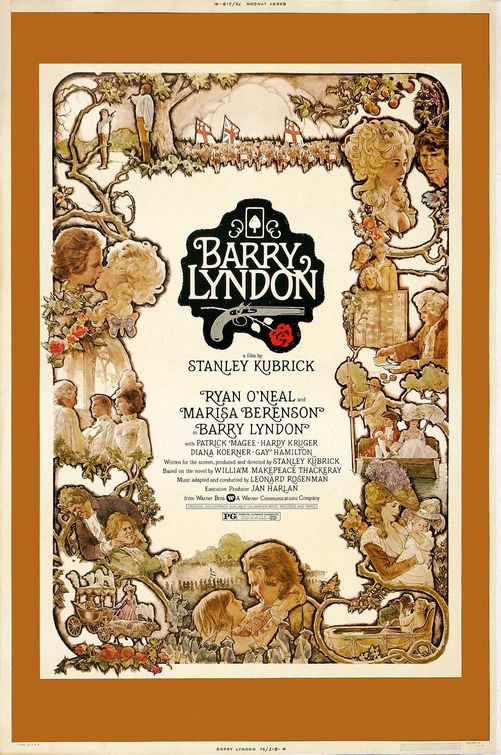

Here's what I knew of Barry Lyndon before first, recent, viewing:

- Kubrick shot it completely with natural lighting
- it's a period piece
- it's a long one
- possibly beautiful, possibly boring
- it stars Ryan O'Neal, whom it's been catalogued, is a huge piece of shit of a human being.

What I learnt while I watched:

- it IS kinda boring, but mainly in the way I find most period pieces of this bloomers and corsets type to be kinda boring.
- it's got a very dry sense of humour which I like, but the pacing kind of obfuscates its hilarities. There a proto-Wes Anderson vibe to all this, like it's the sole influence on Anderson and his sense of humour... but it's just not as swiftly entertaining as any of Anderson's films
- I watched with the subtitles on, and, strangely, the subtitles take extensive liberties with the dialogue. I'd say over 70% of the lines feature some change to what is actually being said
- The film is set in Ireland to start...and Ryan O'Neal may be of Irish heritage but he cannae do an accent for piss.  

If Barry Lyndon failed to entrance me, it's partly because it's overlong, and in need of a punch-up edit, really tightening it up for the humourous aspects.  The other aspect is I find it to be a film quite distanced from its main character.  We're right in the thick of Kubrick's 100 takes filmmaking philosophy, where he just keeps shooting scenes over and over and over.  Part of the point, I suspect, is to drum out any sense of acting out of the performer and attempt to will them into some form of exhaustion.  At the very least he seemed to have beaten O'Neal into a very confused state, which works for Barry's often perplexed, often overwhelmed, yet working-through-it demeanour.  At the same time I think that all those takes wind up making for an inconsistent overall performance, something I find in Kubrick's remaining films from herein.

Barry Lyndon is maybe Kubrick's ultimate satire of class structures in their many forms, the desire of (and futility of desiring for) elite status.  The ultra rich are shown as silly fools yet untouchable and impenetrable (something Kubrick returns to with Eyes Wide Shut).  The point is that their circles operate in a bubble out of step with the rest of the world, and if they're out of touch and elitist, it's utterly intentional.  Of course there's curiosity, a desire to experience that detachment (as well as all the benefits that come with it) but it's also a tenuous life in that bubble and far easier to find yourself outside it than getting into it.  The point here is that desires of Barry's to be part of the bubble, to have money and status led him to utter ruin, losing everything save his life.


The Shining
 competes with 2001 as Kubrick's standout or most popular film, many considering its his best. In his whole oeuvre, it's a standout work, a horror-suspense-thriller that doesn't play into Kubrick's usual themes of class structures or commentary on war.

Instead it's an intense film about domestic abuse, the story of living with/surviving an alcoholic domestic abuser.  It's taken a few viewings for me to realize that Jack is not the protagonist of the story.  Danny and Wendy are.  Jack is the villain from the beginning, from the moment we hear that story about him dislocating Danny's shoulder.

In telling this story about a violent household tyrant, the Stephen King-isms, the supernatural aspects muddy that story as much as they accentuate it. Is Jack purely a bad guy?  Or did he literally sell his soul for a drink?  Did Jack go mad because he doesn't understand how the shining is influencing him, or was he always just an asshole? 

This is the first time watching it (after many times) where I clued into the fact that Jack also has the shining (as Dick Halloran kind of explains, it's genetic).  But even then, is it the shining that allows Jack to experience the ghosts of the hotel like Danny does (and if it's the shining that does that, how is Wendy able to see the ghosts at the film's end?) or is the hotel haunted and Jack's somehow a gateway to unleashing the spirits (as Dick Halloran has been there as head chef for years with the shining and no ghosts bothering him).

And then the question of what it means that Jack "has always been the caretaker", and there's pictures of him from 1921?  Is this a Bob from the Red Room/Twin Peaks-like situation?  Did Jack escape from somewhere?  

At times I get too fixated on the nuances of any of the individual faces (Jack, Shelly, Danny, Scatman, even most of the bit players) that I lose track of what any specific scene is trying to tell me.  I think Kubrick too gets lost in faces, but then he always has.  What did it mean when Jack had no money in his wallet the first time bellying up to the bar in the gold room, but did have money the second time?  Continuity error or is there meaning to it?

I can just as easily get lost in any shot composition, taking in the specificity of the details, the lines and patterns found everywhere, the fastidious organization of the Overlook.  Kubrick, obviously, also gets wrapped up in these details, and it seems to take everything in him to follow our lead characters through their introduction to the Overlook while it's getting shut down, as he seems to want to just watch men and women mop up, tidy up, pack up, and shut the place down.

Nicholson and Duvall deliver pretty wild performances.  Jack knows how to do unhinged, and it's very preformative, but it's hard to watch Duvall knowing the strain the filming took on her and the real anxiety that's on the surface of her role as Wendy.  It's at times less a performance than a reaction, and it's upsetting.  The more you know about Kubrick's process, the more his films start to exist outside of what just on screen.  Metacontext starts to seep into the viewing experience and it can taint or further tempt.


Full Metal Jacket
, outside of any meta context, is unpleasant, unfocussed, unsatisfying (just like war).

I don't like anything going on within the story of this film, but it's probably the point, that I'm not supposed to. And the reality is what's presented here is probably not even close to being as violent, ugly, racist, vile, bloody, homophobic, or misogynistic as it actually was.

Here's an embarrassing truth: up until yesterday (as of this writing) I didn't really know what, exactly, the Vietnam War was about. It's not that Full Metal Jacket explained it to me, because it certainly didn't do that, nor has any other Vietnam War film.  My wife clued me into it being, once more, political posturing in the American's war on the spread of Communism (as was the Korean war, where one was basically treated as a victory, and the other an embarrassing quagmire).

Part of what doesn't work for me with Full Metal Jacket is that there's no exterior life, and no sense of exterior life.  It's a rather cold and myopic film without much sense of warm or direct compassion.  Instead there's an empathetic response to what's presented but not necessarily focussed around character or characters. There's no true protagonist here, Mathew Modine's Joker is a bit of a void, barely present with such random narration...he is not really our guide through all this (and Kubrick seemed to take pains to not make him funny, charismatic, sympathetic or even relatable...but if you weren't there, can you ever relate?). If the point was to dehumanize all these characters into basically blank nothings, basically mission accomplished.

The film is structured in two parts: basic training and the war.  The training sequence, with R. Lee Ermey's iconic drill sergeant to top all drill sergeants commanding the screen with his name calling, slurs, epithets, disparagement, denigration.  He's a direly unpleasant character with the sole purpose of breaking the new recruits of their individuality and turning them into killing machines, to be turned on and pointed at whomever Uncle Sam points them at.  But more specifically, they're bodies to absorb bullets, and if they happen to send some the other way, the more the better.  There's not a single sense of building boys into men or that there's any plan for what's to become of them when they return home.  The reality is they're not supposed to return home.  That Joker experiences his first death within the barracks creates a detachment for him from the horrors of war.  He knows the deal before he even gets overseas.

The second part presents the war in its many ugly details.  It was a shit war largely bankrolled by a terrifying military industrial complex, sacrificing bodies and destroying souls for ill-advised political posturing. In general I find any document of this war from the American POV to be genuinely discomforting. It took men, turned them into monsters (or tried to), completely breaking them with no intention of building them back up, and set them loose with heavy weaponry on a country, and sent what's left back home without any plans for deprogramming them..

I should really explore this war from the other side...in this film soldiers keep asking why the people hate them so much...but they don't really want the answer.

My immediate reaction to Full Metal Jacket was pretty thorough repulsion, but listening to commentary, reading critiques and analyses, and just sitting with it (as well as watching Paths of Glory) I see more of the intent behind the film.  There's power in dispassionate look at the war, but that lack of direct commentary that Paths of Glory had seems to be a critical absence for me.


And finally we have Kubrick's final film, released shortly after he passed away.  The comment is did Eyes Wide Shut kill Kubrick, or did it keep him alive?

Though clearly not intended as his final statement to the world, it is what it is, and it's a curious final statement indeed.

Eyes Wide Shut was not well-received upon its release and it's nearly 2-year production cycle, eating up precious time in both Tom Cruise and Nicole Kidman's peak stardom years, plus all the hype about its supposedly scandalous sexuality, was a bit of a head scratcher.  

It certainly didn't sink anyone's carreer, and in recent years, it's even been reassessed as something of a masterpiece, but I'm still leaning towards that original critical befuddlement.

For 25 years I thought Eyes Wide Shut was an even two-hander of Tom and Nicole exploring the twisted world of secret sex societies.  The opening 40 minutes -- which find Nicole playing drunk, stoned or naked -- seem to lead to the idea that their characters of Dr. Bill and Alice are a swinging couple, into polyamory and kind of get off on the idea of the other having sex with other people...only for the other shoe to drop and instead be about Dr. Bill obsessing (in a pathetic, negative way) over the fact that his wife has vivid fantasies about other people.

This leads to Dr. Bill roaming a very claustrophobic New York (London subbing in with a few false storefronts) at night looking for sex ...but why? Because he's jealous? The pathos of his insecurity is eye rollingly tiresome.  I was really hoping Kubrick would have something truly exciting to say about sex and sexuality. Instead Dr. Bill has a series of unconsummated encounters with a patient's daughter, a sex worker, an underage teen, and eventually finds his way into a secret sex society that spins the film on its head from a relationship drama into a merely decent thriller.

Meanwhile, Alice is at home taking care of their kid, watching TV, going to sleep, primarily existing in this film as catalyst for Dr. Bill's dumb adventures by fuelling his insecurities.

It turns out the super secret sex society takes its sexy secret seriously, as it finds Dr. Bill an infiltrator in its midst.  It threatens him and his family, and some connections he has within have unfortunate things happen to them, which Dr. Bill finds out about, and starts getting more and more paranoid, as much as he is intrigued.

Scenes with Tom and Nicole in this film feel wildly unnatural, and they somehow don't seem to know how to act together. Their performances with other actors are much less...hammy than they are with each other.  At one point a stoned Alice starts to laugh at the idea that Dr. Bill thinks she (and women in general) have no inner sexual desire...she keels over laughing in one of the worst fake laughs I've seen put to screen.

Throughout the film, there's small segments that seems to be making a point about female sexuality, and yet we spend most of the second hour following Cruise's doctor as he obsesses about his wife's sexual fantasy and seeks out his own as.  Are men so comically petty? Rather than exploring these wild misconceptions about women and sex, it becomes a mystery thriller, chock full of tits.. It could have been a potent polemic on monogamy (it seemed sold on that fact) . Instead it's pretty disappointingly narrowminded.

It touches upon sexual repression, and sexual exploitation... but takes no time to explore it.  It instead wallows in its gentle misogyny, something that could have been easily countered with a beefier role for Nicole, who was sold as an even partner in this venture.  

Many actresses (and Alan Cumming) really sell wanting to fuck Tom Cruise, and Cruise is often typically his effortful charming self.  But Nicole...she never seems into it, the idea of fucking Tom Cruise.  I can't tell if that's just Nicole (hey, been there, done that, it's not so great), or if it's her/Kubrick's perspective of Alice.  Maybe leading back to that early line the Hungarian gives her about marriage being the only vehicle for women to lose their virginity, and then they can go off and have relations that are more fulfilling.  But the film seems to hang off the last line of dialogue, of Alice saying to Dr. Bill it a toy store that there's only one thing left for them to do...fuck.  But that that last word of dialogue seems perfunctory. It's like when she says "Fuck" she really means "not each other".

In the end Eyes Wide Shut still leaves you thinking.  Spending the years that Kubrick does on constructing the films he does, it leaves a lot to think about, both in the context of the film, and in the meta context of filmmaking.  How much of what is being said intentional, how much is accidental.  When you shoot a scene 80 times, it's such a marriage of intent and accident, but all that overworking, to me, isn't always a positive.  It affects performances, it affects storytelling, it affects messaging. 

Kubrick clearly is a craftsman, and with every film, even the early ones, there was something he was looking for in every scene, and sometimes he just had to take the closest he could get.  It's sad that his obsessive nature meant his output became such a trickle over the final two decades of his life.  Regardless of how I react to some of them, almost all of his films are memorable, and that's impossible to dismiss.

-----

Ranking Kubrick:

  1. 2001: A Space Odyssey
  2. The Shining
  3. Dr. Strangelove
  4. Paths of Glory
  5. Killer's Kiss
  6. Spartacus
  7. Barry Lyndon
  8. Eyes Wide Shut
  9. Full Metal Jacket
  10. The Killing
  11. A Clockwork Orange
  12. Lolita
    (abstain - Fear and Desire)


Saturday, November 5, 2022

We Agree: Barbarian

2022, d. Zach Cregger - Disney+

If you're hitting this post before Toasty's post... a bit of warning... basically the same warning I heard countless times before every podcast that talked about this film (and that was like 6 or 7 of my regular podcasts)... this is one of those films that the less you know before entering the better.  And I mean knowing absolutely nothing.  Not even the synopsis on the movie booking site. Definitely not the trailer.  Just know nothing.  Because this film reveals itself like an onion, just layers upon layers.  

The short review: it's a blast.  It's a well made film, with really good acting, a lot of great creepy scares, and also a lot of big laughs.  Aspects of it don't hold up to intense scrutiny but none of it matters while watching the film, because it just keeps revealing itself in more and more surprising ways.  But that's already saying too much.

So, seriously, if you have any interest in watching this film, turn back now.

---


So you're still here...or you're back after watching.

I'll be blunt, because I don't want to set expectations too high, Barbarian isn't a great movie, and yet, it's a really, really fun experience.  Like Malignant it's just ridiculously entertaining, but unlike Malignant it has purpose behind its jump scares and tropes-playing.  Toasty gets into some of the early specifics, but the film, whether you like the payoff at the end or not, brings it all together.

Barbarian comes from the mind of sketch comedian Zach Cregger, who, like Jordan Peele, is able to tap the same vein for both horror and comedy quite expertly.  Both comedy and horror derive from the unexpected, and I found myself laughing at the same time as my heart was utterly racing throughout this film. And also like Peele, Cregger seems to either be innately good at positioning his lens, or has found a brilliant cinematographer in Zach Kuperstein (not to mention the lighting department) who deliver some of the best underground tunnel imagery in a long time.

The film is like (at least) four different horror stories in one.  At first, as Toasty explained, there's the Air B'n'B horror, of finding your rental is already occupied.  This is all taken from the feminine lens, the cautiousness and intensity of facing a stranger in exceptionally uncomfortable, suspicious circumstances and never fully letting your guard down.  Here though, Tess (Georgina Campbell), tries to do everything she can to be cautious and mindful.  The film at the same time plays with the expectations of the other side, first by placing Keith, played by Pennywise himself, Bill Skarsgard on the other side of the door.  Handsome, tall, imposing, with those sunken sleepy eyes... he's intriguing but also a little off-putting.  His awkward congeniality and up-front acknowledgement of all the cautious moves that Tess is makig only heighten the tension, rather than deflate it.

Even as the film starts to put us at ease about Keith, it never fully relinquishes that tension, our guard is never really down around him.  But it finds new terrors to confront us with, like mysterious noises at night, doors open or closing seemingly on their own, and Keith's night terrors.  Then, the next morning we see the neighbourhood, an old Detroit suburb, completely abandoned save this one house.  

Later that day, we discover the second horror film.  Tess, coming back to the B'n'B from a job interview is chased down the street by an unhoused man, screaming at her to not go in the house.  The secrets of the house start to unfurl, a secret door to a secret hallway and later a secret room (a video camera, a filthy mattress and a bucket).  Is this something to do with Keith?  When he shows, and Tess tells him they have to leave, Keith can't just believe her and needs to go see for himself.  And when he does, he disappears for too long, which means Tess goes looking for him, to find one more trap door, and a long, deep stairwell to underground tunnels full of darkness and disturbing things, and something moving amidst it all.

Our second act, and third horror, finds Justin Long's AJ, working Hollywood actor, just living high on life driving along the California coast, when a phone call rocks his world.  Long and short, he's cancelled.  The film toys with, for just a few moments, whether he's innocent of what he's being accused of... but really it's clear he is, just he doesn't know it.  He doesn't think himself a villain.  But he is.  And his journey is the horror of facing the music, of there being repercussions for his actions, bringing him to the house he bought as an investment property and wants to liquidate for his defense case.

It's the comedy and the horror of AJ, a man who, upon finding his house scattered with other people's belongings, thinks only the worst for himself, and not any sense of concern for them.  Upon learning Tess' identity, does he do any legwork to find out more about her, whether there's any trouble that may have befallen her?  Not a lick.  And when he finds the secrets hidden beneath, his immediate concern is not what terrors could have created such places, but rather, how can he capitalize upon them, can he count it all as additional square footage in the sale of the house, but his careless, carefree explorations (so drastically different in tone and swagger than when we followed the exact same steps a Tess) find the same trouble coming for him.

Act 3 brings us our biggest nightmare, stepping back in time 40 years to the dawn of the 1980s, same neighbourhood, the shiny brightness of Detroit's lustre not yet faded (but looming).  We meet the house's original owner, Frank (the Night King himself, Richard Brake), a tall, lanky, sallow man with a deep voice with little to say.  He leaves the neighbourhood on an extra creepy expedition for diapers, plastic sheets and gloves, talking about home births, and not a single good vibe coming off him.  Then he spies a woman as he leaves and we learn at least some of his modus operandi.  It's the film's origin story, so to speak, and also a very short segment of the film.  It's deeply unsettling, not just for what we do see, but what is left hanging.. all the insinuation of what this man does and the lengths he goes through to conduct his ugly deeds.

When we return back to the present, our "monster" is exposed (and I don't just mean fully naked) and the film sits perched precariously, teetering between absurdity and scary.  In a way the film doesn't want us to be horrified of this monster, because, as Tess is warned, there's something even worse inside.  And inside, even deeper in the tunnels, AJ finds yet another room, a room the monster won't go near.  Inside is Frank, and AJ is confronted with at least a few of his secrets.  The point is AJ, as a predator, isn't like Frank, but that doesn't make him any better of a person.  Whereas Tess, she IS a good person, the lengths she goes to in order to rescue AJ, and the price she pays for it is a large part of the point.

This is a film about how men and women look at the world. It's a film that points out that men, generally, have a hard time believing or trusting women, even about the smallest of things, never mind bigger things.  It's a film that highlights the everyday tension of being female in a world of men.  It's a film about the ugliness that men bring into the world, an ugliness that both lingers and spreads.  It may not all quite hang together under intense scrutiny, but it's an intensely fun movie, well acted, great-looking horror movie that actually has something to say.  It's only been out a month and it's already a cult classic.

Thursday, November 3, 2022

Horror, not Horror: A Girl Walks Home Alone At Night


 2014, d. Ana Lily Amirpour - CriterionChannel

I recall A Girl... being released with some buzz back in 2014, but I was in year 5 of dad-brain and not registering a lot of what was happening in the world outside of what was cool for a 5-year-old to watch, and the things that would most obviously appeal to me (looking back at 2014 in this blog, and yeah, not a single surprising review from me... I was surprised to see Toasty watched "Un Prophete" though).

What made A Girl Walks... stand out for me was noticing in my strolls through "Previews" magazine (the monthly ordering catalogue for comic book stores) that there were comics of A Girl Walks Home... out there.  So obviously that, big comic nerd that I am, piqued my interest.

A Girl Walks Home Alone... is a bizarre confection.  It's a Persian-language feature, starring American actors of Iranian descent, shot in California posing as Iran, but set in the fictional stead of "Bad City".  Its titular character, the Girl, is a vampire, but this not really a horror movie.  It's parts noir, western, and action movie (but, you know, reservedly so).  It portrays the girl, frequently skateboarding down the empty city streets with her chador flowing behind her like a cape, in an intentionally, strikingly superheroic light. It's a stylish black-and-white feature (shot digitally) that really adores contrast, stark whites against blacks, and playing with lighting intensity.   The soundtrack is a mix of electronic, darkwave, Morricone-inspired neo-western and Persian indie-pop, just an incredibly unexpected yet absolutely perfect mix of tracks, perfectly employed within the film.

The plot is slim, but it's as much about vibe, atmosphere and setting as it is about story.  Arash works very hard, making little money, which he needs to take care of his father (who is addicted to heroin and sex workers).  With what little he's managed to save, Arash bought a classic American muscle car (which fits greatly the James Dean vibes he trying to throw off).  But trouble comes in the form of his father's drug dealer, Saeed, who's an absurd looking fellow, but not to be trifled with. 

In the background the girl seemingly floats through the darkness.  Her prey is almost exclusively men, bad men at that.  She's a hunter, a predator, but also a feminist it seems.  She happens to run into a very intoxicated Arash, having exited a costume party dressed in a very stereotypical "Dracula" costume, and the connection between the two is instantly palpable but also simmering with danger...for both of them.  

If there's a thrust to A Girl Walks Home Alone at Night, it is this relationship...how a vampire and a mortal, both perhaps more than a little lonely, can find comfort in each other.  Amidst all the genre playthings Amirpour injects, its heart is a love story and a familial drama.

The first volume of the comic by Amirpour and artist Michael DeWeese, equally moody as the film though missing the soundtrack, provides an origin for the girl, but it's fairly peripheral.  It does provide a tiny little bit of insight into our mysterious anti-hero, as well as build up the "Bad City" environment marginally more but it's far from essential, at least until Amirpour decides to returns to it and build upon it.

But is it horror?
No, but...well... maybe a little. Horror is maybe 5th or 6th down the list of genres it's playing in, and I would say it's never truly meant to be scary, but it's definitely moody.  I'm not sure I loved it upon first viewing, but it's stuck with me and I'll definitely be watching it again.


Monday, October 31, 2022

31 Days of Halloween: The Dark

2018, Justin P Lange (The Seventh Day) -- Amazon 

Apparently we also finished off the season last year with one of Lange's flicks, The Seventh Day.

This might be a good candidate for Kent's horrornothorror tag, as it plays the thin line between horror movie and horrific faery tale very well. Let's call it a fantasy with horror overtones.

Mina is the boogeyman in the woods, in a remote area of... There are tales of a monster in the woods. She looks like a horrifically scarred zombie and acts like a feral child. Joseff has kidnapped Alex, also horrifically scarred, and blinded, likely by his captors. Mina kills Joseff, whom Alex was completely dependent on, and she is forced by some shred of humanity left in her, to care for Alex. A bond is formed. As the bond and trust increases, as the two hide in the woods, from hunters, and police, Mina's humanity appears to return, her flesh healing, her memories of her past (and her death) returning, until eventually she becomes (again) a real girl.

The tone is what makes this somewhat muddled indie movie. So many are going to compare the interaction with the original Let the Right One In but this movie wants to be more allegorical, more dark fairy tale, than true exploration of monsters. It gets the dark, shadowy nature of two abused people finding connection. But it is challenge by also trying to tie in a thriller plot, of a kidnapping ring, of a police hunt, etc. The timelines seem to be off, when the plot focuses on the thriller/horror aspects -- Alex's scars are years and years old, but the police hunt is fresh; Mina's death and her subsequent murderous resurrection was long enough ago to have her become urban legend but some of the trappings around her death appear to be recent. Either way, despite my desire to skip past the allegory and see a proper monster movie, I did enjoy this.

Sunday, October 30, 2022

31 Days of Halloween: Wendell & Wild

2022, Henry Selick (Coraline) -- Netflix

Not horror, definitely Halloween.

ed. note: finishing this writing looooong after viewing.

Burtonian, but not Tim Burton, which is not unexpected considering he directed one of the seminal "Tim Burton films" - A Nightmare Before Christmas. This one, again, is weird, wonderful, imaginative and visually incredible to look at!

Kat's parents run a very famous local brewery. Apparently its supposed to be root beer, but my craft beer blinders were on and I saw a lovely local craft beer factory! I loved the addition of craft beer as a beloved family business, and the fact the family is black. Craft Beer is a very very white world, so happy to see some inclusion here. So, you can see, that is where my mind was and is.

Unfortunately, Kat (Lyric Ross, This Is Us) loses both her parents in an accident, leaving the brewery's future unknown. She is sent to live in an orphanage (or Catholic School or.... ?). Many orphanages, as she is a bit of a punky wild child, finally being sent to one in her home town, where upon her return, she catches a glimpse of the brewery, which has burned down.

Meanwhile, down in Hell, the titular demons Wendell (Keegan-Michael Key, The Predator) & Wild (Jordan Peele, The Twilight Zone) are using up daddy's hair creme as an intoxicant, and get a vision of Kat. Of note, daddy demon Buffalo Belzer (Ving Rhames, Death Race 2) is colossally big, and they are tasked with applying the creme one follicle at a time.

Kat is weird, sorta punky, very off-putting to her fellow schoolmates, who still seem to adore her, even when she gets all mixed up in the Hell driven hijinx. The story is rather convoluted but focuses around saving the town from the evil land developing Klaxon family, while Wendell & Wilde both plotting against Kat and working with her, lots of machinations going on, and boat loads of weird & wonderful characters (undead Father Bests [James Hong, Big Trouble in Little China] and Manberg, a wheel-chair bound custodian who collects demons in jars [Igal Naor, Riviera]). A recap would be loooong. The art style is a whole buncha fun, mixing the 3D with flat, almost 2D visuals. That said, I need a rewatch as it all is rather fuzzy in my head.


Saturday, October 29, 2022

Series Minded: some Universal horrors

 [Series Minded is an irregular feature here at T&KSD, wherein we tackle the entire run of a film, TV, or videogame series in one fell swoop] 

Ok, this is a bit of a cheat for series minded, as it is in no way I'm going to do the entirety of Universal's classic horror run, which I believe begins with Dracula in 1931 and ends with The Creature of the Black Lagoon sequel in 1956, spanning roughly 40 films in between.   The Criterion Collection curated 10 of these features (all of their most prominent, save for Phantom of the Opera), which is what I watched. 

The early films were all prominently touted as productions of Carl Laemmle Jr., who had a taste for expensive productions, that eventually drove him (and his father) out of Universal after The Bride of Frankenstein.  I covered both the first Dracula and it's superior Spanish-language counterpart earlier this month, as well as Frankenstein and its first sequel, and all are watchable productions in their own way, but I find I'm more interested in them as artifacts than as actual entertainment which is probably why it's been decades since I've last watched them.

The remaining films in the Criterion Channel's curated viewing list are:

The Mummy (1932) dir. Karl Freund
The Invisible Man (1933) dir. James Whale
The Black Cat (1934) dir. Edgar G. Ulmer
The Raven (1935) dir. Lew Landers
The Wolf Man (1941) dir. George Waggner
Creature From The Black Lagoon (1954) dir. Jack Arnold

And although it's not a Universal film, after watching all these, it's absolutely clear that Marvel's delightful Werewolf By Night (2022) dir. Michael Giacchino is absolutely aping the classic Universal movie mold, so we'll talk about that here as well.

---


The Mummy
 is, 90 years later, perhaps the biggest disappointment of all the original Universal Horror features, in that it only contains brief glimpses of the classic bandaged-wrapped Mummy, and that he's not some slow-ambling murderous undead horror.  What we do see, of KARLOFF in the makeup and wrappings, looks phenomenal (perhaps the best looking of all the UH creatures) but again, it's so goddamn brief, and so early in the production.  Some classic archaeologists/tomb raiders/colonials find the tomb of Imhotep, and a sacred scroll that, when read aloud, awakens him.  Imhotep murders a man and then disappears.

Ten years later, Imhotep looks almost fully human and goes by the name of Ardeth Bey, posing as an Egyptian historian, he enters the elite social circles of the graverobbers who found him.  Is this a revenge tale or a high society satire? No, because those would be interesting.

Instead Imhotep/Ardeth Bey becomes fixated on a woman he believes is the reincarnation of his lost love, and she should be the vessel for his old flame's immortal soul.  He looks into a pool of water, often, mind controlling people or just spying, and occasionally murdering, all because of his toxic, unhealthy obsessions with Helen. (His power set is really unclear).

There is a couple scenes where Ardeth Bey converses with Helen, and all the credit to KARLOFF for injecting some real sensuality into those moments.  He's not being creepy, he's genuinely enraptured by this woman, and Zita Johann plays those scenes as being somewhat receptive to his advances.  In a different age, this could have been a really sexy thriller.  Instead, it contains zero tension and is pretty direly boring.

Edward Van Sloane makes his third appearance in an early UH, who once again should have been Van Helsing and thus tying this somewhat dark universe together, but, alas is not. 

The Mummy also uses the same theme music as Dracula (which is actually just an excerpt from Swan Lake).

But is it horror?
Not even.

---


Surprisingly, having never seen the film before, The Invisible Man begins not in a lab, but in an English countryside inn and tavern during a brisk winter's snowstorm.  A man in full bandages and dark goggles trudges through the snow, with thick leather cases.  Entering the tavern, extra dramatically, his boorish behaviour earns him a room, and a whole lot of speculation from the sots at the bar.  Burn victim? Just bundled up for winter?

Nope, dude's invisible.  But, even worse, he's also a raging asshole. Dr. Jack Griffin, for some reason that's not truly explained, needs a quiet place to conduct his experiment, to try and turn himself visible again.  But in the meantime, he's going to be an utter dick to the tavern keeper (the delightful Una O'Connor) and her beta hubbie... he's also not going to pay his rent.

There's a whole other set of characters who knew Jack before he literally disappeared, including the requisite dame who does nothing but pine for her man...despite the raging dickhead he's become.  Jack, it seems, in testing his experimental serum on himself, has driven himself mad, mad to the point of becoming a literal supervillain...sneaking around stark naked in the middle of winter to get revenge on the people who crossed him.  He's gone so stark-raving-looney he thinks he can enact a plan so malevolent that the entire world will buckle at his feet, completely not realizing that something as simple as a bag of flour or a bucket of paint or a sandy beach is all it would take to take him down.  He starts with simple tomfuckery -  sweeping glasses off bars, stealing bicycles, tipping baby carriages over, knocking over grandfather clocks - but then quickly escalates into murder, and then mass-murder by derailing a train.  By the third act he's killed over 120 people... and yet there's still a woman pining over him, because she has nothing better to do.

In the end, it just takes a cop with a bit of brains to stop the unseen menace.  But man, does Claude Rains ever have a lot of fun in both his verbal and physical performance.  It's a charmingly simple and silly movie that dares to make its protagonist just the most caustic asshat, bringing you on board in rooting for his downfall.  The more time you spend with him, the more you want him to get his come-uppence (but only after he does a few more absurdly petty murders, or naive acts of terrorism in his vain acts of world domination.

But is it horror?
Almost. It's too goofy to be truly horrifying. But he knocks over a baby carriage.  What a dick!

---

The Black Cat is the first of the films in this Criterion collection I had no expectations for. It's not one of the iconic Universal Horrors, though it starts their two most famous leads in Karloff (he was really angling for that one-name moniker at this time) and Bela Legosi.

We open on a train cabin with David Manners' Peter, and Julie Bishop (curiously billed as Jacqueline Wells...I should, but won't, dig into that later) as are literally throwing F*me eyes at each other. They are a very convincing couple throughout the film. Later in the film Peter just hoists up a totally game Joan and tosses her on the bed, and then pounces. Was something happening with them off screen? Because it's definitely on screen. Too sexy for 1934, I tells ya.

Peter and Joan are deciding whether they're going to leave the cabin to get food, or, ahem "eat in" (and the way Joan's eyes light up, it's definitely a euphamism), when their romping time is interrupted by the porter who notes that the train was overbooked and this Dracula-looking M*F*er needs to share their cabin.

What really works, at least upon first viewing, is the expectations one has upon seeing Bela Legosi... I mean, he's the most infamous vampire, so there's gotta be something rotten about him, right? The film trades off this uncertainty for a lot of its run time, even as he tells his WWI horror story and heading back to Hungary face the monster of his past... we should have sympathy, but it's freaking Bela Legosi, so there's always just a hint of sinister, even when his eyes are softened and kind (plus is name is Dr. Vitus Werdergast, which is a red-flag name all over). Their time together in the cabin is deliciously awkward in a way we haven't seen in any other Universal Horror thus far, a real truthful moment of strangers pretending to be okay being around each other. At one point the lovebirds are sleeping, and Werdergast strokes Joan's hair, only to see Peter is awake, and the popped-eyes Manners throws at him are epic. He relates a story of the loss of his wife and child, which should further our sympathy, but this man is a total wild card.

The train arrives at station and it's just pissing rain and they all get into a wonderful-looking 1930's bus which has cute little roll-down flaps for doors to keep the rain out. The driver, somewhat gleefully, tells of the horrible history of the area from the War, only to hit a messy patch of road and they roll off the side of a cliff. The driver is killed, Joan is injured. They set off on foot and wind up at Werdergast's destination, the home of architect Hjalmar Poelzig. 

The house is a 30's modernist masterpiece on top of a hill (of death, and, apparently, a old munitions bunker) and the interiors are all clean and curvy with so many modern touches. I wanted this house to be so 30's futuristic, but I guess the set designers broke for lunch early and didn't get that far. It also could very well have been a very modern death trap of secret doors and panels and what not... alas.

The mood between Werdergast and Poelzig is wonderful. Full of animosity and tension, but also tremendous familiarity. The big surprise to me was to see that Karloff, known so famously as the giant Frankenstein monster, is actually a smaller man than Legosi, and later when Legosi has him on a torture rack and rips his top off we see Karloff is extremely lithe, not even close to the giant he can transform himself into.

Following this initial sequence in Poelzig's home, the film flounders as it tries to figure out what its angle is. To this point, the setting has been built extremely effectively and the possibility of danger looms. During the night in this home, there are some weird things, like Joan's sleepwalking that are never explained, and Werdergast's dramatic revulsion to a passing black cat (to the point that he grabs a knife and dead-aims it at the cat, killing it, to which no one really bats an eye) are ham-fisted set-ups that go nowhere. 

It's clear these men want to kill each other, and that Peter and Joan are sort of trapped in between, but their game of cat-and-mouse (where you're never quite sure who is the cat and who is the mouse) never really takes off with any stakes or tension. Poelzig shows Werdergast his trophy room of dead and preserved women in his bunker, which includes Poelzig's wife. It's pretty creepy, but not used effectively enough. LIkewise, we find out that Poelzig has since married Werdergast's daughter and the stakes it should raise also never come to fruition. 

In the end it turns out Poelzig is a Satanist and he's going to hold a sacrificial ceremony, with Joan as the sacrifice, but things don't go his - or really anyone's - way. It all seems like it's escalating in theory, but the stakes never actually rise. 

The film features an almost continuous score, full of classical music excerpts, many of which are more famous from other films, and many of which do feel sort of disconnected from the scene they're playing over, and I'm undecided whether I like this, or the dead space of no score as with the earlier Universal Horrors.

This is perhaps one of the least campy of the Universal Horror offerings (that I've seen...) and it does touch upon traumas experienced in World War I, which seems a rarity in film.

Tisit horror?
You know, it kinda is.

---


The Raven
 is closer to what I was hoping The Black Cat would be... a deranged man invites guests over to his house only to subject them to his many Poe-inspired instruments of torture. It just takes a long, circuitous route to getting to what is one of the more popular contemporary horror genre structures.

Bela Legosi plays the mad Doctor Vollin who thinks himself a god, like Alec Baldwin in Malice (anyone else dropping Malice references in 2022? Ok, how about Dr. Christopher Duntsch from Dr. Death?) but really is just a murderous Poe fanboy with too much money.

The party is nearly a Ruben Östlund-like satire of rich people, and if would have been far more delightful had the intention been for Dr. Vollin to be just fucking with the upper crust, rather than, as is here, just kind of opportunity for his own nerdy bloodlust to present itself.

The Karloff stuff, a lowly street thug looking for a Face Off situation to escape prison, only for Vollin to disfigure him then blackmail him into manservantry - seems really shoehorned in, though, as good a performance as Karloff gives with that terrible wonky-eye makeup he's sporting (the prosthetic eye stretches when he over enunciates).

Oh, also, there's a theatrical interpretive dance (before a sold out crowd) set to a reading of Poe's the Raven in this, which is probably the most batshit insane part of the film.

Horror, maybe?
I think it's too campy to be horror. Perhaps if there were more murder.  But it's pretty fun.

---

Humm.


On the one hand, The Wolf Man is quite a likeable production, with Lon Chaney Jr. spraying his Danny Huston-of-the-40's vibes all over the joint. But on the other hand, it's got red flags all over the play. Certainly a production of its time. 

Larry fucks around with his father's telescope, spying on a pretty girl in town through her bedroom window. He then approaches her at her place of work and uses his knowledge of the interior of her bedroom to try and woo her. Red flag! She says no, a number of times, and yet he persists. Red flag! He also, apparently, is the heir to the estate that pretty much runs the town and he can exude a lot of influence over anyone there (he doesn't, but he could...to his credit, I guess, he tries to hide the fact. Yellow flag). A large contingent of this film's plot revolves around "gypsies" (Red flags a flyin'). Larry takes Gwen on a non-date to the ... encampment in the woods to have fortunes read (Gwen, who's already engaged, agrees to go on the "date" (no flags, fair play) but brings along her friend Jenny, which I think was intended as both escort and perhaps a set-up. Jenny gets her fortune read by Bela Legosi who discovers she's his next victim, and promptly proceeds to victimize her. Red flag (if only for the dire lack of tension around all this). Jenny gets mauled by a wolf-man, Larry steps in to help and beats the living shit right out of the beast with his very distinctive silver-wolf-handled cane, but not before Jenny succumbs and Larry is bit himself. A wounded Larry is escorted home by Gwen and the Romani woman whose wolfmanson (that's a band name) he just killed, and the police go out into the woods to find both Jenny's mauled body and Bela's caved in skull, as well as the murder weapon, the aforementioned cane. The police the next morning confront Larry, suspicious that he committed murder in beating Bela to death (which he did) and that it was not a wolf, like Larry keeps saying (which is also true). They leave the murder weapon behind and Larry proceeds to carry said murder weapon around EVERYWHERE HE GOES! Everyone knows what it is Larry, and you're just throwing it in their faces, constantly. The rich guy, not only getting away with murder, but also just proudly twirling his preferred weapon of assault around all over town. Read the room, Larry, all of them! RED FLAG, Larry.

Anyway, Larry's a werewolf. He attacks and kills a few people. He gets hunted, and despite having killed her son, the Romani woman still helps him out more than once. But, he's too much of a wild beast and he gets put down in the end... or does he?

Am I the only one who thought Chaney and Claude Rains seemed much more like contemporaries than father-son? Only 17 years between them, so, still sorta plausible I guess?

Offensively enjoyable!

But can it be... is it... horror...!?
Close...very close

---


The gill-man from The Creature of the Black Lagoon is arguably Universal's best-looking monster. The suit is an amazing piece of pre-Star Wars creature design, an elaborate, detailed suit that moves incredibly well, works practicably under water, and doesn't look like just a guy in a suit on camera.

It's all too bad then that the actual movie is so boring.  At 80 minutes, you feel every minute ticking past.  

It's a small production with a cast of a half-dozen or so, mainly set in said Amazonian Black Lagoon, where a group of scientists argue about whether to kill or capture the creature, or just leave it alone, while the creature picks off all the unimportant characters one by one.  But the "important" characters have no personality, and you don't care a lick about them or their personal objectives.

There's a lot of solid underwater photography, but underwater photography just isn't as spectacular in black-and-white.  There's also a LOT of scenes of the gill-man's arm and hand emerging from the water onto shore, or the boat, or through the porthole, with the same damn horn sting over, and over and over again.  There's also a lot of shrieking from the one female character whose sole purpose is to look pretty and shriek. 

It's just schlock, but not even enjoyable schlock.  All the money shots of gill-man aren't enough to keep this one from sinking.

But is it horror?
It tries to be.

---


What I hadn't realized about Universal Horror is how tremendously short the films are.  With the exception of Spanish Dracula, they average around 70 minutes.  I also hadn't realized how uniformly thin the UH are on characterization, there's no stand out characters in any of these film beyond the main creature or villain, and even then it's less personality than it is just visualization or traits.  There's not even good mythology building in these films, as the writers don't really seem to have much sense of where these creatures or villains originate, what their power sets are, or what motivates them (except, in some cases, the very generic "madness").

The Disney+ original Marvel "Special" Werewolf By Night is fully inspired by Universal's Horror films of the past, and director/composer Michael Giacchino seems to just relish the opportunity to play in this terrain.  

The special, like classic UH, contains a small cast, limited (but elaborate) sets, and isn't terribly interested in developing characters so much as plowing through its story.  And yet, it can't help but do that Marvel thing of building mythology, creating a few attractive characters portrayed by charismatic actors, and of course using modern tools at its disposal to elevate the visual aspects of the story.

It starts with a gathering, a wake perhaps, of Ulysses Bloodstone, a fabled monster hunter.  A collective of other monster hunters assemble, with the promise of receiving Bloodstone's magic amulet should they win a competition.  The competition involves hunting a special creature released into Bloodstone's maze-like estate, and each other.  In the mix is Jack Russell -- posing as a more prestigious hunter, but actually there to rescue the creature, his friend Ted, the Man-Thing -- and Elsa Bloodstone, the estranged daughter who rejects her father's way, but no less wants his amulet as her birthright. 

Were this a feature-length film, we would have gotten biographies on each of the hunters, spent a lot more time setting up their individual characters and personalities, only to watch them die in so many different ways.  But it's better off this way.  We don't need to know more about them, and everything we really need is here in its 50-ish minutes.

Unlike Universal Horrors, this special is full of action, violence, and blood, things UH tended to shy away from.  It's also bloodier and more aggressive in its violence than Marvel typically is, but it's tempered by the shadows-heavy black-and-white (unfortunately digitally converted, rather than shot in) and the melodramatic tone it takes, doubled down by Giacchino's playful score (another thing unlike UH is the lack of repetitiveness in the soundtrack) and his playful use of light, shadow, colour (and lack thereof) and composition in his first directorial effort.

Gael Garcia Bernal as Jack, Laura Donnelly as Elsa, and Harriet Sansom Harris as the Widow Bloodstone all put in terrific performances that carry the film with ease, and I hope to see more of (those who survive). I enjoyed this tremendously...as a Marvel production, as a Universal Horror pastiche, and as its own thing which really does both stand out and exist independently from the MCU as we know it.

 [toastypost - we agree]

Be it horror?
It's more horror than any of the old Universal Horror, but still not quite straight up horror.

---

Ranking:

  1. The Invisible Man
  2. The Black Cat
  3. Frankenstein
  4. Dracula (Spanish)
  5. The Bride of Frankenstein
  6. The Raven
  7. The Wolfman
  8. Dracula
  9. The Creature from the Black Lagoon
  10. The Mummy


31 Days of Halloween: Even More TV

Guillermo del Toro's Cabinet of Curiosities, 2022, Netflix

This spread over a few nights and fills some gaps in our viewing. The series runs 8 episodes and we watched about two a night, thoroughly enjoying each one. Yes, we are already del Toro fans, but I am also a fan of anthology series, and these are all shot/done around the Toronto area, so we get a lot of familiar faces. AND del Toro worked with some of the most popular horror names currently in the business, as well as a boat load of familiar TV and movie faces, to create an incredible series. Unabashed adoration here, so I will do something I rarely do with TV write-ups, I will go over each episode.

Lot 36, Guillermo Navarro (Sleepy Hollow)

Nick (Tim Blake Nelson, Angel Has Fallen) is an asshole, in deep with his loan shark, looking to make some good money from a storage locker auction. What he gets was owned by some old guy who hid something weird behind all the old furniture and tchotchkes. The episode does a good job of establishing Nick, as surly and unlikeable, virulent to immigrants, and vitriolic even to those he has to work with. When he discovers a couple of books in an obviously magical table, his eyes light up with dollar signs at the suggestion the final volume could net him more than $100k. In tearing apart the locker, he ignores the warnings the buyer, who is assisting him, provides, even after finding a desiccated corpse in a hidden space at the end of the locker. Dude, when the creepy German occult expert tells you to not disturb the demon corpse trapped within a pentagram on the floor, listen to the fucker. Nick ignores him, disturbs the circle to get at the final book, and the tentacle-y, Cthulhian awakens to give chase, well, after eating the creepy German guy. 

The fun in this episode was in the minor details. The lights in the storage facility are on short timer, so Nick is constantly twisting dials, as he moves things out. So, when chased by a demon, we get to do a version of things-move-during-lightning-flashes via the timer lights. Everything that happens is entirely by the trope, but its all so well executed.

Graveyard Rats, Vincenzo Natali (Splice)

Salem, late-1800s; Massam ("Hey, its Rodney!", David Hewlett, Stargate: Atlantis) interrupts some grave robbers, not because he is a studious caretaker of a prestigious grave yard, but because they are interloping on his real job, which is taking the most choice pieces of jewelry from his charges. But Massam has been down on his luck of late, as rats have invaded his graveyard via subterranean tunnels and ... well, are stealing corpses. It sounds like a far fetched tale, but no sooner is he digging up the motherload of buried treasure than he sees the corpses being dragged off into Hell knows where. So, against everyone's (us) better judgement, he gives crawling chase.

Yeah, tunnels again; yay. But not just rats, but ... well, a rather large, blind, hairless rat, something best left fought by 1st level dungeon delvers, than a single man with a revolver. The crawling leads to falling, and Massam ends up in some deep, ancient chamber dedicated to an eldritch god. OK, so two episodes in, and two Lovecraftian references. But ancient chambers to ancient gods mean ancient treasure, but as all good D&D players know, ancient treasure protected by undead guardians!! "Mine! Mine!" the thing squawks as it gives chase, and soon Massam is running from TWO creatures better left to ... OK, 3rd-5th level adventurers. Just when he thinks he has escaped the things, he ends up in... standard karmic response, a buried coffin, and the rats he has been chasing now spill .... into him.

This was just fun. Hewlett embraces the maniacal character on a mission with glee. He does things only a man utterly desperate for shiny things that could net him coin does. Its creepy, full of claustrophobia and fear of unknown things in the dark.

The Autopsy, David Prior (The Empty Man)

Possibly the best of the lot, a story of eldritch creatures from beyond the stars instead of deep in the ground. After a mine explosion, Dr. Winters (F Murray Abraham, Mythic Quest) is brought in by his friend, Sheriff Craven (Glynn Turman, The Wire) to find out why the miner triggered the explosion. The miner is also tied to the disappearances and deaths of many other locals. Inside the miner is an alien parasite/symbiote that inhabits other bodies, using their senses, and eating them from within. And thus begins a battle of wills between creature and coroner.

At it's core, the episode is just a battle of wits, as the Dr. has to defeat the alien creature which wants to inhabit his body. The thing has already freaked him out, and restrained him naked to a table, as it abandons the decaying body of its last host. How will the Dr, who knows he is already dying of cancer, stop this evil thing from continuing. That is the core, but its the construction of the episode around it that wins. The place where Winters does his autopsy is not an ideal location, as Sheriff Craven has asked his friend to do this off the books, so as to foil the insurance company. The story leading up to the mine explosion was already sordid enough and Craven is fully invested in defeating this evil, before he knows what is going on, before he involves his friend. All this, along with a heavy dose of gorey body horror make the episode just fun.

The Outside, Ana Lily Amirpour (The Bad Batch)

Speaking of body horror. Ew, ick, icky! As a man who suffers from occasional flare ups of eczema, this episode just made me itch and cringe.

Stacey (Kate Micucci, Be Cool Scooby-Doo!) just wants to join the clique of "pretty" women at work, who gossip about everyone and spread hand lotion over themselves obscenely. Eww, ick. Stacey's more than a bit weird & wonky, not aware that taxidermy is not everyone's cup of tea, with a wobbly eye and big teeth. But her husband (Martin Starr, Silicon Valley) loves her, and their mundane suburban life, dearly. But nope, Stacey won't have it, as she wants it all, so when a late night TV ad shill (Dan Stevens, Legion) talks her into buying a truck load of previously mentioned hand lotion, she listens to the man on the TV talking to her, the man with the weird mix of European & American South accent and big ol white hair. BTW, by this point, Stacey is already having quite the allergic reaction to the cream, leaving her with bright red patches, peeling skin and an obsessive scritch scritch scritch. Eww, icky, ewww!

Apparently the hand lotion has its own agenda, which Stacey is buying into. I will leave it there, and I am itching already.

Pickman's Model, Keith Thomas (The Vigil)

Back to the HP Lovecraft influence, but more directly this time, adapting one of his short stories.

Its been decades since I read anything Lovecraft directly, but this one reminded me of why I soured quickly on his writing. Sure, the stuff is lush and creepy and full of world building, but its so very often just creepiness for the sake of creepiness, without much real point. It was a technique of pulp-ish spec fic writing back then, for the short stories to be much more about the author's flourid style than plot, but it just doesn't work as well for me.

Anywayz, Thurber (Ben Barnes, The Chronicles of Narnia: Prince Caspian) is an early 20th century art, doing OK for himself, when weirdo Dicky Pickman (Crispin Glover, American Gods; channeling Burn Gorman) shows up. Almost instantly Thurber is drawn to Dicky's work, following him into a cemetery where Pickman sketches dead things, and almost instantly, beginning to feel the affect of being around Pickman. He's seeing weird things, and feeling overwhelming sensations of fear. Exposure to Pickman's work has unsettling affects. If this was a Call of Cthulhu game, Thurber would have failed his sanity check.

Years later, Thurber has divested himself of Pickman's unsettling influence, until the man insinuates himself back into Thurber's life. It leads to Pickman inviting Thurber into his sanctum, likely recognizing the affect it has had, and seeking a like soul, someone who sees the otherworldly in his horrific paintings for what they really are -- doorways to actual supernatural corrupting forces. Instead, Thurber shoots Pickman and escapes. Alas, his paintings were on display, and his family has seen them. End episode with classic utterly horrible ramifications.

I didn't like the episode much, despite really good production values. It just didn't seem to have any point other than depicting the affect that Lovecraftian mythos has on some. Obviously, not on all, for many had seen Pickman's work and just dismissed him, commenting on how weird he and his subject matter was. But Lovecraft was obsessed with the "descent into madness", and liked to explore it, but that's about it.

Dreams in the Witch House, Catherine Hardwick (Twilight)

Some of them stay with me, some of them just leave an impression. While I recall thoroughly enjoying this one, I must have been hitting the Old Man time of the night, as its fading already (ed. note: it could also be the fact that you are writing it long after that date at the top of the post, which is being retained for the sake of the 31 Days event?)

Director of Twilight you say? Not exactly an accolade in my books, but sure, accomplished director. Also, another Lovecraft short story, but lesser on the sanity checks.

It begins with Walter (Rupert Grint, Harry Potter & the ...) and Epperly (Daphne Hoskins, The Baby-Sitters Club) as kids (sorry, what is her name again?). She is very ill, and he is the doting twin. She dies, appears briefly before him as a ghost and then is dragged by vines into some strange forest. And thus begins Walter's quest to find out what happened to his sister.

In most stories, this would mean finding out about some sinister thing that their family had been wound up in, something that ended with Epperly being relegated to a woody purgatory, instead of the afterlife. But being Lovecraft, it just has Walter seeking forbidden knowledge, seeking out charlatan mediums and the like, until he imbibes a narcotic that lets him enter the forest, the Forest of Lost Souls. He does find his sister, but is torn away before he can "save" her. He returns with a bit of her dress.

Also note an encounter with a painter (Tenika Davis, Hudson & Rex) obsessed with a witch's house, which felt like a straying from the ghost story, but does find its way back to the main plot, when on a second journey to the Forest, Walter sees her painting and states to him, he is not supposed to be there. But soon after, zooooop, back to the real world. Without any further funds to continue his journey to save Epperly, he seeks out the painter.

So, the painter lives in an old house that was owned by a persecuted witch, who was killed by whose body was never found. Since moving in, the painter has been haunted by visions. Walter decides that if he stays in the house, maybe he can once again make contact with the Forest and save Epperly. 

The climax and conclusion are rather chaotic involving an undead witch, resurrection, sacrifice, foretold rituals, the bonds between twins and a human faced rat (DJ Qualls, The Core). It all looked spectacular, but didn't really stick with me.

The Viewing, Panos Cosmatos (Mandy

Ouch. My mind got fucked.

This was one weird, brilliant, messed up episode severely lacking any point beyond experience, but was so utterly fucking enjoyable in how it played out, I forgive it entirely.

Its the 70s. A bunch of famous people are invited by an eccentric billionaire to his famous concept abode, the Sandpiper House. They have no idea why they are going, nor why they were invited, but each considers it the greatest opportunity. There is the novelist Guy Landon (Steve Agee, Peacemaker), the astrophysicist Charlotte Xie (Charlyne Yi, House MD), medium/psychic/charlatan Targ Reinhard (Michael Therriault, Locke & Key) and music producer / musician Randall Roth (Eric André, 2 Broke Girls). Each is famous and each understands how famous the other is. 

At the incredible house, all angles and colours (no pink or purple though!), they are greeted by Dr. Zahn (Sofia Boutella, Star Trek Beyond) and Lionel Lassiter (Peter Weller, Star Trek Into Darkness), their hosts. Lassiter has the perfect gift for each of them, seeking to set them at ease, and then dives into a monologue about how they are about to experience the greatest of experiences, because of who each of them is, will help him interpret it via their unique perspectives. The dialogue coming out of Peter Weller's mouth is riveting and steeped in dank bullshit, while Dr. Zahn seduces them with her confidence and giant bowl of cocaine & custom designed additive. She is seeking to open minds.

To what, you ask? Well, a freaky looking rock from space. Its entirely impenetrable, physically or any scan on the know spectrum, but obviously not a natural geographic formation. And obviously Lassiter knows something about it, for he has asked these others to come into its influence. Annnnd, well almost instantly, that doesn't go well. Faces melt, heads explode and the thing cracks open, spewing forth goo. Xie and Landon escape, tearing off into the night while the goo forms into a creature that also escapes into the drainage tunnels that surround LA.

End Scene.

Fuckity, it was trippy. But when is Cosmatos not? Not only does he embrace a 70s aesthetic, but he also triple-down'd on the drug & alien mind induced altered reality feel. The dialogue was incredible, every character chewing on their scenes, convincing us that they are intelligent people, even if some were more than a bit of a DB. And the visuals! I would love to see a Cosmatos attempt at a space opera.

And to end things off, a thoughtful, pensive ghost story...

The Murmuring, Jennifer Kent (The Babadook)

Kent (director Kent, not this-blog Kent) brings back Essie Davis (Miss Fisher's Murder Mysteries) to star in an incredibly well-done, if not unfamiliar story of a couple dealing with the ever present grief of losing a child, and the ghosts in a house they visit. Nancy (Davis) and Edgar Bradley (Andrew Lincoln, Love, Actually) are renowned in ornithological circles for their knowledge of the Dunlin, a migratory bird known for its murmurations, those eerie formations of bird flocks that swoop & dive, creating mesmerizing cloud-like formations. They take an opportunity to study the birds in one of their migratory stops, on a small island off the coast of Nova Scotia, in a vacant house storied by tragedy. But despite their focus on their work, the not equally shared expressions of grief threaten to derail their marriage.

This is a gentle episode, challenging and pain filled. Its a familiar story where one member of a couple deals with her grief differently from the other, leaving them at odds. Even if this was current days, most couples don't well communicate their troubles, and the addition of ghostly figures doesn't help Edgar further his support of his wife's torments. In the end, she has to deal with it head long, on her own, but comes out stronger on the other side, for all concerned, even the dead. As the cliche goes, Davis is masterful in her depiction of this woman, as she was in The Babadook, even considering how underwhelmed I was with that movie, one cannot deny she was grand. In the end, good performances, a tightly told story and eerie, otherworldly real-world ties to ghosts (I once spent an afternoon, watching mumurations over Toronto's waterfront, feeling like I was witnessing something supernatural) and flocks of birds.