Tuesday, February 25, 2014

The Wolverine

2013, James Mangold - DVD

It's interesting to note that this is the sixth feature in which Hugh Jackman plays Wolverine (having a cameo in X-Men: First Class) but that it's truly the character's first solo endeavor.  X-Men Origins: Wolverine was such a convoluted mess trying to cram in as many cameos and sideshows as possible that any sense of character or individuality was left absent from the production.  It truly seemed less a Wolverine spotlight than a new mutant showcase.  This feature quite squarely puts the focus on Logan, applying a sense of meaning to who he is, what he's been through, and how his abilities, particularly his regenerative ones, affect him.

The film opens in 1945, just outside Nagasaki as American planes loom in the distance.  The sirens raise and the soldiers begin to flee.  Captives are freed, all the while, in what looks to be a well with a steel lid chained to the top, eyes peer out from a slot missing a brick.  One soldier thinks twice and opens the well screaming at the man inside to leave.  The soldier joins his commanding officers where they perform seppuku rather than face whatever horror to come, but the soldier loses his nerve, and the man from the well shields him from the firestorm.  Once
 
In the present day Logan lives a secluded life in rural Canada (northern British Columbia perhaps?), following the events of X-Men: The Last Stand, he's taken a vow of non-violence.  He's haunted by the woman he loved, and killed, Jean Grey, and he can't seem to escape his own remorse and heartache.  Living a pained existence, alone, this does not seem like an unfamiliar situation for Logan.  But he's a man who will not be left alone, as the man he saved over 65 years ago is facing his deathbed, and has requested his presence in Japan.

There's a 1960's-style sense of wide-eyed adventure, of Japan feeling like completely foreign territory, much in the same way as James Bond's journey in You Only Live Twice.  Jackman plays it as foreign terrain and (unlike the comics) is oblivious to what is said about and around him, and yet he seems acutely aware of meaning through physical mannerisms and expressions.  It may be a different country and language but Logan knows how to read people.

Yashida, in the decades since he first met Logan, has grown staggeringly rich, one of Japan's most prominent businessmen.  He's spared no expense in extending his own life, and having sought out Logan, seeks to convince him that his regenerative mutant ability can be transferred.  Logan's dreams of Jean often end with a request of joining her in the afterlife, which he laments that he cannot... so Yashida's offer is intriguing, if only a little.  The old man passes that same night, with Logan as a guest in the household he's witness to all manner of ugly family matters, which only escalate later at the funeral.

Yashida's granddaughter Mariko is to be named the heir to his empire, much to his son, Shingen's contempt.  At the funeral Yakuza make an attempt on Mariko's life, unprepared for Logan, save for the fact that Yashida's nurse, the mutant Viper, was able to implant a device in Logan that slows and ultimately nullifies his mutant regenerative ability.  In fighting the Yakuza Logan takes bullets and a beating that continue to plague him.  It's naturally the crux of the tale, to see a near-invincible man suddenly deal with his own mortality.

It's a remarkably cracking three-quarters of a film, with great characterization, some honest intrigue, and a decidedly unique viewpoint for a superhero film.  However, partway through the last act (just after Logan gets taken out by a few dozen ninjas), the film gets bogged down in a conventional "boss battle" fight sequence, involving a giant robot suit of armor and that nurse Viper (a pointless character overall), where everyone apparently dies twice over.  It's a frustrating, tedious and nonsense fight that only exists because that's what happens in these things.  It's like the final act of Iron Man (and Iron Man 2, actually) which even more makes it feel less than unique.  The entire third act distances itself from the rest of the film, which is too bad, because there's an otherwise excellent film here.

The Wolverine is a drastic improvement over the twin abominations that were Origins and The Final Battle but it still could have been a much tighter, more satisfying film.  I do have to say though that the closing sequence -- finding Logan and the young pre-cog mutant Yukio boarding one of Yashida's jets, playing Ingrid Bergman to Mariko's Humphrey Bogart -- that I definitely wanted to see where the pair's adventures would take them.  Shame then that the mid-credits sequence, set 2-years-later find Logan alone, confronting Magneto and a resurrected Charles Xavier...not that that's not cool on its own other merits.

[David's take]

Monday, February 24, 2014

Robocop

2014, José Padilha - in theatre

The original Robocop -- a violent, R-rated sci-fi/crime/action feature -- came out when I was 11 years old.  I was certainly not old enough to see the movie in the theatre, but I was old enough to have the movie marketed towards me.  A steel warrior with a fancy gun and a cool voice?  What kid wouldn't be into that.  After the success of the first film, toys, cartoons, Marvel comics, a television series, and two lesser-than sequels (of equally diminishing returns) would follow, all with an eye on captivating children as much, if not moreso than adults.  I was the right demographic to be totally into all of this, and I was insomuch as I knew all about the story of Alex Murphy and I gave all of his differing adventures in different media a shot, but it was more that I felt I needed to, lesser so that I particularly liked any of it.

I've watched the original Robocop a handful of times over the past 25-ish years, even owning a copy of the trilogy on VHS at one point (I only ever watched those sequels one time each though) but it's not something that's ever endeared itself to me.  It's cold and nasty and ever so much a Paul Verhoeven film.  I know there are die-hard fans out there, but I'm not one of them, and even amidst all my many geek circles I don't think I've ever met one.  Still, they're out there.  When the reboot film was announced, and after the first trailer was released, they reared their heads and were quite vocal about everything, from design changes, to casting, to tone of the film.  The BoCos (as I just now thought of to call the character's fans) seemed rather adamant to hate this movie straight out.  I really couldn't have cared less, not until the wildly diverging reviews started popping up.  How could some reviewers be so positive while others were so negative?

I think it comes down to expectations.  Authentic Robocop fans would go into the picture with a preconceived notion of what should be in the film and what they should be getting out of the film... the original was a caustic satire of futuristic culture based on the trends of mid-1980's Reaganomics.  It's played out many elements in a campy or broadly theatrical manner, and its tone was more exploitative than sincere.  I think anyone else looking at a trailer or even just the idea of a Robocop reboot would be thinking its cheap brand exploitation, loaded with explosions and things meant to be "cool" (starting with the new sleek black look).  Being a product of the original's tainted demographic skewering, it's fairly easy to be cynical about it all.

In all cases, this new iteration defies expectations.  Like the original, it's a satire of today, set in the future, only unlike the old film, this isn't meant to be funny.  The lens we view this satire through is a Fox News-style opinion/interview show, the Novak Element, in which Sam Jackson's host character, Pat Novak, uses his influential position to not report and discuss news but attempt to influence the populace for reasons never quite clear (he quite clearly has an agenda, but as we only ever see him as host, we're not privy to what the agenda means to him).  The issue of the moment is that of robot drone soldiers, both bipedal, humanoid-shaped ones and larger, tank-like ones, deployed around the world in "peacekeeping" efforts by America, but a bill has passed keeping them off American soil.

Omnicorp, the company that manufactures the drones, estimates about 6 billion dollars of lost revenue by being unable to tap into their home market.  Looking for a means to skirt the bill, Omnicorp CEO Ray Sellars looks to humanize his robots by, literally, putting humans inside them.  Dr. Dennett Norton is Omnicorp's chief bioresponsive-prosthetics and is tasked with the job of actually designing, building and making the product a success.  The primary consideration is not functional, but promotional, how good does it look.  The inaugural candidate will have to be just right.  Enter Alex Murphy.

Murphy, as a police detective, went undercover with his partner to find the kingpin of the local drug manufacturing and distribution syndicate.  Things went south and Murphy's partner was almost killed.  Murphy suspected corruption within the Detroit police force and was narrowing in when targeted with a car bomb, nearly ending his life.  Dr. Norton convinced Murphy's wife to let him be part of their program, thus saving him, and Robocop was born.

The film progresses through Murphy's emotions as his humanity is slowly stripped away by the politics of Omnicorp's business.  Dr. Norton struggles with the reality of his own actions, under the sway of his boss, and the desire to reach his own goals, bucking against the emotional toll of manipulating another's entire being.

Director Padilha expertly juggles multiple character threads -- the Novak Element's political dancing, the drug lords and police corruption, Murphy's family, Omnicorp's business and ethics, Dr. Norton's personal crisis -- in a manner that plays out more like television's long-form large ensemble storytelling (in the vein of Game of Thrones or Mad Men and the like) less that a stand-alone cinematic production.  What results is a surprisingly rich story with a meaningful cast of characters that, equally surprisingly, doesn't get bogged down by action setpieces.  There are three prominent action sequences in the film and I'd be surprised if any of them lasted more than three minutes.  It's a welcome respite in a genre film, particularly one whose existence seems to be predicated on action.

If Robocop fails its intended audience, it's in this regard, providing far more drama than a conventional blockbuster would ever dream of.  It's curious, given the name recognition factor, that Robocop's release was buried in the middle of February (where typically troubled or lame duck productions are released for a hibernating audience) but in this regard it feels like a smaller film, and more successful for it.  In February, we're not expecting an authentic blockbuster, and Robocop is more interesting and cerebral than that, and that's something I never expected from this reboot.  With drones and murder-by-remote as well as the morality behind it being a hot topic of conversation, this film approaches that conversation in a very literal sense. 

 Much has been said about the redesign of Robocop, based solely upon the trailers, and that, amusingly enough, is addressed head on in the film, a minor plot point in fact.  So much of the advance griping from the BoCos in advance of film seem to have been predicted by the script and its director.  It doesn't necessarily mean the fanboys will like it, but there's an in-story logic to virtually everything that goes on.

I was impressed, highly impressed, with how this film made me feel.  A typical blockuster will generally just leave me with tingles of excitement, but I was quite invested in the journey here and what it meant to the characters involved, not just the main one but most of them.  Once it was over, I wasn't clamoring for a sequel but instead digesting what was already presented to me.  Design wise everything is modernized, but the story and the storytelling here is leaps and bounds beyond the original in maturity.  It obviously doesn't have the same camp flair, and for some it'll be worse off for it, but I do believe a better film has been made.

Wednesday, February 19, 2014

I Saw This!! More Mythical

Monsters University, 2013, Dan Scanlon -- download
The Mortal Instruments: City of Bones, 2013, Harald Zwart -- download
Odd Thomas, 2013, Stephen Sommers -- download

I just have to clean some out.

Monsters University was a disappointment, but only in that it was not as good as the first, typical of sequelitis. I love the first, being both a buddy movie, a work movie and an incredibly creative exposure of the monsters under the beds. Everything about it is brilliant, from chameleon villain Steve Buscemi to John Goodman playing off oddball (*rimshot*) Billy Crystal, as best pals and workmates. It added "kitty!!" to my lexicon.

The followup is by the numbers, well done but just too typical. You cannot fault it for anything in particular as it is a good use of the frat boy micro-genre (really, are there any other current examples?) to explore the pasts of favourite characters. But it doesn't do anything new with the old story that people my age are familiar with. I hate when animated movies are just done for the kids who will buy the franchise, but this seemed to be the purpose for this entry. Glad I didn't waste my money on it.

The Mortal Instruments: City of Bones, is the beginning of a series, thus the use of a colon. I think people believe that by adding in the colon between franchise titles, they are going to reclaim the throne left empty by Harry Potter. The Hobbit had to do it, purely because... well, you know why. Potter did it well because it was always Harry Potter and the... That just works. This one just seems wonky, as if they are trying to convince us of how great this new mystical creatures teen romance story is already great. It doesn't work for me.

The movie itself is not so bad. Surprisingly, I wasn't as annoyed by the goo-goo eyes being made between characters and was actually impressed they tossed a gay man into the love triangle. The world itself is interesting, more like the plot of a 90s RPG from the White Wolf Vampire series, but that is as far as it goes. Interesting. Nothing here is very startling, the plot very familiar the special effects as well as can be expected. I think the whole franchise would be better suited to TV than movies and I doubt we will see another.

P.S. It was about half-demons fighting half-angels and a destiny being revealed to a young girl.

Speaking of destinies, if you are going to add teenage angst to the mix of having a mystical destiny, then Odd Thomas is the way to go about it. This is an odd movie, excuse the pun, and also the introductory entry to a franchise of people fighting the supernatural. Strangely enough, Dean R Koontz wrote the novel, which I dug up before seeing the movie.

It leaves behind the beautiful people and cool cultural environs for a small story in small town California. Odd, yes that's his name, is a kid who can see mythical creatures he ends up naming bodachs, bogeyman like creatures that are invisible to all but him and are attracted to death. Odd also sees the occasional ghost, often murder victims or some, like Elvis, who hang around for the fun of it. Odd and his odd friends, including a sympathetic local sheriff, and his gorgeous Destined To Be Together Forever girlfriend, help him deal with the ghosts. Its a fun premise but it derails itself almost immediately, going from light and bouncy to dark and tragic. Destiny can be a bitch.

This movie was under the radar, having come into a few cinemas and probably not doing very well. OK, I have to revise that. It never did make it to the cinemas, until now. And it comes out in the dead zone to slide into second place for the weekend, behind The Lego Movie. Should I expect a sequel? It does such a good job at laying down the world and the character and handled the heartbreaking climax with such sincerity. This is one of the times where in both the book and the movie, I had my heart utterly wrenched from me knowing what was about to happen. That works for me in such stories. I hope it makes some slow burn money.

Thursday, February 13, 2014

The Lego Movie

2014, Phil Lord and Christopher Miller

It's easy to be cynical about The Lego Movie, ostensibly a 100-minute commercial for a product that, at this stage, needs very little help in advancing sales.  Lego is a juggernaut in the toy market, some stores dedicating an entire aisle to its output, not to mention the fact that Lego stores have begun to pop up in shopping malls the world over.   There are a few competitors to Lego, but over the past few decades Lego has drilled it into kids minds to accept no substitute, to the point where getting a Kree-O set is a disappointment.  In the past decade Lego has taken great pains to expand its scope, particularly by licensing, taking on all sorts of established and popular brands like DC and Marvel Superheros, Harry Potter, Star Wars, Lord of the Rings, Teenage Mutant Ninja Turtles and more.  Beyond these obvious sorts of properties, Lego has also developed kits that replicate famous landmarks (one I saw recently, in a gargantuan box of just under 3000 pieces, was a recreation of the Sydney Opera House for roughly $350), which only confirms both at price point and subject matter that Lego has extended itself beyond just appealing to children, sustaining and promoting itself among adult collectors and builders as well.

However, with the proliferation of all these building kits, for the most part gone is the idea of free play.  Instead the richly detailed visual instructions have taken over.  Follow the rules rather than create your own. In may ways, Lego has become 3-D puzzles, where the only real challenge is finding the right piece in a pile, and following along.  Hidden in the Lego aisle, if available at all, are simple kits of just blocks, and encouragement to do your own thing.  The Lego Movie, which could have so easily just been a vehicle for selling new model kits and "gotta get em all" mini-figures, instead wisely acknowledges the reality of Lego's branding, the conflicting ideas of following the instructions versus doing your own thing.

The moment I heard that Phil Lord and Chris Miller were involved, I knew that The Lego Movie was going to be something more than crass commercialism.  Lord and Miller were responsible for the way off-beat, short-lived but cult-favourite cartoon series Clone High, and went on to make Cloudy With A Chance of Meatballs not only a surprise hit but one of the best comedy features (animated or otherwise) of the the past decade.  Their comedic sensibility is well honed, and they excel at the surprise gag, delivering laughs from the unexpected as well as toying with cliche and convention.  Even more, they are masters at building a running gag, one that continues to pay off the more it's used.  Even if the film wouldn't deliver on the story, I knew long before even the first trailer appeared that it would be a funny movie.

But there's something to The Lego Movie beyond product placement and gags, there's both a message (or two) and some sentimentality within, and further to that, some great world building, creating a "universe" that I actually wanted to see more of and spend more time in.  The central figure is Emmet, an nondescript construction minifigure who goes with the flow, follows instructions to the letter (err, image) and seems to have no desire for independence.  He lives in a city where it seems everyone is pretty much just like him, until a chance crossing with Wyldstyle draws him into a whole new reality, exposing the walls between dimensions and awakening him to the threat of Lord Business.  Lord Business has forced the different brands of Lego to remain separated, and those who seek to undermine this segregation will be punished.  Emmet and Wyldstyle meet up with the crazy and blind wizard Vitruvius, who unveils the prophecy that the wielder of the Piece of Resistance, (naturally Emmet) will be the one to stave off Lord Business' evil plan to destroy the universe through stagnation (by literally gluing pieces in place).

The band of rebels (joined by 80's Spaceman Benny, cyborg pirate Metal Beard, a cutesy hybrid unicorn/kitten Unikitty, and Batman... Wyldstyle's boyfriend) are all "master builders" and Emmet, being the "chosen one" of this piece, should be preternaturally gifted at building objects, but he constantly disappoints and questions his own validity.

There's heavy shades of the Matrix at play here, and I can't really tell if it's overtly intentional or if it's just retreading the same heroic prophecy-type story elements.  While it's definitely a tale we've seen before, it's not been seen quite this way, where the characters are constantly undermining seriousness of their journey by acknowledging the cliche of it without fully undercutting the intensity of their plight, it still means something to them.  Emmet's journey is one of finding self confidence and learning to think for himself, exploring creativity and problem solving.  As far as character journeys go in these types of films, it's a good one for kids (and most adults too).

The plot sticks firm to "stopping the bad guy's plan" until midway through the third act where it side steps into a stimulating meta story that explores the main theme even further.  There's more than an acknowledgement that Lego, for all it's increasing fanciness and complexity, is still just a toy, a building block system meant to stimulate children's creativity.  Lord Business represents an adult's sense of conformity and compartmentalization, and how oppressive that worldview can seem to children.

The animation in The Lego Movie is phenomenal.  There have been animated Lego features and television shows (Ninjago, Chima) but they're stripped down, feeling like animation.  The Lego Movie feels like the characters are living mini-figures inhabiting environments completely and plausibly built out of Lego.  The level of detail is dizzying, every brick seem accounted for, and it can take a while to visually adjust to the film's environment, but it very quickly defines itself as a unique place.  There's a kinship here to Wreck-It Ralph, where in that film it interconnects videogames into a shared universe.  Here, it's the many realms of Lego colliding, both sensibly and nonsensically, and is responsible for part of the film's charm.

The voice cast is stacked with great talent.  Burgeoning superstar Chris Pratt takes the lead as Emmet, who's close to an extension of his Parks and Recreation character, kind of dumb, but sweet and excitable.  Charlie Day is perfect for the ever keen-come-disappointed 80's spaceman who just wants to build a spaceship, dangit.  Morgan Freeman plays the delightfully daffy wizard Vitruvius, well against type, while Nick Offerman usually recognizable timbre completely disappears under Metal Beard's pirate speak.  Alison Brie is the perfect choice for the cutesy Unikitty who's bottling up her rage, and likewise Liam Neeson shuffles between the temperaments Good Cop and Bad Cop.  Will Ferrell revives Mugatu from Zoolander for his Lord Business, and Elizabeth Banks has a lot of heavy lifting in the love triangle between Emmet and Batman, as Emmet's master builder mentor, and sufferer of Vitruvius.  And one can't forget Will Arnett's Batman, smug, cocky, and a bit of a dink, with a shallow emotional side... Batman's demo tape is brutally funny.  And rounding out the heroes are Channing Tatum's Superman suffering the clingy-ness of Jonah Hill's Green Lantern, and the possible conflict of interest with Cobie Smulders as Wonder Woman.

This is a tremendously enjoyable film, super funny, visually exciting, with a variety of moving parts that make a richer whole than most children's entertainment.  Yes, it's a 100 minute sales pitch for plastic bricks, but it's also a rich little universe both that's at once big and small that's worth spending time in.

Tuesday, January 28, 2014

Double Oh...18: Tomorrow Never Dies

1997, Roger Spottiswoode

Tomorrow Never Dies Preamble:

For the longest time, this was my favourite Bond movie.  I'd say probably until the late '00's when I watched On Her Majesty's Secret Service for the first time did I hold this in my utmost regard of what a Bond film was or should be.  As we've established by now through 17 of these, I really didn't know shit about Bond until recently.  That said, I enter this film with affection and trepidation, I know that I loved it once, but it's been so long since I watched it I don't truly recall it, and my view of the Brosnan pictures was critically tainted by the subsequent two films, one which I outright hated, the other which I enjoyed by only the slimmest of margins.

The one thing I got out of Tomorrow Never Dies was Michelle Yeoh.  I'm struggling to remember if I had seen any of her wuxia films at this point (a friend held a screening of Wing Chun which would have been around the time of this film's release) and Crouching Tiger would be 3 years off still.  What I remember most is seeing a sit-down interview with some entertainment news program and absolutely melting at hearing her lilting voice, her almost, but not quite flawless English, her sense of humour and her great smile.  She was (and remains) one of my biggest celebrity crushes.

Villains:

Henry Gupta (Ricky Jay), is first seen in the opening sequence at a big terrorist swap meet.  He's purchasing a "GPS encoder", stolen from the US military, and it's later used to send a British Naval ship off-course and perilously close to Chinese waters.  This sets off a chain of events, aided by our bad guys, which threatens to spark a war.  Gupta acts as a master hacker and ace A/V guy.  He doesn't really have much to do with anything beyond being the techie help.  Honestly, I don't recall if he makes it out alive or not... he's thoroughly unmemorable, except that he's Ricky Jay.

Gupta is in the employ of Elliot Carver (Jonathan Pryce), a media baron whose newspapers are said to be capable of overthrowing governments.  Carver's goal is to launch a new 24 hour cable news network channel, and to be the king of all media.  He does this by "predicting the news" thus getting the scoop and seeming like the best news source in the world, I guess.  His predictions involve a lot of hired men sent out in the world to kill other people and cause strife.  He's a ruddy lunatic.  He spent probably hundreds of millions on building a stealth boat (buying materials off a Chinese General), and buying the GPS encoder, all so he could manipulate the British and Chinese in to a potential conflict that he could report on in the news.  Also, his ample donations to the General have allowed him to set up a bureau in Beijing and, should everything pan out, he'd get exclusive broadcast rights in the country for 100 years.  It's lunacy, and Pryce plays him completely unhinged.  Not only does he freely admit to anyone who'll listen that he doctors the news, but he revels in the fact that he gets away with it.  Carver meets his fate in the teeth of a really cool torpedo that's also part a boring drill (in a nice call back to earlier in the film)

Carver doesn't like to get his hands dirty, which is where Stamper (Gotz Otto) comes in.  He seems to be everywhere at once, and is the now-common giant, muscular, machine of a henchman.  He's the same style of uber-mensch that we've seen about a half dozen times, generally quiet, unnaturally strong, and unbelievably tough.  He runs the show on the stealth boat, and is the towering menacing figure meant to keep Carver's nemeses in line.  He dies when Bond traps his ankle underneath a rocket that's about to launch

It should also be mentioned that Stamper is the protege of Doctor Kaufman (Vincent Schiavelli), a master of chakra torture.  It's Kaufman who kills Carver's wife and is tasked with pinning the murder on Bond.  The scene between Kaufman and Bond is a drastic tonal shift when Bond discovers Paris dead in his bed, and he's in a state of mourning, anger, and a heightened awareness of being in a trap.  In walks Kaufman and he's over-the-top seething with malevolence.  He's got Bond under his thumb while the lackeys are in the parking garage trying to break into Bond's car without any success.  Just as he's about to do away with Bond, Stamper informs him of the troubles and that he may need to extract from Bond how to gain access to the car, and it's a delightfully silly exchange we're only privy to one side of.  It's unlike anything in any Bond film before or since, a bit of a comedy sketch in the middle of an action movie.  Anyway, Kaufman gets tazed by Bond's phone and Bond gets the upper hand forcing Kaufman to shoot himself in the head.  "Wait, I'm just a professional doing a job" he pleads.  "Me too," Bond replies as he shoots him.  Fantastic scene.


Bond Girls:

After the credits roll, and the stuff with the British warship and the Chinese Migs and Carver's stealth ship happens, Moneypenny (the returning Samantha Bond) is advised to call in 007 at once, where Bond advises her that he's "just brushing up on a little Danish".  The Danish in question is Professor Inga Bergstrom (Cecilie Thomsen) who for some reason takes issue with being called "little".  I'm inclined to think that Bond was supposed to learn Danish (and he did pick up some) but got a little distracted.  She superficial, but somehow showing Bond as a preternatural womanizer seems necessary.

Trying to figure out how Carver managed to report on the sunken British ship in his newspapers when press time was before even MI-6 heard about it, they zero in on Carver, and M tells Bond to focus in on carver's wife, Paris (Teri Hatcher), with whom he had a relationship in the past.   The exact words were "pump her for information".  Moneypenny in this scene in the back of a limo feeds Bond his airplane tickets and some information and a bit of a flirtatious exchange.  I like Samantha Bond's Moneypenny because she's not a doter.  If she would like to have something with Bond, it doesn't show, as she seems quite aware and accepting of who he is and what his nature is, no jealousy involved

 After slapping him, then exchanging flirtatious barbs, Paris shows up at Bond's suite and makes it clear she's not there to flirt, she wants to hash out the past in more ways than one (despite being a married woman).  "Did I get too close?" she asks.  Bond confirms before he drops her dress, but while Brosnan effectively conveys affection towards Paris, he seems less in love and more in lust.  It's interesting though to see sort of the Bond girl after being a Bond girl, and what kind of attachment these women hold onto.  That almost needs its own story.  Hatcher was at the height of her Lois Lane foxiness in this movie (not that she's not still quite attractive today), even being a few months pregnant at the time, very well hidden.  Of course, Carver finds out, not of her infidelity but of her lying about how she knew Bond, and he has her killed.  Harsh.  I recall upon first viewing that I was absolutely shocked to see Hatcher's Bond girl go out in the first act... thankfully there's Michelle Yeoh taking center stage.

Yeoh is Wai Lin, a Chinese secret agent also investigating carver.  We first meet her under cover as a Chinese journalist infiltrating Carver's launch party for his new network.  Here she's in serious glam wear, a sleek, form fitting silver dress, and catches many eyes, but she's also very charming and keenly observant.  We see her a second time when, the next morning, Bond is infiltrating Carver's office and happens across her as well, having just set off the alarm and looking for an escape route.  It's a charmingly playful scene as the both evade gunfire separately and have a mini-rivalry in their egress.  In this scene she has this cool bracelet which shoots out a tether which she uses to scale down the wall.  Their paths cross a third time when Bond investigates the sunken British ship off the coast of Thailand and they fight at first, until they realize who the other is.  They head to surface, are captured by Stamper and taken to Carver's new tower (which it seems he just got in the past 6 hours, considering it was said earlier he didn't have any bureaus in China) where they're handcuffed and make a very well orchestrated escape (I like the "I'm driving" argument as they steal a motorcycle).  They work as a team (though she does try to lose him at one point), and she reveals to him her arsenal hidden within the walls of a modest looking bike shop.  She's got toys as good, or better, than Bond, and she kicks ass better than any Bond girl in the past.   She's so awesome, it's a shame she's captured and left dangling, in need of rescue, and equally a shame that she never gets a really great martial arts fight in (the one in the bike shop isn't even close...).  They've created a few female doubles for Bond over the years, and I keep waiting for them to take one and make a Bond film out of them.  Wai Lin would be so awesome in her own Bond-styled feature.  Wai Lin and Bond don't have any real romantic involvement until the very end, where they wind up on the remains of Carver's destroyed stealth sub...and, well, we know by now that being on the water is Bond's biggest turn-on, and Wei Lin seems more than game.

Theme/Opening Credits:

I cannot tell you how much I disliked Sheryl Crow back in 1997.  "Everyday Is A Winding Road" was just one of many banes of my existence on pop radio in the year preceding it.  A precursor to Nu-Country, Crow was just not anything close to the indie music I was invested in at the time, nor the hip-hop I had grown up with.  But damn if this song I didn't love, and kind of hated myself for loving.  I recall wincing when she hits to sustained "day" notes, just seeming shy of her reach, and yet I like that she has to restrain herself knowing she can't hit it that high.  There's a pulsating element that alternates with it's epic sweep which feels modern, but with a 1930's New York big band chanteuse throwback.  It's fricking great.  The actual lyrics may not resonate or hook in the same way that some of the other Bond themes do, but the melody just envelops you.
The title sequence is appealing, a mash of technology and titillation (foreshadowing the copious amounts of nudity available on the internet, perhaps, unintentionally).   There's a lot of broken glass, and arms stockpiles, but it's the brief x-ray of the gun being loaded with bullets, and later of it firing,  ricocheting off multiple screens, creating a shower of broken glass.  Some of the elements seem a little odd, like the floating diamonds and the woman freefalling off the diamond into a planet, but for the most part it's really interesting, if inconsistent.


Bond:

Brosnan seemed ready for the role in Goldeneye so Tomorrow Never Dies is just more status quo.  Again, he's very physical, and at times harsh in his brutality.  While Bond's always been a very sexual character, I think Brosnan is really the first to really bring that out, perhaps only because he's the guy playing Bond in an era where there's a more liberal attitude towards sex on film.  As well he really brings the steam when he starts getting it going.  One gets the sense that Brosnan really, really liked playing all aspects of Bond, and wanted the best of all worlds (the fighter, the camp icon, the sex god, the sleuth, the spy, the wounded puppy, etc).  This I think is the peak payoff, but rewatches of the subsequent films will say for certain. 

Movie:

Tomorrow Never Dies is easily my favourite of the Brosnan Bond films, which I admit isn't the most audacious statement given that its only real competition is Goldeneye, but I feel it's the more enjoyable of the two with the least amount of demerits.  It feels bigger, more globe-spanning, with more at stake.  It's true, Carver is one of the worst villains in all of Bondome (and by worst, I mean utterly ridiculous in his motivations and non-sensical) though Price makes him very enjoyable to watch.  The idea that a media mogul would manipulate events around the world, spending a fortune to do so in order to capture a story first and to gain exclusive broadcast rights in China is preposterous in a series filled with idiotic motivations.  But despite that, the stakes are high.  They're high in the pre-credits sequence where Bond is trying to avert a nuclear detonation, and they remain high throughout.  Not only does World War III loom, but there's a 48 hour countdown to preventing it.  Talk about ratcheting up the tension...
I love the sequences at the start of the film in the MI-6 den, with all the monitors and technology.  It's a really cool set that is sorrily underused.  The only set that rivals it is Wai Lin's bike shop.
It is not a very dynamically directed film, I mean, Spottiswoode directed Turner and Hooch and Stop, Or My Mom Will Shoot for Q's sake.  But he turns out a very straightforward, very watchable product.  It could be better looking, sure, and the fights and action could be more eye-popping, but even so, they're all still entertaining.  It's like having a hamburger and wanting some garlic aioli on it but only having mustard, ketchup and relish available.  It'll more than do, it's just not spruced up.
Much of what I love about this film, honestly, are the Bond girls.  In a recent heated conversation about Bond, a friend noted that it almost doesn't matter who plays Bond, it's the people around him that really make a film.  Unlike the next film, I don't think there's a miscast role here.  We've got M, her Chief of Staff, Moneypenny Charles Robinson, and the return of Jack Wade, all on support, and the aforementioned villains and Bond Girls.  It really is the strength and charm of Michelle Yeoh that carries this film home for me, but it's also one of Teri Hatcher's most memorable works despite the brief screentime.  The worst thing about this film is probably that there's not a good poster for it.

Q-gadgets:

A little light on the gadgetry in this one, a cel-phone that doubles as a remote control for the new BMW that Bond's given, as well it has a stun gun and an electronic lockpick/safecrack device.
His watch also has a small plastic explosive which he can use as a remote detonator. 

Wai Lin's secret lair is full of gadgets, too bad we never meet the quartermaster who stocks it for her.

Classification [out of 01.0]: 00.8... it's not only one the best Brosnan but one of the better Bond films overall, and that's not just nostalgia talking.

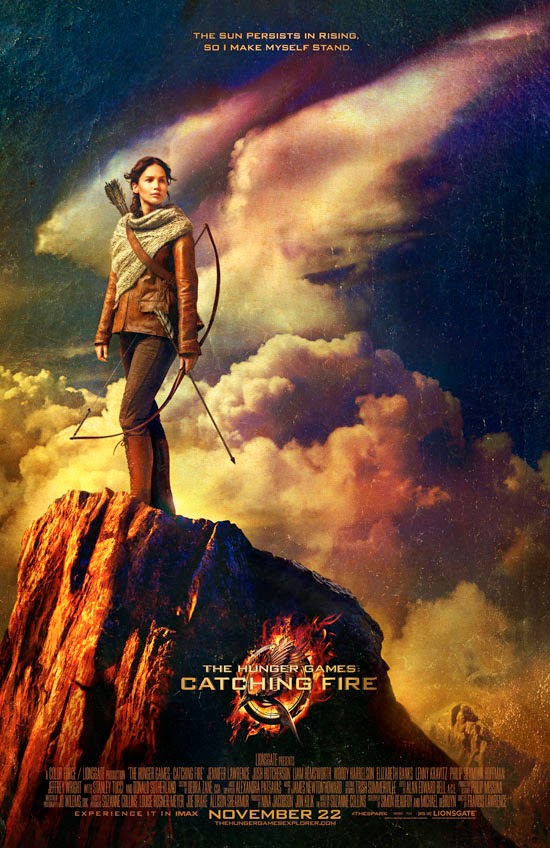
3 Short Paragraphs: The Hunger Games: Catching Fire

2013, Francis Lawrence (I Am Legend, Constantine) -- download

I haven't read the remaining books in the series yet so I was rather pleased to see that this movie focused on her reaction to having survived the Hunger Games. Nightmares, PTSD and a general disillusionment with what she has become is her mindspace as the movie starts. Its not surprising, because no matter how well she pulled off the "two winners" trick in the first movie, the government is well aware she played them. The Hunger Games are supposed to be for their benefit, not the oppressed peoples of the districts. Despite the luxury heaped on the victors, the games are still intended as punishment on a populace that failed in a distant rebellion. I am glad the story picked up solidly in this mess.

Jennifer Lawrence is just brilliant as Katniss Everdeen. I won't argue with her legions of teenage fans about the faithfulness of the portrayal, but for me its how camera friendly Lawrence disappears into the character so we forget all her publicity, for only the character. Yes, there is the lean, toned body that contributes but its also the way she holds her face and the facade the character puts on when in front of her public. There is a weight to that role that she carries so well.

This is the filler book in the story, between the setup of the world and the characters, and the final book which deals (or so I expect) with the new rebellion. This is where a traumatized young girl realizes she wasn't as clever as she hoped and survival of the games wasn't enough. Now she is a figurehead in a growing upset around the districts, a role she again does not want to play. People are dying in her name. So, I was glad when she was tossed into a conspiracy later in the movie, where she is just one of many. Where she is not the only capable, clever victor. I just adored the angry, uncouth nature of Johanna Mason who obviously never has played the Capital game. I applauded Cinna's fashion rebellion that he had to know was going to cost him. It makes me wonder if Katniss will continue to play a supporting role or realize she has to take the reins of this action she inspired.


Monday, January 27, 2014

3 Short Paragraphs: I, Frankenstein

2014, Stuart Beattie (Tomorrow When the War Began) -- cinema

I can honestly say I was actively excited about this movie. It fits my type of genre flick so wonderfully, with a tortured mysterious possible anti-hero, more than one type of mythical antagonist and a dark & gritty setting. These types of movies are never good but I enjoy most of them, Underworld and Van Helsing being a pair of my favourites. And considering this one was written by the guy who also wrote Underworld I was expecting a schlocky movie full of great world building and exciting adventure.

What I got was... well, boring. Can I actually say a movie that was basically wall to wall action boring? Yes, because no matter how well done the fight scenes were done, after you have seen them three times you want something else. Think of the opening sequence of Blade and apply it to the entire movie. I cannot latch onto what exactly bored me but it feels like it was the lack of deep world building. It was like the next to last episode in a TV series season, with all the background dispensed for a drive to complete a story arc. Nobody was fleshed out, the bad and good guys were all cardboard and no real motivations -- good guy wants to kill all bad guys, bad guy wants to Be Bad Guy.

The trailer tells you all you need to know. Gargoyles / Angels are fighting Bad Guys / Demons and Adam / Frankenstein (finally, a good reason to call him Frankenstein, i.e. he is the Doctor's "son") is just stuck between the two factions. Fast forward, for no reason than to highlight that he is ageless and have the story set in current times, to the same pseudo-European city that Underworld is set in, where the Bad Guys are trying to recreate the Frankenstein process so they can give the endless hordes of Hell a nice supply of uncontested bodies to possess. So, the Gargoyles and the Demons fight. And fight. And fight. And Frank growls grouchily. And fights.

Saturday, January 25, 2014

We Agree: Her

2013, Spike Jonze (Being John Malkovich, Adaptation) -- cinema

P.S. There is something to be said in that there is only one poster that Google hits for this movie.

I cannot talk about this movie without revealing some pretty important details, so pretty much take the entire review as a SPOILER ALERT. But, it is not a movie with surprise reveals so they may not be so spoilerish to you.

Her is both a science fiction movie, set in an indeterminate future where the release of an artificial intelligence OS is met not with incredulity but only sense of consumer interest. And it is a movie where love is focused on communication. I could do entire reviews from both fronts, in my usual 3 paragraph format. Instead, I will revert to normal, everyday format of the reviewer.

That in of itself is strange, when the format that was supposed to be the occasional concept when I didn't have much to say, has become the norm, and the longer, characteristic format is the occasional.

The Future. The future looks spectacular in this movie. This is the future of 1920s futurist, full of clean surfaces, buildings connected by wide open concrete spaces, bullet trains and relaxed leisure. The movie is set in LA, but was shot in both LA and Shanghai, something I caught onto very quickly. The US just doesn't have the expansive, pedestrian friendly urban spaces that look.... well, current. That can also translate as covered in concrete. Many wide shots in the movie were CG enhanced, massive skylines of skyscrapers and high-rises, from left screen to right. LA is not that big now. This was MegaCity Two without the dystopia.

It is an idealistic future with technology either unobtrusive or completely absent. Think, Minority Report with its intrusive advertising and full screen interfaces; then forget that. Think of any movie set in a near future and you will see giant TV screens and blaring advertising. There was a surprising lack of media or advertising in this movie, what little there was, relegated to spoken word emails, easily skipped or deleted.  Even the advertising that inspires inspires Theodore Twombly to buy the OS, is more an installation art piece than an in your face ad.

Computers play an important role, and no I don't just pun-ishly mean Scarlett Johansen, but they have a place in the movie, ever present in the main characters' lives. They are presented as just beautiful monitors, more like high-res Umbra picture frames of white or natural wood. The interface is either voice or touch, via the virtual mouse/keyboard space in front of the monitor, i.e. the desk's surface. It states, and reflects on what is already happening now, that computers will someday play an everyday role, much like telephones and TVs now. I am sure there was a time when the telephone was considered a tool that only the techie in the family knew how to handle.

The unobtrusive nature of tech is extended to the mobile interface, a small pocket sized device that looks more like an embossed leather & chrome business card holder than a smart phone. Again, most interaction is done via voice with the hand-held only used for video and small screen. You might think the days of being distracted by your device are gone in this future, but the fact that he can stand on the elevator and talk to his PC and nobody reacts at all means people are used to everyone just babbling to their computers all the time. It would make for a crowded, noisy train space. But I imagine everyone keeps it to a low conversational level.

The other minor comment on technology is that it is ever connected, everywhere, all the time. I mean, the wifi they use is always on, everywhere. Twombly is connected in his apartment, on the subway, in the underground malls, at the beach and even in the snowy mountains when he takes a vacation trip. Computing technology is ubiquitous, all mingled together and indistinguishable.

This is a beautiful future, clean and well dressed. I will go so far as to say poverty may be gone as well as unemployment. This may be me reading into their nice lives, but everyone was living a unstressed, upper middle class life full of realized potential. And yes, well dressed, but by gawds I hated the retro, stylish geeky high waisted pants even if they had comfortable written all over them. I like Graig's comparison to Tom Ford doing comfort wear.

And yet, this movie is not just a commentary on the future, a retro future of times predicted in the 60s. That is just the setting, the setting well thought out and considered. But this is a movie about communication. Of which romantic love is just one example. It is the primary example, the impetus to tell a story, where two people (and I am completely comfortable calling Samantha a person) know each other via communication only. Like the lovers I knew who met via chat rooms in the mid-90s, all the extraneous material of body and voice and other senses have been replaced with the mind, the creativity of what we envision and the senses we are left with when all are absent. Raw communication.

This future accepts unconditionally the importance of human connection. It is a utopia where we have understood tech is just a tool, a toy, but our interactions are the most important. Twombly has my dream job, where he applies his romantic nature and skilled writing to crafting letters between two caring individuals who just lack the poetic words to write a proper letter. Yes, a letter. He might dictate it via a computer and generate a hand-writing font from a laser printer and post the letters via a mailbox of lights and beeps, but he is writing a letter; a letter. One that is mailed and received. As a man who was once addicted to hand written and mailed letters, I get that romantic sentiment. I get it. Its important. Its tangible.

And yet Twombly is emotionally stunted. His previous marriage ended because he couldn't communicate how uncomfortable he was with his wife's introverted and emotionally distant personality. Yet, he exhibits his own. And yet he accepts Samantha as a fascinating creature almost instantly, someone to interact with, like a friend you just met in a social environment you didn't set up. He accepts her. From the day he boots her, she is a person to him, not just an OS. And as she grows, so does he. She, and yes she, helps him grow and get past his blocks.

I could go on and on, but I should leave a bit for you to experience. Both in the science fiction and in the loveliness of  the communication. How judgements of others are dispensed with for understanding. How I believe the AI OS and her lifespan with Twoombly was intentional. How the contribution to people's growth and expansion was intentional, in both the plot of the movie and the plot of the OS developers.

There is so much to this movie.

I am happy I saw it. So, tell us what you thought.


Thursday, January 23, 2014

American Hustle

2013, David O. Russell

At this point I'm a few years and a few Oscars behind on David O. Russell's career.  I need to take a step back into Silver Linings Playbook and The Fighter and I think I need another couple of runs through I Heart Huckabees.  I've heard little but good things about his previous award-bait efforts, and likewise the early buzz on American Hustle was that it was another solid contender for best American film of 2013.  The trailers looked funky and the cast a dynamic collision of those previous two films, all built around a true story in early 80's, post-disco decor.  It was all wood paneling, permed hair and flowing rayon.

The promise of American Hustle was the fun of watching swindlers swindle, at first for their own benefit, but then for the good of the people.  But that promise (or premise rather) didn't quite pan out so much.  Christian Bale is the film's lead as Irving Rosenfeld, a confident and cautious lifelong huckster, owning a chain of legit dry cleaning and window replacement operations, as well as making some solid coin on the side with loan fraud.  He meets and connects immediately with Amy Adams' Sydney Prosser, whose convincing (for 1980) fake British accent they use to draw even more suckers into the scam.  Their partnership is romantic as well as enterprising, but the hitch is Irving's wife and stepson, the former (Rosalyn, played by Jennifer Laurence) who has him in a vice grip of twisted emotions and the latter who he refuses to lose in divorce.

But things only become more complicated when Sydney gets a little to eager with a deal that Irving is uncomfortable with, and she gets busted by eager FBI upstart Richie DiMaso (Bradley Cooper).  DiMaso uses Irving's emotional ties to Sydney to get him to cooperate in a hustle of his own, which starts out as taking down other notable shysters in New York and quickly balloons into taking down corrupt politicians through entrapment.  Richie's key focus is on New Jersey Mayor Carmine Polito (Jeremy Renner), with his eyes constantly wandering to Sydney.

The "hustle" of American Hustle is as much an emotional one as a monetary one, if not moreso.  The romantic manipulations of Sydney, Richie, and Rosalyn make it very difficult to trust anything that they're doing, but through it all Irving rarely lies about how he feels in any given moment or about anyone.  With Sydney and Richie, running a con is an act, but Irving's mantra is you have to live it and believe it.   Part of the trouble, though, is as a viewer one is never quite certain where you are at any time with anyone other than Irving.  Is it a testament to the cast's acting ability that they can act believable when they're acting in character, and equally act somewhat unbelievable when they're in character as their character?  Cooper particularly excelled at looking somewhat shaky when running a con, but I'm still not certain that's a good thing.  Was it an acting choice on his part to convey that he's "in charater" as his character, or was it just his character getting close to blowing his cover?

As much as Bale was the POV center of the film, and was excellent in conveying the mounting weight of the operation, both physically and emotionally on him, he also seemed to be slightly out of step with the rest of the movie tonally.  There was a darkly comedic bent to the film that seemed to subvert so much of the weightiness, but Bale seemed almost incapable of joining in.  Scenes between him and Renner were amazing, though, and likewise Cooper and Adams managed to navigate the tonal shifts within a scene expertly, but it was Jennifer Laurence who destroyed the screen.  She got to be the loose canon, slightly unhinged, a bit scatterbrained, and very, very sly, Rosalyn was built to be a scene stealer and Laurence took every bit.  It was unfortunate then that the relationship between her and Bale seemed off.  Arguably it was supposed to feel off, but there was absolutely no chemistry between them, and the obvious age gap was left ignored.

There were a couple supporting MVPs, the first being Louis CK as Ritchie's boss in the FBI whom Ritchie pushes around with a furious vigor.  The arc that plays out between the two could have supported a film on it's own, it was hilarious and delightful.  CK talks frequently about how mediocre an actor he is, but he definitely undersells himself, particularly in the sad sack department.  The second MVP is a cameo that's best left unspoiled.

I thought the acting was universally phenomenal in American Hustle, with incredible sets and wardrobes, a real feast in many regards, but in the end I didn't love the film.  I found it meandering too often and its plot more convoluted than necessary with the stakes seemingly ever-changing and not all that clear.  Beyond that, as great as the acting was, the characters weren't easy to invest in.  Outside of CK and Renner's roles, which were victims in a sense, the main quartet never seemed to demand that you root for them, and it leaves it feeling a hollow experience.  It's close to an amazing film with somewhat of a bum story.


Monday, January 20, 2014

Her

2013, Spike Jonze -- in theatre

I thought I knew what I was getting into with Her. The advertisements seemed to indicate an awkward loner (oddly dressed and crudely mustachioed) falling in love with his SIRI-esque mobile app.  Of course I also knew it was a Spike Jonze film and that appearances can be, and often are deceiving.  His films may rely upon simple-to-grasp concepts, but rarely (well, never actually) are they emotionally simplistic, and even that easy-to-grasp concept tends to lead the way to richer, more stimulating ones.

Her decimated my expectations within the first five minutes, where we're introduced to Jaoquin Phoenix's Theodore Twombly spilling his heart out with romantic sentiments, dictating them to a computer, which then prints them out with the appearance of a handwritten letter.  He places this letter into an envelope, and along with the other output from his workday, he places atop a large glowing cube -- a sort of scanner -- and then are dropped into it.  Twombly works for a service that provides heartfelt, personalized letters from its clients.  It seems an odd profession, but never are we given the sense that it's a marginalized one, and the company seems to be an ongoing concern for nearly a decade.

Twombly, for his part, seems a very thoughtful and sensitive person, but not exclusively so.  He engages in conversation with a coworker (played by the always enjoyable Chris Pratt) and it's easy to see that he's as personable in his life as he is in his letters.  Perceptions completely dashed.  When Twombly returns home, the state of his otherwise impressive flat immediately conveys his recent breakup, as does a voice message from his friend and neighbour Amy (Amy Adams) inviting him to a party and setting him up on a date.

The film takes its time establishing Twombly's world, his funk, and the world around him before introducing OS1, the new operating system on the market that features a fully realized artificial intelligence capable of learning and growing...not just an app, but a friend.  Twombly buys the product, and after a few establishing questions, out crops the voice of Scarlett Johannson who names herself Samantha.  Samantha quickly establishes herself not as a robotic presence, but a personality, one that immediately demonstrates a sense of self-awareness, a sense of curiosity, and a sense of humour.  Perhaps not desperate for companionship, but certainly welcome of it, especially within the rather safe confines of dealing with someone who isn't truly there.

From there, Twombly's relationship with Samantha grows with near relentless conversation.  She becomes an essential part of his life but there's a constant struggle within the film about whether Samantha is a fully conscious being or if she's programmed for appeasing.  As the film progresses, Jonze never shies from exploring the ideas of artificial intelligence, how capable they are and how quickly they can learn and grow, and even how emotional they can become.  They may not be human but they can evolve to emulate humanity exceptionally well, yet still not confined to human limitations.  Just as she does intellectually, Samantha also rapidly grows her emotional intellect, and she's able to resolve emotional turmoil a lot faster than Theodore.

Jonze does a lot of things masterfully in this film.  He avoids so many common cliches of artificial intelligence, the malevolent Hal 9000, the world conquering Terminators, the wanna-be-a-real-boy Data from Start Trek:TNG, and the ethical/civic parable of I, Robot not even registering as part of the equation.  Jonze approaches the subject matter subtly, and all through the metaphoricle eyes of a character we never see.  More of the impact of artificial intelligence happens in the background of the film as, at first, Twombly is the only one, or one of few walking around engaging with his mobile device, but scene after scene shows the growth of the AI in society.  As more people engage with their AIs, the more accepted relationships with them becomes, even romantic ones.  It's not universal, but it's more widely and commonly appreciated than not.

One of the elements of Jonze's world here seems to be a focus on communication, and the power of words.  Filmed in Shanghai (but standing in for LA), there seems to be a dearth of advertising, and television seems to be obsolete.  Twombly receives news over his earpiece, and he plays a holographic videogame which seems to be as much about developing a relationship with the characters as accomplishing objectives.  The point of the film is hammered home in the sex scene between Twombly and Samantha, which fades to black and we only hear the lovers utterances as they communicate.  It's a captivating scene, intimate and honest, and sexier than almost any flashes of skin most films provide.

What I didn't expect out of Her was a science-fiction film, and it's as much SF as it is a romance, or a comedy, or a drama.  One of the key indicators of this is not just Shanghai's almost retro-futuristic appearance (the choices for settings and locations were amazing) or the subtle advances in technology, but the wardrobe and style of the film.  As fashion cycles and eats itself and keeps cropping back up but in different ways, the outfits in Her are firmly inspired by the mid-80's aesthetic, collarless, loose-fitting button-downs and ugly sweaters, along with mustaches and moussed hair.  At the same time the pants adopt the high-waistedness of 1920's but with sweatpants-inspired banded ankles.  It's like if Tom Ford were designing comfort wear.  The style of the film is both retro and futuristic which fully works to its advantage.

The story of Her carries through to its natural resolution, and it's a balanced one that doesn't disappoint.  It carries through the idea of what an emotional relationship with a liberated AI would be like and where it would end up.  It's sweet, rich and beautiful, with just a hint of tentativeness.  Jonze has made only three features prior to this, but each has their own sustaining merits, primarily being unique.  What Jonze does is generally successful (at least in terms of what he's trying to achieve) but is rarely commercially so, thus there's not a lot of emulators out there.  This is perhaps his most fully realized story, with his most developed characters... and in that regards, I guess this is indeed his best (if not most memorable) film.


Sunday, January 12, 2014

Double Oh...17: Goldeneye

1995, Martin Campbell

Goldeneye Prologue:  This is where I came in.  When I should have really came in with the Dalton features or even the later Moore pcitures, this was my Bond movie, and my initiation into Bond culture and lore.  While I've always considered Moore to be "my Bond", going through this Double Oh series has revealed that I had next to no actual experience with Moore's films, and the harsh reality is that Pierce Brosnan was my Bond... for better or worse.

I wasn't quite 20 yet when Goldeneye arrived in theatres, and after six years without a Bond feature (the longest pause between films by 3 years), the excitement in media, around my local comic shop, and at school even was tangible.  Goldeneye delivered to my generation its first Bond film, and to moviegoers past a whole new Bond, the first Bond after the Cold War ended, with the USSR was dissolved and the Wall came down.  I loved the film, it was Bond to me, mainly because it's the only Bond I really knew.  I saw it in the theatre, watched it on Laserdisc, copied it to tape, and then watched it on tape.  I watched Goldeneye more times than I watched all other Bond films combined (which is saying that I actually hadn't watched very many). Then came Goldeneye on Nintendo 64, and as much as the film revitalized the franchise, the video game immortalized it in a generation of kids and young adults.

I haven't seen the film since videotape was killed by DVD at the turn of the Millennium, and to be honest, beyond a few images of Sean Bean and Famke Janssen, I didn't remember much of the film at all.  Despite following Brosnan through all of his features as Bond, each successive movie lessened my interest in the character, rather than bolstered it.  I've wondered for a few years now, since at least Quantum of Solace debuted, whether Goldeneye still held up, but I could never bring myself to watch it, just in case it didn't.

Villains:  The opening sequence finds 007 meeting up with 006 (Sean Bean) in a Soviet chemical weapons facility where they're to destroy it.  Unfortunately they trip the alarm and 006 is captured by General Arkadi Grigorovich Ourumov (Gottfried John) and a couple dozen armed soldiers... too much for even Bond to handle.  Ourumov apparently shoots 006 in the head, and Bond's left to fend for himself.
Years later Ourumov reappears as the commander of Russia's space weapons division.  He visits the Severnaya Control Center, where he requests an unscheduled systems check of the Goldeneye protocols, but his associate Natalya kills everyone with sadistic pleasure, after which they target the facility with Goldeneye satellite and make their escape in a stolen prototype of the Tiger helicopter that shields it from the Goldeneye's EMP effect.  Ourumov obviously isn't doing this on the Russians behalf.  Working secretly for the Janus crime syndicate, he returns to his superiors and puts the blame on Siberian separatists and (for some reason) sees it as necessity to resign, but stays on when he finds out there was a survivor.  When Bond and the survivor are captured, he kills his superior but fails to kill Bond.  As the film progresses, he continues to fail and he seems more and more bumbling, drinking heavily, until Janus, tired of his incompetence, just shoots him outright.

Janus is an international crime lord and finances the heist French military's Tiger helicopter.  It turns out to be Alex Trevelyan, 006, which, I remember back in 1995 was mind blowing.  Bond's dead ally was his enemy! Sean Bean at the time wasn't Sean Bean of today, so for a double-oh agent to be killed then turn out to be the big bad guy was incredible.  Trevelyan's parents were Kossaks, survivors of Britain's betrayal, but their misery led to Alex becoming an orphan (they make the best double-oh agents, according to Silva, another ex-double-oh as villain in Skyfall).  Alex has held a longstanding grudge, not just towards Britain, but everyone, MI-6, Bond, he's just angry and selfish.  Bond chides him that, when it all comes down to it, he's just a petty robber.  Trevelyan is not a cartoon villain for Bond, which again differentiates him from the Moore and Connery films, and Bean plays him with a lot of jealousy, pain and anger, highly skilled but his emotions cloud his intelligence.

Boris (Alan Cumming) a genius computer hacker, first seen infiltrating the us department of justice.  He works at the Severnaya Control Center but is spared as he's in league with Ourumov and Janus.  He's egocentric and juvenile, the prototypical tech geek.  He's a total cliche but a very enjoyable cliche, played with utter gusto by Cumming.

Valentin Zukovski (Robbie Coltrane) is an ex-KGB agent, now Russian gangster, who Bond once shot in the leg.  Their tenuous past leads to a tenuous partnership as Bond seeks out information.

Bond Girls:

After the opening tease and credits, the film begins with Bond cruising along a winding mountainside highway in his Aston Martin DB5 with Caroline (Serena Gordon) in the passenger seat.  Caroline is an MI6 phychologist who is assessing Bond on his nature, particularly in light of the new M taking charge of the division.  As they cruise along, a red convertible Ferrari driven by Xenia Onatopp (Famke Janssen) pulls beside them in the opposing lane and with a wry, flirty smile, the chase begins.  Caroline is freaking out, and Xenia is a skilled, aggressive driver, which leads to a few close calls as the road keeps winding downhill.  Eventually Xenia spins out in avoiding a collision and Caroline commands Bond to stop (who makes a cheeky comment about having no problem taking orders from a woman).  He uses the moment, her heart racing and completely flustered to totally seduce her, and he does with ease.

M (Dame Judy Dench) is Bond's new superior, and with only a few short scenes, Dench fully takes charge of the role.  While the Daniel Craig Bond films posit her as a mother figure, these put her in slight opposition with him.  She disapproves of his almost pathological sexism and his violent nature, but sees his usefulness.  She calls Bond "a sexist, mysogynist dinosaur, a relic of the cold war".  She also thinks, perhaps not incorrectly, that Bond sees her as an accountant, having not earned her position nor having the fortitude it takes to juggle with people's lives, the "Evil Queen of Numbers" it's said.  She's very severe, in a colorless, collarless suit, but she has poise, and a manner of speaking which seems all about control.

Onatopp is prevalent throughout the film.  She can expertly drive as well as fly a helicopter, she smokes cigars, and is an aggressive baccarat player.  Within her first two scenes she's poised as a match for Bond (even mirroring his drink order).  She walks away from Bond having courted a Canadian Admiral but at the time of their meeting it's obvious to Bond she is in the employ or accompaniment of someone else entirely.  We cut to Onatopp having violent foreplay with the admiral which ends with her orgasmically crushing him with her thighs. Using his credentials, and her sexy, statuesque figure, she infiltrates a new French stealth naval ship and steals the prototype Tiger helicoper.  Later she cuts down the entire staff of a space weapons facility with squeals of pleasure and delight, an obvious sadist, but also a masochist.  She`s extremely tough, strong, a capable fighter.  Invariably she meets her end getting crushed by her harness when the helicopter she's attached to crashes and pulls her into a tree.  I bet she loved it.

Natalya Simonova (Isabela Scorupco) was the sole survivor of Onatopp and Ourumov`s attack on  the Severnaya Control Center.  She`s a second-level programmer, whom Boris (and later Bond) perpetually underestimate, probably because she`s attractive and generally pretty quiet.  She doesn`t flaunt her skills or intellect at all.   Though she`s a primary character of the film, she`s not much of a presence, Scorupco keeping it all rather subdued.  It`s only in the final act, where she shows off her computer skills and demonstrates her weapons training (a kind of out of left field revelation, all things considered) that she shows any interesting spark at all.  She`s really fairly dull.

Samantha Bond takes over as Moneypenny and this time the characters seems well aware of who Bond is, and more than Moneypenny's past, is aware that flirting is just flirting.  There`s not a lot of pining.

Irina is Russian gangster Zukovski's moll, and she's played by Minnie Driver in a delightful cameo.  Her scene involves singing a horrendous rendition of Stand By Your Man in a thick Russian accent, wearing tacky cowboy gear.


Opening Credits/Theme:  This opening credits sequence is an utter breath of fresh visuals after 30 years of Maurice Binder's often brilliant and just as often laughable title sequence.  The sequence, by Daniel Kleinman still features the sexy silhouettes of writhing nude figures, but it also does more than just curiously titillate, it tells a bit of a story in the fall of communism, the shadowy, curvy figures donning industrial tools and tearing down stone representations of Russian iconography.  Beyond that, there's a lot more coordination at work here.  Where Binder's sequences often seemed crude and hastily arranged in the choreography department, all the different figures seem to be in rhythm with one another, as well as with the music.  It's visually quite captivating.
  This, of course, all happen atop the theme sung by Tina Turner, which is in spots quite catchy, though unfortunately not as a whole.  It's definitely got a Bond theme feel, which certainly sets the tone for the film, and Turner's husky timbre fits perfectly the pop and soul mix that the best Bond themes always seem to have.  The song was actually written by U2's Bono and the Edge, which accounts for both its good and bad parts.


The score for Goldeneye, unlike the majority of Bond features, was not done by John Barry, but instead by frequent Luc Besson collaborator Eric Serra.  Serra's penchant for prog synths really dates the soundtrack of the film, and at times is wincingly painful.  The best scored sequence of the film is during the tank chase, which he did not compose, instead provided by John Altman, which felt perfectly Bondian.  Serra provides the end credits song, a full-on Peter Gabriel pastiche, "The Experience of Love" which is either full-on corny or quite good, depending on which side of the Gabriel-pastiche fence you fall.

Bond: The film opens with Bond running along the top of a dam and making a formidable bungee jump off of, firing off a harpoon gun with self-reeling cable to reel him safely to the entrance hatch.  He infiltrates the base and meets up with 006 where things fall apart but Bond escapes by chasing a light aeroplane down the runway on a motorcycle, doing a freefall off the cliff edge and catching the plane as the facility explodes.  Both sequences are utterly amazing (though his use of a machine gun is perhaps too unbelievably effective), and easily some of the best Bond stunts ever done.  It immediately sets the tone for Brosnan's arrival.
  With Bond's seduction of Samantha which at the same time high-speed flirting with Xenia, he's got the ladykiller part down.  Unlike Dalton's Bond, Brosnan is effortlessly quippy and seeping both refinement and charm.  While we know already things go downhill from here for Brosnan, he totally fits the part immediately.  He was ready for it a decade prior, but he gets a great introduction.
  The best part of Bond in this film is his repeating of "yes sir" to the various women in the movie, as if willing himself into getting comfortable with his new boss.  Beyond that there's a great scene where he improvises a towel as a weapon while he's infiltrating Xenia's boat.  It's quick but a very cool moment.  Brosnan is also the most physical of the Bonds (until Craig), doing a lot of sliding around during gunfights.

Movie:  Overall, Goldeneye still holds up as both an action movie and as a Bond installment.  The very minor sub-plot involving M and Bond's acceptance of her is perhaps it's finest touch.  It still fits withing the usual Bond structure, balancing its over the top aspects like the tank chase with its sharper scripting, particularly in the Janus reveal.  It still feels like a big, event movie, even if some elements haven't aged well (if you look closely you can pick apart the visual effects, the greenscreen and the miniatures).  It still feels modern but it suffers somewhat under the weight of what Brosnan's Bond will become.  There's a time for acceptance and forgiveness for Die Another Day, but that time has yet to come.
  The template of this feature was originally supposed to be Dalton's contractual third (final) entry and you can see in certain aspects where Dalton's more serious Bond would fit, but other elements were tailored for a new Bond, the tongue firmly planted in cheek. and it feels somewhat distant from License To Kill.
  The weakest spot of the film is, as always, in the romance part.  Bond rarely handles romance well, and it's just as clunky here.  Natalya seems to fall in love with 007 far too quickly, too eager to risk her life for him, and too invested in making him open up to her.  The film's worst moment finds them on a beach, the sun setting and Bond looking longingly out on the ocean.  Natalya confronts him about his duty/vendetta and she gets angry, and he kisses her forcefully.  It's movie romance at its height and there's no honesty in the scene at all.  Were it excised from the film it wouldn't be missed.
  Finally, in one of the odder casting notes, Joe Don Baker returns to the Bond series as 007's Russian CIA contact Jack Wade.  It's odd, since Baker was the ultimate villain two films previous in The Living Daylights.  Here he's in American blowhard form (he kind of excels at these parts) and he  teads dangerously close to J.W. Pepper territory, calling Bond "Jimmy" or "Jimbo" and just generally being a broad character... but the film is actually balanced enough to allow it without much difficulty.

Q Gadgets -  telescopic spy cam that feeds wirelessly to HQ,
The car's CD player is a printer
Behind the headlights - stinger missiles
Leather belt with 75 foot repelling device
Rocket launcher leg cast
X-ray document scanner serving tray
Pen grenade
Telephone booth airbag
Laser Watch

Classification (out of 01.0): 00.7 -- most of it works, some of it doesn't, but it's got some great Bond moments

Tuesday, January 7, 2014

3 Short Paragraphs: Thor: The Dark World

2013, Alan Taylor (TV including Mad Men, Game of Thrones and The Sopranos) -- cinema

Unlike Graig, my rewatching of the first movie has not generated any fondness for the movie in my mind. But it has tempered my dislike for it. I jumped on the Loki bandwagon and would line up to see his solo movie. While Marmy rewatches for shirtless Thor shots, I rewatch for the tortured Loki scenes -- he really is a bad guy in his blood, but he was raised as a good guy by a loving family and that conflict is done so well. This movie finally gives him some redemption, some, but not much and not much more than he deserves. It also re-establishes the balance between romance and super heroics but this time, dives headlong into the battle scenes. The first may have had to cop out on such to run through the back story, this one needs no such padding and the battle in London is breath taking.

Thor has been away for a few years, dealing with the rebuilding of the Bifrost and the uprisings on the other planets/dimensions/worlds that make up the Nine Realms. I was never sure if these were supposed to be separate planets or other universes or what. Its clear Asgard is not a planet in the traditional sense but Earth cannot be the only one in Midgard or we wouldn't have the aliens from The Avengers movie. Anywayz, that is where Thor has been. But Dr. Jane think he dumped her. So, of course, the Gods of Dramatic Effect (10th realm?) have to drag her into something that requires his return to Midgard, a plot for the Elves of Svartalfheim (excuse you) to doom all the Realms to the Darkness from which they were born. These are not LotR elves, but scary powerful Norse elves. In D&D terms, these would be Dark Elves. But really, in this pseudo-myth world they are just another type of alien. They were thought to be defeated eons ago but have hidden away until the time was opportune. An alignment of the Realms is making it thus.

The battle in London made this movie for me. Thor going up against a being of equal or greater power is astounding. Being knocked about, flying through structures, popping into other Realms as reality breaks down really plays up the fact these guys are Super Beings. The UK military joins in the battle but I don't think any excuse as to why the Avengers don't show up would make any sense to me. The two jets blundering through a portal into Vanaheim, accidentally strafing the idyllic countryside, hit the mark for me. There was weight and impact in this battle, consequences that were later mentioned in the S.H.I.E.L.D. TV series. I rather enjoyed this movie, but no, it doesn't redeem the silly nature of the first movie for me. But at least she doesn't hit him with a car again.

Monday, January 6, 2014

3 Short Paragraphs: Riddick

2013, David Twohy (Pitch Black, A Perfect Getaway) -- download

Full disclosure. While I list this as "download" I will be buying a BluRay for this as soon as it comes out. This time piracy did influence purchase.

I was sitting on the sofa pondering my download queue and my "to be watched" queue and my "My List" queue on Netflix and thinking about what I should watch next. "Something good," was my primary thought, not just the "meh" I have been viewing of late. OK movies but nothing I can say I actually thought was any good. Viewing objectivity does not preclude entertainment but sometimes I just feel the need for something I can define as good. And despite Kent's review of it, I thought Riddick was a brilliant movie, a genre movie through and through but enjoyable, well shot, well acted and tenaciously well scripted.

Like Kent, I am a very big fan of this franchise. Pitch Black is a genre definer, a well done action, scifi, horror mashup that both drew on other examples of the genres and redefined them. It is a good movie. Chronicles of Riddick took the popular character from the first and shoved him into a space opera. Its not a good movie but damn nabbit, I really like it. Now we have Riddick, a labour of love if there ever was one, done by people who know the world, character and tone expected. Despite my early misgivings (based on trailers) that this would be a rehash of the other movies, it really does work. It works really well.

Richard B Riddick has escaped the treachery of the Necromongers, to a desolate planet full of predators. Everything wants to eat him but he bites back. For months, if not years, he survives until he finds a merc station. That mercs are such a staple in  this world, that they have shared outposts says something of the violence inherent to the galaxy. Riddick lures in a pair of merc ships and begins his usual cat and mouse game with both squads. The reputation and history of Riddick is played here like a fine tune, the mercs being both scared of him (as a bogeyman) and over confident they can beat one man. The dialogue and interaction is very self-aware of the genre, trading the familiar "pick them off one by one" for a smart teamup between the squads and eventually Riddick himself. In the final act, it trades Alien for Aliens with the militaristic destruction of scores of the nasty critters that is the king predator of this planet. But even with their skills and firepower, it takes Riddick's bestial survival skill to get them off planet. We start with survival, get an actioner standoff and end with a monster movie. But it consistently hangs onto the tone and feel expected of Riddick and left me very satisfied. Yes, a good movie.