Saturday, February 12, 2022

Star Wars: The Book of Boba Fett

 2021, d. Robert Rodriguez, Steph Green, Bryce Dallas Howard, Kevin Tancharoen and Dave Filoni - Disney+ (7 episodes)
written by Jon Favreau (with Dave Filoni on ep6)

Oof.


There is a long history of bad Star Wars. Inarguably the Holiday Special, the Ewoks tv movies, Resistance, various video games, comics, books and toys, and arguably some or all of the prequels, at least one of the sequels and maybe even Return of the Jedi depending on your tastes and perspective.  But at this stage Star Wars is all about perspective... a certain point of view, if you will.  What one person despises, another loves.  What the critics celebrate, a subculture lambastes. What one person grew up with and holds as the sacred text of Star Wars is very different depending on the generation.  

It's absolutely rare that the masses agree on what is, or isn't, good Star Wars (a tradition that dates back even to The Empire Strikes Back's theatrical debut), and yet The Mandalorian, from the pen of writer Jon Favreau, seemed to be a clear unifier in the Star Wars fandom, something we all could agree was pretty damn awesome, though not infallible.

So, if Favreau could write the bulk of such a resonant and immediately gratifying series like The Mandalorian, surely he would do wonders with a character like Boba Fett, a deeply beloved fan favourite from the Original Trilogy despite having, like, 3 lines of dialogue and 4 minutes of total screentime.  Right?

Sure Boba's story was expanded with an origin in Attack of the Clones, then his background and training as a youth expanded in The Clone Wars animated series, plus he's been in so many comic and books (both canon, and no-longer-canon), so he's not completely unexplored.  But for nearly 40 years the last time we saw live action Boba Fett, he was having his jetpack accidentally triggered and sent off colliding with the gaping maw of the sarlacc pit.  Fans were never satisfied with this end for him and have been wishing for both his return, and an expansion on this supposed "most fearsome bounty hunter in the galaxy" (a term that I believe came from the audio dramatization of Empire).   


And then...he returned, mysteriously so, in The Mandalorian, five years (in story terms) since Return of the Jedi.  He factored heavily in season 2 of The Mandalorian and we were teased in the finale with Fett's own series, one in which he was, supposedly, to take Jabba's mantle as galactic gangster....  

Teasing anything in Star Wars (even movie trailers) tends to go awry time after time after time.  Speculation runs rampant, and expectations become almost impossible to meet as fans build up their own dream projects in their heads which the actual end product could never meet.  Some fans are more than okay with surprises and the unexpected, others want only what they narrowly think they are owed.  

What has worked best in Star Wars in the past decade has been stories that feature original characters exploring the multitudinous facets of the galaxy far, far away. Returning to familiar characters from the original trilogy has been more disastrous than not.

What people from my generation seemingly want, more than anything, is more Star Wars injected into their childhood.. a literal impossibility.  What we want is not more of that thing we grew up loving, but instead to have grown up with more of that thing we love.  What we want is what we never got... Master Jedi Luke Skywalker, Jedi Leia, badass bounty hunter Boba Fett, more cantina aliens, more bounty hunters, more of Jabba's coterie....

So, The Book of Boba Fett *finally* puts Boba in the spotlight. And, while it's not not entertaining, it's also just a mess of fragmented storytelling, poor structuring, and mystifying characterization leading to seven episodes that, although rarely lacking for something interesting to see,  ends up quite unsatisfying.  

Favreau's storytelling formulae for The Mandalorian was a hybrid between serialized and episodic.  It built each episode out as a stand-alone adventure, but advancing the larger arc of the characters and the galaxy building.  With The Book of Boba Fett, it certainly seems like Favreau rather uncertain about how he wanted to tell the story, and wound up handing in rushed first drafts rather than a fully envisioned, fully planned series.


The first four episodes jump back and forth between the "present day" arc of Boba Fett -as former bounty hunters Fett (Temuera Morrison) and Fennec Shand  (Ming-Na Wen) make a play at being gangsters, taking over Jabba the Hutt's former terrain - and the past, from Fett's escape from the sarlacc pit to living with a Tusken tribe to saving Shand (after her encounter with Din Djarin in The Mandalorian Season 1).

A lot of shows try to have a thematic tie between what's happening in a flashback and what's going on in the modern day.  That doesn't seem to be the case here, and some of these four episodes share equal time between the two time periods, and in one the flashbacks dominate, which casts a lot of doubt as to what's really important in the series.  

And then things get very bizarre, as episode 5 is a complete aside... quite literally an episode of The Mandalorian.  Boba Fett does not appear at all.  We instead catch up with Din Djarin as he reunites with other Mandalorians and then winds up on Tattooine, where he builds himself a new ship with space Amy Sedaris.  Episode 6, one would expect, would return from this detour to the main story, only to once more spend the majority of the Episode with Din Djarin, but also visiting a spate of other familiar faces.  Boba Fett appears in one brief scene.

The series' problem is noticeable by way of these two episodes, which feature characters we've come to know and like/love from The Mandalorian (as well as a few other cameos from elsewhere) and just run so smooth and effortlessly in a way that the prior episodes just thudded through with leaden feet.  Episode 5 & 6 have a clear focus, and trajectory, where episodes 1-4 just plod, crosseyed, maybe knowing its destination but not really sure how to traverse the road to get there.  

The finale, finally, brings Boba Fett back to his own show, but it's just as messy as before.  There's no shortage of grand-scale action, but there's also a whole lot of nonsense, ending with a resounding "why?"  We never really get Boba's motivations, and the saga of Boba's time with the Tuskens doesn't really come back around in any meaningful regard.  

The most damning thing is it makes Boba Fett out to be kind of inept, both as a leader and as a tactician.  He kills Bib Fortuna taking over Jabba's operations, but his crew for the longest time is just him, Fennec Shand and two gamorrean guards. They go (futilely) strutting through the town of Mos Espa like they own the place but they're constantly vulnerable and they lack any plan. When they decide they need to hire some "muscle" to fight a war against a huge multi-planetary syndicate, they wind up with a half dozen street kids, a Wookie and Din Djarin.  That's not a gang, at best it's a beer league baseball team.


Where episodes and/or arcs of The Clone Wars would directly ape the story beats of a specific movie in a specific genre, here the show you would think would be reaching for The Godfather or The Sopranos or maybe taking inspiration from foreign mob movies like Infernal Affairs (in the way that Lucas took inspiration from Kurasawa's samurai films) but it doesn't really.  It gets too muddied with western genre tropes, and weird 60's nods that might be cool or different, but don't quite serve the story.

I don't want to say it, but It's true...it's bad Star Wars.  It's not the worst Star Wars, but it's certainly not great, and it doesn't fulfill the promise of the Boba Fett spotlight we've been waiting decades for.  It didn't really have to, frankly, but telling such an erratic story didn't do this interpretation of the character too many favours.  Many say it demystifies him, which is quite true, but only if you hadn't seen The Clone Wars.  It's much more in line with the characterisation of Boba from Clone Wars than the mystery man of the Original Trilogy.

Robert Rodriguez directs 3 of the 7 episodes, and, well, I'm not sure he's the right fit for Star Wars.  I thought this same thing with his episode of The Mandalorian in Season 2.  His quick and dirty style of shooting just doesn't fit with how I like Star Wars to feel.  His action sensibilities are very rough and tumble, which don't work a lot of the time is Star Wars' hyper-stylized sci-fi reality.  But once he kind of gets rolling, as he does in Episode 7, he certainly understands how to build up the action to a crescendo.  Rodriguez does get the western sensibilities (much moreso than the gangster homages) and certainly leans into them nicely.

There were ways this could have worked far better, and made a lot more sense, without really having to shoot or tell the story much differently.  One would be to make all the live action Star Wars on Disney+ an ongoing "Star Wars" anthology series rather than having a bunch of separate series or mini-series.  Then you could just cut to a full episode with Timothy Olyphant's Cobb Vanth, or just present a two-parter of Boba Fett's trials and tribulations after escaping the sarlacc through to meeting up with Fennec, intercut with the ongoing adventures of Din Djarin.  

The other option would have been to call this "The Mandalorian: Book of Boba Fett".  After having seen the entire series, it's much more a literal extension of season 2 of The Mandalorian than a separate Boba Fett series, but it's also not a true season 3.

But, in the end, it's Star Wars.  And I'll (almost) always take more Star Wars.

...

Let's look at the episodes... the good, the bad, the ugly and the awesome (spoilers ahead).

Chapter 1: Stranger in a Strange Land
The Good: Matt Berry as 8D8 (the torture droid from Return of the Jedi returns, now Boba's court administrator but with the voice of Stephen Toast)
The Bad: Fett and Shand's plans, their journey into town, their getting hemmed in by shield-toting parkour ninjas...it all reflects very poorly on them.  They have no plan.
The Ugly: The homage to Ray Harryhousen's Kraken from Clash of the Titans as a desert creature in Fett's flashback.  It's really ugly and meant to look stop motion and I loved it.  It's a nostalgia trigger for me and I was 100% there for it.
The Awesome: Boba Fett's escape from the sarlacc pit. Wasn't necessary to see, but I really loved it.


Chapter 2: The Tribes of Tattooine

The Good
: This episode's flashback highlighted indigenous peoples rights issues, something that I quite admired.  It's really quite rare for Star Wars to resonate with much real-world allusions.  I don't want them to do it all the time, but I liked it here.
The Bad: A second aimless visit to Mos Espa and space Jennifer Beals' bar. Next to no real purpose.
The Ugly: The Hutt twins, cousins to Jabba. They could probably have hovering machines that would lug their massive bodies around, but they make living beings do it, which is insane. And one of them uses a furry little rodent to mop up his sweat. Gross, but great.
The Awesome: I kind of loved all the Tusken rituals at the end of the episode, the wraps and garb, the forging of the gaffee stick, and the tribal dance.  It really gave the Tuskens a culture, and built them beyond western cliche of "the primitive savage" as they've been portrayed in the past.


Chapter 3: The Streets of Mos Espa

The Good: The twin Hutts, for some reason, bow out of fighting with Boba and give him a racor (with Danny Trejo the rancor keeper). Boba: "I want to ride it!"  Hell yeah you do.  Remember, Boba's first appearance in the Star Wars Holiday Special he was riding a big weird beast. 
The Bad: The brightly coloured, highly chromed mods' scooters.  They just don't fit Star Wars.  They might as well be parked outside Dexter Fletcher's diner. Jeezus. And their chase sequence in Mos Espa.  No thank you.
The Ugly: The mods. I mean these are people who are voluntarily amputating limbs and getting prosthesis by their own admission, rather than necessary amputees or people with limb differences who choose a prosthesis. It seems like a minute difference but it's a world of difference when it comes to representation.  Also, fridging Boba's Tusken tribe.
The Awesome: Fuckin' goddamn Black Krrsantan, that's what! The Wookiee bounty hunter torn from the pages of Marvel's recent Star Wars comics.  Just...yeeeaaaahhhh!


Chapter 4: The Gathering Storm
The Good
: Black Krrsantan rips a Transdoshan's arm off at space Jennifer Beals' pointless bar. (Look, space Jennifer Beals is great, but every scene there in this series, save for the end of Episode 6, is kind of pointless).
The Bad: The interminable about of time we have to spend watching Fennec getting her guts replaced.  We know from The Mandalorian she got her guts replaced.  We don't need to waste this time on the procedure.
The Ugly: That dinner scene with the other mob "families" in which Boba asks for their support and they decline, but they do agree to not turn on him, and of course they're going to turn on him. Sigh. It's kind of a hack scene, frankly (except for the rancor moment)
The Awesome: Staring down the maw of the sarlacc pit in the Slave 1 Boba Fett's starship, only to get into a life and death struggle with the sarlacc.  I really, really delighted in this scene, even though I had to wonder exactly how the Slave 1 Boba Fett's starship could possibly hover the way it was when all it's thrusters seem to be on the other side.


Chapter 5: Return of the Mandalorian

The Good
: Hey, it's Mando. I love Mando! He gets to fight some guys in a slaughterhouse on a ring world.  Just...rad.
The so Bad it's good: The weird cult Mando belongs to and their rules. Paz Vizsla and the Armorer are crazy zealots, but they're still pretty cool to watch.
The Ugly: watching the Armorer melt down the beskar spear. Nooo, first the Razor Crest, then Grogu, now this? Mando just can't have anything nice.  
The Awesome: I just loved watching Mando and space Amy Sedaris working on the Naboo N1 starfighter for 20 minutes.  I wanted it to go on for another hour.  I just loved this episode, start to finish.  One of my top favourite Mandalorian episodes.


Chapter 6:  From The Desert Came A Stranger

The Good
: More Mando, more Cobb Vanth, more Ahsoka, more Grogu, more Luke Skywalker, more R2-D2. I love all these things.
The Bad: Luke making Grogu choose between the gift Mando left for him and Yoda's lightsaber.  Luke is still stuck in the old teachings of the Jedi, no attachments.  That is why he failed.
The Ugly: Cobb Vanth getting gunned down.  So hard to witness, but, you know, necessary.  I kind of wish this had just been an all Cobb Vanth episode, just a sort of "day (or days) in the life" kind of thing.
The Awesome: Cad Bane! In live action.  People have been scrutinizing how he looks, how his voice sounds, other shit. I think he looks amazing and seeing him makes me happy.


Chapter 7: In the Name of Honor

The Good: More Cad Bane. Yeah! Cobb Vanth Still alive (post credits).
The Bad: Boba's plan, here, is really really stupid.  Like, really stupid.
The Ugly: There's just some terrible, terrible battle tactics on display here.  Again, it all makes Boba look kind of dumb for having a plan this awful and not really having great improv skills to get out of it.
The Awesome: I mean, baby rancor tearing shit up. One part King Kong, one part the Hulk. Just super fun, and yeah, Boba rides the rancor. 

Friday, February 11, 2022

Ghostbusters: Afterlife

2021, Jason Reitman (Juno) -- download

EVERYONE hated the previous Ghostbusters LeBoot movie. And by everyone, I mean the trollish subset of the Internet that still thinks girls stink and need to stay out of their treehouse. But that said, neither I nor Kent enjoyed that movie very much. It had its moments, but overall it was a waste of talent.

And THAT said, I have successfully escaped being exposed to any of the expected trolling of THIS new movie, which does the legasequel thing by both being a reboot and a sequel. BUT it replaces the Ghostbuster guys with kids. That is sure to get the hate-on, right? Or does the troll community hate kids movies less than they hate the movies with the womyns?

And this little flick does the reboot/sequel mashup thingie rather well !

Callie (Carrie Coon, The Leftovers) has to move her children Phoebe (McKenna Grace, The Handmaid's Tale) and Trevor (Finn Wolfhard, Stranger Things) out to rural Summerville, Oklahoma, to her father's place, the crazy old coot known as The Dirt Farmer, after he passes. Nobody is really happy about the move. Phoebe is just like her grandfather, a scientific genius a bit on the spectrum, while Trevor is just a typical teen trying to fit in. Callie is just not good at the adulting, which is what brought them there, and she blames it squarely on her father's shoulders, after he abandoned them to build this weird, hoarder nightmare house.

And then the kids discover that their grandfather was Egon Spengler of the original Ghostbusters; yes the team that so successfully dealt with ghosts and spirits and otherworldly entities, that by the 90s they had become more urban legend than history. Meanwhile Spengler had abandoned his family and friends, having become obsessed with the origins of the cult remnants of Gozer the Gozerian, who still wants back into our world.

Phoebe is the centre of this movie. Her curiosity leads her straight to the danger, but also straight to the resources that will save them all. She discovers her grandfather's lab, and with a bit of gentle ghost coaching, all his tools and the source of all the trouble Summerville is experiencing. Much of the ghost layer of the plot is already escaping me, which is a sort of a failure for the movie, but Grace as Phoebe stuck the most. She was just so quirky, with her terrible/great dad jokes and her immediate grasp of what is going on. Local science teacher Mr. Grooberson (Paul Rudd, Ant-Man) recognizes her value right away. It was so much fun to watch their interaction.

And yet, the ghosts played such a second-place role in this movie. Sure, the mini-marshmallow men was fun, and the sexified Gozer (played by Olivia Wilde, but voiced by Shoreh Aghdashloo) was punched up, but the rest was a nostalgic nod only. MUCH of the movie is just meant to be a nostalgic nod, because as those watching the Star Wars series on Disney+ understand, that is where the bank is now. Forget new and creative, just resurrect the old, have some fun with it, and you will shut the raving fanboyz up, and even the others will enjoy themselves, as who doesn't like nods to childhood memories. 

Thursday, February 10, 2022

3 Short Paragraphs: Clean

2021, Paul Solet (Bullet Head) -- download

Violence, revenge and redemption. Adrien Brody and Paul Solet team up to do a small, quiet yet extremely violent film that hits with the weight of the pipe wrench that Brody's character Clean wields like John Wick fires a gun. So yeah, Brody is a garbage man named Clean (named? more likely labelled) in the small, sleepy but run down city of Utica, NY a place not much bigger than where I grew up. Clean obviously has a dark past, one he cannot let go no matter how many addiction meetings he goes to, how many kid's bikes he rebuilds, how much garbage he collects.

Clean is sombre, intentionally slow to get going and moody AF. But it got me. Brody plays his character with a tactful amount of emotion, not letting many see the monster he knows is inside him, but also doing his best to steer clear of most people. Using a common enough motivator, not being able to protect the people you choose to, Clean is dragged back into the violence, when the young woman he uses as as surrogate daughter is about to be assaulted. Unfortunately one of the thugs that Clean batters is the son of the local crime lord / fish monger, who then sets his men to take revenge -- with disastrous results.

In watching this movie, and even from the trailer knowing what it was going to be about and knowing I would enjoy, I wonder about my attraction to brutal violence. IRL I am not a violent man, likely incapable of it, but I often feel it beneath the surface, especially in these last few years of anti-vaccine, anti-mandate, anti-black, anti-asian, pro-hate rhetoric AND actions. I want so much for all these hateful people to experience the pain they cause. Clean was about a man dealing with his addictions, and the consequences of them, but also acknowledging that he was attracted to and likely addicted to the killing as well. What must it be like to acknowledge that monster inside you, and get the opportunity to let it out?

Tuesday, February 8, 2022

The Last Duel

 2021, d. Ridley Scott - rental


I'm not sure I ever got over three American actors performing as Frenchmen with vaguely British-ish accents. The occasional jeer from the crowd in French or the minstrel singing his campfire song in French only further exacerbated how weird it all was.

I'm also not sure octogenarian Ridley Scott was necessarily the right person to handle the delicateness of commenting on rape and gender politics in an oppressively patriarchal society. He kind of goes at it with a blunt hammer, seemingly more interested in the dick measuring contests more than the emotional gravity.  Presenting it basically as "Ridley Scott's Rashomon", and it's kind of in spite of his own impulses (and a credit to the script) that it actually succeeds at making any sort of commentary or allusions to regressive ideas about assault or women's issues still present in modern day.  

The first version told from the perspective of Jean de Carrouges (Damon) paints himself as the victim repeatedly, without ever finding fault in himself.  The second finds Jacques Le Gris (Driver) obliviously viewing himself as the consummate frat boy in the ultimate boys' club where the world bends around him, and that he doesn't just deserve what he takes, but that it's owed to him. The final segment comes from Margueite de Carrouges, who is married off to Jacques by her disgraced father and lives under the simmering cruelty of her somewhat inept husband and his mother, only to be raped by Le Gris and then having to go through a gauntlet of confession and cross-examination before justice is left up to two men in a fight to the death where the "winner" is a result of "God's will" and therefore must be the truth.

In the end, the winner of the brutal and fierce duel (very well constructed and shot, as opposed to Scott's shaky-cam, Gladiator-style, war battles earlier in the film) is victorious and heralded but it's not at all about justice or truth, just spectacle. Nobody watching, not the king nor the court nor the spectators nor even the victor himself really cares about the truth nor the crime itself (which is much more about the injury to another man's "property", not so much the assault upon another person).  The triumphant end feels so hollow. There's nothing to celebrate, but I can't tell whether Scott knows that or not, so caught up in the revelry this film is.

It's flawed, but still a tremendously engaging film.

Monday, February 7, 2022

3 Short Paragraphs: Army of Thieves

2021,  Matthias Schweighöfer (You Are Wanted) -- Netflix

Waitasec. The director of Army of Thieves is also the actor who plays the main character, which happened to be my least favourite character in a movie I didn't enjoy much, despite being about zombies and Las Vegas? So, you may ask why I even watched this movie, but the answer is rather easy. Rather than do the usual click-click-click browse through of all the movies we have downloaded or Added To List, we just chose something light, and not likely to interfere with looking down at our phones/laptops while watching the movie. I mean, I do like heist movies, so there was at least a reason. And lo what a surprise, but I ended up really really enjoying the little flick.

Dieter, from Army of the Dead is really just Sebastian Schlencht-Wöhnert, a meek bank employee living a mundane life all the while obsessed with  legendary bank vault maker Hans Wagner. Sebastian raves about how great Wagner was on his YouTube channel with no subscribers, but does end up catching the attention of someone who invites him to what appears to be an underground fightclub safe-cracking club, where he wins the competition with apparent ease. Of course, not a club but an audition to the crime gang run by rich girl gone jewel thief Gwendoline Starr (Nathalie Emmanuel, Game of Thrones). Their goal is to crack all of Wagner's famous vaults, not for the riches within, but for the fame of just doing it. While initially hesitant, Sebastian joins because he cannot miss having a crack (pun intended) at those safes.

Schweighöfer made Schlencht-Wöhnert (whom all the characters comment that he has an unpronounceable last name) an utterly charming, off-beat young man with a very centred moral compass. The movie itself is one that Ryan Reynolds wanted his Europe-based heist flick to be like, set in many exotic locales, tense and exciting but a Hell of a lot more grounded than Red Notice. And Nathalie Emmanuel is leaps & bounds more alluring than Gal Gadot was as The Bishop. Of course, anyone who has seen the zombie movie knows that Ludwig Dieter, the cool name Sebastian adopts as a safe-cracker, ends up chasing down the final Wagner safe in Las Vegas, banking on the reputation he builds in this movie. Part of me hopes they retcon his death for the sequel.

Saturday, February 5, 2022

We Agree: The Matrix Resurrections

2021, Lana Wachowski (Cloud Atlas) -- download

This blog is weird. It is supposed to be where I write about movies, to elicit my love for movies, especially the movies I luuuuv. And yet, much is bemoaning about not seeing movies as much as I used to, and also how I don't watch movies the way I used to. Gone are the days when I would see every movie in the cinema. And my cinema days were pretty much gone pre-COVID. 

This preamble (ramble) factors in two things: Kent and I had originally intended on seeing this together in the cinema, but Wave 93265 of COVID came along as dashed that idea. But also, I have never written about my love of The Matrix ?!? Seriously, how I have not at least written a ReWatch of the first movie? Let me note that, so I can do an entire series writeup like Ken'ts

Ahem. I was unaware of the pressure the Wachowskis were under, to produce another entry in the series; considering the trilogy did sum things up nicely, by having the main characters Neo and Trinity die; I can see why the Wachowskis would balk at the idea. When I heard the chatter about a new movie coming out, I was hoping for a proper reboot of the series, something that would be almost entirely new, without having to rely on all the storylines and characters that came before, maybe even dispensing with the look & feel -- the pseudo-darkwave styles of the late-90s / early-00s are not really with us any longer. Instead we got something more akin to ... what does Kent call them ... a legasequel. This movie literally does pick up after the first three, sitting strongly as a fourth entry, which I guess the Wachowskis were never interested in making. But rather than letting someone butcher their legacy, they had another go at it. Or at least Lana did.

And yes, despite the animosity with which they must have approached the making of this movie, they actually did do something new(ish) with it. As Kent said, there is a lot of subtext in this movie. A LOT. Much of it is commentary on the pop culture sign posts that the original movies created: cool factor, leather coats, sun glasses, bullet time and the eponymous red pill vs blue pill -- free will & choice. Dealing with what Red Pill has come to represent must have been a challenge, but with one line they both dismiss what it means and embrace the truth behind it. For most, there never really is a choice, and the pill just represents actualizing that.

The Matric Resurrections begins with a proper amount of time having passed. More than proper, we learn. Sure, Neo negotiated a truce with the Machine World which should have led to peace between the humans and machines, but we both know that wouldn't work. And also, it couldn't have worked, or we wouldn't be here with a new movie.

The preamble, the prologue, is short and sweet and chock full of nostalgia. Our guide to this new world is Bugs (Jessica Henwick, Iron Fist), "as in Bunny, as in tech that listens", and she is poking around in what we learn is a "modal", a confined "space" inside The Matrix, connected the Matrix but separate... and something weird is going on, something that involves a recreation of the original opening sequence to the first movie, with Trinity and her cat suit, but with one addition -- an Agent who seems to know more than he should, who seems more aware than he should.

And then Act 1; I just love Act 1. The Matrix, the City, a gaming company called Ex Machina, in which a lead programmer / game designer named Thomas Anderson works. Twenty years prior, he and his business partner produced a game trilogy called The Matrix. At the height of his fame, Anderson tried to walk off the top of a building, having lost touch with the reality between the game he created and the world he lives in. And he is still struggling.

This act is where the bulk of the subtext comes into play, from the meta commentary of The Matrix being a game inside the Matrix, which was visually the movies, to the lost, lonely stuck in the rat race, stuck on a tread mill Mr. Anderson, who has more than regular visits to his Analyst (Neil Patrick Harris, Doogie Hauser), a man wearing blue eye glasses, and a blue sweater and supplying Thomas with all of his blue pills. Meanwhile Smith, Anderson's business partner has told him that their parent company, Warner Bros, will do The Matrix sequel game with, or without him. And so the game design company begins the (looping) brainstorming tables on how they will go about bringing the next chapter in a story that was supposed to have ended. Subtle, huh?

But even amidst all this sledgehammer heavy, loud as fuck "sub" text, there are hints of a much more complicated matter going on behind it all. From the flashes of Thomas not appearing who he sees himself as (older Keanu Reeves), to Tiffany (Carrie-Anne Moss, Jessica Jones), the woman at the local coffee shop who reminds Thomas of Trinity, but more represents the life Anderson himself never took on. She has kids, a husband, a "real" life. And even she is not who/what she appears to be. Why would an architect of imprisonment, if Anderson is in fact the "we know he died" Neo, give Neo so many hints of the life he lived and lost? Why be so subtle yet so slap in the face obvious? Because the power of the Matrix (literally, and figuratively) is taken from Neo knowing, yet choosing to stay, for in the Matrix, Anderson has Tiffany, albeit very distantly.

And then Bugs and her crew break out Neo from his rat race, assisted by the modal program Morpheus, now having attained his own freedom / independent state. No, not the Morpheus, but Anderson's own program given life, one aware of who he was modeled from yet bemused by his origins (which also contains a dash of Smith), shirking the shiny black leather for some dashing colour, and colour commentary. This is where the movie begins again, as it did the first time round, but for me, sort of slide backwards. And again, even that, with the less than vibrant battle scenes, and lack of anything as revolutionary as "bullet time", and even somewhat muted sound design for the gunplay, seemed... intentional, meta-commentary on what this "resurrection" should be / needs to be.

The bulk of my enjoyment of this movie comes from watching Neo tackle with this all again. He never truly believed he was ever The One, and even after he performed all those miracles, and did indeed end the war between Zion and the Machines, things never truly got better. Not entirely better. There is still a Matrix, which we should have known there had to be, as how else would the Machines generate power. There are people still living oblivious lives, not free. And once he is again in the mix of working with the captains of Io, the new Zion, he is not who he once was. If The One didn't truly save the world, then what is his true place within it? There is only one answer -- being with Trinity. Weird, how he cannot be The One without his other side.

The rest of the movie is the rescue of Trinity, with proper motivation, as the new Architect, the Analyst, will reset the current Matrix back to the more oppressive previous version if he cannot have both Neo and Trinity in his thrall generating the mass amounts of power they did. There is combat and new-phase references to video games (less fighter, movie zombie apocalypse) but Neo and Trinity never once pick up a gun. Instead, Neo uses his own version of force-push and ... force-shield ? His lacking of remembered true ultimate power is challenging to him, until... he realizes that in this iteration of their lives, it is not his turn. Its hers. And I, for one, want to see what this even newer version of the Matrix, that Trinity will make, will turn out to be.

Thursday, February 3, 2022

Woebots: Mother/Android & Zone 414

Mother/Android, 2021, Mattson Tomlin (Solomon Grundy) -- Netflix
Zone 414, 2021, Andrew Baird (Rebirth) -- Netflix

Without deep diving, I will just say I am fond of the android trope in scifi. But something about the concept has always bothered me. Why android, as in "why limit an artificial intelligence to a humanoid body?" Sure, from a tale telling concept, the Biblical comparisons to creating life in one's own image is obvious, but it seems inherent in the separate but connected trope that AI creation involves creating a walking, talking robot with two arms, two legs, and a face. Even from a non-AI robotics theme, limiting one's designs to humanoid shaped themes seems impractical. At least IRL, we see that the Boston Dynamics dog is proving itself well.

Both of these movies dive shallowly into this likely more fiction than reality desire to make humanoid robots as human as possible. Of course, they both come as cautionary tales.

Zone 414 is more neo-noir crime investigation than anything, which because of Bladerunner is now ingrained in the trope. David (Guy Pearce, The Rover), the grizzled private detective with a tragic past, is hired by Marlon Veidt (a mysteriously unrecognizable Travis Fimmel, Vikings), the creator of the world's best androids, to find his daughter. Despite having created almost human, independent androids which could have a myriad of uses in society, this world has decided they will serve one purpose only -- sex toys. Thus, all use of androids is relegated to a single walled city called Zone 414. Veidt's daughter has disappeared into the zone.

David is provided with one clue -- connect with Veidt's other "daughter", his best designed android Jane (Matilda Anna Ingrid Lutz, Revenge). Well, at least they didn't call her Eve. Jane is considered unique among androids because the feelings she portrays are real feelings, and let's just say that being used as a sex slave is not doing her emotional state well. Meanwhile, she is also being stalked by someone who is killing other androids. Considering they are not people, no one cares if someone pays to stalk and kill an android, as it may just be their kink. But David agrees to find her stalker in return for assistance in finding Veidt's daughter, as the two were friends.

As a noir thriller, the movie is serviceable; Pearce is always up for being gritty, grumpy and tortured. But as an exploration of created life becoming real life it is weak. Really, the movie was more about the kink and shame, but didn't really take one side or the other, despite realizing Jane's Pinocchio goal of becoming a real girl and leaving the zone. Perhaps it was Baird's Irish background, but the shame with which the androids were used seemed entirely out of place in today's world, let alone in a future where near-indistinguishable-from-humans robots could exist. And of course, there was that establishment of ... fear.

That fear is at the terminators-are-coming-to-get-you core of Mother/Android.

In this world, the strongly-in-the-uncanny-valley humanoid androids have an almost mundane place in everyone's lives. Even the most middle classed folks have a butler or maid bot that takes care of the household chores. There is no exploration of the why's or how's, just "here is the world we are about to end" in a brief setup that is more about the mother side of the story, as Georgia (Chloë Grace Moretz, Shadow in the Cloud) finds out she is pregnant, just as she is about to breakup with her boyfriend Sam (Algee Smith, The Hate U Give), which is further interrupted by the robot apocalypse. Nine months later, they are still alive and still on the run.

I saw what they were trying to do with this movie. Instead of being purely redundant robot on human hunting and killing action, they put the relationship of the emerging family at the core. A young woman who wasn't sure about motherhood nor her partner is now tasked with protecting what she has left. A young man who was about to be cut loose feels he has to prove to the woman he loves that he will stick around, that he will protect them. Georgia and Sam are trying to reach Boston, a last human hold out on the East Coast where they can have the baby, and possibly catch a ship to North Korea, where the android apocalypse never happened. But there are miles and miles of wilderness and killer androids in between.

But, I didn't really buy in. It was just too sub-par on all fronts to enthrall; neither the android backstory, which is barely hinted at, leaving them a mysterious foe with no motivation beyond Kill All Humans, nor on the relationship between the two expectant parents. Sure, the acting was decent enough, but I wanted to see more desperation, frustration, utter panic from them considering what they were going up against. I was left feeling flat.

And speaking of Boston Robotics and their dog robots, I would have liked to have seen more non-humanoid killer robots in this movie, as I imagine the industry would have expanded far beyond personal home care.

For example...

Interestingly enough, both of these directors came from the "new faces" camp, but not really, as both have been producing content or working in the industry for quite some time. But directorial, most previous content was shorts or music videos or deep indie features. Here's hoping that the Netflix/Amazon/Hulu/AppleTV/HBO Max/etc. streaming mega-industry becomes the new place to allow new talent to emerge and learn, and isn't just using these projects to fill in the inevitable gap left by a couple of years of pandemic shrinkage which was already following on the coattails of a flagging theatre release world.

Monday, January 31, 2022

Yellowjackets Season 1

 2021 - Showtime - 10 episodes
Created by Ashley Lyle and Bart Nickerson


The trailer, I have to admit, was enticing. A high-school girl's soccer team's plane crashes in remote wilderness, location unknown, and they're forced to survive. But also, that was in 1996.  In the modern day, a few of the remaining survivors, including Melanie Lynskey, Christina Ricci, and Juliette Lewis are having their past probed by a reporter, and nobody's talking...yet.

Great casting, an intriguing spin on Lord of the Flies, and the images from the trailer looked impressive (with director like Karyn Kusama, Deepa Mehta and Billie Woodruff on board, it's bound to be shot well), but I didn't sign on right away.  I hesitated.  Why? Because I thought I had it all figured out.  I thought for sure it was just going to be updated Lord of the Flies (as that what we expect when kids are left to survive on their own) but with cannibalism (as that's what we expect when sports teams crash in remote locations).  I didn't expect the modern day with its bigger name stars to be much more than a framing sequence.

Yellowjackets debuted to a little acclaim in its initial release in November, but as the series went on, it picked up more and more viewers and critical attention.  The buzz (pun intended) was good, real good.  I didn't pick up on anything specific from the buzz, except to say that people were surprised, and enthralled.  It became a week-to-week show that generated much noise on the internet.  Somewhere in the early days of January, just as the penultimate episode aired, we started watching (after a recommendation from friend and regular reader Shaun), and binged the first season over a few days.  It's good, real good.

It opens strong, with a young woman (her face never clearly seen, I tried real hard to look) running through wintery woods, completely inappropriately dressed.  Too much exposed flesh, no shoes.  Clearly panicked, she runs, only to fall into a disguised spike pit.  A fur-wearing masked individual looks down upon them.  That's the first 2 minutes.

We're introduced to the soccer team in 1996, regional champions going to the National Finals in DC.  We get a rapid sense of their dynamics, though there are a lot of girls, so it's hard to know which ones exactly will be come important.  We meet the 2021 (non-pandemic reality) version of Shauna (Lynskey) who is a housewife, completely dissatisfied with life.  Her husband appears to be having an affair, her daughter is an entitled asshole, and that rabbit keeps eating her plants in the garden (she later kills, cooks and makes stew of the rabbit). Tawny Cypress plays the adult Taissa, who is running for state senate with the support of her wife, but is distracted by her troubled son, and her opponent keeps insinuating things about her survivalist times.  Adult Natalie (Lewis) is just getting out of rehab, again, and instantly jumps off the wagon.  She's getting harder and harder the older she gets, but also more self destructive. And then there's Misty (Ricci) who was an outcast in high school and is still an outcast in adult life.  She's perpetually perky to an unappealing degree, which hides her psychopathic tendencies. 

As reported in the commercial, a reporter starts digging around, looking for the story that 25 years later still remains untold.  But there's more to the reporter than she seems.  And a mysterious invitation sent to some of the survivors leads to a possible murder of yet another survivor.  And then there's the charming and mysterious artist/mechanic who "accidentally" rear ends Shauna and pulls her out of her suburban funk.  Taissa's revelations start to strain both her campaign and her marriage. Natalie and Misty become a reluctant duo (mostly due to Misty's intervention) and things get warped.

But back in 1996, the first episode ends with the plane crashing.  Before that we learn that Shauna was sleeping with her best friend's boyfriend, and this relationship between Shauna and Jackie is one of the key focal points of the season.  In the woods over the next four or five months of survival (of an 18 month stint) thing fracture and fray between them until it reaches a breaking point.

Taissa in the past also has a best friend/girlfriend, Van, but Taissa's proactive nature winds up putting them, and a few of the other girls in danger.  And then there's the problem of her sleepwalking...

Misty in the past is the only one with any sort of first aid training, and reveals her competence quickly.  As appreciated as her skills are (and as necessary as they are) she just makes everything weird and awkward at every turn... especially with Coach Ben, the only adult survivor whom she's infatuated with (and starts to Phantom Thread him).

Natalie's past was traumatic enough, and it seems like more trauma just piles on top of her.  But when she proves herself to be the best marksman of the group, she's paired with Travis and they form a thin, yet unbreakable bond.  Travis and his brother Javi both survived the crash, but their father was killed.  Their brotherly bond is a rough one, but it's clear Travis knows he needs to look out for his timid younger sibling.  

Other key players include Laura Lee, the deeply Christian one and Lottie whose medication runs out and starts having "visions" which just weird everyone out.

What I thoroughly enjoyed about Yellowjackets was not just it's two-tiered approach to storytelling (which, yeah, acts like Lost in reverse) but also how it didn't choose the expected path.  Though the young women may have individual bones to pick with each other, they never threaten to fracture into two warring tribes.  Tensions may rise within the group, but also many of them are dispelled through sympathy and conversation.  It really does take into account that these are women, and not boys, and that there's a much different tone to how they interact.  Women use words (and silence, and emotions) to hurt each other, rather than physical violence.  The injection as well of two boys and an adult also really change up the dynamic nature of the entire group.  Very, very little of this played out as I would expect.  And if you were thinking, like I was, that there would just be high-school girls getting picked off every episode or two, well, beyond the first episode there's only, I think, two deaths in the woods, and not how you would think.

The present day is absolutely sodden with the traumas of the past that each of the four women we follow are saddled with.  They each cope in their own way - Shauna avoids the world, Taissa just keeps moving forward like a freight train, Natalie is deep into self-medicating, and Misty kind of seems to be having a good time in spite of everyone being totally weirded out by her.

The show hints as a bit of paranormal or mystical, but almost every instance has a pretty grounded truth to it, save for Lottie's visions.  It could have easily went into very specific horror tropes of having found a malevolent, infectious force in the woods that they then brought home with them, but no, it's all really just about survival, the horrors experienced along the way (wolves and bears and oh my), and the trauma that follows.  Even the insinuated cannibalism...still isn't exactly confirmed.  It's all but confirmed.  But the modern day survivors were definitely responsible, even if indirectly, for some deaths.

Season one gives us a lot to chew on, and really just hits home the characters and their dynamics both in the past and present.  What it doesn't give us is any answers to what ultimately happened.  The two deaths this season were accidental, so we're left to ponder what happened to the rest of them?  I can't wait to find out.

I should also note it has the best opening credits of 2021 (2022's best opening credits award is already locked down by Peacemaker).  Even after the full first season, it's a dizzying display of warped and haunting imagery, accompanied by the Hole-esque growl.  The song "No Return" is by Craig Wedren and Anna Waronker,  from the rock bands Shudder to Think and That Dog, respectively. They also composed the score for the season.

Sunday, January 30, 2022

We Agree: Shadow In The Cloud

 2021, d. Roseanne Liang - netflix


The film opens with a retro-styled WWII-era animated film meant to remind soldiers that there's no such thing as "gremlins" that will destroy their aircraft, that it's only human negligence that causes such errors.  It's a pretty great start, and seems to take more than a bit of inspiration from Roald Dahl's The Gremlins which was intended to be a Disney animated feature.  

Following the animated intro, the first note of score features Carpenter-style 80's synth cue, a cue which  pops up later in the film,  but only stands out in its sporadic use. This very well could be an homage to Carpenter-style action-horror(-camp) storytelling, but it's apparent they only wanted to hint at it, not commit to it.  It's a very Cameron-esque movie, complete with a modest budget, contained setting, the genre bits and pieces, and some semblance of a message underpinning it.

It's a tight 88 minutes full of creatures, aerial action, and so. much. peril. An ensemble piece where 90% of the ensemble is off screen and only heard over the radio 90% of the time. It asks a lot of Chloe Grace Moretz who has to carry all the weight of the film's ridiculous twists, as well as add some (no pun intended) grace to a character facing an agressively flagrant (and, unfortunately, not unrealistic) amount of mysogeny as she interlopes on the military boy's club aboard a war plane, seemingly with a clandestine mission which turns out to be something very personal.  Meanwhile, there's a gremlin tearing the plane apart, and Japanese fighters on attack.

In a film that posits plane-destroying gremlins are real, Moretz (no pun intended) grounds this to such a degree that it's only when she she has to extremely crawl out on the underside of the plane's wing like a seasoned freeclimber, using the bulletholes as finger and toe holds, (a simultaneously ridiculous and awesome sequence, especially given her character is operating with a broken pointer finger) that the film seems to be stretching its limits of credibility (relatively speaking).

Taking a script from (guh) Max Landis, director Roseanne Liang rewrote it into something that speaks truth to sexism women have constantly faced as they enter male dominated fields, and how they have to navigate insult and patronization with gritted teeth, courtesy and inner strength. Moretz's officer and pilot is confident, competent and more than capable, and certainly knows how to (no pun intended) navigate the patriarchy, but is still laid subject to it. Her character has to got to a lot of unusual places emotionally but she does so in a way that feel like a consistent character, that is until the finale. There she decides to go toe-to-toe against a wounded gremlin in what seems like it's revenge motivated, but it's such a typical movie machismo thing where the hero beats the villain creature with their own bare hands...something that a male writer would write to make a female character seem like a badass. It doesn't really feel like an in-character moment. But I liked Moretz ripping off her sleeve to reveal the muscles that just confirmed she was capable of hanging upside down from the underside of a plane wing while in flight.

It is a brisk romp that has no shame about the wild twists and turns it goes through. It doesn't try to explain gremlins, they just are. The parable here is that a woman faces many enemies, the monster that makes itself known, the shadows that lurk with potential to strike at any time, and the enemies she must walk amongst, the ones that say they're friendly but are perhaps the most dangerous of them all.  This, I believe, Liang shaped into a film about the lengths women have to go to to escape these threats, and the strength they possess is kind of beyond belief. 

It's not perfect.  There are definite questions left unanswered, and certainly inquiries about how certain things truly operate, but like Carpenter in the 80's, Liang doesn't slow down long enough for these questions to matter. Not perfect, but also not boring and quite a bit of fun.

[Toasty's take]

Triple Scoop of Pixar and Disney

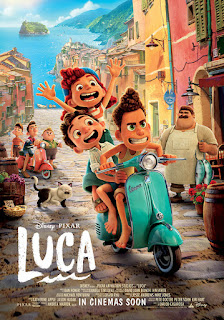
Luca (2021, d. Enrico Casarosa) - Disney+
Onward (2020, d. Dan Scanlon) - Disney+
Encanto (2022, d. Jared Bush, Byron Howard, Charise Castro Smith) - Disney+

For about a decade and a half Pixar was the name to beat in family entertainment.  Every release seemed to have have a kiss of magic to it, a nugget (or nuggets) of something that made it more than just a kid's movie.  It wasn't long before parents began looking forward to a Pixar movie more than their kids did, and it wasn't uncommon to see childless singles or couples in the theatre alongside them.  It wasn't the revolutionary CGI animation, at least not alone, but the maturity in which Pixar films dealt with their supposed children's stories.  They became appointment cinema-going, at a time when parent company/distributor Disney was struggling to find yet another fable or fairy tale to adapt into an expected musical.  Disney was stale, Pixar was inspired.

But Pixar also opened the flood doors and found themselves faced with a sea of competition and imitators, but for every good one like Kung Fu Panda or How To Train Your Dragon there were dozens of others that were just the same old fart joke kid's pap.  CGI animation wasn't an instant sign of quality, but Pixar was.  But something happened around 2010.  Pixar started to lose the handle on their reputation, going back to the well for another Cars movie proved they were just as capitalistic as any other filmmaking company, and the muddled messes of Brave and The Good Dinosaur showed that even the seemingly infallable studio could make a dud.  Disney meanwhile decided to drop traditional animation altogether, having made a few middling-at-best efforts in the first decade of the 2000s, but hitting fairly huge putting their old model of traditional fairy tale into new CGI form with 2010's Tangled.

It would be another few years of muddled output before Disney started to get the formula right, Frozen, obvioulsy, the behemoth that pushed them forward, but Wreck-It Ralph, Big Hero Six, Zootopia and Moana each could very well have been a Pixar film a decade earlier.  Only 4 of Pixar's ten films released in the 2010s would be originals, all the rest would be sequels to earlier hits.  Of this entire run, only Inside Out feels significant.  Beyond 2015 I lose track of which films are Pixar, and which are Disney (sequels excepted).  Such that I could have sworn that Encanto was Pixar and that Onward was Disney, and not vice versa.


Luca
, honestly, feels like neither studio.  While it has some familiarity with traditional animated storytelling, it's not transporting you into a completely other world like Pixar films are so good at doing, but it's also not playing off of familiarity like Disney films do.  Luca is a big, expensive CGI movie that wants to be an Italian art film, focused on the melodrama of emotional friendships and family connections.  I mean, it does involve strange underwater creatures that appear human when they dry out, and we see a bit of that underwarter society, but it's not our focus.  

Our focus is on the mainland where Luca befriends a human boy, Alberto, and they fast become best friends. Luca has basically run away from his family who have threatened to send their disobedient son away, and he feels embraced by Alberto and Alberto's father in a way he never was at home (and also in a way Alberto himself can't be embraced because he hasn't forgiven his father for having abandoning him years ago, much like Alberto's father hasn't forgiven himself).

There's a lot to be said about the friendship between these two boys, and Luca's exploration of himself is a coded puberty metaphor, but in typical Italian fashion, there has to be a female interloper in Giulia who start to cause friction between the boys.  There is definitely a way to read Luca and Alberto's relationship as a gay love story, but I worry about viewing children in this manner.  It's not that I worry about it being a "queer kids in love" story, so much as "kids in love" story. I don't think the kids are quite thinking in these terms, even if deeper down those are the unknown and unfamiliar emotions they're responding to.  I mean, a story of gay and/or bisexual pubescence is far more appropriate a description than "love story".

The animation style is much different than most anything we've seen from a Pixar or Disney feature, a much more rounded, cartoony design to the characters that rings somewhat of Aardman-style clay animation mixed with Studio Ghibli converted to CGI, plus the much simpler environments of post-war Italy.  There's a looseness and bounciness to this picture that makes it's such a light and gentle watch, but allowing for emotionality and drama and a few exciting Vespa and bicycle rides.


In comparison, Pixar's offering from a year earlier, Onward, tried for too much detail, too much world building, that it got lost underneath it all, to the extent that it felt more like a Pixar knock-off effort. 

Where Luca succeeds at building dynamic relationships with dramatic complications, Onward really struggles with its central relationship, that between two brothers, the anxious Ian, and the enthusiastic, outgoing Barley.  They are both magical creatures, living in a world of magical creatures that, well, has become a lot less magical as they seemingly embraced a capitalistic reality similar to our own world.  It's the film's most fatal mistake, making a magical real too similar to our own.  Zootopia, or Monstropolous in Monster's Inc could have had a similar problem, but Zootopia is so uniquely its own place while Monstropolous isn't so much the backdrop as the Monster Factory is (and you get sort of comparisons with the human world and the monster world to highlight the differences).  The world of Onward is the worst possible result, boring.

Ian and Barley happen upon a spell that would allow them time with their long-deceased father (a father Ian doesn't even remember) for one more day only the wand facilitating the spell breaks leading to only the lower torso of their father appearing, and they must embark upon a quest to find some of the land's last remaining magic in order to complete the spell.

Where Luca is a joy throughout, Onward merely has moments that stand out, either visual gags (the half-a-dad pays dividends) or a solid set piece, but overall the world it establishes doesn't really connect.  It's trying to hard to be that kind of reality Cars had, but it winds up feeling like a weird Flintstones knock-off, only less clever.  The weight of the relationship between Ian and Barley isn't appropriately felt until the film's climax.  Ian keeps Barley at arms' length for too long and the film suffers for it.  There's a whole sub-plot about their mother and her cop boyfriend chasing after the boys, which again, has its moments, but altogether feels contrived.

We don't talk about Bruno

Encanto
 makes its own magical reality that exists both within and without our reality, or at least our reality at some point in time.  It also all about family dynamics and the impact of generational trauma.  It's also a lively musical, like Moana and Frozen before it, that should signify that it's definitely a Disney movie, but its fantastical reality feels so much more Pixar.

Escaping with her village from the violence of a civil war in Columbia, Alma witnesses the murder of her husbands by soldiers.  In a fit of grief she screams, triggering something magical.  The land raises up around her secluding the survivors from the violent reality outside.  Decades later, the land is a prosperous, safe, and happily isolated village.  Alma and the two generations of her family that follow live as the head household of the village, in a magical home that seems alive.  Each descendant of Alma is granted a special gift, a superpower basically, which they are to use to help the village grow and prosper.  Each descendant, that is, except Mirabel, who wasn't granted any gift, and as such is treated differently by the family (the townspeople still revere her because she is a part of the family).  But only Mirabel sees that the need for her grandmother to maintain the image of perfection, her need to keep the town safe, the need for everything to just be perfect, is actually causing fractures in the family, and their beloved home.

I'm into superheroes, so this sucked me in easy, being about a family who each get a special gift, all except one. How that person is treated because of it, and how they react to the way they are treated is just one of the film's many, many pleasures. 

The specficity of the location, the history the family (and town) matriarch brings, the ever-present Columbian cultural inspiration (food, music, dance, fashion and decor, flora and fauna)...I may not have picked up on everything, but you feel it. You definitely feel it.

The family members are each so distinct and wonderful, visually and personality. I adored each one of them, even Alma who is so hard on Mirabel. I understood from the tale that opens the film just what Alma had lost, and then had to build and protect. Very, very different story, but my grandmother had to do the same. We come to understand her better late in the film, as we should all come to understand our grandparents when we get older, to see them as human, not just a figurehead or relic of the past or silly old person. They lived a life. But it also doesn't excuse them: to understand them is to find perspective. In Mirabel's case, it's enough to help heal the wounds in her family.

While I didn't pick up on it until the second song, I started hearing Lin Manuel Miranada's voice so clearly in all the songs. I'm not sure what it is within me that wants to knock the tunes for that, but truly they are great. Having to restart a half hour in (because my daughter finally decided to want to watch something with me) and I realized how finely tuned these songs are. He is an exceptionally talented craftsman and, even though he has a few signature tells to his songs, those are kind of what defines an artist. 

I didn't really talk about the actors in either Luca or Onward (young talent in the former not really Italian, big name talent in the latter not really elfs) but Encanto's largely Colombian-American cast really grounds the film with actors with roots to their characters.  I know Stephanie Beatriz from Brooklyn 99 (and a few other things), and Diane Guerrero from Doom Patrol, and I think they're both amazing, verstile performers...I just had no idea they were such wonderful singers. I want them in a live action musical asap. Maybe in that Almodovar musical Penelope Cruz is trying to will into existence.

Encanto resonates magic in a way Onwards lacks.  It builds its fantastical reality based around emotion that make it more like Inside Out than Frozen

Of the recent Disney/Pixar releases, I still need to see Raya and the Last Dragon and if you were to ask me what studio it's from I wouldn't be able to tell you.  The upcoming Lightyear seems like such a Disney cash-cow move, not a Pixar-quality production, yet, that just goes to show how resonant that early Pixar reputation is, that we still hold it to a higher standard that it clearly won't always achieve, or even strive for.

[We agree-ish: Toasty on Luca]
[We agree: Toasty on Onward]

Thursday, January 27, 2022

Last Looks

2021, Tim Kirkby (Brockmire) -- download

This post continues the tradition wherein I have another post sitting in drafts that requires more thought and likely a rewatch because I loved its subject matter, and because I likely have a lot to say about it, but will most likely end up saying, "uhh... movie good." In the meantime, I can distract you the reader, and my brain, with a quick post about a movie that I enjoyed, but didn't leave much of an impression one way or another.

Last Looks, originally called Waldo, after the main character Charlie Waldo, a disgraced LAPD detective who leads a couple of crime books by Howard Michael Gould, is a classic post-noir detective story set in and around Los Angeles, completely dependent on the city & environs as one of its characters. Waldo is hiding out, off the grid, in a trailer in Idyllwild possessing only 100 things, including a chicken named Chicken when his ex Lorena (Morena Baccarin, Deadpool; yes, a movie starring Charlie Hunnam playing a character named Charlie, and Morena Baccarin playing a character named Lorena) shows up to convince him to come back to the city to help her on a case, seeking to keep perpetually drunken Shakespearian actor Alastair Pinch (Mel Gibson, Fatman) out of jail for murdering his wife. Waldo says no, but circumstances, and the violent interventions by two different criminal parties who already think he is working with her, drag him into it, because of course they do.

Long sentences entirely intentional, as the standard convoluted plots and sub-plots of the pseudo gritty detective stories always seem to lend themselves to trains of thought running on and on and on.

I suspect the writer & director don't like LA people much, but love the city. Every character is quirky but most often unlikeable, but even the likeable characters possess traits that would sour most people on them. Pinch is a pompous ass, always drinking, dismissive of his wife's death (not even sure he didn't actually kill her, as he was blackout drunk at the time), constantly looking to get into fisticuffs, but utterly (and charmingly) devoted to his utterly cute daughter. Waldo doesn't really seem all that capable and spends most of the movie getting punched and/or kicked, but he does have a knack for putting all the details together. But the movie is not a whodunnit, as it doesn't dole out the details our way except in the most peripheral manner, so the end reveal is a leap of faith. But the weird, almost mythical nature of Los Angeles and the people within it is always fascinating.

I think about whether I would recommend this movie, and I am not entirely sure. For those who like the paperback style private dicks in LA, it is passable entertainment. For fun, quirky performances, it fills a back tooth. But as a movie, it struck me more as something to be consumed, rather than entertainment. This is one of those movies that people who watch a lot of movies will reference at some point in the future, more as a footnote in comment on some other movie with Charlie Hunnam or Mel Gibson in it. Or in a conversation about the city of Los Angeles and the entertainment business that makes it.

Saturday, January 22, 2022

Masters of the Universe: Revelation (parts 1&2)

 2021, d. Adam Conarroe & Patrick Stannard - netflix
developed by Kevin Smith


There are three things I absolutely loved as a kid: Star Wars, DC Comics, and Masters of the Universe.  In my teenage years, Star Wars made a big comeback first with novels, then comics, and a new line of toys.  DC Comics were kind of "maturing" with me, with more complex storytelling and universe-building and grittier/sexier characters.  But He-Man and his compatriots remained kids stuff from may past: beloved but left behind.

Over 20 years later, my daughter, at a very early age, started watching the classic '80's He-Man and She-Ra cartoons and got very enthusiastic, in the same way I was at her age.  We started collecting classic second-hand Masters of the Universe figures, vehicles and playsets, which ignited my nostalgia, if not altogether my enthusiasm.  I couldn't really stand to sit and watch more than an episode of the '80's cartoons, which were vibrant, colourful, and attractively designed, but samey and juvenile. A rewatch of the early 2000s cartoon revealed them to be action-heavy but quite dull and lacking the same alluring vivacity, and the designs were overdone (my daughter wanted no part of it... the original cartoon series was certainly something uniquely appealing to a child).  

Throughout the 2010s there were constant rumours of a MOTU feature film, but they would never come to pass.  I didn't closely track these rumours but I was excited by the prospect of a whole new MOTU that would maybe appeal to the Gen-Xers who grew up on it but also inspire a whole new generation of fandom. Somewhere in 2019 word came of a whole new wave of nostalgia based MOTU, in the form of a retro-styled toy line and two new animated series on Netflix, one that was said to pick up from where the '80's cartoon left off spearheaded by king of nerds Kevin Smith, the other a revamping of the property for kids of today.

Smith went to conventions, on podcasts and conducted fan-channel interviews stoking the flames of nostalgia, repeatedly talking up how his series would pick up immediately after the '80's cartoon and how it was made by fans for the fans. Excitement in the MOTU fan community was quite high, but, well, I followed Smith for quite a prolonged period of his career, only to eventually see through his geek-done-good exterior and find his skills as a writer and director somewhat limited, and his sense of humour stunted, experiencing no growth since his Clerks debut.  I was dubious how a Smith-run superhero cartoon, particularly one based off a beloved childhood property (meant for children), would fare in his hands.

When part 1 of Revelation debuted (the first 5 of 10 overall episodes) the proverbial shit hit the fan.  The series, for starters, looked nothing like the classic Filmation series (turns out the producers have the rights to the property Masters of the Universe, but not the style or music or original characters from Filmation).  Smith's story, as well, put Teela, not Adam or He-Man as the front-and-center character, and then took some very dramatic swings with the storytelling which set the worst of the fanbase (in the same vein that railed against the 2016 Ghostbusters remake or Star Wars:The Last Jedi).  Bad faith arguments were made, complaints about SJWs and wokeness ruining the property, but there was truth to the fact that Smith sold a bill of goods that he couldn't (and didn't) deliver upon.

Putting aside all the lead in hype, the backlash, and any expectations you might have about the cartoon transporting you to a place that you literally can never go back to, Revelations is, actually, pretty fun interpretation of the property, hung upon a damn good story with some exceptional twists, surprises and subversions.

Where Filmation's He-Man and the Masters of the Universe was an episodic series with no real continuity, no ongoing story threads, and a reset-to-zero conceit each episode. The series played on the ongoing battle between good and evil as He-Man and friends fought the evil forces of Skeletor over and over and over again, with nothing ever resolved, nothing ever advancing, only stopping Skeletor from succeeding. In Revelation each episode moves things quite dramatically forward, starting with a ceremony promoting Teela to man-at-arms, taking over from her father.  The celebrations are interrupted, however, by an all-out assault on Castle Grayskull by Skeletor and his forces.  The kingdom's forces, He-Man, Teela, and others, coming to rescue, and in the battle the power-sword is destroyed and both Skeletor and He-Man are killed, revealing Adam's true identity, and the players in his deceit in the process.

The series then follows Teela, having quit her new post and effectively becoming a mercenary, as she tries to regain some semblance of trust in her world and embarks on a variety of quests with her old allies (and in some cases, old enemies) to try and restore the broken magic of the land.

With He-Man out of the picture, a real spotlight is shone on his typical supporting cast.  Obviously Teela is the lead, but Orko, Cringer, Evil-Lyn, Beast Man and others get pulled into focus, having real character development and depth that was only ever hinted at in prior animated or comic book interpretations.   

Breaking the series up into two parts with a 5 month break in between did a real disservice to the flow of storytelling as well as the perception of the series.  Even fans that were willing to give the series the benefit of the doubt saw the twists of the end of part 1 as, well, fucking with them just too much.

The second half, however, stepped away from being overly dependent on surprises and really dug deep into the character study aspect, particularly of Lyn, which Lena Hedy absolutely demolishes the role.  The ending, after so many turbulent trials and tribulations is suitably triumphant, heroic and epic, but also full of emotional rewards. 

Smith and others have referred to Revelation as an anime, and in how the action is executed it certainly borrows the visual language, but in a design sense it's like a modern extension of the 2002 series, with more shading and depth but similar long angular figures, overly ornate costumes, excessively detailed environments.  It's a very dynamic series, but the action seems almost perfunctory with the drama and world building much more the draw.

My wife has no historical love or really any connection to the property or characters, and yet she was thoroughly engaged by the entire series.  If the series can actually grow the fandom for the property by delivering something that appeals to more than just the existing fanbase, then that's a win.  The existing fanbase of nerdy properties will be harder on any new interpretation of that property than anyone else, but they will still always support it.  In order for these classic franchises to succeed, to continue being viable, there needs to be growth.

If the emotionally stunted, middle-aged, male fanbase want to complain loudly about how it's not what they wanted, that should be taken with a grain of salt.  With every new iteration of some childhood property they are out in force bemoaning how this new take has destroyed their childhood.  Well, you can't actually ruin someone's childhood retroactively, that's not how time works.  What they're basically saying, without having the intelligence or self-reflective insight to adequately do so, is that the new thing doesn't capture the same feelings in them as the old thing.  Well, that's because they are no longer viewing things with a child's eyes.  It's an impossibility for anyone can draft a story, direct a movie, draw a picture, or make a toy that will adequately replicate what every single person loved about something as a child.  The best they can do is take the property and try to make something intriguing and enticing that captures some of what worked about the property in the past, but feels like it also belongs today.  Masters of the Universe: Revelation actually succeeds at that.  


Thursday, January 20, 2022

Ted Lasso Seasons 1&2

2020-2021 - AppleTV+
Developed by Jason Sudeikis, Bill Lawrence, Brendan Hunt, and Joe Kelly

Season 1 of Ted Lasso was an absolute phenomenon.  I know this, because it's a situation comedy about a sports coach and Toasty loved it(!).   Oh, and it won a whole shit-ton of awards and stuff and everyone was talking about it.  But for Toasty to love something that was so steeped in sports, to me, resonated far more than anything anyone else could say about it, or any award that could be given to it.

The only problem with Ted Lasso, as far as I saw it, was that it was on AppleTV+.  Sigh, not another streaming service...


The common description of Ted Lasso season 1 was, affectionately, "kindness porn".  Just people being their best self, or working hard at making other people their best self, with Jason Sudekis' Coach Ted Lasso the chief instigator. 

Ted is an American college football coach brought on by AFC Richmond's new owner Rebecca Welton (who won the team in her divorce settlement.  Rebecca's ex, loving the club far more than he ever loved her, wants revenge, plain and simple, and thinks that the best way to get at her ex is by tanking his beloved team, and she does this by hiring Ted and his right-hand assistant, Coach Beard (yes, he has a beard, but that's just his name).  They made a splash by coaching a little known college to an NCAA championship in one year.  Ted knows nothing about Footie or its rules...but he coaches the people as much, if not more so, than the game.

Ted slowly wins over Rebecca, gets the team to unify under its captain - the hard-as-nails but past-his-peak team captain Roy Kent (hey!) - and even gets through to the selfish, egocentric young phenom Jamie Tartt (I like that people in the crowd sing his name to "Baby Shark").  Ted even lifts locker room manager/doormat Nate up under his wing to becoming an assistant coach.  All Ted's positivism masks the pain he has underneath, putting an ocean's distance between himself and his wife and son, as she has asked for space, so he's giving her as much as he can stomach.  But the pain he's experiencing trying to ignore that his marriage is over and missing his son is applied somehow into a lemons-out-of-lemonade positive manner.  Every major, and most of the minor characters experience some growth, either directly or indirectly from Ted's influence.  It's so damn heartwarming and enjoyable. 

 And, well, it's pretty damn funny on top of it all.

 It shouldn't come as much of a surprise, with Scrubs and Cougartown creator Bill Lawrence on the team with Sudekis, Joe Kelly and Brendan Hunt (who plays Beard).  There's definitely a comedy pedigree on the creative team and in the writer's room.  There's a lot of great world building in and around the Richmond area, including a pile of fans Ted sees on the street or at the pub, and all the many players on the pitch.


Season 2 picks up following the big loss in season 1 looking sunnier than ever.  It's just bright and the optimism is almost unbearable, but an errant penalty kick is a tiding of bad omens and Season 2, while attempting to retain its positivity, gets both heavy and dark, frequently.  The team hires a sports psychologist to help the teammates where Ted can't, but Ted's history with therapy leads to a bit of a tet-a-tet with the new Doctor.  Ted himself starts experiencing panic attacks in the wake of his divorce.  Meanwhile Jamie Tartt's dad rears his ugly head, and Rebecca's dad dies.  But it's Coach Nate, as he starts to come out of his awkward shell, over-compensates, and winds up, very unexpectedly, turning the villain of the piece in a way, and it's quite unsettling.  I literally lost sleep over it after finishing the season.

It's not just the turn into darker thoughts (which mostly provide Ted and crew to find support and solace in each other and find the brightness amidst it all), it's rather the uneven and overly dramatic storytelling the season starts leaning towards.  Two episodes (a fun-if-schmaltzy Christmas episode and a very strange detour featuring Beard) were requested by Apple and added late in the season's production, but inserted into the season at midway points, kind of cutting the storytelling off knees with each episode for over 40-minute detours.  Past the halfway point, all of the episodes run at network TV drama length or longer which puts a fine point on the fact that the show started leaning far more into its dramatic elements than comedic ones.  And some of the drama just didn't play.

Season 2 effectively sidelines Ted with his own issues, which divides his attention and takes his influence out of a lot of the other players' lives.  With the title character busy with his own shit, seems like there's just less of a focused story than in season 1.

Rebecca, powerful, confident, determined in the first season, proving herself every bit the "boss bitch" Keeley dubs her, is relegated almost exclusively to looking for a relationship in the second season.  The match that the show makes for her never fits right, and the show never adequately justifies why either player is so invested in the relationship. Keeley, having moved on from Jamie to Roy in the first season, finds seemingly a perfect match in her new footie beau, but the show mismanages their relationship very late in the game, betraying the honesty they share for the sake of end-of-season drama.  Even the episode about Rebecca's dad's funeral misses a beat for certain characters like Nate and Jamie to reflect on their paternal issues.

There is still a lot of good in season 2, but when season one is pretty much a perfect season, there really was nowhere for them to go but down.  It's not like they could have quit while they were ahead, Ted Lasso was just too much of a freight train...but just like a freight train, it seems it was too hard for them to stop, or even slow down on certain story lines, with no possibility of them turning them around.

Season 3 has its work cut out for it.