Monday, May 20, 2013

3 Short Paragraphs: The Impossible

2012, Juan Antonio Bayona (The Orphanage) -- download

So, here we have it, the possible third movie where we read how I am affected by the onscreen deaths or tragic circumstances. I mourned the deaths of nameless security agents, felled by terrorist bullets (if I do not mourn them, who will) and I suffered a desire to look away from the tragic lives beyond the pines. So here, amidst the South Pacific tsunami where so many died, will I mourn?  Surprisingly no. This movie is not about the death, but about the seemingly impossible act of being swept up in this tragedy, separated and yet reunited.  If you think that is a spoiler, then you didn't see the title of the movie, the impossible act of being reunited against all odds. And from a true story.

I knew this was a surprising movie done by a director I felt some respect for. But I could not remember who, and I blinked during the spanish credits of my download, so I missed it until I just read here in IMDB. Bayona did one of my favourite movies from our Halloween run, The Orphanage, a tragically beautiful ghost story. I guess this must be his hollywood-gives-you-a-test-script movie but no it isn't.  This is a Spanish production with a Spanish screenwriters. The in-English choice was obviously an economics and movie making political choice, but the movie stays distinctly Spanish in style, if such exists. So, the original Spanish family are replaced by an English family to make it more palatable to the world wide audience. At least they are not American.

This is a beautiful movie, if there truly can be beauty in destruction. The horrendous devastation caused by the tsunami is recreated in incredible detail, reminding me more of the photography of Japan than anything I saw of the South Pacific. It is not a movie about the death toll, artfully hiding all the bodies in the swampy water, side stepping the corpses wrapped in plastic sheeting. It is about the act of a family seeking, and finding, each other. It is also not about the plight of the Thai people, staying rigidly focused on these westerners and their ordeal. Is that a fault or a perspective? I would love to see a movie from the point of view of the Thai villagers who sacrificed so much to help the tourists, but that is not this movie.

3 Short Paragraphs: The Place Beyond the Pines

2012, Derek Cianfrance (Blue Valentine) -- cinema

Graig is right. Ryan Gosling has already created a violent indie micro-genre for himself in only a few films, one of them being Drive by Nicolas Winding Refn, and even weirdly enough, the upcoming Only God Forgives. I think it more says what stands out for us with Gosling, than any real attempt at choosing a character typecast.  There may even have been violent characters in his more Hollywoodish earlier films, but it is not this image that seems to be emerging.  For sure, the prevalent images for the marketing of The Place Beyond the Pines were the violent, thuggish character Gosling plays, with his tattoos and bad-ass motorcycle.  Interestingly enough, he is only one facet of the movie.

This is a movie with three definitive acts.  I never truly thought of movies in acts, at least consciously, until Graig and I started talking movies.  Like with board games, he sees structure where I only see play.  He inherently sees a movie broken into three narrative pieces while I generally see only a story. But this movie is so much about its three view points, three jarring narrative shifts. We have Gosling, in the late 80s-early 90s (more likely a town in the mid-90s but stuck in the 80s) riding bikes and robbing banks.  We have Bradley Cooper, made a hero-cop by a shooting but challenged by the heroism of his act, and by corruption in his force.  And finally we have the children of the two men, fifteen years later, each dealing with their dads' legacies and failing in their own ways.

I so much wanted to enjoy this movie, but something nagged me about it as i watched it. Beautiful cinematography, wonderful acting and compelling characters. But it all felt so unfortunate that I didn't want to be watching. It does say something for a movie, that it can show tragic happenstance, and make me not want to watch it -- me, the guy who joyfully watches countless numbers die in disaster movies or emotionlessly watches mooks fall in action movies. I guess, I was pulled in enough that I just didn't want to see what I was seeing.  I have to admit that some parts did drag a bit but it was more the moroseness I felt, that dominated my dislike.  I think I will enjoy it more in a re-watch for the sake of an academic viewing.

Wednesday, May 15, 2013

3 Short Paragraphs: Olympus Has Fallen

2013, Antoine Fuqua (Training Day, King Arthur) -- cinema

Most often, in action movies, when the supporting cast of gun-wielding defenders die you feel little for those fallen NPCs.  Your energy is best directed at the named characters, the ones whose stories you have briefly learned, before they die. The former exist to fall, the latter to be mourned. But as I watched the number of bodies falling to the ground increase, in the astonishing opening sequence to Olympus Has Fallen, I felt a growing feeling of hurt. Not just for the collateral damaged, the fallen tourists and passersby who are cut down by the high calibre cannon firing from the circling plane, but for the numerous cops, security guards, and Secret Service men & women. For some reason, I was painfully aware that each of them was a person, brother or father or daughter. Each one is given a digital blossom of blood, each one receives a killing shot.  Sometimes they got a followup shot to the head.  It was brutal.  Each of them died performing a job, a job none ever thought would lead to death.

Conversely, I enjoy these Die Hard--ish movies.  A single hero overcomes all that is put against him, persevering through a combination of luck and skill.  In the rubble of the White House, Mike Banning (Gerard Butler) survives only because he is the main character -- it is not his role to run blindly into the bullets.  It is also his environment, so he has a great advantage, which he makes use of quickly and securely, picking up the tools and intel he will need.  This movie knows and loves its predecessors, a few nods here and there while following along with the tropes of the genre. I was rather fond of one divergence, somewhat pandering addition to the style -- save the kid. Cliche unto itself, it gives weight to Banning's character in that he sets a first agenda, not to "save the President" but to rescue a kid who he is rather fond of.  This is not "you have to save kids" but a genuine connection between characters. And once it is accomplished, we move away from the pandering to towards the action movie goal.

When I saw who was playing the President (Aaron Eckhart) and First Lady (Ashley Judd) I was rather amused, building a story in my head where this President previously saved the world from an alien invasion (Battle: Los Angeles), got the girl (to me, Bridget Moynahan looks an awful lot like Judd) and ran for Office. But he won't survive this event, at least popularity wise, unless he spins the horrible events well. Not only does a large, well-armed plane invade Washington DC airspace ignoring the threats of two fighter jets, but it was his Administration that missed the smuggling of a few score Korean terrorists into the country, and the purchase of their equipment. He will have a short time as the re-builder, as he comes down hard on his failed Intelligence Agency, but I don't think he will survive such a disastrous attack on American soil. A sad end to his survival of the raw events.

Sunday, May 12, 2013

3 Short Paragraphs: Made in Dagenham

2010, Nigel Cole (Calendar Girls) -- Netflix

I think the first big, British, people do something astounding to better their community movie was The Full Monty, no?  This could probably lead to a couple hours of research on the Internet instead of three quickly penned paragraphs.  So let's let it lie there.  We will assume that you are aware of the genre, of an ensemble cast of working class British folks that are having a difficulty of sorts.  And they do something spectacular, as a group but encouraged by a charismatic leader, to better themselves and their community.  The stereotypical British feel-good-movie. This time round its women's working rights in a 60s Ford factory.

The men assembled the cars, the women did the stitching of the fabric interior.  In what could be called a sweat shop, in that they are all jammed into the shop and the heat has them stripping down to their giant undies, the ladies of Dagenham are a jovial lot of friends, of all ages, working together to sew the seats that the men then attach into the cars.  Cars that few of the workers can afford, as they all bicycle to work.  Bob Hoskins is the shop foreman and Sally Hawkins is Rita, who comes out of her meek shell to demand that the women be considered skilled labour, and be paid as much as the men.

This is a by the books feel good comedy with a message.  We chuckle at the different opinions, the quirky ladies and the occasional fish out of water reactions by the men.  We support their plight and cheer their bravery, especially when reality sets in and strike breakers descend and family lives suffer. I have to admit, I rather like that when a familiar song is played, I hum along with it cheerfully, as long as the song is played well.  That is a metaphor.  There are a few hummable 60s songs but I am being clever.  The problem lies in that it is not a new song whatsoever, not an extremely original song.  Nor are there any truly outstanding bridges or lyrics.  Still, hummable is worth something, right?  OK, metaphor retired.

Saturday, May 11, 2013

What I [Graig] Am Watching 2: Portlandia, Maron, Masters of the Universe, Community

As mentioned in the last WI(G)AW, there's a decided absence of Adult Swim on Canadian Television, thus depriving us Canucks of some of the most outlandish, boundary-pushing comedy in existence. Similarly we also get shafted by IFC Canada, who for some reason are refusing to run IFC's original programs, which are some of the more intriguing comedy offerings (FX and Comedy Central originals pop up with a bit more regularity on Canadian television, mercifully). So for IFC's Portlandia, one of the best sketch shows in the past 15 years, we have to wait generally for DVD release, or, for the thriftier of us, new seasons to debut on Netflix.

I'm halfway through Season 2 at this stage, but still my favourite sketch is the opening one "We Can Pickle That", a pseudo-promotional advert for a couple who insist they can pickle anything.  It starts out as odd, weaves into extremely silly and finishes with subtle absurdity.  The sketches are fitted between the episode's larger story arc, which include things like Fred and Carrie travelling to Southern California to track down the bartender she has a crush on, or Fred, Carrie and the Mayor (a wonderfully cast Kyle Maclachlan) deciding the police need a smarter, fashionable image.  The best of the episode arcs finds a couple rapidly obsessing over Battlestar Galactica, a single episode turning into a weeks-long, job-losing, sleep-deprived marathon.  Facing the end of the show, the couple look up showrunner Ronald D Moore in the phone book (they still have phone books in Portland apparently) and pay him a visit to get him to write one more episode, willfully oblivious that the man is quite obviously not the producer of a successful TV show.  With guest appearances from BSG cast members, it's a story sketch that builds upon itself nicely.

Portlandia makes great use of both celebrity and local talent, in a much different and more earnest manner than, say, the cynical and biting Tim and Eric Awesome Show, Great Job!  Guests are used to surprising and hilarious effect (last season's use of Amy Mann was just the start), while some prominent faces (Kristen Wiig, Andy Samberg) craft characters that fit right in. Creator/writer/stars Fred Armisen (SNL) and Carrie Brownstein (Sleater Kinney) show a great affection for the stuck-in-the-90s culture of the city (that's a hybrid of the 1890's and 1990's apparently) as well as the socially, artistically and environmentally progressive attitude of its denizens.  There's in equal measure hippies and hipsters, bohemians, beatniks and businessmen.  It's a city of culture and quirks, which is both celebrated and exposed.  Every skit doesn't hit, but it's as comedy goes its gentle and sincere nature makes it really stand out.


Another IFC show that will likely never see the light of Canadian cable or broadcast is IFC's newest comedy Maron, which debuted two weeks ago.  IFC threw the IFC-deprived viewers a bone by posting the second episode of Maron to youtube.  The show is a not-quite-sitcom fictionalization of comedian/podcast legend Marc Maron's life, coming out of a divorce and his professional life in shambles, Marc starts a podcast out of his garage where he gets his celebrity friends come have deep and funny conversations with him.  Marc's real-life podcast, WTF, was started the same way, with the comedian equally bitter, angry, desperate, self-effacing and broken.  Now almost 400 episodes deep four years later, Marc's journey has been one of self-discovery and personal development, making amends with his comedian and celebrity friends, discovering a true calling as an interviewer capable of getting his subjects to open up and share with him in a meaningful way that typical talk shows don't or can't.

Prior to the hour-ish long conversation, WTF twice each week opens with Marc sounding off on the notable (or sometimes not so notable) events of his life, filtered through his neuroses in a manner that will either endear him to his audience or drive them away.  This 10-to-15 minutes of "Maron time" informs Maron the TV show, the second episode hinting heavily at his problematic relationship with his mother (Sally Kellerman), his disdain for others (as he wearily takes on a volunteer assistant), his own self-confidence issues (as guest Denis Leary calls into question his courage and manliness), and he stares down the wrongs of his past.  It's a rich and diverse tapestry of ideas that largely marry together well but occasionally feel too disconnected from one another, like the ill-advised spending spree at the hardware store juxtaposed with the dying ex-father-in-law.

But it's ultimately the shows complexity that I'm really taken with.  Like FX's Louie, Maron manages to balance funny with sincere with meaning (and also like Louie it's beautifully shot and well edited).  It's not looking to be a laugh-a-minute type show, and the comedy comes more from attitude and inflection than from jokes or quips.  It works on a cerebral and emotional level very well, it's a mature comedy that will naturally have a difficult time finding an audience (as Marc Maron has faced his entire career).  I have to wonder about Marc's personality though, as I've been an avid WTF listener for four years I know and connect with the Marc of the TV show immediately, but I wonder for the uninitiated if they will connect with him so quickly, or even understand the Maron-ness of Maron that makes it so good?


I don't know how I became so enamored with He-Man as a kid. I remember receiving some of the first wave of characters and Castle Greyskull as a Christmas gifts in '82. I would have been 6 at the time, so I'm not quite sure how I came to know what He-Man was before that. Did I ask for it or did my parents just intuitively know I would absolutely love it? This was well before the cartoon, which didn't appear until 1984, but by then I was already firmly a He-Man fan. The He-Man and the Masters of the Universe cartoon was a groundbreaking programme, the first-ever syndicated-first children's cartoon, as well as the first to produce a 60+ episode season with the expectation of airing 5 days a week.  Being able to come home from school and watch your favourite show based on toys you loved every day was a brilliant idea.  I, and millions of other boys (and girls too) loved it.  The hybrid of sci-fi and sword-and-sorcery was (and remains) pretty unique, which I think is why the characters and concepts have never truly died.  A great many fans of old remain fans.

I'm not quite certain how many new fans He-Man is picking up, but I can say that my daughter loves it all, Skeletor being her particular favourite.  With my long-dormant fandom getting it's pull-start yanked, I thought it best to allow my daughter's curiosity and my nostalgia (as well as my completist sensibilities) to be fed by purchasing the Masters of the Universe 30th Anniversay Commemorative Collection (including all 130 episodes of the original series, all of the 2002-2004 series, and 20 highlight episodes of the dreaded The New Adventures of He-Man).

The '80's series is quite an an enjoyable all-ages show.  There was a specific edict of minimal violence as well as a required moral/educational component to each show.  It seems rather primitive from an adult storytelling perspective, but then it truly was intended as a kids program.  And yet it's still a wonderfully animated, eye-catching program, with great character designs and truly unique adventure situations.  To be honest, I can't dedicate myself to watching it when it's on, I tend to be cruising the net or playing a game on my phone when it's on, but the kids (ages 4 and 11) really quite dig it from start to finish.  My beef with it always was they didn't use a diverse enough selection of characters from the toy line in the show, but that was by design.  The creators were more focused on children's entertainment than selling toys, if you can believe it (considering it was controversial at the time because it was seen as being a 1/2 hour toy commercial).


Speaking of things I can't really watch anymore, Community season 4 has completed it's treacherous 13 episode run, and I'm... I don't know what to say... I'm a little heartbroken, feeling a little betrayed.  After 3 amazing seasons and establishing a deeply personal connection with the characters and the performers who played them, season 4 returned from prolonged hiatus without its creator Dan Harmon in the driver's seat, and the absence was felt immediately and the sense of loss never went away.

Season 4 felt like a batch of poseur episodes.  What made Community so great the seasons before was partly the highly conceptual ideas that dominated each season (a "My Dinner With Andre" homage? A spoof on Ken Burns documentaries?  A Law & Order riff? A painball fight staged as a western?), but it wasn't a Mad TV style of spoof, instead the show's toying with genre and format was always underpinned by character and story.  The comedy came from all sources: performance, dialogue, running gags, characters, story, pratfalls, pop culture references, nerd/geek/hipster culture, religion, family, and still more.  By putting characters first, Community could play in any genre, and work with any story.  Season 4 failed because, by and large, it didn't put its characters before the concept, and when it did, the characters didn't feel true to themselves.

That's largely the result of Harmon's dismissal from the show.  Harmon was a noted taskmaster on the show, each script filtering through him before heading into the production, which accounted for the amazing character consistency in the first 3 seasons, but it didn't train any of the other staff writers to fully find the voices of the characters.  Even still, this season largely abandoned the characters in order to focus on the "clever" stuff or pop culture riffing.  There were germs of good episodes in a lot of the season, but the characters didn't advance much and the comedy was generally lacking (at least in the considerable measure it operated in previously).

I stopped watching the Simpsons in season 10, after putting up with a terrible season 9 in which most episodes the comedy comprised of referencing jokes of the past.  Season 4 of Community fell into the same trap, paying too much attention to the things fans keyed into previously, rather than creating new ones.  But therein lies the rub, the handshake and Inspector Spacetime and the Darkest Timeline and Troy and Abed in the Morning and Britta-the-verb (as in "They really Britta'd this season") all manifested from the character's enjoyment of them, not the audience's and without having much character focus, it was nearly impossibly for season 4 to develop new that would connect with the fans.  The characters referencing or performing like monkeys (Annie's Boobs) on the aundience's behalf took all the joy and natural charm out of the jokes.  Even "Pop Pop" was driven into the ground.

Were there any bright spots?  Barely.  Oscar winner Jim Rash wrote perhaps the best episode of the season, a body-switching epic that had it's roots in Troy's emotional state, but it still didn't fully connect due to the poor handling/ignoring of Troy and Britta's relationship earlier in the season.  The puppet episode many cite as a highlight but I found it's exposing the characters' darkest moments to be hollow and meaningless, a real treading-water moment of characterization.  Even the ultimate reveal of Jeff's dad didn't hit the emotional threads quite right because the writers didn't have the emotional connection to the set-up that Harmon had built for three years.

But the final episode was a series low, centered around a pitiable fake-out dream sequence in which Jeff and company face down their Darkest Timeline alternates, all supposedly in the service of a Jeff Winger who is unable to process his own emotions upon graduating.  Instead it was blatant fan-servicing that backfired completely denying the fans the emotional payoff of the past four years in favour of a rehashing of past glories in faded colors.  So dire was the final episode that I immediately pleaded for its cancellation, a sentiment I couldn't even fathom a year ago when I was lobbying for its return along with all the other devotees.

In cruel irony, where the fans have pleaded for the show's continued existence the prior 3 years, this years the indifference or even hopefulness for cancellation from the fan base has been rewarded with yet another 13-episode order.  This comes from an NBC desperate for any content that will obtain and sustain traction with even a modest loyal fanbase, given that the Office and 30 Rock have both ended their lengthy runs and no other of its comedies, besides Parks and Recreation (also, thankfully, renewed) had anything close to a loyal fanbase.

[

Thursday, May 9, 2013

3 Short Paragraphs: Premium Rush

2012, David Koepp (Stir of Echoes) -- download

Michael Shannon is that guy, that guy with the distinctive voice and the poppy eyes that will spend most of his career playing just shy of the main character.  Most often he is the quirky supporting cast member or the antagonist.  He plays a mean bad guy, excuse the pun.  I mean, just watch him in this reading of the recent sorority email:


So, that guy, right?  The perfect goomba no?  He also plays a decent corrupt cop, Bobby Monday, in Premium Rush.  This is one fucked up guy, at that point in his life where things are just falling apart, where his criminal activities are finally catching up with him.  He has to get the red herring macguffin back from Wilee (Gordon-Levitt) or his life ends.  But considering his behaviour getting it back, its not like he will have much after.  Thus, red red herring macguffin .

You see, Wilee is a cocky, arrogant bike courier who has to deliver the red herring macguffin and runs afoul of Monday, who wants it back.  Cocky meets psycho.  We get a cartoonish, stylish movie of a guy escaping from a crazy cop, on his fixed gear bike, no brakes.  No brakes is important.  Well, important to Wilee.  But I couldn't help but look at Wilee and his bike courier crew and think back to the 90s post-apoc show Dark Angel and wish it really had been Jessica Alba and her cat-DNA riding that bike, escaping the evil cop, imagining scenarios in her head (which we get to peek at) and finding the one that lets her (him) pass through the intersection unharmed and ahead of the bad guy.  But Gordon-Levitt was pretty enough, and more than entertaining in the role.  Fun movie, just more for the performances than anything else.

Tuesday, April 30, 2013

What I [Graig] Am Watching: Mockingbird Lane/Hemlock Grove/Black Dynamite/TableTop/NHL Playoffs

Having shied away from news and rumours sites for the better part of two years, I was completely unaware that Brian Fuller was retooling the Munsters for a modern era.  The Pilot for Mockingbird Lane hit television sets just before Halloween in 2012, though NBC had already passed on taking it to series. which is too bad.  It wasn't a ratings phenom, but it did well, and it was well received.  I missed it, of course, but in the digital age, the only way you can miss something is by not looking for it.

Fuller's morbid sense of humour, which was used sparingly in Dead Like Me and took a rather twee spin in Pushing Daisies here is as broad and lively as can be.  The pilot is occasionally surprising and just as occasionally clever in its use of humour, and sometimes it's just outright cheeky, shamelessly so.  Even the tired riffs on monster cliches (not all that dissimilar to Hotel Transylvania) are so earnestly projected that they come off as charming rather than groan-inducing.   There's very little of the gothic sensibilities of The Addams Family, instead it applies a modern spin on a retro-'60's aesthetic, and Fuller's usual bright and glossy production values keep the show cheery and playful.

The cast is remarkably solid.  Jerry O'Connell made for a solid father figure as Herman, more of a normal-looking patchwork man (assembled of various parts) than a Boris Karloff Frankenstein.  Portia di Rossi as Lili gets vamp it up and look absolutely amazing doing so.  As a vampire she looks ageless, and her wardrobe is incredible.  Mason Cook is incredibly natural as Eddie, who, in the pilot, is unaware that he's the warewolf that terrorized his scout troop.  British actress Charity Wakefield plays the "oddball" of the Munsters, since she's, by all appearances and attitudes, normal.  Finally there's Eddie Izzard made up to look like Paul Williams as Grandpa, a centuries old vampire who doesn't feel that he should have to hide his true nature from anyone.  

It's a great ensemble with good chemisty, and it's unfortunate that this pilot is all we will see of them in these roles (I wonder if NBC would consider annual Halloween or seasonal TV movies? Networks don't do TV movies anymore).  But if I had to choose between Mockingbird Lane and Fuller's latest show, I'm glad Hannibal went to series. But I also have to wonder why more pilots don't make the light of day like this... surely the networks could fill their dead zone (say Friday @ 10:00 with a weekly "Pilot series" showing nothing but pilot episodes they bought but elected not to take to series.


In a just world, we would have seen 13 episodes of Mockingbird Lane on something like Netflix (13 episodes would have been a satisfying amount) but instead we get Hemlock Grove, which is not all that dissimilar to Mockingbird Lane (both even open with werewolf attacks, but this one opts for cliche and gore instead of originality), except it takes itself far, far too seriously. Hemlock Grove is like a Bizarro World/cracked-mirror version of Mockingbird Lane, where instead of being a comedy it's trying to be... I dunno, dramatic maybe?  A mystery?  Scary?  Odd?  Whatever it's trying to be it's just, frankly, painful.  It's garbage television, except it isn't television, it's a Netflix original (in the structure and style of television).

It's trash.  But if people in droves watch terrible programming like the Kardashians or horror shows starring Adam Levine then they will surely eat this crap up. It's so poorly made: terribly structured, awfully acted, shoddily visualized and it's sold as some new landmark of serialized horror (primarily by treading heavily producer Eli Roth's name) but then it doesn't have much to compete with (American Horror Story... ugh) ... except Hannibal which makes it look downright shameful.  (You getting the sense that I like Hannibal.  Because I do.  Like Hannibal.)

The first episode of Hemlock Grove opens up with a sexual rendez-vous in a sporty little car, complete with topless nudity, indicating that it will be "that kind of show", you know, the "adult" kind, except there's nothing mature about the show.  It's hammy at the best of times, with Famke Jansson finding the top within seconds and hurdling well above it.  She seems to be in her own world, turning in a performance that seems to be largely for her own amusement.  Dougray Scott, on the other hand, couldn't appear more bored with his role, the ever present look of "what am I doing here?" in his eyes.

I can't even begin to attempt to explain what the story is, since the show does a lousy job of doing so itself in its first two episodes.  The creators don't present a world for the viewer to invest in easily, they don't set out any rules and they don't provide any clarity on just exactly what type of supernatural is happening in this show and who in this cruddy town actually knows about it.  That would be all well and good if it were a mystery worth revealing, but we're thrust into the fray like we should know what it's all about, and they give us very little reason to care.  Gypsys and mutants and werewolves, and probably some other supernatural crap... and here it's really treated as crap.

I'm trying to decide if it's so bad it's entertaining, or if it's just bad.  I'm leaning far more towards the latter, but I'm certain most who become fans of the show will delight in it in the former.  I'm curious who will enjoy this in earnest, because it's a bewildering possibility.

From TV downloads to Netflix to Android/iPod apps, there's a multitude of ways to get one's entertainment than from the television itself, even though television would be my preferred method of delivery.  The unfortunate thing about television, though, its you can't always get what you want when you wanted.  It is becoming more flexible, but not flexible enough for my liking.  What's more, distribution rights and regional restrictions frequently make it very difficult to watch the things you otherwise only hear about.

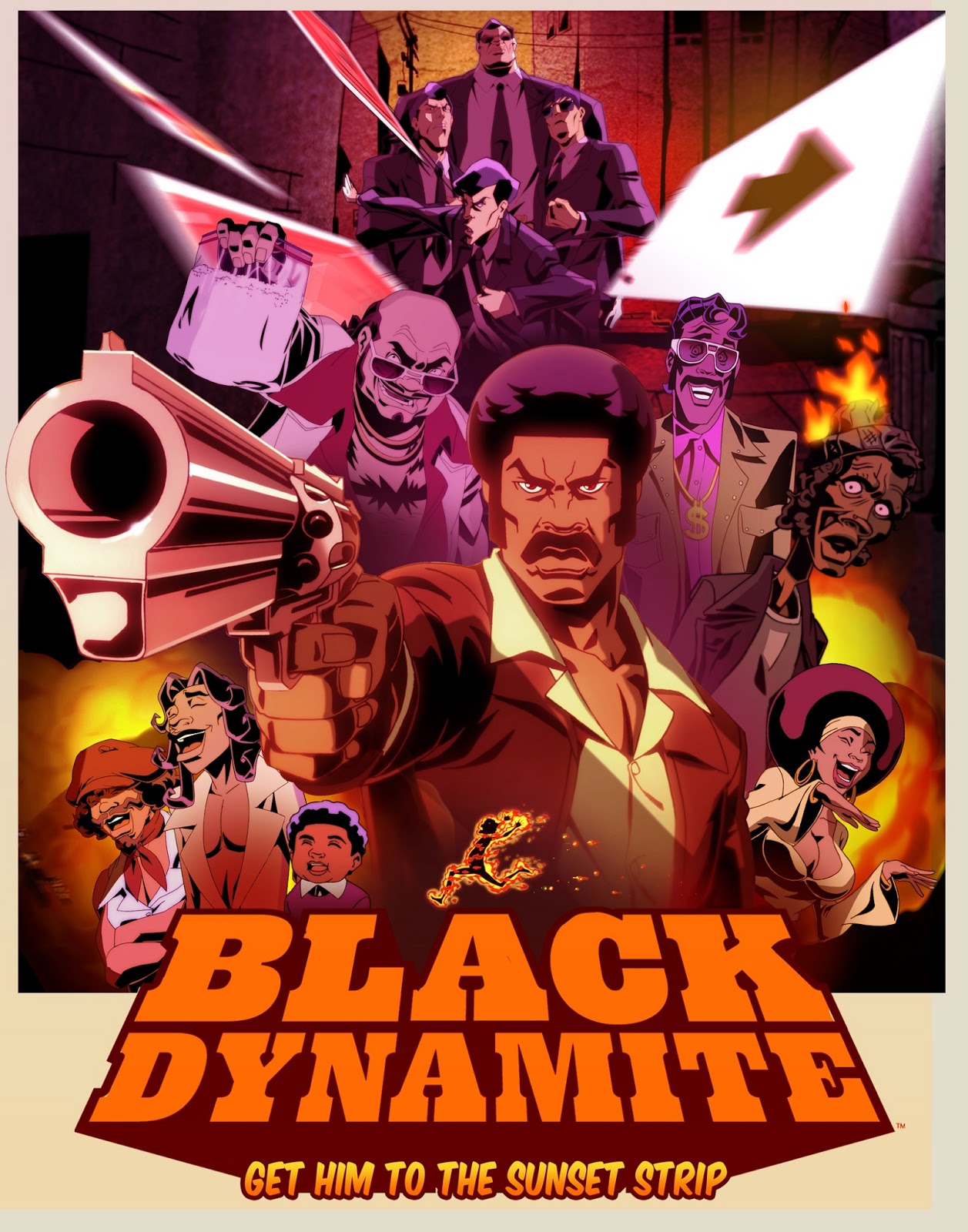
The 2009 motion picture Black Dynamite is, perhaps, my favourite movie of the past dozen years.  It's an on-point homage to Blaxploitation films, satirizing their low production values and sometimes less than professional acting, while at the same time embracing the extreme zaniness that low-budget action films frequently diverged into.  Most of all, it's incredibly funny, conceptually and in execution, in script, in action and in performance.  Everything clicks, everyone involved is in sync and seem to know what is being achieved.  It was an instant underground success, transcending cult, instead becoming pop-cult.  That it branched out into comics, weird web vignettes and animation oddly seemed natural, but I worried that the film was lightning in a bottle, unable to be recaptured twice.

The Adult Swim animated cartoon was announced shortly after the film was released and over the subsequent years I would see the odd article in a magazine or on-line about it's progress, occasionally seeing some test footage, and finally a preview prior to its release on Cartoon Network in 2012.  But, here, in Canada, we don't get the Cartoon Network, which means we don't get Adult Swim, which means we don't get some of the edgiest and wildest television comedy being made.  We have channels here that filter some of it in... Eaglehart, NTSF:SD:SUV::, Delocated, Superjail and the like have made it here, though definitely not at the same time as their airing in the US and definitely not repeated with the same frequency.  And no Black Dynamite as of yet.

But there is an app for that.  A very flaky Adult Swim app which has only five "pages" to look at which are switched out weekly, offering clips and "premium" videos (for US cable subscribers) and on occasion "5 FULL EPISODES" of some of their series like Children's Hospital or Loiter Squad. It's all welcome, but it was when Black Dynamite showed on the App that I did a little happy dance.  The happy dance was short lived though, as the (as mentioned) flaky app for some reason couldn't make it past the commercial that preceded the episode it was trying to show.   Finally, 6 days later, a Saturday if I recall, it was working, if only sporadically (it would crash every so often).  I managed to watch 2 full episodes and 2/3 of two other episodes before the App switched out its offerings later that day, and it was glorious.

The animated series is its own beast, treading in Blacksploitation tropes once more, but going well beyond that into ridiculous high-adventure, ala The Venture Brothers.  It's beautifully animated, perhaps the best going right now, capturing it's day-glo 1970's atmosphere with wondrous effect, and it's damn funny.  A handful of characters from the film are back and they're so on-model with their cinematic portrayal (with the actors reprising their roles), that it's a reminder of just how cartoony and silly the characters were to begin with.  The animated Black Dynamite takes its actions to the extreme, is rife with sexuality, drug use, swearing, and all those things those warnings before TV shows always promise you but rarely deliver.  It's also rife with pop-culture, the first episode I watched hinged around Black Dynamite taking out Mr. T who's still fighting a one-man-war in Viet Nam a few years after the war ended.  Another had Black Dynamite being chased by the IRS for not paying his taxes, and taking a security detail job protecting Richard Pryor.  It's everything I wanted from the Black Dynamite and so much more... all I could ask for is more of it (second season is coming, but that's not what I mean... where's the DVDs?)


And finally, there's YouTube original programming, by way of their partner channels, all of which seems to be the anti-television.  The only obvious restriction for YouTube seems to be overt nudity and pornographic sex.  It's a different beast to create quality programming for YouTube due to budget limitations, so programmers get creative and they get very niche.  Often YouTube channels come out of the "cult of personality" model, where one prominent celebrity (or ce-web-rity) anchors the entire lineup, and the other shows hope for spillover.

TableTop comes from Felicia Day's Geek and Sundry channel, created by Day (who made her name with the impeccable gamer comedy The Guild, the preeminent web-serial success story) and Wil Wheaton (ex of Star Trek The Next Generation, having rebuilt his name as geek icon over the past decade or so), taking the form of "celebrity game show" in a manner of speaking but instead of having one game to play, Wheaton and his guests play a different board game each week.

It's a show for anyone at all into board games, even if you haven't heard of the game in question.  Wheaton and his production crew do a remarkable job of explaining the game mechanics as well as booking a group of players (pulling notable personalities from comedy, acting, web, and gaming circles) who are enticed participants (if not keen gamers themselves).  I frequently use the show as shorthand for understanding the rules to a new game when playing with friends (I'm a terrible reader so instructional web videos are very helpful) and it works well in most cases.  Every episode isn't always great, sometimes the game doesn't interest me, or the guests don't gel together in the spirit of gameplay, but it bats about 90% winning ratio and Wheaton is a fun, competitive, but also helpful host, out to win but also to ensure everyone has a good time.  The only thing better would be playing one's self.

The latest episode sees Felicia Day and three other actresses back (for a 3rd time I think?), playing Resistance (a spy game in which two of the 5 players are anonymously trying to stymie the others), and it winds up being a rollicking good time.  It's in many ways like watching poker, only with the people involved far more lively and engaging one another with an eye towards being entertaining for the viewer.  While it may seem that one or two players have the spies in their midst all figured out, and that the spies have tells that are giving them away, by the end nobody is sure of anything.  This is easily the most enjoyable episode of TableTop, but I might be biased towards "Team Ginger" (I want a T-shirt!)


Oh, and I'm watching NHL Playoffs... without getting too deep, let's go with predictions:

EAST
Pittsburgh Penguins - New York Islanders => Pens in 4
Montreal Canadiens - Ottawa Senators => Sens in 7
Washington Capitals - New York Rangers => Caps in 6
Boston Bruins - Toronto Maple Leafs => Bruins in 6

WEST
Chicago Blackhawks - Minnesota Wild => Hawks in 5
Anaheim Ducks - Detroit Red Wings => Ducks in 7
Vancouver Canucks - San Jose Sharks => Canucks in 7
St. Louis Blues - LA Kings => Blues in 5


3 Short Paragraphs: Branded

2012, Jamie Bradshaw and Aleksandr Dulerayn -- download

It seems I am not the only one who fell for the advertising of this full of itself movie about the power of advertising, post cold war idealism, allegorical destiny and pretentious nonsense.  We all saw the trailers and posters on these specfic blogs, showing weird wibbly-wobbly creatures growing out of people's heads, that nobody but the main character can see, and it is some how connected to advertising.  Nouveau They Live indeed.  Yeah, but that is not this movie.  That was just the shill.

OK, it is  about the power of advertising.  Misha is a genius ad exec in Russia who lives by the core ideal that Lenin created advertising, in its modern conception. He is wrapped up in a skinniness-sells TV show that goes wrong and puts the contestant into a coma.  But really, what is happening behind the scenes is that Big Burger (you know, like Big Oil) has hired a James Bond reject-villain (Max von Sydow) who will manipulate the world sentiment and not only return us to eating burgers, but flip the tables so soundly that we will eat nothing but burgers will suffice.  It is not about eating what you want, but embracing gluttony.  And it works.  So our hero runs away to the countryside and ritualistically kills a cow.

That was the first half of the movie.  When our hero returns we get the wibbly-wobbly alien blobs attached to heads.  Apparently they are doing the burgers-are-good-for-you convincing, or at least he thinks.  We never really know.  Surrealism?  Maybe.  Absurdity?  Really.  As a hero it is now his job to again flip the table (but fast food tables are secured to the floor you say?) and find some way to make burgers Evil.  He is an advertising genius who sacrificed a cow, so he is ready.  It works, and really don't whine about spoilers because you will not / should not see this movie.  It works and villain-reject is killed by a spear of destiny come lightning bolt.  Poof.  Dust.  Gah, what clap trap.

Sunday, April 28, 2013

Tom vs Tom, Jack vs Jack

Oblivion, 2013, Joseph Kosinski (Tron: Legacy) -- cinema
Jack Reacher, 2012, Christopher McQuarrie (The Way of the Gun) -- download

A lot of people dislike Tom Cruise, but do they hate crazy dance-on-a-sofa Tom Cruise? Hate Scientologist Tom Cruise who took the sweetheart from Dawson's Creek and implanted her with his alien symbiote?  Or is it his one-note heroes, all confident smiles and set jaws? I think it is those exactly one-note heroes that makes him so good in so many of his roles, where he saves the girl or saves the planet or at least saves someone.  Where he is the effective man, in control and very good at what he does.  Skip the man of Scientology and see the hero who fits into the roles that make women swoon.

Jack Harper is a soldier on post-apocalypse Earth, likely the last capable man on the planet.  He and his equally effective team mate live in a shiny-glossy-clean penthouse tower overseeing the defence of big machines sucking the remaining oceans to be made into hydrogen that will fuel the ships heading to Titan with the rest of humanity.  You see, we lost the war.  Technically, we won the war, beating the invading aliens who broke the moon, but in doing so we lost the planet.  So  the mostly irradiated, wrecked ball of (eerily beautiful) mud and scraps is abandoned. A few alien scavs are left behind causing trouble for the ocean suckers so Jack and Vica monitor and repair the combat drones, and their lovely baritone bassoon voices, that defend the ocean suckers.  Soon they will be done their tour and will join others on the big tetrahedron satellite, to prepare for the journey to Titan.

The setup for this movie is absolutely lovely.  The wide, open spaces that Jack surveys in his almost-dragonfly flying ship, the wrecked canyons of old cities with their waterfalls and ice crevasses, are just enthralling, supported by ethereal M83 music and smooth, grey tones.  Jack likes to get dirty, get down there on the planet and see what he is leaving behind. Vica will not even consider the idea of leaving her pristine, extremely designy bunker.  They are supposed to be an effective team, but she sees Jack pulling away when she feels they should be pulling closer, to ride out their final two weeks. It doesn't help that Jack is dreaming of another woman, a beautiful woman he meets on the observation deck of the Empire State Building.  But that doesn't make sense, as that was over 60 years ago, before the planet was wrecked.  And thus the hint that things are not what they seem.

Oblivion has been compared to Wall-E, unimaginatively because it is about a lone guy left behind on the wrecked earth to repair things.  But really, if you want to compare the movie to something, try Moon, the Duncan Jones indie scifi movie about a guy doing a three-year stint on the moon, mining and repairing.  Its about longing, and isolation.  It is about style and mood.

The opening act of the movie is all what makes good scifi, a slow burn of setting and story, but I admit to not being as fond as the latter parts, the canyon battles and "this is what we have to do" climax.  Oh, the twist (not Shyamalan twist, but still, a direction I wasn't expecting the story to take) was intriguing but it was not the focus of my after-movie pondering.  I won't spoiler you, you can find that on the rest of the internet.  Or see the movie.

Jack Reacher is the ex-military man hiding in plain site, invisible to the trappings of modern life.  He is recounted as a brilliant investigator for the military police that disappeared after a case went horribly wrong, after an iron clad sniper crime collapsed in a scandal of systemic rape.  Another sniping reaches out from the headlines with one phrase "get Jack Reacher".  This new case is also iron clad, all the evidence at hand, thumbprints and shell casings. But why ask for Jack?  So Jack suddenly appears, also curious.  And again, it all begins to unravel.

Who is Reacher?  That is what everyone, including us, is asking.  He is off the radar, off the grid, hidden in society that relies on credit card statements and cell phone records.  Why?  We never really know but it adds to his mystique as the very effective man.  This role, for Cruise, is all Mary Sue with brilliant deduction, effortless combat and a relentless swooning from every woman in the bloody movie.  I thought it was producer / Cruise intervention but apparently it was present in the novel the movie is based on.  Jack Reacher is a hot capable man.  I admit, Cruise pulls this off for the character has a not-take-advantage aspect that is admirable and focuses his character.  There is something going on and only Reacher seems to actually care and to be capable of pulling the details together.  This is prime pulp crime book fiction.

Jack Reacher starts with potential as well, but slides very very quickly into a trope-ridden action conspiracy movie.  It even has a climactic battle in a construction / mine site with automatic weapons and knife combat in the slip, sliding rain.  The villain is villainous and the mooks die quickly.  The effective, enjoyable parts of the movie are about a very, very capable man at the extent of his limitations but knowing he has to do this.  And as mysteriously as he appeared, Reacher wanders out of the movie without getting the girl and not likely getting a sequel, unless Cruise's alien overlords bankroll the next movie.

Tuesday, April 23, 2013

3 Short Paragraphs: Men in Black 3

The recent trailer for R.I.P.D. made me quip, "So, it's MIB but with the dead??"  That does say something, in that back in 1997 (!!!) a micro-genre was established.  I think that we can forgive a creator for using a comic book based plot device, almost twenty years after another comic book based plot device set the bar.  It's not like the predecessor did much else with the privilege.

I did not like MIB2, in that it was a tired recycling of the elements that made the first one fun but nothing original.  I was glad they waited a few years to make the new one, hoping the sour taste would leave my brain.  I guess it did for I was not overly annoyed by the new one.  But nor was I impressed. You would think that a timeline reset would give them a chance to introduce an entirely new MIB agency to play with, but no, it does the sequel two-step as well and rehashes what we chuckled at in the first movie.  Where it shines is when J is forced to time jump (or leap) back to the 60s to save K.

Its a rather charming romp into the past where J realizes exactly how much of a connection he has with K while trying to stop one of the best villains in the series, Boris the Animal.  Its what you need in these movies, a monster serial killer who creeps you out while chewing up the scenery with a mouthful of alien teeth, and crawling claws.  But the brilliance came with the question, "Who would we get to play Tommy Lee Jones as a younger fella?"  And the answer is Josh Brolin.  Heh.

Sunday, April 21, 2013

What I Am Watching: Person of Interest, Doctor Who, Sons of Anarchy

I admit, I actually only watched the premiere episode of Person of Interest and then dropped it. Not sure if I remember actually why, considering this could easily be my new The Equalizer.  Good Guy with a dark past works with skilled assistants and helps people in trouble.  This time the want ads are not helping out but a really nice computer software system is.  And considering how many times Kent has recommended the show (he's batman!!), I am somewhat chagrinned to say it was actually a recent single episode that clinched it for me -- the episode where Sara Shahi plays Shaw, a killer for the other side of the coin that works for the The Machine.  Yep, I like her but damn that was a fucking good episode, possibly the best thing I had seen on TV this year.  So, back to the torrent-machine (another machine that probably knows a lot about me) to get all of first season.

What I am truly, completely enjoying is the evolution of the supporting characters. Fusco may have been the easily manipulated corrupt cop but he is actually, without a hint of overeager plot development, redeeming himself. He actually seems to be remembering why he liked being a cop in the first place.  And Carter is not just the cop grudgingly trying to figure out a case, but actually quickly realizing she respects what Reese and his accomplice are doing.  And helping where needed.  All that is missing is the too curious guy who works in the morgue.  That['s alright because we do get a rather brilliant scene in a morgue involving an immigrant surgeon and a bag of money.

There is that thing about money.  Good Guys always seem to need and use money but with no source.  But this show actually did two episodes where money is generated and stored, to be used quietly and unspoken of for what I imagine is the rest of the show.  That is the kind of stuff I enjoy -- supporting details that don't need to blatantly played with.  I am somewhat aware of where the show will go, with other supporting people and a full blown antagonist, but until I get there I am enjoying the progression.

And then we have Doctor Who, the latest season.  My favourite, until now considered irreplaceable companion Amy Pond, has been supplanted by Clara Oswald.  Oh, those big brown eyes and eager excitement for the unknown.  But another companion with a dark secret, one that we were introduced to long before she ended up in the blue box.

I am rather fond of a Doctor who is not currently haunted by his completely nasty history-future.  He really is trying to recapture his joy of doing the travel to rare and wonderful places and times.  Unfortunately, not much of this season has truly shown that.  There was that trip to the planetoids circling the monster-sun but that was about it.  But the rest have been random pops into British history.  Meh.

Speaking of that alien planetoid, I was left with an odd thought -- if the TARDIS does all the translating he needs, why were some of the aliens speaking in chirps and growls when the rest spoke the Queen's english?  Some beyond even the TARDIS's capabilities and since the Doctor seems to speak their growls and barks, its OK ?

Finally, we are climbing into the fifth season of Sons of Anarchy.  I avoided this show in the past, simply because the idea of idolizing a bunch of bikers didn't appeal to me.  But we were slipping into a mid-season rut of downloaded things to watch so Marmy snagged it.

For the first couple of seasons, I was rather impressed.  We got an appealing protagonist, a pseudo-Hamlet in a story where his mother married the best friend and nemesis of his deceased father.  Jax is the attractive young heir to a motorcycle club legacy in northern California.  The Sons of Anarchy run a repair shop but really do a profitable job of gun running out of the small town of Charming where they pretty much run the town, funding who they need to fund and keeping the bumpkin of a police chief in their back pocket.  They are a likeable if sleazy & violent bunch, where family is everything and the rules of the club are all.

That is what kept me going for a couple of seasons.  Oh sure, they are all pretty nasty, sleazy types with weird predilections and dark connections but they also have a rather charming (excuse the pun) love for the fellows.  Really, they have no issue saying they love each other with hugs and kisses; not what you would expect from big hairy bikers. And the violence that comes their way seems to be out of the ordinary, not in the norm for them but bad cases of circumstance.  So, we forgive the criminals because we like them and the completely deplorable choices are not their own.

As the seasons progress and the likeable characters make bad choices, because really there are no good choices in crime, we stick with the bunch of thugs because we are now invested.  We care what happens to them; they are our bikers now.  We want Juice and Opie to win and we want Clay to fall, and fall hard.  Jax is learning the ever elusive truth and we want, need, him to get to it.  But... but, they are murderous (yeah yeah, code only murders) gun and drug runners.  But they hug and kiss and are the teddy bears of crime.

But, and yes another but, for fuck's sake, we know that a popular show has to be extended. And while I get that the idea that it is about the road to hell being paved with good intensions, but does everyone have to fall ?  Sure, Hamlet is supposed to be taken over by his desire for vengeance against the man who led to his father's death.  But by season four, the ghost of John Teller is already faded and any reference to the Shakespeare story is gone. We just have things going wrong, and wrong and wrong and wronger.  Now getting into season five, I am not sure exactly why I am sticking with it.  Must be just to see what Tig would be willing to fuck this season.


Double Oh...14: A View To A Kill

d. John Glen

A View To A Kill Preamble: By this point I'm tired of Roger Moore, who himself looks quite tired.  He was getting too old for this shit, and he knew it, but they kept offering him the role and the money and he kept coming back.  I thought I knew this film from my childhood going into it, turns out, not so much.

Villains: A View To A Kill is a spotlight movie for Christopher Walken as Max Zorin, a psychopathic millionaire industrialist, and (besides Grace Jones) the only prominent villain in the piece.  Coming out of Deer Hunter, Heaven's Gate and The Dead Zone, Walken was a prominent figure, but still not a star, certainly not to the level of notoriety he's received over the past decade as a cult figure.  But it's in that context as cult figure that Walken's performance here truly shines.  I'm sure it was notable at the time, but even more so now it's evident that Walken relished the role unfettered with scruples or sympathy.  Part of his backstory/psychopathy is only narrowly explained, that Zorin was the result of a steroidal experiment whilst in the womb, and also trained by the Russians but never a true soldier.
   The ex-Nazi doctor who performed the experiment, Dr. Carl Mortner, is now Zorin's trusted aide, and doting parental figure.  Mortner is also responsible for the design of the microchip Zorin uses do dose his horses with adrenaline boosters as they run.  The ultimate plan Zorin has is to agitate the Hayward and San Andreas faultlines so that Silicon Valley will be destroyed, and his microchips can flood the depressed market to grand riches as well as backdoor exploitation.  It's a rather cool, intricate, Lex Luthor-level scheme, the unveiling of which was the highlight of the film. Although I've never seen Luthor with a semi automatic gleefully chuckle as he mows down all of his hired help in the mines.
  Russian General Gogol returns once more as a background character, his fifth appearance in 5 films.  He's never much of a villain, just as often a collaborator with MI6.  Here he's as interested in Zorin's activities as anyone, especially when Zorin falls out of line (Dolph Lundgren makes a very brief appearance as one of Gogol's KGB security detail).

Bond Girls: May Day, Zorin's right-hand aide, lover and sparring partner is simultaneously scary, intimidating, and striking.  Model Grace Jones has a very ominous, stern presence which makes her quite memorable, unfortunately her acting chops aren't quite so impressive as her physique and editorial-model looks.  At times she lives up to her role, other times it's quite apparent she's a model in a film (line delivery foremost).  She goes out like a boss thought.  An astounding exit.
  Faring no better, Tanya Roberts (later Midge in That '70's Show) is about as convincing a geologist as Denise Richards is a nuclear physicist in The World Is Not Enough.  Perhaps I still see too much Midge in Stacy Sutton to give her more credit, but it's a thin role largely of clueless victim that she plays.  She is the heir to land that Zorin needs in order to execute his plans, but in refusing his offers, he tries to dispense with her other ways.  Bond naturally comes to her rescue, already bounding on tip-toes towards her Pepe Le Pew-style since meeting her at Zorin's soiree.  It's an eye-rolling pairing as he should truly be a surrogate father figure to her rather than lover.
   Pola Ivanova is a Russian spy who Bond once seduced, played here by the buxom Fiona Fullerton.  Pola comes back into Bond's life as they cross paths sneaking around the docs where Zorin has a drilling operation set up.  They help each other escape and fall into bed together (well first splashing around a hot tub together).
  May Day also has a couple of trained assassins on her side, Jenny Flex (played by Allison Doody) and Pan Ho (played by Papillon Soo Soo), who serve as little more than eye candy and a temporary distraction in Bond's endeavor to stop Zorin from destroying California.  Their death also serves as an agitator for Mayday to turn on Zorin.
   I should also note this was Lois Maxwell's last appearance as Moneypenny.  The film should have ended with her and Bond in retirement together, as she seemed to be the closest flirtation to Bond's actual age.

Theme/Credits:  The first Bond theme to be a #1 hit, Duran Duran's "Into The Fire (A View To A Kill)" is a full on 80's pop-glam explosion, the bombastic horns make the song, and if anything undercuts it it's Simon LeBon's whine.  The lyrics, I have to credit them, are aptly Bond-ian.  The neon-blacklit ladies emerging from fire and smoke are perfect Bond opening credit moments.  The silhouetted skiers, less so, but they reflect the transition from the rather limited opening sequences of the past to a more animated or technology-aided openings of the future.  Not the best song, or the best credits sequence, but both quite good.


Bond: So old, this Bond, so obviously old, yet, the age so ignored.  Skyfall dealt with a Bond in far better condition and about 12 years junior dealing more responsibly with the question of capability given his age.  It would have been rewarding to have it addressed, even minimally in A View To A Kill.  But Moore's Bond was always questionable in his methodology and egocentric in his perception of himself.  Where Connery might have a bit of a sweat over a predicament he finds himself in, Moore calmly and casually faces death's door with the attitude of "yeah, right".  Moore's Bond here excels at the social side mingling at a soiree or engaging with contemporaries.  It's the physical side, including sexuality, which are the furthest fetched and most challenging aspects of the character/actor at this point.  I just kept waiting for an "oh, my knees" comment.  The only thing that makes Moore look young is by partnering him with The Avengers' (the TV one) Patrick McNee.  Bond has a sommelier's senses, a refined knowledge and appreciation for wine as well as an expert horse rider. One gets the sense that Bond comes from an elite background (which is exactly what he wants to project).

Movie: Unlike a few other entries in Moore's Bond oeuvre, A View To A Kill actually fares better in hindsight.  I don't think I enjoyed watching it much at the time, but as I think about it, it certainly seems more favourable in my head.  Realistically, though, it's not a terrific picture.  While John Glen made an auspicious debut with For Your Eyes Only, Octopussy and A View To A Kill reveal some tendencies that are downright silly (the opening skiing sequence, for instance, finds Bond snowboarding before snowboarding was really a thing, and playing California Girls overtop, just to hit home that it's like surfing on snow, dude).  There's a great chase sequence that finds Bond's compact car becoming even more compact, after riding on the top of an open-topped double-decker bus, it loses it's roof, then get's bisected, but, front-wheel drive, Bond keeps going.  It's really a cool sequence, if not for the fact that it's played more for chuckles.  As is the fire engine sequence through the streets of San Francisco (Tanya Roberts shrieking "James" constantly wasn't any more endearing to the scene).  It's pre-Die Hard, post-Indiana Jones action and suffers for its influences and lack thereof, filled with cheap fights and 80's-style rescue sequences.  Pretty much up until the mine sequence, it's quite a low-key affair, the stakes don't seem quite so large until Zorin's masterplan is revealed.   The last 25 minutes or so are popping, however, it's unfortunate Moore couldn't put on as good a show as the fight atop the Golden Gate Bridge deserved.

Q-Gadgets: Q toys around with a surveillance robot (that looks kind of like K-9 from Doctor Who).  It doesn't serve too useful in the film.

Classification (out of 01.0) - 00.4 watchable, but barely.

Saturday, April 20, 2013

Catfish

2010, Ariel Schulman, Henry Joost

Since the film's auspicious debut a couple years ago Catfish has permeated the public consciousness in a way few films do, in such a regard that far more people know about the film than have actually seen it, also in such a regard that knowing what the film is about seems to diminish greatly the necessity of seeing it.  "Catfish" is used as a metaphor in the film (as one interviewee states, a catfish is used is the tank hold on cod fishing ships to chase the cod and keep them vital and fresh) but in real life, because of the film (and the MTV series it spawned), catfish has become both a verb and a noun, both relating to false identities on the internet (the verb catfished meaning being fooled by the noun catfish meaning the person adopting the false ID).

The film is at once a love story, a suspense mystery, a human drama. a little bit of horror (curiously enough) and possibly a bit of subterfuge.  It involves two filmmaking partners turning their camera on Nev, one of the filmmaker's photographer brother, as he begins an on-line correspondance with a young artistic prodigy.  This leads to Nev interacting with the girl's family extensively, soon developing a crush aw ultimately a long-distance relationship with the girl's older sister.

But things start to look suspicious when an innocent YouTube search turns up the first sign of deceit.  The more Nev and the filmmakers probe his online friends' claims the more he invalidates their authenticity.  Rather than fully disconnect Nev and friends decide to confront, though without malice, the perpetrator(s) of the hoax he's now certain he's a victim of.

What builds suggests an intense 3rd act to come, horror and danger lie around the corner. It is a clever bit of filmmaking, constructing real world elements into cinematic tropes as to emulate conventional fiction storytelling.  However where the 3rd act would normally be loaded with action and conflict what instead Catfish provides is a potent dose of sympathy and pathos as the perpetrators lies shield a difficult life, and present an escape from an everpresent, crushing reality. 

Catfish is an incredible experience if not altogether believable.  Oh for sure Nev was being fooled but the act of discovering the fraud seemed staged (or reenacted) rather than fully authentic of-the-moment reactions.  As well I have my suspicions that the filmmakers weren't already somewhat wise to what was really going on before they put it to film.  Even still, the storytelling craft is remarkable (is this real or a mookumentary I asked myself constantly during the first two acts) and and the final act is an engrossing and surprisingly compassionate exploration of motivations.

Friday, April 12, 2013

The Queen Of Versailles (2012)

d. Lauren Greenfield -- netflix

North American culture has become obsessed with affluence.  It's the natural byproduct of a consumerist culture.  It's not longer enough to just have stuff, but you have to have the best stuff.  As a result, people are driving themselves deeper and deeper into debt in order to have stuff, and to project the appearance of affluence.  We're now in a new era of feudalism, the divide between the have and have nots, the 99 and the 1 percent, where the all-having 1 percent are basically guiding the bulk of North American culture and spreading it across the glove.  The haves cannot seem to have enough.  They want it all as long as there's any left to get.

Popular media is run by the haves, and since the moment they realized that millions of people at a time enjoy watching spoiled, nasty, talentless people behave rudely in public with a general disregard for common decency and civility, and a total disrespect for everyone (including most often themselves), it's flooded our society.  We've idolized the rich and famous in the past, but generally when celebrities or the "elite" society behaved badly in public, it was severely frowned upon and potentially career-killing.  Today, we celebrate the awful, starting with Paris and Nicole, making way for Kim, and busting the doors open for Snooki and an endless parade of "Real" Housewives and predatory Basketball Moms.  It's the new American dream, to have more money than you can possibly spend and not have to give a crap about anyone or anything anymore.  Popular media would have us to believe this is reality, and we can all have it all.

The Queen Of Versailles started as a documentary about a family who have it all, and want more.  David Siegal brought himself up from nothing, his beginnings were extremely modest, but he was frugal and shrewd, and when the right opportunity came up he started what became an empire of time shares, Westgate Resorts.  His wife, Jackie was also from humble beginnings, but after struggling to achieve an engineering degree and through an abusive marriage, she made it big via Miss America pageantry, where she met David (some 30-ish years her senior).  David's empire is so lucrative that he played kingmaker and takes personal credit (repeatedly) for winning George W. Bush the presidency ("I'd rather not say, it may not have necessarily been legal"), a decision he does have some apprehension about in hindsight .

The film follows David and Jackie, (and their 8 kids, their nanny, their limo driver and David's adult son who's general manager of Westgate Resorts) through their affluent lives, with a keen focus on David's two biggest projects, his new PH Towers Westgate building, a 52-storey blue glass monolith in Las Vegas, and one of the largest mansions in America, Versailles, a 90,000 square foot dwelling backing onto Disneyworld, modeled after the French Palace of Versailles.  The excesses of David and Jackie's life, and especially their plans for Versailles are so extravagant, so unreal, so inconceivable that it verges on nauseating ("This is what five million dollars worth of marble looks like", Jackie exclaims as she shows their documentary crew their garage filled solely with crated stone).

It begins a story of excess, and then November 2008 occurs, the housing bubble bursts, the mortgage backed securities are seen for the sham they were, and the stock market crashes.  Suddenly Westgate is forced to lay off hundreds upon hundreds of employees, David's refusal to turn over the PH Towers Westgate building to creditors threatening to take down him personally and his entire company (even the rich still want more than they can afford).  It then follows the family and the people around them as they struggle to cope with having to struggle, something which their clearly not used to. 

There's an element of schadenfreude to the Siegal's story, a tantalizing look at the felling of the mighty, but it's still not easy to watch, especially as they struggle to maintain some semblance of their own normality.  Their nanny's story is the most painful, separated from her own family for more than a decade, having missed out on her son growing up, sending all the money she makes back to the Philippians (and one can surmise she's not rewarded for her dedicated and tireless service particularly well), straining to find some comfort in the family she's made having taken the lead in raising the Siegal's kids (Jackie is not an absent mother by any stretch, but even she acknowledges that she wouldn't have had more than two had she not had nannies).  Other house staff are not so lucky, as the Siegals pare back 3/4 of their home crew.  The most noticeable effect is not on David, Jackie or the kids (forced to attend public school), but the many, many pets they have.  Lizards die of starvation or dehydration, fish go belly up, and dog crap is, quite literally, everywhere.  More collateral damage from their descent.

During their hardship, only David (and his son) seems truthfully aware of their situation, something Jackie laments late in the film.  "I kind of wish I was more involved, because I'm not a stupid person," Jackie notes, upon learning from the crew that Versailles in foreclosure, "but when you don't have the information, it makes you look stupid."  If not told outright, Jackie is made painfully aware that things are not good, yet she proceeds to spend excessively, if only at Wal-Mart.  She buys with reckless abandon, four shopping carts full of duplicate products for Christmas.  When she arrives home, the crew makes a point of showing the new bike she bought carried through a garage filled with other bikes. 

The Siegal's don't seem like bad people, and they seem to have an awareness of how lucky they are to have achieved affluence (despite hardships).  Jackie and David's relationship (as well as David's relationship with the kids) is strained incredibly by Westgate's misfortune and while you don't ever feel particularly bad for them, you don't really feel as good about their situation as you'd think. Yet, I was kind of rooting for David's business to tank completely.  I think Westgate's business practices are at best distasteful and at worst aggressively predatory.  Their tactic is to sell average people luxurious time share properties they can't afford to buy and likely will be unable to use most of the time.  They sell themselves a vision of "helping" these people, but realistically, they're praying upon their desire to taste a bit of affluence they really can't achieve even in this limited regard.  Where a company like Westgate can default on loans and work tricky magic like buying back their own overdue credit for 15million less than it was initially worth, the people who buy into their time shares, the suckers and the rubes who are even more harmed by the recession, are still on the hook, and you can bet Westgate isn't going to let up.  A large part of the company's value is in the "balance owing".

The coda to the film still inferred the Siegals were struggling, but a web search shows that Westgate has recovered, turning record profits, and that David is pursuing the completion of Versailles (as well as a couple of lawsuits against the filmmakers).  It's a fascinating doc, a rich character study, as well as a unique perspective of the 2008 market downfall and its aftereffects.  The doc originally started out as a borderline Real Housewives/Lifestyles of the Rich and Famous but it transcends its vapid origins tenfold into something brilliant.


Red Dawn vs Tomorrow, When the War Began

Red Dawn, 2012, Dan Bradley (stunt man, first time director) -- download
Tomorrow, When the War Began, 2010, Stuart Beattie (writer, first time director) -- Netflix

Red Dawn is the remake of the classic 80s movie ("Wolverines !!") about teenagers in a small American town reacting to invasion by Russia and their Cuban allies.  Tomorrow, When the War Began is the recent movie, based on a series of teen novels, about small town Australia being invaded by "the coalition of three countries" -- Korea and allies.  Neither are very good.

The original Red Dawn was not very good either.  But it was a classic adventure story where teenagers and young adults stand up to oppressive authority and overcome the odds.  And unrealistically defend their town against trained soldiers.  As a kid who "played guns" I was convinced (at 15-16) that we could have done the same, with no problem.

The remake is a patch-work of all the sentiments and ideas from the first movie but blandly updated to the current age.  It was supposed to be China, but China is an American economic ally so it had to be Korea, with some backing from ex-Russia special forces.  You might even assume they are related to the Russians from the first movie.  By patch-work, I am not kidding.  It literally pieces together a bunch of rah-rah patriotism scenes with combat scenes under a non-existent plot.  The dialogue barely serves any purpose, the acting is unfocused and shouty and the villains are disposable.  Hell, even some of the main cast are disposable as, when two youngsters died, it took me ten minutes to determine which ones were killed.  You could see the way this would have been story-boarded with connector arrows on a giant white board, but the stunt man now director assumed the suits meant for him to do it literally.

Bad movie.

And yet, would you expect the movie based on teen novels to be better?  It was, but not by much.  This was CW (the TV channel) style of casting and production where we have the average girl, the pretty girl, the Christian girl and the chubby girl.  We have the pretty guy, the dumb tough guy, the sensitive guy and the stoner.  Once again, we are given the plot where they are away from their small town when the Bad Guys invade.  Subjected to the capture and/or death of family and friends, they have to figure out what to do next -- hide or fight back.

There is a primary difference in these movies and it really highlighted the difference between American and Australian ideals.  In both movies, the kids are overwhelmed and frightened by a situation they didn't think they could happen to their country.  Red Dawn quickly moves onto the patriotic decision to train and fight, moving through montages of learning to shoot, guerrilla tactics and finally expertly defeating (seemingly) badly trained enemies.  Its all about raising the guns over their head and shouting "Wolverines!" while ignoring any ramifications kids-becoming-soldiers might have. At least the first version showed the toil it took on their young psyches.

Tomorrow, When the War Began really focuses on the fear and trauma the kids are going through. That they have to fight back is overshadowed by the fact they are about to kill people.  They know they will have to but it is considered reprehensible.  The main character Ellie even asks, "Really, it just comes down to the fact that I valued my life over theirs, doesn’t it? How many people is it okay to kill in order to keep me alive?"  There is the knowledge they are fighting for their families and there is the knowledge they will have to kill people, some who are not much older than they are.  Even the Christian girl, with her "thou shalt not kill" is put in a tough situation.

Unfortunately, even with these challenging topics posed, the movie is not very good.  Why would they be having boy-talk conversations in the middle of "an operation" ?  And there are too many Baysplosions and too few skilled soldiers.  There really is only one operation against the invaders, but it is supposed to be the first in a series of movies, so that is (thankfully) understandable.  As I said, it is meant to be teen-novel / CW light so it is forgiven its naivete and it is leaps and bounds ahead of its American counterpart.

We Agree: Roger Ebert

I have delayed in writing something about Mr Roger Ebert; it's been too raw.  Seriously, I have not been so affected by the death of a celebrity since the passing of Jim Henson all those years ago.  I don't look up to celebrities, I don't care how good of an actor or writer or director they are; they are people of the limelight and so outside my life, I cannot raise the effort to grieve their passing.  I may be bummed, but never suffer true loss.  Ebert was different.

I am a geek, a nerd, an introvert (a loud one, admittedly) and of the socially confused.  We don't often have Heroes, at least not non-fictional ones.  If we do, they are people who do what we would really want to do if not for our day jobs.  Ebert was that for me.

I never really found my passion, my drive.  I will never ever do "what I love" because I never truly believed you could do what you loved, and get paid for it.  But every so often, I do something and realize that if I had understood the get-started-early philosophy, at an early age, I would probably be living a different life.  I would probably be a graphic designer.  Or a proper movie journalist.  I look back at Ebert's life, being exposed to so so so many good articles over the past week, and see a man who just dove into his chosen path.  I am sure his early stuff was not that good but to have produced THOUSANDS of reviews, just led to an extremely well polished skill.  It shows the proof in perseverance to what you love.

Even beyond writing about movies, he was the first influence on my love of movies.  In the 80s, during my absorption of videos from the local stores, I was pretty non-critical -- I would watch anything.  But as time went by and Arnie movies proved to be terrible, a little bit of a snob grew in me.  I wanted more out of my movie watching.  By the time I was in university, I was reading as much as I could about movies I would never see in the theatre and rarely find in the video store. And when I left university, I got access to rep theatres and decent video stores.  And I had the battery of review books from Ebert, and the show to watch, to become more discerning.

But it was more than his choices of what to watch; it was in the way he said it.  He, as a good writer always should, spoke to me.  Even when I didn't agree with him, I understood and respected his view.  I remember when I began to be tickled about his biases, about his fondness for certain pretty girls and how he would forgive them a crappy movie and write a decent review, despite the one or two stars.  He taught me that snobbishness was not the way, but truly knowing what you liked and what you didn't --- and WHY.  It was about this time that I realized I had a hero, someone I wanted to emulate.  And then he joined the Internet.

This man entered the Internet when the rest of us were inventing blogs and joining fledgling social apps.  He was writing truly journalistic articles on a medium that was assumed to be for amateurs and geeks only.  He joined Twitter and found an extremely prolific voice in 140 characters.  He became my hero again and again.

...

I have never really tried to invest myself in much (of anything) to any great degree.  I have been a jack-of-many-trades for all my life, losing interest and passion as often as I find something else to spark my interest. But in the past few months, I have been thinking about this blog and what I want to do with it. I want to do more.  I want to learn a craft. I want to read more and learn more and really develop my voice.  But the more how do be a movie reviewer I read the less I enjoy what others tell me I should do.  But Ebert reminded me how you could write an entire review that was so much not about the weak plot of the movie, but about the fleeting elements you so enjoyed about it.  He could do what I would strive to do --- just write about the love of the art form.

I will struggle to live up to his ideal.

It makes me sad that the world does not have his voice, albeit a purely typed one in the latter days.  I absolutely love that what we got from him in his post-cancer days was a man who focused, at least publicly,  on what he knew he could give to the world.  Even if he was hurting from what he had lost, he didn't let on... loudly.  Again, heroic.  Fucking heroic.  But in the end, he was tired and I am glad he was at least able to pass on in an alert mind frame, when he was aware of what he had done, if not being able to accomplish more of what he intended. But damn, I miss him.

Last night, a large crowd gathered in Chicago to talk about Roger Ebert.  Would that I could have been in that audience, to smile and wipe away tears.